Why in News?
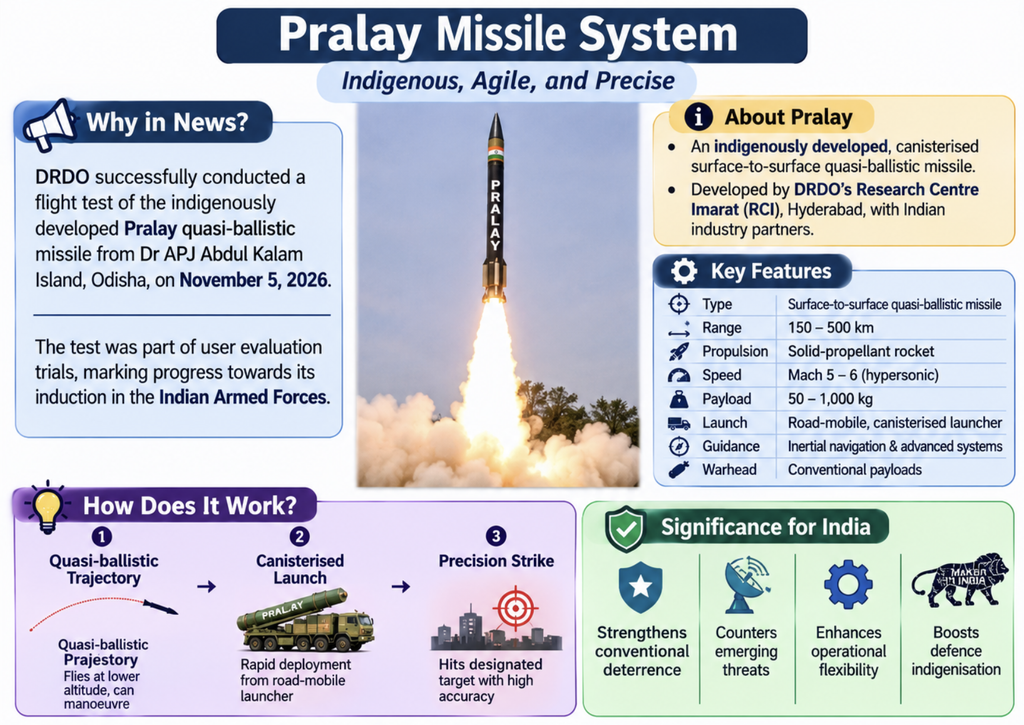
The Defence Research and Development Organisation (DRDO) successfully conducted a flight test of the indigenously developed Pralay quasi-ballistic missile from Dr APJ Abdul Kalam Island, Odisha, on November 5, 2026.
- The test was conducted as part of user evaluation trials, with all stipulated objectives reportedly achieved. The successful trial marks progress towards the induction of the missile system into the Indian Armed Forces.
| UPSC Relevance: GS-3 Science and Technology: Defence Technology Prelims: Pralay Missile System, Quasi-ballistic missiles |
About Pralay Missile System:
- Pralay is an indigenously developed, canisterised, surface-to-surface quasi-ballistic missile designed primarily for conventional tactical and battlefield operations.
- It has been developed by DRDO’s Research Centre Imarat (RCI), Hyderabad, in collaboration with other DRDO laboratories and Indian defence industries.
Key Features of Pralay Missile System:
| Feature | Details |
| Type | Surface-to-surface quasi-ballistic missile |
| Range | 150-500 km |
| Propulsion | Solid-propellant rocket propulsion |
| Speed | Hypersonic terminal speed, approximately Mach 5-6 |
| Payload capacity | Approximately 50-1000 kg |
| Launch system | Road-mobile, canisterised launcher |
| Guidance | Inertial navigation and advanced guidance systems |
| Warhead | Conventional payload configurations |
| Quasi-ballistic trajectory:Unlike conventional ballistic missiles, which generally follow a predictable parabolic trajectory, quasi-ballistic missiles fly at relatively lower altitudes and can maneuver during flight. They can alter their trajectory during the mid-course and terminal phases, making their flight path less predictable. This manoeuvrability complicates interception by conventional missile-defence systems. Canisterised launch system:The missile is stored and transported in a sealed canister, facilitating mobility, rapid deployment, storage and launch readiness. Its road-mobile launcher allows deployment from different locations, improving operational flexibility. |
Significance for India’s Defence Capabilities:
- Strengthening Conventional Deterrence: Provides the Armed Forces with a precision-strike capability against high-value military targets, including command centres, airfields, radar installations and logistics infrastructure. Offers a conventional strike option below the nuclear threshold, expanding India’s range of military responses during a conflict.
- Countering Emerging Security Threats: Its manoeuvrability and relatively unpredictable flight path can complicate interception by adversary air-defence and missile-defence systems. Its 150-500 km range provides tactical strike capability against targets in the immediate operational theatre.
- Enhancing Operational Flexibility: Canisterisation and road mobility facilitate transportation, concealment, deployment and launch readiness. The ability to carry different conventional payload configurations allows it to address different battlefield requirements.
- Defence Indigenisation: Reflects the growing role of DRDO and Indian defence industries in developing advanced missile technologies.
Pralay represents an important addition to India’s indigenous conventional missile capabilities. Its eventual induction can strengthen India’s precision-strike capability and conventional deterrence.
Practice Prelims MCQ:
Q. Consider the following statements regarding the ‘Pralay’ Missile System:
1. It is a surface-to-surface ballistic missile capable of carrying both conventional and strategic nuclear warheads.
2. It follows a quasi-ballistic trajectory that allows mid-course and terminal phase manoeuvrability within the atmosphere.
3. The canisterised configuration of the missile ensures all-weather operational readiness, rapid deployment, and reduced maintenance overheads.
Which of the statements given above are correct?
(a) 1 and 2 only
(b) 2 and 3 only
(c) 1 and 3 only
(d) 1, 2 and 3
Answer: (b) 2 and 3 only
Explanation: Pralay is strictly designed for conventional tactical and battlefield operations (carrying payloads ranging from 50 kg to 1,000 kg). It is not intended for strategic nuclear warheads.
Tell Google you want more of this.
Add Anantam IAS as a preferred sourceOne tap, and this site shows up more often in your own Top Stories, AI Overviews and AI Mode. Remove it any time.