Why in News?
The Hindu’s November 29 science coverage highlighted research using fibre-optic sensing to reconstruct a small earthquake that ruptured in two distinct stages.
- The research, published in Science on November 26, examined a magnitude-2 earthquake in California’s Brawley Seismic Zone using a telecommunications cable alongside the fault.
- The two stages were separated by 42 milliseconds. Rice University reported that the observations suggested stress from the first rupture could have triggered the second nearby rupture.
- The team combined distributed acoustic sensing, seismic recordings and computer models. These complementary records supported reconstruction of the timing and location of fault slip.
- Small earthquakes provide frequent opportunities to study fault mechanics, including behaviour that may be difficult to resolve with more widely spaced instruments.
- The result concerns a particular earthquake and fault setting. Its value lies in improving observation and interpretation of rupture processes.
UPSC Relevance
Prelims Relevance
- Distributed acoustic sensing and optical backscatter.
- Strain as the relative change in length.
- Fault rupture and seismic waves.
- Earthquake swarms and instrument resolution.
Mains Relevance
GS Paper 3
- Use of communications infrastructure for scientific observation.
- Complementarity between emerging sensors, conventional instruments and models.
GS Paper 1
- Fault mechanics and spatial variation in earthquake rupture.
Background and Context
A Cable Can Sample Many Places
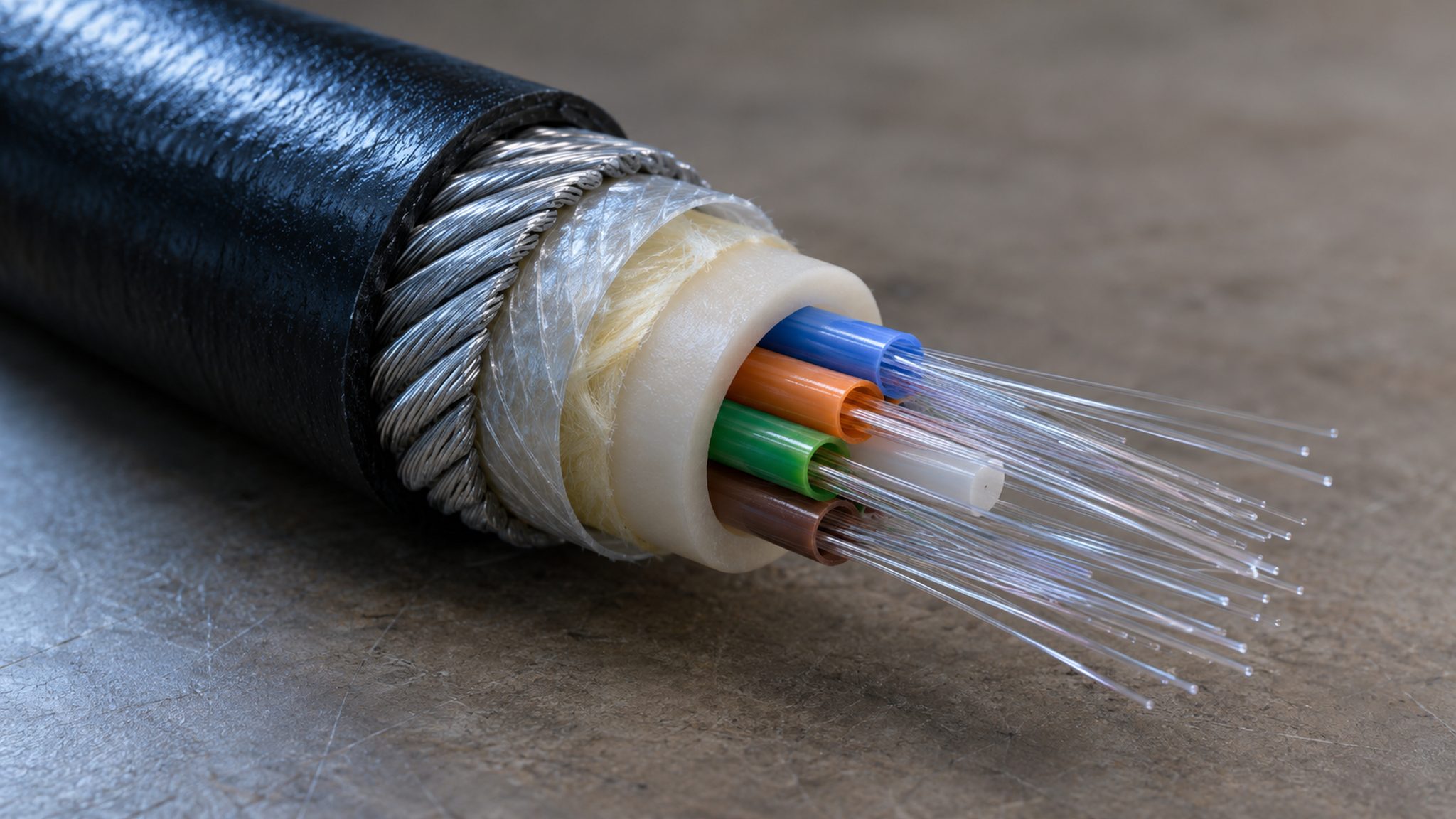
An optical fibre can provide measurements along an extended route, increasing the spatial detail available for studying ground deformation.
- Distributed sensing obtains observations at many positions along a fibre. An optical instrument at its end interrogates the cable repeatedly, building a record of changing deformation over time and distance.
- The Brawley study used a 28-kilometre cable near the fault. That arrangement gave researchers closely spaced observations of weak signals associated with a small earthquake’s short rupture process.
- Dark fibre refers to unused fibre channels in an installed cable. Such infrastructure can support sensing applications where access, geometry and connection to the surrounding ground are suitable.
- A conventional seismometer measures ground motion at its location. Fibre sensing measures deformation along the cable, giving a different spatial view that can be combined with seismic station records.
- Connecting the recorded signals to the underground rupture requires analysis and modelling. The cable samples the passing wavefield, and researchers use those observations to infer how slip developed on the fault.
From Laser Backscatter to Strain
The sensing method links the return of scattered light to changes in the optical path along the fibre.
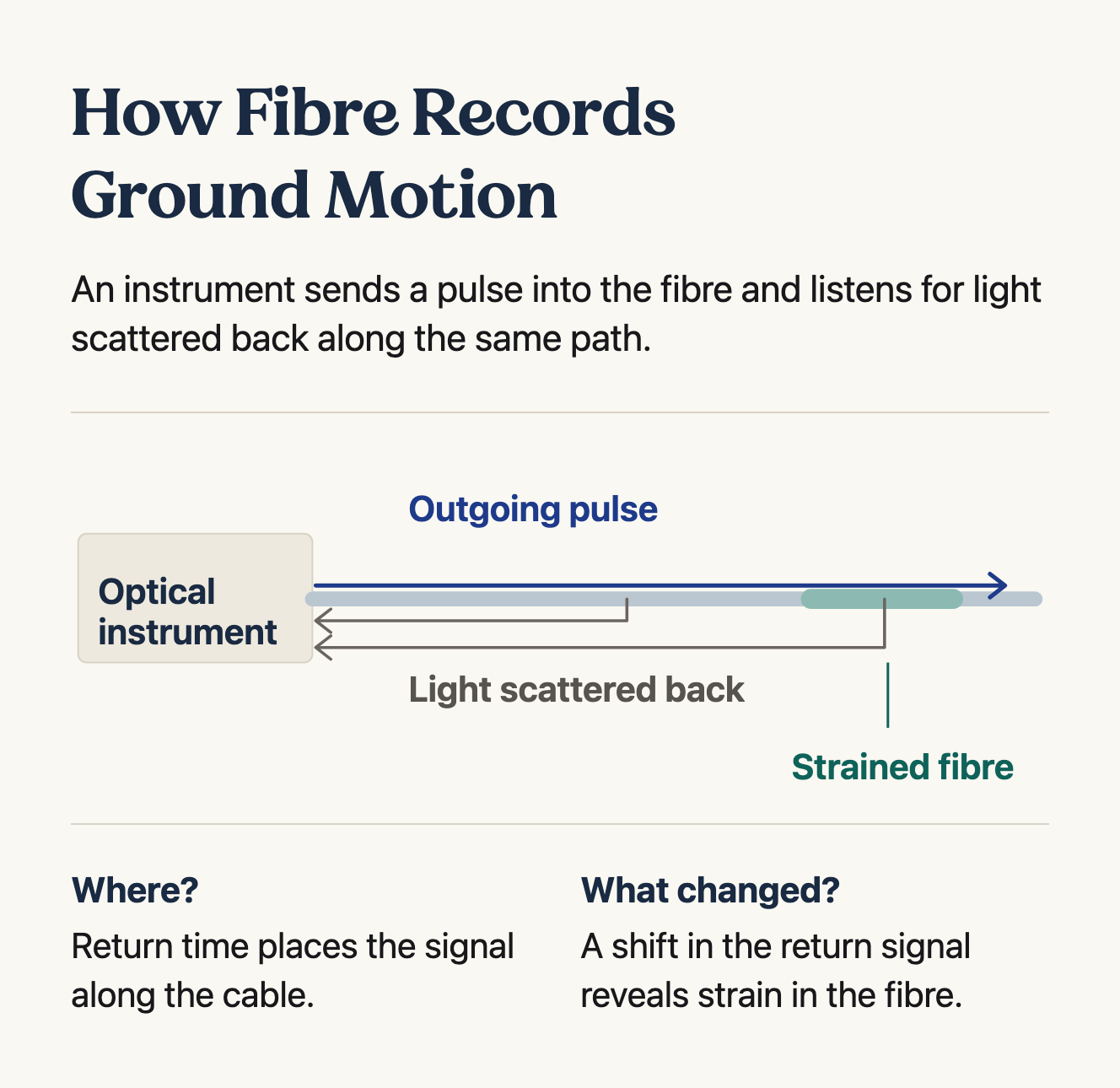
- An interrogator sends laser pulses into the fibre. Small variations within the glass scatter a fraction of the travelling light backwards, producing returns from positions throughout the cable’s length.
- The round-trip travel time associates returned light with a position along the fibre. Repeating the pulse sequence allows the instrument to compare signals from that position over successive moments.
- Ground deformation can stretch or compress a coupled cable, changing its optical path. Comparing the phase of backscattered light allows the sensing system to detect these small changes.
- Strain describes a change in length relative to the original length. DAS instruments measure strain or its rate of change over a finite sensing interval, giving the measurement a defined spatial scale.
- A study in Proceedings of the Royal Society A explains that each measurement averages along-fibre strain across a short cable segment. Signal strength depends on the cable and wave directions.
Reading the Findings Within Their Limits
A detailed record improves the evidence for rupture analysis, while cable placement and the studied setting shape what can be inferred.
- The observed two-stage rupture shows that a small earthquake can involve separate fault patches. It challenges the assumption that every small event is adequately represented by a single smooth circular rupture.
- Cable orientation affects sensitivity to incoming seismic waves. The measurement is dominated by deformation along the fibre, so changes in the cable’s direction can change the recorded response.
- Ground coupling matters because the fibre must respond to deformation in its surroundings. Burial, conduits and local installation conditions can alter how well the signal represents the nearby ground.
- Gauge length averages deformation over a finite interval. Closely spaced output channels should be interpreted together with that averaging scale when judging the system’s ability to distinguish nearby features.
- The study provides a reconstruction of recorded events. Extending its implications requires observations in other settings and comparison with independent instruments before drawing broader conclusions about fault behaviour.
Way Forward
Build Comparable Observations
- Document cable routes and installation conditions so researchers can interpret differences in signal quality along the array.
- Combine fibre records with seismic stations and suitable models to examine where their interpretations agree or diverge.
- Report resolution and uncertainty alongside rupture estimates, including the effects of gauge length and cable orientation.
Conclusion
- Distributed acoustic sensing expands the spatial detail available to earthquake science by turning suitable optical fibres into records of deformation along their length.
- The Brawley finding supports closer study of fragmented rupture. Its significance rests on the observed event, the sensing method and carefully stated limits on generalisation.
UPSC Practice Questions
Prelims MCQ 1
With reference to distributed acoustic sensing, consider the following statements:
- It can analyse backscattered laser light to detect changes in strain along a fibre.
- The orientation of a fibre can influence its seismic response.
- Every output channel represents a completely independent point measurement with no spatial averaging.
How many of the above statements are correct?
(a) Only one (b) Only two (c) All three (d) None
Answer: (b) Only two
Explanation:
Statements 1 and 2 are correct. DAS measurements involve a finite gauge length, so spatial averaging affects the interpretation of output channels.
Prelims MCQ 2
What did the reported Brawley earthquake study establish?
(a) Conventional seismic records were unnecessary for the analysis. (b) One studied small earthquake ruptured in two stages at nearby fault patches. (c) All earthquakes have exactly two rupture stages. (d) Optical fibres directly measure future earthquake dates.
Answer: (b) One studied small earthquake ruptured in two stages at nearby fault patches.
Explanation:
The finding concerns the reconstructed event. The researchers combined fibre observations with seismic recordings and computer models.
UPSC Mains Questions
- Explain how distributed acoustic sensing can complement conventional earthquake monitoring. Discuss the main limitations in interpreting its observations.
- How can improvements in measurement resolution change scientific understanding of fault rupture? Discuss with reference to the recent Brawley study.
Sources: Korea.net, reporting the Ministry of Science and ICT research announcement and Seismological research in the Royal Society journal, hosted by NIH.
Frequently Asked Questions
What is distributed acoustic sensing?
It is a method that repeatedly sends laser pulses through an optical fibre and analyses returned scattered light to measure changes in strain or strain rate along the fibre.
Why does the light return to the instrument?
Small variations in the glass scatter a fraction of the travelling light backwards. The instrument analyses these returns and associates their travel time with positions along the cable.
What did the earthquake study find?
The studied magnitude-2 earthquake ruptured in two stages at nearby fault patches, separated by 42 milliseconds. The observations suggested that the first rupture helped trigger the second.
What limits the interpretation of fibre measurements?
Cable orientation, coupling to the surrounding ground and averaging over a gauge length affect the signal. Researchers must account for these factors when comparing observations and reconstructing fault behaviour.
Tell Google you want more of this.
Add Anantam IAS as a preferred sourceOne tap, and this site shows up more often in your own Top Stories, AI Overviews and AI Mode. Remove it any time.