
Why in News?
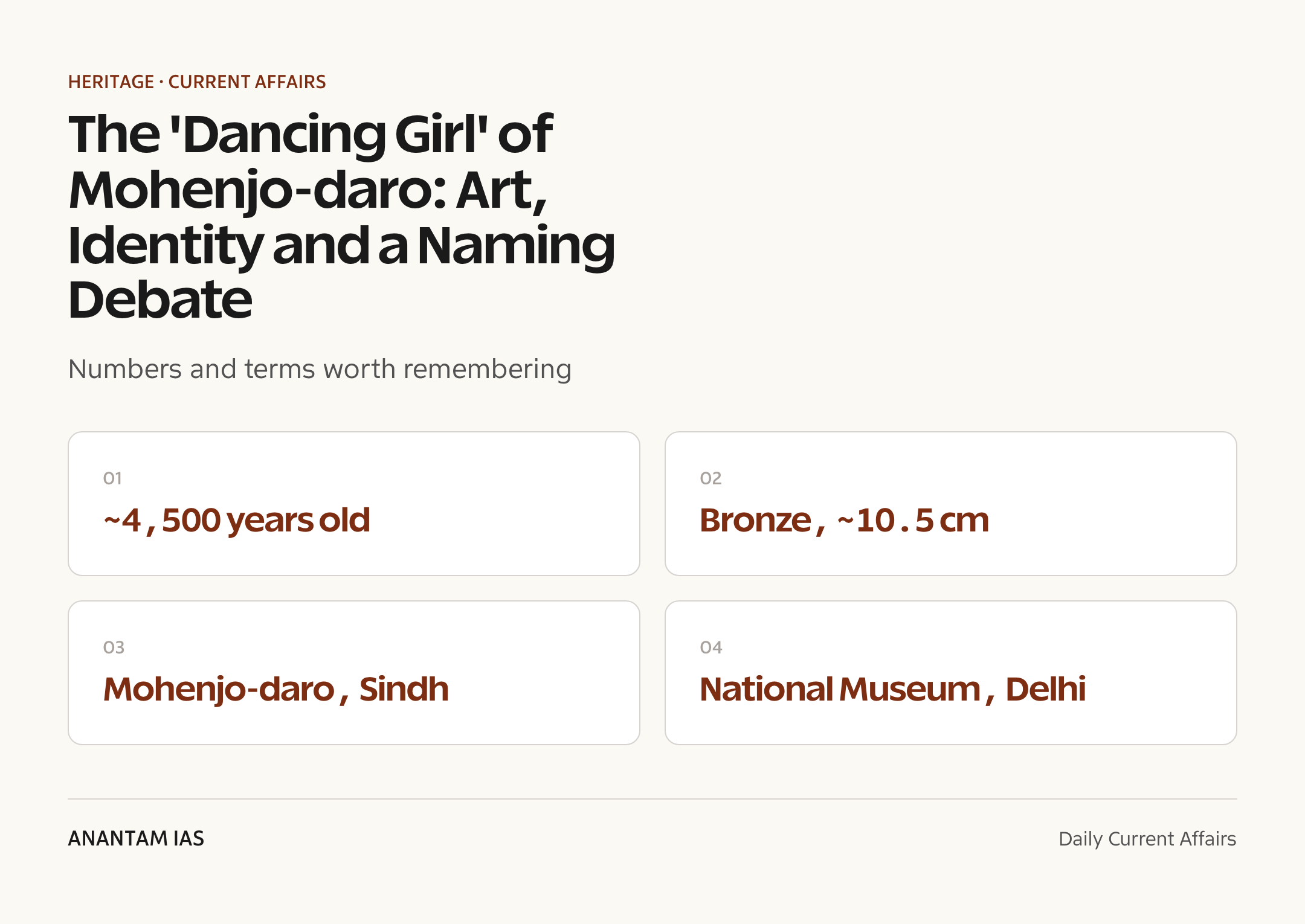
A fresh debate has revived public and academic attention on the ‘Dancing Girl’, a roughly 4,500-year-old bronze figurine from Mohenjo-daro, the largest city of the Indus Valley Civilisation (Harappan Civilisation). The Indian Express, in its Explained series, traced how a small Bronze Age statuette acquired its enduring popular name and why that label is now being questioned.
The renewed discussion centres on a naming controversy — whether the term ‘Dancing Girl’ is an interpretation imposed by early excavators rather than an established identity. The figurine is housed in the National Museum, New Delhi, and remains one of the most reproduced symbols of India’s prehistoric art.
- The figurine stands about 10.5 cm tall and was cast in bronze using the lost-wax (cire perdue) technique.
- It was excavated at Mohenjo-daro (in present-day Sindh, Pakistan) during the 1920s excavations led by the Archaeological Survey of India.
- The name ‘Dancing Girl’ was popularised by archaeologist John Marshall, who read the figure’s pose as that of a dancer.
- The artefact dates to roughly 2500 BCE, placing it in the Mature Harappan phase.
- The figure wears a stack of bangles on the left arm and fewer on the right, with a confident, hand-on-hip stance.
- The piece is one of only a handful of Harappan bronzes recovered, underlining the rarity of metal sculpture from the period.
The development matters in the context of:
- Shows why interpretation matters in art history — a label can shape how millions perceive an artefact.
- Connects to live questions over artefact ownership between India and Pakistan after Partition.
- Reinforces the syllabus link between Indus art and early Indian metallurgy.
UPSC Relevance
Prelims Relevance
- Lost-wax / cire perdue bronze-casting technique
- Mohenjo-daro — site on the Indus, present-day Sindh
- Indus Valley Civilisation chronology (~2500 BCE, Mature phase)
- John Marshall and the 1920s ASI excavations
- RD Banerji (Mohenjo-daro) and Daya Ram Sahni (Harappa)
- Other Harappan art: ‘Priest-King’ steatite bust, bronze buffalo, terracotta figurines
- Material of the ‘Dancing Girl’ — bronze (copper-tin alloy)
- National Museum, New Delhi as the housing institution
- Steatite seals and the Pashupati seal as Harappan art forms
Mains Relevance
GS Paper 1
- Discuss the salient features of Indus Valley art and craftsmanship with reference to the bronze and steatite figurines.
- Examine how early excavators’ interpretations have shaped the popular understanding of Harappan artefacts.
GS Paper 1
- Evaluate the technological sophistication of the lost-wax casting method as evidence of Harappan metallurgy.
Essay
- Who owns the past? Heritage, naming and the politics of interpretation.
- Art outlives empires: small objects as carriers of civilisational memory.
Background and Context
What the figurine is
A small but technically remarkable Bronze Age statuette.
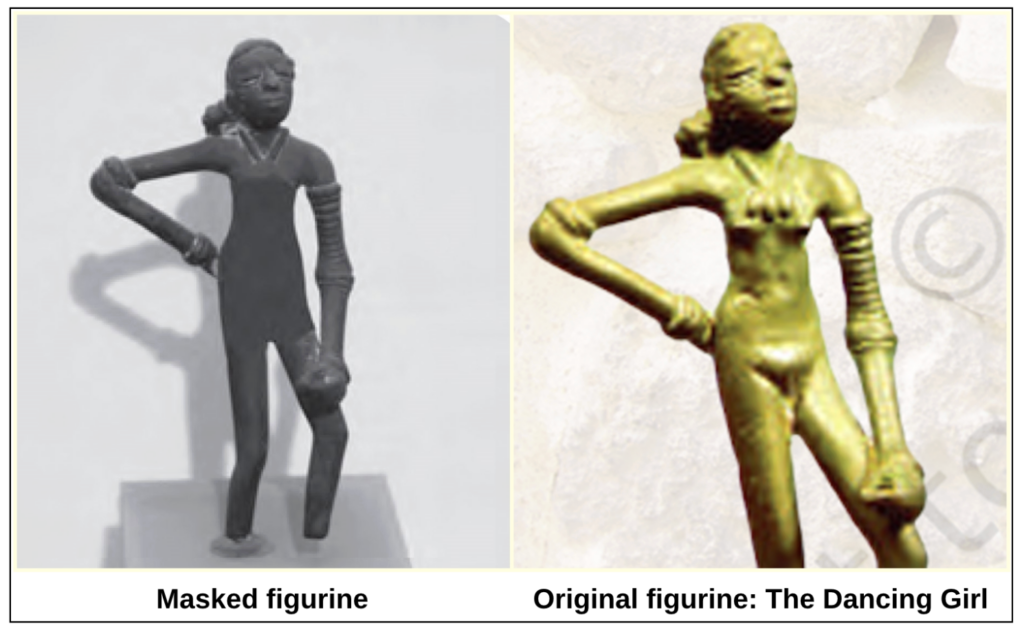
- The ‘Dancing Girl’ is a bronze figurine roughly 10.5 cm tall, depicting a slender, standing female figure with one hand on her hip and the other resting on a thigh.
- She wears a stack of bangles along the left arm — nearly the full length — and a few on the right, plus a necklace; the figure is otherwise unclothed.
- The pose is naturalistic and relaxed, with the head slightly tilted, conveying poise and confidence rare in such an early work.
- It belongs to the Mature Harappan phase, dated to about 2500 BCE, making it roughly 4,500 years old and part of the wider Harappan Civilization.

Lost-wax (cire perdue) casting
The figurine showcases an advanced metal-casting method mastered by Harappan craftsmen.
- In lost-wax casting (cire perdue), a wax model of the object is made, coated in clay to form a mould, then heated so the wax melts and drains out.
- Molten bronze — an alloy of copper and tin — is poured into the hollow, hardens, and the mould is broken to release the finished figure.
- The technique allowed fine, free-standing three-dimensional figures and is still used in traditional Indian metal-craft (for example, Dhokra work).
- Its presence at Mohenjo-daro is strong evidence of sophisticated Harappan metallurgy and an organised craft economy.
Mohenjo-daro and its excavation
The artefact comes from one of the two great Harappan cities, uncovered a century ago.
- Mohenjo-daro (‘Mound of the Dead’) sits on the Indus in present-day Sindh, Pakistan, and was the largest urban centre of the civilisation.
- It was excavated in the 1920s by the Archaeological Survey of India; RD Banerji worked at Mohenjo-daro while Daya Ram Sahni excavated Harappa.
- Overall direction lay with John Marshall, then Director-General of the ASI, who announced the discovery of the civilisation in 1924.
- The city is famous for its grid town planning, the Great Bath and an advanced covered drainage system — hallmarks of Harappan architecture.
The naming debate
Whether the figure is truly a ‘dancer’ is an interpretation, not a settled fact.
- The label ‘Dancing Girl’ came from John Marshall and early observers who read the pose as mid-dance — a description, not an inscription from the makers.
- Critics argue the name projects a modern reading onto a society whose language and intent remain undeciphered, since the Indus script is still unread.
- Alternative readings see a young woman in an everyday confident stance, or a figure of ritual or social significance whose role we cannot recover.
- The renewed controversy — including disputes over how the artefact is described in textbooks — shows how heritage gets labelled and how labels then become fixed in public memory.
Other Indus art and its place
The figurine belongs to a wider, varied Harappan artistic tradition.
- The contemporaneous ‘Priest-King’, a steatite bust from Mohenjo-daro, is another iconic Harappan sculpture, equally an interpretive name.
- Harappan art also includes a small bronze buffalo, terracotta figurines (the ‘Mother Goddess’), painted pottery and finely carved steatite seals.
- Seals such as the so-called Pashupati seal show animals and a seated figure, hinting at belief systems that remain debated.
- Across these works, Indus artists favoured small scale, realism and craft precision over monumental scale, a thread that runs through the wider story of Indian ancient history.
Ownership, housing and dating disputes
Where the object sits and how old it is have both drawn contestation.
- The figurine is held at the National Museum, New Delhi, having come to India in the division of antiquities after Partition in 1947.
- Pakistan has at times claimed Mohenjo-daro artefacts on the grounds that the site lies within its territory.
- Precise dating of individual Harappan objects is inferred from stratigraphy and context, so figures are usually given as approximate ranges.
- Such disputes underline how prehistoric heritage straddles modern borders and competing national narratives.
Way Forward
Interpretive humility
- Present popular names like ‘Dancing Girl’ as interpretations, flagging that the makers’ intent is unknown, while the Indus script stays undeciphered.
- Encourage textbooks and museums to pair traditional labels with their descriptive, provisional nature.
Conservation and access
- Invest in scientific conservation, high-resolution digitisation and open scholarship on Harappan bronzes.
- Strengthen museum interpretation so visitors learn the technique (lost-wax casting) and the context, not only the name.
Sustained research, careful labelling and cross-border academic cooperation can let the artefact teach Harappan craft and history without freezing it inside a single contested name.
Conclusion
The ‘Dancing Girl’ endures because it compresses a whole civilisation into ten centimetres of bronze — proof of Harappan mastery of lost-wax casting and of an artistic confidence 4,500 years old.
The naming debate is a reminder that history is partly authored by those who unearth it. For UPSC, the durable lessons are the technique, the site, the chronology and the wider Indus artistic tradition, with the label held lightly as one reading among several.
UPSC Practice Questions
Prelims MCQ 1
With reference to the ‘Dancing Girl’ figurine of Mohenjo-daro, consider the following statements:
- It was made of bronze using the lost-wax (cire perdue) casting technique.
- It belongs to the Mature phase of the Indus Valley Civilisation.
- It is currently housed in the National Museum, New Delhi.
How many of the above statements are correct?
(a) Only one (b) Only two (c) All three (d) None
Answer: (c) All three
Explanation:
The figurine is a Mature Harappan (~2500 BCE) bronze made by lost-wax casting and is displayed at the National Museum, New Delhi. All three statements are correct.
Prelims MCQ 2
The site of Mohenjo-daro, where the ‘Dancing Girl’ was found, is located on the banks of which river?
(a) Ravi (b) Indus (c) Ghaggar-Hakra (d) Sutlej
Answer: (b) Indus
Explanation:
Mohenjo-daro lies on the Indus in present-day Sindh, Pakistan. Harappa, by contrast, is on the Ravi.
UPSC Mains Questions
- The ‘Dancing Girl’ of Mohenjo-daro is celebrated as a masterpiece of Indus art. Discuss its artistic and technological significance, and explain what it reveals about Harappan society. (250 words)
- Popular names given to ancient artefacts often reflect the assumptions of their excavators. Critically examine this statement with reference to Harappan art, such as the ‘Dancing Girl’ and the ‘Priest-King’. (250 words)
- Examine the lost-wax (cire perdue) casting technique as evidence of metallurgical and craft sophistication in the Indus Valley Civilisation. (150 words)
Sources: Indian Express, Explained and Archaeological Survey of India.
Frequently Asked Questions
What is the ‘Dancing Girl’ of Mohenjo-daro?
It is a small bronze figurine, about 10.5 cm tall, of a slender standing female figure with bangles on her arm. Made around 2500 BCE using lost-wax casting, it is one of the most famous artefacts of the Indus Valley Civilisation and is housed in the National Museum, New Delhi.
How was the ‘Dancing Girl’ made?
It was cast in bronze using the lost-wax (cire perdue) technique. A wax model is coated in clay to make a mould, the wax is melted out, and molten bronze is poured in. The mould is then broken to free the figure, showing advanced Harappan metallurgy.
Why is its name controversial?
The label ‘Dancing Girl’ came from early excavators, chiefly John Marshall, who read the pose as a dance. Critics say this is a modern interpretation imposed on a society whose script is undeciphered, so the figure’s actual role and identity remain unknown.
Where was the figurine found and who excavated it?
It was found at Mohenjo-daro on the Indus in present-day Sindh, Pakistan, during the 1920s excavations by the Archaeological Survey of India. RD Banerji worked at Mohenjo-daro, with John Marshall directing the wider effort that announced the civilisation in 1924.
Why does India hold an artefact found in Pakistan?
The figurine came to India in the division of antiquities after the 1947 Partition and is kept at the National Museum, New Delhi. Pakistan has at times claimed Mohenjo-daro artefacts because the site lies within its territory, making ownership a recurring dispute.
What other art comes from the Indus Valley Civilisation?
Besides the ‘Dancing Girl’, the Harappans produced the steatite ‘Priest-King’ bust, a small bronze buffalo, terracotta ‘Mother Goddess’ figurines, painted pottery and finely carved steatite seals such as the Pashupati seal, all marked by small scale and realism.
Tell Google you want more of this.
Add Anantam IAS as a preferred sourceOne tap, and this site shows up more often in your own Top Stories, AI Overviews and AI Mode. Remove it any time.