Why in News?
Gaganyaan Mission, India’s first indigenous human-spaceflight programme, requires astronauts capable of operating complex spacecraft, responding to emergencies and remaining healthy in space.
ISRO’s selection and training of astronaut-designates, in collaboration with the Indian Air Force (IAF) and international partners, marks an important step towards developing India’s indigenous human spaceflight ecosystem.
| UPSC Relevance: GS-3 Science and Technology: Space Technology Prelims & Mains: Gaganyaan Mission (Key facts & significance) |
About Gaganyaan Mission:
- Initiative of: Indian Space Research Organisation
- Human spaceflight mission to Low Earth Orbit (400 kilometres).
- The mission aims to carry 3 astronauts (Vyomanauts) to LEO for a short-duration mission (~3–7 days), and bring them back safely to Earth by landing in Indian waters.
- Launch: Crewed launch is scheduled for the first quarter of 2027.
- Crew members: Astronauts have been shortlisted by the Indian Air Force (IAF) & ISRO, and trained with international collaboration. The crew will perform microgravity technology demonstrations and other scientific experiments.
- Launch Vehicle: Human-rated Launch Vehicle Mark 3 (LVM3)
- The Human Space Flight Centre will coordinate the implementation of the project.
How were Astronaut Candidates Selected?
- ISRO has selected and trained the four astronaut-designates for the Gaganyaan Mission through a multi-tiered, joint selection process with the Indian Air Force (IAF) and medical evaluations by the Institute of Aerospace Medicine (IAM), Bengaluru.
- The four designated astronauts are Group Captain Prasanth Balakrishnan Nair, Group Captain Ajit Krishnan, Group Captain Angad Pratap, and Wing Commander Shubhanshu Shukla.
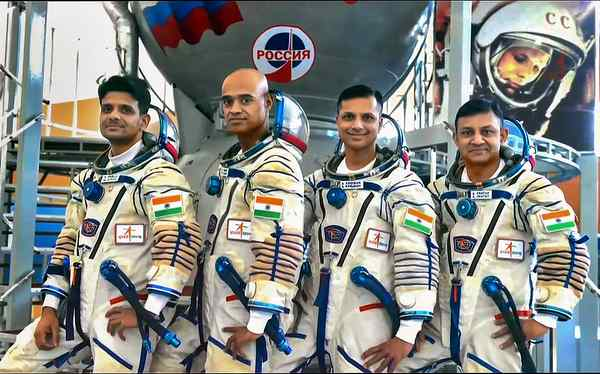
Dimensions of Astronaut Selection and Training;
1. Selection Criteria and Process:
- Source Pool: The selection started with a short-list from a pool of elite IAF test pilots who possess high G-force (gravitational force) tolerance, psychological calm, and experience in evaluating experimental aircraft.
- Medical & Psychological Evaluation: Conducted by the Institute of Aerospace Medicine (IAM), Bengaluru, which specialises in high-stress physiological and psychological testing.
- Parameters Tested: Candidates underwent intensive clinical, physical, and psychological assessments testing body mass index (BMI), cardiovascular fitness, mental resilience, and technical aptitude.
2. Training Phases:
- Generic Cosmonaut Training: All four completed foundational and generic space training at the Yuri Gagarin Cosmonaut Training Centre in Russia between 2020 and 2021. This covered high-acceleration centrifuge runs, parabolic weightlessness flights, and cold-weather and sea survival drills.
- Mission-Specific & International Training:
- Training at the Astronaut Training Centre in Bengaluru tailored to ISRO’s human-rated LVM3 vehicle and crew module systems.
- Specialised mission preparation, including training for select members like Wing Commander Shubanshu Shukla and Group Captain Prasanth Balakrishnan Nair linked to international cooperative programs (such as NASA’s Johnson Space Centre).
- Simulator Workouts: Extensive use of fixed-base, motion-base, and part-task subsystem simulators, alongside virtual and augmented reality (VR/AR) tools to practice both nominal operations and emergency abort scenarios.
3. Health Protocols and Quarantine:
- Pre-Launch Isolation: A mandatory quarantine protocol is enforced roughly two weeks before launch to prevent infectious illnesses from spreading inside the tight, sealed Crew Module.
- Bioastronautics Impact: The program establishes indigenous frameworks for bioastronautics- monitoring the human body’s behavioural, biological, and medical adaptations to microgravity and spaceflight.
Significance of the Mission:
- Strategic Milestone: Upon completion, India will become the 4th nation to independently launch a human spaceflight mission after the USA, Russia, and China.
- Technological Indigenisation: Involves mastering critical subsystems like the Human-Rated Launch Vehicle (HLVM3), Crew Escape System (CES), and Environmental Control and Life Support System (ECLSS).
- Spinoff & Institutional Growth: Strengthens collaboration between ISRO, the IAF, IAM, academic institutions, and private industry, laying the groundwork for future goals like the Bharatiya Antariksh Station (BAS) targeted for 2035.
UPSC PYQ 2025
Q. Consider the following space missions:
I. Axiom-4
II. SpaDex
III. Gaganyaan
How many of the space missions given above encourage and support microgravity research?
(a) Only one
(b) Only two
(c) All three
(d) None
Answer: (c)
Tell Google you want more of this.
Add Anantam IAS as a preferred sourceOne tap, and this site shows up more often in your own Top Stories, AI Overviews and AI Mode. Remove it any time.