India has stepped into a role it has been quietly preparing for over a decade. On May 7 and 8, 2026, New Delhi hosted the 10th Indian Ocean Dialogue, the first edition convened by India as the new chair of the Indian Ocean Rim Association (IORA) for the 2025 to 2027 term. The theme this year was sober and deliberate: “Indian Ocean Region in a Transforming World.”
Behind that careful phrasing sits a sharper reality. The Indian Ocean carries roughly four-fifths of global oil trade and a third of all bulk cargo. It is also the maritime space where Chinese naval visibility, Houthi disruptions in the Red Sea, climate-driven coastal stress, and undersea cable vulnerabilities are colliding at once. The India IORA chairship is the country’s chance to set the regional agenda for the next two years, and the 10th Indian Ocean Dialogue was the venue where that agenda was first sketched in public.
For aspirants, this is not just another summit headline. It is a live case study in maritime diplomacy, blue economy strategy, and the evolution of India’s SAGAR doctrine into what External Affairs Minister S. Jaishankar now calls MAHASAGAR.
Quick Facts
- Event: 10th Indian Ocean Dialogue (IOD-10)
- Dates: May 7 to 8, 2026
- Venue: New Delhi, hosted by the Ministry of External Affairs with the Indian Council of World Affairs (ICWA) and the IORA Secretariat
- Theme: “Indian Ocean Region in a Transforming World”
- India’s IORA chairship: Assumed in November 2025, term runs 2025 to 2027
- India’s chairship theme: “Innovation, Openness, Resilience and Adaptability in the Indian Ocean Region”
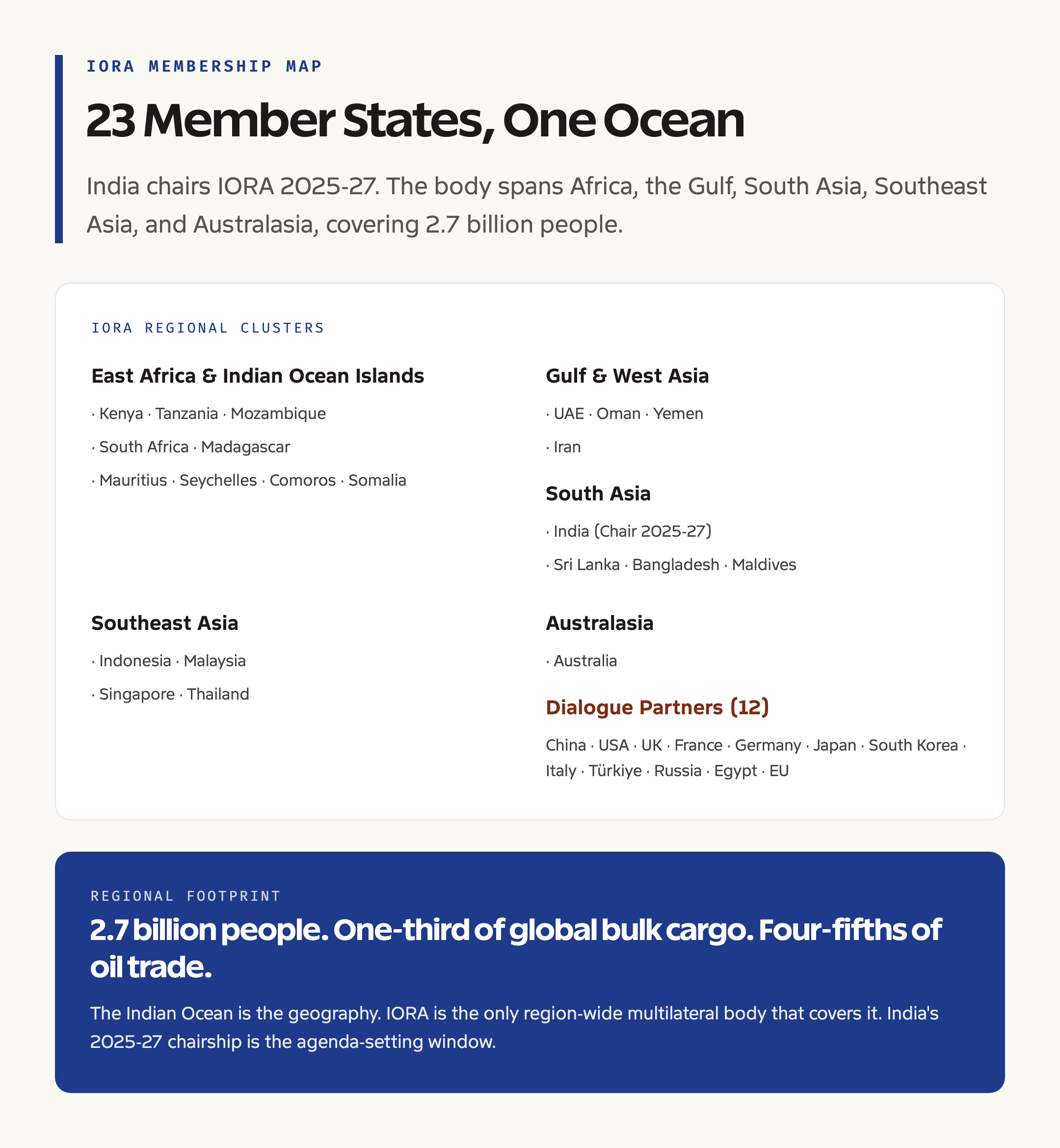
- IORA membership: 23 member states and 12 dialogue partners, covering roughly 2.7 billion people
- Headline doctrine: MAHASAGAR (Mutual and Holistic Advancement for Security and Growth Across Regions)
What Just Happened
India took two distinct but linked steps. First, the country formally moved into the IORA chair, replacing Sri Lanka, which had held the position before. The IORA chairship rotates among member states and the chair runs the Council of Foreign Ministers, sets the agenda for the Committee of Senior Officials, and shapes the working group calendar across maritime safety, fisheries, disaster risk management, and the blue economy. The chairship builds on a decade of Indian Ocean diplomacy that reframed the region from a trade zone into a security and connectivity space.
Second, India used the chairship to convene the 10th edition of the Indian Ocean Dialogue. The dialogue is IORA’s Track 1.5 platform, meaning it sits between official negotiations and pure academic discussion. Senior officials, scholars, and policy thinkers from member states and dialogue partners showed up to debate where the region is headed.
The Indian side framed the chairship as a continuation of a longer story. From SAGAR (Security and Growth for All in the Region), articulated by Prime Minister Narendra Modi in 2015, the country has now moved to MAHASAGAR, which extends the geography and the ambition. The “Mahasagar” framing pulls in the broader Indo-Pacific while keeping the Indian Ocean at the core.
Background and Historical Context
The Indian Ocean sits at the center of this story for good reason. IORA itself is older than people think. It was founded in 1997 in Mauritius as the Indian Ocean Rim Association for Regional Cooperation (IOR-ARC), then renamed IORA in 2013. For most of its early years it was a quiet trade-promotion body. The seven priority areas it focuses on today, including maritime safety and security, trade and investment facilitation, fisheries management, disaster risk management, academic and cultural exchange, tourism, and the blue economy, only took clear shape after 2014.
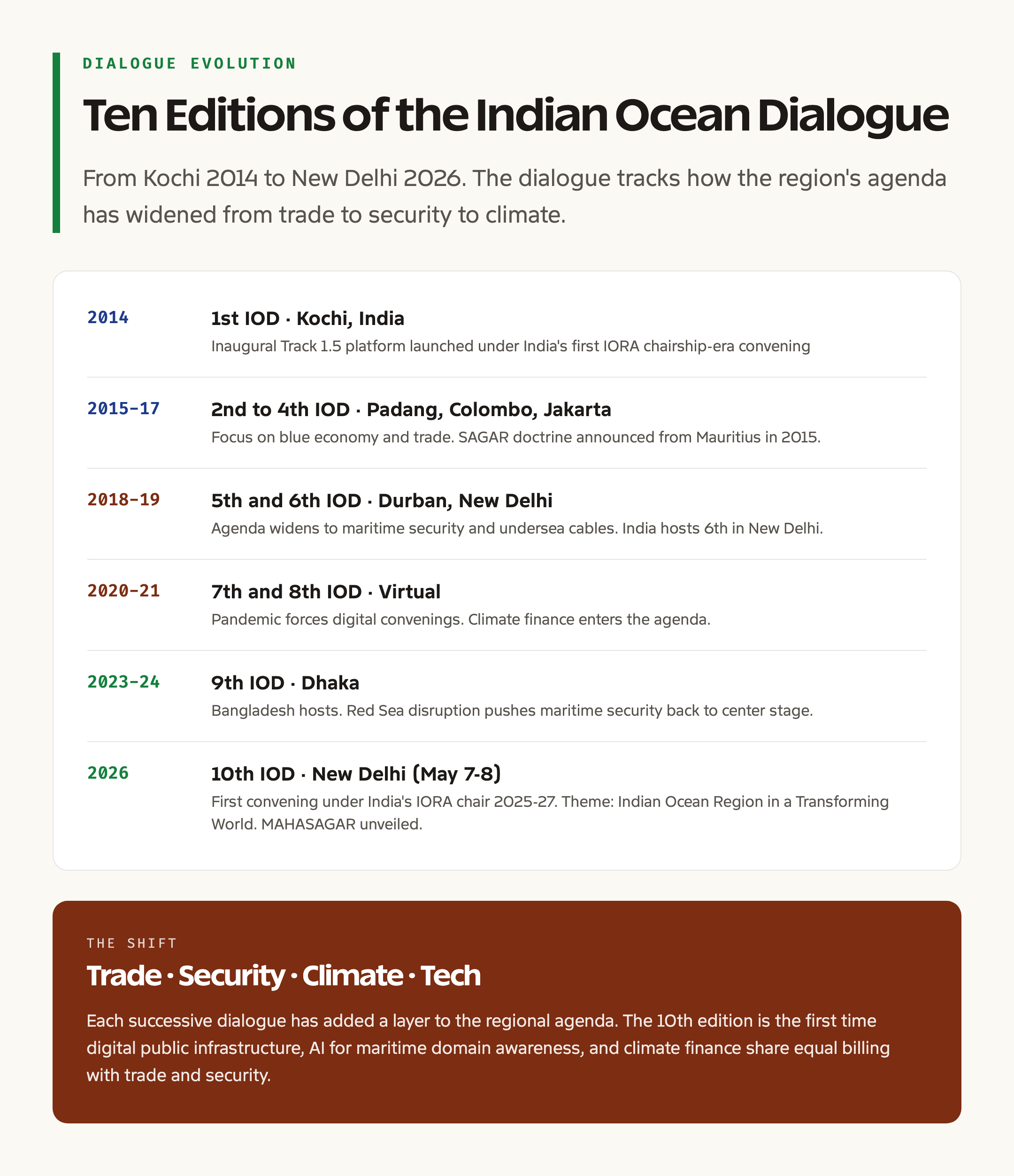
India’s relationship with IORA tracks its own maritime awakening. The country hosted the first Indian Ocean Dialogue in Kochi, Kerala, in 2014. It hosted the sixth edition in New Delhi in 2019 and the eighth virtually in 2021. Each time, the focus widened from trade to security to climate. The SAGAR doctrine, announced from Mauritius in March 2015, gave that arc a name. It put India on record as a net security provider in the Indian Ocean.
The decade that followed reshaped the region. China deepened its presence at Hambantota, Gwadar, Djibouti, and across the digital silk road. Climate change battered small island developing states from the Maldives to Seychelles. The Houthi attacks in the Red Sea in 2024 and 2025 rerouted shipping around the Cape of Good Hope and exposed how thin global maritime security really is.
India also stepped up its maritime outreach in parallel, including the IOS Sagar deployment that reflected India’s maritime outreach across the western Indian Ocean. By the time India IORA chairship became formal in late 2025, the region needed a chair willing to push the agenda harder. India’s IOD-10 framing made it clear it sees that as the job.
Key Provisions and Features of India’s Chairship Agenda
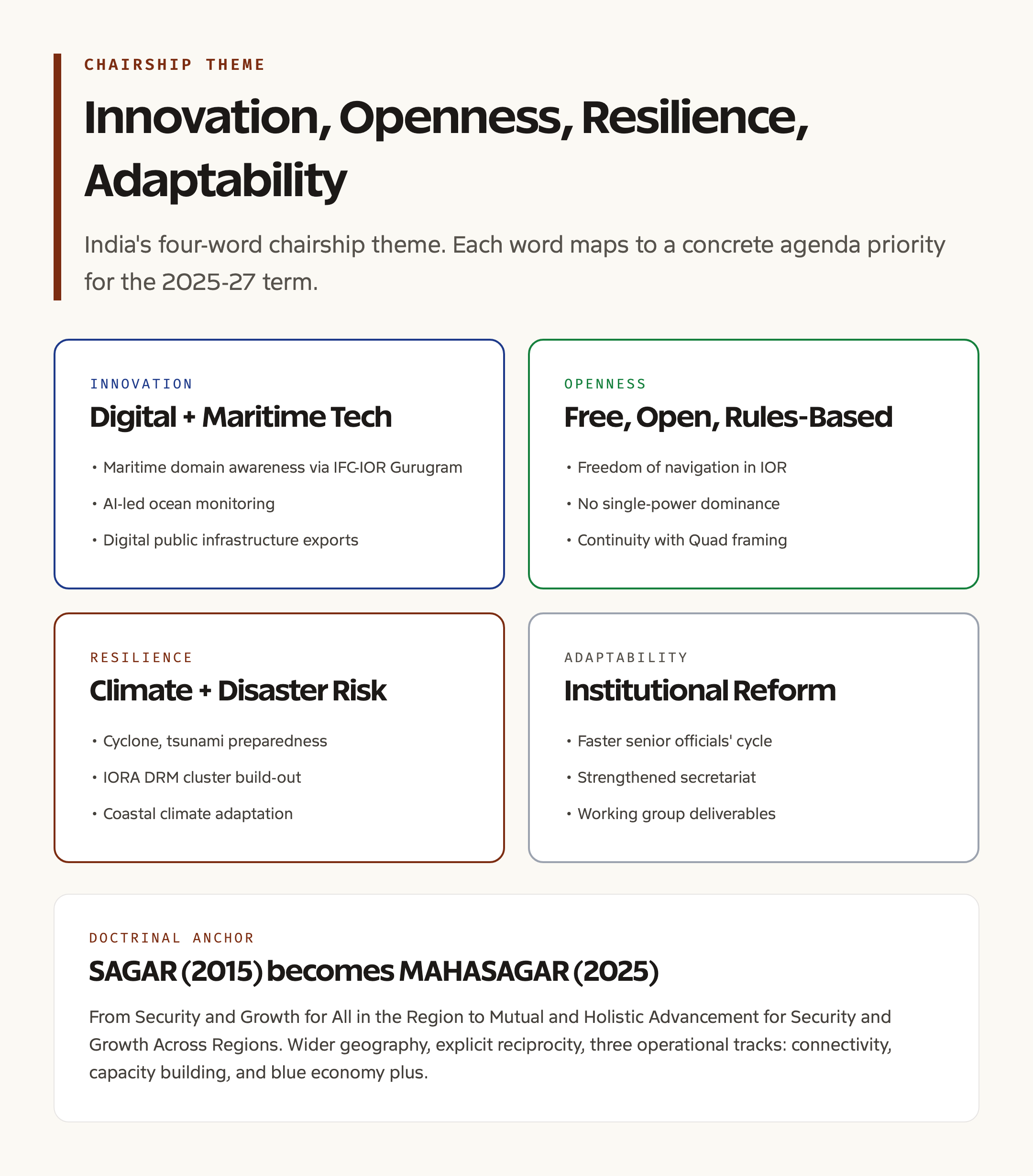
India’s chair theme is built around four words. Each carries a specific commitment.
- Innovation: Push digital public infrastructure, AI for maritime domain awareness, and shared satellite-based ocean monitoring across IORA states. The Information Fusion Centre – Indian Ocean Region (IFC-IOR) at Gurugram is positioned as the regional anchor.
- Openness: Keep the Indian Ocean a free, open, and rules-based space. The phrasing carefully avoids naming China but signals continuity with the Quad framing.
- Resilience: Strengthen disaster preparedness, particularly for cyclones, tsunamis, and coastal climate stress. Build out the IORA Disaster Risk Management cluster.
- Adaptability: Reform IORA’s own working processes so the body can act faster. India wants more frequent senior officials’ meetings, clearer working group deliverables, and a stronger secretariat.
The MAHASAGAR doctrine layers on top. It expands SAGAR’s focus on neighborhood and littoral cooperation to a wider “regions” framing, pulling in the African coast, the Gulf, Southeast Asia, and Pacific island states.
Why It Matters for India
India IORA chairship matters on four dimensions. First, it gives India agenda-setting power in the only region-wide multilateral body that covers the Indian Ocean. ASEAN handles East Asia, the GCC handles the Gulf, but the Indian Ocean as a coherent unit has only IORA.
Second, it lets India translate bilateral muscle into multilateral structure. India already has bilateral defense and economic agreements with most IORA states. The chairship is the chance to convert those into regional norms, especially on maritime domain awareness, fisheries management, and undersea cable protection.
Third, it positions India as the natural convener for blue economy financing. The blue economy contribution to India’s GDP is estimated at roughly 4 percent, and the country wants to scale that toward 8 to 10 percent by 2030. Sustainable fisheries, ocean energy, coastal tourism, marine biotechnology, and shipping are all part of that mix.
Fourth, it sharpens India’s role as a counterweight to Chinese maritime expansion without forcing a binary choice on smaller states. This is the same logic that has shaped the maritime sector in India and the recent step-up in Persian Gulf maritime monitoring by the Ministry of Ports. Many IORA members trade more with China than with India. The chairship gives India a platform to offer a different kind of regional cooperation without demanding alignment.
Detailed Analysis: SAGAR to MAHASAGAR
The shift from SAGAR to MAHASAGAR is more than a rebranding exercise. SAGAR, as articulated in 2015, had a clear focus on the immediate maritime neighborhood: littoral states, island states, and the Indian Ocean basin itself. The five pillars were security, capacity building, sustainable development, blue economy cooperation, and collective action on maritime threats.
MAHASAGAR widens the canvas. The acronym expansion, Mutual and Holistic Advancement for Security and Growth Across Regions, deliberately drops the single-ocean framing. It signals that India sees its maritime stake stretching from the African coast to the western Pacific. The doctrine also embeds a more explicit reciprocity. Where SAGAR was framed as India offering security and growth, MAHASAGAR insists on “mutual” advancement, an acknowledgment that smaller states want partnership, not patronage.
Three operational elements run through the MAHASAGAR framing. One is connectivity, both physical and digital, including ports, undersea cables, and digital public infrastructure exports through the India Stack. Two is capacity building, particularly coast guard training, hydrographic surveys, and joint exercises. Three is what Delhi calls “blue economy plus”, meaning fisheries, tourism, and shipping bundled with climate finance, ocean health monitoring, and renewable ocean energy.
Comparative Perspective
India is not the only power trying to write the Indian Ocean rulebook. The comparison sharpens the stakes.
| Actor | Primary Vehicle | Focus | Style |
|---|---|---|---|
| India | IORA chairship, MAHASAGAR, IFC-IOR | Maritime domain awareness, blue economy, capacity building | Convening, partnership-led |
| China | Belt and Road Initiative, naval port access | Ports, infrastructure, naval presence | Bilateral, infrastructure-heavy |
| United States | Indo-Pacific Strategy, Quad, CMF | Freedom of navigation, security | Alliance-based, security-first |
| France | Indo-Pacific strategy, Réunion-based presence | Maritime presence, EU coordination | Quiet, resident-power framing |
| Japan | FOIP, infrastructure finance | Quality infrastructure, ODA | Standards-led |
Each model carries trade-offs. The Chinese approach delivers ports faster but stirs sovereignty concerns. The American framing offers security depth but pushes states toward camps. India’s pitch is the middle path, regional, inclusive, and slower but stickier.
Challenges Ahead
The chairship will not be easy. IORA has structural weaknesses, including a small secretariat in Mauritius, modest funding, and uneven member commitment. Some members, including Pakistan, are members in name but rarely active. Others, including Australia and Indonesia, prefer the Indo-Pacific framing through ASEAN or the East Asia Summit over IORA.
The blue economy agenda has to compete with developmental urgency. Coastal states want jobs, not just sustainability frameworks. Fisheries disputes between members, particularly around illegal, unreported, and unregulated (IUU) fishing, will test India’s convening skills.
Maritime security cooperation is sensitive. China is an IORA dialogue partner, which limits how directly India can push back on Chinese naval expansion through the forum. The IOD-10 framing kept the language careful for exactly this reason.
Finally, India’s own bandwidth is finite. Running an IORA chairship in parallel with G20 follow-through, BRICS expansion, Quad coordination, and the SCO calendar will stretch the Ministry of External Affairs thin.
Prelims Pointers
- IORA was founded in 1997 in Mauritius, originally as IOR-ARC. It was renamed IORA in 2013.
- IORA Secretariat is in Cyber City, Ebene, Mauritius.
- IORA has 23 member states and 12 dialogue partners as of 2026.
- Seven priority areas of IORA: maritime safety and security, trade and investment facilitation, fisheries management, disaster risk management, academic and cultural exchange, tourism and cultural exchange, and the blue economy.
- India’s IORA chairship term: 2025 to 2027.
- India hosted the inaugural Indian Ocean Dialogue in Kochi in 2014.
- SAGAR was announced by Prime Minister Modi from Mauritius in March 2015.
- The IOD-10 theme is “Indian Ocean Region in a Transforming World.”
- India’s chairship theme is “Innovation, Openness, Resilience and Adaptability in the Indian Ocean Region.”
- MAHASAGAR stands for Mutual and Holistic Advancement for Security and Growth Across Regions.
- The Information Fusion Centre – Indian Ocean Region (IFC-IOR) is in Gurugram, Haryana.
Mains Questions
- “India’s IORA chairship is an opportunity to reposition the Indian Ocean as a coherent strategic region rather than a contested space.” Examine. (GS Paper 2, International Relations, 250 words)
- The shift from SAGAR to MAHASAGAR reflects both ambition and constraint. Critically evaluate India’s maritime doctrine evolution since 2015. (GS Paper 2, 250 words)
- Discuss how the blue economy can become a structural pillar of India-IORA cooperation. What domestic reforms does India need to credibly lead this agenda? (GS Paper 3, Economy and Environment, 250 words)
- Compare the Indo-Pacific framing and the Indian Ocean framing in India’s foreign policy. Are they complementary or competing? (GS Paper 2, 150 words)
Way Forward
The next two years should see four concrete moves. India needs to push IORA toward time-bound deliverables, especially on undersea cable protection and IUU fishing. The secretariat in Mauritius needs more staff and funding, and India should be the first to put money on the table. The Indian Ocean Dialogue should expand into a year-round track with rolling working groups, not just an annual event. And the MAHASAGAR doctrine needs implementing arms, whether through the IFC-IOR, the National Maritime Foundation, or new institutional vehicles.
For aspirants, the deeper takeaway is structural. Maritime diplomacy is no longer a niche topic. It now sits at the intersection of trade, security, climate, and technology, and India is positioning itself as the natural anchor for a region that holds a third of humanity. The chairship is the test. The next two years will show whether India can convert the SAGAR vision into a working regional system.
Frequently Asked Questions
What is India IORA chairship and when does it run?
India assumed the chairship of the Indian Ocean Rim Association (IORA) in November 2025 for the 2025 to 2027 term. The chairship rotates among member states and gives India the lead role in setting IORA’s agenda, convening ministerial meetings, and coordinating working groups across the seven priority areas.
What was the 10th Indian Ocean Dialogue and where was it held?
The 10th Indian Ocean Dialogue (IOD-10) was held in New Delhi on May 7 and 8, 2026, hosted by the Ministry of External Affairs in collaboration with the Indian Council of World Affairs (ICWA) and the IORA Secretariat. The theme was “Indian Ocean Region in a Transforming World.”
What is the difference between SAGAR and MAHASAGAR?
SAGAR, announced in 2015, stood for Security and Growth for All in the Region and focused on India’s maritime neighborhood. MAHASAGAR stands for Mutual and Holistic Advancement for Security and Growth Across Regions. It expands the geography to include the African coast, Gulf, Southeast Asia, and Pacific, and adds an explicit reciprocity to the partnership framing.
How many member states does IORA have?
IORA has 23 member states and 12 dialogue partners as of 2026, covering roughly 2.7 billion people across the Indian Ocean rim.
Where is the IORA Secretariat located?
The IORA Secretariat is in Cyber City, Ebene, Mauritius.
What is the Information Fusion Centre – Indian Ocean Region?
The IFC-IOR is a maritime information-sharing hub in Gurugram, Haryana, hosted by the Indian Navy. It works with international liaison officers from partner navies to build maritime domain awareness across the region.
Why is the blue economy important for India?
The blue economy currently contributes about 4 percent to India’s GDP. The government aims to scale it toward 8 to 10 percent by 2030 through fisheries, ocean energy, marine biotechnology, coastal tourism, and shipping. The IORA chairship gives India a platform to align regional financing and standards for this agenda.
How does India’s chairship differ from the previous IORA chair?
Sri Lanka held the chair before India and focused largely on disaster management and digital cooperation. India has signaled a wider agenda anchored in four themes: innovation, openness, resilience, and adaptability, with explicit links to MAHASAGAR and the IFC-IOR.
Is China part of IORA?
China is a dialogue partner of IORA, not a member state. Dialogue partners can attend Council of Foreign Ministers meetings as observers but cannot vote on decisions.
What are the main challenges to India’s IORA chairship?
Limited secretariat capacity, uneven member engagement, competing regional frameworks like ASEAN and the East Asia Summit, sensitivity around China as a dialogue partner, and the bandwidth strain on India’s Ministry of External Affairs are the main constraints. The next two years will test whether IORA can become an action-driven body or remains primarily a consultative platform.
Tell Google you want more of this.
Add Anantam IAS as a preferred sourceOne tap, and this site shows up more often in your own Top Stories, AI Overviews and AI Mode. Remove it any time.