Why in news?
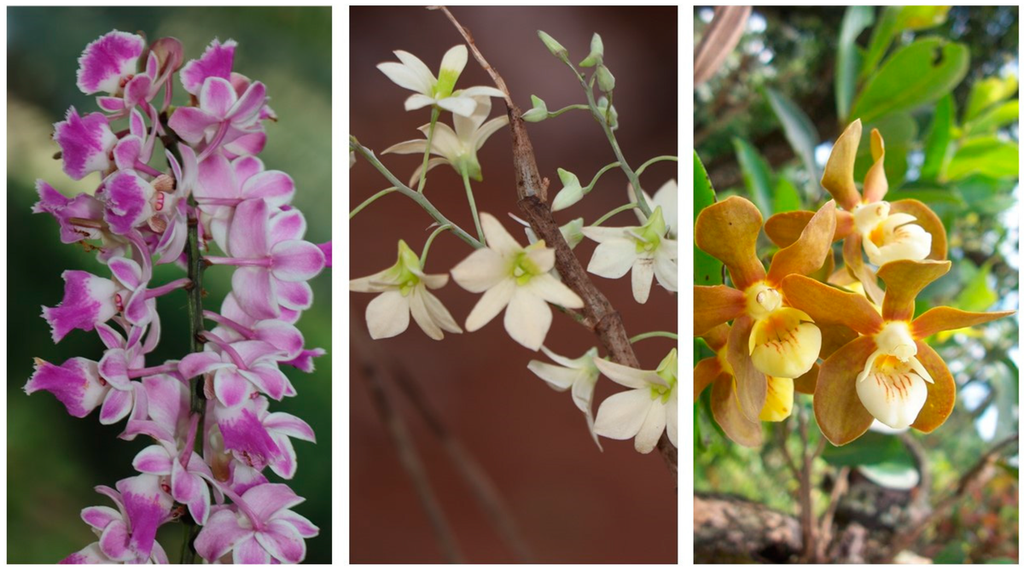
A low-cost project rescued over 27,000 native orchids from felled roadside trees in Keralam; over 71% survived after relocation.
UPSC Relevance
Prelims: Orchids – features, distribution, protection status (CITES, Wild Life Protection Act), state flowers, BSI, IUCN Red List categories, epiphytes.
Orchids
- Family: Orchidaceae – one of the largest families of flowering plants, with over 29,500 species. Found on every continent except Antarctica; richest in the tropics.
- India: Around 1,256 species. According to ‘Orchids of India: A Pictorial Guide’ (BSI, 2019), India has 307 endemic orchids, and Keralam accounts for more than a third of them.
- Hotspots in India: Himalaya and Northeast (Arunachal Pradesh has the highest number of species), Western Ghats, and Andaman and Nicobar Islands.
- Keralam’s richness: The State’s native orchid density is comparable to Costa Rica in South America.
Types of orchids by habit
| Type | Features |
|---|---|
| Epiphytes | Grow on other plants (trees) only for support; NOT parasites. Make their own food. About 70% of orchids are epiphytes. |
| Terrestrial | Grow on soil, often with tubers or rhizomes (e.g., Habenaria) |
| Lithophytes | Grow on rocks |
| Mycoheterotrophs (saprophytic) | Lack chlorophyll and depend on fungi for food (e.g., Neottia) |
Special features
- Velamen roots: Epiphytic orchids have aerial roots covered by a spongy tissue called velamen, which absorbs moisture from the air.
- Dust-like seeds: Orchids produce lakhs of tiny seeds without endosperm (stored food).
- Mycorrhizal dependence: Seeds need a symbiotic fungus (mycorrhiza) to germinate in nature. In labs, they are grown through tissue culture.
- Labellum: A modified petal (lip) that serves as a landing platform for pollinators. Some orchids mimic female insects to attract males (e.g., Ophrys).
- Column (gynostemium): Male and female parts are fused into a single structure.
- Slow growth: Many take years to flower, so they recover slowly from habitat loss.
Economic and ecological value
- Vanilla: Comes from the pods of the orchid Vanilla planifolia – the only orchid grown widely as a food crop. Keralam and Karnataka grow it in India.
- Floriculture: Cut flowers and potted plants (Dendrobium, Cymbidium, Vanda); Sikkim and the Northeast are key growing areas.
- Medicine: Used in traditional medicine (e.g., Ayurveda’s ‘Ashtavarga’ group includes orchids like Jeevak and Rishabhak).
- Bio-indicators: Sensitive to changes in climate and habitat, so their presence shows a healthy forest.
Orchids in News
| Fact | Details |
|---|---|
| Sikkim state flower | Noble Dendrobium (Dendrobium nobile) |
| Arunachal Pradesh and Assam state flower | Foxtail orchid (Rhynchostylis retusa); called ‘Kopou phool’ in Assam, worn in Bihu |
| Meghalaya state flower | Lady’s slipper orchid (Paphiopedilum insigne) |
| ICAR–National Research Centre for Orchids | Pakyong, Sikkim |
| Orchids in the clipping (Wayanad) | Aerides crispa, Dendrobium ovatum, Vanda thwaitesii |
Protection Status
- CITES: All orchid species are listed in Appendix II (trade regulated with permits). A few, such as Lady’s slipper orchids (Paphiopedilum), are in Appendix I.
- Wild Life (Protection) Act, 1972: After the 2022 amendment, Schedule III lists ‘specified plants’, including Blue Vanda (Vanda coerulea), Red Vanda (Renanthera imschootiana) and Lady’s slipper orchids. Picking, uprooting or trading them without permission is an offence.
- Foreign Trade Policy: Export of wild orchids is prohibited; only cultivated (artificially propagated) orchids can be exported.
Practice MCQ
Q1. Consider the following statements regarding orchids:
1. Epiphytic orchids are parasites that draw nutrients from the trees on which they grow.
2. Orchid seeds lack endosperm and depend on mycorrhizal fungi for germination in nature.
3. Vanilla is obtained from the pods of an orchid.
How many of the statements given above are correct?
(a) Only one (b) Only two (c) All three (d) None
Answer: (b). Statement 1 is incorrect – epiphytes only use trees for support and make their own food; they are not parasites.
Q2. Consider the following pairs:
| State | State flower |
|---|---|
| 1. Sikkim | Noble Dendrobium |
| 2. Meghalaya | Lady’s slipper orchid |
| 3. Assam | Foxtail orchid |
How many of the pairs given above are correctly matched?
(a) Only one (b) Only two (c) All three (d) None
Answer: (c). All three state flowers are orchids.
Tell Google you want more of this.
Add Anantam IAS as a preferred sourceOne tap, and this site shows up more often in your own Top Stories, AI Overviews and AI Mode. Remove it any time.