Why in News?
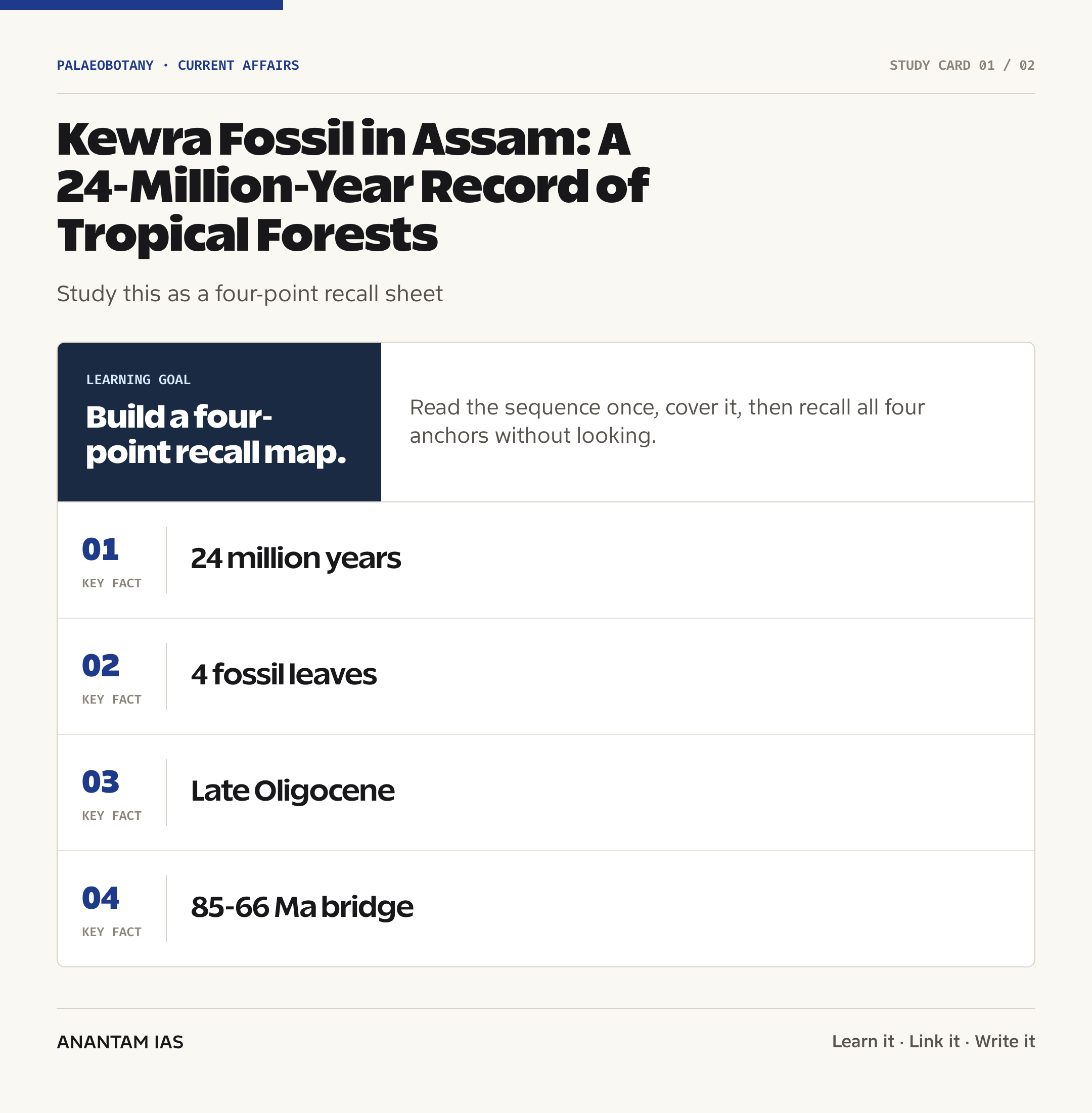
The kewra fossil in Assam has extended the Indian record of the screw-pine family, Pandanaceae, to about 24 million years ago. Four well-preserved fossil leaves came from the Tikak Parbat Formation of the Makum Coalfield in Assam.
A PIB release dated 15 July 2026 highlighted the study by Harshita Bhatia and Gaurav Srivastava of the Birbal Sahni Institute of Palaeosciences, an autonomous institute of the Department of Science and Technology. Their research was published in the journal Geobios.
- The researchers recovered four fossil leaves from the Tikak Parbat Formation of the Makum Coalfield, Assam.
- The late Oligocene leaves were assigned to Pandanites trinervis, a fossil-leaf taxon with diagnostic affinity to Pandanaceae.
- Key characters included an M-shaped transverse section, parallel veins, transverse veins and well-developed marginal prickles.
- The study combined morphological and microscopic analysis with comparisons against herbarium material, botanical databases and fossil records.
- The Assam record helps connect older 85-66 million-year-old records from Europe and North America with younger tropical records in Asia and Australia.
The development matters in the context of:
- The discovery strengthens the study of India’s palaeobiodiversity and complements the wider story of biodiversity in India.
- It presents India as a possible climatic refuge where ancient tropical lineages persisted while cooling removed them from higher latitudes.
- It links plant evolution, continental-scale biogeography and long-term responses to climate change.
- It shows why fossil-rich sedimentary formations are scientific archives, not merely sources of extractive resources.
UPSC Relevance
Prelims Relevance
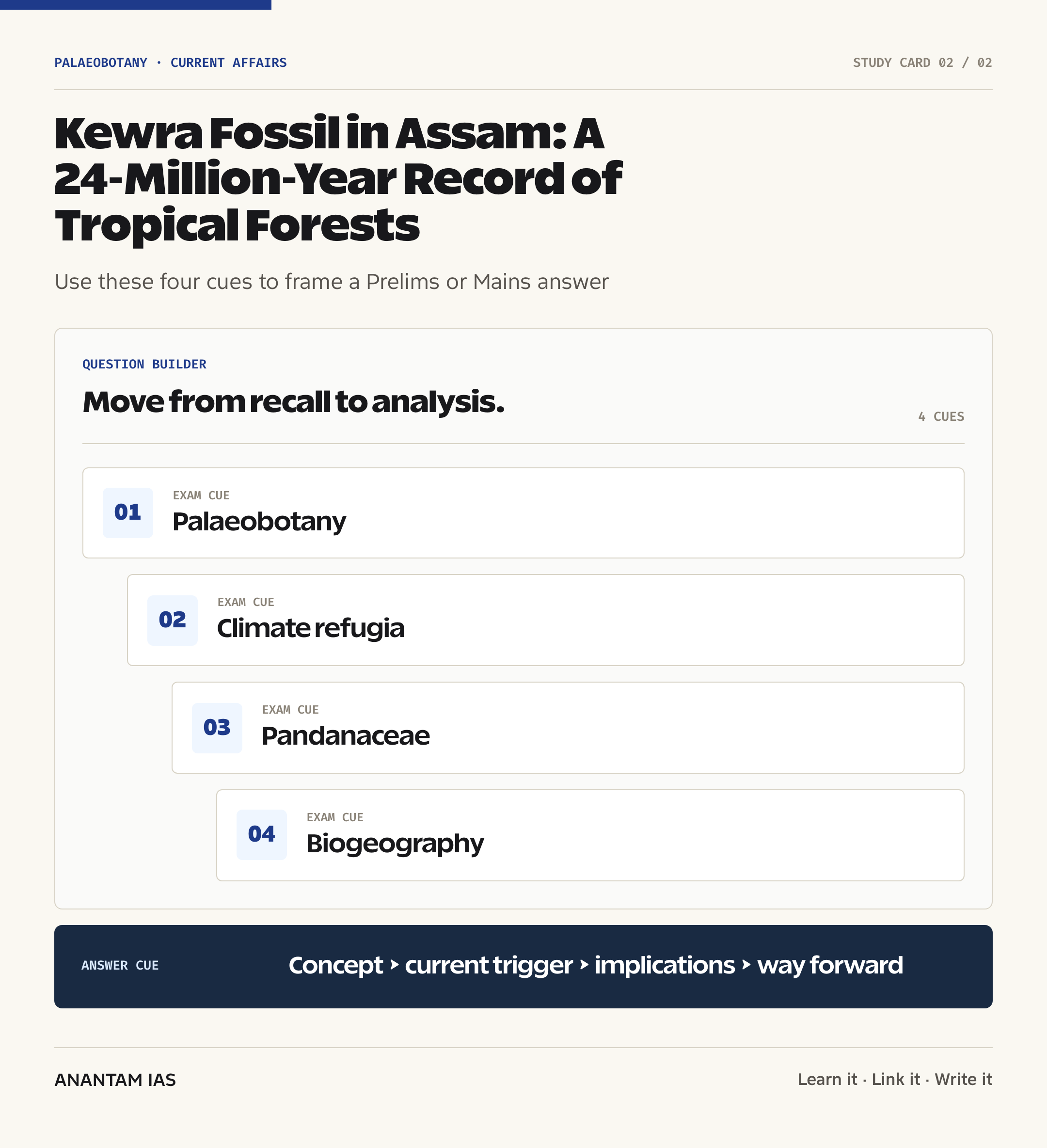
- Palaeobotany studies fossil plants and uses them to reconstruct past vegetation, environments, climates and plant evolution.
- The fossil locality is the Makum Coalfield in Assam; the leaves occur in the Tikak Parbat Formation.
- The fossils are about 24 million years old and belong to the late Oligocene.
- The fossil leaves were attributed to Pandanites trinervis, not directly identified as the living species Pandanus odorifer.
- Pandanaceae, commonly called the screw-pine family, is an early-diverging monocot lineage with a mainly tropical and subtropical distribution today.
- Diagnostic features include a long linear lamina, parallel secondary veins, transverse veins, an M-shaped cross-section and marginal prickles.
- Older pandanaceous fossil records from Europe and North America date to roughly 85-66 million years ago.
- Global cooling after about 34 million years ago coincided with the retreat of these plants from many northern regions toward the tropics.
- The Birbal Sahni Institute of Palaeosciences is an autonomous institute under the Department of Science and Technology.
Mains Relevance
GS Paper 3
- Science and technology: fossil identification through comparative morphology, microscopy, herbarium evidence and multidisciplinary palaeoscience.
- Environment: climate refugia, persistence of tropical lineages and the value of deep-time evidence for anticipating ecosystem responses.
GS Paper 1
- Physical geography: geological time, the late Oligocene environment and the spatial redistribution of vegetation under long-term climate change.
- Biogeography: India as a bridge and refuge within the wider palaeotropical distribution of Pandanaceae.
Essay
- A species lineage may survive not by remaining everywhere, but by finding a climatic refuge.
- The deep past is a laboratory for understanding the relationship between climate and biodiversity.
Background and Context
What the Researchers Actually Identified
The popular label ‘kewra fossil’ is useful, but the scientific identification needs a precise qualification.
- The authors assigned the leaves to Pandanites trinervis, a fossil-leaf taxon showing a diagnostic combination of Pandanaceae characters.
- The fossils closely resemble modern screw-pine leaves, including those associated with kewra, but they were not identified as the exact living species Pandanus odorifer.
- A form taxon allows palaeobotanists to classify an isolated fossil organ when the complete parent plant is unavailable.
- The result supports a pandanaceous presence in South Asia during the Paleogene; it does not prove that every modern use or ecological trait existed then.
Fossil Locality and Geological Setting
The rock layer and its age give the fossil its evolutionary meaning.
- All four leaves were recovered from the Tikak Parbat Formation in the Makum Coalfield of Assam.
- The formation preserves late Oligocene plant remains, placing the new leaves at about 24 million years ago.
- The late Oligocene belongs to the Paleogene and records a world undergoing major climatic and vegetational reorganisation.
- A fossil locality is valuable because the specimen, surrounding sediment and associated flora together reveal age, habitat and regional environmental history.
How Leaf Anatomy Established the Family Affinity
Identification rested on a combination of characters rather than one superficial resemblance.
- The leaves have an elongated, linear or sword-shaped lamina, comparable in general form to modern Pandanaceae leaves.
- Their transverse profile preserves a distinctive M-shaped section with a central midvein, a strong diagnostic clue.
- Uniformly developed parallel secondary veins are crossed by finer veins running obliquely or nearly perpendicular to them.
- Well-developed marginal prickles complete the character set used to distinguish the fossils from superficially similar monocot leaves.
- Researchers checked these features against herbarium specimens, botanical databases and earlier fossils from other regions.
Pandanaceae, Pandanus and Kewra
The living comparison links a culturally familiar plant with a much older botanical lineage.
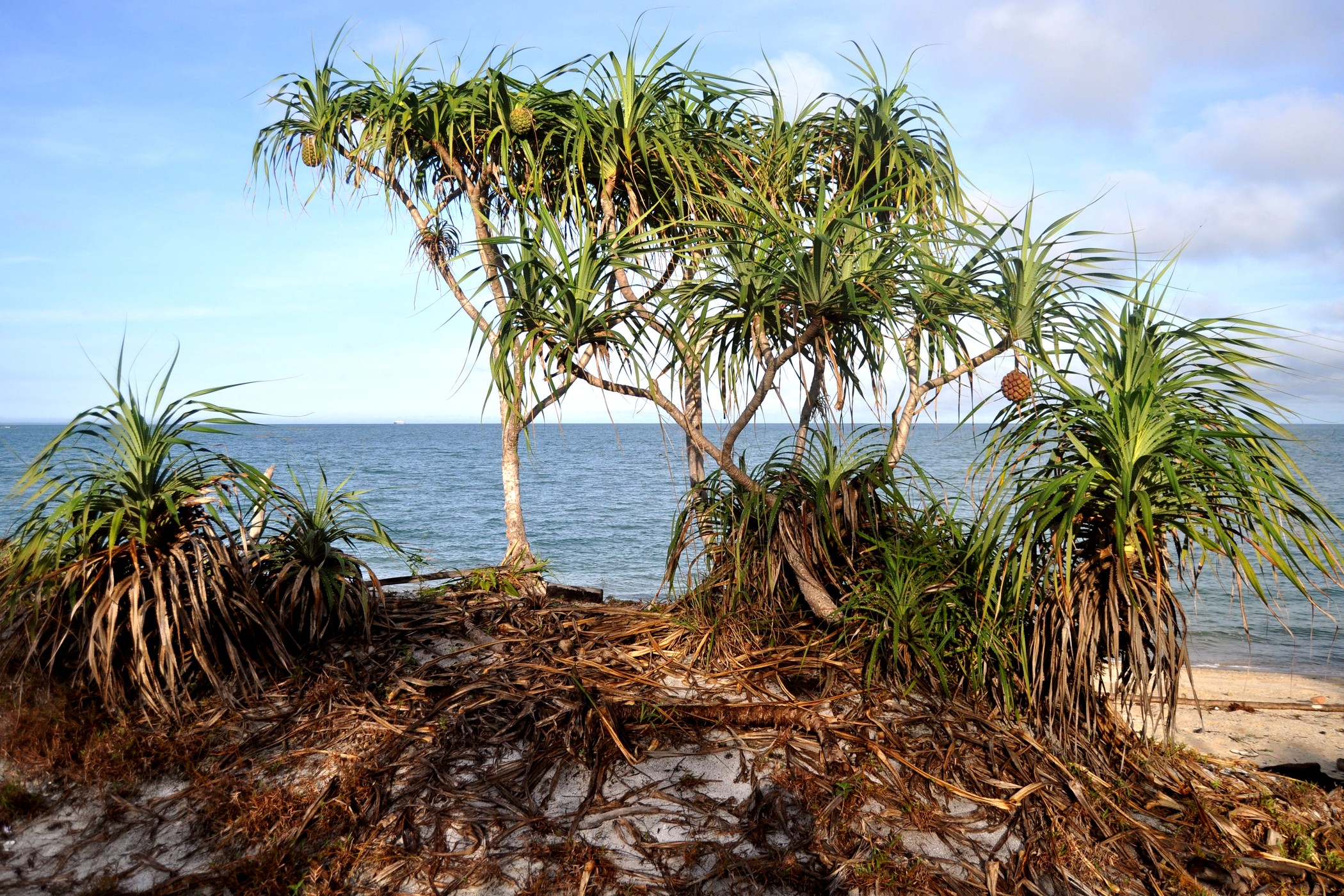
- Pandanaceae is the screw-pine family, an early-diverging lineage of monocot flowering plants.
- Its best-known genus, Pandanus, is now concentrated in tropical and subtropical regions rather than across the Northern Hemisphere.
- Modern kewra is associated with the fragrant screw-pine, whose male flowers yield an aromatic essence used in sweets, traditional practices and perfumery.
- The cultural familiarity of kewra should not obscure the larger scientific result: the fossil records persistence of the family lineage in India.
India as a Tropical Climate Refuge
A refuge is a region where a lineage survives conditions that cause its decline elsewhere.
- Pandanaceous ancestors had a broader northern distribution, with fossil evidence from Europe and North America dating to about 85-66 million years ago.
- As global climates cooled after about 34 million years ago, these plants disappeared from many regions and became increasingly confined to warmer zones.
- The Assam leaves show that South Asia retained the lineage during this contraction, filling a temporal and geographic gap in its fossil record.
- The finding supports India’s role as a palaeotropical refuge, a concept relevant to current discussions of India’s biodiversity hotspots.
How the Assam Record Bridges the Fossil Gap
A fossil becomes biogeographically important when it links separated records across both time and space.
- The oldest comparison set cited by the study comes from Europe and North America, where pandanaceous fossils occur in rocks roughly 85-66 million years old.
- The Makum Coalfield leaves place the family in South Asia during the late Oligocene, long after those older northern occurrences but before many younger tropical records.
- Younger evidence from tropical Asia and Australia shows the family within regions closer to its present mainly tropical and subtropical range.
- Taken together, the sequence supports persistence across the palaeotropics while cooling progressively reduced the lineage’s former Northern Hemisphere range.
- This bridge is temporal because it fills part of a long interval, and geographic because it inserts India between Laurasian and later tropical occurrences.
- The pattern supports regional survival of the family lineage; it doesn’t demonstrate uninterrupted occupation of one locality or survival of one unchanged species.
- Such intermediate records help palaeobotanists distinguish between a genuine absence, limited sampling and an incomplete fossil record.
Scientific Significance and Necessary Caution
Deep-time evidence is powerful when its claims are matched to what the fossil preserves.
- The record bridges older Laurasian occurrences and younger records from tropical Asia and Australia, improving the family’s biogeographic timeline.
- It demonstrates how plant macrofossils can test ideas about migration, regional survival and vegetation change inferred from living distributions.
- Past cooling unfolded over geological timescales, so the fossil is an analogue, not a simple forecast of the pace or effects of present warming.
- Four leaves establish an important occurrence, but broader conclusions need more specimens, precise stratigraphic control and independent palaeoclimate evidence.
- The study’s strength lies in combining geology, palaeobotany and palaeoclimate rather than treating leaf shape alone as conclusive.
Way Forward
Protect Fossil Context
- Document fossil-bearing horizons in the Makum Coalfield before specimens are removed, because stratigraphic context carries evidence that a loose fossil cannot preserve.
- Develop coordinated salvage, cataloguing and repository protocols among geological agencies, BSIP, universities and local authorities.
- Use high-resolution photography and three-dimensional records to create accessible digital archives without risking fragile originals.
Strengthen Chronology and Palaeoclimate Evidence
- Pair plant morphology with sedimentology, palynology and geochronology wherever suitable material is available.
- Record uncertainty clearly so that headline ages, stratigraphic ranges and taxonomic affinities aren’t presented as more exact than the evidence permits.
- Compare multiple fossil groups from the same formation to reconstruct a fuller late Oligocene ecosystem.
Build Comparative Collections
- Expand digitised herbarium and fossil databases with standardised images of venation, prickles and transverse anatomy.
- Support collaboration across South and Southeast Asia, where younger tropical records can test proposed migration and persistence pathways.
- Train researchers in both botanical taxonomy and Earth science so fossils are interpreted within biological and geological limits.
Connect Deep Time with Conservation
- Identify modern climate refugia using palaeo-records alongside present species distributions, habitat connectivity and future climate projections.
- Protect ecological gradients that allow plants to shift ranges, rather than relying only on isolated protected patches.
- Use fossil evidence to improve public understanding of why preserving evolutionary lineages matters beyond counting present-day species.
Conclusion
The kewra fossil in Assam is important because it places Pandanaceae in the Indian subcontinent about 24 million years ago. Its carefully preserved anatomy turns four leaves into evidence for a wider story of tropical plant persistence.
The strongest lesson is methodological as well as ecological. Fossils, rock context and living comparisons together reveal how lineages responded to past cooling. That deep-time perspective can sharpen conservation planning, provided scientists keep the distinction between a useful analogue and a direct prediction.
UPSC Practice Questions
Prelims MCQ 1
With reference to the kewra fossil discovery in Assam, consider the following statements:
- The fossil leaves were recovered from the Tikak Parbat Formation of the Makum Coalfield.
- The leaves were assigned to Pandanites trinervis and show affinity with Pandanaceae.
- The fossils date to the Late Cretaceous.
How many of the above statements are correct?
(a) Only one (b) Only two (c) All three (d) None
Answer: (b) Only two
Explanation:
Statements 1 and 2 are correct. The Makum Coalfield leaves are about 24 million years old and belong to the late Oligocene, not the Late Cretaceous.
Prelims MCQ 2
Which one of the following combinations most strongly supported the fossil leaves’ affinity with Pandanaceae?
(a) Reticulate venation, smooth margins and a heart-shaped lamina (b) Lobed margins, palmate venation and a hollow petiole (c) M-shaped transverse section, parallel veins and marginal prickles (d) Needle leaves, resin canals and naked seeds
Answer: (c) M-shaped transverse section, parallel veins and marginal prickles
Explanation:
The diagnostic combination included an M-shaped transverse section with midvein, uniformly developed parallel veins, transverse veins and well-developed marginal prickles.
UPSC Mains Questions
- The Assam Pandanaceae fossil is evidence not only of plant antiquity but also of India’s role as a climatic refuge. Explain how palaeobotanical records help reconstruct biogeography, vegetation change and the long-term response of tropical lineages to global climate transitions. (250 words)
- Fossil interpretation requires both biological comparison and geological context. Using the Makum Coalfield discovery as an example, discuss how morphology, microscopy, stratigraphy, herbarium collections and palaeoclimate evidence combine to produce a defensible account of plant evolution and biogeography in South Asia. (250 words)
- Deep-time climate analogues can inform conservation but cannot serve as simple forecasts of present warming. Examine this statement and suggest how palaeoecological evidence can be integrated with modern species data, connectivity planning, protected-area management and regional climate projections. (250 words)
Source: PIB, Ministry of Science and Technology.
Frequently Asked Questions
What was discovered in Assam?
Researchers found four well-preserved fossil leaves in the Tikak Parbat Formation of the Makum Coalfield, Assam. Their venation, transverse anatomy and marginal prickles support assignment to Pandanites trinervis, a fossil-leaf taxon with affinity to the ancient monocot screw-pine family, Pandanaceae.
How old are the fossil leaves?
The leaves are about 24 million years old and come from the late Oligocene Tikak Parbat Formation. The study treats this as a Paleogene record of Pandanaceae in South Asia, filling part of the gap between older northern fossils and younger tropical occurrences.
Is the fossil exactly modern kewra?
No. The fossils resemble leaves of modern kewra-related Pandanus, but scientists assigned them to Pandanites trinervis. The defensible claim is family-level pandanaceous affinity and long persistence in India, not proof that the exact living species Pandanus odorifer grew at the site.
Which features identified the fossil?
The leaves preserve an elongated linear lamina, an M-shaped transverse section with a midvein, uniformly parallel secondary veins, oblique-to-perpendicular transverse veins and well-developed marginal prickles. Researchers compared this combined character set with living herbarium specimens, botanical databases and earlier fossils.
Why is India called a refuge?
Older Pandanaceae relatives once occurred more widely across the Northern Hemisphere. As climates cooled after about 34 million years ago, the lineage vanished from many regions. The Assam record shows its survival in South Asia, supporting the idea that tropical India provided suitable refuge conditions.
Why does the fossil matter today?
It shows how fossil plants can reveal past range shifts, survival zones and responses to climatic change. Such evidence helps scientists frame hypotheses about modern climate refugia and habitat connectivity. It doesn’t directly predict present warming, whose speed and human pressures differ from ancient transitions.
Tell Google you want more of this.
Add Anantam IAS as a preferred sourceOne tap, and this site shows up more often in your own Top Stories, AI Overviews and AI Mode. Remove it any time.