Why in News?
The Indian Express reported on September 28 that AI in disaster response was helping reconcile missing-person information and map damage during Nepal’s recent disaster.
- The report describes a web portal matching crowdsourced missing-person information against official lists of people reported dead or injured.
- It attributes the portal’s damage mapping, using open-source satellite imagery, to accounts in Nepali news outlets.
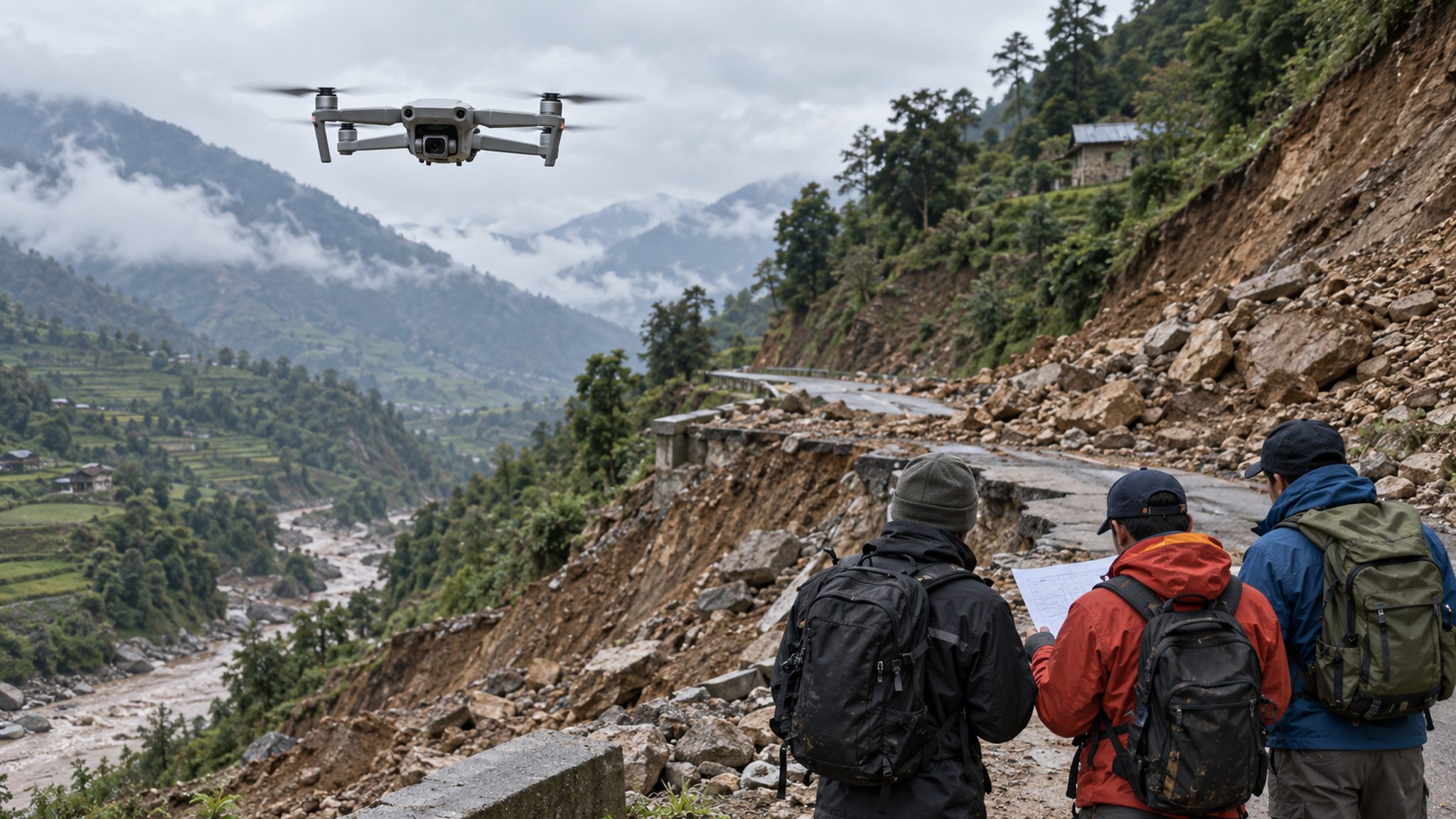
- It also reports thermal-camera drones helping identify possible search locations; thermal detection itself does not establish that an AI model was used.
- These are reported applications, without independently established accuracy or rescue totals in the cited account.
- During emergencies, the bottleneck can be reconciling conflicting reports, even when many images, messages and lists are available.
- A useful system must move from possible matches to verified information that a responsible response team can act upon.
UPSC Relevance
Prelims Relevance
- Entity resolution: assessing whether different records refer to the same person, place or incident.
- Data provenance: retaining where information came from and when it was collected.
- Remote sensing: observing surface conditions through sensors without direct physical contact.
- Thermal imaging: sensing emitted infrared radiation, distinct from confirming a person’s identity.
- Human oversight: authorised responders retain responsibility for consequential decisions.
Mains Relevance
GS Paper 3
- Information triage and technology-assisted disaster response
- Resilient communications and human verification before deployment
GS Paper 2
- Accountability, privacy and inclusion in emergency information systems
Essay
- Better information serves people only when institutions can interpret and act on it.
Background and Context
Why scattered reports need reconciliation
The first task after an event is often establishing what happened, where assistance is needed and which reports describe the same incident.
- A missing-person report, hospital entry and family message may describe one individual differently. Treating every entry as a separate person can distort the response picture.
- Entity resolution compares available attributes, such as names and last-known locations, to suggest possible matches. Similar spelling alone should never determine identity or a person’s condition.
- Duplicate removal should preserve the underlying reports. A correction becomes difficult if the original message, source and time disappear after records are merged into a single entry.
- A confidence label expresses uncertainty in a suggested match; it cannot certify the truth of either input. Confident processing of an incorrect report still produces unreliable information.
- For study purposes, Nepal illustrates post-event information triage. The reported portal should not be presented as a verified national system or evidence of a measured reduction in deaths.
How a possible match becomes an operational decision
A practical response workflow should separate machine-assisted sorting, human verification and the authority to deploy scarce rescue resources.
- Collect and timestamp messages from permitted channels, retaining their source. A newly forwarded message may describe an old event; forwarding time is different from observation time.
- Extract and compare people, locations and needs across records. Language tools can organise unstructured messages, but generated summaries must remain traceable to the original evidence.
- Verify consequential matches with the relevant field team, hospital or authorised contact. Contradictory records should enter a review queue instead of being silently converted into one definite answer.
- Human dispatch combines validated needs with access, team safety and available equipment. Identifying a likely trapped person does not establish that a route or building is safe.
- Close the feedback loop when responders report their findings. Updated status prevents repeated deployment to resolved requests and exposes incorrect matches that need correction across linked records.
What imagery can add, and what it cannot prove
Images provide another evidence stream, but the object being detected and the decision being made must remain clearly distinguished.
- Satellite damage mapping can flag changed buildings or access routes for closer assessment. An apparent change is a reason to investigate, not a complete account of local needs.
- Thermal cameras detect heat patterns. A human-shaped signature may guide a search, but requires interpretation and field confirmation; it does not establish identity, survival or medical condition.
- Image age and coverage matter because access conditions can change after observation. Operational decisions should state when the evidence was captured and where observations remain unavailable.
- Predictive AI estimates a future condition; text-sorting tools organise reports already received. Neither capability automatically supplies the other’s evidence or removes the need to check outputs.
- Read radar-based early warning separately: forecast-to-warning systems act before anticipated harm, while this Nepal example concerns reconciling information after an event.
Why governance remains part of the mechanism
The people missing from digital records may also be those whose needs require the most deliberate outreach.
- Digital silence cannot be read as absence of need. Poor connectivity, language barriers and damaged devices can leave an affected settlement less visible than a well-connected neighbourhood.
- Access controls should separate operational records from public information. Publishing names, contact details and health status widely can expose survivors and families to avoidable harm.
- Resilient fallback channels are necessary when power or communications fail. A response system dependent on continuous connectivity can lose visibility precisely when physical disruption becomes most severe.
- UNDRR’s earlier analysis stresses institutional accountability and community participation. It supports these governance principles; it does not independently verify Nepal’s reported deployments or their effectiveness.
- Post-disaster learning should examine missed requests and mistaken matches, alongside response speed. The lesson is whether the information system improved decisions for affected people.
Way Forward
Build verification into response information systems
- Assign named responsibility for validating records, resolving contradictions and authorising dispatch; make correction possible without deleting the original evidence.
- Test local-language and offline reporting with affected communities before emergencies, including procedures for reconciling information when connectivity returns.
- Assess missed needs, false matches and correction time, alongside speed; a larger volume of processed reports is not sufficient evidence of better response.
- Use restricted access and retention rules for personal data, while publishing only information necessary for public safety and coordination.
Conclusion
- AI-assisted reconciliation can make scattered reports easier to act upon, but uncertain matches must remain uncertain until checked against reliable evidence.
- The durable policy test is verified action: who checks the information, who decides the response and how mistakes reach the people able to correct them.
UPSC Practice Questions
Prelims MCQ 1
With reference to digital disaster-response systems, consider the following statements:
- Entity resolution assesses whether different records concern the same person or incident.
- A high-confidence record match independently proves that the original reports are accurate.
- Thermal imagery alone cannot establish a person’s identity.
How many of the above statements are correct?
(a) Only one (b) Only two (c) All three (d) None
Answer: (b) Only two
Explanation:
Statements 1 and 3 are correct. Confidence in matching records is distinct from verification of the underlying reports.
Prelims MCQ 2
Which response best addresses contradictory missing-person records generated during a disaster?
(a) Retain only the newest social-media message (b) Treat each message as a different individual (c) Preserve sources and refer the possible match for authorised verification (d) Automatically publish all personal details
Answer: (c) Preserve sources and refer the possible match for authorised verification
Explanation:
Provenance allows correction, while authorised verification prevents a tentative match from becoming an unsupported operational or personal-status claim.
UPSC Mains Questions
- Explain how AI-assisted reconciliation of post-disaster information can improve response. Why must verification and dispatch remain institutionally accountable?
- Discuss how data gaps, privacy risks and infrastructure failure can undermine digital disaster-response systems. Suggest practical safeguards.
Sources: Indian Express Explained and UNDRR.
Frequently Asked Questions
What is AI in disaster response?
It includes tools that organise messages, compare records or interpret imagery after an emergency. Their useful output is evidence for responders, rather than an automatic instruction to deploy resources or declare someone’s condition.
What did the Nepal example involve?
The Indian Express described a portal matching crowdsourced missing-person information with official dead and injured lists, alongside satellite damage mapping. These reported applications do not establish independently verified accuracy or rescue outcomes.
Does a thermal-camera drone necessarily use AI?
No. Thermal imaging senses infrared radiation and can operate without an AI interpretation system. A reported human-shaped thermal signature requires assessment and field confirmation before responders draw conclusions about a person.
Why is human verification necessary?
Records may be outdated, duplicated or inconsistent, and a plausible match can still be wrong. Authorised checks connect tentative information with real conditions before consequential personal-status or rescue decisions are made.
How does this differ from early warning?
Early warning concerns communicating an anticipated hazard so people can act before harm. Post-event information reconciliation compares reports about an emergency that has occurred, helping responders determine current needs and coordinate assistance.
Tell Google you want more of this.
Add Anantam IAS as a preferred sourceOne tap, and this site shows up more often in your own Top Stories, AI Overviews and AI Mode. Remove it any time.