Why in News?
ISRO launched NVS-03 aboard GSLV-F18 on 30 October 2026, placing the navigation satellite in its intended geosynchronous transfer orbit, a significant milestone toward strengthening NavIC services.
- The launch date is recorded in ISRO’s launch inventory; The Hindu reported the successful injection on 31 October.
- ISRO’s mission brief confirms transfer-orbit injection and identifies NVS-03 as the third satellite in the next-generation navigation series.
- The satellite adds an L1 signal alongside the existing L5 and S signals, with service continuity as its stated purpose.
- The Hindu reported expectations of restored navigation capability; completed commissioning is not independently established by the available mission brief.
- A successful launch vehicle delivers a satellite to its specified injection orbit; the spacecraft must then perform the tasks required for its service role.
- Navigation infrastructure includes satellites, ground control and users’ receivers. Improving one segment does not automatically establish end-to-end service performance.
UPSC Relevance
Prelims Relevance
- GTO: an elliptical transfer orbit used on the way to a geosynchronous operational orbit.
- Orbit raising: controlled spacecraft manoeuvres that change its orbit after launch-vehicle separation.
- Commissioning: checking and accepting spacecraft and payload performance before routine service.
- L1, L5 and S: signal bands supported by the NVS navigation payload.
- NavIC: India’s regional positioning, navigation and timing system.
Mains Relevance
GS Paper 3
- Assess space capability through verified service delivery, not launch totals alone.
- Connect satellite replenishment with ground monitoring, receiver adoption and resilient public infrastructure.
Essay
- The difference between building infrastructure and making it dependable.
Background and Context
What the Launch Establishes
The launch confirms a specific delivery milestone; later service claims require evidence from the spacecraft and its ground systems.
- GSLV-F18 carried NVS-03 from Sriharikota and injected it into the intended transfer orbit. ISRO’s mission page describes this result; it does not provide a completed commissioning record or user-service acceptance report.
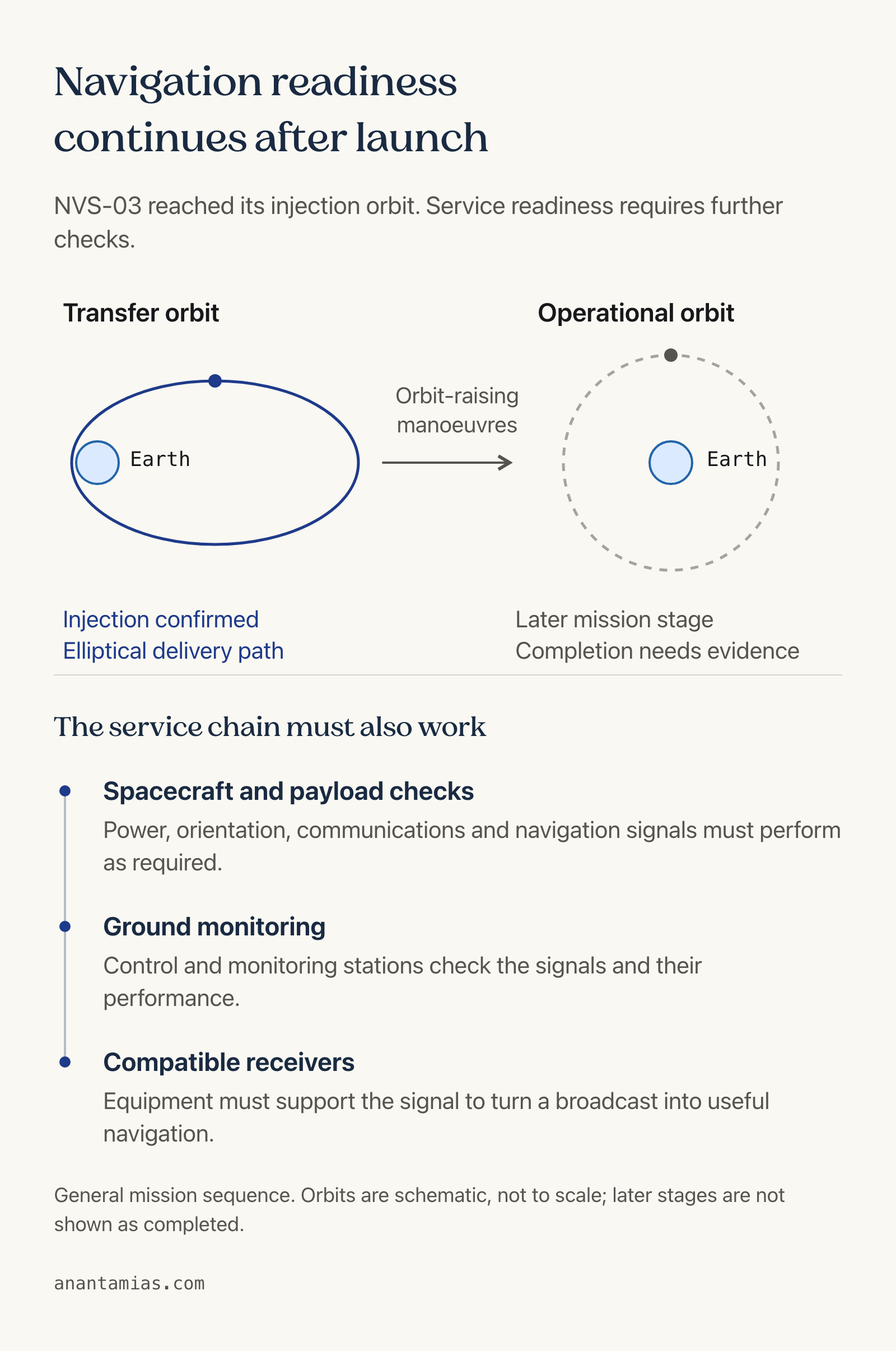
- Transfer orbit describes a route toward the operational orbit. Its elliptical path has unequal distances from Earth, so being successfully placed there does not mean the satellite already occupies its intended final service orbit.
- Launch success and spacecraft readiness answer different questions. The first concerns delivery to the injection conditions; the second concerns whether the satellite can complete its own operations and sustain the functions expected of it.
- Service continuity is the stated purpose of the NVS series. A replacement mission strengthens the programme only when its spacecraft, navigation payload and supporting systems become available for dependable use across the intended service area.
- The earlier NavIC note explains clock reliability. This launch adds a separate operational question: what evidence shows that newly delivered hardware has progressed from deployment toward usable navigation service?
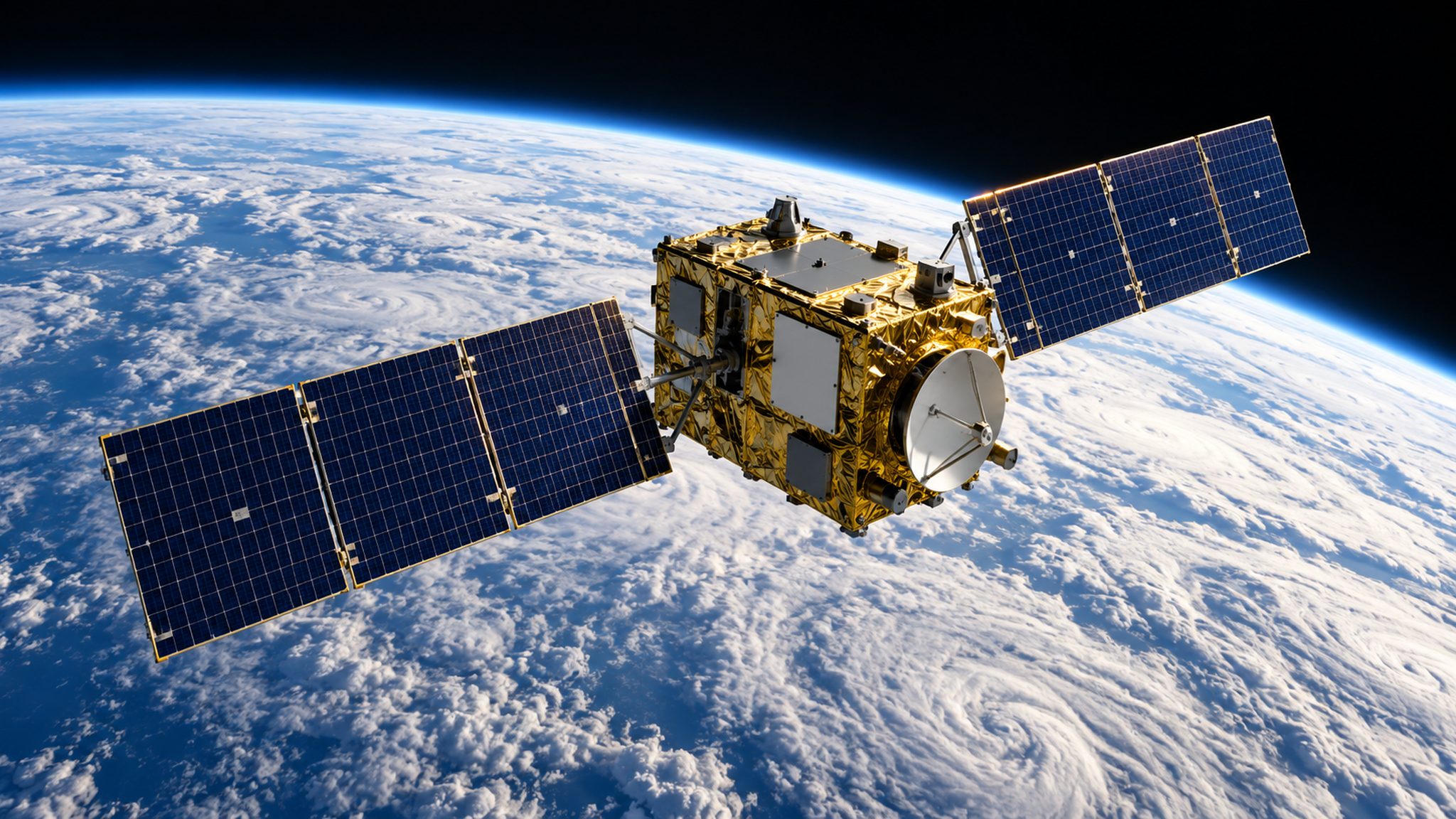
How a Satellite Moves Toward Service
Orbit raising and in-orbit checks turn a delivered spacecraft into a candidate for operational use; these are distinct engineering tasks.
- Orbit raising uses controlled propulsion manoeuvres to change the spacecraft’s path. ISRO’s NVS-01 mission description explicitly separated transfer-orbit deployment from subsequent manoeuvres to reach the intended orbit, illustrating the general mission sequence.
- Spacecraft health must support those operations: power generation, stable orientation and communication with controllers matter after separation. A payload cannot provide a reliable service if the platform carrying it cannot maintain the required operating conditions.
- Payload verification asks whether navigation signals behave as required in operation. Ground control, precise timing and monitoring stations form part of NavIC’s architecture, linking the satellite’s transmitted signals with the system that checks their performance.
- Ground monitoring then connects spacecraft performance with service quality. ISRO states that calibrated receivers continuously monitor NavIC signals; the relevant question is what users can reliably receive, rather than whether a satellite merely transmits.
- Readiness evidence should identify the completed stage and its limits. The distinction resembles propulsion validation: a demonstrated component or mission milestone supports further assessment, without proving every later operating condition.
Why L1 Still Needs Compatible Receivers
A new signal broadens the technical opportunity for civilian use, while practical adoption depends on equipment that can process it.
- L1 capability is additional to L5 and S in ISRO’s NVS-03 brief. The extra signal gives receiver designers another supported navigation input; it does not mean that every existing device automatically acquires NavIC functionality.
- Receiver compatibility involves implementing the relevant signal interface. ISRO published the civilian L1 signal-in-space interface document to facilitate user-segment implementation, linking satellite design with the engineering decisions made by equipment and chipset developers.
- System performance depends on the entire chain: the spacecraft must operate, ground systems must monitor it, and the receiver must process supported signals. Failure at any one stage can limit the usefulness of otherwise successful infrastructure.
- Regional navigation remains NavIC’s role. Adding a signal band does not by itself convert the constellation into a global service; signal format and geographical service coverage are different design questions with different evidence requirements.
- Public assessment should follow confirmed milestones: orbit delivery, spacecraft operations, payload verification and service availability. Avoid assigning an unverified completion date or treating reported expectations as a measured restoration of performance for all users.
Way Forward
Report Readiness in Verifiable Stages
- ISRO should communicate orbit and commissioning milestones with their operational meaning, so launch announcements and user-service availability remain distinguishable.
- Service agencies should assess receiver compatibility before procurement and verify performance in the environments where navigation will actually be used.
- Track signal monitoring and service notices alongside spacecraft additions when evaluating the reliability of national navigation infrastructure.
Conclusion
- NVS-03’s successful launch is a verified advance toward stronger NavIC capability. Transfer-orbit injection establishes delivery; dependable navigation requires the spacecraft, ground systems and compatible receivers to work together through subsequent operational stages.
- For a Mains answer, assess space infrastructure by service readiness: explain the mission sequence, identify the verified milestone and state what further evidence is needed before claiming full operational restoration.
UPSC Practice Questions
Prelims MCQ 1
With reference to navigation-satellite missions, consider the following statements:
- Successful injection into a transfer orbit necessarily establishes completion of operational commissioning.
- Orbit-raising manoeuvres can change a spacecraft’s orbit after its separation from the launch vehicle.
- An added navigation signal requires compatible receiver implementation to be useful to a user.
How many of the above statements are correct?
(a) Only one (b) Only two (c) All three (d) None
Answer: (b) Only two
Explanation:
Statements 2 and 3 are correct. Transfer-orbit injection is a launch milestone; subsequent spacecraft operations and payload verification are separate from it.
Prelims MCQ 2
Which statement best explains the significance of adding L1 to an NVS navigation payload?
(a) It eliminates the need for ground monitoring. (b) It makes the regional constellation a global system. (c) It guarantees support in every existing mobile receiver. (d) It provides an additional signal that compatible receivers can implement.
Answer: (d) It provides an additional signal that compatible receivers can implement.
Explanation:
L1 adds a supported signal. Receiver implementation, ground monitoring and geographical coverage remain distinct requirements.
UPSC Mains Questions
- Explain why a successful navigation-satellite launch should be distinguished from operational service readiness.
- How can satellite replenishment, ground monitoring and receiver adoption jointly strengthen the reliability of India’s navigation infrastructure?
Sources: ISRO mission brief and launch inventory and The Hindu.
Frequently Asked Questions
What did the NVS-03 launch achieve?
ISRO confirmed that GSLV-F18 placed NVS-03 into the intended geosynchronous transfer orbit on 30 October. This establishes successful injection, while completed operational commissioning requires separate evidence from later mission stages.
Why is transfer orbit different from the final operational orbit?
A transfer orbit is an intermediate elliptical path. Spacecraft manoeuvres change that path toward the intended operational orbit, after which health and payload checks help establish readiness for routine service.
Does an L1 signal make every phone NavIC-compatible?
No. The receiver must implement the relevant signal interface. Adding L1 expands the supported signal options, while practical compatibility depends on the hardware and software of the receiving equipment.
Has full NavIC service restoration been confirmed here?
The available sources confirm successful launch and report expectations of stronger navigation capability. They do not independently establish completed commissioning and measured restoration for all users, so that outcome remains conditional in this note.
Tell Google you want more of this.
Add Anantam IAS as a preferred sourceOne tap, and this site shows up more often in your own Top Stories, AI Overviews and AI Mode. Remove it any time.