Why in News?
On November 27, the Department of Science and Technology reported a CeNS–IIT Delhi study using two protections against colour instability in perovskite-based white LEDs.
- Researchers reduced halide vacancies using lead selenide and added an ultrathin alumina coating to restrict exchange between colour-emitting layers.
- The study produced devices on glass and flexible PET, demonstrating that the materials could be arranged on both rigid and bendable supports.
- Optimised devices maintained white emission during up to 24 hours of continuous operation in the reported laboratory demonstration.
- The work appeared in Small. The official account identifies lead toxicity as an issue requiring further attention before wider commercial use.
- Lighting materials must preserve their emission characteristics during operation. Bright initial output alone cannot establish whether a device will remain useful over its service life.
- The study connects nanomaterial design with manufacturing and environmental constraints, a useful example of the steps between a laboratory result and a consumer product.
UPSC Relevance
Prelims Relevance
- Halide perovskite nanocrystals and colour emission
- Anion exchange between neighbouring materials
- Surface vacancies and ion migration
- Atomic layer deposition and alumina encapsulation
- PET as a flexible substrate
Mains Relevance
GS Paper 3
- Material stability as a condition for translating research into usable technology.
- The relationship between domestic materials research, scalable production and environmental safety.
Background and Context
Why Adjacent Nanocrystals Change Colour
The colour problem begins when different halide compositions exchange ions, changing the material that produces the light.
- Perovskite describes a family of crystal structures. In this study, all-inorganic halide nanocrystals contain caesium, lead and a halide, with the halide composition helping determine the colour they emit.
- Green-emitting caesium lead bromide and red-emitting caesium lead iodide illustrate the problem. Their distinct compositions allow different optical outputs, making them useful building blocks when researchers combine colours for lighting.
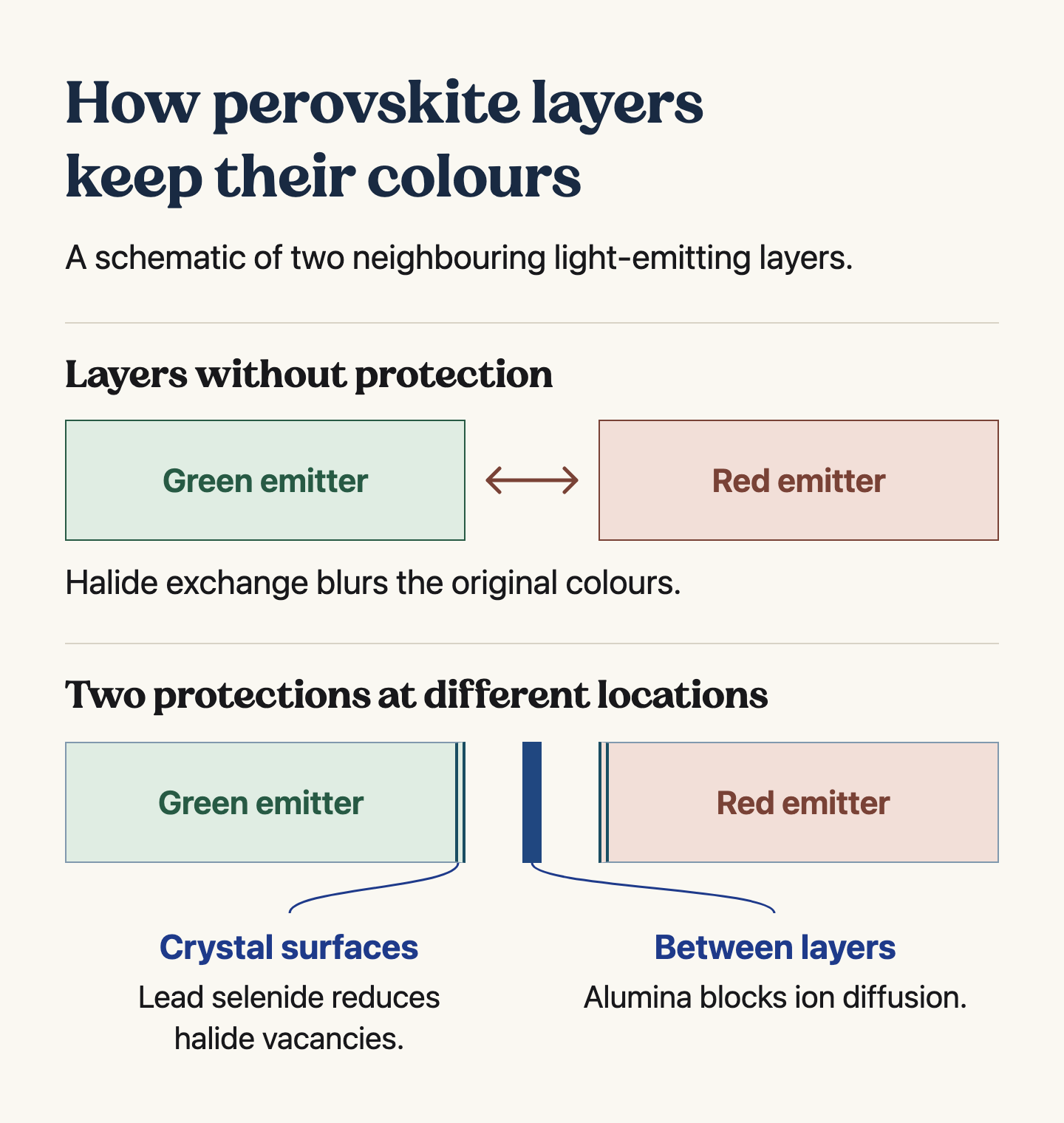
- When these nanocrystals come into close contact, halide ions can move between them. The exchange alters their compositions, so the original emission colours can drift towards an intermediate colour during use.
- The release describes unwanted orange emission when the intended red and green components exchange ions. This is a change inside the materials that generate light, beyond the normal optical mixing of separate colours.
- Surface vacancies provide pathways that assist migration. A vacancy is an unoccupied site where an ion would normally occur, so reducing these defects can help preserve the intended composition of each nanocrystal.
How the Two Protections Work
Surface treatment reduces migration pathways, while a transparent coating limits exchange between neighbouring emitting layers.
- The researchers used lead selenide to reduce halide vacancies at nanocrystal surfaces. The official account reports that this treatment suppressed a principal migration pathway while preserving the material’s brightness and emission colour.
- A separate alumina barrier restricted ion diffusion between adjacent layers. Aluminium oxide provides physical separation, adding protection at the interface where ions could otherwise pass from one emitting material to another.
- Atomic layer deposition produced a transparent coating about 5–6 nanometres thick. Its role was to impede ion movement while allowing light to pass through, linking a surface-engineering method to optical performance.
- The mechanisms act at different locations. Defect reduction changes accessible pathways on nanocrystal surfaces, and encapsulation adds a boundary between layers. Together they help maintain the compositions responsible for the intended colours.
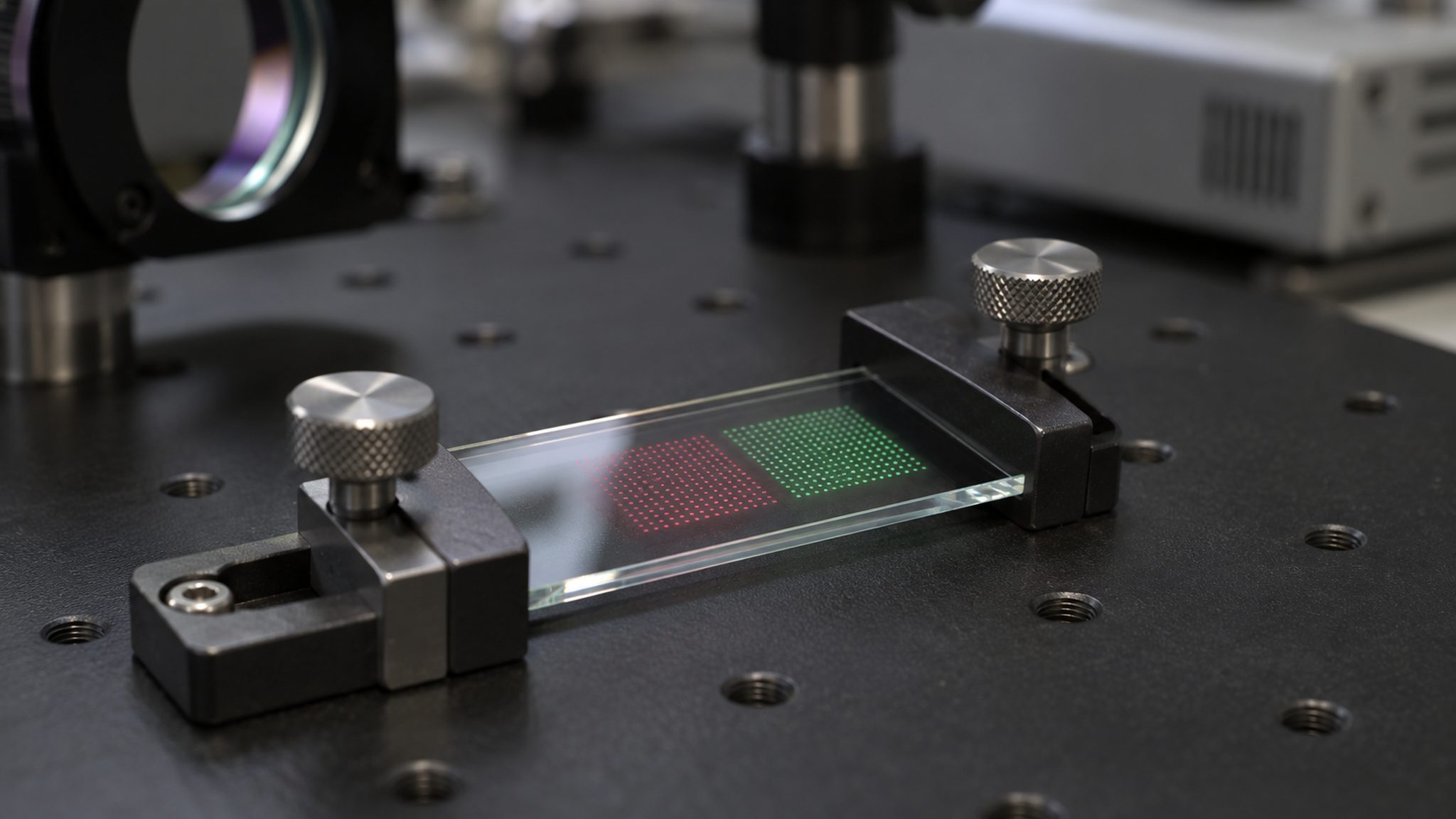
- Researchers combined spray coating and micropatterning to build devices on glass and PET. These supports demonstrate rigid and flexible configurations, while the patterned arrangement organises the colour-emitting materials within the lighting structure.
What the Laboratory Result Establishes
The demonstration supports improved colour stability under the reported conditions, while product lifetime and environmental safety need further evidence.
- Continuous operation for up to 24 hours is a bounded experimental result. It demonstrates behaviour over that observation period, while a dependable consumer light requires evidence across much longer operating and storage conditions.
- The reported devices retained emission close to white light when heated and cooled. This adds a thermal-stability observation, but the release does not establish performance across every temperature encountered during manufacture or use.
- The team also reported adjustable light tone through changes in electrical current. This describes an observed device capability, whose reliability would still need assessment alongside brightness, energy consumption and repeated operation.
- Lead remains present in the material system, including its surface treatment. The barrier’s optical and stability functions do not by themselves establish safe manufacture, disposal, recycling or resistance to material release after damage.
- Scale-up needs reproducibility across larger areas and production batches. This research-to-application gap also arises in laboratory photocatalysis and in building reliable electronics manufacturing capabilities.
Way Forward
Evaluate Performance and Safety Together
- Extend durability testing across operating cycles, temperature changes and storage conditions, with transparent reporting of which device configuration achieves each result.
- Assess lead containment and end-of-life handling alongside optical performance, including what happens when a coating or flexible substrate is damaged.
- Test manufacturing consistency over larger areas before drawing conclusions about affordable mass production or reliable consumer lighting.
Conclusion
- Ion migration links material composition to colour stability. Combining vacancy reduction with an interlayer barrier illustrates how interventions at different physical locations can protect an optical device’s performance.
- The study offers a promising laboratory demonstration for perovskite lighting. Its practical significance will depend on longer durability evidence, repeatable production and credible management of the lead-containing materials.
UPSC Practice Questions
Prelims MCQ 1
With reference to the reported perovskite lighting research, consider the following statements:
- Halide exchange can alter the emission colour of neighbouring nanocrystals.
- Alumina encapsulation acts as a barrier to ion diffusion between emitting layers.
- The reported surface treatment removes all lead from the device.
How many of the above statements are correct?
(a) Only one (b) Only two (c) All three (d) None
Answer: (b) Only two
Explanation:
The first two statements describe the reported mechanism. Lead remains in the perovskite system, and the treatment itself uses lead selenide.
Prelims MCQ 2
Which distinction best explains why the researchers combined surface treatment with alumina encapsulation?
(a) Both methods convert lead into an inert gas. (b) Surface treatment reduces vacancies, while encapsulation limits exchange between layers. (c) Encapsulation increases the rate of halide exchange. (d) Surface treatment makes the supporting glass flexible.
Answer: (b) Surface treatment reduces vacancies, while encapsulation limits exchange between layers.
Explanation:
The two protections address migration pathways at different locations: nanocrystal surfaces and the boundary between adjacent emitting layers.
UPSC Mains Questions
- Explain how controlling defects and interfaces can improve the performance of emerging materials, using perovskite lighting as an example.
- Discuss the evidence required to translate a promising laboratory lighting material into an environmentally responsible consumer product.
Source: PIB, Department of Science and Technology.
Frequently Asked Questions
Why does colour drift occur in halide perovskite nanocrystals?
Halide ions can migrate between nearby nanocrystals with different compositions. This changes the compositions responsible for their emission colours and can shift the intended red and green outputs towards an intermediate colour.
What does the alumina coating do?
The transparent aluminium oxide coating acts as a physical barrier between emitting layers. It restricts ion diffusion while permitting light transmission, complementing the treatment that reduces vacancies on nanocrystal surfaces.
Does the 24-hour test establish a commercial product lifetime?
It establishes operation during the reported laboratory observation period. Product lifetime needs longer testing, repeatability and evidence under operating and storage conditions representative of the intended application.
Why is lead safety still relevant?
The perovskite materials contain lead, and lead selenide is used in the surface treatment. Better colour stability does not establish safe handling, containment, recycling or disposal throughout a product’s life.
Tell Google you want more of this.
Add Anantam IAS as a preferred sourceOne tap, and this site shows up more often in your own Top Stories, AI Overviews and AI Mode. Remove it any time.