Why in News?
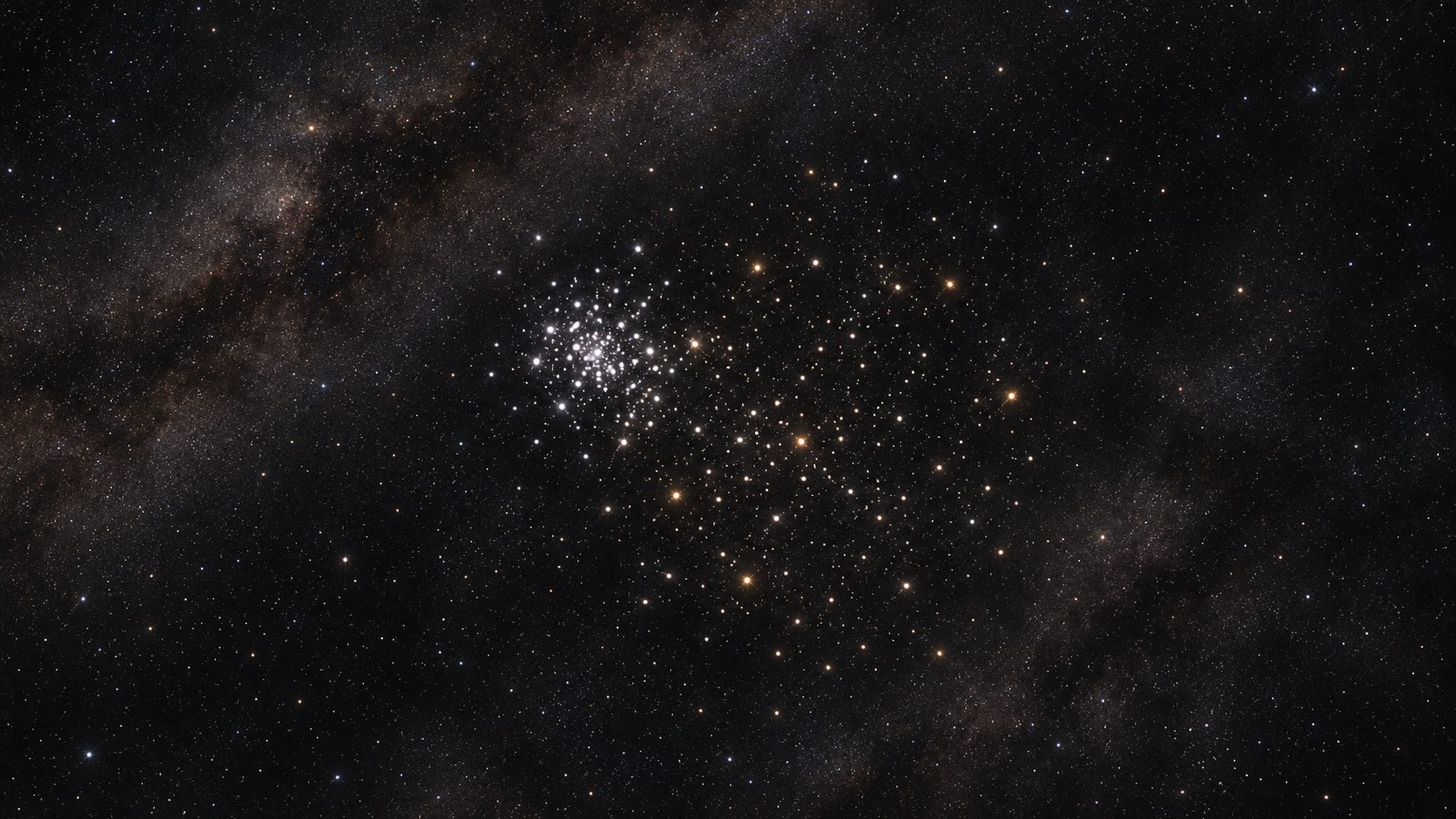
On November 5, the Department of Science and Technology reported that an Indian-led team using Gaia data identified two star clusters of different ages in UBC 63.
- Researchers distinguished UBC 63A and UBC 63B within a region previously treated as one open cluster.
- The estimated ages are about 21 million years for A and 562 million years for B.
- A reconstruction places their closest approach about six million years ago.
- Stars close together in a sky image can occupy different depths along the same line of sight.
- The pair’s relative motion helps distinguish a temporary encounter from a bound orbit.
UPSC Relevance
Prelims Relevance
- Gaia is a European Space Agency mission.
- Parallax helps astronomers estimate stellar distances.
- Proper motion measures angular movement across the sky over time.
- A colour–magnitude diagram compares stellar colour with brightness.
Mains Relevance
GS Paper 3
- Explain how survey observations and numerical models answer different questions about stellar systems.
- Use UBC 63 to illustrate how astronomers test an existing classification.
Background and Context
Why the Sky Image Suggested One Cluster
A photograph flattens a volume of the Milky Way into two dimensions. This makes assigning stars to an open cluster a problem of membership.
- An open cluster is a group of stars formed together from gas and dust. Its members can remain loosely held by gravity while the surrounding Galaxy influences their paths.
- A patch of sky can contain foreground and background stars as well as cluster members. Measuring the angle between two points of light tells us little about their separation along the line of sight.
- The European Space Agency’s Gaia mission repeatedly measured stellar positions. The apparent shift associated with Earth’s orbital motion, called parallax, gives astronomers a way to estimate distance.
- Astronomers can also measure proper motion, the change in a star’s direction on the sky over time. Groups with similar distances and motions are promising candidates for a common stellar population.
How Researchers Separated UBC 63A and UBC 63B
The team combined two kinds of evidence. One concerned how the stars moved, the other how far the stars had progressed through their lifetimes.
- Researchers grouped stars using measurements of position, parallax and proper motion from Gaia’s third data release. The measurements favoured two distinct populations in the region previously catalogued under a single name.
- A colour–magnitude diagram places each star according to its colour and brightness. Stars with a shared formation history trace a recognisable sequence because their masses affect how quickly they evolve.
- UBC 63 showed two sequences. Comparing these patterns with models of stellar evolution gave a much younger age for A than for B. The ages are estimates derived from the populations as a whole.
- The age gap rules against formation in the same episode. That conclusion concerns when the stars formed. Whether the clusters now orbit one another requires separate evidence about their speeds and separation.
How a Flyby Differs From a Bound Pair
The team used present measurements to calculate earlier positions. The resulting history describes a modelled encounter that took place long before astronomical observations began.
- In the orbital reconstruction, the centres approached to roughly seven parsecs and subsequently moved apart. The present separation is estimated at about 26 parsecs. Both distances carry uncertainties.
- A parsec measures distance. Here the quoted separation is between cluster centres in three dimensions. The separation of their images on the sky would capture only part of that physical distance.
- The researchers compared the clusters’ relative speed with the escape speed for the pair. Their estimated relative speed was higher, supporting a flyby in which the systems move apart after a close approach.
- The gravity within each cluster and the gravity between the two clusters act on different scales. Individual stars can belong to their respective clusters even as the clusters themselves follow unbound paths.
Way Forward
Test the Reconstruction
- Refine membership estimates as improved stellar measurements become available.
- Check whether the closest approach persists when plausible measurement errors enter the orbital calculation.
- Compare other candidate pairs using the same age and motion tests.
Conclusion
- UBC 63 illustrates how an apparent concentration of stars can contain distinct populations. The age difference and the measured motions answer separate questions about their origin and their present relationship.
- A flyby is inferred from the reconstructed paths. As in the study of Centaurus X-3, identify what the instrument measured before explaining the physical history researchers inferred.
UPSC Practice Questions
Prelims MCQ 1
With reference to UBC 63, consider the following statements:
- Gaia astrometry helped distinguish two populations in the same sky region.
- The researchers estimated that UBC 63B is older than UBC 63A.
- Gaia directly recorded the closest approach of the two clusters.
How many of the above statements are correct?
(a) Only one (b) Only two (c) All three (d) None
Answer: (b) Only two
Explanation:
The first two statements are correct. Researchers reconstructed the earlier encounter using measured motions and dynamical models.
Prelims MCQ 2
Which observation most directly supports the interpretation that the two clusters are mutually unbound?
(a) Their estimated relative speed exceeds the escape speed for the pair. (b) Their images lie close together on the sky. (c) Both are visible in the Milky Way. (d) Their stars occupy distinct colour–magnitude sequences.
Answer: (a) Their estimated relative speed exceeds the escape speed for the pair.
Explanation:
Relative speed compared with the pair’s escape speed tests gravitational binding. The colour–magnitude sequences help estimate ages.
UPSC Mains Questions
- How can an astrometric survey distinguish overlapping stellar populations? Illustrate with UBC 63.
- Explain how astronomers combine observations and simulations to distinguish a temporary encounter between open clusters from a bound orbit.
Sources: PIB, Ministry of Science and Technology and Biswas and colleagues, study preprint.
Frequently Asked Questions
What did the UBC 63 study find?
Researchers identified two stellar populations of markedly different ages where earlier catalogues listed a single cluster. Their analysis suggests the two clusters passed close together and are now moving apart.
How does Gaia help identify cluster members?
Gaia measures stellar positions, parallax and proper motion. Astronomers can use similarities in these properties to identify groups whose members lie at comparable distances and move together across the sky.
What did the colour–magnitude diagram reveal?
The stars fell along two sequences. Comparing the sequences with stellar evolution models indicated that UBC 63A is much younger than UBC 63B, weakening the case for a single formation episode.
How did astronomers date the flyby?
They calculated how the clusters’ orbits would evolve from the available measurements. Their reconstruction put the closest approach around six million years ago, with the clusters now farther apart.
Tell Google you want more of this.
Add Anantam IAS as a preferred sourceOne tap, and this site shows up more often in your own Top Stories, AI Overviews and AI Mode. Remove it any time.