5 current affairs published on Saturday, 18 April 2026
18 April 2026 Current Affairs for UPSC — every
Why-in-News article AnantamIAS published on Saturday, 18 April 2026, broken down with
Why in News?, the exact GS paper it feeds, sub-topic mapping, MCQ-ready facts and a
UPSC-style practice question. 5 articles in total, covering Polity, Economy, Environment, S&T, IR, Geography, History, Society and Internal
Security — the same Why-in-News + GS-paper-mapping + practice-question format the Compass uses across
every daily digest on the site.
Daily current affairs for UPSC is where new material enters your prep stream. Read this
18 April 2026 digest end-to-end in 25–35 minutes, attempt the practice question
at the foot of each article (it's MCQ for some, 10/15-marker for others), then bookmark the entries
that fall inside your active revision window. Everything stays cross-linked: tap any subject pill to jump
to that subject's hub, or use the table of contents above to skip straight to a specific story.
Use this page three ways. Read sequentially for a one-sitting scan of everything that
mattered on 18 April 2026. Download the
18 April 2026 PDF below for offline study or print revision. Or use
the April 2026 Current Affairs compilation
to see this day in the month's full context. For the previous day's reading, see
17 April 2026 Current Affairs;
the next day's is 19 April 2026 Current Affairs.
Why we publish daily current affairs separately from the monthly compilation: daily is learning,
monthly is revision. Use the daily page to add fresh material to your notes the day it breaks;
come back to the April 2026 compilation 60 days before Prelims when the
noise has settled and only the lasting takeaway is worth re-reading.
Decriminalisation, Governance Reform & Political Economy of Regulation
“The Jan Vishwas Bill reflects India’s transition from a coercive legal state to a facilitative regulatory state, balancing ease of doing business with constitutional principles of proportionality and rule of law.”
Conceptual Anchor: From Criminal State to Regulatory State
At its core, the Bill represents a shift from a “punitive state” → “facilitative regulatory state.”
In political theory, the state exercises coercive authority through law (Weberian framework).
However, modern governance increasingly prefers:
Compliance-based regulation
Administrative penalties over criminal sanctions
👉 As noted in political theory, law is not merely coercive but also instrumental in shaping behaviour and governance outcomes
Thus, the Bill reflects: ➡️ Transition from criminal justice paradigm → administrative governance paradigm
Legislative Evolution & Background
Stage
Development
2023
Jan Vishwas Act (initial decriminalisation push)
2025 Bill
Covered 17 Acts → sent to Select Committee
2026 Bill
Expands scope → amends 80 Central Acts
Committee chaired by Tejasvi Surya
Recommendation: expand reforms → include 65 additional Acts
👉 Indicates:
Incremental reform → systemic overhaul
Evidence of committee-driven legislative deepening
Key Provisions (Substantive Legal Changes)
Decriminalisation of Offences
Replaces imprisonment with civil penalties
Example:
Drugs & Cosmetics Act → penalty up to ₹1 lakh or 3× value
National Highways Act → ₹10 lakh to ₹1 crore
👉 Principle:
Economic offences ≠ moral crimes → should not attract jail
Removal of Imprisonment
Indian Succession Act, Electricity Act:
Jail → replaced by monetary fines
👉 Reflects:
Proportionality in punishment (Article 14 jurisprudence)
Omission of Certain Offences
Examples:
False fire alarm (Delhi Police Act)
Failure to report births/deaths
False entries in copyright register
👉 Indicates:
De-bureaucratisation + trust-based governance
Graduated Enforcement Mechanism
Stage
Response
1st violation
Advisory
2nd violation
Warning
Subsequent
Civil penalty
👉 Shift from:
State as punisher → State as compliance facilitator
Improvement Notices (Legal Metrology Act)
First violation → opportunity to rectify
👉 Inspired by:
Regulatory governance models (UK, OECD)
Adjudication Framework
Appointment of:
Adjudicating officers
Appellate authorities
👉 Significance:
Quasi-judicial decentralisation of justice delivery
Dynamic Penalty Revision
Fines increase by 10% every 3 years
👉 Ensures:
Avoids inflation erosion
Creates credible deterrence
Municipal Governance Reform
NDMC Act amendments:
Property tax = building + vacant land
Valuation Committee
Grievance redressal body
Removal of advertisement tax
Indicates:
Urban fiscal rationalisation + ease of doing business
Constitutional & Legal Significance
A. Article 14 – Reasonableness & Proportionality
Reduces arbitrary criminalisation
Aligns punishment with gravity of offence
B. Article 21 – Due Process
Avoids:
Unnecessary incarceration
Criminal stigma
C. Rule of Law
Moves from:
Over-criminalisation → rationalised legal order
👉 This aligns with the idea that law must balance order and liberty
Governance Perspective (GS-II Core)
Positive Outcomes
1. Ease of Doing Business
Reduces compliance burden
Encourages entrepreneurship
2. Decongestion of Judiciary
Fewer criminal cases
Administrative resolution
3. Trust-Based Governance
Promotes:
Self-regulation
Voluntary compliance
Administrative Transformation
Old Model
New Model
Criminalisation
Civil regulation
Punishment
Compliance
Central courts
Administrative adjudication
Fear-based
Trust-based
Criticism & Concerns
A. Risk of Regulatory Capture
Corporates may treat penalties as “cost of doing business”
B. Weak Deterrence
Absence of jail term may reduce seriousness
C. Executive Overreach
Adjudicating officers → risk of bureaucratic discretion abuse
D. Inequality Issue
Monetary penalties:
Rich → manageable
Poor → punitive
Political Economy Dimension
The Bill reflects a deeper shift:
From: Inspector Raj / Licence Raj mindset
To: Market-friendly regulatory state
Aligns with Liberal economic philosophy:
Minimal coercion
Maximum compliance
But also raises:
Debate between:
Efficiency vs Accountability
Ease vs Enforcement
Comparative Perspective
Country
Approach
UK
Civil penalties + improvement notices
USA
Heavy fines + regulatory agencies
India (pre-reform)
Criminal-heavy framework
India moving towards:
Global best practices in regulatory governance
Ethical Dimension
Key ethical dilemma:
Should the state prioritise compliance or punishment?
The 16th Finance Commission sits at the heart of India’s fiscal federal compact. It was expected to answer three big questions: how much fiscal space states should get, how that space should be divided among states, and whether the Union’s growing reliance on cesses, surcharges, and discretionary channels has weakened constitutional devolution. The Commission retained the states’ share in the divisible pool at 41%, altered the horizontal formula in favour of growth-linked criteria, discontinued revenue-deficit grants, and significantly increased urban local body grants.
The controversy is that many economists and commentators think the 16th FC has managed the symptoms of fiscal stress without squarely addressing the structural imbalance in Indian federalism. That criticism runs through recent pieces by C. Rangarajan and D.K. Srivastava, M. Govinda Rao, R. Mohan, Ajay Jha, and Mint’s fiscal-policy commentary.
FAST FACT
Chair: Dr. Arvind Panagariya | Period: 2026-27 to 2030-31 | Constituted under: Article 280 | Tabled in Parliament: 1 Feb 2026
1. Constitutional & Institutional Background
The Finance Commission is a constitutional body established under Article 280 of the Indian Constitution. The President constitutes the Commission every five years (or earlier if required) to recommend the distribution of central tax revenues between the Union and the States, and among the States themselves.
Key Constitutional Articles
Article
Provision
Article 280
Constitution of Finance Commission by the President
Article 281
Report of Finance Commission to be laid before each House of Parliament
Article 275
Grants-in-aid to certain States from Consolidated Fund of India
Article 282
Expenditure defrayable by Union or a State out of its revenues
16th FC — Composition
Chairman: Dr. Arvind Panagariya (former Vice-Chairman, NITI Aayog)
Smt. Annie George Mathew
Dr. Manoj Panda
Shri T. Rabi Sankar
Dr. Soumyakanti Ghosh (Part-time — Group Chief Economic Advisor, SBI)
Secretary: Shri Ritvik Pandey
2. Vertical Devolution — States’ Share in Central Taxes
Vertical devolution refers to the division of the divisible pool of central taxes between the Union and States. The divisible pool is computed after excluding: (i) cost of collection, (ii) cesses, and (iii) surcharges from the gross tax revenue of the Central Government.
KEY REC.
States’ share in divisible pool retained at 41% — same as the 15th Finance Commission. The 14th FC had recommended 42%.
Critical Debate: Cesses & Surcharges
Southern and opposition-ruled states have consistently argued that the rising share of cesses and surcharges (which are outside the divisible pool) erodes the effective devolution to states. The share of cesses and surcharges reached ₹13.5 for every ₹100 of taxes collected by the Centre in 2021-22 — the highest in over a decade. The 16th FC has not addressed this structural concern, which is likely to remain a Mains-relevant issue.
3. Horizontal Devolution — Distribution Formula Among States
Horizontal devolution determines each state’s share out of the 41% pool. The 16th FC has revised the weightage formula significantly from the 15th FC:
Criteria
15th FC (2021-26)
16th FC (2026-31)
Change
Income Distance (GSDP)
45%
42.5%
▼ 2.5%
Population (2011 Census)
15%
17.5%
▲ 2.5%
Demographic Performance
12.5%
10%
▼ 2.5%
Area
15%
10%
▼ 5%
Forest Cover
10%
10%
No Change
Tax & Fiscal Efforts
2.5%
—
Removed
Contribution to GDP
—
10%
New
Total
100%
100%
—
Parameter-wise Analysis
a) Income Distance (42.5%)
Defined as the difference between a state’s per capita GSDP and the average of the top three large states with the highest per capita GSDP. Per capita GSDP is averaged over 2018-19 to 2023-24 (excluding the pandemic year 2020-21). States with lower per capita GSDP receive a higher share — this is an equity measure favouring poorer states.
b) Population — 2011 Census (17.5%)
Share in devolution is determined by population share as per the 2011 Census. The 16th FC has increased this weight from 15% to 17.5%. Using 2011 data protects states that controlled population growth from being penalised if a new Census is conducted.
c) Demographic Performance (10%)
The 15th FC used Total Fertility Rate (TFR) to reward states for population control. The 16th FC has redefined this parameter to account for population growth between 1971 and 2011. States with lower population growth over this longer period receive a higher share. Southern states generally benefit as they achieved demographic transition earlier.
d) Forest Cover (10%)
The 16th FC assigns weightage to both the share of total forest area AND the increase in forest area between 2015 and 2023. Crucially, it now includes open forests (not just dense/moderately dense as in 15th FC). This broadens the scope for states with diverse forest types.
e) Contribution to GDP (NEW — 10%)
This is a brand-new parameter replacing Tax & Fiscal Efforts. A state’s contribution is calculated as the square root of its GSDP divided by the sum of the square roots of GSDPs of all states (averaged 2018-19 to 2023-24, excluding 2020-21). This rewards economically productive states, particularly benefiting Maharashtra, Gujarat, Karnataka, and Tamil Nadu.
f) Area (10%)
Weight for area has been reduced from 15% to 10%. Larger states like Rajasthan, Madhya Pradesh, and Uttar Pradesh are relatively disadvantaged under this reduction.
Notable Shifts in State-wise Shares
State
15th FC (%)
16th FC (%)
Change
Uttar Pradesh
17.94
17.62
▼
Bihar
10.06
9.95
▼
Maharashtra
6.32
6.44
▲
Karnataka
3.65
4.13
▲
Kerala
1.93
2.38
▲
Andhra Pradesh
4.05
4.22
▲
Gujarat
3.48
3.76
▲
West Bengal
7.52
7.22
▼
Madhya Pradesh
7.85
7.35
▼
All five Southern states (Andhra Pradesh, Karnataka, Kerala, Tamil Nadu, Telangana) have witnessed an increase in their share — a significant shift partly due to the revised Demographic Performance definition and the new GDP Contribution parameter.
4. Grants-in-Aid
The 16th FC has recommended total grants of ₹9,47,409 crore over five years (2026-31). This comprises grants for local governments and disaster management.
IMPORTANT
The 16th FC has DISCONTINUED: (i) Revenue Deficit Grants, (ii) Sector-Specific Grants, and (iii) State-Specific Grants — all of which were recommended by the 15th FC.
Grants Summary
Category
Amount (₹ crore)
Rural Local Bodies — Basic Grant
3,48,188
Rural Local Bodies — Performance Grant
87,048
Urban Local Bodies — Basic Grant
2,32,125
Urban Local Bodies — Performance Grant
58,032
Urban Local Bodies — Special Infrastructure
56,100
Urban Local Bodies — Urbanisation Premium
10,000
Disaster Management (Centre’s share)
1,55,916
TOTAL
9,47,409
Local Body Grants — Entry-Level Conditions
All local body grants are conditional upon fulfilling three entry-level criteria:
Constitution of local bodies as per the Constitution
Publication of provisional and audited accounts in the public domain
Timely constitution of the State Finance Commission (SFC)
Basic Grants (80% of local body grants)
50% Untied — states/ULBs can use freely
50% Tied — specifically for (i) sanitation and solid waste management, and/or (ii) water management
Performance Grants (20% of local body grants)
State Performance Grants: Linked to a minimum benchmark for transfers to local bodies from state resources
Local Body Performance Grants: Linked to minimum Own Source Revenue (OSR) growth targets
Special Infrastructure Component — Urban (₹56,100 crore)
Tied to development of a comprehensive wastewater management system. Eligible cities: those with population between 10–40 lakh as per 2011 Census (22 cities including Pune, Jaipur, Lucknow, Patna, Vadodara, Coimbatore, etc.).
Urbanisation Premium (₹10,000 crore)
One-time grant for: (i) merger of peri-urban villages into adjoining urban local body areas, and (ii) formulation of a Rural-to-Urban Transition Policy.
Disaster Management Grants (₹2,04,401 crore corpus — SDRF/SDMF)
Centre’s share is ₹1,55,916 crore. Cost-sharing pattern:
North-eastern and Himalayan states: 90:10 (Centre:State)
All other states: 75:25 (Centre:State)
5. Fiscal Roadmap & Consolidation
The Commission has set out a comprehensive fiscal consolidation framework for both the Centre and States:
Parameter
Recommendation
Centre Fiscal Deficit Target
Reduce to 3.5% of GDP by 2030-31
States Fiscal Deficit Limit
3% of GSDP per year
Off-Budget Borrowings
Strictly discontinue; bring all on-budget
Definition of Fiscal Deficit
Expand to uniformly include all off-budget borrowings
Combined Debt (Centre+States)
Decline from 77.3% GDP (2026-27) → 73.1% GDP (2030-31)
6. Structural Reform Recommendations
6.1 Power Sector Reforms
The Commission recommended that states should actively pursue privatisation of electricity distribution companies (DISCOMs). Key provisions:
Create a Special Purpose Vehicle (SPV) to warehouse existing DISCOM debt, shielding private investors from legacy liabilities
States may use funds from the Special Assistance Scheme for Capital Investment for DISCOM debt repayment/pre-payment
Access to this assistance only after privatisation process is complete
MAINS ANGLE
DISCOM privatisation is contentious — free power schemes in states like Punjab, Delhi, and Tamil Nadu create political pressure against it. This tension between fiscal prudence and welfare politics is a key Mains theme.
6.2 Subsidy Rationalisation
States should review and rationalise subsidy expenditure
Schemes providing unconditional cash transfers tend to have large, untargeted beneficiaries — set clear exclusion criteria
Discontinue financing subsidies through off-budget borrowings
Adopt uniform accounting and disclosure standards for subsidies and transfers across states
Address misclassification of subsidies as ‘assistance’, ‘grants’, or ‘other expenditure’
6.3 Public Sector Enterprise (PSE) Reforms
Review and closure of 308 inactive State Public Sector Enterprises (SPSEs)
Formulate a state-level PSE disinvestment policy targeting inactive and underperforming SPSEs
PSEs incurring losses for 3 out of 4 consecutive years must be placed before the respective Cabinet for a decision on: closure, privatisation, or continuation based on strategic importance
7. Critical Analysis
1. The first big criticism: 41% looks stable, but effective devolution remains weak
On paper, retaining 41% appears status-quoist and reassuring. But the strongest criticism is that headline devolution has become misleading because the effective pool itself has shrunk. Since cesses and surcharges are excluded from the divisible pool, states argue that the Centre can formally preserve 41% while practically reducing the resources available for sharing. The 16th FC acknowledged the problem, noting that cesses and surcharges had reduced the size of the divisible pool substantially compared to gross tax revenue, but it stopped short of prescribing a binding corrective.
This is why Rangarajan and Srivastava called the report a case of “misses and concerns”: the Commission recognized the distortion but did not recommend hard limits or a roadmap for bringing cesses and surcharges back into the shareable tax base. The Hindu’s editorial also made the same point: the Commission flags the shrinking of the effective divisible pool but does not really solve it.
R. Mohan goes a step further and argues that the Commission should have estimated the vertical fiscal imbalance more rigorously. In his reading, without a proper empirical assessment of the gap between states’ expenditure responsibilities and own revenues, the choice of 41% lacks a robust normative foundation. He specifically argues that the 16th FC missed an opportunity to ground devolution in a transparent VFI methodology.
The problem is not just the number “41”. The problem is that states’ real fiscal share is increasingly shaped outside the constitutional devolution formula. In that sense, the Commission may have preserved nominal federalism while failing to arrest the centralising drift in actual fiscal practice.
2. Efficiency versus equity: the horizontal formula has clearly shifted
The most visible design change is in horizontal devolution. The 16th FC reduced the weight of income distance from 45% to 42.5%, raised the weight of 2011 population to 17.5%, reduced demographic performance to 10%, cut area to 10%, retained forest cover at 10%, and introduced a new 10% criterion for contribution to GDP, while removing tax and fiscal effort.
This has led many commentators to say that the Commission has shifted from a classic equalisation logic toward a more efficiency-and-output logic. Mint welcomed this as a “small but significant shift” that rewards productive states and growth.
But scholars critical of the report say this is precisely the problem. Govinda Rao argues that the Commission’s new design leans too far toward efficiency and weakens the redistributive purpose of Finance Commission transfers. He sees the GDP-contribution criterion as a hedge against the equalising power of income distance, which means richer and more productive states get compensated in ways that dilute vertical solidarity.
The Mint critique by Rangarajan and Srivastava is sharper: it argues that the Commission has “given up a tradition of tax-sharing impartiality,” with efficiency gaining over equity and poorer states likely to lose in relative terms.
This is not merely a technical formula tweak. It raises a philosophical question: Should the Finance Commission primarily reward economic performance, or should it primarily equalise fiscal capacity across unequal states?
The 16th FC’s answer is visibly more performance-oriented than before. That may be defensible economically, but politically it changes the meaning of Indian fiscal federalism.
North–South tensions have been softened, not resolved
A lot of political attention focused on whether the 16th FC would “punish” southern states for successful population control and stronger economic performance. In the final outcome, southern states did improve their shares, helped by the new GDP criterion and the reworked demographic-performance design. Your report summary captures this shift clearly.
That has led some to say the Commission achieved a workable compromise. Mint described the report as “balancing southern efficiency against northern equity.”
Yet this compromise is partial. Southern states’ core grievance was never only horizontal shares; it was also the Centre’s reliance on non-shareable cesses and surcharges. Karnataka and Maharashtra had earlier explicitly asked the Commission to address this and even sought higher vertical devolution and merger of cesses/surcharges into the divisible pool.
So the political lesson is important: The 16th FC may have reduced immediate resentment on the distribution among states, but it has not really settled the larger federal dispute over the distribution between Union and states.
The North–South debate is often framed as a fight over horizontal devolution. But the more consequential issue is vertical federalism. On that front, the report remains conservative.
4. Ending revenue-deficit grants: fiscal discipline or withdrawal of a safety net?
Perhaps the most consequential institutional break is the discontinuation of revenue-deficit grants, along with state-specific and sector-specific grants. The 16th FC clearly moves away from gap-filling transfers and toward a harder fiscal-discipline framework.
There is a principled argument for this. Revenue-deficit grants can create moral hazard by encouraging weak fiscal effort and a dependence on transfers. Mint’s commentary on the subject accepts that the move is intended to restore discipline and reduce soft-budget constraints.
But the criticism is serious. Prachi Mishra and Vijay Singh Chauhan warn that the burden of adjustment may fall on states that are not the worst offenders but are structurally constrained.
Ajay Jha’s argument in The India Forum is even more constitutional in tone: he says the Commission may have treated grants too narrowly and “skirted” the wider constitutional purpose of grants-in-aid under Article 275. He argues that while no specific grant is mandatory, the Commission cannot be arbitrary or insufficiently reasoned in abandoning equalising and need-based transfers.
Rangarajan and Srivastava also appear to favour a more careful use of equalisation-type grants rather than a near-complete retreat from such instruments. A summary of their argument notes that while ad hoc grants are undesirable, some equalisation grants remain necessary for balanced development.
The abolition of revenue-deficit grants marks a conceptual shift: from federal equalisation to fiscal self-reliance under discipline.
That may improve incentives, but it also risks underestimating structural asymmetries among states in taxation capacity, social-sector burdens, geography, and inherited deficits.
5. The Commission is tougher on states than on the Union
This is one of the strongest lines of criticism in recent commentary. Govinda Rao argues that the Commission scrutinises state subsidies, deficits, borrowing, and freebies closely, but is much softer on the Union government’s own role in fiscal strain.
The report’s warnings on subsidies and transfers are not trivial. It notes a substantial rise in subsidies/transfers across 21 states, which Business Standard linked to the expanding freebie culture debate.
But critics say the same rigour should have been applied to:
the Union’s reliance on cesses and surcharges,
the shrinking divisible pool,
discretionary transfers under Article 282 and CSS,
and the Centre’s own centralising use of fiscal power.
The CPR paper by Suyash Rai and Milan Vaishnav is useful here. It argues that one must understand fiscal transfers through both the Finance Commission and discretionary Union schemes, and that India’s federal politics cannot be understood by devolution formulas alone. In other words, constitutional transfers may remain stable while political centralisation advances through other channels.
The 16th FC’s philosophy appears asymmetrical: states are told to reform, rationalise, privatise, disclose, and consolidate; the Union is advised, but not comparably constrained.
This feeds the charge of “centrist bias.”
6. Local bodies: a genuine bright spot, but with an implementation caveat
One area where the 16th FC has drawn broad approval is local government funding. Urban local body grants have risen sharply, with new components such as special infrastructure support and an urbanisation premium. Business Standard called this a major improvement and noted the highest-ever urban share in FC history.
This matters because India’s urbanisation challenge is severe, and fiscal federalism has long underfunded cities relative to their infrastructure and service burdens.
But the criticism is that money alone will not strengthen local democracy. Entry-level conditions such as audited accounts and timely constitution of State Finance Commissions are good in theory, yet the real obstacle remains the states’ political reluctance to devolve power, staff, and taxation authority to local bodies. That means the success of these grants still depends on a state-level decentralisation culture that remains weak in many places.
The 16th FC is more urban-aware than its predecessors. But unless state governments empower municipalities institutionally, these grants may improve projects without transforming urban governance.
7. Climate and ecology: still under-theorised
The Commission retained forest-related weightage and broadened the forest parameter, which is welcome. But some experts had hoped the 16th FC would more systematically integrate climate vulnerability and climate-action incentives into intergovernmental transfers. ORF’s pre-report expectations article had explicitly argued for deeper climate-sensitive fiscal federalism.
The final framework does not appear to fully mainstream climate federalism; it adjusts forest treatment, but does not build a wider climate-equalisation architecture. In the long run, that is a missed opportunity because climate shocks will affect state expenditure needs very unevenly.
The 16th FC modernised some ecological criteria, but it did not yet create a robust fiscal architecture for climate adaptation across states.
8. The deeper constitutional issue: has Article 280 become too narrow in practice?
A very interesting criticism from R. Mohan is that the 16th FC’s terms of reference were more limited, and that Article 280(3)(d)-type broader referral space was not used. He argues that this constrained the Commission’s capacity to lay down a fuller fiscal roadmap and to engage more deeply with structural federal questions.
This links to a larger constitutional concern. If the Finance Commission is treated narrowly as a periodic tax-sharing formula body, while real fiscal power shifts toward cesses, CSS, and executive discretion, then India may retain the shell of constitutional federalism but hollow out its substance.
The issue is no longer just whether the Finance Commission is constitutional. It is whether the Constitution’s intended fiscal balance is being bypassed by extra-formula practices.
8. Previous Year Questions (UPSC) — Pattern
The following types of questions have appeared on Finance Commission topics:
Prelims-Style MCQ Themes
Constitutional provision for Finance Commission (Article 280)
Criteria used for devolution of taxes
Difference between tax devolution and grants-in-aid
Divisible pool definition — what is excluded
Comparison of 14th, 15th, and 16th FC recommendations
Mains GS-II — Likely Questions
“The 16th Finance Commission’s recommendations reflect a shift toward efficiency over equity. Critically examine.” (250 words)
“Discuss the significance of the new GDP Contribution parameter introduced by the 16th Finance Commission. How does it affect cooperative federalism?” (150 words)
“Examine the fiscal consolidation roadmap recommended by the 16th Finance Commission. What structural challenges do states face in achieving these targets?” (250 words)
“The Finance Commission remains the cornerstone of Indian fiscal federalism. Analyse the 16th FC’s recommendations in this context.” (250 words)
The Constitution (131st Amendment) Bill, 2026 was DEFEATED in the Lok Sabha on April 17, 2026 — the first time in 12 years that a constitutional amendment bill brought by the Modi government failed to pass. 298 voted in favour; 230 against. Required: 352 votes (two-thirds of 528 present). The government then withdrew the Delimitation Bill and UT Laws Amendment Bill.
PART I: Background — The Unfinished Promise
1.1 The Long Road of Women’s Reservation in India
The demand for legislative reservation for women in Parliament is one of the oldest unresolved democratic debates in post-independence India. Bills to reserve one-third of parliamentary seats for women were introduced and lapsed in 1996, 1998, 1999, and 2008 — each time dying due to political disagreement, particularly over whether Other Backward Class (OBC) women should have a sub-quota within the women’s reservation.
Year
Bill / Development
Outcome
1996
Women’s Reservation Bill introduced in 11th Lok Sabha (Deve Gowda Govt)
Lapsed with dissolution of Lok Sabha
1998
Reintroduced under Vajpayee government
Lapsed
1999
Introduced again under Vajpayee
Lapsed
2008
Introduced in Rajya Sabha (Manmohan Singh Govt); passed in RS in 2010
Lapsed with 15th Lok Sabha
2023
Constitution (106th Amendment) Act — Nari Shakti Vandan Adhiniyam — passed unanimously by both Houses
Received Presidential assent; but not notified into force — tied to post-Census delimitation
Apr 2026
3-Bill package introduced to operationalise 2023 Act
Defeated in Lok Sabha
1.2 The 2023 Act and Its Structural Delay
The Constitution (One Hundred and Sixth Amendment) Act, 2023 — known as the Nari Shakti Vandan Adhiniyam — was passed unanimously in September 2023. It amended Article 334A of the Constitution to provide for 33% reservation for women in the Lok Sabha and State Legislative Assemblies (including the Delhi Assembly). However, Section 1(2) of the Act tied its commencement to a separate government notification.
CRITICAL
The 2023 Act explicitly made women’s reservation operative ONLY after: (i) the next Census is conducted and published, AND (ii) a delimitation exercise is carried out based on that Census. Since the 2021 Census was delayed (to 2026-27) due to COVID-19 and other administrative reasons, the 2023 Act remained a dead letter for three years — passed with fanfare but never implemented.
On April 16, 2026 — the first day of the special session — the Union government issued a notification under Section 1(2) bringing the 2023 Act formally into force. On the same day, it introduced three new bills in the Lok Sabha to enable implementation of the Act through a revised delimitation framework.
PART II: The Three Bills — Provisions in Detail
2.1 Overview of the Package
The Union government introduced the three bills as a coordinated legislative package on April 16, 2026, during a specially convened session of Parliament. The bills were presented as necessary to operationalise the 2023 women’s reservation law ahead of the 2029 General Elections, by bypassing the requirement to wait for the delayed post-2021 Census and conducting delimitation on the basis of the 2011 Census instead.
Bill
Introduced by
Core Purpose
Constitution (131st Amendment) Bill, 2026
Home Minister Amit Shah
Expand Lok Sabha to 850 seats; remove Census freeze; enable immediate delimitation; link women’s reservation to this delimitation
Delimitation Bill, 2026
Law Minister Arjun Ram Meghwal
Replace Delimitation Act 2002; constitute new Delimitation Commission to redraw constituencies using 2011 Census data
Union Territories Laws (Amendment) Bill, 2026
Home Minister Amit Shah
Extend same changes to Delhi, Puducherry, and Jammu & Kashmir
Current cap: Article 81 limits Lok Sabha to a maximum of 550 members (530 from States + 20 from UTs)
Proposed cap: Maximum of 850 members — up to 815 from States and up to 35 from Union Territories
Practical effect: A near 57% increase in House strength — the largest expansion in India’s parliamentary history. Aligns with the seating capacity of the new Parliament building (888 seats, expandable to 1,272 for joint sittings)
B. Removal of the 1971 Census Freeze on Seat Allocation
This is constitutionally the most consequential change. Since the 84th Constitutional Amendment (2001), Article 81 froze inter-state seat distribution on the basis of the 1971 Census, until the first Census after 2026. This was done to protect states that had successfully controlled population growth from losing parliamentary seats as a consequence.
The Bill removes this freeze entirely. It allows Parliament to pass a simple law determining (i) when delimitation will be done, and (ii) which Census data will be used.
Implication: Parliament — i.e., the government of the day — gains the power to decide both the timing of delimitation and the demographic baseline, through a simple majority. This replaces a constitutionally entrenched protection that previously required a two-thirds majority to alter.
C. Amendment of Article 82 — Delimitation No Longer Mandatory After Every Census
Under the existing constitutional scheme, Article 82 mandates that delimitation must occur after every Census. The Bill severs this link — delimitation becomes a discretionary legislative act rather than a constitutional obligation.
D. Amendment of Article 334A — Women’s Reservation Linked to New Delimitation
The 2023 Act (106th Amendment) had tied women’s reservation to a post-Census delimitation.
The 131st Amendment Bill rewrites Article 334A to link commencement of women’s reservation to the new delimitation exercise being proposed — i.e., the 2011 Census-based delimitation.
Government’s stated target: Implement 33% women’s reservation in time for the 2029 Lok Sabha elections.
E. Knock-on Effects on Other Constitutional Provisions
Rajya Sabha power imbalance: Rajya Sabha remains capped at 250 seats under Article 80, which the Bill does not amend. With Lok Sabha expanding to 850, the LS:RS ratio changes from 2.2:1 to 3.3:1. In a joint sitting (Article 108), a government with 56% of Lok Sabha seats could override even a two-thirds Rajya Sabha majority.
Council of Ministers size: Article 75 caps Ministers at 15% of Lok Sabha strength. At 850 seats, the permissible Cabinet size rises from 81 to 127 ministers — potentially enabling larger political patronage networks.
Presidential/VP elections: Expanded Lok Sabha alters the electoral college for President and Vice-President, reducing the relative weight of Rajya Sabha and state assemblies.
2.3 Delimitation Bill, 2026
This Bill operationalises the constitutional changes proposed in the 131st Amendment. It replaces the Delimitation Act, 2002 and constitutes a fresh Delimitation Commission.
Delimitation Commission: Chaired by a serving or former Supreme Court judge; includes the Chief Election Commissioner or a nominated Election Commissioner as a member.
Census basis: Uses the ‘latest published Census figures’ — which as of April 2026 means the 2011 Census, since the 2026-27 Census exercise has not yet concluded.
Allocation of seats: Proportional to population — reverts to ‘one person, one vote, one value’ principle, directly triggering seat shifts between States.
Reservation determination: Commission also determines SC/ST reserved seats and women’s reserved seats within constituencies.
Accountability gap: Critics note the Bill provides no formula or allocation mechanism for distributing additional seats across states — leaving a significant policy vacuum for political discretion.
2.4 Union Territories Laws (Amendment) Bill, 2026
This Bill amends three laws — the Government of Union Territories Act 1963, the Government of National Capital Territory of Delhi Act 1991, and the Jammu & Kashmir Reorganisation Act 2019 — to extend the same delimitation and women’s reservation framework to Delhi, Puducherry, and Jammu & Kashmir.
PART III: Arguments in Favour
3.1 The Government’s Position
The ruling National Democratic Alliance, led by the BJP, and Home Minister Amit Shah presented the bills as a historic step for gender justice and democratic modernisation. The government’s core arguments:
Gender Justice — Implementing the Promise
The 2023 Nari Shakti Vandan Adhiniyam was passed unanimously — there is political consensus on 33% women’s reservation. The 3-bill package is simply the mechanism to implement it.
India currently has only about 15% women in Lok Sabha — well below the global average of 27% and far behind countries like Rwanda (61%), Iceland (48%), and Sweden (46%).
The only practical way to operationalise the 2023 Act before the 2029 elections — without waiting for the delayed Census — is the route proposed in these Bills.
Constitutional Principle of One Person, One Vote
Since 1971, India has not redistributed Lok Sabha seats between States. In 50 years, massive population disparities have emerged — some constituencies in UP have 4x the voters of a constituency in Kerala.
Amit Shah: ‘For 50 years, from 1976 to 2026, India did not get representation as per the population. This is a constitutional injustice that must be corrected.’
Proportional representation is a foundational democratic norm. States like UP, Bihar, Rajasthan have been under-represented for decades relative to their populations.
Larger Lok Sabha = Better Democracy
An 850-seat Lok Sabha would reduce the population-per-constituency ratio, making MPs more accountable to smaller constituents.
The new Parliament building was built with 888 seats precisely anticipating this expansion. A larger House enables more diverse voices, including more women.
In absolute terms, every state gains more seats under the expanded House even if proportional shares shift.
Gainers Among Southern States — Counter to ‘South India Loses’ Narrative
Shah argued: Tamil Nadu would go from 39 to 59 seats under the expansion. Even if its proportional share slightly decreases, it gains 20 seats in absolute terms, of which 20 would be reserved for women.
South Indians would have more women MPs in absolute numbers under the new scheme than under the status quo.
North-South divide framing by the opposition was characterised by the government as ‘manufactured’ and ‘misleading’.
Expediting the Frozen Process
The 2021 Census was delayed by COVID-19. If India waits for the post-2021 Census and then conducts delimitation, women’s reservation cannot practically commence before 2034-2035 — five election cycles away.
The 2011 Census, though 15 years old, is the latest complete, verified data and is constitutionally valid as ‘latest Census’.
The government framed delay as the real injustice — not expediting the process.
PART IV: Arguments Against — Opposition Parties & Scholars
4.1 Rahul Gandhi (Congress — Leader of Opposition, Lok Sabha)
Rahul Gandhi — Leader of Opposition, Lok Sabha
“This bill is not a women’s bill. It has nothing to do with the empowerment of women. This is an attempt to change the country’s electoral map, using and hiding behind India’s women.”Called the constitutional amendment an ‘anti-national act’ — one that would strip representation from southern, north-eastern and smaller statesArgued the government was using women’s reservation as a ‘Trojan horse’ to reshape India’s parliamentary geography in the BJP’s political interestNoted that the 2023 Women’s Reservation Act was passed unanimously — the opposition supports it. But these Bills go far beyond that ActCharged that the bills were designed to delay caste-based census demands by creating a diversion — ‘using women to deny OBCs their rights’Offered to pass the original 2023 Act for immediate implementation if the government separated it from the delimitation packageLikened PM Modi to ‘a failed magician’ trying to mislead the public, citing that both Indira Gandhi and Vajpayee had chosen caution over haste on delimitation
4.2 Other Prominent Opposition Voices
DMK / Tamil Nadu Block — Penalising Demographic Success
“Empowering women is a cause we all support, but using it as a Trojan horse to diminish the voice of the South is an affront to our federal structure.”Tamil Nadu’s seats would decline from 39 to 32 under 2011 Census-based proportional allocation (PRS data). Kerala from 20 to 15.Southern states achieved the Centre’s family planning goals — they are being punished for demographic discipline by losing parliamentary seatsUP, Bihar, Rajasthan — which have higher fertility rates — would gain disproportionately, skewing national policy towards northern demographicsTamil Nadu CM MK Stalin had earlier described any such delimitation as ‘constitutional murder of southern states’
Samajwadi Party / OBC bloc — No Sub-Quota for OBC Women
The bills do not carve out a sub-quota for women belonging to OBC communities within the 33% women’s reservation.OBC women constitute the single largest social group excluded from legislative representationThe 2023 Act only reserves within SC/ST categories; OBC women get no guaranteed seatsSP’s Swami Prasad Maurya had termed the 2023 Act ‘flawed’ for this reason — the same flaw is replicated in the 2026 packageOBC demands for political reservation have been pending since the Mandal Commission; bundling delimitation with women’s reservation sidesteps this demand
INDIA Bloc — Procedural & Timing Objections
The government rushed three transformative bills through a special session without committee scrutiny, consultation with states, or broad public debate.A proper Census (2026-27) is already underway — why use 15-year-old 2011 data when fresh data will be available within a year?No standing committee referral; no consultation with state governments whose representation would be fundamentally alteredThe Bills were introduced on Day 1 of a special session and pushed for vote on Day 2 — insufficient time for democratic deliberation on the largest constitutional restructuring since 1950Bihar CM Nitish Kumar (NDA ally) had earlier questioned the delayed implementation of the 2023 Act — ironically, the 2026 package still defers actual reservation to 2029Kapil Sibal (earlier had sought assurance of implementation by 2029 for the 2023 Act) — now noted the opposition had always supported women’s reservation; the issue was the package around it
PART V: Scholarly & Constitutional Analysis
5.1 The Federalism Problem — Constitutional Law Scholars
Constitutional Law and Philosophy (academic blog — ‘Reshaping Federalism in the Name of Women’): The blog authored an influential pre-vote analysis arguing that the 131st Amendment is, in its core design, a delimitation bill masquerading as a women’s reservation bill. A close reading of the bill dispels any notion that it is primarily about women’s reservation.
The Bill’s primary operative provision is the deletion of the proivso in Articles 81 and 82 — the freeze protecting southern states from losing seats due to successful population control. This is the single largest change to Indian parliamentary design in the nation’s history.
The government’s assurance that ‘southern states will not lose seats’ appears nowhere in the Bill text itself. The constitutional default under Art 81(2) — which the Bill reverts to — mandates proportional seat distribution, which automatically advantages fast-growing northern states.
Giving Parliament the power to decide WHEN to delimitate and ON WHAT CENSUS DATA — through a simple majority — effectively converts a constitutionally protected process into a government-controlled one. Future ruling coalitions could game electoral boundaries to their advantage.
5.2 PRS Legislative Research — Structural Concerns
PRS Legislative Research, India’s foremost parliamentary research body, documented the following structural issues:
Concern
Detail
Rajya Sabha power erosion
Lok Sabha: RS ratio shifts from 2.2:1 to 3.3:1; government with 56% LS seats can override 2/3rd RS majority in joint sittings under Art 108
Cabinet expansion risk
Art 75 cap rises from 81 to 127 ministers — potentially enabling larger patronage coalitions
Presidential election skew
Expanded LS alters electoral college, reducing relative weight of RS and State Assemblies
No seat allocation formula
Delimitation Bill provides no formula for distributing seats across states — gap between political assurance and legal architecture
Discretionary delimitation
Parliament given power to determine timing + census used — risks political misuse of electoral boundary-drawing
5.3 The ‘Penalising Demographic Success’ Argument
Academic economists and political scientists — drawing on similar debates in the United States over Congressional reapportionment — have highlighted India’s peculiar dilemma: the Constitution simultaneously mandates ‘one person, one vote’ (requiring proportional representation) and makes implicit promises to states about maintaining their political voice. These two principles are in irreconcilable tension when States have vastly different population growth rates.
State
Current Seats (1971 basis)
Seats under 2011 Pop. (est.)
Change
Uttar Pradesh
80
89
▲ +9
Bihar
40
46
▲ +6
Rajasthan
25
30
▲ +5
Tamil Nadu
39
32
▼ −7
Kerala
20
15
▼ −5
Andhra Pradesh
25
22
▼ −3
Karnataka
28
27
▼ −1
West Bengal
42
41
▼ −1
Note: These are indicative estimates under unchanged Lok Sabha strength. Even with the proposed expansion to 850 seats, the proportional share of southern states would decline relative to northern states. The absolute seat gain does not compensate for reduced federal bargaining power in the House.
5.4 The OBC Women Question — Social Justice Scholars
Social policy scholars — and parties like the Samajwadi Party and BSP — have consistently argued that a blanket 33% reservation for women, without a sub-quota for OBC women, entrenches elite capture of the reserved seats. Evidence from State Assembly elections shows that women elected from general or upper-caste-dominated parties tend to be from privileged socioeconomic backgrounds.
The 2023 Act contains SC/ST sub-quotas within the 33% — but no OBC sub-quota
OBC women are estimated to constitute 40-45% of all Indian women, yet have virtually no guaranteed political representation
Zoya Hasan (political scientist) and others have argued that women’s reservation without social diversification within the category reproduces existing inequalities
The 131st Amendment Bill inherits this flaw without addressing it
PART VI: The Defeat — What Happened on April 17, 2026
6.1 The Vote
Parameter
Numbers
Total members present
528
Votes in favour (Ayes)
298
Votes against (Noes)
230
Required for constitutional amendment (2/3 of present & voting)
~352
Shortfall
~54 votes
Result
BILL DEFEATED
The Constitution (131st Amendment) Bill required a two-thirds majority of members present and voting under Article 368 of the Constitution — the procedure for constitutional amendments. The NDA did not have this supermajority on its own and required opposition support. The united opposition, led by the INDIA bloc, voted en masse against, denying the government the numbers.
HISTORIC
This was the first time in 12 years — since the Modi government took office in 2014 — that a constitutional amendment it brought failed to pass Parliament. Prime Minister Modi was present in the House when the Bill fell.
6.2 Amit Shah’s Response
In his closing speech before the vote, Home Minister Amit Shah made a sharp political attack on the opposition, accusing the Congress and its allies of stalling women’s reservation for the ‘fifth time’. He warned: ‘Be ready to face the wrath of women.’ Shah rejected the opposition’s three concerns — North-South divide, OBC rights, and caste census — as ‘false narratives’. He also challenged the DMK directly with seat arithmetic, arguing Tamil Nadu would gain more women MPs in absolute terms under the expanded House.
6.3 Withdrawal of the Other Two Bills
After the 131st Amendment Bill fell, the government withdrew the Delimitation Bill, 2026 and the Union Territories Laws (Amendment) Bill, 2026 from consideration. Since the constitutional amendment (which was the enabling framework for both bills) had failed, the government acknowledged the other two bills could not proceed independently.
AFTERMATH
The 2023 Women’s Reservation Act (106th Amendment) remains in force — it was notified into force on April 16, 2026 — but remains unimplementable without census and delimitation. Women’s reservation thus continues to be a constitutional promise without operational effect. The political battle is expected to resume with the next government, or after the 2026-27 Census is completed.
PART VII: Critical Analysis — What Does This Mean for Indian Democracy?
7.1 Women’s Representation — A Genuine Commitment or Instrument of Politics?
The defeat of the bills leaves India in a peculiar situation: a law reserving one-third of parliamentary seats for women exists in the Constitution, has been notified into force, but has no practical machinery to implement it. Both the government and the opposition claim to support women’s reservation — yet it remains unrealised. The episode reveals the challenge of separating genuine gender equity goals from competitive electoral politics.
7.2 The Federal Bargain — India’s Constitutional Moment
The 1976 and 2001 freezes on seat distribution were exercises in political statesmanship — recognising that strict population-proportionality would destroy the political incentive for states to control population growth and would corrode the voice of smaller, better-governed southern states. The 131st Amendment proposed to undo this bargain through a simple parliamentary majority rather than genuine federal consensus. The defeat may ultimately preserve the constitutional compact between the Union and its southern states.
7.3 Institutional Design — Lowering the Bar for Delimitation
The scholarly critique that the Bill gave Parliament discretionary control over both the timing of delimitation and the census data used is perhaps its deepest structural flaw. Delimitation — the drawing of electoral boundaries — is inherently a process vulnerable to gerrymandering. Constitutionally mandated delimitation after every census, using that census’s data, is a protection against political manipulation. The Bills would have replaced this objective trigger with a subjective, majority-controlled one.
7.4 The Way Forward
Option A: Wait for 2026-27 Census; conduct delimitation after Census is published; implement 2023 Act as originally designed.
Option B: Bring a narrower bill that ONLY amends Article 334A to allow women’s reservation without linking it to a new delimitation — i.e., implement 33% on existing constituencies. This would require a two-thirds majority but would not provoke the federal and federalism objections.
Option C: Political parties voluntarily give 33% of their candidate tickets to women — as many democracies have achieved parity through party-level commitments rather than constitutional mandates.
Option D: Include OBC sub-quota within women’s reservation to build broader political consensus — this was the demand that has blocked women’s reservation since 1996.
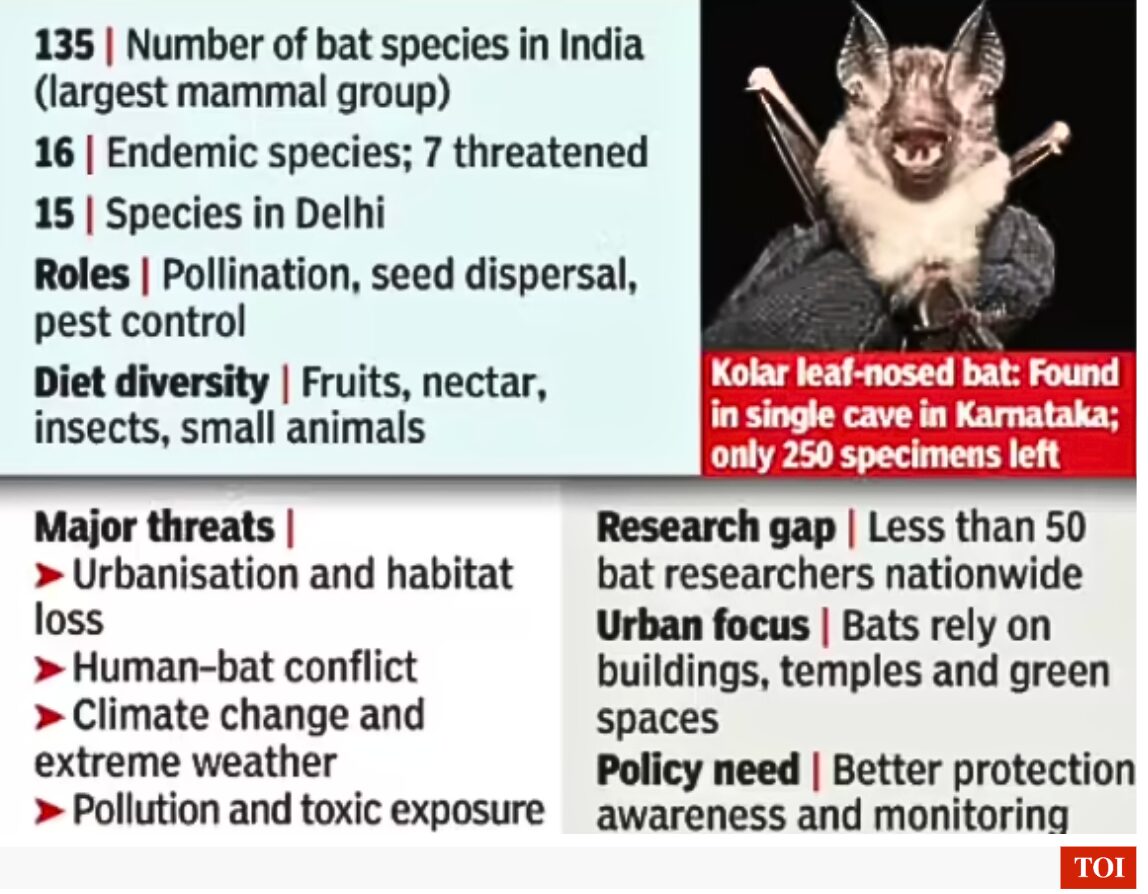
The first-ever State of India’s Bats Report (2024-25) was recently released by Nature Conservation Foundation, Bat Conservation International, World Wide Fund for Nature (WWF), and Centre For Wildlife Studies.
UPSC Relevance: GS-3 Environment and Biodiversity: Species in News
Prelims: Key facts about Bats; Important species & their ecological role.
Key Findings of the Assessment:
Species Diversity and Endemism: India is home to at least 135 bat species, of which 16 are endemic (found only in India). This makes bats India’s most diverse mammal group.
High Risk and Decline: The report highlights significant risks in the Northeast region, notably Assam, where Indian flying fox colonies are losing roosts.
Major Threats: Rapid urbanisation, loss of habitat, deforestation, mining and climate change. Increasing human-bat conflict.
Data Deficit: There is a significant data gap, particularly for the Khasian Leaf-nosed bat, which faces high threats from mining and persecution.
The report calls for urgent research into bat ecology, disease risks, and habitat protection.
Key Facts about Bats:
Bats are the only mammals capable of true powered flight (distinct from gliding mammals like flying squirrels).
The second largest order of mammals after rodents (~1,400+ species globally).
Behaviour & Adaptations:
Mostly nocturnal, though some species are crepuscular (only active during morning and evening hours) and even diurnal.
Many bats undergo Hibernation (cold regions).
Echolocation: Many bats use Echolocation:
Emit ultrasonic sounds (inaudible to humans). Detect prey via returning echoes.
Most fruit bats do NOT echolocate; they rely on vision and smell.
Found on all continents except Antarctica. Only 3 species of vampire bats exist. All are found in Central & South America. Feed mainly on livestock (cattle, horses).
Bats are reservoirs for some viruses (e.g., Nipah, Ebola). Human attacks are rare, but they can transmit diseases like rabies.
Ecological Role of Bats:
Insect Control: Insectivorous bats consume huge quantities of insects, including agricultural pests. Significant for natural pest control.
Pollination & Seed Dispersal: Frugivorous and nectar-feeding bats pollinate plants and disperse seeds. Known as a “keystone species” in many ecosystems.
Guano (Bat Droppings) are rich in nitrogen, phosphorus, and potassium. Used as an organic fertiliser.
Important Bat Species:
Indian Flying Foxes are the largest bats, some attaining a wingspan of 1.5 metres (5 feet) with a head and body length of about 40 cm.
Formerly, the Indian Flying Fox was listed under Schedule V of the Wildlife (Protection) Act, 1972, considered “vermin,” allowing its hunting. Post 2022, it is protected under Schedule II of the WPA 1972. Flying foxes have gone from ‘least concern’ to ‘near threatened.’
It is also called the Great Indian Fruit Bat as it eats fruits.
UPSC PYQ 2024:
Q. With reference to the Indian Flying Fox, consider the following statements:
1. The Indian Flying Fox is placed under the “vermin” category in the Wildlife (Protection) Act, 1972.
2. The Indian Flying Fox feeds on the blood of other animals.
Which of the statements given above is/are correct?
(a) Both Statement I and Statement II are correct, and Statement II explains Statement I
(b) Both Statement I and Statement II are correct, but Statement II does not explain Statement I
(c) Statement I is correct, but Statement II is incorrect
(d) Statement I is incorrect, but Statement II is correct
(This question was cancelled by UPSC as both the statements I & II are incorrect)
Correct Answer: Both statements I & II are incorrect.
UPSC PYQ 2014:
Q. Consider the following:
1. Bats
2. Bears
3. Rodents
The phenomenon of hibernation can be observed in which of the above kinds of animals?
(a) 1 and 2 only
(b) 2 only
(c) 1, 2 and 3
(d) Hibernation cannot be observed in any of the above
The enactment of the SHANTI Act 2025 marks a major legislative shift in India’s nuclear energy sector. The Atomic Energy Commission has given its nod for the new foreign direct investment (FDI) policy for the nuclear power sector (the policy is being worked out).
UPSC Relevance: GS-3 Science and Technology: Nuclear Technology
Prelims: SHANTI ACT; India’s Nuclear Energy Profile; Nuclear Energy Mission Mains: India’s Nuclear Energy Programme: Growth and Challenges
India and the growing demand for Energy:
India has an ambitious aim to achieve Viksit Bharat by 2047 and net-zero emissions by 2070.
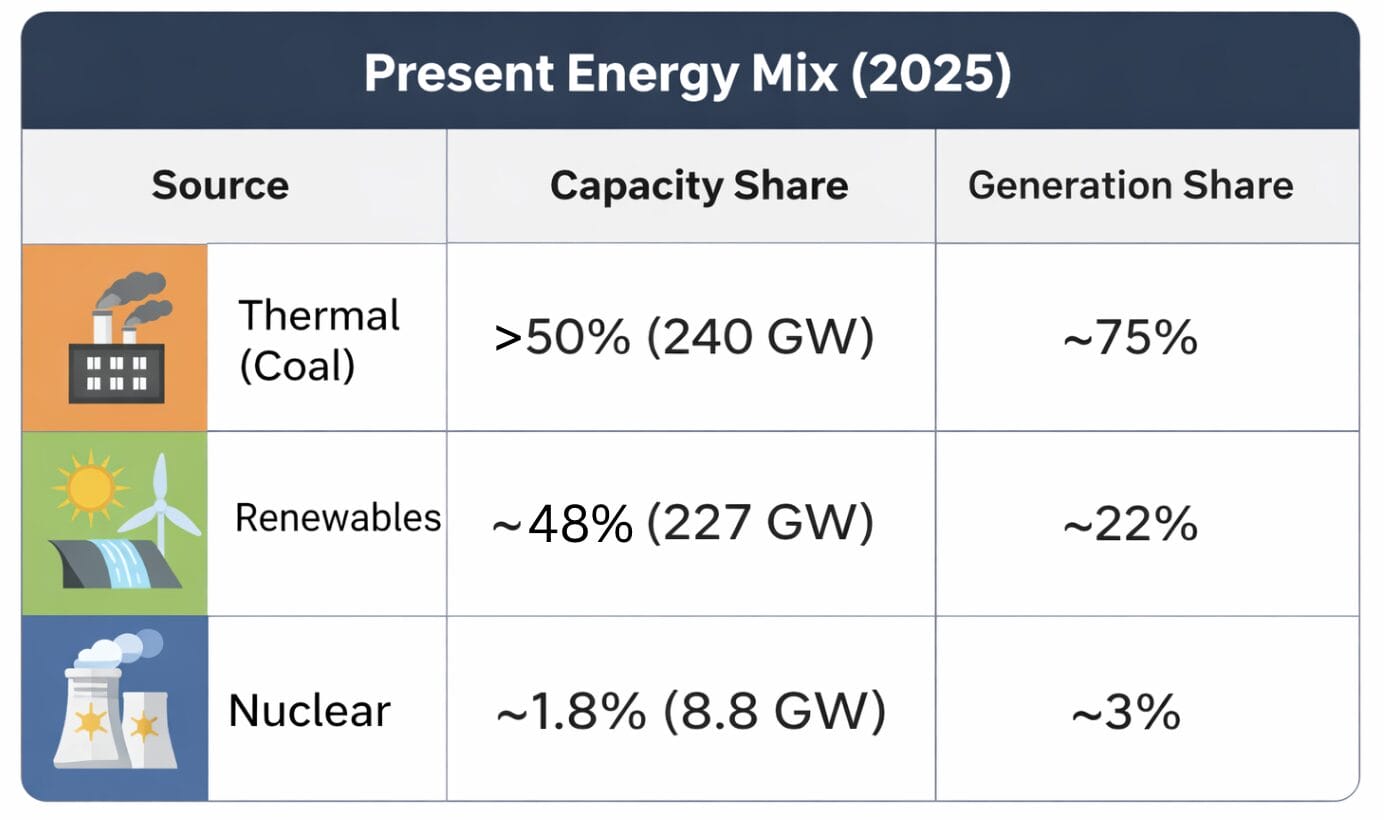
India’s current electricity-generating capacity: ~476 GW. Approximately 50% of which is from non-fossil fuel sources.
India will need to grow its electricity-generating capacity to over 2000 GW to reach Viksit Bharat levels.
The “net zero” target requires a shift away from fossil fuel-based power generation towards renewables and other low-carbon options.
India has committed to increasing the installed capacity of renewables to 500 GW by 2030.
Given the intermittent nature of renewable energy sources, Nuclear power is a viable low carbon option (low carbon).
India’s Nuclear Energy Profile:
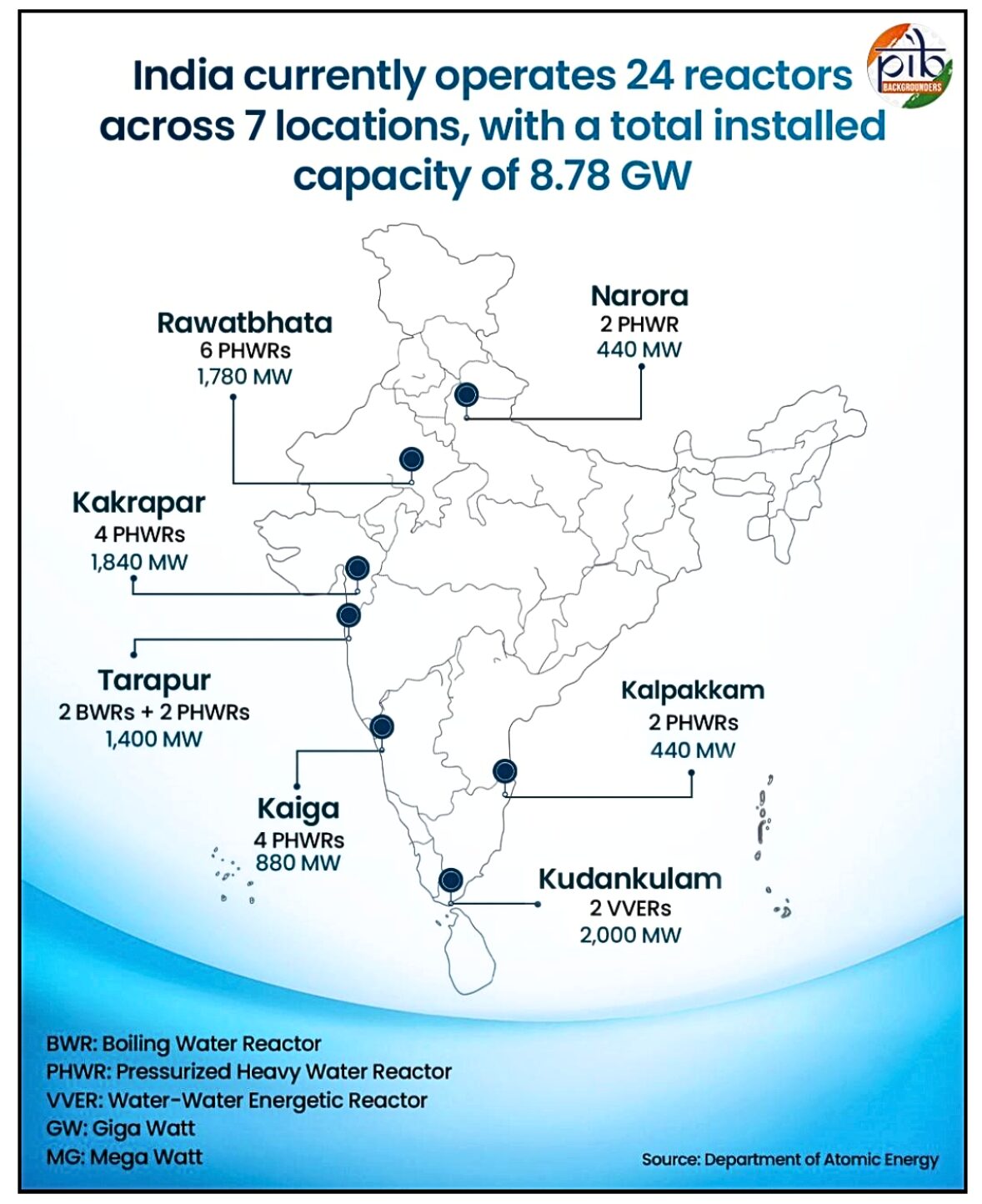
Current installed capacity: ~8.78 GW (≈1.8% of total capacity)
Share in electricity generation: ~3% (57 TWh)
Managed by Nuclear Power Corporation of India Limited (NPCIL), under the Department of Atomic Energy (DAE)
Reactor Mix in India:
Boiling Water Reactors (BWRs): Tarapur (oldest)
VVER (Pressurised Water Reactor or PWR): Kudankulam (Russian design)
Pressurised Heavy Water Reactors (PHWRs): Indigenous backbone (220 MW → 540 MW → 700 MW)
SHANTI Act, 2025:
The Sustainable Harnessing and Advancement of Nuclear Energy for Transforming India (SHANTI) Act was enacted in 2025. The Act aims to accelerate installed nuclear power generation capacity from 8.8 GW (at present) to 100 GW by 2047.
Key provisions of the SHANTI Act, 2025:
Earlier, all nuclear activity was the exclusive preserve of the Department of Atomic Energy (DAE).
Private Sector Participation: The Act enables private Indian companies and joint ventures to build, own, and operate nuclear power plants. Private companies can also engage in equipment manufacturing, fabrication of nuclear fuel (including conversion, refining and enrichment of Uranium-235 up to a threshold value). All activities that involve radiation exposure must obtain prior safety authorisation from the regulatory authority.
Activities under Exclusive Central Government purview: Certain sensitive nuclear fuel-cycle activities are reserved exclusively for the Central Government. These include enrichment or isotopic separation of radioactive substances, management of spent fuel such as reprocessing, recycling, radionuclide separation, and high-level waste handling, production and upgradation of heavy water.
Licensing and Safety Oversight: Establishes a structured system for granting, suspending, or cancelling licences and safety authorisations for nuclear energy production and use.
Regulatory Changes: Grants formal statutory backing to the Atomic Energy Regulatory Board (AERB) to strengthen regulatory independence and authority. It repeals the Atomic Energy Act, 1962 and the Civil Liability for Nuclear Damage Act (CLNDA), 2010.
New Civil Liability Framework: Introduces a clear, graded liability system for nuclear operators. Liability caps: ₹3000 crore (large plants), ₹1500 crore (medium), ₹100 crore (SMRs). The government bears liability beyond the cap through a Nuclear Liability Fund. Removes supplier liability completely (repeals CLNDA, 2010).
Dispute Redressal Mechanism: Establishes an Atomic Energy Redressal Advisory Council to facilitate the redressal of disputes.
Appellate Tribunal Provision: The Appellate Tribunal for Electricity, set up under the Electricity Act, 2003, will serve as the appellate authority, empowered to hear appeals under provisions of the Act.
Nuclear Damage Claims Commission: Provides for a dedicated Commission to handle cases involving severe nuclear damage and ensure timely adjudication.
Claims Commissioner Appointment: Empowers the Central Government to appoint Claims Commissioners for adjudicating compensation claims related to nuclear damage.
Regulation of Non-Power Applications: Provides a regulatory framework for the use of nuclear and radiation technologies in health care, agriculture, industry, research, and other peaceful applications.
India’s 700 MW PHWR construction cost is $2 million per MW, among the lowest globally for nuclear power. To add 90 GW over the next two decades would require an outlay of over $200 billion (₹18 lakh crore), only feasible with private investment, both domestic and foreign.
Nuclear Energy Mission: • Announced in the Union Budget 2025-26, it allocates ₹20,000 crore to drive the design, development, and deployment of Small Modular Reactors (SMRs). • Target: At least 5 indigenously designed SMRs to be operational by 2033, strengthening India’s clean energy roadmap.
Way Forward:
Achieving the 100 GW target requires careful planning.
DAE should identify institutions to accelerate research and development for indigenous SMRs, especially of the molten-salt reactor design.
Use of Thorium cladding with HALEU (High Assay Low Enriched Uranium) that can provide an alternative to the Breeder Reactor route to permit early exploitation of India’s thorium reserves.
Promote the indigenised 220 MW PHWR model as an economically viable replacement for several captive power plants (most of which are fossil fuel-based).
An appropriate financing model to meet the high upfront capital requirement. The Atomic Energy Commission (AEC) has given its nod for the new foreign direct investment (FDI) policy for the nuclear power sector (policy is being worked out).
UPSC Mains PYQ 2018
Q. With growing energy needs, should India keep on expanding its nuclear energy programme? Discuss the facts and fears associated with nuclear energy.
UPSC Mains PYQ 2017
Q. Give an account of the growth and development of nuclear science and technology in India. What is the advantage of the fast breeder reactor programme in India?
UPSC PYQ 2023
Q. Consider the following statements:
Statement-I: India, despite having uranium deposits, depends on coal for most of its electricity production.
Statement-II: Uranium, enriched to the extent of at least 60%, is required for the production of electricity.
Which one of the following is correct in respect to the above statements?
(a) Both Statement-I and Statement-II are correct and Statement-II is the correct explanation for Statement-I
(b) Both Statement-I and Statement-II are correct and Statement-II is not the correct explanation for Statement-I
(c) Statement-I is correct but Statement-II is incorrect
(d) Statement-I is incorrect but Statement-II is correct
Answer: (c)
UPSC PYQ 2016
Q. India is an important member of the ‘International Thermonuclear Experimental Reactor’. If this experiment succeeds, what is the immediate advantage for India?
(a) It can use thorium in place of uranium for power generation
(b) It can attain a global role in satellite navigation
(c) It can drastically improve the efficiency of its fission reactors in power generation
(d) It can build fusion reactors for power generation