Opens in a new tab
Join Anantam IAS Channel on Telegram

Daily Digest · Wednesday

13 May 2026 Current Affairs for UPSC

9 current affairs published on Wednesday, 13 May 2026

13 May 2026 Current Affairs for UPSC — every Why-in-News article AnantamIAS published on Wednesday, 13 May 2026, broken down with Why in News?, the exact GS paper it feeds, sub-topic mapping, MCQ-ready facts and a UPSC-style practice question. 9 articles in total, covering Polity, Economy, Environment, S&T, IR, Geography, History, Society and Internal Security — the same Why-in-News + GS-paper-mapping + practice-question format the Compass uses across every daily digest on the site.

Daily current affairs for UPSC is where new material enters your prep stream. Read this 13 May 2026 digest end-to-end in 25–35 minutes, attempt the practice question at the foot of each article (it's MCQ for some, 10/15-marker for others), then bookmark the entries that fall inside your active revision window. Everything stays cross-linked: tap any subject pill to jump to that subject's hub, or use the table of contents above to skip straight to a specific story.

Use this page three ways. Read sequentially for a one-sitting scan of everything that mattered on 13 May 2026. Download the 13 May 2026 PDF below for offline study or print revision. Or use the May 2026 Current Affairs compilation to see this day in the month's full context. For the previous day's reading, see 12 May 2026 Current Affairs; the next day's is 14 May 2026 Current Affairs.

Why we publish daily current affairs separately from the monthly compilation: daily is learning, monthly is revision. Use the daily page to add fresh material to your notes the day it breaks; come back to the May 2026 compilation 60 days before Prelims when the noise has settled and only the lasting takeaway is worth re-reading.

National Testing Agency

Open article →Download PDF

The National Testing Agency (NTA) on Tuesday cancelled the National Entrance-cum-Eligibility Test-Undergraduate (NEET-UG) conducted on May 3 after evidence emerged that the paper was leaked. The NTA is expected to announce the schedule for the re-test in seven to 10 days.

1. Basic Identity

DimensionPrelims-ready fact
Full formNational Testing Agency
Parent MinistryMinistry of Education, Department of Higher Education
NatureAutonomous, self-sustained premier testing organisation
Legal statusSociety registered under the Societies Registration Act, 1860
Cabinet approval10 November 2017
RegistrationRegistered on 15 May 2018
Core functionConduct entrance examinations for higher educational institutions
First phase roleTook over exams earlier conducted by bodies like CBSE; other exams were to be added gradually
Funding modelOne-time Government grant of ₹25 crore; thereafter intended to be financially self-sustaining

The Union Cabinet approved NTA as a Society under the Societies Registration Act, 1860, to function as an autonomous and self-sustained testing body for entrance examinations.

2. Why was NTA brought?

NTA was created because entrance examinations in India had become too large, high-stakes, and administratively complex for bodies like CBSE, AICTE and others whose core mandate was not professional testing. The idea was to create a specialised testing body similar to systems in advanced countries.

Key reasons

Problem before NTANTA’s intended solution
Multiple agencies conducting entrance examsCentralised professional testing body
Burden on CBSE/AICTE and other agenciesRelieve them so they can focus on core academic/regulatory work
Lack of uniform testing standardsStandardised difficulty level and high reliability
Need for scientific assessmentResearch-based, valid, reliable and transparent tests
Rural access concernsCentres at district/sub-district level and hands-on training
One-shot examination pressureOnline exams at least twice a year where possible

The official objective was to bring “high reliability, standardized difficulty level” in assessing aptitude, intelligence and problem-solving abilities of students.

3. Important creation facts for Prelims

FactDetail
Announced inUnion Budget 2017–18
Approved byUnion Cabinet
Approved on10 November 2017
Registered asSociety under Societies Registration Act, 1860
Registration date15 May 2018
Initial examsExams then conducted by CBSE; CMAT and GPAT as entrusted by AICTE
First exam mentioned in 2018 orderUGC-NET in December 2018
Mode envisagedComputer-Based Testing, at least twice a year where possible
ChairpersonEminent educationist appointed by Government/MHRD
CEODirector General appointed by Government
GovernanceBoard/General Body with members from user institutions

A common Prelims trap: NTA is not a statutory body created by an Act of Parliament. It is a registered Society.

4. What does NTA do?

NTA’s strategic plan identifies four broad areas of expertise:

AreaMeaning
ResearchScientific/psychometric research in testing
Test DevelopmentPreparing fair, valid and reliable test content
Test AdministrationConducting the examination securely and efficiently
Test MarkingEvaluation, scoring and result processing

NTA states that it works in research, test development, test administration and test marking, with the aim of fair, valid and reliable testing.

Major exams associated with NTA

Examples include:

ExamBroad purpose
JEE MainEngineering admissions
NEET-UGMedical admissions
CUET-UG/PGUniversity admissions
UGC-NETEligibility for Assistant Professor/JRF
CSIR-UGC NETScience research/teaching eligibility
CMATManagement admissions
GPATPharmacy admissions
AIAPGETAYUSH postgraduate admissions
SWAYAM examsOnline course assessment

5. How has NTA performed?

Intended achievements

AreaPositive contribution
ScaleCreated capacity to conduct very large national-level exams
StandardisationBrought multiple exams under one testing architecture
Digital shiftExpanded Computer-Based Testing in several exams
Student opportunitySome exams like JEE Main moved toward multiple sessions
Institutional reliefReduced burden on CBSE and other bodies
Centralised systemHelped create a single national-level testing mechanism

The Cabinet note expected NTA to benefit around 40 lakh students and relieve CBSE, AICTE and other agencies from conducting entrance tests.

But performance has been mixed

NTA has succeeded in scale and centralisation, but its credibility has been repeatedly questioned because of paper leaks, technical glitches, grievance redressal issues, normalisation disputes, result controversies, and security concerns.

6. Major issues faced by NTA

A. Paper leak and exam integrity concerns

The most serious issue has been the integrity of high-stakes exams, especially NEET-UG 2024. The Supreme Court in Vanshika Yadav v. Union of India, 2024 INSC 568 noted that a leak of the NEET-UG 2024 paper at Hazaribagh and Patna was not in dispute, though it did not order a nationwide re-test because sufficient material showing a widespread systemic leak was not available at that stage.

B. Grace marks and result controversy

NEET-UG 2024 also saw controversy around compensatory/grace marks for loss of time, unusual scores, and student grievances. This created a major public trust crisis in the national testing system.

C. Data security and paper-setting vulnerabilities

The Ministry of Education constituted a High-Level Committee in June 2024 specifically to examine reforms in the examination process, data security protocols, and the structure and functioning of NTA.

D. Organisational structure concerns

The 2024 High-Level Committee headed by Dr. K. Radhakrishnan recommended restructuring NTA and improving its institutional linkages, describing the reform objective as making national entrance tests adaptable, accountable, credible, error-free, student-friendly, secured, tamper-proof and transparent.

E. Single-day, single-shift risk in very large exams

The High-Level Committee recommended multi-session testing spread over a few days or weeks, especially when registered candidates exceed around two lakh. It also suggested that multi-stage testing for NEET-UG could be explored.

F. Grievance redressal weakness

The Ministry’s terms of reference included assessing the current grievance redressal mechanism of NTA and recommending improvements.

G. Student stress and one-shot exam pressure

The reform committee also discussed reducing exam stress through computerised adaptive testing, multiple opportunities, better learning resources, guidance to parents, and early grievance redressal.
India to host BRICS Foreign Ministers’ Meeting 

Open article →Download PDF

Why in News?

India will host the BRICS Foreign Ministers’ Meeting on May 14-15, 2026, under its chairship of the BRICS grouping. The meeting will be chaired by India’s External Affairs Minister, and will witness participation from foreign ministers and heads of delegation from BRICS member and partner countries. 

UPSC Relevance: GS-2 International Relations: International Organisations 

Prelims: BRICS, New Development Bank, Contingent Reserve Arrangement 

Major Highlights: 

  • The foreign ministers of BRICS member nations will discuss global and regional issues of mutual interest during the two-day meeting. 
  • On the second day, BRICS members and partner countries will participate in a special session titled: BRICS@20: Building for Resilience, Innovation, Cooperation and Sustainability.
  • Discussions will also focus on:
    • Reform of global governance institutions
    • Strengthening multilateralism
    • Enhancing cooperation among emerging economies
    • Sustainable development and resilience-building. 

The meeting assumes significance amid ongoing geopolitical tensions in West Asia and growing calls from developing countries for greater representation in international institutions such as the United Nations Security Council (UNSC), International Monetary Fund (IMF), and World Bank.

image 38

 What is BRICS?

  • BRICS is an intergovernmental organisation of major emerging economies aimed at promoting cooperation in economic, political, financial, and strategic areas.
  • Members of BRICS: BRICS currently comprises 11 member countries: Brazil, China, Egypt, Ethiopia, India, Indonesia, Iran, Russia, Saudi Arabia, South Africa, and the United Arab Emirates. 

Evolution of BRICS

  • The term “BRIC” was coined in 2001 by economist Jim O’Neill of Goldman Sachs to describe rapidly growing emerging economies.
  • Timeline: 
    • 2006: BRIC countries began formal cooperation.
    • 2009: First BRIC Summit held in Yekaterinburg, Russia.
    • 2010: South Africa joined the grouping, transforming BRIC into BRICS.
    • 2024: Egypt, Ethiopia, Iran, and the UAE joined as full members.
    • 2025: Indonesia became a full member of BRICS.

Objectives of BRICS: 

  • Economic Cooperation: Promote trade, investment, infrastructure development, and financial cooperation among member countries. Reduce excessive dependence on Western-led financial systems.
  • Reform of Global Governance: Advocate reforms in institutions such as the United Nations (UN), International Monetary Fund (IMF), World Bank, and World Trade Organisation (WTO).
  • South-South Cooperation: Strengthen cooperation among developing and emerging economies.
  • Strategic and Political Coordination: Enhance consultation on global security, climate change, energy security, and geopolitical issues.
  • Cultural and People-to-People Exchanges: Promote academic, cultural, educational, and technological collaboration among member nations.

Economic Importance of BRICS: 

  • BRICS brings together eleven major emerging economies of the world, representing around 49.5% of the global population, around 40% of the global GDP and around 26% of global trade.
  • The grouping is increasingly viewed as an important voice of the Global South and a counterweight to Western-dominated forums such as the Group of Seven (G7).
  • BRICS nations are also exploring: trade in local currencies, financial cooperation, alternative payment systems, and supply-chain resilience.

Contingent Reserve Arrangement (CRA): 

  • The BRICS CRA is a financial safety mechanism established in 2014. It has a total size of USD 100 billion.
  • Objective: To provide liquidity support and financial assistance to member countries facing balance-of-payments crises or currency volatility.
  • Contribution Structure
    • China: USD 41 billion
    • Brazil, India, Russia: USD 18 billion each
    • South Africa: USD 5 billion
  • The CRA is often viewed as an alternative support mechanism parallel to IMF-led emergency financing systems.

New Development Bank (NDB): 

  • The New Development Bank is a multilateral development bank established by the BRICS countries.
  • Established in 2014 during the BRICS Summit in Fortaleza. Operational since 2015.
  • Headquarters: Shanghai.
  • Objectives: Mobilise resources for infrastructure projects, sustainable development, renewable energy, and climate-resilient development in emerging economies.
  • Key Features: 
    • Initial authorised capital: USD 100 billion. 
    • Provides loans in local currencies to reduce exchange-rate risks. 
    • Membership has expanded beyond BRICS countries.

Significance of BRICS for India: 

  • Strengthening Voice of the Global South: India uses BRICS as a platform to represent the concerns of developing countries regarding climate finance, food security, technology access, and equitable global governance.
  • Strategic Balancing: BRICS enables India to engage simultaneously with Russia and China, West Asian economies, and African partners, while maintaining strategic autonomy in global politics.
  • Economic Opportunities: The platform helps India expand trade, connectivity, energy cooperation, investment partnerships, and digital and technological collaboration.
  • Reform of Multilateral Institutions: India consistently pushes within BRICS for reforms in the UNSC, the IMF quota systems, and global financial governance structures.

Key Challenges within BRICS: 

  • India-China Geopolitical Rivalry: Ongoing border disputes and strategic competition between India and China create friction, often forcing other members to navigate these tensions. The bilateral rivalry limits cohesive action.
  • China-Centric Influence: China’s GDP is significantly larger than all other BRICS members combined, leading to fears of economic dependency and domination, particularly among smaller or newer members.
  • Divergent Geopolitical Interests: Members have differing relations with Western powers. Russia and China often adopt an anti-Western stance, while India, Brazil, and South Africa maintain more balanced or cooperative relations with the West, leading to inconsistent stances on global security and governance.
  • Internal Differences on Conflicts: The group lacks a unified voice on major global crises, such as the conflict in Ukraine and instability in West Asia, which directly conflict with the national interests of various members.
  • Lack of Unified Strategic Vision: The group struggles to move beyond economic cooperation toward a shared political and security agenda. Divergent political systems (ranging from democracies to authoritarian regimes) make it difficult to form a cohesive alternative to Western institutions.

India’s hosting of the BRICS Foreign Ministers’ Meeting underlines its growing diplomatic role in shaping the agenda of the Global South and reforming global governance institutions. 

India-Oman CEPA likely to come into force on June 1

Open article →Download PDF

Why in News?

The Comprehensive Economic Partnership Agreement (CEPA) between India and Oman is expected to come into force from June 1, 2026. The pact was signed in December 2025.

UPSC Relevance: GS-2 International Relations: Trade Agreements; Bilateral Trade

Prelims: India-Oman Comprehensive Economic Partnership Agreement (Key Facts) 

What is the Comprehensive Economic Partnership Agreement?

  • A Comprehensive Economic Partnership Agreement (CEPA) is an advanced form of Free Trade Agreement (FTA) that covers not only trade in goods but also:
    • Trade in services
    • Investment flows
    • Rules of origin
    • Customs cooperation
    • Trade facilitation
    • Professional mobility
    • Intellectual property and regulatory cooperation
  • CEPAs are broader and deeper than conventional FTAs because they aim at comprehensive economic integration between partner countries.

India has signed CEPAs with countries such as the United Arab Emirates, Japan, and South Korea. 

image 39

India-Oman Comprehensive Economic Partnership Agreement: 

  • The India-Oman Comprehensive Economic Partnership Agreement (CEPA) is expected to become operational from June 1, 2026. 
  • Aim: To deepen bilateral trade, investment, and strategic economic cooperation. 
image 41

Major Highlights of the India-Oman CEPA: 

  • Duty-Free Access for Indian Exports: 
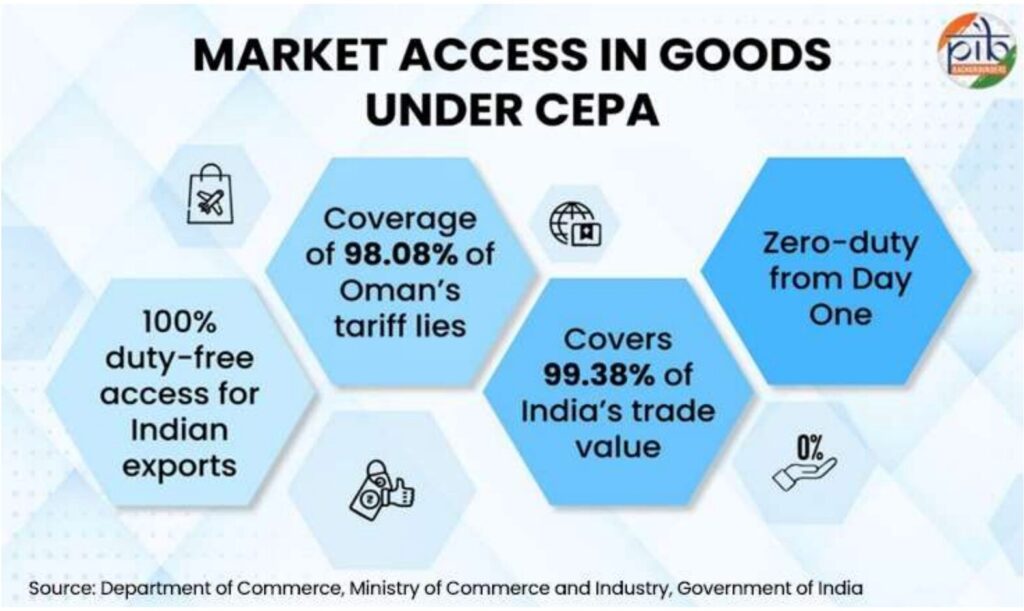
    • Oman has offered duty-free access on 98.08% of its tariff lines. This covers nearly 99.38% of India’s exports by value. 
    • Key Indian sectors expected to benefit: Textiles and garments, Leather and footwear, Gems and jewellery, Pharmaceuticals, Agriculture and processed food, Engineering goods, Medical devices, Chemicals and plastics, Automobiles and auto components & Labour-intensive sectors. 
  • Tariff Concessions by India: India will reduce tariffs on selected Omani products, including dates, Marble, Petrochemical products and certain industrial inputs. 
  • Protection of Sensitive Sectors: India excluded several sensitive products from tariff concessions, including dairy products, Tea and coffee, Tobacco, Rubber, and certain jewellery items. 
  • Services and Investment Cooperation: The agreement expands opportunities in Information Technology (IT), Education, Healthcare, Professional services, Research and development and Audiovisual services. 
  • Mobility of Professionals: The agreement includes provisions for easier movement of Indian professionals, enhanced quotas for intra-corporate transferees and longer duration of stay for contract workers. This is expected to benefit skilled Indian workers and service providers in Oman.

India-Oman Economic Engagement: 

  • During FY 2024-25, bilateral trade between the two countries stood at USD 10.61 billion, compared to USD 8.94 billion in FY 2023-24. 
  • India’s major exports to Oman: Engineering goods, Food products, Pharmaceuticals, Machinery, Textiles. 
  • India’s major imports from Oman: Crude oil and petroleum products, Urea and fertilisers, Chemicals, Metals and minerals. 

Strategic Significance of the CEPA:

  • Strengthening India’s West Asia Outreach: The agreement strengthens India’s economic and strategic engagement with the Gulf region and complements India’s broader West Asia policy.
  • Boost to Exports and Manufacturing: The CEPA is expected to increase Indian exports, enhance manufacturing competitiveness, generate employment in labour-intensive sectors and support MSMEs. Estimates suggest the pact could raise Indian exports by nearly USD 2 billion over the next few years.
  • Gateway to Gulf and African Markets: Oman’s strategic location can help Indian businesses access Gulf Cooperation Council (GCC) markets, East African markets and Global shipping routes through the Arabian Sea. 
  • Supply Chain Diversification: The agreement may strengthen resilient supply chains amid global trade disruptions and geopolitical uncertainties.

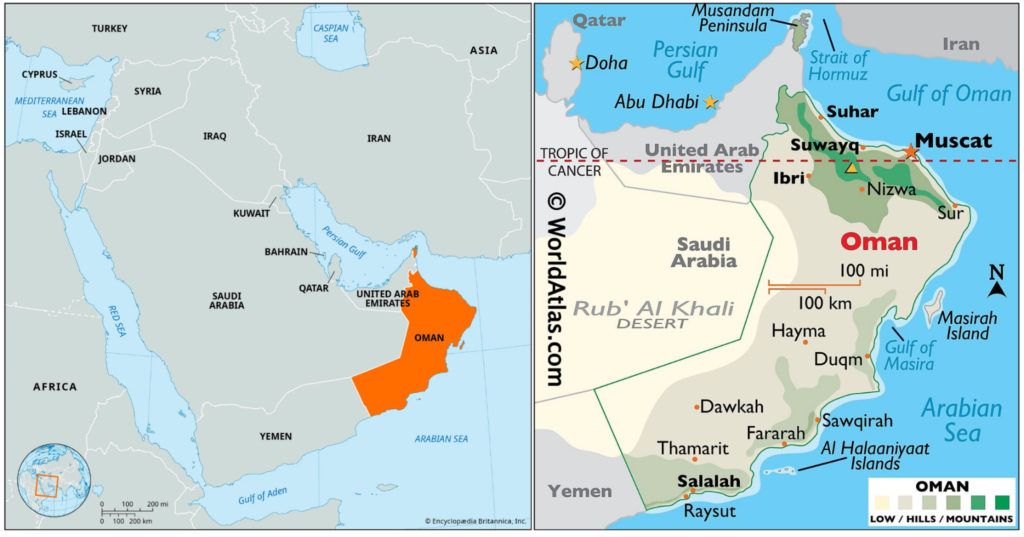
The India-Oman CEPA marks a major step in India’s trade diplomacy and economic engagement with the Gulf region. The agreement is also significant as Oman occupies a strategic position near the Strait of Hormuz, one of the world’s most important energy transit routes. 

UPSC PYQ 2020

Q. With reference to the international trade of India at present, which of the following statements is/are correct?

1.    India’s merchandise exports are less than its merchandise imports.

2.    India’s imports of iron and steel, chemicals, fertilisers and machinery have decreased in recent years.

3.    India’s exports of services are more than its imports of services.

4.    India suffers from an overall trade/current account deficit.

Select the correct answer using the code given below:

(a)    1 and 2 only

(b)    2 and 4 only

(c)    3 only

(d)    1, 3 and 4 only

Answer: (d) 

UPSC PYQ 2020

Q. Consider the following statements:

1.    The value of Indo-Sri Lanka trade has consistently increased in the last decade. 

2.    “Textile and textile articles” constitute an important item of trade between India and Bangladesh. 

3.    In the last five years, Nepal has been the largest trading partner of India in South Asia. 

Which of the statements given above is/are correct?

(a)     1 and 2 only 

(b)    2 only

(c)    3 only 

(d)    1, 2 and 3

Answer: (b) 

Data and justice: On courts in India and AI tools

Open article →Download PDF

image 41

Why in News?

The Chief Justice of India (CJI) Justice Surya Kant recently announced two major initiatives aimed at deepening the digitisation of the Indian judiciary:

  • ‘One Case, One Data’ (OCOD): A unified judicial data platform intended to create a seamless digital trail for cases across courts.
  • ‘Su-Sahayak’: An AI-powered chatbot integrated into the Supreme Court website to assist users in accessing judicial information and services.

These initiatives are part of the broader effort to modernise India’s judicial administration and improve access to justice through technology.

UPSC Relevance

GS Paper 2

  • Judiciary and judicial reforms, E-governance in justice delivery, Access to justice and inclusivity, Issues related to transparency and accountability

GS Paper 3

  • Artificial Intelligence and emerging technologies, Cybersecurity and data governance, Digital divide and technological inclusion

Essay

  • Technology and democracy
  • AI and ethics
  • Governance in the digital age

Background/Context

India’s judiciary is one of the largest judicial systems in the world, with:

  • The Supreme Court
  • 25 High Courts
  • Thousands of district and subordinate courts

The judicial system faces persistent structural challenges:

  • Massive case pendency
  • Delays in procedural processes
  • Lack of standardised record management
  • Limited accessibility for ordinary citizens
  • Variations in digitisation levels across States

To address these issues, the judiciary and the government launched the e-Courts Mission Mode Project under the National e-Governance Plan.

Evolution of Judicial Digitisation in India

Phase I of e-Courts Project

Focused on:

  • Computerisation of district courts
  • Basic digital infrastructure
  • Case Information Systems (CIS)

Phase II

Expanded toward:

  • e-Filing
  • Virtual hearings
  • National Judicial Data Grid (NJDG)
  • Digital records
  • Video conferencing

Phase III (ongoing)

Aims at:

  • Interoperable digital justice ecosystem
  • Paperless courts
  • AI-assisted judicial administration
  • Integrated judicial databases

The OCOD and Su-Sahayak initiatives represent the next stage in this transformation.

One Case, One Data (OCOD): Meaning and Significance

What is OCOD?

The “One Case, One Data” initiative seeks to create a unified digital identity for every legal dispute as it moves through various stages of litigation.

For example:

  • A case filed in a district court
  • Appealed before a High Court
  • Finally reaching the Supreme Court

would carry a linked digital trail across institutions.

Key Features of OCOD

Unified Judicial Database

The system aims to consolidate records from:

  • District courts
  • High Courts
  • Supreme Court
  • Associated tribunals

This reduces duplication and fragmentation.

End-to-End Case Tracking

Litigants and lawyers can track:

  • Case status
  • Appeals
  • Orders
  • Filings
  • Related proceedings

through a single framework.

Improved Data Analytics

Standardised data can help identify:

  • Delay-prone stages
  • Procedural bottlenecks
  • Judge-wise pendency
  • Infrastructure gaps

This supports evidence-based judicial administration.

Reciprocal Access Across Courts

Different courts may gain interoperable access to records, reducing repetitive verification and paperwork.

Potential Benefits of OCOD

Improving Judicial Efficiency

India has more than 5 crore pending cases across courts. Fragmented data systems worsen delays.

OCOD can:

  • Reduce duplication of filings
  • Speed up procedural verification
  • Improve coordination between courts
  • Enable faster case movement

Better Policy Planning

Reliable judicial statistics can assist:

  • Law Commission studies
  • Parliamentary committees
  • Judicial infrastructure planning
  • Allocation of judges and staff

Enhanced Transparency

A standardised digital trail can:

  • Reduce record tampering
  • Improve accountability
  • Enable easier public access to case-related information

Strengthening Access to Justice

Digitised systems can reduce:

  • Physical visits to courts
  • Costs of accessing records
  • Dependence on intermediaries

especially for litigants from distant regions.

Su-Sahayak: AI in Judicial Administration

What is Su-Sahayak?

Su-Sahayak is an AI-powered chatbot introduced on the Supreme Court website.

It helps users access:

  • Case status
  • Cause lists
  • Orders and judgments
  • e-Services
  • Frequently asked questions

AI in Indian Judiciary: Earlier Initiatives

SUVAS (Supreme Court Vidhik Anuvaad Software)

AI-based translation tool for translating judgments into regional languages.

SUPACE (Supreme Court Portal for Assistance in Court Efficiency)

AI-assisted legal research platform helping judges identify:

  • Facts
  • Precedents
  • Relevant legal materials

These initiatives show that Indian courts are cautiously using AI for administrative assistance rather than judicial decision-making.

Constitutional and Legal Dimensions

Access to Justice as a Fundamental Right

The Supreme Court has repeatedly interpreted Article 21 (Right to Life and Personal Liberty) to include:

  • Fair trial
  • Speedy justice
  • Access to courts

Important Cases

Hussainara Khatoon v. State of Bihar (1979)

Recognised speedy trial as a fundamental right.

Anita Kushwaha v. Pushap Sudan (2016)

Held that access to justice is an essential constitutional guarantee.

Digitisation initiatives can strengthen these constitutional commitments if implemented inclusively.

Article 39A and Legal Aid

The Directive Principle under Article 39A directs the State to ensure equal justice and free legal aid.

Technology-enabled justice delivery must therefore remain:

  • Affordable
  • Inclusive
  • Accessible to vulnerable sections

Data Protection and Privacy Concerns

Judicial Data as Sensitive Information

Court databases contain:

  • Personal identities
  • Financial records
  • Criminal histories
  • Family disputes
  • Medical information

Centralised databases increase risks of:

  • Data breaches
  • Surveillance
  • Profiling
  • Misuse of litigant information

Right to Privacy

In Justice K.S. Puttaswamy v. Union of India (2017), the Supreme Court recognised privacy as a fundamental right.

Thus, judicial digitisation must comply with:

  • Data minimisation
  • Consent principles
  • Secure storage
  • Purpose limitation

Governance and Administrative Challenges

Interoperability Problems

India’s district courts use different software systems and record formats.

Challenges include:

  • Legacy paper records
  • Inconsistent digitisation
  • Poor data quality
  • Lack of standard metadata

Without standardisation, OCOD may face implementation hurdles.

Capacity Constraints

Many courts face:

  • Staff shortages
  • Limited IT infrastructure
  • Poor internet connectivity
  • Lack of trained personnel

Digitisation without adequate training may worsen inefficiencies.

Cybersecurity Risks

Judicial systems are vulnerable to:

  • Ransomware attacks
  • Data theft
  • Manipulation of records

Critical institutions require robust cybersecurity frameworks and periodic audits.

Social Dimensions: Digital Divide and Exclusion

Unequal Access to Technology

Large metropolitan law firms can adapt easily to digital systems.

However:

  • Small lawyers
  • Rural litigants
  • Taluka-level practitioners

may struggle with:

  • Digital filing costs
  • Scanners and software expenses
  • Cloud storage requirements

This could create unequal access within the legal profession itself.

Emergence of Digital Middlemen

People unfamiliar with e-court systems may depend on intermediaries for:

  • Filing cases
  • Uploading documents
  • Tracking proceedings

This may create:

  • Informal charges
  • Exploitation risks
  • Reduced transparency

Linguistic and Accessibility Barriers

Su-Sahayak is currently largely text-based.

This may exclude:

  • Illiterate citizens
  • Elderly litigants
  • Persons unfamiliar with English
  • Digitally unskilled populations

Voice-based multilingual systems are necessary for true inclusivity.

AI Bias and Ethical Concerns

Risks of Algorithmic Bias

AI systems trained on historical legal data may reproduce existing systemic biases.

Marginalised groups historically affected by:

  • Higher arrest rates
  • Bail denial
  • Social discrimination

could face indirect algorithmic prejudice.

Judicial Independence and Human Decision-making

Globally, debates continue regarding AI in courts.

India’s judiciary has so far maintained an important distinction:

  • AI for assistance → acceptable
  • AI for judicial reasoning → problematic

This distinction is crucial because:

  • Judicial reasoning involves ethics and constitutional morality
  • AI lacks contextual understanding and empathy
  • Automated justice may undermine due process

International Experiences

United States

AI-based risk assessment tools like COMPAS faced criticism for racial bias in sentencing.

European Union

The EU AI Act proposes strict regulation of high-risk AI systems, including judicial applications.

China

Extensive use of “smart courts” has raised concerns about state surveillance and algorithmic control.

India can learn from these experiences while designing safeguards.

Challenges and Criticisms

Over-centralisation of Judicial Data

A unified digital fingerprint for cases may increase surveillance risks and concentration of sensitive information.

Digital Exclusion

Marginalised litigants may face barriers due to:

  • Lack of internet access
  • Low digital literacy
  • Language constraints

Dependence on Private Technology Vendors

Judicial systems relying heavily on external vendors may raise concerns regarding:

  • Data ownership
  • Vendor lock-in
  • Confidentiality

Incomplete or Inaccurate Legacy Records

Old paper records may contain errors or missing information, affecting data reliability.

Lack of Clear AI Accountability Framework

Questions remain regarding:

  • Liability for AI errors
  • Transparency of algorithms
  • Auditability of AI systems

Way Forward

Build Inclusive Digital Justice Infrastructure

Digitisation must not remain urban-centric. Courts at district and taluka levels require:

  • High-speed internet
  • Hardware support
  • Trained technical staff
  • Affordable digital access systems

This will reduce disparities between metropolitan and rural judicial ecosystems.

Develop Multilingual and Voice-Based AI Systems

AI tools such as Su-Sahayak should support:

  • Indian languages
  • Voice interaction
  • Accessibility features for disabled users

This aligns with the constitutional principle of equal access to justice.

Establish Robust Data Protection Safeguards

Judicial databases should follow strict standards relating to:

  • Encryption
  • Data anonymisation
  • Role-based access
  • Periodic cybersecurity audits

Independent oversight mechanisms should monitor data usage.

Maintain Human Oversight in Judicial Decision-making

AI should remain assistive rather than adjudicatory.

Final judicial reasoning must always remain with judges to preserve:

  • Constitutional morality
  • Judicial independence
  • Principles of natural justice

Capacity Building and Training

Judges, court staff, lawyers, and litigants require:

  • Digital literacy programmes
  • Technical support centres
  • Training in AI ethics and cybersecurity

The National Judicial Academy and State Judicial Academies can play a major role.

Create a Transparent AI Governance Framework

India needs judicial AI guidelines covering:

  • Algorithmic transparency
  • Accountability
  • Bias audits
  • Ethical standards
  • Public consultation

This would improve trust in AI-enabled judicial systems.

Strengthen Legal Aid and Assisted Access

Legal Services Authorities should provide:

  • e-filing assistance centres
  • Digital kiosks in courts
  • Free technical help for poor litigants

This will reduce dependence on exploitative intermediaries.

Conclusion

The OCOD and Su-Sahayak initiatives represent an important milestone in India’s transition toward technology-enabled justice delivery. Properly implemented, they can improve efficiency, transparency, and accessibility in the judicial system. However, digitisation alone cannot guarantee justice.

The true success of judicial AI and data-driven governance will depend on whether India can balance technological innovation with constitutional values such as fairness, privacy, equality, and access to justice. The judiciary must therefore adopt a cautious, inclusive, and rights-based approach while integrating AI into the legal system.

UPSC Practice Questions

With reference to Artificial Intelligence (AI) in the Indian judiciary, consider the following statements:

  1. SUVAS is an AI tool used for translation of judicial documents.
  2. SUPACE is intended to replace judges in legal decision-making.
  3. The Supreme Court has recognised privacy as a fundamental right under Article 21.

How many of the above statements are correct?

(a) Only one
(b) Only two
(c) All three
(d) None

Answer: (b) Only two

Explanation:

  • Statement 1 is correct: SUVAS is used for translating judgments into regional languages.
  • Statement 2 is incorrect: SUPACE is only an assistive tool and does not replace judges.
  • Statement 3 is correct: Privacy was recognised as a fundamental right in the Puttaswamy judgment.

Prelims MCQ 2

Which of the following constitutional provisions are directly associated with access to justice in India?

  1. Article 21
  2. Article 39A
  3. Article 32

Select the correct answer using the code below:

(a) 1 and 2 only
(b) 2 and 3 only
(c) 1 and 3 only
(d) 1, 2 and 3

Answer: (d) 1, 2 and 3

Explanation:

  • Article 21 includes fair and speedy justice.
  • Article 39A promotes equal justice and free legal aid.
  • Article 32 provides constitutional remedies for enforcement of Fundamental Rights.

UPSC Mains Questions

Discuss the opportunities and ethical concerns associated with the use of Artificial Intelligence in India’s judicial system. How can India ensure a rights-based approach to judicial digitisation?

“Digitisation of the judiciary can improve efficiency, but without inclusivity it may deepen inequality.” Examine in the context of recent AI-based judicial initiatives in India.

Managing coexistence in human-wildlife conflict zones 

Open article →Download PDF

image 42

Why in News?

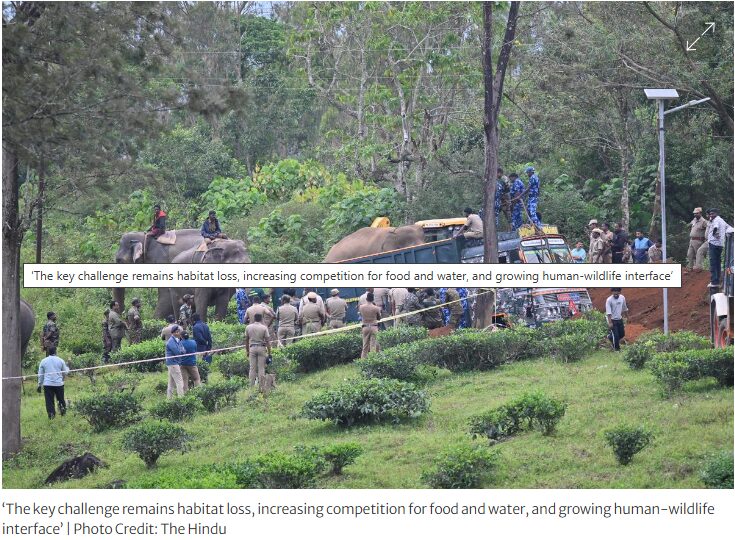
Human-wildlife conflict (HWC) has emerged as a major ecological and governance challenge across India and several developing regions of the world. Rising incidents involving elephants, tigers, leopards, wild boars and other wildlife species have renewed attention on the need for sustainable coexistence between conservation goals and human livelihoods. Recent discussions have focused on improving compensation systems, ecological planning, wildlife corridors and community-based conservation approaches.

UPSC Relevance

Prelims Relevance

  • Wildlife Protection Act, 1972, Project Elephant and Project Tiger, Wildlife corridors and protected areas, Human-wildlife conflict mitigation measures, IUCN, biodiversity conservation

Mains Relevance

GS Paper 3

  • Conservation, environmental degradation and biodiversity, Human-animal conflict, climate change, Sustainable development, land-use planning

GS Paper 2

  • Governance challenges in environmental management, Role of local communities, decentralised conservation

Essay

  • Development versus conservation
  • Ecological justice and sustainability
  • Climate change and resource conflicts

Background and Context

Human-wildlife conflict refers to interactions between humans and wild animals that result in harm to people, property, livelihoods or wildlife itself. Such conflicts include:

  • Crop damage by elephants and wild boars
  • Livestock predation by leopards, tigers and wolves
  • Human deaths or injuries caused by wild animals
  • Retaliatory killings of wildlife

Historically, wildlife populations and human settlements were separated by extensive forests and natural landscapes. However, rapid population growth, infrastructure expansion, urbanisation and agricultural intensification have fragmented habitats and increased overlap between human and wildlife spaces.

India is one of the world’s megadiverse countries and also among the most densely populated. This creates a unique challenge where biodiversity-rich regions often coincide with heavily populated rural landscapes.

According to government data:

  • India records hundreds of human deaths annually due to elephant attacks.
  • Thousands of livestock are lost each year to predators.
  • Railway lines, highways and mining activities increasingly intersect wildlife habitats.

The issue has therefore evolved beyond a conservation concern into a broader socio-economic, developmental and governance challenge.

image 43

Understanding the Ecological Basis of Human-Wildlife Conflict

Habitat Fragmentation

Forests are increasingly fragmented due to:

  • Roads and railway projects
  • Mining activities
  • Dams and hydropower projects
  • Agricultural expansion
  • Urban sprawl

Fragmentation disrupts wildlife movement corridors and isolates animal populations.

Large mammals such as elephants require extensive migratory routes for food, water and breeding. When these pathways are blocked, animals move through villages and farms, increasing conflict.

Decline of Natural Prey and Food Sources

Carnivores such as leopards and tigers may attack livestock when natural prey populations decline due to habitat degradation or poaching.

Similarly:

  • Wild boars raid crops
  • Monkeys exploit human food waste
  • Elephants enter farms during food shortages

These behaviours are adaptive ecological responses rather than deliberate aggression.

Climate Change and Ecological Stress

Climate change is intensifying:

  • Water scarcity
  • Droughts
  • Forest fires
  • Altered vegetation patterns

This affects resource availability for wildlife and pushes animals closer to human settlements.

For example:

  • Drought conditions in elephant habitats can increase crop-raiding incidents.
  • Shrinking water bodies force wildlife to enter villages in search of water.

Human-Wildlife Conflict in India

India experiences some of the world’s most complex forms of HWC due to:

  • High biodiversity
  • Dense human population
  • Dependence on forests for livelihoods

Major Conflict Zones

Elephant Corridors
States such as:

  • Assam
  • Odisha
  • Karnataka
  • Kerala
  • West Bengal
  • Jharkhand

face recurrent elephant-related conflicts.

India has identified more than 100 elephant corridors, many of which are fragmented or encroached upon.

Tiger and Leopard Landscapes
Conflicts involving big cats are common in:

  • Maharashtra
  • Uttarakhand
  • Madhya Pradesh
  • Karnataka

Leopards increasingly inhabit peri-urban landscapes due to shrinking habitats.

Wild Boar and Monkey Conflicts
Agricultural regions near forest boundaries face severe crop losses from:

  • Wild boars
  • Monkeys
  • Nilgai

These species adapt quickly to human-modified environments.

Constitutional and Legal Dimensions

Constitutional Provisions

Article 48A
Directs the State to protect and improve the environment and safeguard forests and wildlife.

Article 51A(g)
Makes it a Fundamental Duty of citizens to protect the natural environment and show compassion for living creatures.

Right to Life under Article 21
The Supreme Court has expanded Article 21 to include environmental protection and ecological balance.

Wildlife Protection Act, 1972

The Act provides:

  • Legal protection to wildlife species
  • Creation of national parks and sanctuaries
  • Regulation of hunting and trade

It remains the cornerstone of wildlife conservation in India.

Forest Rights Act, 2006

The Act recognises forest-dwelling communities’ rights over forest resources. Balancing conservation goals with community rights remains an important governance challenge.

Important Supreme Court Judgments

T.N. Godavarman Thirumulpad Case
Expanded judicial oversight over forest conservation.

Centre for Environmental Law, WWF-India vs Union of India
Highlighted the importance of species conservation and ecological protection.

Government Initiatives and Policy Measures

Project Elephant

Launched in 1992, it focuses on:

  • Elephant conservation
  • Protection of corridors
  • Reducing human-elephant conflict

Project Tiger

Apart from tiger conservation, the project indirectly supports habitat preservation and ecological connectivity.

National Wildlife Action Plan (2017–2031)

It emphasises:

  • Landscape-based conservation
  • Community participation
  • Scientific conflict mitigation

National Board for Wildlife (NBWL)

Acts as an advisory body for wildlife conservation policies and protected area management.

Use of Technology

Several States use:

  • Drone surveillance
  • GPS collaring
  • Early-warning systems
  • SMS alerts
  • Thermal imaging

However, effectiveness varies depending on local conditions and administrative capacity.

Community-Based Conservation Approaches

International experiences show that conflict management is more successful when local communities become active stakeholders.

African Models

Countries such as Botswana and Namibia use:

  • Community-based natural resource management
  • Revenue-sharing from eco-tourism
  • Local stewardship mechanisms

This aligns economic incentives with conservation goals.

South Asian Examples

Bhutan
Community forestry programmes have improved coexistence and reduced ecological pressure.

Nepal
Predator-proof livestock enclosures and coordinated grazing systems have reduced livestock losses.

These models highlight the importance of decentralised and locally adapted solutions.

Challenges in India’s Existing Approach

Delays in Compensation

Although compensation mechanisms exist, many victims face:

  • Delayed payments
  • Complex paperwork
  • Low compensation amounts

Marginalised communities are often the most affected.

Inadequate Land-Use Planning

Infrastructure projects frequently ignore ecological connectivity. Roads, railways and linear projects cut through wildlife corridors.

This increases:

  • Animal mortality
  • Habitat fragmentation
  • Human-wildlife encounters

Weak Local Participation

Conservation policies are sometimes implemented in a top-down manner without adequate community consultation.

Local communities may therefore perceive wildlife as an economic burden rather than a shared ecological resource.

Retaliatory Killings

Crop damage and livestock loss often trigger:

  • Poisoning of wildlife
  • Electrocution
  • Illegal hunting

This threatens already vulnerable species.

Limitations of Technical Solutions

Measures such as:

  • Solar fencing
  • Tranquilisation
  • Fertility control

may provide temporary relief but cannot substitute long-term ecological restoration.

Experts argue that habitat degradation and resource scarcity are the root causes of conflict.

Economic and Social Dimensions

Human-wildlife conflict disproportionately affects:

  • Small farmers
  • Tribal communities
  • Forest-dependent populations

Crop losses and livestock deaths can severely affect rural incomes.

Women and children are also vulnerable because:

  • They often collect fuelwood and water from forests.
  • They travel through wildlife-prone areas.

Thus, HWC is also linked to:

  • Rural poverty
  • Livelihood insecurity
  • Social justice

Importance of Wildlife Corridors

Wildlife corridors are ecological pathways connecting fragmented habitats.

They are essential for:

  • Seasonal migration
  • Genetic exchange
  • Long-term species survival

The Supreme Court and conservation agencies have repeatedly emphasised corridor protection.

For example:

  • The Nilgiri elephant corridor is one of India’s most important wildlife movement routes.
  • Kaziranga-Karbi Anglong corridors in Assam are critical for elephant and rhino movement.

Securing such corridors is central to reducing conflict.

The Need for Ecological Governance

Conservation cannot succeed through policing alone. Human-wildlife conflict requires integrated ecological governance involving:

  • Forest departments
  • Local communities
  • Urban planners
  • Disaster management agencies
  • Agricultural departments

Landscape-level planning is necessary to reconcile development and conservation objectives.

Way Forward

Strengthening Habitat Connectivity

Protection and restoration of wildlife corridors should become a central element of infrastructure and land-use planning.

Environmental Impact Assessments must adequately account for:

  • Animal movement routes
  • Habitat fragmentation
  • Long-term ecological impacts

Eco-sensitive infrastructure such as wildlife overpasses and underpasses should be expanded.

Improving Compensation Systems

Compensation mechanisms should be:

  • Timely
  • Transparent
  • Technology-enabled
  • Accessible in local languages

Direct Benefit Transfer (DBT)-based compensation can reduce delays and corruption.

Insurance-based approaches may also be explored for crop and livestock losses.

Community-Centred Conservation

Local communities should be treated as partners rather than obstacles to conservation.

Measures may include:

  • Revenue-sharing from eco-tourism
  • Community forest management
  • Employment in conservation activities
  • Participatory monitoring systems

This can improve trust and reduce hostility toward wildlife.

Scientific and Data-Driven Planning

Conflict mitigation should be based on:

  • GIS mapping
  • Wildlife movement data
  • Climate projections
  • Behavioural ecology studies

Scientific monitoring can help predict conflict-prone areas and enable preventive action.

Climate-Resilient Conservation Strategies

Climate adaptation plans should integrate wildlife conservation and ecosystem management.

Restoration of:

  • Wetlands
  • Water bodies
  • Grasslands
  • Forest ecosystems

can reduce ecological stress and improve resource availability.

Education and Awareness

Public awareness programmes should focus on:

  • Safe behaviour in conflict zones
  • Ecological literacy
  • Community preparedness

School curricula and local governance institutions can play an important role in building coexistence-oriented attitudes.

Strengthening Institutional Coordination

Human-wildlife conflict is an inter-sectoral issue requiring coordination among:

  • Forest departments
  • Revenue departments
  • Rural development agencies
  • Infrastructure ministries

Integrated governance frameworks are essential for long-term conflict reduction.

Conclusion

Human-wildlife conflict is not merely an isolated conservation issue but a reflection of deeper ecological and developmental imbalances. As human activities increasingly reshape landscapes, interactions with wildlife are becoming more frequent and complex.

The challenge before India is not to eliminate wildlife from human spaces, but to create landscapes where both humans and wildlife can coexist sustainably. This requires balancing ecological protection with livelihood security through scientific planning, community participation and inclusive governance.

A durable solution lies in recognising that conservation and human welfare are not competing goals but mutually interconnected components of sustainable development.

Practice Questions

With reference to human-wildlife conflict in India, consider the following statements:

  1. Habitat fragmentation is one of the major causes of increasing human-wildlife conflict.
  2. Article 48A of the Constitution relates to protection of wildlife and environment.
  3. Project Elephant was launched before Project Tiger.

How many of the above statements are correct?

(a) Only one
(b) Only two
(c) All three
(d) None

Answer: (b) Only two

Explanation:

  • Statement 1 is correct. Habitat fragmentation increases encounters between humans and wildlife.
  • Statement 2 is correct. Article 48A directs the State to protect the environment and wildlife.
  • Statement 3 is incorrect. Project Tiger was launched in 1973, while Project Elephant was launched in 1992.

Which of the following are important objectives of wildlife corridors?

  1. Facilitating genetic exchange among wildlife populations
  2. Reducing habitat fragmentation
  3. Supporting seasonal migration of animals

Select the correct answer using the code below:

(a) 1 and 2 only
(b) 2 and 3 only
(c) 1 and 3 only
(d) 1, 2 and 3

Answer: (d) 1, 2 and 3

Explanation:

Wildlife corridors help connect fragmented habitats, support migration, and maintain genetic diversity among wildlife populations.

Mains Questions

  1. Examine the ecological, socio-economic and institutional causes of human-wildlife conflict in India. Suggest a balanced strategy for promoting coexistence between humans and wildlife.
  2. Human-wildlife conflict in India is increasingly becoming a governance and developmental challenge rather than merely a conservation issue. Discuss.

A nearly 40-year-old pending case spurs Supreme Court to declare speedy trial a ‘human right’

Open article →Download PDF

image 43

Why in News?

The Supreme Court recently declared that the right to speedy trial is not only a part of the fundamental right to life under Article 21 but also a “human right”. The observation came while quashing a nearly 35-year-old criminal case pending in Uttar Pradesh involving five police constables accused in a minor altercation during Kumbh Mela duty in 1989.

The judgment by a Bench led by Justice J.B. Pardiwala has also triggered a wider judicial inquiry into:

  • Pendency of criminal cases in Uttar Pradesh
  • Long incarceration of undertrial prisoners
  • Judicial vacancies
  • Delayed bail applications in subordinate courts

The case has once again highlighted the structural crisis of delays in India’s justice delivery system.

UPSC Relevance

Prelims Relevance

  • Article 21, Fundamental Rights, Undertrial prisoners and bail
  • Judicial system and subordinate courts, Legal aid and fair trial, Human rights jurisprudence

Mains Relevance

GS Paper 2

  • Judiciary and judicial reforms, Access to justice, Pendency of cases and judicial accountability, Undertrial prisoners and prison reforms

GS Paper 1

  • Social justice and rights-based governance

Essay

  • Justice delayed is justice denied
  • Human rights and constitutional governance
  • Rule of law and democratic accountability

Background and Context

India’s judicial system faces one of the largest case backlogs in the world. More than five crore cases are pending across various courts:

  • Supreme Court
  • High Courts
  • District and subordinate courts

A significant proportion of these are criminal cases involving:

  • Undertrial prisoners
  • Bail applications
  • Minor offences
  • Procedural delays

The present case reflects the extreme consequences of systemic delay. A criminal case involving allegations of “simple hurt” remained pending for 35 years without effective prosecution. During this period:

  • Two accused died
  • Witnesses were not produced
  • The trial remained stagnant for decades

The Supreme Court viewed this as a serious violation of constitutional protections and human dignity.

Evolution of the Right to Speedy Trial in India

The Constitution does not explicitly mention the “right to speedy trial”. However, the Supreme Court has progressively interpreted it as part of the broader guarantee of life and personal liberty under Article 21.

The evolution of this doctrine reflects judicial expansion of procedural fairness and human rights protections.

Constitutional Basis

Article 21

Article 21 states:

“No person shall be deprived of his life or personal liberty except according to procedure established by law.”

Over time, the Supreme Court interpreted “procedure established by law” to mean:

  • Fair
  • Just
  • Reasonable
  • Non-arbitrary procedure

A delayed trial undermines fairness because prolonged uncertainty itself becomes a form of punishment.

Article 14

Excessive delay may also violate Article 14 because unequal and arbitrary justice administration undermines equality before law.

Article 39A

The Directive Principle under Article 39A directs the State to ensure:

  • Equal justice
  • Free legal aid

This implies accessible and timely justice delivery.

Important Supreme Court Judgments

Hussainara Khatoon v. State of Bihar (1979)

This landmark case exposed the plight of undertrial prisoners in Bihar jails who had spent years in custody without trial.

The Supreme Court held:

  • Speedy trial is a fundamental right under Article 21.
  • Prolonged detention without trial is unconstitutional.

This case became the foundation of India’s speedy trial jurisprudence.

A.R. Antulay v. R.S. Nayak (1992)

The Court clarified:

  • No rigid time limits can universally apply to all criminal trials.
  • Courts must examine delays case-by-case.
  • Nature of offence, conduct of parties and systemic constraints are relevant factors.

Abdul Rehman Antulay Case

The Court emphasised balancing:

  • Rights of the accused
  • Interests of society
  • Administrative realities

P. Ramachandra Rao v. State of Karnataka (2002)

The Supreme Court ruled that courts cannot mechanically terminate proceedings solely based on time duration, but constitutional courts can intervene in cases of oppressive delay.

Satender Kumar Antil v. CBI (2022)

The Court stressed liberal bail principles and highlighted overcrowding of prisons due to excessive incarceration of undertrials.

Speedy Trial as a Human Right

The recent judgment goes a step further by explicitly calling speedy trial a “human right”.

This reflects the influence of international human rights jurisprudence.

International Legal Framework

Universal Declaration of Human Rights (UDHR), 1948
Article 10 recognises the right to a fair and public hearing.

International Covenant on Civil and Political Rights (ICCPR), 1966
Article 14 guarantees trial without undue delay.

India is a signatory to the ICCPR and therefore has international obligations regarding fair trial standards.

Why Delayed Trials are a Serious Concern

Violation of Human Dignity

The Supreme Court observed that the label of “accused” itself affects:

  • Social standing
  • Employment opportunities
  • Mental health
  • Personal dignity

An individual living under criminal prosecution for decades suffers continuous psychological punishment even before conviction.

Impact on Undertrial Prisoners

India has one of the world’s largest undertrial prison populations.

According to National Crime Records Bureau (NCRB) data:

  • Around 75% of prisoners in Indian jails are undertrials.
  • Many remain incarcerated longer than the maximum punishment for their alleged offences.

This raises serious constitutional and humanitarian concerns.

Erosion of Public Trust

Justice delayed reduces confidence in:

  • Courts
  • Rule of law
  • Democratic institutions

Delayed justice may encourage:

  • Vigilantism
  • Extrajudicial settlements
  • Distrust in formal legal mechanisms

Economic and Social Costs

Prolonged litigation imposes:

  • Legal expenses
  • Income loss
  • Social stigma
  • Administrative burden

Poor and marginalised groups suffer disproportionately because they lack resources to sustain long legal battles.

Structural Causes Behind Judicial Delays

Judicial Vacancies

India faces persistent shortages of judges.

The judge-to-population ratio remains far below global standards. Vacancies in subordinate courts significantly slow down case disposal.

Delay in Appointments

Procedural delays in appointments and lack of coordination between the judiciary and executive worsen the problem.

Inadequate Judicial Infrastructure

Many lower courts suffer from:

  • Poor digital infrastructure
  • Inadequate courtrooms
  • Shortage of staff
  • Lack of technological support

This affects case management efficiency.

Procedural Complexity

Frequent adjournments, lengthy evidence procedures and multiple appeals prolong litigation.

Criminal trials often get delayed because:

  • Witnesses fail to appear
  • Police investigations remain incomplete
  • Prosecution lacks coordination

Burden of Undertrial Cases

Minor offences continue to consume large judicial time because:

  • Bail is denied or delayed
  • Chargesheets are delayed
  • Plea bargaining remains underutilised

Weak Investigation and Prosecution Systems

Low conviction rates and delayed trials are often linked to:

  • Poor evidence collection
  • Lack of forensic support
  • Overburdened prosecutors

Bail and the Problem of Incarceration

The Supreme Court has increasingly emphasised that:

“Bail is the rule, jail is the exception.”

However, in practice:

  • Bail applications often remain pending
  • Poor accused persons cannot furnish sureties
  • Lower courts adopt restrictive approaches

This contributes to prison overcrowding.

The present judgment specifically sought details about:

  • Pending bail applications
  • Undertrials incarcerated for years
  • Duration of custody without conviction

This indicates growing judicial concern regarding liberty and procedural fairness.

Digitalisation and Judicial Reforms

The judiciary has attempted reforms through:

  • e-Courts Mission Mode Project
  • Virtual hearings
  • National Judicial Data Grid (NJDG)
  • e-Filing systems

The National Judicial Data Grid provides real-time pendency statistics and aims to improve transparency and case management.

However, digitisation alone cannot solve structural deficiencies without:

  • Adequate manpower
  • Administrative reforms
  • Better coordination between institutions

Prison Reforms and Undertrial Justice

Several committees have highlighted prison and undertrial issues.

Justice Amitava Roy Committee (2018)

The committee recommended:

  • Fast-tracking of undertrial review committees
  • Legal aid improvements
  • Bail reforms
  • Better prison management

Mulla Committee on Prison Reforms

It emphasised:

  • Humane prison administration
  • Reduction of undertrial incarceration
  • Speedy disposal of criminal cases

Challenges in Ensuring Speedy Justice

Balancing Speed and Fairness

Excessive focus on disposal rates may compromise:

  • Quality of justice
  • Due process
  • Proper examination of evidence

Thus, speedy trial should not become hurried justice.

Federal and Administrative Constraints

Subordinate courts fall largely under State administrative control, while constitutional oversight lies with High Courts.

Coordination challenges affect reform implementation.

Unequal Access to Justice

Marginalised groups often face:

  • Lack of legal representation
  • Limited awareness of rights
  • Inability to secure bail

Thus, procedural delays disproportionately affect vulnerable populations.

Pendency in High Courts

Large numbers of appeals and bail applications also remain pending in High Courts, creating cascading delays throughout the judicial hierarchy.

Way Forward

Filling Judicial Vacancies

Vacancies in subordinate courts and High Courts should be filled through:

  • Time-bound appointment mechanisms
  • Better coordination between constitutional authorities
  • Expansion of sanctioned judicial strength

Increasing the judge-to-population ratio is essential.

Strengthening Subordinate Judiciary

District courts handle the bulk of litigation and therefore require:

  • Better infrastructure
  • Additional staff
  • Digital support systems
  • Continuous judicial training

Investment in grassroots judicial institutions is critical.

Bail Reforms

Clearer and more liberal bail guidelines are needed for:

  • Minor offences
  • First-time offenders
  • Undertrials with prolonged incarceration

Use of personal bonds and simplified surety systems can reduce unnecessary detention.

Reducing Procedural Delays

Measures may include:

  • Strict regulation of adjournments
  • Improved witness management systems
  • Greater use of plea bargaining
  • Fast-track mechanisms for minor offences

Case-flow management systems should be institutionalised.

Strengthening Legal Aid

The National Legal Services Authority (NALSA) and State Legal Services Authorities should expand:

  • Legal awareness programmes
  • Free legal representation
  • Prison legal aid clinics

This will improve access to justice for vulnerable groups.

Police and Prosecution Reforms

Improving investigation quality through:

  • Modern forensic support
  • Better training
  • Independent prosecution mechanisms

can reduce delays and improve conviction standards.

Technology-Driven Monitoring

AI-based case management tools and data analytics can help identify:

  • Long-pending cases
  • Bail delays
  • Undertrial detention trends

However, technological reforms must remain rights-based and transparent.

Alternative Dispute Resolution (ADR)

Encouraging:

  • Mediation
  • Lok Adalats
  • Plea bargaining

can reduce pressure on regular courts, particularly in minor disputes.

Conclusion

The Supreme Court’s recognition of speedy trial as a human right reaffirms the constitutional principle that justice must not only be fair but also timely. A criminal process that continues for decades transforms procedure itself into punishment and undermines human dignity.

The judgment highlights the urgent need for structural judicial reforms in India. Addressing pendency, vacancies, undertrial incarceration and procedural inefficiencies is essential for strengthening the rule of law and restoring public confidence in the justice system.

A democratic legal order cannot permit justice to remain indefinitely suspended. Ensuring timely and accessible justice is therefore central to constitutional governance, human rights protection and the credibility of the judiciary itself.

UPSC Practice Questions

Prelims MCQ 1

With reference to the “right to speedy trial” in India, consider the following statements:

  1. The Constitution explicitly mentions the right to speedy trial under Article 21.
  2. The Supreme Court has interpreted speedy trial as part of the right to life and personal liberty.
  3. India is a signatory to the International Covenant on Civil and Political Rights (ICCPR).

How many of the above statements are correct?

(a) Only one
(b) Only two
(c) All three
(d) None

Answer: (b) Only two

Explanation:

  • Statement 1 is incorrect because the Constitution does not explicitly mention speedy trial.
  • Statement 2 is correct as the Supreme Court interpreted it under Article 21.
  • Statement 3 is correct because India is a signatory to the ICCPR.

Prelims MCQ 2

Which of the following committees are associated with prison and undertrial reforms in India?

  1. Justice Amitava Roy Committee
  2. Mulla Committee
  3. Sarkaria Commission

Select the correct answer using the code below:

(a) 1 and 2 only
(b) 2 and 3 only
(c) 1 and 3 only
(d) 1, 2 and 3

Answer: (a) 1 and 2 only

Explanation:

  • Justice Amitava Roy Committee and Mulla Committee are associated with prison and undertrial reforms.
  • Sarkaria Commission dealt with Centre-State relations.

UPSC Mains Questions

Discuss the structural causes behind judicial delays and undertrial incarceration in India. Suggest measures required to ensure timely and accessible justice delivery.

“Justice delayed is justice denied.” Examine the constitutional and human rights dimensions of the right to speedy trial in India.

Increasing Electrical Fire Incidents in India 

Open article →Download PDF

Why in News?

A major fire in a four-storey residential building in Vivek Vihar, Delhi in May 2026 resulted in nine deaths. The incident has renewed concerns over the rising incidence of electrical fires in India. 

UPSC Relevance: GS-3 Disaster Management: Urban Infrastructure and Safety

Prelims: National Building Construction Standards (NBCS). Mains: Fire Safety in India: Issues, regulations and way forward. 

India records approximately 1.6 lakh fire incidents annually, resulting in over 27,000 deaths. While 57% of deaths occur in residential settings, casualties in commercial spaces (hospitals, factories, markets) are rising due to mixed land-use violations.

Growing Electrical Fire Risk in India: 

Electrical faults have emerged as one of the leading causes of urban fires in India. 

  • India’s electricity demand hit 256 GW in April 2026, roughly double the early-2010s peak.
  • Indians bought 15.4 million ACs in 2025, with the installed base expected to rise from 93 million (2024) to 240 million by 2030 (IEA). 
  • A fan-and-bulb circuit installed in the 1980s is now expected to carry an inverter AC, induction hob, geyser, EV charger, and multiple phone chargers, none of which existed when those wires were sized. This load-growth mismatch is creating severe stress on old wiring systems. 

Key Fire Safety Regulations in India: 

  • Constitutional Framework: Fire services are a State subject. State governments are responsible for fire prevention and ensuring the safety of life and property. 
  • National Building Code (NBC): NBC is India’s central standard for fire safety, published by the Bureau of Indian Standards (BIS) in 1970 and last updated in 2016. The NBC is a voluntary, recommendatory document. State governments and local bodies are recommended to adopt NBC into their local building bylaws. Once adopted locally, it becomes legally binding. 
  • Model Bill for Fire and Emergency Services, 2019: The Central Government introduced the Model Bill for Fire and Emergency Services as a template law for states to modernise their fire departments. However, adoption by states has been slow. 
  • National Electrical Code (NEC) of India 2023: Issued by the Bureau of Indian Standards for safe electrical installations.
  • Other Central Legislation complements the NBC:
    • Factories Act, 1948: fire safety provisions in industrial establishments. 
    • Electricity Act, 2003: safety measures for electrical installations. 
  • Fire NOC System: Local fire departments are responsible for evaluating building plans for fire safety compliance, issuing No Objection Certificates (NOCs); conducting regular inspections, firefighting operations, and public awareness. A Fire NOC is mandatory for commercial units above 500 sq. m. and is subject to periodic renewal. 
  • BIS Standards: Bureau of Indian Standards is the nodal body for publishing and revising national building standards. BIS has formulated more than 150 standards on fire safety, including: IS 1641-1646 (fire safety of buildings); IS 2189 (fire detection and alarm systems), etc. 
  • NDMA Guidelines: The National Disaster Management Authority provides supplementary guidelines on fire safety for homes, schools, and hospitals, and sets benchmarks for fire service response times and equipment standards. 
  • National Building Construction Standards (NBCS): In April 2026, the Govt replaced the National Building Code (NBC) with the National Building Construction Standards (NBCS). 
National Building Code of India (NBC 2016): Key Provisions: 

• Flame-retardant wiring: requires wiring and cabling to have flame-retardant properties to reduce fire spread. 
• Separate shafts/conduits for voltage levels & fire-stopping: High, medium, and low voltage wiring running in shafts must be separated and, where passing through floors, sealed with fire-stop materials having the same fire resistance as the floor.
• Bonding of metallic structural members: All metallic structural members and items must be properly bonded to the earthing system to ensure safety. 
• Nine building categories: NBC 2016 classifies buildings based on occupancy into nine main groups: (1) Residential, (2) Educational, (3) Institutional, (4) Assembly, (5) Business, (6) Mercantile, (7) Industrial, (8) Storage, and (9) Hazardous.
• Non-combustible materials & 120-minute staircase rating: Internal walls of staircase enclosures must be constructed of non-combustible materials (e.g., brickwork or RCC) with a minimum 120-minute (2-hour) fire resistance rating. 
National Building Construction Standards (NBCS): Key Provisions: 

• NBCS treats many provisions as advisory guidelines rather than mandatory rules. 
• Fire and life safety provisions continue to exist, but many mandatory terms, such as “shall” in NBC 2016, have reportedly been replaced with advisory wording like “should,” raising concerns among fire-safety experts. 
• In NBC, residential buildings above 15 metres in height had to adhere to norms laid down for “fire and life safety.” But in NBCS, the norms apply to buildings that are 24 metres high or more.
• States and municipal authorities have been given wider discretion in adopting and modifying standards because land and buildings fall under the State List.

Key Challenges in India’s Fire Safety Ecosystem:

  • Rapid and Unplanned Urbanisation: Congested settlements, narrow roads, and illegal constructions delay the arrival of fire engines and hinder rescue operations. Many older buildings lack adequate staircases, ventilation, and emergency exits prescribed under the National Building Code (NBC) 2016.
  • Ageing and Non-Compliant Buildings: Older residential and commercial buildings often ignore fire-resistant materials, refuge areas, smoke alarms, and sprinkler systems. Locked exits, metallic grills, and inaccessible terraces frequently trap occupants during emergencies.
  • Electrical Overload: Rising electricity demand, especially during heatwaves, places enormous stress on ageing wiring systems. Excessive AC usage, poor-quality wiring, illegal connections, and a lack of periodic electrical audits increase the risk of short circuits and electrical fires.
  • Mixed Land-Use Violations: Residential buildings are frequently converted into warehouses, factories, coaching centres, or commercial establishments storing flammable materials without complying with industrial fire safety norms.
  • Weak Enforcement of Fire Norms: Fire safety clearances often become “paper-only” approvals due to a shortage of inspectors and weak monitoring. Many buildings fail to maintain functional smoke detectors, sprinklers, and fire exits after obtaining No Objection Certificates (NOCs).
  • Political and Regulatory Laxity: Fire safety rules are often ignored due to the absence of uniform safety legislation and the NBC being a recommendatory document. Regulatory dilution under pressure from builders and local interests weakens enforcement.
  • Inadequate Fire Service Capacity: India faces a major shortage of fire stations, trained personnel, and modern firefighting equipment. Many urban fire departments lack high-rise rescue tools such as hydraulic ladders and aerial platforms.
  • Fragmented Institutional Framework: Fire services are a State subject, and result in varying standards and uneven implementation across states. The Model Fire and Emergency Services Bill, 2019, has seen limited adoption.
  • Low Public Awareness: Fire drills are rarely conducted, and residents often remain unaware of evacuation routes and emergency protocols. Stairwells and exits are frequently misused for storage.
  • Extreme Heat and Rising Energy Demand: Frequent heatwaves and rising cooling demand have sharply increased electricity consumption. India’s peak power demand crossed 256 GW in April 2026, intensifying stress on ageing urban electrical infrastructure.
  • Night-Time Vulnerability: Many high-fatality fires occur late at night or early morning when occupants are asleep, delaying evacuation and rescue responses. 

Way Forward: 

  • Adopt the Model Fire Services Act: Enact a central framework to bring uniformity across state fire services.
  • Harmonic compliance standards: IEEE 519-style power-quality monitoring to building approvals for hospitals, commercial premises, data centres, and EV-charging hubs.
  • Periodic inspection regime: Mandatory electrical inspection triggered by major load additions (rooftop solar, EV chargers, battery storage) on the Japan/Korea/EU model. 
  • Strengthening Electrical Infrastructure: Upgrade old wiring systems in residential and commercial buildings. Ensure dedicated circuits for heavy appliances such as ACs and EV chargers.
  • Adoption of Advanced Safety Technologies: Promote AFCIs and smart monitoring devices capable of detecting overheating and micro-arcing. Encourage power-quality monitoring to control harmonics.

How India is governing its water resources 

Open article →Download PDF

image 44

Why in News?

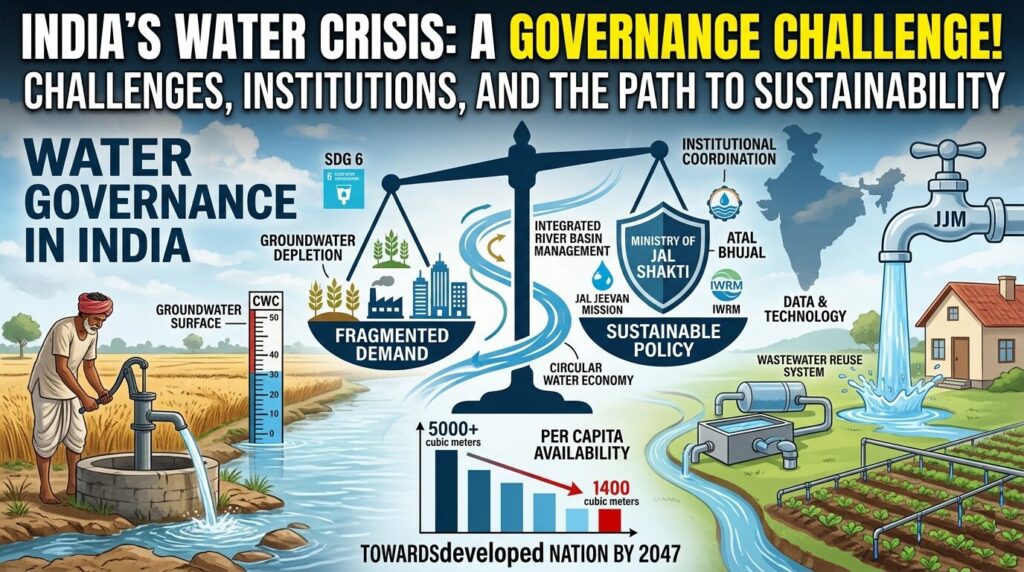
India’s growing water stress and the need for effective governance have once again come into focus amid discussions on sustainable development, groundwater depletion, urban water scarcity and climate resilience. Policymakers are increasingly emphasising that India’s water crisis is not merely a question of scarcity, but one of governance, management and institutional coordination.

The debate gains significance as India seeks to achieve:

  • Sustainable Development Goal (SDG) 6 on clean water and sanitation
  • Long-term economic and developmental goals linked to the vision of becoming a developed nation by 2047

UPSC Relevance

Prelims Relevance

  • Jal Jeevan Mission, Atal Bhujal Yojana, Pradhan Mantri Krishi Sinchayee Yojana, Namami Gange Programme, Constitutional provisions related to water, Groundwater and irrigation

Mains Relevance

GS Paper 2

  • Federalism, Centre-State relations, Governance, public policy, Decentralisation, local governance

GS Paper 3

  • Water conservation, resource management, Climate change, sustainable development, Agriculture and irrigation, Urban infrastructure, environmental management

Essay

  • Water security and development
  • Sustainable governance
  • Climate resilience and natural resources

Background and Context

Water is central to:

  • Agriculture
  • Industrial development
  • Public health
  • Food security
  • Ecological sustainability

India possesses significant water resources in absolute terms due to:

  • Monsoon rainfall
  • Himalayan river systems
  • Groundwater aquifers

However, despite receiving nearly 4,000 billion cubic metres (BCM) of annual rainfall, only a portion becomes effectively usable due to:

  • Uneven spatial distribution
  • Seasonal concentration of rainfall
  • Inadequate storage infrastructure
  • Pollution and ecological degradation

Hydrological assessments indicate that only around 1,100 BCM of water is considered utilisable.

India’s water challenge has therefore evolved from a purely physical scarcity problem into a broader governance and sustainability issue.

The Emerging Water Crisis in India

Declining Per Capita Water Availability

India’s per capita water availability has steadily declined because of:

  • Population growth
  • Urbanisation
  • Industrialisation
  • Rising agricultural demand

Per capita availability:

  • Exceeded 5,000 cubic metres annually after independence
  • Has now declined to nearly 1,400 cubic metres

According to international standards:

  • Below 1,700 cubic metres indicates water stress
  • Below 1,000 cubic metres indicates water scarcity

Several Indian regions are approaching severe stress conditions.

Groundwater Depletion

India is the world’s largest extractor of groundwater, accounting for nearly one-fourth of global groundwater extraction.

Groundwater supports:

  • Irrigation
  • Drinking water
  • Rural livelihoods

However, overdependence has caused:

  • Falling water tables
  • Aquifer depletion
  • Land subsidence in some regions
  • Declining water quality

States such as:

  • Punjab
  • Haryana
  • Rajasthan
  • Gujarat
  • Tamil Nadu

face serious groundwater stress.

Regional and Seasonal Imbalances

India’s rainfall is highly uneven:

  • Most rainfall occurs during the southwest monsoon
  • Some regions face floods while others face droughts

For example:

  • Assam and Bihar often experience floods
  • Rajasthan and parts of peninsular India face chronic water scarcity

This uneven distribution creates major governance challenges.

Water Pollution

Rivers, lakes and groundwater sources are increasingly polluted due to:

  • Untreated sewage
  • Industrial effluents
  • Agricultural runoff
  • Solid waste dumping

The Central Pollution Control Board (CPCB) has identified several polluted river stretches across the country.

Pollution reduces the quantity of usable freshwater and increases health risks.

Gemini Generated Image btupuvbtupuvbtup 1

Constitutional and Federal Dimensions of Water Governance

Water as a State Subject

Under the Seventh Schedule of the Constitution:

  • Water primarily falls under the State List (Entry 17)

States are responsible for:

  • Irrigation
  • Water supply
  • Canal systems
  • Groundwater management

Union Government’s Role

The Union can legislate on inter-State rivers under:

  • Entry 56 of the Union List

This creates a complex federal framework where both Union and States influence water governance.

Article 262

Article 262 empowers Parliament to adjudicate inter-State river water disputes.

Parliament enacted:

  • Inter-State River Water Disputes Act, 1956

to resolve river-sharing conflicts.

Important Inter-State Water Disputes

India has witnessed several major disputes:

  • Cauvery dispute
  • Krishna dispute
  • Ravi-Beas dispute
  • Mahadayi dispute

These conflicts highlight the political and federal complexities of water governance.

Institutional Architecture of Water Governance

Ministry of Jal Shakti

Created in 2019 by merging:

  • Ministry of Water Resources
  • Ministry of Drinking Water and Sanitation

It acts as the nodal ministry for:

  • Water resources
  • Drinking water
  • Sanitation
  • River development

Central Water Commission (CWC)

The CWC is responsible for:

  • Surface water planning
  • Flood management
  • River basin development
  • Technical guidance

Central Ground Water Board (CGWB)

The CGWB:

  • Assesses groundwater resources
  • Conducts aquifer mapping
  • Provides scientific data for groundwater management

NITI Aayog and Water Governance

NITI Aayog introduced the:

  • Composite Water Management Index (CWMI)

The index evaluates States on:

  • Irrigation efficiency
  • Groundwater management
  • Drinking water
  • Watershed development

It aims to improve competitive and evidence-based governance.

Major Government Initiatives

Jal Jeevan Mission (JJM)

Launched in 2019, the mission aims to provide:

  • Functional Household Tap Connections (FHTCs)
    to all rural households.

The programme focuses on:

  • Drinking water access
  • Water quality
  • Community participation
  • Source sustainability

The mission has significantly expanded rural tap water coverage.

Importance

Access to safe drinking water:

  • Improves public health
  • Reduces disease burden
  • Benefits women and children by reducing water collection burdens

Atal Bhujal Yojana

This scheme targets groundwater sustainability in water-stressed regions.

It promotes:

  • Participatory aquifer management
  • Water budgeting
  • Community monitoring

The programme reflects a shift from top-down regulation toward local participation.

Pradhan Mantri Krishi Sinchayee Yojana (PMKSY)

The scheme seeks to improve irrigation efficiency through:

  • “Per Drop More Crop”
  • Micro-irrigation
  • Watershed development

Agriculture consumes nearly 80% of India’s freshwater resources, making irrigation reform critical.

Atal Mission for Rejuvenation and Urban Transformation (AMRUT)

AMRUT aims to improve:

  • Urban water supply
  • Sewerage systems
  • Wastewater treatment
  • Urban infrastructure

Urban water governance is increasingly important due to rapid urbanisation.

Namami Gange Programme

The programme combines:

  • River cleaning
  • Sewage treatment
  • Riverfront development
  • Biodiversity conservation
  • Ecological restoration

It represents a basin-based approach to river management.

The Need for Integrated Water Resource Management

Traditional water governance often treated:

  • Surface water
  • Groundwater
  • Irrigation
  • Drinking water
  • Wastewater

as separate sectors.

Modern approaches advocate:

Integrated Water Resource Management (IWRM)

IWRM promotes coordinated management of:

  • Water
  • Land
  • Ecosystems

to maximise social and economic welfare without compromising ecological sustainability.

Core Principles of IWRM

River Basin Approach
Water should be managed at the river basin level rather than through fragmented administrative boundaries.

Participatory Governance
Local communities, farmers and urban residents should participate in decision-making.

Ecological Sustainability
Wetlands, rivers and aquifers must be protected as ecological assets rather than merely economic resources.

Circular Water Economy

A circular water economy aims to:

  • Reduce wastage
  • Recycle wastewater
  • Improve efficiency
  • Reuse treated water

This approach is becoming increasingly important for water-stressed countries.

Wastewater Reuse

Treated wastewater can be used for:

  • Industry
  • Agriculture
  • Urban landscaping

This reduces pressure on freshwater resources.

Cities such as Chennai and Nagpur have initiated wastewater reuse models for industrial purposes.

Efficient Irrigation Practices

Technologies such as:

  • Drip irrigation
  • Sprinkler irrigation
  • Precision agriculture

can significantly reduce water consumption.

Crop Diversification

Water-intensive crops such as:

  • Paddy
  • Sugarcane

are often cultivated in ecologically unsuitable regions.

Encouraging less water-intensive crops can improve sustainability.

Climate Change and Water Security

Climate change is intensifying water-related risks through:

  • Erratic monsoons
  • Floods
  • Droughts
  • Glacier retreat
  • Sea-level rise

The Himalayan glaciers, which feed major river systems, are vulnerable to warming temperatures.

Climate-resilient water governance is therefore becoming essential for:

  • Food security
  • Energy security
  • Urban resilience

Challenges in India’s Water Governance

Institutional Fragmentation

Multiple agencies operate with overlapping mandates, creating:

  • Coordination failures
  • Administrative duplication
  • Policy inconsistency

Weak Groundwater Regulation

Groundwater extraction remains poorly regulated despite severe depletion.

In many regions, groundwater functions as an open-access resource.

Urban Water Mismanagement

Cities face:

  • Leakages
  • Non-revenue water losses
  • Poor sewage treatment
  • Encroachment of water bodies

Urban planning often neglects hydrological sustainability.

Inadequate Data and Monitoring

Reliable real-time water data remains limited.

Effective governance requires:

  • Aquifer mapping
  • Water accounting
  • Digital monitoring systems

Socio-Economic Inequality

Marginalised communities often face:

  • Unequal access to safe water
  • Poor sanitation
  • Higher vulnerability to droughts and contamination

Thus, water governance is also linked to social justice.

Way Forward

Strengthening Local Water Governance

Gram Panchayats, urban local bodies and water user associations should play a greater role in:

  • Water budgeting
  • Source protection
  • Local monitoring

Decentralised governance improves accountability and sustainability.

Promoting Aquifer-Based Groundwater Management

Groundwater governance should shift toward:

  • Scientific aquifer mapping
  • Community regulation
  • Participatory water budgeting

This can reduce over-extraction.

Expanding Wastewater Recycling

Indian cities should invest in:

  • Sewage treatment infrastructure
  • Wastewater reuse systems
  • Industrial water recycling

This is essential for long-term urban water security.

Improving Agricultural Water Efficiency

Policy reforms should encourage:

  • Crop diversification
  • Micro-irrigation
  • Climate-resilient agriculture

Water pricing and incentives should discourage wasteful extraction.

Adopting River Basin Management

Integrated river basin authorities can improve:

  • Inter-State coordination
  • Ecological management
  • Flood and drought planning

This is particularly important for transboundary rivers.

Leveraging Technology and Data

Use of:

  • Remote sensing
  • GIS mapping
  • AI-based forecasting
  • Smart metering

can improve evidence-based water governance.

Protecting Ecosystems

Wetlands, forests and rivers must be treated as natural infrastructure that supports:

  • Groundwater recharge
  • Flood control
  • Biodiversity
  • Climate resilience

Ecological restoration should become central to water policy.

Conclusion

India’s water challenge is fundamentally a governance challenge shaped by institutional capacity, ecological sustainability and social equity. Although the country receives substantial rainfall, inefficient management, groundwater overexploitation, pollution and fragmented governance have created conditions of increasing water stress.

The future of India’s water security will depend not only on increasing supply but also on transforming governance systems through scientific planning, technological innovation, ecological conservation and participatory institutions. A sustainable and equitable water future requires moving from fragmented management toward integrated and circular water governance frameworks.

UPSC Practice Questions

Prelims MCQ 1

With reference to water governance in India, consider the following statements:

  1. Water is primarily a State subject under the Constitution of India.
  2. Article 262 relates to adjudication of inter-State river water disputes.
  3. The Central Ground Water Board is responsible for groundwater assessment and aquifer management studies.

How many of the above statements are correct?

(a) Only one
(b) Only two
(c) All three
(d) None

Answer: (c) All three

Explanation:

  • Statement 1 is correct because water falls under Entry 17 of the State List.
  • Statement 2 is correct as Article 262 deals with inter-State river water disputes.
  • Statement 3 is correct because CGWB undertakes groundwater assessment and aquifer studies.

Prelims MCQ 2

Which of the following initiatives specifically focuses on participatory groundwater management in water-stressed regions?

(a) Namami Gange Programme
(b) Atal Bhujal Yojana
(c) AMRUT Mission
(d) Jal Jeevan Mission

Answer: (b) Atal Bhujal Yojana

Explanation:

Atal Bhujal Yojana promotes community-based groundwater management and water budgeting in water-stressed regions.

UPSC Mains Questions

  1. Examine the institutional and ecological challenges associated with water governance in India. Suggest measures required for achieving sustainable and integrated water resource management.
  2. India’s water crisis is increasingly becoming a governance challenge rather than merely a problem of physical scarcity. Discuss.

In a Shifting World Order, Five Principles Should Guide India’s Diplomacy

Open article →Download PDF

Why in News?

Indian Prime Minister’s visit to the United Arab Emirates (UAE) en route to Europe — encompassing the Netherlands, Sweden, Norway, and Italy — comes amid growing uncertainty over the fragile ceasefire between the United States and Iran, threat of regional escalation in West Asia, and an upcoming Trump-Xi Jinping summit in Beijing, China. 

Simultaneously, India is set to host BRICS and Quad foreign ministers’ meetings in New Delhi, and an India-Africa Summit. Together, these diplomatic events highlight the five core principles that should anchor India’s foreign policy during this period of extraordinary geopolitical turbulence.

UPSC Relevance: GS-2 International Relations: India’s Foreign Policy 

Mains: India’s Foreign Policy: Key Aspects & Challenges.  

Five Principles that should guide India’s Diplomacy: 

1. Principle of Reciprocity: 

Reciprocity means supporting partners who support India’s core interests. 

  • The UAE has consistently backed India on critical issues like Kashmir and cross-border terrorism. The UAE is one of India’s most important strategic partners: it is a major energy supplier, a growing source of investment, and home to millions of Indian diaspora whose remittances and contributions bind the two nations deeply.
  • PM’s visit to Abu Dhabi during heightened regional tensions demonstrates that India values this solidarity and reciprocates it. India’s diplomatic solidarity builds durable strategic partnerships, enhances diplomatic reliability and creates long-term political and economic benefits. 

2. Principle of Diversification: 

India must deepen engagement with multiple regions and not over-rely on any single power or bloc. 

  • Historically, India’s engagement with Europe remained limited during the Cold War due to its proximity to the Soviet Union.
  • The recent conclusion of trade agreements with the European Union (EU) and the European Free Trade Association (EFTA) reflects India’s new strategic appreciation of Europe.  Europe has now emerged as a critical partner in:
    • Trade and investment
    • Green technologies
    • Clean energy transition
    • Higher education and skilled mobility
    • Advanced manufacturing and innovation.
  • Diversification reduces overdependence on any one power bloc and improves India’s economic and technological resilience.

3. Principle of Strategic Flexibility: 

Strategic flexibility means adapting to rapid shifts in great-power dynamics. India must avoid rigid alignments and maintain issue-based partnerships.

  • The evolving relationship among the United States, China, Europe, and Russia is reshaping global geopolitics. 
  • India must prioritise relationships based on concrete gains rather than sentiment, such as working with Israel on defence, the Gulf states on energy, and maintaining ties with both Russia and the West.

4. Principle of Strategic Expansion: 

India must deepen engagement with emerging regions, particularly Africa.

  • Africa is becoming increasingly important because of rapid population growth, expanding consumer markets, and vast reserves of critical minerals. Global powers, including China, the US, Russia, Turkey, and Gulf countries, are intensifying their presence in Africa.
  • While India’s ties with Africa have historically been rooted in anti-colonial solidarity, the relationship now requires a sharper strategic focus on trade ties, investment, connectivity, and maritime and security cooperation.  

5. Domestic Renewal: 

Domestic strength remains the foundation of effective diplomacy.

  • No foreign policy activism can compensate for weak economic growth, bureaucratic inefficiency, technological backwardness and lack of industrial competitiveness.
  • Countries that continuously reform internally are better able to attract investment, shape global rules, expand geopolitical influence, and secure prosperity for citizens. 

India’s diplomacy is entering a phase of complex multi-dimensional engagement in an increasingly fragmented world order. India’s long-term global influence will depend not only on diplomatic outreach abroad but also on sustained economic and institutional transformation at home.