Opens in a new tab
Join Anantam IAS Channel on Telegram

Daily Digest · Friday

22 May 2026 Current Affairs for UPSC

8 current affairs published on Friday, 22 May 2026

22 May 2026 Current Affairs for UPSC — every Why-in-News article AnantamIAS published on Friday, 22 May 2026, broken down with Why in News?, the exact GS paper it feeds, sub-topic mapping, MCQ-ready facts and a UPSC-style practice question. 8 articles in total, covering Polity, Economy, Environment, S&T, IR, Geography, History, Society and Internal Security — the same Why-in-News + GS-paper-mapping + practice-question format the Compass uses across every daily digest on the site.

Daily current affairs for UPSC is where new material enters your prep stream. Read this 22 May 2026 digest end-to-end in 25–35 minutes, attempt the practice question at the foot of each article (it's MCQ for some, 10/15-marker for others), then bookmark the entries that fall inside your active revision window. Everything stays cross-linked: tap any subject pill to jump to that subject's hub, or use the table of contents above to skip straight to a specific story.

Use this page three ways. Read sequentially for a one-sitting scan of everything that mattered on 22 May 2026. Download the 22 May 2026 PDF below for offline study or print revision. Or use the May 2026 Current Affairs compilation to see this day in the month's full context. For the previous day's reading, see 21 May 2026 Current Affairs; the next day's is 23 May 2026 Current Affairs.

Why we publish daily current affairs separately from the monthly compilation: daily is learning, monthly is revision. Use the daily page to add fresh material to your notes the day it breaks; come back to the May 2026 compilation 60 days before Prelims when the noise has settled and only the lasting takeaway is worth re-reading.

What does Russia’s growing dependence on China mean for India’s Security?

Open article →Download PDF

Why in News?

The Russian President arrived in Beijing, China, less than a week after the US President concluded his three-day visit. Such high-level engagements underline China’s emergence as a central hub of global diplomacy. 

UPSC Relevance: GS-2 International Relations: Effect of policies and politics of developed and developing countries on India’s interests. 

Mains: Implications of Russia’s growing dependence on China for India. 

The deepening Russia-China strategic partnership, accelerated by Western sanctions post-2022, is reshaping Asia’s security architecture. 

As Moscow’s dependence on Beijing grows, India’s traditional twin-pillar strategy, balancing a security partnership with the US while maintaining strong ties with Russia, faces fundamental stress, demanding a fresh strategic recalibration.

Phases of Russia-China Relations: 

Russia-China relations span three broad historical phases. 

  • In the imperial period, the two civilisational states coexisted across a shared border of roughly 4,300 km. 
  • Episodic tensions arose from 19th-century treaties: Aigun (1858), Peking (1860), and Tarbagatai (1864), which China regards as imposed under duress during its period of humiliation.
  • The 1950 Treaty of Friendship brought the two communist states close.
  • The Sino-Soviet schism of the 1960s, driven by disputes over Marxist interpretation, nuclear technology, and Stalin’s legacy, culminated in armed border clashes in 1969. This split created the geopolitical opening for then US President’s 1972 visit to Beijing and cementing of the Washington-Beijing-Islamabad triangle.
  • In the post-Soviet period, formal relations resumed with the Strategic Partnership Treaty of 1992. 
  • The relationship gained decisive momentum under Putin and Xi Jinping, who have met over 40 times since 2012 and declared a no-limits partnership in 2022, days before Russia invaded Ukraine.

Nature and Depth of Russia-China Interdependence: 

The post-2022 economic relationship is structurally asymmetric: Russia needs markets, technology, and capital, while China needs energy and defence products. Western sanctions have turned this complementarity into a dependency.

  • Bilateral trade between China and Russia reached over $228.1 billion in 2025. China represents roughly 32% of Russia’s total global trade.
  • China is the largest single buyer of Russian crude, accounting for about 42% of Russia’s global crude exports annually. 
  • China has filled the vacuum left by Western firms across automobiles, telecom, semiconductor supply, and industrial electronics. 
  • Power of Siberia 1 pipeline (3,000 km) reached full capacity in 2025, and negotiations continue on Power of Siberia 2 (2,600 km) through Mongolia from Arctic gas fields. 
  • Bilateral trade is increasingly settled in yuan and ruble, reflecting accelerating de-dollarisation. 
  • In military-technical cooperation, China and Russia held a senior-level defence meeting in 2025 to deepen security cooperation.

Despite the rhetorical closeness, a formal military alliance is unlikely in the near term as China does not wish to be dragged into Russia’s conflict with the West. Russia similarly wishes to avoid engaging in China’s confrontation with the US over Taiwan.

Implications for India’s Security: 

  • Erosion of Russia as a strategic balancer: A 2025 statement by Russia’s ambassador to India confirmed Moscow would remain neutral in any India-China war. This is a stark departure from the historical Soviet role of providing India a counterbalance against China on the continental landmass.
  • Shrinking diplomatic space: India’s twin-pillar strategy, balancing US partnership with Russia ties, is under stress as both Trump and Putin simultaneously court Xi Jinping. India’s leverage within BRICS and the SCO has been curtailed by growing Sino-Russian alignment within these forums. 
  • Defence supply chain vulnerabilities: Russia remains India’s largest historical arms supplier, but deliveries have been delayed due to sanctions-related disruptions. India’s Parliamentary Standing Committee on Defence (2025) warns that any coercive dismantlement of India-Russia defence links would create operational asymmetries across two hostile borders.
  • Economic pressure from the US: From August 2025, India faces 50% US tariffs, including a 25% penalty tied to its Russian oil purchases. This constrains India’s ability to exploit discounted Russian energy without geopolitical cost, complicating its multi-alignment calculus.

India’s Strategic Response: the Multi-Alignment Framework: 

  • Defence diversification: India has systematically reduced dependence on Russian arms since 2024, sourcing from France (Rafale jets, Scorpene submarines), the US (MQ-9B drones, Javelin missiles, Stryker vehicles), and Israel. India’s Defence Budget 2025-26 stands at ₹6.81 lakh crore (1.85% of GDP), with rising capital outlay for indigenous platforms like Tejas LCA, INS Vikrant, and BrahMos exports.
  • Minilateral coalition-building in the Indo-Pacific: India is deepening the Quad (with the US, Japan, and Australia), engaging in Indo-Pacific Economic Framework for Prosperity (IPEF), and conducting joint maritime patrols. Deepening ties with South Korea (shipbuilding) and accelerating FTAs with the UK and EU diversify India’s security and economic partnerships.
  • Stabilising the China relationship directly: India and China reached a patrolling agreement in October 2024 to defuse Himalayan border tensions. The Modi-Xi meeting at the SCO Summit in Tianjin (2025) marked the first high-level bilateral engagement in seven years, signalling India’s intent to manage the China relationship independently of its Russia and US ties.
  • Sustained Russia engagement on India’s terms: India continues nuclear submarine leasing and civil nuclear cooperation with Russia, and maintains BRICS and SCO participation as platforms to assert its own interests within China-dominated multilateral groupings. Putin visited India in 2025, reinforcing India’s preference for managed, sovereign engagement with Moscow.
  • Atmanirbhar Bharat as strategic insurance: Domestic defence manufacturing through DPSUs and private sector participation is now a core pillar of India’s security strategy, reducing long-term structural dependence on any single external supplier, whether Russia, the US, or France.

India must treat the Sino-Russian partnership as a long-term reality and build strategic resilience through defence indigenisation, diversification, calibrated Quad engagement, balanced China policy, and selective Russia ties. 

India’s goal should be an actively shaped multipolar order driven by indigenous capability, coalition-building, and strategic autonomy.
Sedition trials can go on if accused is willing: Supreme Court

Open article →Download PDF

Why in News?

The Supreme Court recently clarified that trials, appeals, and related proceedings involving sedition under Section 124A of the Indian Penal Code (IPC) may continue if the accused has no objection. The clarification comes four years after the Court had put a stay on pending sedition proceedings while the Union government reconsidered the colonial-era provision.

UPSC Relevance:

Prelims: Sedition law, Article 19, Article 21, UAPA,

Mains: GS II (Fundamental Rights, Judiciary, Criminal Justice Reforms).

Background/Context

The offence of sedition under Section 124A IPC was introduced by the British colonial administration in 1870 to suppress dissent and nationalist movements.

The law criminalised acts or speech that brought or attempted to bring hatred, contempt, or disaffection against the government established by law.

Several freedom fighters including Mahatma Gandhi and Bal Gangadhar Tilak were prosecuted under this provision.

Following independence, the provision continued in the IPC and became the subject of constitutional debate due to concerns regarding freedom of speech and expression.

In May 2022, the Supreme Court, while hearing challenges to Section 124A, suspended ongoing sedition proceedings and expected governments to refrain from filing new cases until the Union government completed a review of the provision.

The latest order clarifies that proceedings can continue if the accused voluntarily seeks continuation of trial or appeal.

Understanding Sedition under Section 124A IPC

Section 124A of IPC punished actions or expressions that attempted to create:

  • Hatred against the government.
  • Contempt toward the government.
  • Disaffection against the government.

Punishment included:

  • Life imprisonment, or
  • Imprisonment up to three years along with fines.

The law was criticised because of broad and vague expressions that could potentially criminalise legitimate criticism and dissent.

Judicial Evolution of Sedition Law

Kedar Nath Singh v. State of Bihar

The Supreme Court upheld the constitutional validity of Section 124A while limiting its scope.

The Court held that sedition applies only when speech:

  • Incites violence; or
  • Creates public disorder.

Mere criticism of government policies was held insufficient to constitute sedition.

Supreme Court Interim Order (2022)

The Court observed that there was a need to balance:

  • National security and sovereignty concerns.
  • Protection of civil liberties and fundamental rights.

The Court accordingly:

  • Suspended ongoing proceedings.
  • Expected governments to avoid registering fresh cases.
  • Directed reconsideration of the provision.

Present Clarification (2026)

The Supreme Court has clarified that:

  • Trials may proceed if the accused consents.
  • Courts may decide cases on merits according to law.
  • Judicial review of sedition provisions remains pending.

Sedition and Bharatiya Nyaya Sanhita (BNS)

Though Section 124A IPC has effectively ceased to operate after replacement of IPC by BNS, concerns continue regarding Section 152 of the BNS.

Section 152 criminalises acts involving:

  • Endangering sovereignty.
  • Endangering unity and integrity of India.
  • Encouraging separatist activities.
  • Subversive actions against the State.

Critics argue that some provisions resemble or expand the scope of the earlier sedition framework.

Supporters contend that the provision focuses more directly on threats against national integrity rather than criticism of government.

Constitutional Dimensions

Article 19(1)(a): Freedom of speech and expression

Citizens have the right to express opinions and criticise the government.

Article 19(2): Reasonable restrictions

Restrictions may be imposed in the interests of:

  • Sovereignty and integrity of India
  • Security of the State
  • Public order
  • Friendly relations with foreign states

Article 21: Right to life and personal liberty

The right includes:

  • Fair procedure
  • Protection against arbitrary detention
  • Speedy trial

Challenges and Concerns

Vagueness and Broad Interpretation

Terms such as “disaffection” or “subversive activity” may be interpreted broadly, increasing risks of misuse.

Prolonged Undertrial Detention

Individuals accused under national security laws often remain incarcerated for extended periods before trial completion.

Chilling Effect on Free Speech

Fear of prosecution may discourage criticism, debate and democratic participation.

Balancing Security and Liberty

The State has a legitimate responsibility to protect national integrity, but this must be balanced against constitutional freedoms.

Continuity of Colonial Legal Legacy

Retention of colonial-era provisions raises questions regarding compatibility with democratic constitutional values.

Way Forward

Clear Legislative Definitions

Parliament should ensure precise and narrow definitions of offences affecting sovereignty and national security to avoid misuse.

Strengthening Judicial Safeguards

Courts should continue applying strict standards requiring evidence of incitement to violence or public disorder.

Ensuring Speedy Trials

Cases involving national security offences should be fast-tracked to avoid prolonged incarceration.

Periodic Review of Criminal Laws

Criminal provisions affecting civil liberties should be periodically reassessed according to constitutional principles.

Protecting Democratic Dissent

Legal frameworks should distinguish between legitimate criticism of government and genuine threats to national security.

Conclusion

Democratic systems require both national security and constitutional freedoms. The Supreme Court’s clarification reflects continuing attempts to balance these competing concerns. As India reforms its criminal justice architecture through new legislation, ensuring that security laws do not suppress legitimate dissent remains essential to preserving constitutional democracy.

Practice Questions

Prelims Question 1

With reference to sedition law in India, consider the following statements:

  1. Section 124A of the IPC was introduced during British rule.
  2. The Supreme Court in the Kedar Nath Singh case held that mere criticism of the government amounts to sedition.
  3. Article 19(2) permits reasonable restrictions on freedom of speech.

Which of the statements given above is/are correct?

(a) 1 only
(b) 1 and 3 only
(c) 2 and 3 only
(d) 1, 2 and 3

Correct Answer: (b)

Explanation:
Statement 2 is incorrect because the Supreme Court restricted sedition to acts involving incitement to violence or public disorder.

Prelims Question 2

Consider the following rights:

  1. Freedom of speech and expression
  2. Right to life and personal liberty
  3. Right against arbitrary detention

Which of the above are associated with debates surrounding sedition laws?

(a) 1 only
(b) 1 and 2 only
(c) 1, 2 and 3
(d) 2 and 3 only

Correct Answer: (c)

Explanation:
Debates over sedition involve free speech protections under Article 19 and personal liberty protections under Article 21, including concerns over arbitrary detention.

Mains Question

  1. Discuss the constitutional issues surrounding sedition laws in India. How can national security concerns be balanced with freedom of expression?
  2. Examine whether criminal law reforms under the Bharatiya Nyaya Sanhita adequately address concerns regarding misuse of sedition provisions.

Regulation vs Ban of Online Gaming: Lessons for India’s Digital Governance

Open article →Download PDF

Why in News?

The implementation of the Promotion and Regulation of Online Gaming (PROG) Act, 2025, has triggered debate regarding the effectiveness of blanket prohibitions on online gaming involving money. Studies indicate that instead of reducing participation, many users have shifted toward unregulated offshore platforms, raising concerns about cybercrime, money laundering and consumer protection.

UPSC Relevance

Prelims: Information Technology Act, cybercrime, online gaming regulation, money laundering, digital governance.

Mains:
GS-II: Government policies and interventions; issues relating to governance and digital regulation.
GS-III: Cybersecurity, money laundering, digital economy and internal security.

Background/Context

The rapid expansion of internet penetration, digital payments and smartphone access has transformed online gaming into a large digital industry in India. Concerns over addiction, financial losses, privacy risks and youth vulnerability led to regulatory interventions by States and the enactment of the PROG Act, 2025.

However, restrictions on domestic platforms appear to have encouraged users to migrate to offshore and unregulated networks that function outside India’s legal framework. This has reopened the debate on whether regulation is preferable to outright prohibition.

Understanding Online Gaming Regulation in India

Online gaming broadly includes:

  • Games of skill: Outcomes depend predominantly on expertise, strategy and knowledge.
  • Games of chance: Outcomes depend primarily on luck and probability.

Indian courts have traditionally distinguished games of skill from gambling activities.

Key constitutional aspects

  • Entry 34, State List: Betting and gambling fall under State jurisdiction.
  • Entry 31, Union List: Telecommunications and digital communication networks involve Central jurisdiction.
  • Article 19(1)(g): Guarantees freedom to practice trade or profession, subject to reasonable restrictions.

The digital nature of online gaming creates overlap between State and Central domains.

Major Concerns Emerging from Blanket Prohibitions

Migration toward offshore platforms

Restrictions on domestic platforms can redirect users toward foreign operators that remain outside regulatory oversight.

  • Offshore entities frequently change domains and mirror websites.
  • Users access services through VPNs and encrypted channels.

Consumer protection challenges

Unregulated platforms generally lack:

  • Grievance redress mechanisms.
  • Age verification systems.
  • Deposit limits.
  • Data protection safeguards.

Users often have limited legal recourse in cases of fraud.

Threat of money laundering and illegal finance

Illegal gaming networks can become channels for:

  • Hawala transactions, Money laundering, Terror financing, Cyber-enabled fraud.

The use of “mule accounts” and anonymous digital transactions complicates investigations.

Cybersecurity and privacy risks

Offshore applications may collect sensitive user information without complying with Indian data protection standards.

Administrative limitations

Blocking websites alone may prove ineffective because:

  • Domains can rapidly reappear.
  • VPNs bypass geographic restrictions.
  • Encrypted applications reduce traceability.

Wider Governance Lessons: Why Bans Often Face Limitations

Digital markets differ from conventional markets because digital services can cross borders instantly.

Examples from other sectors show that prohibitory approaches often lead to:

  • Expansion of underground markets.
  • Reduced regulatory visibility.
  • Increased criminal activity.
  • Weak enforcement capacity.

Thus, governance increasingly shifts from “prohibition” toward “risk management.”

International Experiences

United Arab Emirates

The UAE introduced a controlled licensing structure with:

  • Strict compliance requirements.
  • Financial monitoring systems.
  • Deposit and spending limits.
  • Consumer safeguards.

Sri Lanka

Sri Lanka is moving toward establishing a centralised gambling regulatory authority to monitor online activity.

Broader international trend

Many countries increasingly favour:

  • Licensed operators.
  • Responsible gaming norms.
  • Real-time monitoring systems.
  • Strong anti-money laundering measures.

Challenges in Building a Regulatory Framework

Jurisdictional overlap

Coordination between the Centre and States remains difficult because online platforms transcend territorial boundaries.

Technological sophistication of illegal networks

Illegal operators frequently use:

  • VPNs
  • Proxy servers
  • Cryptocurrency payments
  • Encrypted messaging services

Social concerns

Excessive online gaming can contribute to:

  • Addiction
  • Financial distress
  • Psychological stress
  • Youth vulnerability

Enforcement gaps

Regulatory agencies require stronger technological capabilities for monitoring digital ecosystems.

Key Terms

Offshore platform: A digital platform operating outside India’s legal and regulatory jurisdiction.

Money laundering: The process of concealing the origins of illegally obtained money and presenting it as legitimate income.

Mule account: A bank account used by criminals to transfer or hide illicit funds.

VPN (Virtual Private Network): Technology that masks a user’s location and internet activity.

Challenges/Criticisms

  • Blanket bans may produce unintended consequences.
  • Excessive restrictions can reduce regulatory visibility.
  • Domestic industry and innovation may be adversely affected.
  • Enforcement against foreign entities remains difficult.
  • Social harms continue despite prohibition.

Way Forward

Develop a calibrated regulatory framework

India should move toward a licensing-based framework with strong accountability standards rather than complete prohibition.

Introduce responsible gaming safeguards

Mandatory age verification, deposit limits, spending caps and self-exclusion options can reduce harm.

Strengthen anti-money laundering mechanisms

Real-time monitoring of suspicious financial transactions and stronger KYC systems should be integrated.

Improve Centre-State coordination

A harmonised national framework with State participation can reduce regulatory fragmentation.

Enhance digital literacy and awareness

Public campaigns should educate users regarding financial risks, addiction and cyber fraud.

Build technological enforcement capacity

Artificial intelligence-based monitoring systems and cyber intelligence tools can strengthen oversight.

Conclusion

Digital governance increasingly requires balancing innovation with public welfare. The challenge before India is not merely whether online gaming should be allowed or banned, but how a transparent and accountable regulatory ecosystem can protect users while preventing the expansion of illegal networks.

Practice Questions

Prelims MCQ 1

With reference to online gaming regulation in India, consider the following statements:

  1. Betting and gambling fall exclusively under the Union List of the Constitution.
  2. VPNs can make enforcement against offshore platforms more difficult.
  3. Money laundering risks may increase through unregulated online platforms.

Which of the statements given above is/are correct?

(a) 1 only
(b) 2 and 3 only
(c) 1 and 3 only
(d) 1, 2 and 3

Correct Answer: (b)

Explanation: Betting and gambling are primarily in the State List. VPNs and unregulated offshore platforms can complicate enforcement and facilitate illegal financial activities.

Prelims MCQ 2

Consider the following:

  1. Deposit limits
  2. Age verification
  3. Self-exclusion mechanisms
  4. Grievance redress systems

Which of the above can be used as responsible gaming safeguards?

(a) 1 and 2 only
(b) 1, 2 and 3 only
(c) 2, 3 and 4 only
(d) 1, 2, 3 and 4

Correct Answer: (d)

Explanation: All are internationally used safeguards to reduce risks associated with online gaming.

Mains Questions

  1. “Blanket prohibitions in digital markets often create unintended governance challenges.” Examine in the context of online gaming regulation in India.
  2. Discuss the challenges involved in regulating offshore digital platforms in India. Suggest a framework that balances innovation, consumer protection and cybersecurity.

How does the Gaganyaan’s Life-Support System Operate?

Open article →Download PDF

Why in News?

ISRO confirmed that approximately 90% of Gaganyaan’s development work is complete, with the crewed launch now rescheduled to the first quarter of 2027. A key milestone is the indigenous development of the ECLSS (Environmental Control and Life Support System).

UPSC Relevance: GS-3 Science and Technology: Space Technology

Prelims: Gaganyaan Mission, Environmental Control and Life Support System (ECLSS)

What is the Environmental Control and Life Support System (ECLSS)?

  • The ECLSS is the critical subsystem aboard a spacecraft that replicates Earth’s atmospheric conditions in the hostile environment of space. It manages breathable air, potable water, temperature, humidity, cabin pressure, waste handling, and fire safety needed to survive beyond Earth’s atmosphere.
    • For short-duration missions like Gaganyaan (3-7 days), all consumable supplies (oxygen, water, and food) are carried from Earth, and waste is stored in sealed containers for post-mission disposal. 
    • Long-duration missions (e.g., the International Space Station) recycle waste back into usable air and clean water through closed-loop systems.
  • India’s development of the ECLSS is particularly significant: ISRO had no prior experience in building such a system, and despite extensive diplomatic efforts, no other space-faring nation agreed to transfer this technology. ISRO was therefore compelled to develop it entirely indigenously, making it one of the most challenging feats in the Gaganyaan programme.

How does Gaganyaan’s Life-Support System Work?

1. Air Revitalisation System (ARS): 

  • In Earth’s atmosphere, carbon dioxide is naturally removed by photosynthesis and oceanic absorption. 
  • In an enclosed spacecraft cabin, astronauts’ exhalation continuously increases the CO₂ concentration, which must be artificially managed. Elevated CO₂ levels cause hypercapnia, characterised by headaches, dizziness, and impaired cognitive function, which can be fatal if unchecked. 
  • A healthy adult exhales approximately 1 kg of carbon dioxide per day at rest, and this increases substantially with physical exertion. The ARS performs three core functions: (i) supplying fresh oxygen, (ii) removing CO₂, and (iii) filtering trace contaminants and odours that accumulate in the enclosed cabin.
  • In Gaganyaan, lithium hydroxide (LiOH) canisters are used to chemically absorb carbon dioxide. Each canister is also fitted with activated charcoal to adsorb cabin odours. A spent canister is replaced by the crew approximately every 20-24 hours.
  • Oxygen is supplied from high-pressure gas bottles; a crew member requires approximately 0.84 kg of oxygen per day for baseline metabolic functions.

A critical design consideration in microgravity is the absence of natural convection. Without gravity-driven air circulation, pockets of lethal CO₂ or depleted oxygen can form around a crew member. Small fans within the ECLSS continuously circulate cabin air, serving as an artificial circulatory system to prevent such hazardous accumulations.

2. Pressure, Temperature and Humidity Control: 

  • The Gaganyaan crew module is designed to maintain a cabin pressure of 101.3 kPa, equivalent to sea-level atmospheric pressure on Earth. This is achieved using electronic pressure sensors and safety valves that continuously balance oxygen and nitrogen levels. Any deviation from this range can cause barotrauma or hypoxia.
  • Temperature is maintained between 20°C and 26°C, with relative humidity between 30% and 70%. The primary sources of heat inside the cabin are the metabolic body heat of astronauts (100-150 W per crew member) and continuously operating onboard electronics and avionics systems. An active cooling system circulates air through heat exchangers that radiate excess heat into the cold vacuum of space.
  • Humidity management is equally critical. Too little humidity causes dry skin, eye irritation, and the risk of electrostatic discharge damaging sensitive electronics. Too much humidity encourages microbial growth and leads to condensation on electrical components, causing short-circuits or corrosion. Condensing units collect moisture from the air before it can accumulate to dangerous levels.

3. Water Supply and Management: 

  • Water management in space poses unique challenges that do not exist on Earth. In microgravity, liquid does not pour or settle; it forms free-floating globules that can drift into electronics, causing short-circuits, or accidentally enter an astronaut’s respiratory tract if inhaled.
  • In Gaganyaan, all drinking water is stored in specially designed pressurised pouches. Astronauts press the pouch to force water directly into their mouths, completely bypassing the need for gravity. Water is mechanically driven using pressurised bladder systems that prevent gas-liquid mixing, ensuring safe and controlled delivery.
  • Since Gaganyaan is a short-duration mission, there is no onboard water recycling system. All potable water is carried from Earth. Long-duration missions such as those aboard the ISS recover water from urine and cabin humidity through regenerative life support systems — a technology ISRO will likely need for future deep-space or longer-duration missions.

4. Waste Management:

  • Since gravity does not pull waste downward, liquid and solid waste do not follow predictable paths. Without active intervention, waste would float freely in the cabin, creating serious hygiene, health, and contamination hazards.
  • In Gaganyaan, suction-based airflow systems are used for both liquid and solid waste collection. Urine is drawn through specially designed funnels using negative air pressure, while solid faecal matter is collected in specialised faecal collection bags. 
  • All waste is then chemically treated to neutralise odours and inhibit bacterial growth, before being sealed in airtight containers for storage until the crew returns to Earth.

This approach prevents the buildup of toxic gases such as ammonia, controls microbial contamination, and maintains a hygienic environment throughout the mission duration.

5. Fire Detection and Suppression: 

  • On Earth, gravity-driven convection causes hot gases to rise and flames to form a teardrop shape, making them predictable and easier to suppress. In microgravity, fire expands omnidirectionally into a sphere, is harder to contain, and produces significantly more toxic smoke in an enclosed cabin.
  • In Gaganyaan, smoke detectors provide the first line of defence by triggering an audible alarm to alert the crew at the earliest stage of ignition. The primary suppression tool is a fine water mist extinguisher, which both cools the fire rapidly and physically scrubs toxic smoke particles from the cabin air. 

Key fact: Russia’s Soyuz spacecraft retains a last-resort option of depressurising the cabin to starve a fire of oxygen, but only after the crew has donned pressure suits.

What is Gaganyaan Mission?

  • India’s first human spaceflight programme led by the Indian Space Research Organisation.
  • Aim: To carry 3 astronauts (Vyomanauts) to Low Earth Orbit  (400 kilometres) for a short-duration mission (~3–7 days), and bring them back safely to Earth by landing in the Indian waters. 
  • Launch: Crewed launch is scheduled for the first quarter of 2027. 
  • Crew members: Astronauts have been shortlisted by the Indian Air Force (IAF) & ISRO, and trained with international collaboration. The crew will perform microgravity, technology demonstrations and other scientific experiments. 
  • Launch Vehicle: Human-rated Launch Vehicle Mark 3 (LVM3)
  • Human Space Flight Centre will coordinate the implementation of the project. 

Upon completion, India will become the fourth nation to conduct an independent human spaceflight after Russia, the United States and China.

Components of Gaganyaan Mission: 

  • Crew Module (CM) and Service Module (SM): The Orbital Module of Gaganyaan consists of:
    • Crew Module (CM): Habitable capsule for astronauts.
    • Service Module (SM): Provides propulsion, power, avionics and thermal systems. 
  • Crew Module Atmospheric Re-entry Experiment (CARE): CARE (2014) was a key precursor experiment launched using LVM3 (then GSLV Mk III). It validated the full-scale thermal protection and parachute systems essential for surviving the extreme heat of a sub-orbital re-entry, i.e., the capsule’s ability to withstand extreme temperatures (~1600°C+) during atmospheric re-entry.
  • Crew Escape System (CES): CES is the emergency escape system to quickly separate the crew module from the rocket during launch failure. Pad Abort Test (PAT) successfully demonstrated the escape system. Further validated through Test Vehicle missions (TV-D1, TV-D2, etc.).
  • Environmental Control and Life Support System (ECLSS): Engineering models of ECLSS have already been developed and tested. ECLSS ensures a habitable environment inside the crew module: Functions include- Maintain cabin pressure, Regulate oxygen levels, Remove carbon dioxide, Control temperature & humidity, Detect and suppress fire, Manage waste and air purification. 
  • Vyom Mitra: ISRO’s female humanoid robot astronaut. Will fly in upcoming uncrewed mission before the crewed launch (~2027). It will test life-support systems and simulate human presence.

UPSC PYQ 2025

Q. Consider the following space missions: 

I. Axiom-4 

II. SpaDex 

III. Gaganyaan

How many of the space missions given above encourage and support microgravity research?

(a) Only one 

(b) Only two 

(c) All three 

(d) None 

Answer: (c)

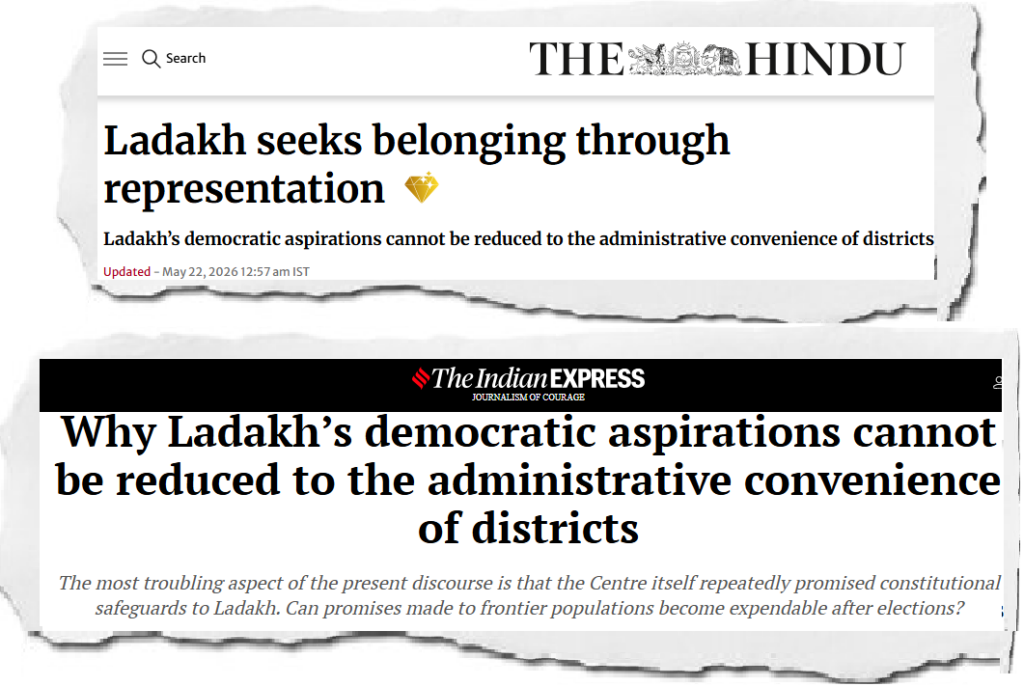
Ladakh seeks belonging through representation 

Open article →Download PDF

Ladakh’s Demand for Representation: Democracy, Sixth Schedule and the Future of India’s Frontier Governance

Why in News?

The debate over Ladakh’s democratic aspirations has resurfaced following the Union government’s emphasis on administrative decentralisation through creation of additional districts rather than granting a legislature or stronger constitutional safeguards under the Sixth Schedule. The issue has gained significance amid continuing demands by Ladakhi groups for constitutional protection over land, jobs, culture and local governance.

UPSC Relevance

Prelims: Sixth Schedule, Union Territories, 73rd and 74th Constitutional Amendments, Article 370, Autonomous District Councils.

Mains:
GS-II: Issues and challenges pertaining to federal structure, devolution of powers, governance and constitutional mechanisms for vulnerable regions.
GS-III: Border area development, internal security and sustainable development of Himalayan regions.

Background/Context

Ladakh became a separate Union Territory in August 2019 after the abrogation of Abrogation of Article 370 and the enactment of the Jammu and Kashmir Reorganisation Act, 2019.

Unlike Delhi and Puducherry, Ladakh was created as a Union Territory without a legislative assembly.

Since then, various political, social and religious organisations in Ladakh have demanded:

  • Statehood or a legislature
  • Inclusion under the Sixth Schedule
  • Constitutional safeguards for land and employment
  • Greater local autonomy

Recently, the Union government announced creation of additional districts such as Nubra, Changthang, Sham, Zanskar and Drass, arguing that administrative decentralisation could improve governance.

However, the debate now extends beyond administrative efficiency and enters larger questions of democracy, federalism and representation.

Understanding the Sixth Schedule

The Sixth Schedule under the Constitution provides special arrangements for tribal-majority areas in northeastern India.

Features of the Sixth Schedule

  • Establishes Autonomous District Councils (ADCs).
  • Provides legislative and executive powers over specified subjects.
  • Protects traditional customs and practices.
  • Allows local management of land and natural resources.
  • Grants powers related to taxation and local administration.

Currently, Sixth Schedule provisions apply in:

  • Assam
  • Meghalaya
  • Mizoram
  • Tripura

Constitutional Basis of Asymmetric Federalism

India does not follow a rigid or uniform federal structure.

The Constitution recognises diversity and allows differentiated arrangements for regions with unique cultural, historical or geographical characteristics.

Examples include:

  • Earlier special provisions under Article 370
  • Article 371 provisions for several States
  • Sixth Schedule arrangements
  • Special provisions for northeastern regions

Thus, constitutional asymmetry has historically been used as an instrument of integration rather than fragmentation.

Why is Ladakh Demanding Greater Representation?

Protection of land and demographic identity

Ladakh possesses:

  • Fragile mountain ecosystems
  • Sparse population
  • Distinct tribal cultures
  • Limited habitable land

Concerns exist regarding:

  • Unregulated land acquisition
  • Large-scale infrastructure projects
  • Migration pressures
  • Cultural dilution

Political participation in decision-making

Administrative bodies can implement policies, but major policy choices require representative institutions.

Issues requiring political participation include:

  • Land rights
  • Tourism expansion
  • Renewable energy projects
  • Mining activities
  • Grazing rights
  • Education and employment policies

Preservation of ecological systems

Ladakh represents a highly sensitive cold desert ecosystem vulnerable to:

  • Climate change
  • Water scarcity
  • Glacial retreat
  • Infrastructure expansion

Local communities argue that ecological decisions should involve elected representation.

Border area confidence and national integration

Ladakh borders:

  • China
  • Pakistan

Border populations often play a significant role in national security.

Political inclusion may strengthen:

  • Trust in institutions
  • Sense of belonging
  • Local participation in governance

Administrative Decentralisation versus Political Representation

A central issue in the debate is the distinction between administrative structures and democratic institutions.

Administrative decentralisationPolitical representation
Focuses on service deliveryFocuses on policy-making
Implemented through districtsImplemented through legislatures
Bureaucratically drivenCitizen-driven
Reports upward to governmentAccountable downward to people
Limited autonomyWider policy authority

Creation of districts improves administrative accessibility but may not address larger concerns regarding political agency.

Arguments Advanced Against Legislature or Sixth Schedule Status

Sparse population

It is argued that Ladakh’s relatively small population may not justify a legislature.

Strategic sensitivity

Because Ladakh lies along sensitive borders, stronger Central control is considered necessary.

Financial dependence

The argument suggests that Ladakh’s dependence on central transfers limits viability of autonomous institutions.

Counter-Arguments to These Objections

Small population has never prevented political empowerment

Several States entered the Union with relatively small populations:

  • Nagaland
  • Mizoram
  • Sikkim
  • Arunachal Pradesh

Political representation was not denied because of population size.

Strategic importance may require greater participation

Border populations with stronger political ownership may contribute more effectively to national integration.

Arunachal Pradesh itself demonstrates that strategic sensitivity can coexist with democratic empowerment.

Fiscal dependence is common in Indian federalism

India’s fiscal structure is redistributive.

Several States depend significantly on:

  • Tax devolution
  • Grants-in-aid
  • Centrally sponsored schemes

Fiscal dependence has never been treated as grounds for reducing democratic rights.

Emerging Development Questions in Ladakh

Ladakh increasingly occupies an important position in India’s development strategy.

Renewable energy projects

Large renewable energy projects are being planned in areas such as Changthang.

Potential concerns include:

  • Grazing rights of Changpa communities
  • Ecological carrying capacity
  • Land acquisition
  • Revenue sharing
  • Local employment opportunities

Tourism expansion

Rapid tourism growth creates both opportunities and pressures:

Opportunities:

  • Employment generation
  • Infrastructure development

Challenges:

  • Waste management
  • Water scarcity
  • Ecological degradation

Resource extraction and mining

Future mining activities may raise concerns regarding:

  • Environmental sustainability
  • Community participation
  • Benefit-sharing mechanisms

Important Institutions in Ladakh Governance

Ladakh Autonomous Hill Development Council (LAHDC)

Two Autonomous Hill Councils currently function in:

  • Leh
  • Kargil

Functions:

  • Local planning, Development activities, Certain administrative functions

Limitations:

  • Limited legislative powers
  • Dependence on the Union administration

Challenges in Granting Greater Autonomy

Security considerations

Sensitive border locations require balancing autonomy with national security concerns.

Administrative capacity

Creating new institutional structures requires:

  • Human resources
  • Financial resources
  • Administrative mechanisms

Inter-regional differences

Leh and Kargil sometimes differ in political priorities and developmental expectations.

Need for institutional clarity

Questions remain regarding:

  • Extent of legislative powers
  • Relationship with Union administration
  • Scope of Sixth Schedule provisions

Key Terms

Sixth Schedule: Constitutional provisions providing autonomous governance arrangements to tribal regions.

Asymmetric federalism: A system where different regions receive different constitutional arrangements according to their specific needs.

Autonomous District Council: Local representative body with specified legislative and executive powers.

Political representation: Participation of citizens in governance through elected institutions.

Challenges/Criticisms

  • Administrative decentralisation alone may not resolve political demands.
  • Lack of constitutional safeguards can create insecurity regarding land and identity.
  • Excessive centralisation may reduce local participation.
  • Balancing national security and regional autonomy remains complex.

Way Forward

Explore tailored constitutional mechanisms

Ladakh’s unique geography and demographics require a customised approach rather than uniform solutions.

Strengthen local democratic institutions

Existing Hill Councils can be empowered with greater financial and functional authority.

Consider Sixth Schedule-type protections

Safeguards relating to land, tribal culture and local resources may address community concerns.

Promote participatory development

Large infrastructure and energy projects should include structured consultation with local communities.

Balance strategic and democratic objectives

National security and democratic representation should be treated as complementary rather than competing goals.

Encourage sustained dialogue

Continuous engagement among the Union government, local representatives and civil society can create durable solutions.

Conclusion

India’s constitutional strength lies in its ability to accommodate diversity through flexible institutional arrangements. Ladakh’s demands are not merely about administrative restructuring but about participation, dignity and political belonging. The larger challenge before India is to ensure that strategic frontiers are integrated not only through infrastructure and administration, but also through meaningful democratic representation.

Practice Questions

Prelims MCQ 1

With reference to the Sixth Schedule of the Constitution, consider the following statements:

  1. It provides for Autonomous District Councils in certain tribal areas.
  2. It currently applies to all northeastern States.
  3. Autonomous District Councils possess limited legislative powers.

Which of the statements given above is/are correct?

(a) 1 only
(b) 1 and 3 only
(c) 2 and 3 only
(d) 1, 2 and 3

Correct Answer: (b)

Explanation: Sixth Schedule applies only to specified tribal areas of Assam, Meghalaya, Mizoram and Tripura, not all northeastern States.

Prelims MCQ 2

Which of the following best describes asymmetric federalism?

(a) Equal powers distributed to all States
(b) A system where States possess identical constitutional status
(c) A system providing differentiated constitutional arrangements to certain regions
(d) Complete decentralisation of power to local bodies

Correct Answer: (c)

Explanation: Asymmetric federalism recognises regional differences and grants differentiated constitutional arrangements.

Mains Questions

  1. Examine the role of asymmetric federalism in accommodating regional diversity in India. Discuss in the context of Ladakh’s demands.
  2. “Administrative decentralisation cannot substitute political representation.” Critically examine this statement with reference to India’s border regions.

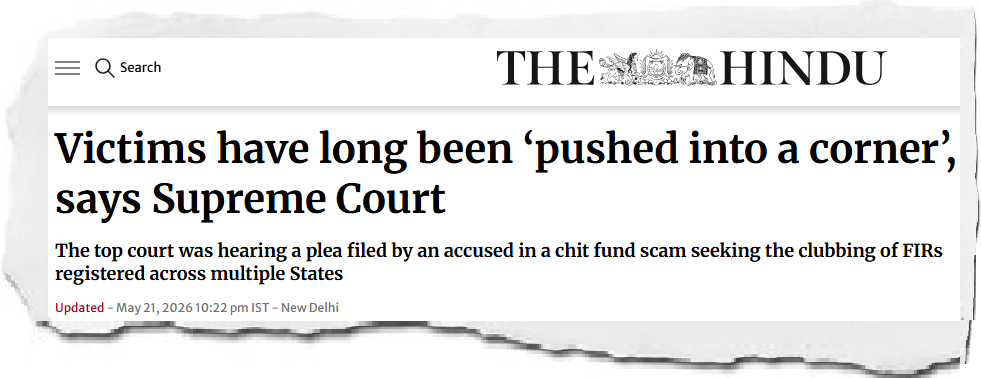
Victims have long been ‘pushed into a corner’, says Supreme Court

Open article →Download PDF

Why in News?

The Supreme Court, while hearing a plea in a multi-crore chit fund scam involving Micro Finance Limited, emphasised the need for a more victim-centric criminal justice system. Refusing to club FIRs registered across different States for the convenience of the accused, the Court observed that victims have historically been “pushed into a corner” and that criminal jurisprudence has largely remained accused-centric.

UPSC Relevance

Prelims: Victim-Centric Criminal Justice, FIR provisions, territorial jurisdiction, Bharatiya Nagarik Suraksha Sanhita (BNSS), Article 21.

Mains:
GS -II: Judiciary, criminal justice reforms, victim rights and access to justice.

Background/Context

India’s criminal justice framework historically evolved around safeguarding the rights of the accused against arbitrary state action. Constitutional guarantees such as protection against self-incrimination, the presumption of innocence, and fair trial provisions aimed to prevent misuse of state power.

However, over time concerns emerged that while accused rights received substantial attention, victims frequently remained peripheral participants in the process. Victims often face financial burdens, prolonged litigation, inadequate compensation, and limited participation in proceedings.

The Supreme Court’s recent observations indicate an attempt to recalibrate this balance by integrating victim rights into the criminal justice framework.

Understanding Victim-Centric Justice

Victim-centric justice refers to an approach where the interests, dignity, protection, and rehabilitation of victims become integral components of criminal proceedings.

It aims to ensure that victims are not treated merely as witnesses but as stakeholders in the justice process.

Key elements include:

Recognition of victims as rights holders

Victims should possess procedural rights during investigation and trial rather than remaining passive observers.

Access to justice

Legal procedures should not impose excessive economic or geographical burdens on victims.

Compensation and rehabilitation

Victims may require financial assistance, psychological support, and rehabilitation measures.

Participation in proceedings

Victims should have opportunities to present concerns and participate in judicial processes where permitted.

Supreme Court’s Observations in the Chit Fund Case

The Court rejected the argument that multiple FIRs should be clubbed into one proceeding solely for the convenience of the accused.

The Court highlighted several concerns:

Burden on poor victims

The Court observed that many investors were labourers, senior citizens and economically weaker individuals who invested their life savings.

Forcing them to travel long distances for hearings would disproportionately affect access to justice.

Territorial jurisdiction and multiple offences

The Bench noted that when a conspiracy results in separate overt acts across different locations, each act creates independent jurisdiction for trial.

Shift from accused-centric jurisprudence

The Court acknowledged that criminal law traditionally focused heavily on accused rights while victim concerns often remained neglected.

Constitutional and Legal Dimensions

Article 21

Article 21 guarantees protection of life and personal liberty.

The judiciary has progressively interpreted Article 21 broadly to include:

  • Right to fair trial, Right to speedy justice, Right to dignity, Rights of victims and survivors

The Supreme Court has increasingly recognised that Article 21 protects victims as much as accused persons.

Directive Principles of State Policy

Though non-justiciable, several principles support welfare-oriented justice:

  • Article 38: Promotion of social justice
  • Article 39A: Equal justice and free legal aid

Victim Compensation Framework

Section 396 of the Bharatiya Nagarik Suraksha Sanhita (earlier Section 357A of CrPC) provides for victim compensation schemes.

States are expected to establish funds for compensating victims suffering loss or injury.

Evolution of Victim Rights in India

Early criminal justice approach

The colonial criminal justice system largely viewed crime as an offence against the State rather than against individual victims.

Judicial expansion of victim rights

The Supreme Court gradually expanded victim rights through various judgments:

  • Victims can challenge acquittals.
  • Victims can seek compensation.
  • Victims may participate in certain stages of proceedings.

Recent legislative developments

The new criminal laws attempt to provide greater visibility to victim rights through:

  • Expanded compensation mechanisms
  • Witness protection provisions
  • Speedier investigation procedures

Challenges in India’s Existing Criminal Justice System

Limited role of victims: Victims often remain dependent upon prosecutors and have minimal direct influence over proceedings.

Financial constraints: Court appearances involve travel expenses, loss of wages and legal costs.

Delays in justice delivery: Lengthy trials can reduce confidence in the judicial system.

Poor rehabilitation mechanisms: Psychological counselling and long-term support structures remain inadequate.

Witness intimidation: Victims and witnesses often face threats and pressure from accused persons.

Low awareness: Many victims remain unaware of compensation schemes and procedural rights.

Global Practices in Victim-Centric Justice

Several countries have institutionalised victim rights:

United States

Victim Rights Acts provide: Right to information, Right to participation, Right to restitution

    United Kingdom

    Victim Charters specify standards for treatment and support.

    European Union

    The EU Victims’ Rights Directive establishes minimum standards for protection and participation.

    Significance of a Victim-Centric Framework

    A stronger victim-oriented system can generate multiple benefits:

    Enhancing trust in institutions

    Citizens are more likely to trust justice systems that visibly protect vulnerable individuals.

    Improving access to justice

    Reducing procedural hardships encourages reporting and participation.

    Strengthening social legitimacy

    Justice should not merely punish offenders but also restore faith among victims.

    Balancing constitutional protections

    Protection of accused rights should coexist with protection of victims.

    Challenges in Moving Towards a Victim-Centric Model

    Maintaining balance with accused rights

    Excessive emphasis on victims should not undermine principles such as presumption of innocence.

    Institutional capacity constraints

    Courts, prosecutors and legal aid institutions remain overburdened.

    Financial implications

    Compensation and rehabilitation systems require sustained funding.

    Risk of emotional influence

    Criminal justice should remain evidence-based and not become driven solely by public emotion.

    Way Forward

    Strengthen victim participation mechanisms

    Victims should be given meaningful opportunities to engage with proceedings while preserving fair trial principles.

    Improve compensation delivery

    Compensation schemes should operate efficiently with simplified procedures.

    Expand legal aid and counselling

    Victims require legal, psychological and social support systems.

    Establish stronger witness protection

    Robust protection mechanisms can reduce intimidation and improve trial outcomes.

    Use technology for accessibility

    Virtual hearings and digital systems can reduce financial burdens on victims.

    Build institutional sensitivity

    Police, prosecutors and judges should receive regular training on victim rights and trauma-sensitive approaches.

    Conclusion

    The Supreme Court’s observations indicate an evolving philosophy within India’s criminal justice system. While constitutional safeguards for accused persons remain indispensable, justice cannot ignore those who suffer the consequences of crime. A balanced system requires moving beyond an exclusively accused-centric model and ensuring that victims become active participants rather than forgotten stakeholders in the pursuit of justice.

    Practice Questions

    Prelims Question 1

    With reference to victim compensation in India, consider the following statements:

    1. Victim compensation provisions were introduced only under the Bharatiya Nagarik Suraksha Sanhita (BNSS).
    2. States are required to establish victim compensation schemes.
    3. Victims have no right to appeal against acquittal.

    Which of the statements given above is/are correct?

    A) 1 only
    B) 2 only
    C) 1 and 3 only
    D) 2 and 3 only

    Correct Answer: B

    Explanation: Victim compensation existed earlier under CrPC Section 357A and continues under BNSS. Victims can challenge acquittals under specified provisions.

    Prelims Question 2

    Article 39A of the Constitution primarily deals with:

    A) Protection of minorities
    B) Free legal aid and equal justice
    C) Uniform Civil Code
    D) Local self-government

    Correct Answer: B

    Explanation: Article 39A directs the State to ensure equal justice and provide free legal aid.

    Mains Question 1

    1. “India’s criminal justice system has historically remained accused-centric rather than victim-centric.” Examine in the context of recent judicial developments.
    2. Discuss the constitutional, legal and institutional challenges in developing a victim-centric criminal justice system in India.

    Should the Rupee be left to Depreciate?

    Open article →Download PDF

    Why in News?

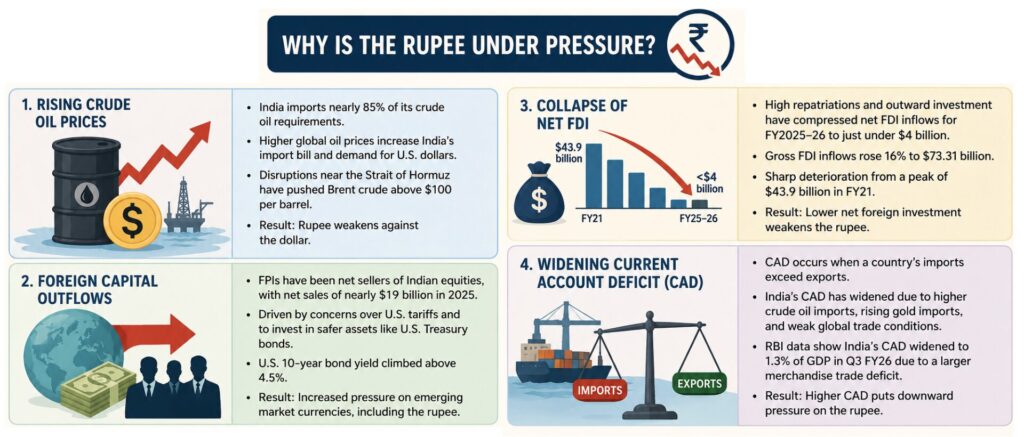
    The Indian rupee has witnessed sustained depreciation pressures and reportedly touched nearly ₹97 per U.S. dollar in recent trading sessions. This has started a debate: Should the Reserve Bank of India (RBI) intervene aggressively to stop the fall, or should it let the rupee find its own level naturally?

    UPSC Relevance: GS-3 Economy: Balance of Payments, Capital Flows, Exchange Rate Management

    Prelims: Rupee Depreciation, Current Account Deficit (CAD), Foreign Institutional Investors (FIIs), Managed Float Exchange Rate System 

    What is Rupee Depreciation?

    • Rupee depreciation refers to a decline in the value of the Indian rupee relative to foreign currencies, especially the U.S. dollar.
    • For example, If $1 = ₹83 earlier and later becomes $1 = ₹97, the rupee is said to have depreciated.
    • India follows a managed floating exchange rate system, where market forces determine the exchange rate, but the RBI intervenes occasionally to reduce excessive volatility. 

    Two Sides of the Debate: 

    Side 1: Let Rupee fall (Non-Intervention view):

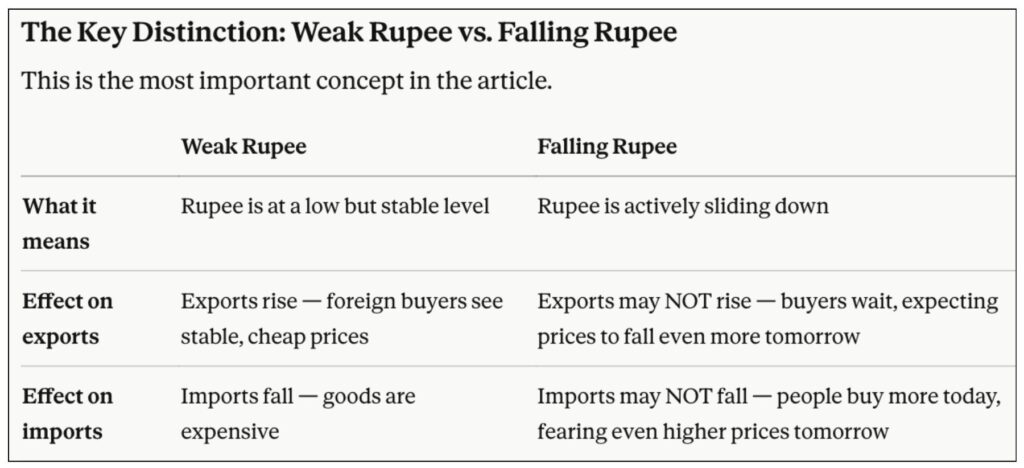
    • A weaker rupee automatically fixes the problem. When the rupee falls, Indian goods become cheaper for foreign buyers, so exports go up. 
    • At the same time, imported goods become costlier for Indians, so imports come down. This reduces the current account deficit on its own. 

    Side 2: RBI should Intervene (Stability view):

    • The non-intervention view has a serious flaw. It confuses a weak rupee with a falling rupee, which are two different scenarios. 
    • A falling rupee (present case) produces higher import bills but no reliable increase in exports, meaning the trade deficit is not corrected but actually deepens. Example: When petrol prices were hiked, consumers rushed to fill their tanks immediately, anticipating further increases. The same psychology applies to imports during a falling rupee. Instead of import demand falling as the rupee slides, it can actually spike in the short run, worsening the trade deficit. 

    The Role of Speculation: 

    • Much of the rupee’s fall is not driven by real trade factors, but by speculative foreign capital flows. Foreign institutional investors (FIIs) pull money out of India when they expect better returns elsewhere, for example, when US interest rates rise. This capital outflow pushes the rupee down. There is no fundamental economic value behind the falling rupee, but pure financial speculation.

    As a result, the rupee cannot find a natural equilibrium quickly. It may keep falling for a long time, driven entirely by investor sentiment rather than India’s actual trade position.

    Why is uncontrolled Depreciation dangerous? 

    The key dangers of letting the rupee fall without any check include:

    • Inflation: India imports essential goods, especially crude oil. A weaker rupee means higher oil prices in rupees, which raises the cost of transport, food, and almost everything else. This hits common people the hardest.
    • No quick export boost: Because the rupee is falling (not just weak), foreign buyers delay purchases. So the expected increase in exports does not materialise quickly.
    • Rising import costs squeeze real wages and hurt people who are already under economic stress.

    Available Policy Options:

    • RBI Forex Intervention: Selling dollars from reserves to absorb excess demand for foreign exchange, as the primary short-term tool. 
    • Monetary Policy Tightening: Raising interest rates to attract foreign capital, though this risks slowing domestic growth. 
    • Import Rationalisation: Restricting non-essential imports such as luxury goods to reduce outward pressure on dollar demand. 
    • Currency Swap Agreements: Bilateral swaps with countries like Japan or the UAE can stabilise dollar demand without depleting reserves. 
    • Structural Export Promotion: Long-term competitiveness through manufacturing capacity, PLI schemes, and trade diversification to reduce structural dependence on imports.

    UPSC PYQ 2019

    Q. Which one of the following is not the most likely measure the Government/ RBI takes to stop the slide of the Indian rupee? 

    (a) Curbing imports of non-essential goods and promoting exports

    (b) Encouraging Indian borrowers to issue rupee-denominated Masala Bonds

    (c) Easing conditions relating to external commercial borrowing

    (d) Following an expansionary monetary policy

    Answer: (d)

    UPSC PYQ 2022

    Q. With reference to the Indian economy, consider the following statements:

    1.     If the inflation is too high, Reserve Bank of India (RBI) is likely to buy government securities.

    2.     If the rupee is rapidly depreciating, RBI is likely to sell dollars in the market.

    3.    If interest rates in the USA or European Union were to fall, that is likely to induce RBI to buy dollars.

    Which of the statements given above are correct?

    (a)     1 and 2 only 

    (b)     2 and 3 only 

    (c)     1 and 3 only 

    (d)     1, 2 and 3 

    Answer: (b) 

    Why Iran War, Monsoon worries could make 2026 India’s Year of Millets

    Open article →Download PDF

    Why in News?

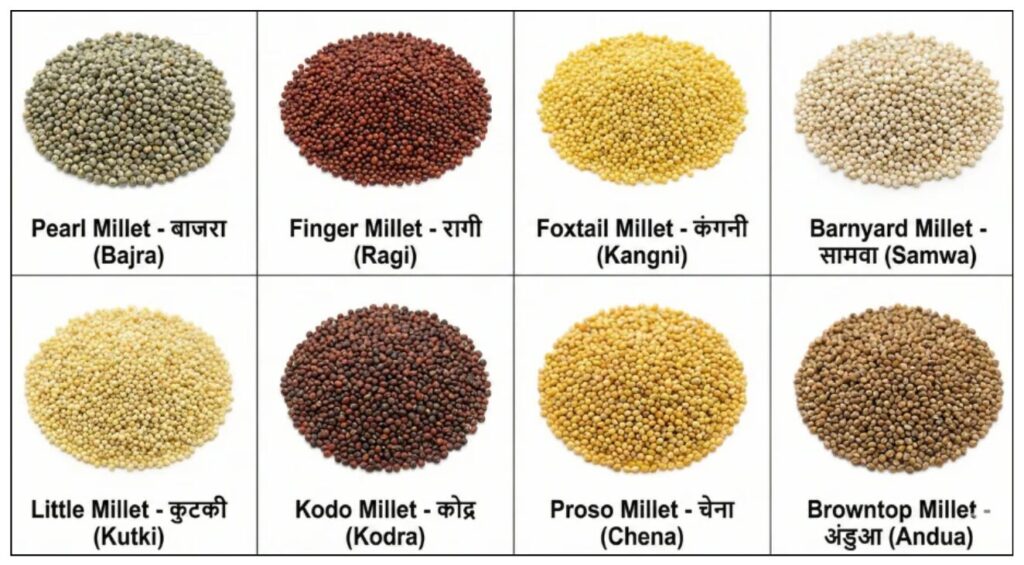
    A geopolitical supply shock from the Iran conflict and a below-normal monsoon season forecast are accelerating a structural shift in India’s kharif cropping pattern. Farmers across Northwest India are pivoting from input-intensive crops such as cotton, paddy, and maize towards millets like bajra (pearl millet) and pulses such as moong (green gram).

    UPSC Relevance: GS-3 Economy: Agriculture, Food Security, Cropping Pattern 

    Mains: Millets Production: Advantages, Govt schemes, Associated Challenges. 

    The Catalyst for Change in Cropping Pattern

    1. The Geopolitical Trigger:

    The US-Iran conflict escalated to the effective closure of the Strait of Hormuz. The Strait facilitates the movement of approximately one-fifth of the world’s petroleum and a significant portion of global LNG. For India, the disruption is not merely an energy problem but has triggered an acute agricultural input crisis.

    • Fertiliser Price Shock: The conflict has significantly choked global fertilizer supply chains, causing prices of synthetic inputs to spike. E.g., Urea prices have nearly doubled from February 2026 to April 2026. Similarly, the prices of DAP (di-ammonium phosphate), Sulphur and Ammonia have substantially risen. 
    • Domestic Production Disruptions: India typically produces around 2.5 million tonnes of urea per month domestically. Output fell to 1.5 million tonnes in March 2026 due to LNG feedstock shortages, as Gulf Cooperation Council (GCC) countries account for over 60% of India’s LNG imports. Domestic urea plants are now running at only 60-70% capacity as a consequence. 

    For the Kharif 2026 season, India’s urea requirement is estimated at 19.4 million tonnes, against opening stocks of only 5.5 million tonnes. As Millets thrive with minimal fertiliser, it allows farmers to bypass these supply constraints. 

    2. The Climatic Trigger: 

    • The India Meteorological Department (IMD), in its Long Range Forecast, has forecast the 2026 southwest monsoon (June-September) to be below normal at 92% of the Long Period Average (LPA) of 87 cm, with a model error of ±5%. 
    • The primary driver is the expected development of El Niño conditions in the equatorial Pacific Ocean during the second half of the monsoon season. 

    Approximately 60% of India’s farmers remain entirely rain-fed and thus directly exposed to monsoon variability. Water-intensive crops such as rice require 5-7 irrigations per season. In contrast, bajra requires only 1-2 irrigations to complete its 90-95 day growth cycle.  

    A below-normal monsoon, therefore, raises the relative agronomic competitiveness of drought-tolerant millets and short-duration pulses substantially.

    3. Ground-Level Dynamics: 

    The theoretical advantages of millets are translating into measurable crop-area shifts, particularly in Northwest India’s cotton-growing belt spanning Haryana, Punjab, and Rajasthan.

    • Abandonment of Cotton: Pink bollworm has devastated cotton yields in various districts of Haryana and Punjab. Average raw cotton yields have fallen from 10-12 quintals per acre to 3.5 quintals in recent years. Cotton’s 180-185 day growing cycle demands 5-10 pesticide spray cycles and significant doses of urea, DAP, MOP, and SSP, all of which are subject to the current input price shock. Labour costs for cotton picking, ranging from Rs. 12 to Rs. 25 per kg, further erode margins. 
    • Bajra’s Competitive Advantages: Bajra’s short maturity window of 90-95 days, irrigation requirement of 1-2 per season, and low fertiliser requirement give it a competitive edge over cotton. A farmer who harvests bajra by September-October can still sow rabi mustard (130-140 days) by mid-October, followed by a summer (zaid) moong crop from mid-March to mid-April. This triple-cropping possibility is structurally unavailable with cotton. 

    Policy Architecture Supporting Millets: 

    • Shree Anna Mission: Sub-Mission on Nutri-Cereals under the National Food Security and Nutrition Mission (NFSNM), covers bajra, jowar, ragi, and small millets across 28 states and 2 Union Territories. India produced 180.15 lakh tonnes of millets in FY25, an increase of 4.43 lakh tonnes over FY24. Among all millet types, bajra contributes the largest share.
    • Minimum Support Price (MSP): The MSP for bajra has been raised to Rs. 2,900 per quintal for Kharif 2026. However, effective market realisation remains a persistent gap. Farmers have demanded that MSP be backed by actual government procurement rather than remaining a notional price signal. 
    • Public Distribution System Integration: The Ministry of Food and Public Distribution has revised guidelines to increase procurement of Shree Anna under the Targeted Public Distribution System (TPDS), Integrated Child Development Services (ICDS), and the Mid-Day Meal scheme.
    • Export and Value Chain: An Export Promotion Forum dedicated to Shree Anna has been established to facilitate international marketing. The Ministry of Food Processing Industries (MoFPI) has implemented the Production Linked Incentive Scheme for Millet-Based Products (PLISMBP) with a financial outlay covering FY23 to FY27 to build a processed millet foods industry.

    Associated Concerns & Way Forward: 

    • MSP-to-Market Linkage: An MSP without procurement infrastructure is a policy half-measure. Price difference compensation model (E.g., Bhavantar Bharpai model of Haryana) of compensating for the price difference between market rates and MSP is a step forward. But effective procurement through FCI or state agencies is necessary to make the price signal credible for farmers planning acreage decisions.
    • Seed System Strengthening: The rapid uptake of hybrid bajra varieties demonstrates farmer responsiveness to technological innovation. Scaling up public-sector millet breeding through ICAR’s All India Coordinated Research Project on Pearl Millet, and ensuring certified seed availability at the district level before kharif sowing windows, is critical.
    • Integrating Millets in Food Safety Net: Systematically substituting a portion of the Public Distribution System (PDS) rice and wheat allocations with millets, using the existing provision under the National Food Security Act (NFSA). 
    • Diversifying Import Dependence: India has begun redirecting fertiliser procurement to Morocco, Jordan, Indonesia, and Malaysia. Bilateral agreements for long-term fertiliser supply contracts with non-Gulf producers, acceleration of domestic green ammonia production capacity, Transition to nano urea, nano DAP, biofertilisers, and phosphate-solubilising bacteria are structurally important for food security. 

    Millets offer significant nutritional advantages over rice and wheat. Bajra is rich in iron, zinc, magnesium, and B-vitamins, making it particularly relevant for addressing anaemia and micronutrient deficiencies prevalent in India’s rural population. 

    FSSAI’s Eat Right campaign is creating consumer awareness around millets as part of a healthy diet. Integrating millets more substantially into the PDS would represent a transition from calorie-focused food security towards nutrition-sensitive food security, addressing hidden hunger.