Why in News?
India and the leaders from the five Nordic nations officially elevated their relations to a Green Technology and Innovation Strategic Partnership during the 3rd India-Nordic Summit in Oslo.
| UPSC Relevance: GS-2 International Relations: International Summits Mains: India-Nordic Summit, Significance of Nordic Nations to India. |
What is the India-Nordic Summit?
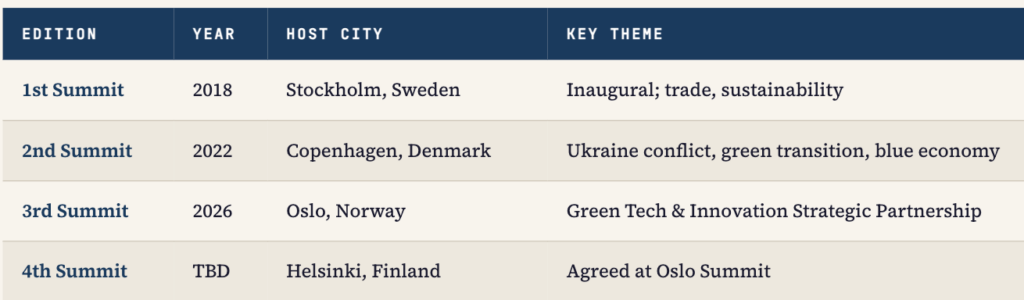
- The India-Nordic Summit is a multilateral diplomatic forum that brings India together with five Nordic nations– Denmark, Finland, Iceland, Norway, and Sweden for high-level strategic dialogue. The format was established in 2018 and has progressively deepened in scope and ambition.
Trade Agreement Linkage with Nordic countries:
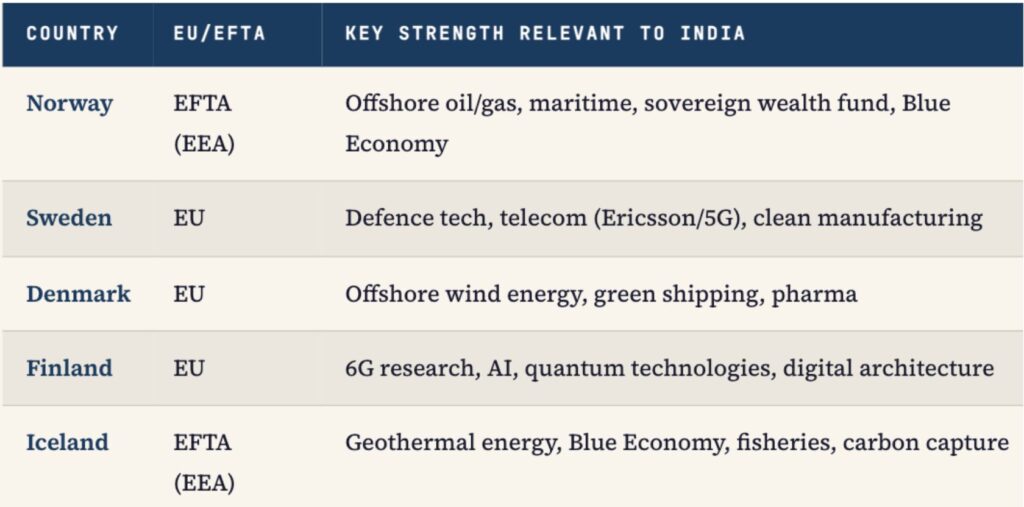
India is the only non-Western country that engages the five Nordic nations at a comprehensive collective summit level. The Nordic countries collectively have a GDP exceeding USD 1.9 trillion, making them a significant economic bloc.
- Denmark, Sweden, Finland (EU members) are covered under the India-EU FTA (concluded 2026).
- Norway and Iceland (EFTA members) are covered under the India-EFTA TEPA (entered in 2025, alongside Liechtenstein & Switzerland).
Key Outcomes of the 3rd India-Nordic Summit:
- Green Technology & Innovation Strategic Partnership: Elevates India-Nordic ties to a strategic level. Covers blue economy, circular economy, digital infrastructure, climate action, energy security, water, and education.
- Leveraging India-EU FTA & India-EFTA TEPA: EFTA countries target USD 100 billion investment in India over 15 years, projected to create 1 million direct jobs. Boosts trade, tech transfer & supply chain resilience.
- India-Nordic Climate Action Initiatives: Translates Nordic clean-tech innovation into large-scale investible solutions in India. Supports Mission LiFE, LeadIT 3.0. Accelerates renewable energy & low-emission tech cooperation.
- India-Nordic Arctic Cooperation: Enhances polar research and joint Arctic research projects. India is an Arctic Council observer (since 2013) and operates the IndARC underwater observatory.
- STEM Research Initiative: Joint R&D in identified STEM areas, start-up & incubator linkaOutcome 01: ges. Promotes research in next-gen communications, including 6G technology.
- Blue Economy Cooperation: Promotes sustainable Blue Economy, green ship recycling, free & open Indo-Pacific. Jointly works through Indo-Pacific Oceans Initiative (IPOI) under India’s MAHASAGAR vision.
- Talent Mobility Promotion: Enhances movement of students, academics, researchers & professionals between India and Nordic nations.
- Defence Industrial Collaboration: Taps 100% FDI opportunities being offered to Nordic defence firms in India’s Defence Industrial Corridors (UP and Tamil Nadu corridors).
Geopolitical & Strategic Significance for India:
India’s engagement with the Nordic bloc reflects a mature, multi-vector foreign policy that goes beyond traditional great-power diplomacy.
- UNSC Reform: Nordic nations reiterated support for India’s permanent membership in a reformed & expanded UN Security Council. Also support India’s NSG membership bid, diplomatically significant despite China’s veto.
- Arctic Access: India has been an observer at the Arctic Council since 2013. Norway is a key Arctic state. Growing polar cooperation gives India scientific access, climate data, and a presence in a geostrategically important region.
- Supply Chain Resilience: India-EU FTA + India-EFTA TEPA opens Europe-quality supply chains. Nordic nations offer high-tech components in defence, telecom, and clean energy, thus reducing dependence on China-dominated supply chains.
- Counter-Terrorism: Nordic nations condemned the Pahalgam terror attack and the Red Fort incident (2025); backed India’s fight against cross-border terrorism at the UNSC and FATF levels.
- India as Global South Voice: India positioned itself as a bridge between developed (Nordic) and developing nations, calling for affordable climate finance, technology transfer, and just energy transitions for developing countries.
- Defence Diversification: Nordic expertise in dual-use technologies, maritime systems & aerospace; 100% FDI offered in India’s Defence Industrial Corridors presents a strategic opportunity to reduce defence import dependency.
Associated Challenges:
- Trade Asymmetry: Bilateral trade at $19B is modest relative to India’s trade with the EU as a whole; significant untapped potential remains.
- Technology Transfer Barriers: Nordic dual-use and defence technologies face export-control restrictions; bridging this gap requires policy-level commitments beyond summit declarations.
- NSG Membership: Nordic support for India’s NSG bid is diplomatically significant but insufficient to overcome China’s consensus-based veto.
- Climate Finance Gap: Nordic nations are advanced economies; ensuring commitments on affordable climate finance and technology transfer for developing nations requires institutional follow-through.
- TEPA Implementation: The $100B investment target over 15 years requires consistent ease-of-doing-business reforms in India and dedicated investment facilitation mechanisms.
- Arctic Governance: India’s observer status in the Arctic Council limits its formal decision-making role; deeper engagement requires managing geopolitical complexities involving Russia and China.
Way Forward:
- Establish a dedicated India-Nordic Green Technology Fund to operationalise climate-tech investment commitments.
- Leverage GIFT City as a neutral financial hub to channel Nordic sovereign wealth into India’s green infrastructure projects.
- Institutionalise the India-Nordic STEM Research Initiative through university MOUs, joint labs, and student exchange quotas.
- Integrate Nordic defence FDI into both Defence Industrial Corridors under a streamlined single-window clearance mechanism.
- Strengthen India’s scientific Arctic engagement, building on the IndARC observatory to contribute substantively to polar research — supporting a future bid for enhanced observer status.
- Create a Joint Trade Facilitation Cell under the India-EFTA TEPA framework to track the $100B investment target with quarterly benchmarks.
Practice Question for Mains:
Q. Examine the strategic significance of the 3rd India-Nordic Summit for India’s foreign policy goals in a multipolar world order. How does the Green Technology and Innovation Strategic Partnership align with India’s climate and development objectives?