Opens in a new tab
Join Anantam IAS Channel on Telegram

Daily Digest · Saturday

10 October 2026 Current Affairs for UPSC

12 current affairs published on Saturday, 10 October 2026

10 October 2026 Current Affairs for UPSC — every Why-in-News article AnantamIAS published on Saturday, 10 October 2026, broken down with Why in News?, the exact GS paper it feeds, sub-topic mapping, MCQ-ready facts and a UPSC-style practice question. 12 articles in total, covering Polity, Economy, Environment, S&T, IR, Geography, History, Society and Internal Security — the same Why-in-News + GS-paper-mapping + practice-question format the Compass uses across every daily digest on the site.

Daily current affairs for UPSC is where new material enters your prep stream. Read this 10 October 2026 digest end-to-end in 25–35 minutes, attempt the practice question at the foot of each article (it's MCQ for some, 10/15-marker for others), then bookmark the entries that fall inside your active revision window. Everything stays cross-linked: tap any subject pill to jump to that subject's hub, or use the table of contents above to skip straight to a specific story.

Use this page three ways. Read sequentially for a one-sitting scan of everything that mattered on 10 October 2026. Download the 10 October 2026 PDF below for offline study or print revision. Or use the October 2026 Current Affairs compilation to see this day in the month's full context. For the previous day's reading, see 9 October 2026 Current Affairs; the next day's is 11 October 2026 Current Affairs.

Why we publish daily current affairs separately from the monthly compilation: daily is learning, monthly is revision. Use the daily page to add fresh material to your notes the day it breaks; come back to the October 2026 compilation 60 days before Prelims when the noise has settled and only the lasting takeaway is worth re-reading.

Anti-Defection Proceedings: Condonation and Who May Challenge

Open article →Download PDF

Why in News?

The Hindu reported that the Supreme Court on October 9, 2026 declined to intervene in the Tamil Nadu Speaker’s closure of anti-defection proceedings against AIADMK legislators after the party sought withdrawal.

  • The report links the proceedings to legislators supporting another party’s government during a confidence vote, allegedly contrary to their own party’s direction.
  • It identifies the challenger as a third party whose earlier petition had been rejected by the Madras High Court for lack of standing.
  • The reported oral observations concerned the party’s decision not to pursue proceedings; they should not be read as a universal exemption from the Tenth Schedule.
  • Condonation, the Speaker’s adjudication and a challenger’s standing answer different questions; combining them produces misleading conclusions about when legislators lose membership.
  • The constitutional text supplies a precise time condition for excusing a voting breach; political reconciliation alone does not explain every disqualification ground.

UPSC Relevance

Prelims Relevance

  • Tenth Schedule: disqualification on the ground of defection.
  • Paragraph 2(1)(a): voluntarily giving up party membership.
  • Paragraph 2(1)(b): contrary voting or abstention, permission and condonation.
  • Paragraph 6: decision by the Speaker or Chairman.
  • Locus standi: standing to bring a particular legal challenge.

Mains Relevance

GS Paper 2

  • Party discipline, legislative accountability and freedom of representatives.
  • Distinguishing adjudicatory finality, standing and constitutional judicial review.

Essay

  • Democratic stability requires rules that preserve both accountability and lawful political choice.

Background and Context

Two Grounds Must Be Examined Separately

Anti-defection law regulates membership and voting conduct through separate grounds; the correct legal question depends on what the legislator allegedly did.

  • The Tenth Schedule distinguishes voluntarily giving up party membership from voting against a party direction. A petition should identify its ground before discussing exceptions, evidence or the legal effect of later reconciliation.
  • Paragraph 2(1)(a) addresses voluntarily giving up membership. Its text does not contain the voting clause’s fifteen-day condonation proviso; do not automatically transfer that proviso to an allegation made under this separate ground.
  • Paragraph 2(1)(b) covers both voting and abstaining contrary to an authorized party direction in the House. The relevant direction must come from the political party or a person or authority it authorizes.
  • Prior permission matters: the voting ground expressly concerns conduct undertaken without permission from the party or its authorized person or authority. Checking this condition prevents treating every difference in voting as automatic disqualification.
  • House membership is the consequence at issue, not simply an internal party reprimand. The Schedule creates a constitutional disqualification framework; political disagreement and loss of a legislative seat are not interchangeable descriptions.

What Timely Condonation Actually Does

Condonation is a defined safeguard within the voting ground, so timing and authority matter as much as the party’s political preference.

  • The voting ground requires that the contrary vote or abstention has not been condoned within fifteen days. This period runs from the conduct concerned, not from a later hearing or the Speaker’s final decision.
  • Permission and condonation operate at different moments: permission precedes the voting conduct, while condonation excuses it afterward within the stated window. Evidence should establish which occurred instead of describing both loosely as party approval.
  • The permitted condoning actor is the political party or its authorized person or authority. A member’s personal claim of forgiveness does not establish the required authorization, timing or scope of the decision.
  • The Hindu reported a party withdrawal request preceding the Speaker’s closure of proceedings. That account explains the dispute, but a reported political settlement should not be generalized into an unlimited constitutional power of forgiveness.
  • For a problem involving a whip breach, check the direction, authorization, vote or abstention, prior permission and timely condonation. If giving up membership is separately alleged, examine that allegation independently rather than assuming identical rules.

Standing Does Not Eliminate Judicial Review

The right to bring a particular challenge and the court’s power to review an unlawful decision must remain analytically separate.

  • Paragraph 6 ordinarily assigns disqualification questions to the Speaker or Chairman. The presiding officer determines the question under the Schedule; the party’s role in issuing directions or condoning conduct does not replace this constitutional function.
  • Locus standi asks whether this petitioner can pursue this challenge. The Hindu reports that the courts rejected intervention by the third-party challenger; that procedural outcome should not become a rule excluding every possible challenger.
  • Judicial review survives the finality attached to the Speaker’s decision. The Supreme Court’s Keisham Meghachandra Singh judgment discusses review for constitutional violations, bad faith, denial of natural justice and perversity.
  • Compare PIL maintainability: a court first considers whether proceedings can be entertained. A refusal at that stage does not by itself settle every underlying substantive constitutional question raised by the controversy.
  • The related legislative privilege debate also concerns institutional boundaries. Here, keep the focus narrower: standing, the applicable defection ground and lawful condonation, rather than claiming that legislative decisions are entirely beyond courts.

Way Forward

Make the Decision Legally Traceable

  • Record the party direction, its authorization and the relevant voting conduct before deciding whether the voting ground is established.
  • Document permission or condonation with dates and authority, and address any separate membership allegation on its own legal basis.
  • Give a reasoned decision identifying the applicable provision and evidence; distinguish procedural objections from findings about the alleged defection.

Conclusion

  • Anti-defection analysis begins with the correct ground: giving up membership differs from contrary voting, and the latter contains specific permission and condonation conditions. A political settlement cannot substitute for reading those conditions carefully.
  • Standing and judicial review are separate safeguards. Use the reported dismissal as a case-specific example of that distinction, not as proof that party forgiveness is unlimited or that every Speaker’s decision is immune from challenge.

UPSC Practice Questions

Prelims MCQ 1

With reference to paragraph 2(1)(b) of the Tenth Schedule, consider the following statements:

  1. It covers abstention contrary to an authorized party direction as well as contrary voting.
  2. It expressly recognizes prior permission from the party or its authorized person or authority.
  3. The condonation period starts when the Speaker decides the petition.

How many of the above statements are correct?

(a) Only one (b) Only two (c) All three (d) None

Answer: (b) Only two

Explanation:

The first two statements are correct. The fifteen-day condonation period runs from the date of the voting or abstention, not the Speaker’s decision.

Prelims MCQ 2

What does locus standi primarily concern in a challenge to an anti-defection decision?

(a) The number of legislators supporting a government (b) The petitioner’s standing to bring the challenge (c) The automatic cancellation of a party whip (d) An absolute exclusion of judicial review

Answer: (b) The petitioner's standing to bring the challenge

Explanation:

Standing concerns whether the particular petitioner may pursue the case. It is distinct from the merits and from whether the decision can be judicially reviewed.

UPSC Mains Questions

  1. Distinguish voluntarily giving up party membership from voting contrary to a party direction under the Tenth Schedule. Explain the relevance of permission and condonation.
  2. How should courts distinguish standing, the Speaker’s adjudicatory role and judicial review in anti-defection disputes? Discuss the constitutional interests at stake.

Sources: Legislative Department, Constitution of India and The Hindu.

Frequently Asked Questions

What is condonation under the anti-defection law?

For the voting ground in paragraph 2(1)(b), the party or its authorized person or authority may excuse the contrary vote or abstention within fifteen days of that conduct.

Is voting against a whip the same as giving up membership?

They are separate grounds in the Tenth Schedule. Contrary voting must be examined with its permission and condonation conditions; the voting clause’s fifteen-day provision should not automatically be applied to giving up membership.

Can a Speaker’s anti-defection decision be reviewed?

Yes. Constitutional judicial review remains available on recognized grounds, including constitutional violations, bad faith, denial of natural justice and perversity. The finality clause does not create complete immunity from judicial scrutiny.

What does the reported Tamil Nadu dismissal establish?

The Hindu reports rejection of a third party’s challenge after the party sought withdrawal of proceedings. Reported oral observations should be read in that context, not as a universal rule overriding the Schedule.

CBAM Review: Embedded Emissions and Trade Compliance

Open article →Download PDF

Why in News?

On 8 October 2026, the US Trade Representative invited comments on the European Union’s Carbon Border Adjustment Mechanism (CBAM) and proposals to expand its product coverage.

  • The comment deadline is 9 November 2026; the notice seeks evidence of costs, compliance burdens and effects on market access.
  • The exercise examines existing CBAM obligations and possible extension to downstream steel- and aluminium-intensive goods.
  • The notice asks what enforcement action might be appropriate; it does not announce retaliation or establish a Section 301 investigation.
  • Indian Express discussed possible benefits for Indian exporters on 10 October; actual relief would depend on final rules and eligibility, not the US request itself.
  • For Indian industry, credible emissions records and cleaner production remain relevant even while governments debate the fairness of carbon-linked trade measures.

UPSC Relevance

Prelims Relevance

  • CBAM: carbon pricing linked to selected imported goods.
  • Embedded emissions: greenhouse gases generated during production.
  • EU ETS: emissions trading framework anchoring CBAM certificate prices.
  • EU importer: entity responsible for compliance obligations.
  • Legislative proposal: distinct from an adopted expansion of coverage.

Mains Relevance

GS Paper 3

  • Climate policy, industrial decarbonisation and export competitiveness.
  • Compliance capacity of smaller manufacturers in global supply chains.

GS Paper 2

  • Trade negotiations and regulatory differences between major economies.

Essay

  • Environmental responsibility and fairness in international trade.

Background and Context

What the US Notice Actually Opens

The new development is an evidence-gathering exercise about a functioning EU mechanism and a separate proposed expansion, not a completed trade dispute.

  • The USTR request covers producers, workers, direct exports and indirect exports. This wider lens matters because a manufacturer can face compliance pressure through a buyer even without selling directly into Europe.
  • The Federal Register notice seeks evidence on costs and market access, including effects on smaller firms. These submissions can inform government engagement; collecting complaints does not itself establish unlawful discrimination or authorize sanctions.
  • The proposed downstream extension concerns goods using substantial steel or aluminium. It could carry carbon-related requirements further along supply chains, beyond the covered materials currently entering the EU market in their own right.
  • The notice describes different EU institutional positions that still require legislative reconciliation and formal approval. A product appearing in a proposal should not be described as already covered solely on that basis.
  • Keep this request separate from established trade-remedy investigations: the legal instrument determines the procedure. A headline using the word probe does not establish a particular statutory investigation or a final decision.

How Embedded Emissions Become a Trade Obligation

CBAM connects information about production outside Europe with compliance by an importer inside Europe; these are different responsibilities within the same supply chain.

  • Embedded emissions refer here to greenhouse gases generated in making covered goods. The focus is production, rather than simply the shipping distance or transport emissions from moving a finished product across borders.
  • The EU importer declares emissions and meets certificate obligations, while the foreign producer supplies usable production information. This distinction explains why an Indian steelmaker can face demands even though the legal obligation falls abroad.
  • Company-level data must undergo accredited third-party verification under the rules described in the notice. When usable producer data is unavailable, default values provide an alternative basis, making the quality of records commercially important.
  • Default values use country and sector production and energy information, with a markup described by USTR. They are estimates for compliance, not proof that every factory in the same country has identical emissions.
  • Certificate prices are linked to EU ETS allowance auction prices. The Commission describes CBAM as addressing carbon leakage: emissions-intensive production shifting abroad when carbon constraints differ, undermining the environmental purpose of domestic pricing.

What Indian Exporters Should Watch

The practical comparison is between proving a factory’s production emissions and relying on standard estimates; neither diplomacy nor paperwork alone makes production cleaner.

  • Plant-level records can distinguish an individual producer from a country-level estimate. Exporters need to connect production information to the covered goods supplied, rather than presenting a general corporate sustainability statement as equivalent evidence.
  • Verification capacity creates a separate challenge from cleaner technology. A producer may improve operations yet struggle to demonstrate those changes; smaller suppliers can need shared technical support to assemble consistent, auditable production records.
  • Carbon pricing already paid in the country of production is another record identified in the notice. Exporters should retain evidence rather than assuming that any environmental expenditure automatically receives equivalent recognition under CBAM.
  • Unlike bilateral climate crediting, CBAM compliance concerns covered imports and their embedded emissions. Participation in a climate project does not by itself establish that a shipment meets the importing jurisdiction’s requirements.
  • Indian gains from possible US-negotiated flexibility remain conditional on the resulting measure and its application. A comment request does not guarantee a concession, an Indian exemption, or automatic equal treatment under an unverified treaty provision.

Way Forward

Prepare Evidence While Tracking Final Rules

  • Map covered products and supplier data requirements before assuming that every steel-containing export falls within current CBAM coverage.
  • Support smaller producers with credible measurement and verification capacity, alongside investment that actually reduces production emissions.
  • Assess proposed regulatory changes against their final adopted text; keep compliance planning separate from speculative promises of negotiated exemptions.

Conclusion

  • CBAM connects industrial production emissions with import compliance, while the US notice invites evidence about its trade effects. The central distinction is between existing obligations, proposed expansion and any future enforcement decision.
  • For India, the defensible response combines cleaner production, reliable records and evidence-led negotiation. Diplomatic pressure may alter implementation, but it does not replace the need to show how a covered product was made.

UPSC Practice Questions

Prelims MCQ 1

With reference to CBAM, consider the following statements:

  1. It concerns embedded emissions associated with production of covered imported goods.
  2. EU importers face compliance obligations while foreign producers may supply emissions information.
  3. The October USTR notice itself brings all proposed downstream products within EU law.

How many of the above statements are correct?

(a) Only one (b) Only two (c) All three (d) None

Answer: (b) Only two

Explanation:

Statements 1 and 2 are correct. The USTR request does not enact EU legislation; downstream coverage remains a separate legislative proposal.

Prelims MCQ 2

Which best describes the role of default emissions values under CBAM?

(a) They measure the distance a shipment travels. (b) They exempt every small producer from compliance. (c) They provide estimates when usable producer-level data is unavailable. (d) They prove all factories within a country emit equally.

Answer: (c) They provide estimates when usable producer-level data is unavailable.

Explanation:

The notice describes defaults based on country and sector production and energy information. They do not establish identical performance at every plant.

UPSC Mains Questions

  1. Explain how embedded-emissions accounting can affect export competitiveness even when the formal compliance obligation rests with a foreign importer.
  2. Discuss the opportunities and limitations of diplomatic negotiations as a response to carbon border measures. What complementary steps should Indian producers take?

Sources: USTR, Federal Register and European Commission.

Frequently Asked Questions

What did USTR announce in October 2026?

USTR invited comments on existing CBAM requirements and proposals to expand coverage. The notice seeks information about costs, market access and possible enforcement responses; it does not itself announce retaliatory measures.

Who is responsible for CBAM compliance?

EU importers bear the relevant declaration and certificate obligations. Foreign producers can nevertheless need to supply verified production-emissions information, because importers depend on those records to meet their own compliance requirements.

Are embedded emissions the same as shipping emissions?

In this context, embedded emissions concern greenhouse gases generated during production of covered goods. They should not be reduced to the transport emissions or distance involved in shipping the finished goods overseas.

Will the US review automatically help Indian exporters?

No automatic benefit follows from a request for comments. Any benefit would depend on what changes are eventually adopted, who qualifies and how those changes apply to Indian products and producers.

GSDP Expenditure Draft: Measuring State Consumption and Investment

Open article →Download PDF

Why in News?

On 9 October 2026, the National Statistics Office released draft guidelines for estimating Gross State Domestic Product from the expenditure side using the 2022-23 base year.

  • The consultation draft seeks comments by 28 October; it does not announce final state estimates or completed implementation.
  • According to MoSPI, some States and Union Territories compile fixed investment and government consumption estimates, but none currently compile state PFCE estimates.
  • The proposed framework covers consumption, capital formation and net exports, with state data preferred and allocation indicators used where direct information is unavailable.
  • Comparable expenditure estimates would help distinguish state consumption from investment, complementing information about which sectors produce output.
  • The immediate policy question is measurement quality: whether available state evidence supports reliable allocation, rather than merely producing a complete-looking set of numbers.

UPSC Relevance

Prelims Relevance

  • GSDP: domestic product measured for a State or Union Territory.
  • PFCE: Private Final Consumption Expenditure.
  • GFCE: Government Final Consumption Expenditure.
  • GFCF: Gross Fixed Capital Formation.
  • State Directorates of Economics and Statistics: statistical compilation capacity.

Mains Relevance

GS Paper 3

  • State-level consumption and investment measurement.
  • Reliability of administrative data and allocation indicators.

GS Paper 2

  • Statistical coordination between Union institutions and States.

Essay

  • Better measurement can reveal policy choices while still concealing uncertainty.

Background and Context

What Expenditure Accounts Add

The expenditure approach asks how final output is used, adding a demand-side perspective to familiar measures of production within a state.

  • Production-side estimates describe economic activity through producing sectors; expenditure accounts organise final uses into consumption and investment components. These are complementary perspectives on the economy, not competing definitions of whether economic activity exists.
  • PFCE measures final consumption by resident households and institutions serving them. Its absence from state accounts is a specific statistical gap; it does not mean household consumption itself is absent or economically unimportant.
  • GFCE captures government final consumption, while GFCF concerns fixed capital formation. Reading them separately helps distinguish consumption from investment instead of treating every government purchase as the same kind of economic use.
  • Changes in inventories, valuables and net exports complete the component list identified in the draft release. A consumption-and-fixed-investment total alone would leave out expenditure categories needed for the proposed accounting framework to be complete.
  • State expenditure accounts would make the composition of economic activity more visible. Their usefulness lies in identifying what the estimates actually measure, rather than assuming a higher aggregate automatically proves stronger household welfare.

How State Estimates Can Be Built

The practical difficulty is assigning economic uses to individual states when direct observations do not cover every component consistently.

  • State-specific sources are the preferred starting point wherever feasible. The guideline addresses concepts, coverage, data sources and estimation procedures together because comparable figures require common definitions as well as information from individual states.
  • Allocation indicators provide an indirect route when direct state data are unavailable. They support the distribution of estimates across states; an allocated estimate should not be mistaken for expenditure measured directly in every location.
  • Indicator choice matters because the proxy must relate meaningfully to the component being estimated. A practical review should ask what the indicator captures, what it misses and whether coverage differs between states.
  • Methodological standardisation seeks consistent and comparable estimation across States and Union Territories. Uniform rules are valuable, but comparability also depends on the quality and completeness of each underlying source used in compilation.
  • State Directorates of Economics and Statistics need capacity to apply the framework and interpret source limitations. Building expenditure accounts is an institutional task involving repeatable compilation, not simply adding columns to existing published tables.

What the Draft Does Not Establish

A proposed measurement framework should be read separately from published results and from other reforms in economic statistics.

  • The official release describes a draft open to stakeholder feedback. It cannot establish that all states already produce the proposed expenditure accounts or that consultation recommendations have become final methodology.
  • The 2022-23 base year identifies the revised framework used in this proposal. The announcement does not supply a new state growth comparison, so it cannot support claims that any state has become richer.
  • The earlier national accounts methods note concerns national estimation; this development addresses state expenditure compilation. Keep the analytical focus on state coverage and allocation instead of repeating the broader national accounts reform debate.
  • Environmental accounts connect natural assets and economic activity. This draft instead organises state expenditure components; it is not a new measure of ecological depletion or a substitute for environmental accounting.
  • Allocation uncertainty remains an analytical caution, not evidence that the draft is defective. Users should distinguish observed information from derived estimates before interpreting differences as precise measures of state consumption or investment performance.

Way Forward

Make the Method Reproducible

  • Publish component-level documentation identifying direct sources, allocation indicators, coverage gaps and revision procedures so users can interpret state estimates responsibly.
  • Test indicator suitability with State Directorates before finalisation, especially where indirect allocation replaces unavailable direct observations.
  • Use consultation feedback to improve comparability and transparency, including clear explanations of uncertainty instead of presenting derived estimates as uniformly observed facts.

Conclusion

  • The draft seeks to close a real gap in state expenditure statistics, especially household consumption. Its significance is a proposed common measurement framework, not the release of new GSDP results.
  • For an answer on statistical reform, connect data availability, allocation indicators and state capacity. A comparable series becomes more useful when readers also understand which components are directly measured and which depend on estimation.

UPSC Practice Questions

Prelims MCQ 1

With reference to the draft guidelines for expenditure-side GSDP, consider the following statements:

  1. The framework includes PFCE, GFCE and GFCF.
  2. The official release states that every State already compiles PFCE estimates.
  3. Allocation indicators may be used where direct state data are unavailable.

How many of the above statements are correct?

(a) Only one (b) Only two (c) All three (d) None

Answer: (b) Only two

Explanation:

Statements 1 and 3 are correct. MoSPI states that no State or Union Territory currently compiles PFCE estimates.

Prelims MCQ 2

What is the principal purpose of an allocation indicator in the proposed state expenditure framework?

(a) To replace all directly collected state data (b) To determine a compulsory state tax rate (c) To derive state estimates where direct data are unavailable (d) To rank states by ecological depletion

Answer: (c) To derive state estimates where direct data are unavailable

Explanation:

The draft recommends suitable allocation methodologies and indicators when direct state-level data are not available.

UPSC Mains Questions

  1. Explain how expenditure-side GSDP estimates can complement production-side estimates. What challenges arise when state consumption data are incomplete? (150 words)
  2. Assess the role and limitations of allocation indicators in producing comparable state economic statistics. Suggest measures to improve transparency. (250 words)

Sources: PIB, Ministry of Statistics and Programme Implementation and MoSPI, National Accounts Sources and Methods.

Frequently Asked Questions

What is new in the GSDP expenditure draft?

It proposes a common framework for state expenditure accounts, including consumption and investment. MoSPI identifies missing state PFCE estimates as a key gap, while some states already compile GFCE and GFCF.

Are the guidelines already final?

No. The 9 October announcement releases a consultation draft and invites feedback until 28 October 2026. It does not announce final methodology or a completed set of new state expenditure estimates.

Why are allocation indicators needed?

Direct state-level information is not available for every expenditure component. Allocation indicators help derive state estimates consistently, but their suitability and coverage must be understood before treating derived figures as directly observed spending.

How does this differ from environmental accounts?

Expenditure-side GSDP organises state economic activity by final uses such as consumption and investment. Environmental accounts connect natural assets and environmental flows with economic activity, addressing a different measurement question.

IPTV DRM Audit Draft: Verifying Access and Subscription Records

Open article →Download PDF

Why in News?

On 9 October 2026, the Telecom Regulatory Authority of India released a draft DRM audit manual to guide verification of IPTV distribution systems against existing interconnection requirements.

  • Consultation status: TRAI invited evidence-backed comments by 30 October; the proposed guidance must not be described as an already finalised manual.
  • Existing duty: The Interconnection Regulations already require annual audits of distributors’ addressable systems, including subscriber management, conditional access and DRM.
  • Proposed coverage: The manual brings clause-wise procedures, documentary requirements, stakeholder responsibilities and report formats together for Schedule X compliance.
  • Auditability connects technical access controls with commercial subscription records: secure delivery alone cannot establish that the subscriber information shared with broadcasters is accurate.
  • Regulatory clarity matters because operators, broadcasters and auditors need a common evidentiary basis for checking the same system, rather than incompatible interpretations.

UPSC Relevance

Prelims Relevance

  • TRAI and broadcasting interconnection regulation
  • IPTV: Internet Protocol Television
  • DRM: Digital Rights Management
  • SMS: Subscriber Management System
  • Schedule X and DRM-based addressable systems

Mains Relevance

GS Paper 2

  • Regulatory accountability through auditable procedures and evidence.

GS Paper 3

  • Digital content protection, access control and reliable subscriber records.

Essay

  • Technical trust depends on institutions that can verify claims.

Background and Context

What the Draft Changes

The immediate change concerns how compliance is checked, while the underlying obligation to undergo an annual audit already exists in regulation.

  • The legal baseline is the Interconnection (Addressable Systems) Regulations, 2017. As amended, these cover audits of television distributors’ systems; the October announcement does not create annual auditing for the first time.
  • Schedule X specifies DRM requirements primarily for IPTV distribution. The draft translates that regulatory framework into checks that auditors can perform and document, rather than announcing a new broadcasting delivery technology.
  • The earlier audit manual addresses Schedule III systems, including conditional access, subscriber management and set-top boxes. The proposed DRM manual addresses the corresponding need for procedures covering the distinct Schedule X framework.
  • Stakeholder roles are part of the proposal: the distribution platform operator, broadcaster and auditor have defined responsibilities. Standard declarations and reports can make evidence easier to compare, without substituting paperwork for actual examination.
  • Draft status remains decisive. TRAI is seeking comments, supported by reasons and evidence; students should distinguish an existing regulatory requirement from proposed guidance on conducting the audit and recording its findings.

How Subscriber Records Connect to Viewing Access

An IPTV service must connect the subscription recorded for a customer with the viewing entitlement enforced by its technical systems.

  • IPTV distributes television through Internet Protocol networks. In the draft’s description, its addressable architecture typically uses a DRM packager, licence servers and associated key-management and entitlement systems, sometimes alongside conventional conditional access.
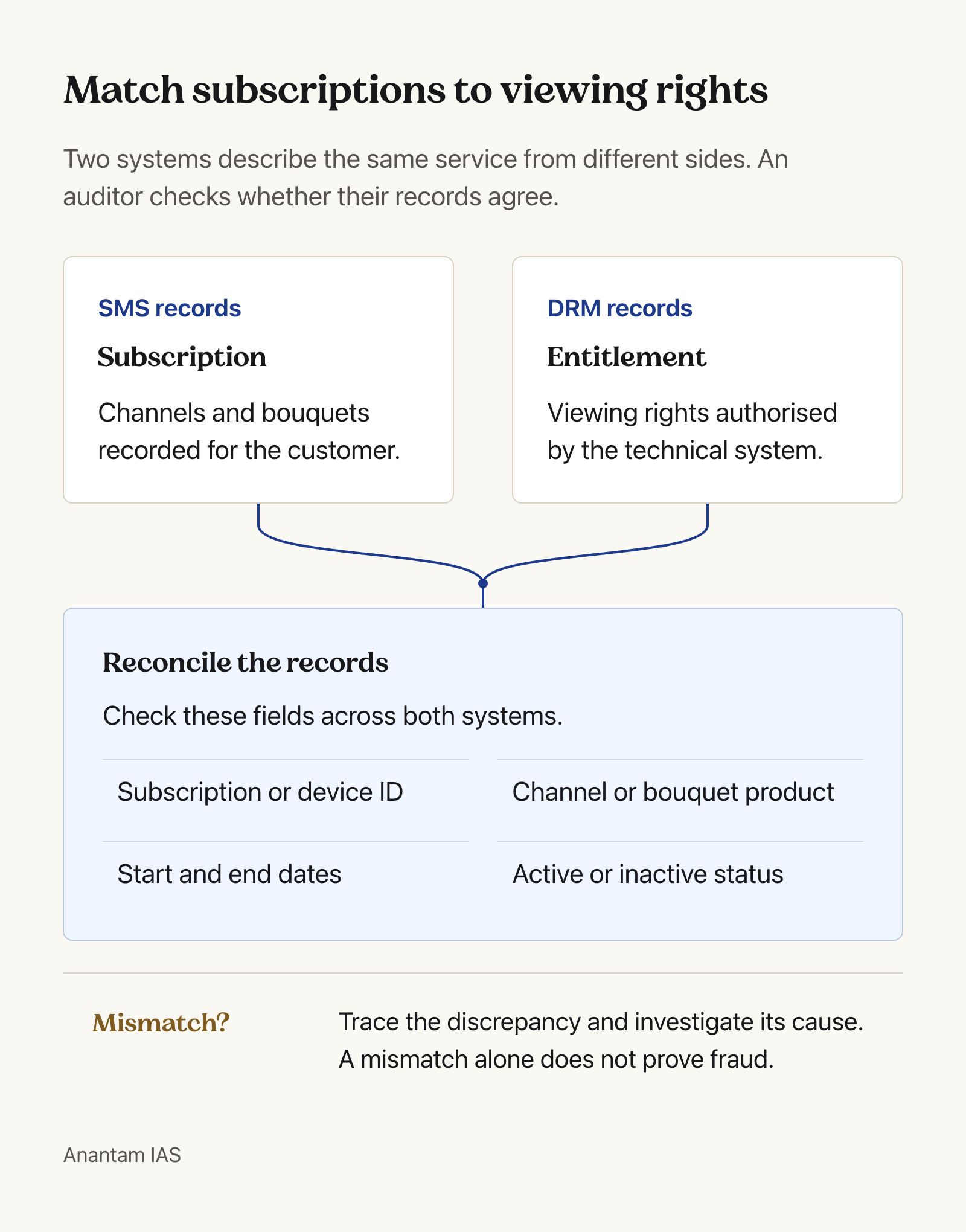
  • SMS means Subscriber Management System, not text messaging. Its records identify subscriptions and associated products; the audit relationship concerns whether those records agree with the rights represented in the DRM system.
  • DRM manages encryption-related access to protected television content. An entitlement identifies what a subscription may receive; encryption protects delivery, while entitlement controls determine the authorised access represented in the system.
  • Reconciliation compares SMS and DRM data to identify inconsistencies. The draft manual proposes examining records together, rather than treating either database as sufficient proof that subscription reporting is correct.
  • Useful matching fields include the subscription or device identifier, channel or bouquet product, entitlement dates and active status. These connect an abstract subscriber total to records that an auditor can actually trace and compare.
SMS subscription records and DRM viewing entitlements converge on an audit comparing identifiers, products, dates and active status.
An IPTV audit reconciles subscription and entitlement records; a mismatch requires investigation rather than automatically proving fraud.

What an Audit Can Establish

Technical compliance and subscription verification ask related but different questions, so neither should be treated as a complete substitute for the other.

  • Compliance checks examine whether the system meets applicable requirements. The proposed procedures cover subscriber management, conditional access and encryption, fingerprinting, and set-top boxes or software applications used to receive the television service.
  • Subscription audits examine the reporting side of distribution. Their purpose includes verification of subscription information supplied to broadcasters, connecting the commercial account of service delivery to the underlying addressable-system records and supporting evidence.
  • Testing matters alongside documents: the draft includes simulated activation and deactivation checks. Observing an operation helps an auditor examine system behaviour instead of relying entirely on a vendor declaration that a function exists.
  • An illustrative discrepancy would be an inactive subscription in one system but a continuing entitlement in the other. It warrants reconciliation and investigation; the mismatch alone does not establish deliberate fraud or explain its cause.
  • Audit scope has limits: checking these records does not itself prove freedom from every cyberattack, settle every consumer dispute or validate all streaming services. The relevant question remains compliance within the applicable television-distribution framework.

Way Forward

Make Findings Reproducible

  • Operators should maintain traceable records of entitlement changes and reconcile systems so discrepancies can be investigated without relying on reconstructed spreadsheets.
  • Auditors should connect each finding to the applicable requirement, tested operation and supporting record, separating observed failures from unexplained discrepancies.
  • TRAI should assess consultation responses for procedures that remain practical across different DRM implementations while protecting the reliability of subscription evidence.

Conclusion

  • The central distinction is between a subscription record, a technical viewing entitlement and evidence that both agree. An audit makes those relationships examinable; no single database or security feature can replace the full exercise.
  • For governance answers, use this draft to explain how regulators turn requirements into verifiable procedures. Preserve the status distinction: annual auditing already exists, while the October DRM audit manual remains a consultation proposal.

UPSC Practice Questions

Prelims MCQ 1

With reference to the draft DRM audit manual, consider the following statements:

  1. SMS refers to the Subscriber Management System.
  2. The October draft introduced the annual audit obligation for the first time.
  3. Schedule X concerns DRM requirements primarily for IPTV distribution.

How many of the above statements are correct?

(a) Only one (b) Only two (c) All three (d) None

Answer: (b) Only two

Explanation:

Statements 1 and 3 are correct. The annual audit duty already exists under the Interconnection Regulations; the draft proposes audit guidance.

Prelims MCQ 2

Which exercise most directly tests consistency between subscription records and technical access entitlements?

(a) Comparing the operator’s advertising budgets (b) Counting channels without checking subscriptions (c) Reconciling SMS and DRM records (d) Measuring television screen dimensions

Answer: (c) Reconciling SMS and DRM records

Explanation:

Reconciliation compares subscription and DRM data, including identifiers, product entitlements, dates and status, to identify inconsistencies.

UPSC Mains Questions

  1. Explain how auditable technical procedures can strengthen accountability in digital television distribution.
  2. Distinguish technical compliance from subscription verification in IPTV systems. What evidentiary safeguards make an audit useful?

Sources: PIB, Ministry of Communications and TRAI, Draft DRM Audit Manual.

Frequently Asked Questions

What is the status of the DRM audit manual?

TRAI released it as a consultation draft on 9 October 2026. It proposes guidance for checking existing requirements and invites stakeholder comments; it should not be described as an already finalised manual.

Does SMS mean a mobile text message here?

No. SMS means Subscriber Management System in this broadcasting context. It contains subscription-related records that need to be consistent with the entitlements represented in the DRM system.

Why compare SMS and DRM records?

The two systems represent related aspects of the service: recorded subscriptions and technical access entitlements. Comparing them can reveal inconsistencies requiring investigation, rather than assuming either dataset alone proves accurate reporting.

Did this draft create the annual audit requirement?

No. The Interconnection Regulations already require annual audits of addressable distribution systems. The draft supplies proposed DRM-specific procedures, documentary requirements and standard reporting arrangements for carrying out the relevant checks.

Caller Identity Verification: Testing Trust Across Borders

Open article →Download PDF

Why in News?

On 9 October 2026, India welcomed an ITU proposal for joint trials of caller identity verification across international networks and expressed readiness to contribute.

  • The Ministry of Communications reported the announcement at an ITU roundtable on standards against fraudulent communications.
  • India suggested starting with willing countries on selected international routes, including different network technologies.
  • Proposed participants include governments, regulators, operators and technology companies; trial lessons would inform further standards development.
  • The announcement establishes willingness and a proposed approach, not completed trials, a universal rollout or demonstrated performance.
  • A call crossing borders raises a shared verification problem: national protections must interact with networks outside their jurisdiction.
  • The exam issue is interoperability and its limits, rather than another list of domestic anti-fraud tools.

UPSC Relevance

Prelims Relevance

  • Caller identity verification and caller-number spoofing
  • Interoperability across different telecom networks
  • ITU standards and proposed joint international trials
  • Distinction between verified identity and trustworthy content

Mains Relevance

GS Paper 3

  • Telecom security across international network boundaries
  • Layered protection against impersonation and cross-border fraud

GS Paper 2

  • Cooperation among national regulators, operators and international standards institutions

Essay

  • Digital trust depends on institutions and incentives as well as technical design.

Background and Context

Why Caller Identity Becomes a Cross-Border Problem

A familiar number on a screen is an identity claim; cross-border cooperation concerns how networks can check that claim beyond national boundaries.

  • Caller-number spoofing means presenting a false calling identity. Its security relevance lies in impersonation: the recipient may treat the displayed number as evidence that the call comes from a familiar or authoritative source.
  • International routing brings different operators into the same communication chain. A domestic safeguard cannot, by itself, establish how every overseas network checks or communicates calling identity before the call reaches its destination.
  • The PIB announcement acknowledged the limits of national solutions and stressed digital verification across international networks. The development concerns cooperation at network boundaries, rather than merely adding another complaint channel within India.
  • Interoperability asks whether different networks can work together meaningfully. Here, a useful trial would examine whether identity information can be understood consistently across participating systems, without assuming that they use identical technology.
  • This differs from domestic spam regulation: unsolicited communication concerns unwanted contact, while the international proposal addresses verification of calling identity across networks; the problems can overlap but are not interchangeable.

What the Proposed Trials Would Need to Establish

Selected routes offer a bounded setting for testing cooperation, but the announcement does not specify a completed technical design or an implementation timetable.

  • India proposed beginning between willing countries on selected routes. This is a suggested starting scope, not an agreement binding all countries or proof that any particular route has already undergone successful testing.
  • Including different network technologies matters because a design that works only between similar systems would leave interoperability uncertain. The proposal explicitly calls for technological diversity, rather than assuming one uniform global telecom network.
  • The proposed multi-actor participation brings public authorities together with operators and technology companies. Their involvement recognizes that standards, regulatory coordination and practical implementation must meet, although the release does not assign detailed responsibilities.
  • Trial evidence should distinguish whether checks are technically possible from whether they remain reliable across participating networks. Successful demonstrations on selected routes would still require careful evaluation before broader claims about international coverage.
  • The announced feedback loop is trials informing further improvement of ITU standards. Readers should not attach an unnamed protocol, certification system or completed architecture to the proposal when the source supplies no such detail.

Verified Identity Is Not a Guarantee Against Fraud

Verification can address an identity claim without deciding whether the words spoken, the requested action or the caller’s intentions are trustworthy.

  • A verified number does not establish that every statement made through it is true. Identity assurance and content trust answer different questions; a genuine connection can still carry deception or an improper request.
  • Coverage is a separate limitation. A trial restricted to willing partners and selected routes cannot demonstrate protection across every international call; participating boundaries must remain explicit when results are eventually assessed and communicated.
  • False confidence is a practical risk if recipients interpret a verification signal as official approval of a conversation. User-facing explanations should state what was checked and avoid implying that financial instructions are automatically safe.
  • Accountability should accompany technical tests: participating authorities need clarity about who examines failures and disputed checks. This is an evaluation recommendation, not a claim that the announcement has already created a redress mechanism.
  • National measures and international cooperation remain complementary. The proposal responds to the cross-border gap; it does not establish that domestic investigations, operator safeguards or independent checking of suspicious requests have become unnecessary.

Way Forward

Evaluate the Boundary Before Expanding Coverage

  • Define trial scope publicly: participating networks, routes, tested identity claims and unresolved limitations.
  • Assess interoperability failures alongside successful calls, including how uncertainty is communicated rather than hidden.
  • Require clear user explanations so verification is not presented as a guarantee of safe content or legitimate payment requests.
  • Feed documented findings into standards improvement before making claims about wider deployment.

Conclusion

  • The proposed trials frame cross-border caller identity as a cooperation problem: technical checks need compatible networks, participating institutions and evidence from implementation.
  • For UPSC answers, distinguish proposal from deployment and identity assurance from trustworthy content; these distinctions prevent overstating what a telecom security intervention can establish.

UPSC Practice Questions

Prelims MCQ 1

With reference to the caller identity trials welcomed by India, consider the following statements:

  1. India suggested beginning between willing countries on selected international routes.
  2. The proposal calls for participation by different network technologies.
  3. The announcement confirms completed trials on all international routes.

How many of the above statements are correct?

(a) Only one (b) Only two (c) All three (d) None

Answer: (b) Only two

Explanation:

The first two statements reflect the proposal. The release reports willingness and suggested trial scope, not completed universal testing.

Prelims MCQ 2

Which statement best describes a limitation of caller identity verification?

(a) It necessarily proves that the caller’s financial instructions are legitimate. (b) It makes international cooperation unnecessary. (c) It can establish an identity claim without guaranteeing that the conversation is trustworthy. (d) It establishes that every telecom network uses identical technology.

Answer: (c) It can establish an identity claim without guaranteeing that the conversation is trustworthy.

Explanation:

Identity assurance concerns who or which number is represented. It does not independently establish the truth or legitimacy of the communication.

UPSC Mains Questions

  1. Why does caller identity verification across international networks require cooperation beyond national anti-fraud measures? Discuss the role of interoperability. (150 words)
  2. A verified caller identity is not a guarantee of trustworthy communication. Explain this distinction and suggest safeguards for evaluating international telecom security trials. (250 words)

Source: PIB, Ministry of Communications.

Frequently Asked Questions

What did India announce about international caller identity trials?

India welcomed an ITU proposal for joint trials and expressed readiness to contribute. It suggested beginning with willing countries on selected international routes and including different network technologies.

Have the cross-border trials already been completed?

The cited announcement does not establish completed trials or a universal rollout. It describes a proposal, Indian willingness to contribute and a suggested starting scope for future testing.

Why is interoperability important for caller identity verification?

An international call can involve different operators and network technologies. Interoperability concerns their ability to work together consistently, so an identity check is not confined to a single participating system.

Does verified caller identity mean a call is safe?

No. Verifying an identity claim does not prove that a conversation is truthful or a requested transaction is legitimate. Recipients still need independent checks before acting on suspicious instructions.

Mangrol: Matching Anti-Submarine Craft to Shallow Waters

Open article →Download PDF

Why in News?

On 9 October 2026, the Defence Ministry announced that Mangrol, an indigenous anti-submarine warfare shallow-water craft, was scheduled for commissioning on 12 October at Mumbai.

  • Cochin Shipyard Limited built Mangrol for detecting and countering underwater threats in coastal and shallow waters.
  • The announced equipment includes Abhay sonar, lightweight torpedoes, an anti-submarine rocket launcher and Maareech torpedo decoys.
  • Waterjet propulsion supports manoeuvrability; the craft can also undertake underwater surveillance and mine warfare-related tasks.
  • Ports and coastal approaches need underwater protection alongside surface surveillance; a visible patrol presence alone does not identify submerged threats.
  • Specialised craft supplement the fleet by matching equipment and movement to the operating environment rather than treating warship size as the measure of capability.

UPSC Relevance

Prelims Relevance

  • Anti-Submarine Warfare Shallow Water Craft (ASW-SWC)
  • Abhay: compact hull-mounted sonar
  • Active and passive sonar
  • Maareech: torpedo defence through decoys
  • Waterjet propulsion and coastal manoeuvrability

Mains Relevance

GS Paper 3

  • Matching defence capability to coastal operating conditions.
  • Integrating indigenous sensors, weapons and propulsion into a useful naval platform.

Essay

  • Specialisation and cooperation as complementary sources of institutional capability.

Background and Context

Why Shallow Waters Need Specialised Craft

A coastal anti-submarine craft is designed around its operating environment, where movement and underwater surveillance must work together near valuable maritime infrastructure.

  • Mission fit: The Defence Ministry identifies coastal waters as an area where larger warships face operational limitations. Mangrol addresses that specific requirement rather than replacing every role performed by a larger naval vessel.
  • Protected approaches: Ports, harbours and their approaches concentrate movements of naval and commercial vessels. Detecting underwater threats nearby supports access to these facilities, making local surveillance part of wider maritime security.
  • Waterjet propulsion: Mangrol’s diesel engines power waterjets, which the announcement links to high manoeuvrability in shallow water. Propulsion supports positioning and movement; it is not a substitute for the sonar that detects threats.
  • Capability boundaries: The release also lists low-intensity maritime operations and mine warfare-related tasks. That wording does not establish a complete minesweeping capability or justify treating every specialised underwater mission as interchangeable.
  • Operational status: As of this edition, commissioning remains scheduled. The announcement describes intended roles and installed equipment; it should not be presented as evidence that Mangrol has already completed an operational deployment.

Sonar Detects; Weapons and Decoys Have Different Jobs

The equipment list becomes useful when separated into sensing, countering a submarine threat and defending the surface ship against an incoming torpedo.

  • Sound underwater: NOAA explains sonar as sound-based detection and ranging. Sound travels farther underwater than light or radar waves, making acoustic sensing important for locating objects that cannot be seen directly.
  • Active sonar emits sound and listens for returning echoes; passive sonar listens without transmitting its own signal. These describe sensing methods, not two different kinds of weapon or a guarantee of finding every target.
  • Abhay is the announced hull-mounted sonar. The Defence Ministry describes active and passive sensing for smaller platforms, bringing underwater surveillance to vessels designed for coastal patrol and shallow-water operations.
  • Lightweight torpedoes and the anti-submarine rocket launcher are weapons for countering underwater threats. Their presence does not remove the need to detect, identify and track a contact before deciding what response is appropriate.
  • Maareech has a defensive role: official descriptions identify torpedo detection and countermeasures, including decoying. A decoy seeks to mislead the threat; it is not the same function as attacking a submarine.

Cooperation Makes a Specialised Platform More Useful

A craft contributes to a wider naval system when observations and responses can be coordinated across ships and aircraft, with clear capability limits.

  • Complementary platforms: The announcement says Mangrol can operate alongside maritime patrol aircraft, helicopters and other warships. The teaching point is cooperation between different platforms, not a claim that one craft can secure an entire coastline.
  • Interoperability requires crews to share usable information and coordinate action. The earlier SLINEX note explains why practising together matters; equipment compatibility alone cannot demonstrate effective cooperation during an operation.
  • System integration: Indigenous construction becomes militarily useful when sensors, weapons and propulsion work together reliably. Listing domestic components establishes neither their operational availability nor their performance under every condition encountered at sea.
  • Evidence of capability must come from appropriate trials, maintenance experience and crew proficiency. The defence test-ranges note provides the related distinction between developing equipment and generating evidence about its performance.
  • Limits of public evidence: The announcement supplies no verified detection range or claim of acoustic invisibility. An answer should explain the functions actually disclosed instead of converting a commissioning announcement into unproven technical specifications.

Way Forward

Assess Readiness Through Functions

  • Exercise the whole chain: Test whether crews can interpret contacts and coordinate responses with other platforms, rather than judging readiness from a list of installed systems.
  • Maintain sensor availability: Connect training, spares and maintenance to the craft’s surveillance mission so that indigenisation translates into usable equipment at sea.
  • Keep roles distinct: Assess anti-submarine capability, torpedo defence and mine-related tasks against their own requirements instead of assuming success in one proves competence in all.

Conclusion

  • Mangrol illustrates mission-specific design: suitable movement, underwater sensing and differentiated weapons or decoys must operate as a coordinated system to protect coastal approaches.
  • For an examination answer, connect specialised platforms with cooperation and evidence of readiness; retain the distinction between a scheduled commissioning and demonstrated operational performance.

UPSC Practice Questions

Prelims MCQ 1

With reference to underwater naval systems, consider the following statements:

  1. Active sonar transmits sound and receives echoes.
  2. Passive sonar necessarily transmits its own signal to locate a target.
  3. Torpedo decoys and anti-submarine weapons perform different functions.

How many of the above statements are correct?

(a) Only one (b) Only two (c) All three (d) None

Answer: (b) Only two

Explanation:

Statements 1 and 3 are correct. Passive sonar listens without emitting its own signal. A decoy misleads a threat, whereas an anti-submarine weapon is used to counter a submarine.

Prelims MCQ 2

Which pairing correctly matches an announced Mangrol system with its principal role?

(a) Abhay : hull-mounted underwater sensing (b) Maareech : waterjet propulsion (c) Waterjets : acoustic target identification (d) Lightweight torpedoes : passive surveillance

Answer: (a) Abhay : hull-mounted underwater sensing

Explanation:

Abhay is a hull-mounted sonar. Maareech is a torpedo-defence system, waterjets provide propulsion, and lightweight torpedoes are weapons.

UPSC Mains Questions

  1. Explain why specialised shallow-water anti-submarine craft complement larger naval platforms in protecting coastal approaches. (150 words)
  2. Distinguish underwater sensing, anti-submarine weapons and torpedo decoys. Why does integrating them require both technical compatibility and trained crews? (150 words)

Sources: PIB, Ministry of Defence and NOAA Ocean Exploration.

Frequently Asked Questions

Has Mangrol been commissioned?

The Defence Ministry’s announcement of 9 October scheduled commissioning for 12 October 2026. As of this 10 October edition, the event remains upcoming and should not be described as completed.

What is Abhay sonar?

Abhay is a compact hull-mounted sonar developed for smaller naval platforms. The Defence Ministry describes active and passive sensing, helping distinguish its surveillance role from that of weapons carried by the ship.

How does Maareech differ from an anti-submarine weapon?

Maareech is intended to defend a surface ship against torpedoes through detection and acoustic decoying. Anti-submarine weapons counter submarine threats; a decoy instead seeks to mislead an incoming threat.

Does a shallow-water craft replace a minesweeper?

Not on the evidence in this announcement. The Ministry lists mine warfare-related tasks, which is narrower than establishing the full capabilities needed for specialised mine clearance or every minesweeping operation.

NTA Reform Report: Exam Security and Parliamentary Accountability

Open article →Download PDF

Why in News?

A parliamentary standing committee presented its NTA reform report on 9 October 2026, recommending stronger examination security, institutional accountability and accessible computer-based testing.

  • The Rajya Sabha Secretariat release describes recommendations on strengthening the National Testing Agency; these are proposals, not a notification bringing new examination rules into force.
  • The report links question-bank security with specialist staffing, government examination infrastructure and candidate safeguards, rather than treating paper leaks as only a policing problem.
  • The committee recommends a phased move to computer-based NEET-UG, subject to infrastructure, accessibility and transparent score-normalisation arrangements.
  • Examination integrity protects both merit and trust: a secure test must also give candidates a fair opportunity to demonstrate what they know.
  • Institutional capacity matters because national examinations depend on coordination among the testing agency, governments, centres, technical providers and subject experts.

UPSC Relevance

Prelims Relevance

  • National Testing Agency and entrance examinations
  • Department-related parliamentary standing committees
  • Question banks and computer-based testing
  • Score normalisation across examination sessions
  • Equity audits and candidate grievance redressal

Mains Relevance

GS Paper 2

  • Accountability of public institutions and parliamentary scrutiny
  • Examination integrity, digital access and equality of educational opportunity

Essay

  • A fair examination measures ability without making access itself a test.

Background and Context

What Parliamentary Scrutiny Can Change

The report connects operational failures with the way the testing agency is staffed, supervised and made answerable to candidates.

  • The committee report recommends a parliamentary accountability framework for NTA, matching its responsibilities with resources and oversight; the recommendation itself does not establish that framework or change existing examination rules.
  • A permanent specialist workforce is proposed because examination expertise develops through repeated experience; short deputation tenures cannot alone supply sustained capability in psychometrics, digital infrastructure, examination security and logistics.
  • The proposed independent examination mechanism would audit security protocols, investigate candidate grievances and report directly to the Ministry, separating scrutiny of the agency from its everyday task of administering examinations.
  • The committee proposes a clearer duty of care towards candidates, including possible compensation for administrative cancellations and grievance timelines; these should be read as recommendations, not as compensation rights already operational.
  • Its suggested research wing would study whether examinations fulfil their educational purpose, making institutional quality about valid assessment as well as successful administration; this shifts attention beyond merely completing an examination schedule.

How Question Banks Could Reduce Exposure

Security requires limiting who can know the final paper in advance while retaining expert scrutiny of question quality and fairness.

  • A large, diverse question bank would separate producing individual questions from knowing the eventual paper; continuously updating it also reduces dependence on repeatedly used sets and predictable pools of material.
  • The committee recommends assembling papers close to the examination, using digital selection followed by expert vetting; shorter advance exposure is intended to reduce opportunities for misuse before candidates sit the test.
  • Computer-based testing can remove the need to print and transport paper sets beforehand; this changes the security chain, but it does not by itself eliminate insider misconduct or attacks on examination systems.
  • Integrity screening of question developers and translators is recommended to identify conflicts of interest, including coaching connections; the committee also calls for sequestering final paper-vetters until the examination has concluded.
  • The proposed in-house cybersecurity team would strengthen examination software against remote access and related misuse; digital delivery requires new safeguards because reducing physical paper exposure shifts some risks to computers and networks.

Why Digital Security Must Include Access

Moving an examination onto computers changes the candidate experience as well as the way papers are protected and delivered.

  • The committee supports government-owned testing infrastructure across underserved locations before a NEET-UG transition; nearby dependable centres matter because travel and accommodation burdens can prevent candidates from benefiting equally from digital reform.
  • Practice opportunities should familiarise candidates with computer interfaces before a high-stakes test; otherwise, differences in digital exposure may influence performance alongside subject knowledge, weakening the fairness that examination reform seeks to protect.
  • For examinations spread across sessions, score normalisation addresses differences in paper difficulty; the committee wants the methodology explained publicly and independently audited before transition, so candidates can understand how comparable scores are produced.
  • A proposed equity audit would examine participation alongside pass rates and cutoff achievement across candidate groups; registrations alone show who enters the process, not whether barriers persist through its later stages.
  • Disability access includes suitable centres, accessible platforms, scribes and compensatory time where applicable; the report calls for a dedicated protocol, complementing the broader inclusion concerns discussed in whole-school inclusion.

Way Forward

Sequence Reform Around Candidate Protection

  • Publish an implementation response identifying accepted recommendations, responsible institutions and milestones, so students can distinguish proposals from rules actually brought into operation.
  • Link digital transition to demonstrated centre readiness, accessible mock tests and independently reviewed normalisation before changing examination delivery.
  • Track security and equity together: publish meaningful grievance outcomes and audit findings while protecting candidates’ personal information.

Conclusion

  • Examination reform should join question security, professional capability and independent accountability with accessible delivery; none of these safeguards can substitute for the others when public trust has been damaged.
  • For a governance answer, use the report to distinguish announced recommendations from implementation, then assess whether the proposed security architecture also protects fair access, transparent assessment and effective remedies for candidates.

UPSC Practice Questions

Prelims MCQ 1

With reference to the parliamentary recommendations on NTA reform, consider the following statements:

  1. A large question bank can separate question development from advance knowledge of the final paper.
  2. Computer-based testing eliminates the need for cybersecurity safeguards.
  3. An equity audit should examine outcomes as well as participation.

How many of the above statements are correct?

(a) Only one (b) Only two (c) All three (d) None

Answer: (b) Only two

Explanation:

Statements 1 and 3 are correct. The report recommends question banks and outcome-based equity audits, but explicitly recognises cybersecurity risks in computer-based testing.

Prelims MCQ 2

Why does the report recommend transparent normalisation for examinations conducted across multiple sessions?

(a) To replace all subject questions with interviews (b) To guarantee an equal number of successful candidates from every centre (c) To address differences in difficulty when making scores comparable (d) To remove the need for question quality checks

Answer: (c) To address differences in difficulty when making scores comparable

Explanation:

Normalisation is intended to support comparability across papers or sessions with different difficulty levels. It does not guarantee identical outcomes or replace sound question design.

UPSC Mains Questions

  1. Examine how specialist capacity and independent oversight can strengthen accountability in national entrance examinations.
  2. A secure examination is not necessarily an accessible examination. Discuss with reference to the proposed transition towards computer-based testing.

Source: PIB, Rajya Sabha Secretariat.

Frequently Asked Questions

Have the committee’s recommendations become examination rules?

No. The release reports parliamentary recommendations. A proposal to change examination delivery, accountability arrangements or candidate safeguards should not be treated as operational unless the relevant authority formally implements it.

How can question banks improve examination security?

A large and regularly updated bank allows the final paper to be assembled close to the examination. Question developers need not know the selected combination, reducing advance exposure while preserving expert vetting.

Does computer-based testing eliminate paper leaks and cheating?

Computer-based delivery can remove advance printing and transport risks, but it introduces or retains risks involving software, networks and insiders. The report recommends cybersecurity capability alongside changes to examination delivery.

What would an examination equity audit examine?

The proposed audit would compare participation, pass rates and cutoff achievement across candidate groups. This helps distinguish broad registration from fair outcomes and identify barriers that participation figures alone may conceal.

Prescription Drug Advertising: Extending Controls Across Sellers

Open article →Download PDF

Why in News?

On October 9, 2026, the Health Ministry publicised a draft amendment extending prescription-drug advertising restrictions to retail, wholesale and distribution licence holders.

  • The draft notification, dated September 28, proposes a new sub-rule under Rule 65 of the Drugs Rules.
  • Advertising medicines in Schedules H, H1 and X would require previous Central Government sanction for sale and distribution licence holders.
  • The Gazette invites objections and suggestions within thirty days of copies containing the draft becoming available to the public.
  • The proposal is not an enacted blanket ban; the draft provides for commencement upon final publication in the Official Gazette.
  • Prescription medicines require medical supervision; advertising restrictions seek to reduce promotion that may encourage inappropriate self-medication.
  • The proposal addresses a supply-chain gap: restrictions already described for manufacturers would explicitly extend to sale and distribution licence holders.

UPSC Relevance

Prelims Relevance

  • Drugs Rules: subordinate legislation governing specified aspects of medicine regulation.
  • Rule 65: proposed location of the new advertising condition for sale licence holders.
  • Schedules H, H1 and X: the medicine categories named in this draft.
  • Previous sanction: Central Government approval before the covered advertisement.
  • DTAB: Drugs Technical Advisory Board, consulted in preparing the proposal.

Mains Relevance

GS Paper 2

  • Health governance: regulation of commercial promotion and inappropriate self-medication.
  • Delegated legislation: technical consultation, public objections and final notification.

Essay

  • Consumer choice in healthcare depends on safeguards against misleading commercial influence.

Background and Context

What Regulatory Gap Does the Draft Address?

The proposal follows the medicine through the commercial supply chain, extending an advertising control to additional licence holders rather than changing its clinical use.

  • The existing restriction, as explained by the Health Ministry, prevents pharmaceutical manufacturers from advertising medicines in the named schedules without prior Central Government sanction; the proposal addresses actors further along the supply chain.
  • Retailers, wholesalers and distributors can promote medicines even when they did not manufacture them, so regulating manufacturers alone does not explicitly place the same advertising condition on every licensed seller or distributor.
  • The draft places its new condition within Rule 65, covering holders of licences to sell, stock, exhibit or offer drugs for sale, or distribute them; the mechanism is regulation through sale-licence conditions.
  • The named scope is Schedule H, Schedule H1 and Schedule X, rather than every product sold in a pharmacy; an answer should preserve those categories without inventing an exhaustive list of covered medicines.
  • The proposal concerns advertising permission, not a new clinical authorisation for a medicine; permission to promote a covered product cannot be treated as permission for any individual to use it without appropriate supervision.

How Would Prior Sanction Work?

The operative distinction is between permission before advertising and enforcement after unauthorised promotion; the draft chooses the first as its explicit legal condition.

  • Previous sanction means that Central Government approval must precede the advertisement; the draft does not describe an arrangement in which an advertiser can proceed first and seek approval only after a complaint arrives.
  • The wording retains an approval route, making an absolute prohibition an inaccurate description; its practical effect would depend on how applications, decisions and compliance are administered under the final regulatory framework.
  • The Central Government is the sanctioning authority named in the proposed text; the ministry release does not establish a separate seller-created approval mechanism or allow an industry endorsement to replace that governmental decision.
  • The Gazette text states the advertising condition concisely but does not supply a detailed implementation manual; claims about automatic approvals, application fees or fixed processing times would go beyond the verified proposal.
  • The intended safeguard is against inappropriate self-medication, including risks involving certain antibiotics and psychotropic medicines; this explains the regulatory rationale without implying that an advertisement alone establishes whether a treatment is medically suitable.

Why Does Draft Status Matter?

A consultation opens a rule-making process; it does not establish that the proposed obligation has already taken legal effect for every affected business.

  • The Drugs Technical Advisory Board was consulted before the draft was published, linking specialist advice to rule-making; technical consultation supports policy design but does not replace the final legal step that creates an operative amendment.
  • The public-comment period runs from the date Gazette copies containing the draft become available to the public; counting automatically from the notification date or the ministry press-release date could produce an incorrect deadline.
  • The Central Government will consider objections and suggestions received within that period; affected businesses and members of the public can raise practical issues before the government settles the final form of the amendment.
  • The proposed commencement clause specifies final publication in the Official Gazette; until that occurs, describe the extension as proposed rather than claiming that new seller obligations commenced when the ministry announced the draft.
  • Medicine price regulation addresses affordability, whereas this proposal addresses commercial promotion; lower prices and advertising controls are separate policy instruments, and neither announcement establishes the other instrument’s scope or legal effect.

Way Forward

Make the Final Rule Operationally Clear

  • Clarify the sanction procedure and the records licence holders should retain, so the final condition can be checked against identifiable approvals.
  • Explain how the final rule applies to different advertising channels, avoiding uncertainty about who is responsible for promotional material distributed through intermediaries.
  • Publish the final terms and commencement clearly, separating consultation proposals from duties that affected licence holders must actually follow.

Conclusion

  • The draft seeks consistent advertising controls across manufacture, sale and distribution of specified prescription medicines, but the correct legal description remains a proposed extension requiring previous Central Government sanction, not an implemented prohibition on all medicine advertising.
  • For a governance answer, connect regulatory coverage with a workable approval process and public consultation; judge the final rule by its clarity and enforceability without confusing commercial promotion, medicine pricing and clinical decisions.

UPSC Practice Questions

Prelims MCQ 1

With reference to the proposed prescription-drug advertising amendment, consider the following statements:

  1. It expressly names medicines in Schedules H, H1 and X.
  2. It would require previous Central Government sanction for covered advertising.
  3. Its publication as a draft means that the new seller obligation has already commenced.

How many of the above statements are correct?

(a) Only one (b) Only two (c) All three (d) None

Answer: (b) Only two

Explanation:

The draft names all three schedules and requires previous Central Government sanction. It provides for commencement on final publication in the Official Gazette, so the third statement is incorrect.

Prelims MCQ 2

What starts the thirty-day consultation period specified in this draft?

(a) The date the draft notification was signed. (b) The date the ministry issued its press release. (c) The date Gazette copies containing the draft are made available to the public. (d) The date a retailer first submits an advertisement.

Answer: (c) The date Gazette copies containing the draft are made available to the public.

Explanation:

The Gazette expressly ties the period to public availability of the copies containing the draft, rather than automatically to the notification or press-release date.

UPSC Mains Questions

  1. Explain how extending advertising conditions to sale and distribution licence holders can address gaps in prescription-medicine regulation. (150 words)
  2. Discuss the importance of technical advice, public consultation and clear commencement provisions in delegated legislation affecting public health. (250 words)

Sources: PIB, Ministry of Health and Family Welfare and Official Gazette, draft Drugs Rules amendment.

Frequently Asked Questions

Has India imposed a new blanket ban on prescription-drug advertising?

No. This development is a draft amendment proposing previous Central Government sanction for advertising specified prescription medicines by sale and distribution licence holders. It is not evidence that the extension has already commenced.

Which medicines are named in the proposal?

The draft names medicines specified in Schedule H, Schedule H1 and Schedule X of the Drugs Rules. Its wording should not be expanded into a claim that it covers every pharmacy product.

Does the proposal change medicine prices?

The proposed condition concerns advertising, not medicine prices. Price regulation and advertising regulation address different policy problems, so a change in one cannot be assumed to establish new rules under the other.

When would the amendment come into force?

The draft says the amendment would commence on final publication in the Official Gazette. It also provides a public-comment period before consideration, so draft publication must be distinguished from commencement of the final rule.

SC rejects A.P. plea to restore 34% BC quota in local bodies

Open article →Download PDF

Why in news?

Supreme Court upheld High Court ruling striking down Andhra Pradesh’s 34% BC quota in local bodies for lacking empirical data.

UPSC Relevance –

 Prelims: Articles 243D and 243T, triple test, 50% ceiling.

Mains, GS2: Devolution of powers and finances up to local levels.

The case in brief

  • Andhra Pradesh decided in 2026 to restore 34% reservation for Backward Classes (BCs) in local bodies, which would take total reservation above 50%.
  • The High Court struck it down on October 1, holding the State had not produced the empirical data needed to cross the 50% ceiling. The Supreme Court has now dismissed the State’s appeal.
  • The Court found that figures from a unified family survey (a general household database) were not enough. There was no specific assessment of backwardness and representation in local bodies, which the law requires.

Constitutional framework

  • 73rd and 74th Amendments (1992) gave constitutional status to Panchayats (Part IX) and Municipalities (Part IXA).
  • Article 243D / 243T: Seats for SCs and STs must be reserved in proportion to their population in that area. At least one-third of seats (including SC/ST seats) are reserved for women. Offices of chairpersons can also be reserved as the State law provides.
  • Article 243D(6) / 243T(6): These are enabling provisions. The State Legislature may reserve seats and chairperson posts for backward classes. Unlike SC/ST reservation, BC reservation is not mandatory and has no constitutional formula.

Key judgments

CaseYearWhat it held
K. Krishna Murthy vs Union of India2010Upheld 243D(6) and 243T(6). Held that political backwardness is different from social and educational backwardness, so data used for jobs and education cannot be used automatically for local bodies. Vertical reservation in local bodies should not exceed 50% (except Scheduled Areas).
Vikas Kishanrao Gawali vs State of Maharashtra2021Struck down Maharashtra’s OBC quota in local bodies and laid down the triple test.
Suresh Mahajan vs State of Madhya Pradesh2022Elections cannot be delayed for want of OBC data; if the triple test is not met, seats go to the general category.

The triple test

Before reserving seats for OBCs in local bodies, a State must:

  1. Set up a dedicated commission to conduct a contemporaneous, rigorous empirical inquiry into the nature and implications of backwardness in local bodies.
  2. Specify the proportion of reservation local body-wise, based on the commission’s recommendations, to avoid over-breadth.
  3. Ensure that total reservation for SCs, STs and OBCs does not exceed 50% of seats.

The test asks a narrow question: are OBCs under-represented in local bodies, and by how much? A general socio-economic or household survey does not answer this. That is why the AP survey data failed.

The debate

Arguments for raising BC reservation

  • BCs form a large share of the population in most States; a 50% cap may leave them under-represented in grassroots democracy.
  • Local bodies are the first step to political leadership. Fair share there builds a pipeline for higher levels.
  • The EWS judgment shows the 50% limit is not absolute, which States cite to argue for flexibility.

Arguments for the Court’s approach

  • Reservation must rest on quantifiable data, not political announcements made before elections.
  • The 50% ceiling protects equality of opportunity for others and is part of a balanced reading of Article 14.
  • Backwardness in politics may differ from area to area. Some groups may already be well represented in local bodies.

Concerns

  • Delayed elections: Litigation over quotas has kept local bodies without elected representatives, against the spirit of Article 243E/243U (five-year term and timely elections).
  • Data deficit: No caste-wise data since 1931 census (except SC/ST). The decision to include caste enumeration in the upcoming Census may help, but local body-level data on representation will still be needed.
  • Populism: Parties promise quotas they cannot legally deliver. In this case, the ruling party has said it will give 34% of tickets to BCs in local polls, a party-level choice that needs no legal backing.

Way forward

  • Permanent, well-resourced State backward class commissions that keep local body representation data updated, instead of hurried exercises before each election.
  • Use the upcoming caste census data along with local body records to meet the triple test.
  • Hold elections on time; quota disputes should not suspend local democracy.
  • Ensure the most backward among BCs benefit through sub-classification, as recommended by the Rohini Commission for central OBC lists.
  • Parties can widen representation voluntarily through ticket distribution, as AP’s ruling party now proposes.

The judgment does not deny the case for BC representation. It insists that reservation be based on evidence about local bodies. States that build that evidence carefully are more likely to see their quotas survive.

Practice MCQ 

Q1. With reference to reservation in Panchayats, consider the following statements:

  1. Article 243D(6) enables the State Legislature to reserve seats for backward classes in Panchayats.
  2. Seats for Scheduled Castes and Scheduled Tribes in Panchayats are reserved in proportion to their population in that Panchayat area.
  3. Under the triple test, total reservation for SCs, STs and OBCs in local bodies should not exceed 50% of seats.

How many of the statements given above are correct?

(a) Only one

(b) Only two

(c) All three

(d) None

Answer: (c)

Mains Practice Question 

Q. “The triple test seeks to ground OBC reservation in local bodies in evidence, but its application has often delayed grassroots democracy.” Critically examine. (15 marks, 250 words)

India’s WorldSkills medals reflect patient investment

Open article →Download PDF

Why in news?

India finished 10th at the 48th WorldSkills Competition in Shanghai, winning a record 26 medals, its best-ever performance.

UPSC Relevance – Prelims: WorldSkills Competition, Skill India Mission, PMKVY, PM-SETU, NSQF, NCVET, PM Vishwakarma.

Mains: GS2 – Issues relating to development of Human Resources, Education, Government policies and interventions. GS3 – Inclusive growth, Employment, Demographic dividend.

About WorldSkills Competition

  • What: Often called the ‘Olympics of skills’. Held every two years by WorldSkills International. Over 1,400 young people from about 70 countries and regions compete in trades from welding and bakery to robotics and cyber security.
  • Age limit: Competitors are generally up to 22 years of age (up to 25 in some advanced skills).
  • India’s participation: India became a member in 2007. Teams are selected through IndiaSkills, run by the Ministry of Skill Development and Entrepreneurship (MSDE) and the National Skill Development Corporation (NSDC), with district, State, regional and national rounds.
  • India’s performance: 10th in Shanghai (2026). The 2026 haul had 6 silvers and 20 Medallions for Excellence. India also competed in 11 skills for the first time.

Skill Development in India – Why It Matters

  • Demographic dividend: Around two-thirds of India’s population is of working age, and the median age is under 30. Without skills, this advantage can turn into a burden of unemployed youth.
  • Low formal skilling: According to PLFS 2022-23, only about 4% of India’s workforce has received formal vocational training. The figure is far higher in Germany, Japan and South Korea.
  • Employability gap: Industry surveys (India Skills Report) find only about half of Indian graduates employable. Employers report a shortage of skilled workers even as educated youth remain unemployed.
  • Jobs need: The Economic Survey 2023-24 estimated India needs to create about 78.5 lakh non-farm jobs every year till 2030.
  • Manufacturing and Viksit Bharat: Make in India, semiconductors, green energy and electronics all need technicians, not just degree holders.
  • Global opportunity: Ageing societies like Japan, Germany and Israel need skilled workers; India has signed migration and mobility agreements with several countries.

Government Initiatives

  • Institutions: MSDE (2014); NSDC (2008), a PPP company that funds training providers; Sector Skill Councils led by industry; National Council for Vocational Education and Training (NCVET, 2018) as the regulator.
  • Frameworks: National Skills Qualifications Framework (NSQF, 2013) arranges qualifications by levels so that skills are comparable with academic degrees. National Policy on Skill Development and Entrepreneurship (2015).
  • Skill India Mission (2015): Includes Pradhan Mantri Kaushal Vikas Yojana (PMKVY, now in its 4.0 phase with focus on new-age skills like AI, drones and 3D printing), Jan Shikshan Sansthans and apprenticeship schemes.
  • PM-SETU: ₹60,000 crore scheme to upgrade 1,000 government ITIs in a hub-and-spoke model (200 hubs, 800 spokes), with industry partners managing the clusters.
  • Apprenticeships and internships: National Apprenticeship Promotion Scheme (2016), National Apprenticeship Training Scheme, and the PM Internship Scheme (2024) offering internships in top companies.
  • PM Vishwakarma (2023): Skilling, toolkits and credit for traditional artisans in 18 trades such as carpenters, potters and blacksmiths.
  • Education linkage: NEP 2020 aims to integrate vocational education into school and higher education, so that at least 50% of learners get exposure to vocational education.
  • Digital: Skill India Digital Hub (2023), a single platform for courses, certification and jobs.

Challenges

  • Social stigma: Vocational work is seen as a ‘second choice’ for those who fail academically. As the article notes, skilling has had no place of honour in Indian public life, unlike toppers’ lists and ranks.
  • Weak placement: Audits and parliamentary committees have repeatedly flagged low placement rates and poor tracking of outcomes under schemes like PMKVY. Training is often counted by numbers enrolled, not jobs secured.
  • Poor quality of ITIs: Outdated equipment and syllabus, shortage of trained instructors and low seat utilisation in many ITIs.
  • Weak industry participation: Industry often prefers to hire rather than train. Apprenticeship numbers remain small compared to the size of the workforce.
  • Mismatch: Courses do not match local job demand; rapid technology change (AI, automation) makes skills outdated quickly.
  • Informal sector: Nearly 90% of workers are in the informal sector, where skills are learnt on the job and not certified, so they earn less and cannot move up.
  • Gender gap: Women’s participation in skilling and technical trades is low; training is often limited to ‘traditional’ roles like tailoring and beauty.
  • Fragmentation: Skilling schemes are spread across many ministries, leading to overlap and poor coordination.
  • Low wages: Skilled blue-collar jobs often pay poorly and lack social security, so youth do not see skilling as worth the effort.

Committee Recommendations

  • Kothari Commission (1964-66): Called for vocationalisation of secondary education, a goal that largely remained unmet.
  • Sharada Prasad Committee (2016): Reviewed Sector Skill Councils and found them weak and driven by targets. Recommended restructuring SSCs, stronger quality control, and a single regulator, which led to the creation of NCVET.
  • Parliamentary Standing Committee on Labour, Textiles and Skill Development: Has repeatedly recommended better placement tracking, third-party assessment, and closer industry linkage for skilling schemes.

Way Forward

  • Give dignity to skills: Celebrate skill champions like academic toppers; the PM meeting WorldSkills winners sends that signal.
  • Skill-Ex: As the author argues, treat investment in people (Skill-Ex) as seriously as Capex and Opex. Industry should co-invest in training.
  • Dual system: Learn from Germany’s model, where students split time between classroom and workplace. Expand apprenticeships through simpler rules and stipend support.
  • Outcome-based funding: Pay training providers based on placement, wages and retention, not just enrolment.
  • Modernise ITIs: Implement PM-SETU well, with updated syllabi, trained instructors and real industry management.
  • Credit and mobility: Use the National Credit Framework so that students can move between vocational and academic streams without losing years.
  • Recognise informal skills: Expand Recognition of Prior Learning (RPL) to certify workers who learnt on the job.
  • Inclusion: Hostels, stipends and safe transport to bring more women and rural youth into technical trades.
  • Future skills: Focus on AI, green jobs, semiconductors and healthcare, while protecting traditional crafts.

Practice MCQ

Q1. Consider the following statements:

  1. The WorldSkills Competition is held every two years.
  2. The National Skill Development Corporation (NSDC) is a statutory body established by an Act of Parliament.
  3. The PM-SETU scheme aims to upgrade government Industrial Training Institutes in a hub-and-spoke model.

How many of the statements given above are correct?

(a) Only one     (b) Only two     (c) All three     (d) None

Answer: (b)

Explanation: Statement 2 is incorrect. NSDC is a not-for-profit company set up in 2008 under a public-private partnership model, not a statutory body.

Q2. Consider the following pairs:

Initiative  –  Purpose

  1. National Skills Qualifications Framework  –  Organises qualifications by levels of knowledge, skills and aptitude
  2. NCVET  –  Regulator for vocational education and training
  3. PM Vishwakarma  –  Support for traditional artisans and craftspeople
  4. National Apprenticeship Promotion Scheme  –  Collateral-free loans to start-ups set up by skilled youth

How many of the pairs given above are correctly matched?

(a) Only one     (b) Only two     (c) Only three     (d) All four

Answer: (c)

Explanation: Pair 4 is incorrect. NAPS promotes apprenticeship training by sharing part of the stipend paid to apprentices with employers.

Mains Practice Question 

Q. “India’s demographic dividend can turn into a demographic burden unless skilling is given the same respect as formal education.” Discuss the challenges facing India’s skill development ecosystem and suggest measures to make it outcome-oriented. (15 marks, 250 words)

Nobel Peace Prize 2026 

Open article →Download PDF

Why in News?

Former UN Human Rights Chief and International Court of Justice judge Navanethem (Navi)  Pillay has been awarded the 2026 Nobel Peace Prize.  

She received the award for her efforts to promote peace and international law by ensuring that war crimes, crimes against humanity, and genocide are prosecuted.

UPSC Relevance: GS-1 Art and Culture: Nobel Prize 

Prelims: Nobel Peace Prize 2026
image 17

Key Career Milestones:

  • Early Life & Anti-Apartheid Work: Born on September 23, 1941, in Durban, South Africa, to a Tamil family of Indian origin, she overcame apartheid-era segregation and defended anti-apartheid activists and political prisoners, including Nelson Mandela. 
  • National Judiciary: She became the first non-white woman to open a law practice in Natal and later served as the first Black woman judge on South Africa’s High Court. 
  • International Tribunals:
    • Served as a judge and president of the International Criminal Tribunal for Rwanda (ICTR), where she helped establish that rape and sexual violence can constitute acts of genocide and crimes against humanity.
    • Served as a judge on the International Criminal Court (ICC).
  • United Nations Leadership: Served as the UN High Commissioner for Human Rights from 2008 to 2014. 
  • Recent Roles: Chaired the UN Independent International Commission of Inquiry on the Occupied Palestinian Territory, and served as a judge at the International Court of Justice (ICJ) in the genocide case concerning Myanmar.

About the Nobel Peace Prize:

  • Origin: Established under Alfred Nobel’s will; first awarded in 1901.
  • Selection: By the five-member Norwegian Nobel Committee, whose members are selected by Norway’s Parliament.
  • Eligibility: Can recognise individuals or organisations.
  • Presentation: Held in Oslo, Norway, on 10 December, the anniversary of Alfred Nobel’s death.

Pillay’s recognition highlights the role of independent judicial institutions in protecting human dignity and making accountability a foundation of lasting peace. 

Prelims Practice MCQ:

Q. Consider the following statements regarding the Nobel Peace Prize:

1. Unlike the other Nobel Prizes, which are selected by Swedish committees, the Nobel Peace Prize is awarded by a committee chosen by the Parliament of Norway.

2. The prize can be awarded to both individuals and organisations.

3. The UN High Commissioner for Refugees (UNHCR) has won the Nobel Peace Prize multiple times, making it one of the few organisations to receive the honour more than once.

Which of the statements given above are correct?

(a) 1 and 2 only

(b) 2 and 3 only

(c) 1 and 3 only

(d) 1, 2 and 3

Answer: (d) 1, 2 and 3

Bamboo replacing Poppy patches in Manipur jungles

Open article →Download PDF

Why in News? 

The Manipur Forest Department has successfully established bamboo plantations across 255 hectares out of 307 hectares of identified forestland previously cleared for illegal poppy cultivation, in three crucial hill districts of the state. 

UPSC Relevance: GS-3 Environment & Biodiversity: Conservation; GS-3 Internal Security: Narcotics and organised Crime 

Prelims: Bamboo, National Bamboo Mission, Indian Forest (Amendment) Act, 2017.

Core Challenge: Poppy-Conflict-Degradation triad

  • Environmental Degradation: While 78% of Manipur’s geographical area is classified as forestland, the actual forest cover has shrunk to 74%. Illegal poppy cultivation acts as a major driver of deforestation, soil erosion, and biodiversity loss in fragile hill ecosystems.
  • Fueling Internal Security Crises: Illicit narco-trade generates unaccounted wealth (black money), which frequently funds insurgent groups, arms smuggling, and sustains local ethnic polarisation.
  • Border Vulnerabilities: The proximity to the India-Myanmar border facilitates a dual challenge: the outflow of drugs and the illegal inflow of contraband like Areca nuts and Burmese teak.

Why Bamboo: Ecological and Economic Strategy

The Forest Department’s selection of bamboo as a replacement crop is a strategic move, as:

  • Ecological Suppression (Biocontrol): Poppy is a fast-growing, opportunistic weed. To counter it, the department needed a highly dominant, fast-spreading native species. Bamboo quickly establishes a dense canopy, blocking sunlight and physically choking out dormant poppy seeds in the soil.
  • Eco-Restoration: Bamboo is excellent for soil binding, preventing landslides on cleared hill slopes, and restoring the water table.
  • Sustainable Livelihoods: Eliminating poppy requires addressing the economic vacuum left behind. Bamboo provides long-term livelihood security through paper mills, textiles, construction, and traditional handicrafts.

Relevant Policy and Legal Framework

  • National Bamboo Mission: Restructured in 2018, the Mission supports bamboo cultivation on non-forest government and private land, along with nurseries, processing, value addition and marketing. Its value-chain approach offers useful lessons for livelihood development. 
  • Indian Forest (Amendment) Act, 2017: The amendment removed bamboo from the definition of “tree” under the Indian Forest Act, 1927, facilitating cultivation and movement of bamboo grown outside forests. However, bamboo sourced from forests remains subject to applicable forest regulation. 
  • Forest Rights Act, 2006: Bamboo is included within minor forest produce. Recognised rights of eligible forest-dwelling communities are therefore relevant to harvesting, livelihood planning and benefit-sharing.

Governance and Administrative Interventions

  • Community-Led Conservation: Administrative authorities are engaging directly with Village Chiefs to build consensus, counsel local communities against illegal farming, and smoothly transition them toward legal agroforestry.
  • Technology-Driven Monitoring: Using space technology and drone surveys (active since 2018) to map hidden, deep-jungle poppy patches that are otherwise inaccessible due to difficult terrain.
  • Inter-Agency Security Coordination: Enhanced synergy between the Forest Department, security forces, and intelligence agencies to curb cross-border smuggling.

Way Forward:

To replicate this model successfully across the North-East, a multi-pronged strategy is required:

  • Integrated Border Management: Strengthening the anti-smuggling grid along the Indo-Myanmar border to choke the supply chains of illegal timber and areca nuts.
  • Value-Chain Creation: Merging the bamboo growers of Manipur with national schemes like the National Bamboo Mission (NBM) to ensure institutional buyers buy their produce.
  • Alternative Development Models: Scaling up other cash-crop interventions (like coffee, tea, and rubber) alongside bamboo to offer diverse income portfolios to the tribal communities.

Bamboo can contribute to Manipur’s forest restoration and livelihood diversification, provided plantation efforts are supported by community participation, viable markets and sustained action against illicit drug networks. 

Prelims Practice Question

Q. Consider the following statements:

  1. Bamboo is botanically a grass.
  2. The 2017 amendment exempted bamboo harvested from all forests from forest regulation.
  3. Bamboo is included within minor forest produce under the Forest Rights Act, 2006.

Which of the statements are correct?

(a) 1 and 2 only
(b) 1 and 3 only
(c) 2 and 3 only
(d) 1, 2 and 3

Answer: (b)