Opens in a new tab
Join Anantam IAS Channel on Telegram

Daily Digest · Monday

2 November 2026 Current Affairs for UPSC

10 current affairs published on Monday, 2 November 2026

2 November 2026 Current Affairs for UPSC — every Why-in-News article AnantamIAS published on Monday, 2 November 2026, broken down with Why in News?, the exact GS paper it feeds, sub-topic mapping, MCQ-ready facts and a UPSC-style practice question. 10 articles in total, covering Polity, Economy, Environment, S&T, IR, Geography, History, Society and Internal Security — the same Why-in-News + GS-paper-mapping + practice-question format the Compass uses across every daily digest on the site.

Daily current affairs for UPSC is where new material enters your prep stream. Read this 2 November 2026 digest end-to-end in 25–35 minutes, attempt the practice question at the foot of each article (it's MCQ for some, 10/15-marker for others), then bookmark the entries that fall inside your active revision window. Everything stays cross-linked: tap any subject pill to jump to that subject's hub, or use the table of contents above to skip straight to a specific story.

Use this page three ways. Read sequentially for a one-sitting scan of everything that mattered on 2 November 2026. Download the 2 November 2026 PDF below for offline study or print revision. Or use the November 2026 Current Affairs compilation to see this day in the month's full context. For the previous day's reading, see 1 November 2026 Current Affairs; the next day's is 3 November 2026 Current Affairs.

Why we publish daily current affairs separately from the monthly compilation: daily is learning, monthly is revision. Use the daily page to add fresh material to your notes the day it breaks; come back to the November 2026 compilation 60 days before Prelims when the noise has settled and only the lasting takeaway is worth re-reading.

Court-Fee Refunds: Settlement Timing and Statutory Conditions

Open article →Download PDF

Why in News?

The Hindu reported on 2 November 2026 that the Madras High Court denied court-fee refund entitlement for private settlements reached after trial commenced in the civil disputes before it.

  • The reported ruling concerns Tamil Nadu court-fee provisions and settlement after commencement of trial.
  • The judge reportedly relied on Afcons Infrastructure while taking a different approach from the later M.C. Subramaniam decision.
  • The verified Supreme Court judgment in M.C. Subramaniam is dated 17 February 2021.
  • The report raises a question of refund eligibility; it does not establish a nationwide prohibition on parties settling disputes.
  • A refund incentive can encourage settlement, but its availability depends on the applicable provision and judicial interpretation.
  • The dispute connects access to justice, public expenditure on trials and predictable treatment of similarly situated litigants.

UPSC Relevance

Prelims Relevance

  • Court-fee refunds and settlement validity are distinct legal questions.
  • Tamil Nadu Sections 69 and 69A address different statutory refund settings.
  • Section 89 CPC concerns out-of-court dispute-resolution processes.
  • M.C. Subramaniam is a Supreme Court judgment delivered in 2021.
  • A reported High Court ruling does not overrule a Supreme Court judgment.

Mains Relevance

GS Paper 2

  • Designing financial incentives for civil dispute resolution.
  • Reconciling statutory wording, purposive interpretation and predictable administration of justice.

Essay

  • Procedural incentives influence whether access to justice becomes timely resolution.

Background and Context

How Settlement and Fee Refund Differ

Ending a dispute and recovering the fee paid to litigate it are separate questions, even when both arise from the same settlement.

  • Court fees are payments associated with bringing proceedings before a court. A later compromise may end the contested dispute, but the return of those payments requires a basis in the applicable refund provisions.
  • Section 69, as discussed in the report, covers a suit dismissed following private settlement before evidence has been recorded on the merits. That timing condition is central to the reported High Court reasoning.
  • Section 69A addresses refunds linked to court reference to dispute-resolution modes under Section 89 CPC. Reading the provisions together raises the question of how private settlements should be treated alongside court-referred processes.
  • Private negotiation involves parties resolving their differences themselves, while court-referred processes use a procedural route identified by the court. Both can save judicial resources, but statutory wording may describe their refund consequences differently.
  • Settlement validity does not automatically answer the refund question. Refusing a financial benefit in a particular procedural setting should not be presented as a general rule that parties are forbidden from compromising their dispute.

What the Supreme Court Held in 2021

The primary Supreme Court judgment explains why a narrow distinction between private and court-referred settlements can undermine the purpose of a refund incentive.

  • M.C. Subramaniam involved private settlement while appeals were pending, followed by requests to withdraw them and recover court fees. The Supreme Court upheld the refund through a purposive reading of the relevant provisions.
  • Purposive interpretation asks how statutory language should operate in light of the law’s objective. The Court reasoned that private negotiation can save judicial time and resources just as recognised alternative dispute-resolution routes can.
  • Equal treatment was central to that reasoning: parties who resolve their dispute without needing a court-arranged process should not lose the incentive merely because they achieved the same settlement objective through private negotiation.
  • Equitable limits also appear in the judgment. It recognised possible refusal where parties seek refunds after prolonged trials or frivolous litigation, depending on their conduct and the relevant rules; the benefit was not described as unconditional.
  • Legally arrived-at settlements formed the Court’s stated scope. Its reasoning concerned economic encouragement of genuine resolution, rather than a mechanical refund whenever a party uses the word settlement in an application.

Why the Reported Ruling Creates an Interpretive Question

The new report concerns how a High Court approached earlier Supreme Court decisions and the stage at which a refund incentive should operate.

  • The reported High Court approach emphasised the statutory timing language and its reading of Afcons Infrastructure. It reportedly preferred that earlier reasoning when assessing private settlements reached after trial had begun in the cases before it.
  • Precedent and factual context both matter. Describing this as a High Court overruling the Supreme Court would misstate the judicial relationship; the report instead presents a disagreement about which earlier reasoning governs the refund issue.
  • Early resolution incentives can reduce expenditure on contested hearings. However, treating every later settlement identically could overlook differences in procedural history, party conduct and the particular statutory route through which relief is sought.
  • Refund predictability affects settlement decisions because parties need to understand financial consequences. Clear rules should identify relevant stages and conditions without encouraging unnecessary applications merely to obtain a more favourable procedural label.
  • Scope must remain precise: the new ruling is described through The Hindu’s report, while the 2021 judgment is available as a primary source. The report alone cannot establish a universal national refund rule.

Way Forward

Clarify Conditions and Communicate Them Early

  • Provide plain-language refund guidance identifying the applicable provision, procedural stage and documents needed.
  • Clarify statutory ambiguities through appropriate legislative or judicial processes while preserving the distinction between a proposal and enacted law.
  • Explain financial consequences when parties consider settlement, including limits on automatic refund assumptions.
  • Record reasons for refund decisions so comparable cases can be assessed consistently and challenged through appropriate procedures.

Conclusion

  • Court-fee refunds can support timely settlement, but the incentive operates through statutory conditions and judicial interpretation. A sound answer distinguishes the right to resolve a dispute from the separate entitlement to recover litigation fees.
  • The broader issue is predictable civil justice: rules should reward genuine resolution while accounting for procedural stage and party conduct. Use the reported ruling to explain this tension without converting it into a nationwide prohibition.

UPSC Practice Questions

Prelims MCQ 1

With reference to court-fee refunds and dispute settlement, consider the following statements:

  1. A valid settlement and entitlement to a court-fee refund are distinct questions.
  2. The Supreme Court in M.C. Subramaniam adopted a purposive interpretation supporting private settlements.
  3. Every private settlement automatically creates an unconditional nationwide right to a refund.

How many of the above statements are correct?

(a) Only one (b) Only two (c) All three (d) None

Answer: (b) Only two

Explanation:

The first two statements are correct. Refunds depend on applicable provisions and judicial interpretation; the 2021 judgment also recognised possible equitable limits.

Prelims MCQ 2

Which consideration best explains the policy rationale for refunding court fees following a qualifying settlement?

(a) Treating every settlement as proof that the original claim was false. (b) Replacing all civil trials with mandatory private negotiation. (c) Encouraging dispute resolution that saves judicial time and resources. (d) Removing the need to examine statutory refund conditions.

Answer: (c) Encouraging dispute resolution that saves judicial time and resources.

Explanation:

The 2021 Supreme Court judgment described refunds as an economic incentive for settlement and conservation of judicial resources. That rationale does not eliminate statutory or equitable conditions.

UPSC Mains Questions

  1. Examine how court-fee refund provisions can encourage civil dispute resolution while creating questions of statutory interpretation and equal treatment.
  2. Why is it necessary to distinguish settlement validity from refund eligibility? Discuss with reference to predictability and access to justice.

Sources: The Hindu and Supreme Court, M.C. Subramaniam judgment17Feb2021.

Frequently Asked Questions

Does an out-of-court settlement always entitle parties to a refund?

No. Refund eligibility depends on the applicable statutory provisions and judicial interpretation. Settlement validity, procedural timing and entitlement to recover fees are related but separate questions that should not be collapsed.

What did M.C. Subramaniam decide?

The Supreme Court in 2021 upheld a refund after private settlement during pending appeals. It adopted a purposive interpretation supporting genuine private settlements while recognising possible limits based on conduct and equitable considerations.

Does the reported High Court ruling ban late settlements nationwide?

No. The report concerns refund entitlement in particular civil disputes under Tamil Nadu provisions. It should not be read as a national prohibition on settling disputes or as a High Court overruling the Supreme Court.

Why can refund rules influence access to justice?

A predictable financial incentive can encourage parties to resolve disputes and save judicial resources. Unclear conditions can create additional applications and uncertainty, making accessible guidance and reasoned refund decisions important for effective administration.


Property Returns: Making Asset Disclosures Useful

Open article →Download PDF

Why in News?

The Indian Express reported on 2 November 2026 that several senior officials’ published property returns lacked details needed to assess their declared immovable assets.

  • The newspaper identified missing measurements and current values in a number of the declarations it reviewed.
  • Its examination covered self-acquired immovable assets, rather than a comprehensive assessment of every asset or source of wealth.
  • The findings concern disclosure quality; they do not establish corruption, unlawful ownership or deliberate concealment by the officials concerned.
  • A DoPT reminder issued earlier this year restated the existing annual immovable-property-return requirement for IAS officers; the deadline is not a new reform.
  • Public accountability requires information that can be understood and checked, as well as timely submission of forms.
  • Fair scrutiny separates an incomplete declaration from a proven violation and gives the official an opportunity to explain or correct the record.

UPSC Relevance

Prelims Relevance

  • Immovable property returns are distinct from a complete assessment of all financial assets.
  • Rule 16(2) of the All India Services (Conduct) Rules concerns annual immovable property returns.
  • The cited DoPT reminder states a filing deadline of 31 January of the following year.
  • Different services have their respective conduct rules; the AIS rule cannot be applied indiscriminately to every public employee.
  • Submission, public disclosure and verification are separate accountability functions.

Mains Relevance

GS Paper 2

  • Transparency and accountability in civil services.
  • Designing usable disclosure systems with correction and verification.

GS Paper 4

  • Probity, conflict of interest and fair assessment of suspected misconduct.

Essay

  • Transparency becomes useful when information can support informed scrutiny.

Background and Context

What a Property Return Establishes

A property return records declared holdings under an applicable service framework; its evidentiary value depends on both the information supplied and the questions being asked.

  • Immovable assets include land and buildings. A return concerning these holdings should not be treated as a complete statement of financial wealth, which may involve other asset categories and separate reporting requirements.
  • Annual filing provides a recurring record that can support comparison over time. It does not, by itself, demonstrate that every entry has been independently checked or that every change has been satisfactorily explained.
  • Rule 16(2) of the All India Services (Conduct) Rules is cited in the DoPT reminder requiring annual immovable property returns by 31 January of the following year. This is an existing obligation.
  • Institutional scope must remain precise: the reminder addresses IAS returns, while officials from other services fall under their respective conduct frameworks. A shared transparency objective does not make every procedural rule identical across cadres.
  • Public availability is a separate function from submission to the employer. A filed document may satisfy a procedural step while still requiring publication arrangements, intelligible presentation and lawful safeguards for information made accessible to others.

How Missing Details Weaken Scrutiny

The comparison that matters is between a form being present and a disclosure containing enough consistent information to answer a legitimate accountability question.

  • Incomplete descriptions make it harder to identify what has been declared and compare successive returns. A property description without usable measurements may leave readers unable to distinguish an unchanged holding from an expanded one.
  • Valuation information needs a clear basis to be interpretable. Acquisition cost, an assessed value and an estimated current value answer different questions; comparing them without identifying their basis can produce misleading conclusions about wealth.
  • Standardised fields would help distinguish a genuinely unavailable value from an overlooked entry. An explanation of uncertainty is more useful than an unexplained blank, although the explanation itself may still require examination by competent authorities.
  • Changes across years can prompt questions about additions, transfers or corrections. A difference is a starting point for inquiry, not a conclusion about wrongdoing; records and the official’s explanation are needed to interpret it.
  • Conflict-of-interest scrutiny asks whether private interests might intersect with public responsibilities. Ownership alone does not establish improper conduct, but sufficiently clear disclosures can help authorities identify circumstances that warrant closer examination or appropriate management.

Verification Must Preserve Due Process

A credible disclosure system combines usable information with proportionate checks, accurate conclusions and an opportunity to resolve errors before adverse findings are reached.

  • Verification requires checking relevant information against appropriate records through authorised processes. Publishing a return does not substitute for this institutional responsibility, and public suspicion cannot serve as proof that an entry is false.
  • Missing information may reflect an error, uncertainty, an ambiguous field or non-compliance requiring investigation. The newspaper’s review does not establish which explanation applies in each case, so a general finding of corruption would be unsupported.
  • Correction procedures should preserve the earlier entry and explain the amendment. A correction history would improve accountability without forcing readers to guess whether a changed figure reflects a new asset, an updated estimate or a mistake.
  • Privacy safeguards should protect unnecessary sensitive particulars while retaining information required for legitimate scrutiny. The design question is how to disclose useful evidence without exposing unrelated personal details that add no accountability value.
  • Procedural fairness requires a clear allegation, relevant evidence and an opportunity to respond before an adverse conclusion. Strong transparency and fair treatment reinforce each other when officials and citizens can distinguish questions from established findings.

Way Forward

Make Returns Comparable and Correctable

  • Specify clear field definitions and distinguish missing information from an explained valuation uncertainty.
  • Use completeness checks to flag entries requiring clarification before treating submission as finished.
  • Maintain dated correction histories and apply proportionate verification through competent authorities.
  • Publish usable information with privacy safeguards, while recording reasons and allowing responses before adverse findings.

Conclusion

  • Property disclosure is useful when the record is sufficiently complete to support meaningful comparison and verification. Timely filing remains necessary, but it cannot establish the accuracy of every entry or resolve questions about the assets declared.
  • In an answer on probity, connect disclosure quality with institutional checking and due process. Treat missing details as a reason for clarification and appropriate inquiry, while reserving conclusions about misconduct for evidence that supports them.

UPSC Practice Questions

Prelims MCQ 1

With reference to annual immovable property returns, consider the following statements:

  1. The cited DoPT reminder invokes Rule 16(2) of the All India Services (Conduct) Rules.
  2. Public availability of a return necessarily establishes that all its entries have been independently verified.
  3. An incomplete entry, by itself, proves that the property was acquired unlawfully.

How many of the above statements are correct?

(a) Only one (b) Only two (c) All three (d) None

Answer: (a) Only one

Explanation:

Only the first statement is correct. Publication and verification are separate functions. Missing information may justify clarification or investigation, but it does not by itself establish unlawful acquisition.

Prelims MCQ 2

Which measure would most directly improve the usefulness of property disclosures for accountability?

(a) Counting every submitted form as a verified declaration. (b) Treating every valuation uncertainty as proof of corruption. (c) Using defined fields, recorded corrections and appropriate verification with an opportunity to respond. (d) Applying the same service rule to all public employees without examining its scope.

Answer: (c) Using defined fields, recorded corrections and appropriate verification with an opportunity to respond.

Explanation:

Clear fields and correction histories make declarations more interpretable, while appropriate verification and a right to respond support reliable and fair accountability.

UPSC Mains Questions

  1. Distinguish compliance through filing from meaningful transparency in public servants’ asset disclosures. Suggest measures to improve their accountability value.
  2. How can property-disclosure systems support probity while preserving privacy and procedural fairness? Discuss.

Sources: Indian Express and DoPT circular hosted by Haryana Chief Secretary.

Frequently Asked Questions

What prompted the current discussion on property returns?

The Indian Express reported gaps in measurements and current values in senior officials’ declarations. The review raises questions about the usefulness of disclosed information; it does not establish corruption or unlawful acquisition.

What deadline does the cited DoPT reminder state?

The reminder cites the All India Services conduct framework and states that annual immovable property returns must be submitted by 31 January of the following year. The deadline is an existing requirement.

Does an incomplete property return prove misconduct?

An incomplete entry may require clarification, correction or investigation. It does not, by itself, establish deliberate concealment or unlawful acquisition. Any adverse finding needs relevant evidence and a fair opportunity for the official to respond.

Why are publication and verification different?

Publication makes information available for scrutiny. Verification examines its accuracy through appropriate records and authorised processes. A publicly accessible declaration can still contain errors or unresolved entries that require institutional follow-up.

Peptide Compounding: Access Rules and Clinical Evidence

Open article →Download PDF

Why in News?

A US HHS notice published on 30 October 2026 describes draft interim enforcement discretion for specified peptide compounding while the statutory bulk-substances list undergoes rulemaking.

  • The Federal Register notice identifies the policy as draft and invites comments; the underlying list-making process remains unfinished.
  • Enforcement discretion concerns specified compounding activities under section 503A of the US Federal Food, Drug, and Cosmetic Act.
  • The notice states that compounded drugs are not FDA-approved; the policy does not establish their clinical benefits.
  • HHS may reconsider the interim policy if safety signals or product-quality concerns emerge.
  • Conditional access can be mistaken for a scientific endorsement when experimental products are marketed using regulatory announcements.
  • Indian Express discussed the development on 2 November; US enforcement policy does not confer regulatory permission in India.

UPSC Relevance

Prelims Relevance

  • Peptides and amino-acid chains
  • Patient-specific drug compounding
  • Section 503A and bulk drug substances
  • Enforcement discretion versus FDA approval
  • Clinical efficacy, product quality and safety signals

Mains Relevance

GS Paper 2

  • Regulatory accountability and communication of uncertainty.
  • Balancing access to medicines with evidence and patient protection.

GS Paper 3

  • Distinguishing laboratory findings from clinical validation.

Essay

  • Scientific possibility creates a responsibility to communicate uncertainty.

Background and Context

What Compounding and Enforcement Discretion Mean

The announcement concerns how specified drug preparation is treated during an unfinished regulatory process, rather than a completed approval decision.

  • A peptide is a chain of amino-acid residues joined by peptide bonds. This molecular category includes different substances; membership alone cannot establish that a particular preparation produces a useful or safe effect in patients.
  • Compounding involves combining, mixing or altering drug ingredients to meet an individual patient’s needs. The Federal Register recognises its medical role while explaining that compounded preparations do not undergo FDA premarket approval.
  • Enforcement discretion describes an authority’s approach to taking enforcement action within a specified scope. It does not change a substance into an approved medicine or demonstrate that all advertised therapeutic claims are supported.
  • The 503A bulks list concerns bulk drug substances used for compounding under that statutory route. The notice situates the interim policy alongside ongoing rulemaking, leaving future inclusion decisions dependent on the relevant evidence and process.
  • The notice describes the draft policy as nonbinding and says it creates no rights. Readers should preserve that status when discussing access, rather than treating a policy announcement as a completed statutory amendment.

Why Product Quality and Clinical Benefit Need Different Evidence

The central comparison is between establishing what a preparation contains and establishing what it does to people under defined conditions.

  • Chemical identity and purity concern the material supplied. A preparation can contain its intended ingredient accurately without demonstrating that the ingredient improves the illness, injury or functional outcome for which it is promoted.
  • Clinical efficacy asks whether a defined intervention produces a meaningful benefit in the relevant patient group. Reliable comparison helps separate an intervention’s effect from natural recovery, concurrent treatment and expectations surrounding its use.
  • Laboratory plausibility can justify further investigation, but a cellular response or animal observation does not by itself establish patient benefit. Claims must remain matched to the population, preparation and outcome actually studied.
  • Safety evidence addresses harms as well as benefits. Absence of a reported problem in limited observations cannot establish that uncommon or delayed adverse effects will remain absent when more people receive a product.
  • Evidence cannot be transferred automatically between related molecules or formulations. A finding about another peptide, a modified version or a different route of administration requires justification before it supports the preparation being discussed.

How Conditional Access Should Be Evaluated

Access arrangements need credible preparation standards, transparent limits and a route for emerging safety information to influence regulatory decisions.

  • The HHS policy document includes conditions on patient-specific prescriptions, traceable manufacturing and quality documentation. Such safeguards address aspects of supply and preparation; satisfying them is not equivalent to demonstrating effectiveness for an advertised indication.
  • Adverse-event and quality reporting allows concerns arising during use to reach the authorities. A reporting system is valuable only when information can be assessed and linked to the relevant substance, preparation and circumstances.
  • Revisability is explicit in the notice: HHS may reconsider the interim approach following safety or quality concerns. This makes continuing oversight part of the policy rather than treating the announcement as an irreversible endorsement.
  • Jurisdiction matters when foreign policy changes circulate in Indian advertising. An American enforcement position does not decide Indian regulatory status, and references to overseas access should not imply domestic approval or proven therapeutic value.
  • Public communication should distinguish a research hypothesis, a conditional supply arrangement and an established treatment claim. These categories answer different questions, helping students evaluate the announcement without repeating promotional promises about healing or longevity.

Way Forward

Make the Evidence and Regulatory Status Clear

  • Require public claims to state the actual regulatory status and avoid presenting enforcement discretion as approval.
  • Assess clinical outcomes and harms separately from ingredient-quality documentation when evaluating therapeutic claims.
  • Maintain usable adverse-event reporting and explain how safety findings could change the policy.
  • Treat Indian regulatory status as a separate jurisdictional question, supported by the applicable domestic decisions.

Conclusion

  • Conditional access and clinical validation serve different purposes. A compounding policy may define the circumstances of regulatory enforcement while leaving the effectiveness and safety of particular therapeutic claims unresolved.
  • Use this case to distinguish product quality, clinical evidence and regulatory status. A defensible public-health answer connects access with transparent uncertainty, continuing oversight and evidence relevant to the proposed use.

UPSC Practice Questions

Prelims MCQ 1

With reference to the US draft peptide-compounding policy, consider the following statements:

  1. Enforcement discretion automatically gives a compounded drug FDA approval.
  2. The notice describes ongoing rulemaking for the relevant bulk-substances list.
  3. HHS may reconsider the interim policy following safety or product-quality concerns.

How many of the above statements are correct?

(a) Only one (b) Only two (c) All three (d) None

Answer: (b) Only two

Explanation:

Statements 2 and 3 follow the Federal Register notice. Enforcement discretion is not FDA approval, making statement 1 incorrect.

Prelims MCQ 2

Which observation most directly distinguishes product quality from clinical efficacy?

(a) A pure ingredient necessarily benefits every patient. (b) A foreign enforcement policy establishes approval in India. (c) Correct ingredient identity does not establish meaningful patient benefit. (d) An animal finding eliminates the need to evaluate human outcomes.

Answer: (c) Correct ingredient identity does not establish meaningful patient benefit.

Explanation:

Identity and purity concern what a preparation contains. Clinical efficacy concerns its demonstrated benefit for a defined use and patient population.

UPSC Mains Questions

  1. Explain the difference between enforcement discretion and drug approval. Discuss its importance in communicating experimental treatment policies.
  2. How should regulators balance access to compounded medicines with product quality, clinical evidence and continuing safety oversight?

Sources: US Federal Register, HHS and HHS policy document.

Frequently Asked Questions

Does the announcement mean the peptides are FDA-approved?

No. The Federal Register explicitly states that compounded drugs are not FDA-approved. The draft interim policy concerns enforcement discretion during rulemaking; it does not establish clinical effectiveness or approval of advertised uses.

What is drug compounding?

Compounding involves combining, mixing or altering drug ingredients to meet an individual patient’s needs. It can serve a medical purpose, but the notice distinguishes compounded preparations from drugs reviewed through FDA premarket approval.

Why does a certificate of quality not prove a treatment works?

Quality documentation concerns the identity and characteristics of the supplied material. Whether a treatment produces meaningful benefit requires clinical evidence relevant to the preparation, intended use and patient population.

Does US enforcement discretion apply in India?

No. A US enforcement position does not confer Indian regulatory permission. Domestic status must be assessed separately, and overseas access should not be represented as evidence of approval or established therapeutic benefit.

EPF Settlement: Returning Small Balances With Verification

Open article →Download PDF

Why in News?

EPFO launched automatic settlement of eligible Aadhaar-verified inoperative EPF accounts on 1 November 2026, removing individual claim filing after prescribed identity and bank-account verification.

  • The facility covers eligible inoperative EPF accounts with balances up to ₹1,000.
  • Aadhaar verification is an eligibility condition, while prescribed identity and bank-account checks remain necessary.
  • EPFO will initiate settlement automatically; eligible subscribers need not submit an individual claim.
  • The announcement describes a launched facility, not evidence that every eligible account has already received payment.
  • Small balances can remain inaccessible when the effort of filing and following a claim discourages the rightful beneficiary.
  • Administrative simplification must still establish entitlement and send the money to the correct bank account.

UPSC Relevance

Prelims Relevance

  • EPFO administers employment-linked provident fund services.
  • The announced automatic-settlement facility concerns eligible inoperative EPF accounts.
  • The stated balance ceiling is ₹1,000.
  • Aadhaar-verified status does not remove prescribed bank-account verification.
  • Automatic initiation differs from unconditional or universally completed payment.

Mains Relevance

GS Paper 2

  • Reducing administrative burden in social-protection delivery.
  • Balancing accessible services with verification, correction and accountability.

GS Paper 3

  • Delivery of workers’ accumulated savings and the reliability of payment systems.

Essay

  • A public service succeeds when an entitlement becomes accessible to its rightful holder.

Background and Context

What Automatic Settlement Changes

The reform changes how an eligible settlement begins while retaining checks on the person entitled to the balance and the account receiving payment.

  • Individual claim filing is no longer required for the specified eligible accounts. This shifts the initial administrative action from the subscriber to EPFO, reducing one procedural step between an existing balance and its settlement.
  • Eligibility remains limited to Aadhaar-verified inoperative EPF accounts within the announced balance ceiling. The measure cannot be read as permission to automatically withdraw every member’s savings or settle all categories of provident fund accounts.
  • Prescribed verification precedes automatic initiation under the announcement. Describing the service as claim-free is accurate for eligible subscribers; describing it as verification-free would remove a condition expressly retained by the official release.
  • Inoperative status is part of the specified account category, rather than a label for every worker who has changed jobs or stopped contributing. The release does not provide a new universal definition of inactivity.
  • Launch and completion are different stages of implementation. An announcement that the system will settle eligible accounts does not establish that every transfer succeeded, every bank record matched or every beneficiary received the money.

Why Identity and Bank Verification Both Matter

A sound payment process must establish the rightful beneficiary and the correct destination, because these are related but distinct administrative questions.

  • Identity verification connects the person to the relevant account record. An accurate match protects the member’s entitlement, while a mismatch should be treated as a case requiring resolution rather than presumed absence of ownership.
  • Bank-account verification addresses where the settlement should go. Establishing a subscriber’s identity alone does not establish that recorded banking details are correct, usable and associated with the intended beneficiary at the time of payment.
  • Record errors can interrupt an otherwise valid entitlement. Administrative design should provide a correction route for inconsistent particulars instead of requiring the subscriber to discover an unexplained failure after waiting for an automatic transfer.
  • Exception handling is the necessary counterpart of automation. Cases that do not satisfy prescribed checks need a clear reason and an appropriate resolution channel; these are recommended safeguards, not additional procedures announced in the release.
  • Auditability should connect each initiation, verification outcome and payment result. Such records would help officials investigate disputed settlements and distinguish a rejected identity match from a failed bank transfer or an account outside eligibility.

Returning Savings and Measuring Delivery

The useful comparison is between initiating a claim and initiating settlement automatically, with the same underlying obligation to protect the worker’s entitlement.

  • Administrative burden includes understanding eligibility, supplying information and following a case. Removing individual claim filing can reduce this burden, but the practical gain depends on whether required records are accurate and problems can be corrected.
  • EPF savings represent an accumulated provident fund balance. Returning that balance should not be confused with granting a new pension, providing insurance coverage or creating a general cash benefit for every worker outside organised employment.
  • Institutional scope matters in social-protection answers. This measure concerns EPFO account settlement; developments involving other welfare institutions cannot establish eligibility here merely because they also address worker security or simplify an administrative process.
  • Outcome measurement should follow the money through to successful receipt. Counting accounts selected for processing alone would leave unanswered whether the intended beneficiaries received their balances and whether unsuccessful cases reached a usable resolution.
  • Distributional effects deserve examination because a small monetary balance may still matter to its owner. Evaluation should ask whether people with outdated records can obtain assistance, rather than assessing convenience only among cases that match automatically.

Way Forward

Make Exceptions Visible and Correctable

  • Provide clear account-level reasons when an eligible-looking case cannot proceed, without disclosing unnecessary personal information.
  • Offer assisted correction for identity or bank-record mismatches through accountable service channels.
  • Track successful receipt and unresolved exceptions separately from accounts selected for processing.
  • Maintain traceable settlement records so disputed transfers and repeated failures can be investigated.

Conclusion

  • Automatic EPF settlement reduces the need for an individual claim within a defined account category. Its public-service value depends on preserving verification and converting an existing entitlement into a completed transfer to the rightful beneficiary.
  • In an answer on administrative reform, distinguish fewer procedural steps from weaker safeguards. Judge automation by successful receipt, intelligible exceptions and accessible correction, while keeping the announced eligibility limits separate from broader welfare ambitions.

UPSC Practice Questions

Prelims MCQ 1

With reference to the automatic settlement facility announced by EPFO in November 2026, consider the following statements:

  1. It covers eligible Aadhaar-verified inoperative EPF accounts with balances up to ₹1,000.
  2. Prescribed identity and bank-account verification remains necessary.
  3. Every EPF subscriber must file an individual claim to access this facility.

How many of the above statements are correct?

(a) Only one (b) Only two (c) All three (d) None

Answer: (b) Only two

Explanation:

The first two statements match the announced eligibility and verification conditions. Eligible subscribers are not required to file individual claims, so the third statement is incorrect.

Prelims MCQ 2

Which of the following best captures the governance purpose of automatic initiation of an eligible EPF settlement?

(a) Converting provident fund balances into a universal pension. (b) Removing all identity and banking safeguards. (c) Reducing claim-filing burden while retaining checks on entitlement and payment destination. (d) Establishing that all announced transfers have already succeeded.

Answer: (c) Reducing claim-filing burden while retaining checks on entitlement and payment destination.

Explanation:

Automatic initiation removes the individual claim-filing requirement for the specified eligible category. It does not remove verification, create a universal pension or prove completion of every payment.

UPSC Mains Questions

  1. Discuss how automatic settlement of eligible EPF accounts can reduce administrative burden while protecting workers’ entitlements.
  2. Why should digital public-service reforms be evaluated through exception handling and successful delivery rather than initiation counts alone? Explain.

Source: PIB, Ministry of Labour and Employment.

Frequently Asked Questions

Which EPF accounts are covered by the announced facility?

The announcement covers eligible Aadhaar-verified inoperative EPF accounts with balances up to ₹1,000. It does not extend automatic settlement to every EPF account or remove other prescribed verification requirements.

Must an eligible subscriber file an individual claim?

No individual claim is required under the announced facility. EPFO will initiate settlement automatically after prescribed identity and bank-account verification, subject to the specified account category and balance ceiling.

Why is bank verification needed after identity verification?

Identity and payment destination are different questions. Identity checks establish the person connected with the account, while bank verification helps ensure that the settlement reaches the correct destination under the prescribed process.

Does the launch mean every eligible balance has been paid?

No. Launching the facility establishes its availability, not completion of every transfer. Successful payments, verification exceptions and failed transfers need separate tracking before officials can assess the actual delivery outcome.

Digi Yatra Trials: Digital Identity and Border Checks

Open article →Download PDF

Why in News?

The Ministry of Civil Aviation announced on 1 November 2026 that Digi Yatra international-passenger trials had begun at seven airports.

  • The November–December trials cover eligible Indian e-passport holders on selected Air India and IndiGo international flights.
  • The facility applies at enabled terminal entry, Security Hold Areas and boarding gates, depending on available infrastructure.
  • Passengers must carry their travel documents and complete mandatory airline checks, immigration procedures and other formalities.
  • Passenger feedback will inform a planned wider rollout; trial availability does not establish universal international coverage.
  • A reusable identity credential can reduce repeated presentation of information across airport touchpoints.
  • Different agencies still decide travel eligibility and border clearance; identifying a passenger does not answer every regulatory question.

UPSC Relevance

Prelims Relevance

  • MRZ: Machine Readable Zone of an e-passport.
  • NFC: Near Field Communication used to read the passport chip.
  • VC: Verifiable Credential stored in the passenger’s Digi Yatra wallet on the device.
  • SHA: Security Hold Area at an airport.
  • Trial eligibility and enabled touchpoints differ from universal service availability.

Mains Relevance

GS Paper 2

  • Digital public-service delivery with accessible alternatives and clear responsibility.
  • Privacy and accountability across separate airport and immigration functions.

GS Paper 3

  • Electronic identity credentials and the limits of automated verification.

Essay

  • Convenience in public services must preserve meaningful access and accountability.

Background and Context

How an E-Passport Becomes a Digital Credential

The announced workflow links information from a physical travel document with a credential stored on the passenger’s device for use at enabled airport touchpoints.

  • The passenger first scans the e-passport’s Machine Readable Zone in the application. This is the document-reading stage of enrolment, distinct from a later decision about whether the person may cross a border.
  • A compatible smartphone then reads the embedded passport chip through Near Field Communication. The release specifies this chip-reading step; possession of an ordinary smartphone alone does not establish compatibility with the trial workflow.
  • The passenger captures a selfie and verifies the details before creating the credential. These enrolment steps connect the presented document information with the passenger; the release does not disclose every technical validation method.
  • The resulting Verifiable Credential is stored in the Digi Yatra wallet on the device. Readers should distinguish this stated storage location from broader claims about all system records, retention periods or encryption architecture.
  • The credential can be presented at enabled airport touchpoints covered by the trial. Its operational value comes from carrying verified identity information forward, rather than requiring every touchpoint to begin the enrolment process again.

Identity Verification and Travel Permission Serve Different Functions

Airport processing involves several decisions, and a digital identity credential addresses only part of that chain, even when the passenger encounters them within one journey.

  • Identity verification asks whether the passenger matches the identity being presented. It does not, by itself, determine whether the person has satisfied every document requirement attached to an international journey or its destination.
  • Airline document checks remain mandatory under the announced arrangement. A successful digital interaction at terminal entry cannot be treated as evidence that the airline has completed its separate checks before carrying the passenger abroad.
  • Immigration procedures also continue as required. The official release explicitly preserves these formalities, so describing Digi Yatra as automatic border clearance would confuse an airport identity facility with the responsible authority’s separate decision.
  • The physical travel documents must still accompany the passenger. A wallet credential is useful at specified digital touchpoints, but the announced trial does not convert it into a general replacement for the passport.
  • The useful comparison is credential versus permission: one carries identity information while the other reflects satisfaction of applicable requirements. In an examination answer, explain the decision each institution makes before claiming that technology replaces it.

What the Trial Can Establish and What Needs Evaluation

A trial tests a defined service under limited conditions; conclusions about national access, reliability and safeguards require evidence beyond the announcement of its commencement.

  • Eligibility is bounded by nationality, e-passport possession, selected flights and participating airports. An international ticket alone does not establish access, and the release does not extend this trial to every foreign national or airline.
  • Infrastructure availability matters within the participating airports. The stated facility applies wherever the required systems exist; coverage at one touchpoint should not be assumed to prove identical coverage throughout the rest of the journey.
  • Passenger feedback is intended to inform expansion. Useful evaluation should distinguish reduced processing time from failed enrolment, mistaken rejection or repeated document checks, rather than treating registrations alone as proof of a better service.
  • Assisted alternatives should be assessed for passengers with incompatible devices or difficulties using the application. This is an accessibility recommendation, not a claim that the release announced a particular manual-assistance mechanism or service guarantee.
  • Data-governance scrutiny should ask who receives which information, for what purpose and with what remedy for errors. The announcement supports explaining the workflow, but does not establish a complete answer to every privacy question.

Way Forward

Evaluate the Complete Passenger Journey

  • Publish stage-specific trial results covering successful passage, failed verification and time spent resolving errors.
  • Provide clear eligibility and document guidance before passengers reach the airport, including the continuing requirement to carry travel documents.
  • Evaluate accessible assistance and routes for correcting identity mismatches without making an application failure an unexplained barrier to travel.
  • Clarify institutional responsibility for credential errors, airline checks and immigration decisions so passengers know where to seek resolution.

Conclusion

  • Digi Yatra’s international trial extends a digital identity workflow to selected passengers and touchpoints while preserving mandatory travel checks. Its significance lies in coordinating those functions without confusing their distinct legal and operational purposes.
  • For governance answers, assess convenience, access and accountability together. A successful credential interaction is one stage of the journey; broader rollout should follow evidence about the complete passenger experience and the handling of exceptions.

UPSC Practice Questions

Prelims MCQ 1

With reference to the announced Digi Yatra international-passenger trials, consider the following statements:

  1. Eligible Indian nationals holding e-passports can participate on selected international flights.
  2. The workflow uses NFC on a compatible smartphone to read the passport chip.
  3. The credential replaces mandatory immigration procedures.

How many of the above statements are correct?

(a) Only one (b) Only two (c) All three (d) None

Answer: (b) Only two

Explanation:

The first two statements match the announced eligibility and enrolment process. Mandatory immigration and airline document checks continue, so the third statement is incorrect.

Prelims MCQ 2

Which distinction best explains the role of an airport digital identity credential?

(a) It establishes exemption from all airline document checks. (b) It turns every international ticket into permission to enter another country. (c) It supports identity verification while separate authorities retain applicable travel checks. (d) It removes the need to carry physical travel documents.

Answer: (c) It supports identity verification while separate authorities retain applicable travel checks.

Explanation:

The credential supports identity processing at enabled touchpoints. The announced trial preserves travel documents, airline checks and immigration procedures.

UPSC Mains Questions

  1. How can digital identity systems improve airport processing while preserving institutional accountability and access? Discuss with reference to the Digi Yatra international trials.
  2. Distinguish identity verification from regulatory permission. Explain why this distinction matters when evaluating digital public-service delivery.

Source: PIB, Ministry of Civil Aviation.

Frequently Asked Questions

Who is eligible for the international trial?

The announced trial covers eligible Indian nationals holding e-passports on selected international flights operated by Air India and IndiGo at participating airports. Access also depends on the required touchpoint infrastructure.

Does Digi Yatra replace a passport or immigration clearance?

No. Passengers must continue carrying their travel documents and completing mandatory airline document checks, immigration procedures and other applicable formalities. The digital credential supports specified identity-processing stages within that journey.

How is the e-passport credential created?

The announced process involves scanning the passport’s Machine Readable Zone, reading its embedded chip through a compatible smartphone’s NFC feature, capturing a selfie and verifying details before storing the credential in the device wallet.

What should policymakers evaluate during the trial?

Evaluation should examine the complete passenger journey, including processing time, failed verification, error correction and accessibility. These are recommended assessment criteria; the announcement itself does not provide measured results for each of them.

Multimodal Logistics: Linking Inland Cargo With Export Gateways

Open article →Download PDF

Why in News?

PIB reported on 1 November 2026 that work on the Sindi multimodal logistics park in Maharashtra had commenced, while its first automobile freight rake had already begun operations.

  • The project links inland production in Vidarbha with wider freight networks and export gateways.
  • Cold storage, warehouses and a customs office are planned facilities; the release does not establish that the entire park is operational.
  • The release identifies JNPA as an export gateway and separately describes a route towards Bangladesh through Haldia.
  • Projected transport savings are expectations in the announcement, rather than independently demonstrated outcomes from completed park operations.
  • Freight integration connects production, collection, storage and long-distance transport; constructing one facility does not automatically coordinate these services.
  • Small producers may benefit when consolidation makes larger transport services accessible, provided collection, handling and delivery remain reliable.

UPSC Relevance

Prelims Relevance

  • Multimodal logistics involves integration of different transport modes.
  • MMLPs can function as regional cargo aggregation and distribution hubs.
  • A dry port is an inland logistics facility, distinct from a maritime seaport.
  • Cold storage and warehousing perform different cargo-preservation functions.
  • Sindi lies in Maharashtra; JNPA and Haldia are distinct maritime gateways.

Mains Relevance

GS Paper 3

  • Integrated infrastructure, supply chains and agricultural market access.
  • Modal transfers, freight consolidation and the conditions for lower logistics costs.

GS Paper 2

  • Coordination among transport authorities, infrastructure developers and service operators.

Essay

  • Infrastructure delivers value through connections and dependable services.

Background and Context

What a Multimodal Logistics Park Does

A logistics park is useful when its connections and services let cargo move through a coordinated chain, rather than merely occupying a large developed site.

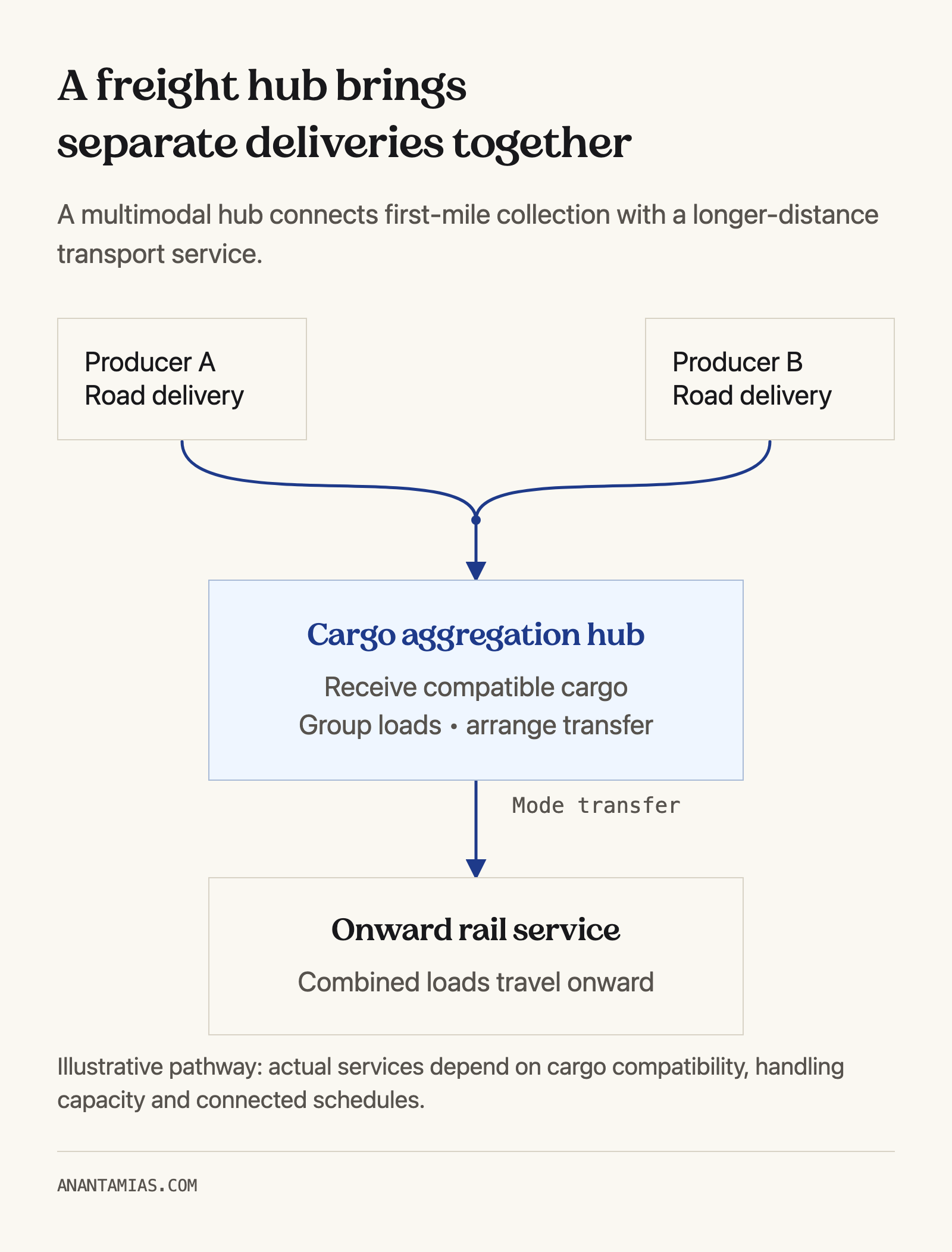
  • Cargo aggregation brings consignments from different producers into a common hub. The transport system can then organise onward loads around shared destinations, while collection from farms and factories remains an essential part of the service.
  • Modal integration links transport modes suited to different legs of a journey. Trucks can serve dispersed collection points, while rail can carry consolidated freight over a longer route when connections and service demand support it.
  • Supporting facilities handle cargo between movements. The official MMLP framework includes storage, freight handling and value-added services, so the park’s role extends beyond providing a place where vehicles arrive or containers are temporarily parked.
  • A warehouse primarily provides storage; a multimodal park combines storage with transport connections and related services. A seaport handles maritime access, while an inland hub can feed cargo towards that gateway without becoming a seaport itself.
  • The Sindi announcement illustrates this distinction between an early service and a completed network. An automobile rake beginning operations demonstrates freight activity, but cannot by itself establish that every planned facility is available to all users.

How Consolidation Connects Producers With Gateways

The central mechanism is aggregation followed by coordinated onward movement; each transfer must preserve the advantage gained by combining cargo.

  • First-mile collection connects individual producers with the hub. Reliable access roads, suitable collection schedules and predictable handling matter because an efficient long-distance service offers limited benefit when goods cannot reach its departure point on time.
  • Consolidation and dispatch combine compatible consignments into onward loads. This can help smaller shippers access a larger freight service, although waiting to assemble a load may offset benefits where volumes are irregular or delivery is urgent.
  • Modal transfer requires equipment, operating space and coordinated schedules. A road-to-rail connection is useful only if handling and waiting remain manageable; a transfer adds an operational step whose costs must be included when judging the route.
  • Storage requirements differ by cargo. Cotton and automobile freight do not face the same preservation needs as oranges or vegetables; planned cold storage should be assessed through the continuity of temperature-sensitive handling across the relevant journey.
  • Gateway choice depends on the destination and the connected services. The release’s JNPA export connection and Haldia-linked Bangladesh route are separate routing propositions, not successive stops in one compulsory chain for every shipment leaving Sindi.
Two road deliveries converge at a cargo aggregation hub before a consolidated onward rail service
A generic cargo-consolidation pathway. Actual services depend on compatible cargo, handling capacity and connected schedules.

When a Hub Produces Real Logistics Gains

A working hub must improve the complete movement of goods, with benefits evaluated against handling costs, service reliability and cargo-specific needs.

  • End-to-end cost includes collection, storage, transfer and onward transport. A cheaper long-distance leg may not lower the final bill if extra handling or waiting adds more expense elsewhere in the same supply chain.
  • Service frequency affects usefulness alongside physical capacity. Producers need departures that fit their production and delivery commitments; a large terminal with infrequent services can leave cargo waiting and working capital tied up in undelivered goods.
  • Operational readiness should be reported facility by facility. The Sindi release places warehouses, cold storage and the customs office in the planned category, so their expected contribution must remain separate from the already-started automobile rake.
  • Producer access depends on practical booking and collection arrangements. An evaluation should examine whether smaller consignments can join services on usable terms, rather than assuming that proximity to a major park automatically delivers access.
  • Measured performance could include transfer waiting, missed departures and cargo damage. These are proposed assessment measures, not reported Sindi results; comparisons should use similar cargo and routes before attributing savings to the new logistics arrangement.

Way Forward

Evaluate the Complete Freight Service

  • Publish facility-specific operating status so users can distinguish available services from planned infrastructure.
  • Coordinate collection, terminal handling and train schedules to reduce avoidable waits at transfers.
  • Design small-consignment access and appropriate preservation services around the needs of actual producers.
  • Measure total journey cost and reliability before presenting projected savings as achieved outcomes.

Conclusion

  • Multimodal logistics joins cargo aggregation, transport connections and supporting services. Sindi provides a current example, but the first operational freight rake and the complete planned park represent different stages of delivery.
  • For a Mains answer, explain how the links work together and where transfers can create costs. Judge a hub through dependable end-to-end freight movement, rather than treating construction or capacity as sufficient evidence of success.

UPSC Practice Questions

Prelims MCQ 1

With reference to multimodal logistics parks, consider the following statements:

  1. They can aggregate cargo from multiple production centres.
  2. An inland logistics hub necessarily provides direct maritime berthing facilities.
  3. Warehousing and modal-transfer services can form part of their functions.

How many of the above statements are correct?

(a) Only one (b) Only two (c) All three (d) None

Answer: (b) Only two

Explanation:

Statements 1 and 3 are correct. An inland logistics hub can connect cargo with a seaport but does not necessarily provide maritime berthing facilities.

Prelims MCQ 2

Which is the most useful measure for assessing whether a new multimodal connection benefits a producer?

(a) The developed area of the park alone (b) The number of facilities announced for future construction (c) Total journey cost and delivery reliability, including transfers (d) The assumption that every rail movement eliminates handling costs

Answer: (c) Total journey cost and delivery reliability, including transfers

Explanation:

Benefits depend on the complete supply chain. Collection, handling, waiting and onward transport must be considered together; a lower cost on one leg is insufficient evidence.

UPSC Mains Questions

  1. Explain how multimodal logistics parks can connect inland producers with export gateways. Examine the operational conditions needed for smaller producers to benefit.
  2. A transport connection is only one part of a functioning supply chain. Discuss with reference to cargo consolidation and modal transfers.

Sources: PIB, Ministry of Road Transport and Highways and PIB, Ministry of Ports, Shipping and Waterways.

Frequently Asked Questions

What is a multimodal logistics park?

A multimodal logistics park integrates transport connections with cargo aggregation, handling and supporting services such as storage. It can connect regional production centres with distribution networks and export gateways.

Is the entire Sindi logistics park operational?

The November release says the first automobile rake had begun operations, while facilities including warehouses, cold storage and a customs office were planned. It does not establish that the entire park was operational.

How does a dry port differ from a seaport?

A dry port is an inland logistics facility that connects cargo with wider transport and trade services. A seaport provides maritime access; an inland hub can feed that gateway without becoming one.

Does shifting freight to rail always reduce total costs?

Not automatically. Collection, transfer, storage and waiting costs also matter. A lower cost on the long-distance leg benefits the shipper only when the complete journey remains economical and sufficiently reliable.

India–EU Customs: Preparing Border Processes for Trade

Open article →Download PDF

Why in News?

PIB reported on 2 November 2026 that India and European Commission officials discussed customs cooperation, trade facilitation and preparations for implementing the India–EU free trade agreement.

  • The Brussels engagement included DG TAXUD, the European Commission directorate responsible for taxation and customs union.
  • Both sides emphasised efficient, transparent and digitally enabled customs procedures for legitimate trade.
  • The release describes implementation preparations; it does not establish that new tariff concessions have taken effect.
  • The discussions did not announce a new customs agreement or automatic recognition of each other’s compliance decisions.
  • Border procedures influence the time and effort required to move goods even when businesses understand the applicable tariff.
  • Predictability matters to smaller exporters because uncertain clearance can disrupt delivery commitments and tie up working capital.

UPSC Relevance

Prelims Relevance

  • DG TAXUD concerns taxation and the customs union within the European Commission.
  • CBIC administers India’s customs and indirect-tax framework.
  • A single window supports coordinated submission and processing of trade information.
  • Risk management directs scrutiny towards selected consignments rather than identical examination of all goods.
  • Pre-arrival processing allows documentary work before goods reach the border.

Mains Relevance

GS Paper 3

  • Trade facilitation and the administrative costs of exporting.
  • Risk-based customs control and predictable participation in global value chains.

GS Paper 2

  • India–EU cooperation and coordination between border agencies.

Essay

  • International agreements deliver through institutions that can implement them.

Background and Context

What Customs Readiness Adds to Trade Agreements

A trade agreement and a functioning border procedure solve different problems; businesses need both legal clarity and reliable administration to use market access.

  • Tariff commitments concern the treatment available under an agreement. Customs procedures determine how a consignment is declared, assessed and released, so an agreed commercial opportunity still requires a workable administrative route at the border.
  • The Brussels discussions focused on cooperation and preparation. They should be read as an implementation agenda, without inferring a commencement date, revised duty schedule or completed operational arrangement that the official release does not announce.
  • DG TAXUD provides the relevant European Commission customs interface in these talks. The institutional detail matters because border administration requires specialised cooperation alongside the broader negotiations over trade, investment and market access.
  • Transaction costs include the work of submitting information and responding to scrutiny. Unclear requirements can generate repeated corrections; reducing that uncertainty requires consistent procedures rather than merely presenting an existing paper form on a screen.
  • Legitimate trade remains the object of facilitation. Faster processing should coexist with lawful controls, because simplifying the route through customs does not remove obligations concerning accurate declarations or compliance with applicable restrictions on goods.

How Digital and Risk-Based Clearance Works

India’s existing customs reforms provide background for understanding the practical tools discussed, rather than proof of a newly operational bilateral system.

  • Electronic documentation lets traders submit information for customs processing through digital systems. CBIC’s February background release describes connections among traders, authorities, banks and logistics operators; it does not establish a new India–EU data-sharing arrangement.
  • A single-window interface supports coordinated handling of information required at the border. Its practical value depends on agencies using compatible information and resolving decisions, rather than leaving businesses to repeat the same submission through disconnected channels.
  • Risk management concentrates scrutiny on consignments selected for closer attention. Compared with identical physical examination of every shipment, this approach can preserve enforcement capacity while reducing avoidable intervention in lower-risk trade that meets applicable requirements.
  • Pre-arrival processing moves documentary work ahead of the goods’ arrival. It can reduce sequential waiting, but early submission is not an unconditional release order; the applicable checks and the accuracy of supplied information still matter.
  • The Authorised Economic Operator programme is another instrument identified in the CBIC background. Trusted-operator arrangements should not be confused with automatic mutual recognition between India and the EU, which this latest release does not announce.

How to Judge Implementation

A useful assessment follows the trader’s experience through the border process and separates a proposed improvement from an outcome supported by evidence.

  • Clear requirements help an exporter prepare correctly before dispatch. A practical reform programme should explain what information is required, who decides each issue and how a trader can correct a rejected submission without restarting unnecessarily.
  • Inter-agency coordination addresses dependencies within clearance. A customs interface alone cannot remove every delay if another required decision remains unresolved; the administrative task is to make those dependencies visible and assign responsibility for resolving them.
  • Small-business access deserves attention because compliance effort is not equally affordable for all firms. Understandable instructions and accessible support should be assessed alongside digital availability, especially where businesses have limited specialised customs expertise.
  • Performance measures could track release-time variability, repeated data requests and correction cycles. These are suggested evaluation tools, not results reported from the Brussels meetings, and should distinguish routine consignments from cases requiring legitimate additional scrutiny.
  • Accountable discretion supports both facilitation and enforcement. Risk-based selection needs reviewable decisions and reliable information; a faster average clearance figure would be incomplete evidence if unresolved cases or inconsistent treatment were left outside the assessment.

Way Forward

Turn Cooperation Into Usable Procedures

  • Publish clear operational requirements when implementation decisions are final, distinguishing binding changes from ongoing discussions.
  • Test information compatibility and agency handoffs before claiming that a digital interface has removed repeated submissions.
  • Provide accessible correction channels for small exporters facing rejected or inconsistent records.
  • Evaluate predictability and unresolved cases alongside processing speed while retaining lawful risk-based controls.

Conclusion

  • India–EU customs cooperation concerns the institutional work needed to make trade easier to conduct. The current development is preparation and dialogue, while operational changes and their results require separate evidence.
  • For a Mains answer, connect digital documentation, coordinated decisions and risk-based scrutiny to predictable trade. Keep market-access commitments, border procedures and measured implementation outcomes distinct when judging the value of an agreement.

UPSC Practice Questions

Prelims MCQ 1

With reference to customs trade facilitation, consider the following statements:

  1. Pre-arrival processing can begin documentary work before goods arrive.
  2. Risk management requires identical physical examination of every consignment.
  3. A single-window interface can support coordinated handling of border information.

How many of the above statements are correct?

(a) Only one (b) Only two (c) All three (d) None

Answer: (b) Only two

Explanation:

Statements 1 and 3 are correct. Risk management selects consignments for appropriate scrutiny rather than requiring identical physical examination of all goods.

Prelims MCQ 2

What can be concluded from the November 2026 PIB release on India–EU customs discussions?

(a) All new FTA tariff concessions have entered into force. (b) Customs checks have been abolished for bilateral trade. (c) Both sides discussed customs cooperation and implementation preparations. (d) Automatic mutual recognition of all trusted traders has been introduced.

Answer: (c) Both sides discussed customs cooperation and implementation preparations.

Explanation:

The release reports cooperation and preparations. It does not establish commencement of tariff concessions, abolition of checks or automatic mutual recognition.

UPSC Mains Questions

  1. Explain why customs preparedness is essential for realising the benefits of a trade agreement. Discuss with reference to India–EU cooperation.
  2. How can risk-based customs administration reduce compliance costs while preserving enforcement? Examine the role of inter-agency coordination.

Sources: PIB, Ministry of Commerce and Industry and PIB, CBIC trade facilitation background.

Frequently Asked Questions

What was announced in the India–EU customs discussions?

PIB reported discussions on customs cooperation, trade facilitation and preparations for FTA implementation. The release emphasised efficient, transparent and digitally enabled procedures without announcing a new operational customs agreement.

Does the release establish that new FTA tariffs are effective?

No. Implementation preparations do not establish when tariff concessions take effect. Such a conclusion requires the relevant final instruments and commencement provisions, which this release does not provide.

How does risk management help customs clearance?

Risk management directs scrutiny towards selected consignments rather than treating every shipment identically. It can reduce unnecessary intervention while preserving closer examination where information indicates that additional attention is justified.

Why does a single window need inter-agency coordination?

A digital submission interface is useful only when the necessary agencies can process information and resolve their decisions. Otherwise, businesses may still face repeated requests or unresolved approvals despite submitting information electronically.

Dwindling support

Open article →Download PDF

Why in news?

Support for the UNGA resolution against the U.S. embargo on Cuba fell sharply to 130 votes; India still backed it.

UPSC Relevance

Mains GS2 – Effect of policies and politics of developed countries on India’s interests; Bilateral, regional and global groupings

What is Unilateralism?

Unilateralism means a country acting on its own in foreign affairs, without consulting or seeking approval of other countries or international bodies. It is the opposite of multilateralism, where decisions are taken collectively through institutions like the UN or WTO.

A related term is Unilateral Coercive Measures (UCMs) – sanctions or embargoes imposed by one country without UN Security Council approval. Under Article 41 of the UN Charter, only the UNSC can impose sanctions binding on all members. The UN Human Rights Council has a Special Rapporteur that studies the negative impact of UCMs on human rights.

The Cuba Embargo – Background

YearDevelopment
1959Cuban Revolution under Fidel Castro; American properties nationalised
1962President Kennedy imposed a near-total trade embargo on Cuba
1992Cuban Democracy (Torricelli) Act tightened the embargo; UNGA passed its first resolution against it
1996Helms-Burton Act – penalised even foreign companies dealing with Cuba (extraterritorial reach)
2015Obama-era thaw – embassies reopened; in 2016 the U.S. abstained on the UNGA vote for the first time
2017 onwardsTrump administration reversed the thaw; Cuba placed back on the State Sponsors of Terrorism list
2026UNGA vote: 130 in favour, 17 against, 25 abstentions – the lowest support in decades

Why Did Support Drop This Year?

  • U.S. pressure – The Trump administration reportedly lobbied countries to change their votes.
  • Shift in Latin America – Countries like Costa Rica, Ecuador, Argentina and Colombia, which have grown closer to the U.S. and downgraded ties with Havana, switched their votes. This followed the U.S. operation in Venezuela in January 2026, when President Maduro was taken to the U.S. for trial.
  • Russia factor – The U.S. argued that Cuba-Russia ties support Russia’s war in Ukraine. Ukraine and Poland cited this; Germany and Italy abstained for the first time in years.
  • Global South held firm – Most of the G77 and NAM, including India, kept supporting the resolution.

Note – UNGA resolutions are recommendatory, not binding. So the vote is mainly a measure of global opinion. Falling support shows how power politics is reshaping that opinion.

U.S. Unilateralism 

AreaUnilateral Action
TradeSweeping “reciprocal” tariffs from 2025, ignoring WTO’s MFN principle; India faced tariffs of up to 50% in 2025, partly linked to its Russian oil purchases
Dispute settlementU.S. has blocked appointments to the WTO Appellate Body, leaving it non-functional since December 2019
SanctionsSecondary sanctions on third countries dealing with Iran, Russia, Venezuela; CAATSA (2017)
Nuclear dealsExit from the Iran nuclear deal (JCPOA) in 2018
Climate and healthWithdrawal from the Paris Agreement (twice) and from the WHO
UN bodiesExit from UNESCO and the UN Human Rights Council; funding cuts to UN agencies
International lawSanctions on officials of the International Criminal Court
Use of forceMilitary operation in Venezuela (January 2026) without UN authorisation

Consequences

  • Humanitarian costs – Sanctions hurt ordinary people more than governments. Cuba faces shortages of food, medicine and fuel; the BRICS New Delhi declaration flagged the “worrying humanitarian impact”.
  • Might is right against rules based order– Smaller countries lose the protection that rules and institutions give them.
  • Fragmentation – The world is splitting into blocs and rival trade, payment and technology systems.
  • Paralysis on global problems – Climate change, pandemics, AI and debt crises need cooperation that unilateralism weakens.
  • Economic uncertainty – Tariff wars and sanctions disrupt supply chains and raise costs, including for India.

India’s Position

  • Consistent on Cuba – India has supported the UNGA resolution every year and this year called for “dialogue and diplomacy”.
  • Opposes unilateral sanctions – India’s stated policy is to follow only UN-mandated sanctions.
  • Strategic autonomy – India keeps ties with the U.S. and also with Russia, Iran and others, choosing positions based on its own interests.
  • Reformed multilateralism – India calls for UNSC expansion, WTO reform and a bigger voice for developing countries.
  • Voice of the Global South – India pushed for the African Union’s G20 membership (2023) and hosts the Voice of Global South Summits. As BRICS chair in 2026, it raised concern over the Cuba blockade.
  • Practical limits – India too has felt the pressure of U.S. unilateralism – it cut Iranian oil imports in 2019 under sanctions threats, and faced steep tariffs in 2025. Principles have to be balanced with economic realities.

Way Forward

  • Reform institutions – Expand the UNSC, restore the WTO Appellate Body and make IMF quotas reflect today’s economy.
  • Build coalitions – Work with like-minded middle powers (EU, Brazil, South Africa, ASEAN) to defend core rules.
  • Reduce vulnerability – Diversify trade partners, sign FTAs, promote rupee trade settlement and resilient supply chains.
  • Humanitarian carve-outs – Push for exemptions for food, medicine and essential goods in all sanctions regimes.
  • Lead by example – India’s own respect for international law (for example, accepting the 2014 Bangladesh maritime award) adds to its credibility.

A world without rules suits only the most powerful. For a rising power like India, a fair and predictable order is not charity for smaller states – it is in India’s own long-term interest.

Mains Practice Question 

 “Growing unilateralism by major powers signals the decline of the rules-based international order.” Critically examine this statement. How should India respond while protecting its strategic autonomy? (15 marks, 250 words)

What does the Binance hack mean for investors?

Open article →Download PDF

Why in news?

A cyberattack on Binance, a top global crypto exchange, caused losses of over $6 billion, allegedly by North Korea-linked hackers.

UPSC Relevance

Prelims – Cryptocurrency, blockchain, stablecoins, CBDC (e-Rupee), VDA taxation, FATF

Mains GS3 – Indian Economy (money, banking and mobilisation of resources); Awareness in the field of IT and computers; Challenges to internal security through communication networks, basics of cyber security, money laundering and its prevention

What is Cryptocurrency?

A cryptocurrency is a digital asset that uses cryptography to secure transactions and runs on a blockchain – a shared, tamper-resistant ledger maintained by a network of computers rather than by a central bank. Bitcoin, launched in 2009 by the pseudonymous Satoshi Nakamoto, was the first. Today there are thousands of coins and tokens, including Ether, BNB and stablecoins like USDT.

In India, the law does not call it “currency”. Crypto is neither legal tender nor banned in India. The Income-tax Act uses the term Virtual Digital Asset (VDA) under Section 2(47A), which covers crypto tokens and NFTs but excludes Indian and foreign currency.

Key Features

  • Decentralised – No single authority issues or controls it; transactions are validated by network participants (miners or validators).
  • Blockchain-based – Every transaction is recorded in blocks linked together, so past records are very hard to alter.
  • Pseudonymous – Users are identified by wallet addresses, not names. Transactions are public, but owners are not directly visible.
  • Borderless and fast – Value can move across countries within minutes, without banks or SWIFT.
  • Irreversible – Once confirmed, a transaction cannot be cancelled. Stolen funds are hard to recover.
  • Limited supply (for some) – Bitcoin is capped at 21 million coins, which supporters compare to digital gold.
  • Highly volatile – No intrinsic value or central backing, so prices swing sharply on sentiment.

Types of Digital Money 

BasisPrivate CryptocurrencyStablecoinCBDC (e-Rupee)
IssuerNo central issuerPrivate company (e.g. Tether, Circle)Central bank (RBI)
ValueMarket driven, volatilePegged to fiat, usually US dollarSame as rupee, 1:1
Legal tender in IndiaNoNoYes
ControlDecentralisedCentralised – issuer can freeze tokensFully centralised
ExamplesBitcoin, Ether, BNBUSDT, USDCe₹-R (retail), e₹-W (wholesale)

Economic Challenges

  • Threat to monetary sovereignty – Wide use of private crypto or dollar-backed stablecoins can weaken RBI’s control over money supply and interest rates. RBI has repeatedly flagged this risk.
  • Financial stability – Sharp price crashes can spread to banks and markets as links grow. The FTX collapse in 2022 wiped out billions overnight.
  • Dollarisation through stablecoins – Most stablecoins are pegged to the US dollar. Their spread in emerging economies can quietly shift savings into dollars.
  • Capital flight – Crypto can be used to move money abroad outside FEMA and LRS limits.
  • Tax evasion – Offshore exchanges and peer-to-peer trades make it difficult to track income.
  • Weak investor protection – No deposit insurance, no grievance redressal and no single regulator. When an exchange is hacked, users depend on the exchange’s goodwill.
  • Energy use – Proof-of-work mining (like Bitcoin) consumes large amounts of electricity.

Security Challenges

  • Exchange hacks – Centralised exchanges keep huge funds in “hot wallets” connected to the internet, making them prime targets.
    • WazirX (India, July 2024) lost about $230 million; Bybit (Feb 2025) lost about $1.5 billion; now Binance.
  • State-sponsored cyber theft – North Korea uses crypto theft to bypass UN sanctions. UN experts have linked such funds to its weapons programmes. Chainalysis estimated DPRK-linked hackers stole over $1.3 billion in 2024 alone.
  • Insider and social engineering risk – As the Binance case shows, one compromised employee device can open the door. Hackers often use fake job offers and phishing to target staff.
  • Money laundering and terror financing – Mixers, chain-hopping and anonymous wallets help hide the source of funds.
  • Cybercrime ecosystem – Ransomware payments, darknet drug sales and investment scams (like “pig butchering”) mostly use crypto. Indian police have found mule accounts being used to cash out crypto frauds.
  • Cross-border enforcement gap – Exchanges sit in one country, users in another and hackers in a third. Investigation needs international cooperation that is often slow.

Legal and Regulatory Framework in India

YearDevelopment
2018RBI barred banks and regulated entities from dealing with crypto businesses
2020Supreme Court (Internet and Mobile Association of India vs RBI) struck down the RBI circular as disproportionate
2021Cryptocurrency and Regulation of Official Digital Currency Bill listed in Parliament, but never introduced
2022Finance Act – 30% flat tax on VDA income (Sec 115BBH), no set-off of losses, 1% TDS on transfers (Sec 194S)
2022CERT-In directions – crypto service providers must keep KYC and transaction records for 5 years and report cyber incidents within 6 hours
2022RBI launched e-Rupee pilots (wholesale in November, retail in December)
2023VDA service providers brought under PMLA, 2002; must register with FIU-IND
2023G20 under India’s presidency adopted the IMF-FSB Synthesis Paper – favours a global, coordinated approach

Current status – Crypto is neither legal tender nor banned in India. It is taxed and covered by anti-money laundering rules, but there is no dedicated regulator. A government discussion paper on crypto policy has been delayed several times.

How Others Are Handling It

  • European Union – Markets in Crypto-Assets (MiCA) regulation gives a single licensing system, reserve rules for stablecoins and consumer safeguards.
  • United States – GENIUS Act (2025) created a framework for dollar stablecoins; exchanges face enforcement by multiple agencies.
  • China – Banned crypto trading and mining in 2021, while promoting its own digital yuan.
  • El Salvador – Made Bitcoin legal tender in 2021, but later made its acceptance voluntary under an IMF programme.
  • FATF – Recommendation 15 and the “Travel Rule” require exchanges to share sender and receiver details for transfers.

Way Forward

  • Dedicated regulator – Assign clear oversight, possibly SEBI for crypto as assets and RBI for payment and stablecoin aspects.
  • Mandatory security standards – Proof-of-reserves audits, majority of funds in offline “cold wallets”, regular cyber audits and insurance for user funds.
  • Rationalise taxation – Very high TDS has pushed trading to offshore platforms. A calibrated tax can bring activity back into the regulated system.
  • Stronger cyber capacity – Train police and agencies in blockchain forensics; strengthen CERT-In and Indian Cyber Crime Coordination Centre (I4C).
  • Global cooperation – Push for implementation of the G20 roadmap, FATF Travel Rule and OECD’s Crypto-Asset Reporting Framework for tax information sharing.
  • Investor awareness – Clear warnings on risks, similar to market-linked products.
  • Promote the e-Rupee – Expand use cases so that the public has a safe digital alternative.

The Binance hack shows that crypto’s biggest promise – freedom from intermediaries – is also its weakest point. Until a clear framework is in place, Indian investors will continue to carry most of the risk on their own.

Practice MCQ 

Q1. Consider the following statements regarding Virtual Digital Assets (VDAs) in India:

1. Income from the transfer of VDAs is taxed at a flat rate of 30%, and losses can be set off against other income.

2. Virtual digital asset service providers are reporting entities under the Prevention of Money Laundering Act, 2002.

3. The Supreme Court in 2020 set aside the RBI circular that barred regulated entities from dealing with crypto businesses.

4. The e-Rupee issued by RBI is treated as a VDA under the Income-tax Act.

How many of the above statements are correct?

(a) Only one

(b) Only two

(c) Only three

(d) All four

Answer: (b)

Explanation: Statement 1 is incorrect – VDA losses cannot be set off against any other income. Statement 4 is incorrect – the e-Rupee is legal tender (Indian currency) and is excluded from the VDA definition. Statements 2 and 3 are correct.

Q2. Consider the following statements:

Statement-I: Issuers of stablecoins such as USDT and USDC are able to freeze tokens linked to illegal activity, such as stolen funds.

Statement-II: Stablecoins are issued and managed by centralised entities that hold reserves to keep their value pegged to a fiat currency.

Which one of the following is correct in respect of the above statements?

(a) Both Statement-I and Statement-II are correct and Statement-II explains Statement-I

(b) Both Statement-I and Statement-II are correct, but Statement-II does not explain Statement-I

(c) Statement-I is correct, but Statement-II is incorrect

(d) Statement-I is incorrect, but Statement-II is correct

Answer: (a)

Explanation: Unlike Bitcoin, stablecoins have a central issuer that controls the token contract. This is why Tether and Circle could freeze funds linked to the Binance hack.

Mains Practice Question 

“Cryptocurrencies promise financial freedom but pose serious risks to economic stability and national security.” In the light of recent large-scale crypto exchange hacks, examine this statement and suggest a suitable regulatory approach for India. (15 marks, 250 words)

Even as unemployment falls, lack of ‘decent work’ in India

Open article →Download PDF

Why in news?

A study using PLFS data finds India’s job quality improved slightly since 2017-18, but most work remains informal and insecure.

UPSC Relevance 

Mains GS2: Welfare schemes for vulnerable sections; mechanisms and laws for their protection.

Mains GS3: Indian economy – growth, development and employment; inclusive growth.

What is Decent Work?

Having a job is not the same as having decent work. A garment worker without a contract, a delivery rider without insurance, or a construction labourer without paid leave is “employed”, but not decently employed.

  • ILO definition: Decent work is productive work that gives a fair income, security at the workplace, social protection for families, freedom to organise, and equal opportunity and treatment for women and men.
  • Decent Work Agenda (ILO, 1999): Has four pillars:
    • Employment creation – enough jobs with fair income.
    • Rights at work – freedom of association, no forced or child labour, no discrimination.
    • Social protection – safe workplaces, health cover, pension, maternity benefits.
    • Social dialogue – talks between workers, employers and government.
    • Gender equality is a cross-cutting theme across all four.
  • SDG 8: “Promote sustained, inclusive and sustainable economic growth, full and productive employment and decent work for all.” Target 8.5 seeks full employment and equal pay for work of equal value; Target 8.8 seeks protection of labour rights and safe working environments.
  • Job-counting vs job-quality: Unemployment rate only tells us whether people are working. Decent work asks what kind of work, at what wage, with what security.

Constitutional and Legal Framework

  • Labour is in the Concurrent List: Both Centre and States can make laws on trade unions, industrial disputes, welfare of labour and social security.
  • Fundamental Rights: Article 23 (ban on forced labour/begar) and Article 24 (no child labour in factories, mines and hazardous work).
  • Directive Principles:
    • Article 39(a) and (d): adequate means of livelihood; equal pay for equal work.
    • Article 41: right to work, education and public assistance in certain cases.
    • Article 42: just and humane conditions of work and maternity relief.
    • Article 43: living wage and decent standard of life; Article 43A: workers’ participation in management.

Key Findings of the Study

  • Unemployment rate fell from 6.1% (2017-18) to 3.2% (2023-24), and female workforce participation rose for the first time in decades.
  • Job quality improved, but the level is still very low. The Decent Work Index (DWI) rose from 0.247 to 0.302.
  • Uneven progress: Women from STs and OBCs saw decent-work outcomes decline, while men’s outcomes improved. Goa, Kerala, Tamil Nadu and Haryana do well; Bihar, Jharkhand and Uttar Pradesh lag.
  • Informality: Nearly 90% of the workforce is informally employed, a share that has risen since 2019 (India Employment Report 2024, ILO-IHD).

Sector-wise Decent Work Index

Sector2017-182023-24Main reason
Manufacturing0.3240.411Gradual formalisation and digitalisation
Transport0.2850.350Urban logistics and app-based platform work
Agriculture0.2110.267Still lowest; mostly self-employed or unpaid family workers
Overall0.2470.302Improvement, but level remains low

Why Low Unemployment Can Mislead

  • Disguised and under-employment: Many people work fewer hours or in low-productivity jobs, mainly in agriculture, but are still counted as employed.
  • Self-employment as fallback: More than half of India’s workers are self-employed, including unpaid helpers in household enterprises. Much of this is ‘survival work’, not entrepreneurship.
  • Distress-driven women’s work: Part of the rise in female workforce participation is in unpaid family work and agriculture, especially in rural areas.
  • Poor counting tools: PLFS ‘usual status’ counts a person as employed even with limited work during the year.

Causes of the Decent Work Deficit

  • Structural transformation is incomplete: Workers leaving farms move mainly into construction and low-end services, not into factory jobs. Manufacturing’s share in employment has stayed around 11-12%.
  • Contractualisation: Even organised firms rely on contract and outsourced labour to cut costs and avoid compliance, so ‘informal jobs in formal sector’ are growing.
  • Rise of gig and platform work: It offers flexibility and quick entry, but workers are treated as ‘partners’, not employees, with no minimum wage or leave.
  • MSME dominance: Most enterprises are tiny and unregistered, with thin margins and low capacity to provide benefits.
  • Skill mismatch: Only a small share of workers have formal vocational training, while educated youth face high unemployment.
  • Caste and gender barriers: Women, especially Dalit, Adivasi and OBC women, are crowded into low-paid, unsafe work. The study shows this penalty has deepened after COVID-19.
  • Weak enforcement and voice: Low unionisation, few labour inspectors and weak grievance redressal limit workers’ bargaining power.

Way Forward

  • Shift to a job-quality approach: Track a Decent Work Index alongside the unemployment rate in official reporting.
  • Universal and portable social protection: Benefits should follow the worker across jobs and States, covering gig, self-employed, farm and informal workers.
  • Link incentives to labour standards: Tax breaks, PLI and subsidies should require written contracts, paid leave and social security contributions.
  • Labour-intensive manufacturing: Push sectors such as textiles, food processing, leather and electronics assembly, especially in lagging States.
  • Intersectional policy: Childcare, safe transport, skill training and anti-discrimination safeguards for marginalised women.
  • Strengthen social dialogue: Revive tripartite bodies such as the Indian Labour Conference and improve inspection and grievance systems.
  • Implement the Labour Codes fully: Notify rules quickly and operationalise the social security fund for gig workers.

India’s jobs story is now less about how many people work and more about how they work. Dignity, security and fair pay must become the measure of success.

Practice MCQ

Q1. Consider the following pairs:

Article of the ConstitutionProvision
1. Article 39(d)Equal pay for equal work for both men and women
2. Article 41Living wage and decent standard of life for workers
3. Article 42Just and humane conditions of work and maternity relief
4. Article 43AParticipation of workers in management of industries

How many of the pairs given above are correctly matched?

(a) Only one     (b) Only two     (c) Only three     (d) All four

Answer: (c)

Explanation: Pair 2 is incorrect. Living wage is under Article 43. Article 41 deals with the right to work, to education and to public assistance in certain cases.

Mains Practice Question

“Falling unemployment in India has not been matched by a rise in decent work.” Discuss the reasons for the decent work deficit in India and suggest measures to move from a job-counting to a job-quality approach. (15 Marks, 250 words)