Opens in a new tab
Join Anantam IAS Channel on Telegram

Daily Digest · Tuesday

3 November 2026 Current Affairs for UPSC

18 current affairs published on Tuesday, 3 November 2026

3 November 2026 Current Affairs for UPSC — every Why-in-News article AnantamIAS published on Tuesday, 3 November 2026, broken down with Why in News?, the exact GS paper it feeds, sub-topic mapping, MCQ-ready facts and a UPSC-style practice question. 18 articles in total, covering Polity, Economy, Environment, S&T, IR, Geography, History, Society and Internal Security — the same Why-in-News + GS-paper-mapping + practice-question format the Compass uses across every daily digest on the site.

Daily current affairs for UPSC is where new material enters your prep stream. Read this 3 November 2026 digest end-to-end in 25–35 minutes, attempt the practice question at the foot of each article (it's MCQ for some, 10/15-marker for others), then bookmark the entries that fall inside your active revision window. Everything stays cross-linked: tap any subject pill to jump to that subject's hub, or use the table of contents above to skip straight to a specific story.

Use this page three ways. Read sequentially for a one-sitting scan of everything that mattered on 3 November 2026. Download the 3 November 2026 PDF below for offline study or print revision. Or use the November 2026 Current Affairs compilation to see this day in the month's full context. For the previous day's reading, see 2 November 2026 Current Affairs; the next day's is 4 November 2026 Current Affairs.

Why we publish daily current affairs separately from the monthly compilation: daily is learning, monthly is revision. Use the daily page to add fresh material to your notes the day it breaks; come back to the November 2026 compilation 60 days before Prelims when the noise has settled and only the lasting takeaway is worth re-reading.

FRRO Expansion: Registration and Lawful Stay

Open article →Download PDF

Why in News?

On 2 November 2026, the Ministry of Home Affairs reported new FRRO notifications for Kohima, Agartala and Bhubaneswar as part of regional expansion.

  • Regional access is intended to make immigration services more accessible to eligible foreign visitors and residents.
  • Notified offices must be distinguished from offices already established and from proof of fully staffed operations.
  • FRRO functions include eligible registration, changes in particulars, permissions and handling overstay cases.
  • Lawful stay involves continuing compliance after entry, especially when personal particulars or immigration permissions change.
  • Administrative proximity can reduce travel and coordination burdens, but service quality depends on staff, records and clear responsibility.

UPSC Relevance

Prelims Relevance

  • Foreigners Regional Registration Officer
  • Bureau of Immigration
  • Registration Certificate and Residential Permit
  • Entry permission versus post-arrival compliance

Mains Relevance

GS Paper 2

  • Regional administrative capacity and accessible public services
  • Reasoned decisions and coordination in immigration administration

GS Paper 3

  • Lawful foreign travel and immigration compliance

Essay

  • Administrative accessibility and effective regulation can support each other.

Background and Context

What the Expansion Changes

Regional offices bring administrative responsibility closer to foreign visitors and residents, while the legal conditions governing their stay continue to determine which services they need.

  • Kohima, Agartala and Bhubaneswar are the newly notified locations identified in the release. The announcement concerns a redistribution of administrative presence; it does not itself grant visitors a new visa category or longer stay.
  • Earlier jurisdiction placed Kohima and Agartala under Kolkata, and Bhubaneswar under Hyderabad, according to the Ministry. Local offices can shorten the administrative distance between applicants, their records and officials responsible for their cases.
  • Notification establishes an administrative designation, while actual service delivery also requires personnel, premises and functioning processes. The release does not independently establish that every newly notified office has completed all these operational steps.
  • Eligible visitors may need assistance for tourism, medical treatment or education-related stays. The relevant question is which conditions apply to a particular person, rather than assuming that every foreign national faces identical registration requirements.
  • State coordination matters because residence, local records and compliance issues arise where a person actually stays. Regional capacity should connect those facts to the competent immigration authority without making applicants navigate conflicting instructions.

Registration and Continuing Compliance

FRRO work follows a person through relevant changes after arrival, linking official records to the conditions under which that person may remain in India.

  • Registration applies to eligible categories of foreigners. The FRRO issues a Registration Certificate or Residential Permit on registration; these administrative records should not be described as citizenship documents or as unconditional permission to remain indefinitely.
  • Changes in particulars can include residential address, passport details or travel plans within India, as stated in the release. Keeping records current helps authorities assess the person’s circumstances against the permissions that actually apply.
  • Visa extensions and conversions are among eligible immigration services. Availability of an application channel does not guarantee approval: the requested change remains subject to the applicable conditions and the competent authority’s decision on the case.
  • Protected and restricted areas can require specific permissions. A valid general stay document should not be interpreted as unrestricted access to every location; applicants must establish which additional permission applies before undertaking the relevant travel.
  • Exit permits serve cases involving expired visas, overstay or required clearance before departure. They are part of resolving an immigration situation, rather than evidence that an earlier violation automatically disappears when the person seeks to leave.

Facilitation and Enforcement Need Clear Boundaries

The Ministry presents service access and immigration compliance as connected responsibilities, making administrative clarity as important as the physical expansion of offices across regions.

  • The Bureau of Immigration is assisted by authorised FRROs under the statutory framework described by the Ministry. The division of work concerns entry, stay, movement and exit; individual powers depend on the relevant authorisation.
  • Border checks and post-arrival administration answer different questions. The recent Digi Yatra trial discussion concerns airport credentials and checks, while FRRO services address eligible registration and changes during a person’s stay.
  • Overstay and visa violations require case-specific handling, with legal action or penalties coordinated where necessary. The expansion announcement supplies no universal penalty schedule, so it should not be used to infer automatic consequences for every case.
  • Personal records support administration but also require careful handling. The broader privacy and public-interest debate highlights why institutional purpose, access controls and accountable use matter when government systems process sensitive information about individuals.
  • Performance assessment should examine whether applicants find the responsible office, receive intelligible requirements and obtain decisions without avoidable transfers. Office counts alone cannot establish improved compliance, faster service or a reduction in administrative errors.

Way Forward

Make Regional Responsibility Clear

  • Publish current jurisdiction and operational service arrangements so applicants know which office is responsible for their case.
  • Explain decisions with applicable conditions and missing information, reducing repeated applications caused by unclear requirements.
  • Coordinate records between regional offices and relevant authorities while limiting access to staff who need it for their duties.

Conclusion

  • FRRO expansion can improve access to immigration administration when regional presence is matched by staff, reliable records and clear procedures. A notification is the starting point for capacity, not a complete measure of service delivery.
  • For governance answers, connect administrative proximity with lawful stay and accountable decision-making. Distinguish entry checks, eligible registration, changes in permission and resolution of violations instead of treating all immigration functions as a single approval.

UPSC Practice Questions

Prelims MCQ 1

With reference to Foreigners Regional Registration Offices, consider the following statements:

  1. Registration applies to eligible categories of foreigners.
  2. A newly notified office necessarily proves that all operational arrangements are complete.
  3. FRRO functions include recording changes in relevant particulars.

How many of the above statements are correct?

(a) Only one (b) Only two (c) All three (d) None

Answer: (b) Only two

Explanation:

Statements 1 and 3 are correct. Notification alone does not establish staffing or operational readiness.

Prelims MCQ 2

Which situation most directly concerns post-arrival immigration administration?

(a) Updating a foreign resident’s recorded address (b) Granting Indian citizenship automatically on registration (c) Treating a visa as permission for every restricted area (d) Removing all conditions on stay after airport entry

Answer: (a) Updating a foreign resident’s recorded address

Explanation:

Recording changes in particulars, including residential address, is among the FRRO functions described by the Ministry.

UPSC Mains Questions

  1. Explain how regional immigration offices can improve both service accessibility and regulatory compliance.
  2. Distinguish border-entry checks from post-arrival immigration administration. What institutional safeguards make the latter effective?

Source: PIB, Ministry of Home Affairs.

Frequently Asked Questions

Must every foreign visitor register with an FRRO?

The Ministry describes registration for eligible categories of foreigners. The applicable requirement depends on the person’s circumstances and immigration conditions; the expansion announcement does not impose an identical registration duty on every visitor.

Does notification prove an office is fully operational?

No. Notification and operational readiness are separate matters. Service delivery also requires personnel, facilities and working procedures. The release identifies notified locations without independently confirming completion of every operational arrangement.

What changes can an FRRO record?

The Ministry lists changes in particulars such as residential address, passport details and travel plans within India. Recording relevant changes helps connect administrative records to the conditions governing a foreign national’s stay.

Does an exit permit erase an overstay?

An exit permit can address departure clearance in cases involving expired visas or overstay. It should not be understood as automatically removing a violation; the relevant case may also require legal action or penalties.


Seismic Monitoring: From Ground Motion to Hazard Assessment

Open article →Download PDF

Why in News?

On 2 November, the Ministry of Earth Sciences inaugurated a seismological observatory at Kishtwar to strengthen earthquake monitoring and support disaster preparedness.

  • The observatory has digital seismic equipment and will transmit data in real time to the National Centre for Seismology in New Delhi.
  • The official release places Kishtwar in a high seismic region and links the facility to improved understanding of local hazards.
  • The expected applications include response planning and safer infrastructure; the announcement does not claim reliable prediction of future earthquakes.
  • A monitoring station produces evidence about ground motion, which requires scientific interpretation before administrators can use it.
  • Seismic monitoring and weather surveillance concern different physical processes, even when both appear in a disaster-preparedness programme.

UPSC Relevance

Prelims Relevance

  • Seismometer and seismogram: measuring instrument and recorded signal.
  • P-waves arrive before S-waves at a station.
  • Hypocentre: earthquake origin within the Earth; epicentre: point above it at the surface.
  • National Centre for Seismology: earthquake monitoring institution.
  • Earthquake detection differs from prediction before an event.

Mains Relevance

GS Paper 3

  • Connect seismic observations with resilient infrastructure and emergency planning.
  • Explain why monitoring networks need maintenance, interpretation and administrative response.

GS Paper 1

  • Explain how seismic waves help locate earthquakes.

Essay

  • Scientific uncertainty makes preparedness more necessary, rather than making observation less useful.

Background and Context

What the Kishtwar Observatory Adds

A local station strengthens a wider observing network by supplying a continuous record from a region where earthquake hazards matter for infrastructure and settlements.

  • The new observatory is a physical monitoring facility, with digital equipment recording seismic activity. Its practical contribution depends on usable observations reaching the national monitoring centre, rather than on the inauguration alone.
  • Real-time transmission connects the local instrument with the National Centre for Seismology. The release describes this data link; it does not specify sensor models, guaranteed warning times or a new earthquake-prediction technology.
  • Continuous observations help researchers examine where earthquake activity occurs and how it develops over time. A longer record supplies evidence for understanding hazards, although it cannot remove uncertainty about the next damaging event.
  • The release discusses weather instruments alongside seismology, but their measurements serve different questions. Rain gauges and weather radars observe atmospheric conditions; a seismic observatory records ground motion associated with earthquakes and other vibrations.
  • District planning is the intended public use of better information. Administrators can combine scientific findings with local infrastructure knowledge when preparing response arrangements, instead of treating every recorded tremor as a forecast of disaster.

How Recorded Waves Help Locate an Earthquake

Scientists compare observations from a network because a signal at one station contains only part of the information needed to locate an earthquake.

  • A seismometer senses ground motion, and the recorded trace is a seismogram. A trace needs interpretation because traffic and other vibrations can also produce signals; an instrument does not record only damaging earthquakes.
  • P-waves travel faster than S-waves, so their arrivals are separated in a station record. The interval helps estimate distance from the source when interpreted using knowledge of seismic-wave travel through the Earth.
  • Several stations provide arrival times from different positions. Scientists compare these observations with travel-time models to estimate the source location, depth and origin time, refining a solution rather than simply reading coordinates from one sensor.
  • The hypocentre is the point inside the Earth where rupture begins; the epicentre lies above it at the surface. Keeping these terms distinct helps explain why locating an event includes estimating its depth.
  • Network quality affects the usefulness of the estimate: reliable timing, functioning instruments and consistent records support interpretation. The USGS explanation of seismographs describes how wave arrivals help locate sources and characterise their motion.

Monitoring, Prediction and Preparedness

The strongest public claim is improved knowledge and response capacity; an observatory does not establish when and where the next destructive earthquake will occur.

  • Detection identifies an earthquake through waves it has already generated. Prediction would specify a future event before it happens; treating these as interchangeable can create false confidence about what a monitoring system delivers.
  • The USGS states that reliable earthquake prediction is unavailable. A claim must specify time, location and magnitude to qualify as a prediction; broad warnings without these elements do not establish predictive skill.
  • Hazard assessment concerns potentially damaging earthquake effects, while actual losses also depend on buildings, population and preparedness. A monitoring upgrade supplies useful evidence, but it does not itself strengthen vulnerable structures or provide emergency access.
  • The distinction complements downstream flood-warning decisions: different hazards need different evidence. A lake-breach warning mechanism cannot be transferred unchanged to earthquakes simply because both require rapid administrative action.
  • Likewise, cyclone warning decisions rely on atmospheric and ocean observations. Public communication should explain the scope of each system, so an improved weather forecast is never presented as evidence of earthquake prediction.

Way Forward

Turn Observations Into Safer Decisions

  • Maintain power, communications and instrument calibration so recorded data remain usable.
  • Link scientific information with building-safety reviews and district response plans, assigning clear responsibilities.
  • Communicate uncertainty and capability limits in public advisories, correcting unsupported earthquake forecasts.

Conclusion

  • Kishtwar’s observatory strengthens the evidence available for understanding seismic hazards. Its value should be judged through reliable observations, scientific analysis and their use in safer planning, rather than an unsupported promise to predict the next earthquake.
  • For an answer, connect measurement, interpretation and preparedness. Better monitoring helps authorities understand events and risks, while resilient buildings and practiced response arrangements address the consequences that an observing instrument cannot prevent by itself.

UPSC Practice Questions

Prelims MCQ 1

With reference to earthquake monitoring, consider the following statements:

  1. P-waves generally arrive before S-waves at a seismic station.
  2. The hypocentre lies within the Earth.
  3. Installing a seismic observatory enables reliable prediction of the exact date of the next earthquake.

How many of the above statements are correct?

(a) Only one (b) Only two (c) All three (d) None

Answer: (b) Only two

Explanation:

The first two statements are correct. Seismic monitoring records and analyses ground motion; it does not provide reliable exact-date earthquake predictions.

Prelims MCQ 2

Why are observations from several seismic stations useful?

(a) They prevent rupture along faults. (b) They replace the need for travel-time models. (c) Their arrival times help constrain an earthquake’s location and depth. (d) They guarantee that no damaging earthquake will occur.

Answer: (c) Their arrival times help constrain an earthquake’s location and depth.

Explanation:

Wave arrival times from different locations are compared with travel-time models to estimate the earthquake source.

UPSC Mains Questions

  1. Explain how a seismic monitoring network contributes to earthquake preparedness despite the limits of earthquake prediction.
  2. Distinguish seismic monitoring from meteorological forecasting. Discuss why this distinction matters for public disaster communication.

Sources: PIB, Ministry of Earth Sciences and USGS.

Frequently Asked Questions

What will the Kishtwar observatory do?

It will record seismic activity and transmit data to the National Centre for Seismology. The stated purposes include understanding regional hazards, supporting response planning and informing safer infrastructure decisions.

Can it predict the next earthquake?

The announcement makes no such claim. Recording earthquake activity and assessing hazards differ from reliably specifying the time, location and magnitude of a future earthquake before it occurs.

Why are several seismic stations needed?

Wave arrival times differ across stations. Combining these observations with travel-time models helps scientists estimate the earthquake’s source location, depth and origin time more effectively than one isolated record.

Are seismic and weather monitoring the same?

No. Seismic instruments record ground motion, while weather instruments observe atmospheric conditions such as rainfall. Both support preparedness, but their measurements and the claims they can support are different.

Organic Fisheries: Certification and Traceable Production

Open article →Download PDF

Why in News?

On 2 November 2026, the Union fisheries minister launched an SOP for organic certification of fisheries in the Northeastern region.

  • The SOP provides a framework for organic production and supports traceability across the fisheries value chain.
  • Soreng in Sikkim is identified by PIB as the first organic fisheries cluster launched under PMMSY.
  • Market access is an intended benefit; the announcement does not establish guaranteed premiums or automatic export approval.
  • Credible labels require evidence connecting a production claim with the fish actually offered for sale.
  • Small producers need workable records and market arrangements so compliance costs do not exclude them.

UPSC Relevance

Prelims Relevance

  • Organic production standards and certification
  • Traceability across the fisheries value chain
  • PMMSY and cluster-based development
  • Distinction between production claims and food safety

Mains Relevance

GS Paper 3

  • Standards, farmer incomes and agricultural value chains
  • Environmental sustainability and credible market claims

Essay

  • Trust in a product depends on the evidence behind its label.

Background and Context

What the Organic Fisheries Announcement Establishes

The new SOP addresses how organic production can become a credible market claim, connecting farm practices with records across the value chain.

  • The official release describes a structured framework for organic production and traceability. It does not publish the complete SOP, so exact certification procedures, inspection intervals and permitted inputs cannot be inferred from this announcement alone.
  • Soreng’s cluster focuses on ecologically healthy fish farming, avoiding harmful chemicals, antibiotics and pesticides, according to PIB. These stated objectives should be distinguished from the detailed compliance conditions that individual producers must eventually demonstrate.
  • A cluster approach brings production, processing, value addition and marketing together within an identified area. Its practical value depends on whether shared services connect farmers to dependable handling, verification and purchasing arrangements after harvest.
  • Certification concerns compliance with a defined production standard. A farm’s location in Sikkim or membership of a notified cluster cannot, by itself, establish that every batch it sells meets the applicable organic requirements.
  • The new development concerns production claims and their verification. Earlier coverage of inland fishing rights addresses access and ecosystem management, which remain separate policy questions even when the same communities are involved.

Traceability Connects the Claim to the Product

Traceability makes it possible to follow a product through successive handlers; certification assesses whether the relevant production requirements have been met.

  • Production records can connect a harvest with its farm and management history. For implementation, records should capture information needed to check the claim without forcing small farmers to maintain repetitive paperwork that nobody reviews.
  • Batch identity should survive aggregation, storage and processing. If fish from different production systems are mixed without reliable separation or records, a buyer may be unable to establish which products carry the verified claim.
  • Each transfer should preserve the connection between the product and its supporting records. Traceability consequently depends on cooperation among producers, traders, processors and retailers rather than on a farm certificate considered in isolation.
  • Traceability and compliance answer different questions: a traceable batch has a documented path, while an organic claim requires evidence about production practices. Knowing where fish travelled does not alone demonstrate how it was raised.
  • Accountability across handlers also matters in food disposal controls. The shared lesson is maintaining a verifiable chain of responsibility; organic certification applies that principle to a different claim about production and subsequent product handling.

Certification Has Limits in Safety and Market Access

The policy aims to improve credibility and market opportunities, but a production label cannot establish every quality claim or commercial outcome.

  • Organic status describes compliance with production requirements; food safety concerns whether the product is safe to consume. Sound handling and appropriate storage still matter after harvest, whatever production claim appears on the product.
  • A premium price depends on demand, reliable supply and buyers recognising the standard. Certification may support differentiation, but the announcement offers no basis for promising that every farmer will earn a higher selling price.
  • Export access also depends on the importing market’s requirements and acceptance of the relevant assurance arrangements. A domestic SOP cannot be read as automatic authorisation to sell every certified fish product in every foreign market.
  • Institutional purchasing can provide a more predictable outlet when specifications, capacity, pricing and inspection are agreed. PIB describes a proposed trout-supply arrangement with ITBP; an intended market linkage should not be reported as completed regular procurement.
  • Implementation quality should be assessed through usable records, credible verification and producer participation. Counting notified clusters alone cannot establish whether product claims remain reliable through the chain or whether farmers receive a sustainable commercial benefit.

Way Forward

Make Verification Work for Producers

  • Publish practical requirements in accessible formats so farmers can distinguish binding conditions from promotional expectations.
  • Support shared recordkeeping and batch handling while retaining clear responsibility for each producer and intermediary.
  • Track market outcomes alongside compliance costs, including whether smaller producers can participate and retain reliable buyers.

Conclusion

  • Organic fisheries certification can make production claims more credible when verification remains connected to the fish sold. The SOP’s value will depend on usable standards, reliable records and implementation across successive handlers.
  • For policy analysis, distinguish the production standard, the traceability system and the market outcome. Each needs its own evidence; a notified framework alone cannot prove safe handling, higher prices or foreign-market acceptance.

UPSC Practice Questions

Prelims MCQ 1

With reference to organic fisheries, consider the following statements:

  1. Traceability can connect a batch with its route through the value chain.
  2. A documented route alone proves compliance with organic production requirements.
  3. Organic certification automatically guarantees access to every export market.

How many of the above statements are correct?

(a) Only one (b) Only two (c) All three (d) None

Answer: (a) Only one

Explanation:

Only statement 1 is correct. Production compliance needs separate evidence, and importing markets retain their own requirements.

Prelims MCQ 2

Which distinction best describes certification and traceability?

(a) Certification assesses compliance with a standard; traceability follows the product through the chain. (b) Certification guarantees a premium price; traceability guarantees export approval. (c) Traceability removes the need for production records. (d) Cluster membership establishes compliance for every batch.

Answer: (a) Certification assesses compliance with a standard; traceability follows the product through the chain.

Explanation:

The two functions support each other, but evidence of a product’s path does not alone establish compliance with production requirements.

UPSC Mains Questions

  1. Explain how certification and traceability can improve the credibility of organic fisheries products. What implementation problems can exclude small producers?
  2. Discuss why organic production standards, food safety and market access require distinct forms of assurance.

Source: PIB, Ministry of Fisheries, Animal Husbandry & Dairying.

Frequently Asked Questions

What did the fisheries announcement introduce?

It announced the launch of an SOP for organic certification of fisheries in the Northeastern region. PIB describes a framework for organic production and traceability, without publishing its full operational requirements.

Does cluster membership automatically certify every fish batch?

No. Cluster membership identifies participation in a development arrangement. Establishing an organic claim requires evidence that the relevant production and assurance requirements are met for the products offered for sale.

How does traceability differ from certification?

Traceability follows a product through the value chain and connects it with supporting records. Certification assesses compliance with a defined standard; a documented product route alone does not prove organic production.

Does organic certification guarantee higher prices or exports?

No. Higher prices depend on demand and purchasing arrangements. Export access depends on the destination market’s requirements and acceptance of the relevant assurance system, alongside other applicable product conditions.

Rural Housing Credit: Assistance, Loans and Repayment

Open article →Download PDF

Why in News?

On 2 November 2026, lenders proposed dedicated housing credit for PMAY-G beneficiaries at a Ministry of Rural Development and National Housing Bank dialogue.

  • Loan products were proposed to help households bridge construction costs beyond scheme assistance.
  • Seasonal repayment, property constraints and last-mile lending costs were central concerns.
  • The Ministry will examine the suggestions with NHB, States and lending institutions; the release does not announce an approved financing entitlement.
  • Construction gaps can delay completion when households cannot arrange the balance beyond assistance.
  • Responsible credit requires affordable repayment and clear terms, even when the borrower is already verified under a welfare scheme.

UPSC Relevance

Prelims Relevance

  • PMAY-G assistance and institutional credit
  • National Housing Bank and refinance
  • Seasonal cash flow and repayment capacity
  • Partial credit guarantees and risk sharing

Mains Relevance

GS Paper 2

  • Welfare delivery and coordination between governments and financial institutions

GS Paper 3

  • Financial inclusion, rural housing and responsible lending

Essay

  • Access to finance must be judged alongside the ability to repay.

Background and Context

Assistance and Credit Serve Different Purposes

A house can remain unfinished even after assistance is sanctioned, because construction costs and household resources do not necessarily match the timing or size of available support.

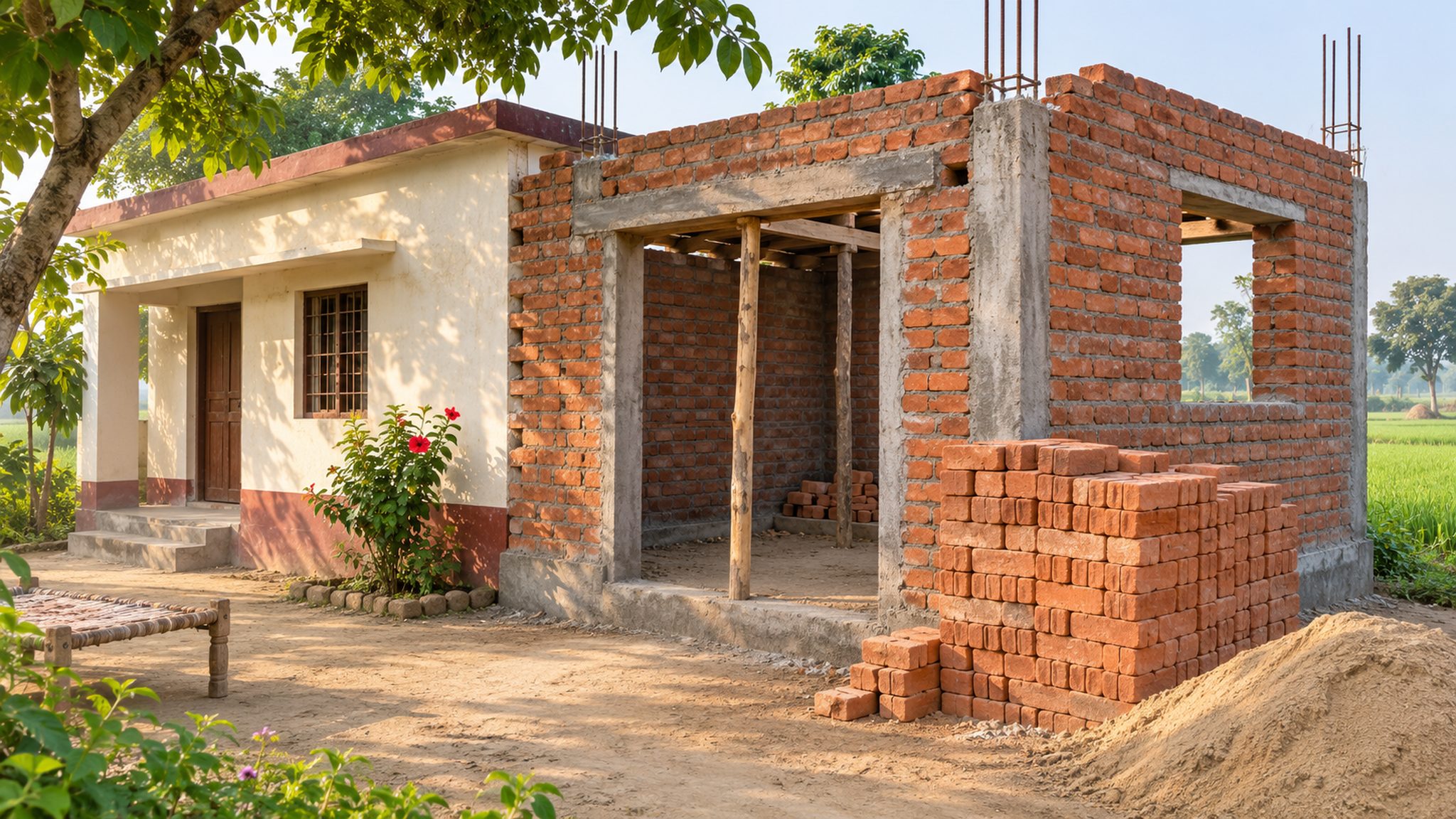
  • PMAY-G assistance contributes towards a rural house, while a housing loan creates a repayment obligation. Combining them can close a financing gap, but it also changes the household’s future commitments and exposure to financial stress.
  • The financing gap arises when construction costs exceed scheme assistance and available household resources. The Ministry identifies delayed completion and reliance on costly informal borrowing as concerns motivating discussion of suitable institutional credit products.
  • Beneficiary verification and recorded construction milestones can help lenders assess an application. They do not establish disposable income, prove that every applicant can repay, or remove the need to examine existing debts and essential expenditure.
  • Proposed support includes partial guarantees, interest subvention and refinance. These were recommendations at the dialogue; the release does not establish a sanctioned benefit, an automatic loan offer or an approved change in prudential regulation.
  • Housing quality remains the purpose of financing. A completed structure is useful only when affordable borrowing supports safe construction without forcing households to cut essential consumption or repeatedly borrow to service earlier repayments.

Match Repayment to Rural Cash Flow

Credit appraisal needs to examine when money reaches the household, how reliable it is and what remains after necessary expenditure throughout the repayment period.

  • Seasonal income can produce receipts at particular times rather than in equal monthly amounts. Participants recommended repayment aligned with these patterns; an instalment schedule should reflect realistic cash availability instead of assuming a regular salary.
  • Repayment capacity depends on income stability, other obligations and room for shocks. A loan that appears manageable in a good season may become difficult after crop losses, illness or interrupted work, requiring conservative appraisal.
  • Construction milestones provide information about progress and the next funding need. Linking assessment to progress can reduce uncertainty, but unfinished work still requires scrutiny of costs, workmanship and the borrower’s ability to complete the house.
  • Last-mile delivery through local institutions and self-help-group networks was proposed to reduce access barriers. Their local knowledge can help gather information, while lenders must retain clear responsibility for appraisal, terms and fair treatment.
  • Inclusion should be assessed through usable, affordable finance rather than loan numbers alone. The poverty and job-quality discussion helps explain why household security depends on earnings and vulnerability, not merely access to a financial product.

Property Rights and Funding Shape Lending

A suitable borrower and an unfinished house are only part of the lending decision; documentation, security, funding costs and institutional responsibilities also affect feasible loan terms.

  • Unclear land titles and restrictions on mortgaging allotted properties were identified as barriers. States would need to examine the relevant property arrangements; the workshop itself does not remove restrictions or create transferable ownership rights.
  • Refinance supplies funding to lending institutions, whereas a retail housing loan is the household’s borrowing relationship. The proposed NHB window concerns the funding layer; it should not be described as direct automatic lending to every beneficiary.
  • A partial guarantee, if adopted with specified conditions, would share defined lender losses. It would not inherently cancel the borrower’s repayment duty, eliminate appraisal or cover every loss; the actual design would determine its scope.
  • Prudential safeguards address recognition and management of lending risk. Participants suggested differentiated treatment, but the banking review discussion reinforces the distinction between examining proposals and implementing changes to capital or other regulatory requirements.
  • A pilot was recommended before wider rollout. Its value would lie in testing completion, repayment and borrower outcomes across realistic conditions, allowing policymakers to examine whether support reaches households without transferring excessive risk to them.

Way Forward

Test Affordability Before Expansion

  • Assess household cash flow and disclose repayment schedules, charges and consequences before sanction.
  • Clarify property conditions through State-level review rather than treating documentation barriers as solved.
  • Evaluate a pilot using construction completion, repayment stress and complaints alongside lender viability.

Conclusion

  • Rural housing credit can bridge a construction gap when loan terms match household resources. Its success depends on affordability, clear property arrangements and accountable lending, rather than the assumption that verified welfare beneficiaries are uniformly creditworthy.
  • For policy analysis, distinguish assistance, household borrowing, lender refinance and proposed guarantees. The current development is a set of financing recommendations under examination, with implementation and safeguards still requiring decisions by the competent institutions.

UPSC Practice Questions

Prelims MCQ 1

With reference to proposed rural housing finance, consider the following statements:

  1. Refinance and a retail household loan operate at different funding layers.
  2. Verification under a housing scheme automatically establishes repayment capacity.
  3. A partial guarantee necessarily cancels the borrower’s repayment obligation.

How many of the above statements are correct?

(a) Only one (b) Only two (c) All three (d) None

Answer: (a) Only one

Explanation:

Only statement 1 is correct. Scheme verification does not establish affordability, and a guarantee does not inherently cancel borrower obligations.

Prelims MCQ 2

Which lending approach best addresses seasonal household income?

(a) Assuming every borrower receives a regular monthly salary (b) Matching repayment to assessed cash flow and essential expenditure (c) Treating scheme assistance as proof that no appraisal is needed (d) Ignoring other debts when construction has begun

Answer: (b) Matching repayment to assessed cash flow and essential expenditure

Explanation:

Seasonal cash-flow appraisal helps align repayments with realistic household resources while accounting for necessary expenditure and existing obligations.

UPSC Mains Questions

  1. Examine how institutional credit could improve rural housing completion while creating risks for low-income households.
  2. Distinguish welfare assistance, retail credit and refinance. What safeguards should guide a proposed rural housing finance pilot?

Source: PIB, Ministry of Rural Development.

Frequently Asked Questions

Has a new PMAY-G loan entitlement been approved?

The release reports recommendations from a stakeholder dialogue. The Ministry will examine them with relevant institutions. It does not announce an approved automatic loan entitlement, guarantee or interest subsidy for beneficiaries.

Why does seasonal income matter for repayment?

Income may arrive unevenly across the year. Appraisal should assess the timing and reliability of receipts, essential spending and other debts so that repayment obligations reflect realistic household cash flow.

Is NHB refinance the same as a household loan?

No. Refinance supports the funding of lending institutions, while the retail loan is the borrower’s relationship with a lender. The proposed window should not be presented as automatic direct credit to beneficiaries.

Does beneficiary verification establish creditworthiness?

Verification can help establish scheme eligibility and provide useful records. Repayment capacity still requires assessment of income, existing debts, necessary expenditure and exposure to shocks; eligibility alone does not answer those questions.

Rural Employment Grievances: Registration and Escalation

Open article →Download PDF

Why in News?

On 2 November 2026, the Ministry of Rural Development announced notified grievance-redressal rules under VB-G RAM G, establishing mandatory registration and time-bound handling of scheme-related complaints.

  • Registration cannot be refused because of format, language, submission method or procedural deficiency.
  • Enquiry must finish within seven working days of receipt; resolution is required within 15 days of receipt.
  • Unresolved complaints move to the next higher level; appeals against orders follow Schedule I of the Act.
  • A worker needs an accessible remedy when implementation fails, alongside the underlying employment entitlement.
  • Recording a complaint creates a traceable administrative responsibility; effective redress also requires investigation and corrective action.

UPSC Relevance

Prelims Relevance

  • Gram Panchayat, Block and District grievance levels
  • Mandatory registration despite procedural defects
  • Seven working days for enquiry; 15 days for resolution
  • Escalation of unresolved grievances versus appeals against orders

Mains Relevance

GS Paper 2

  • Administrative accountability and accessible public-service delivery
  • Digital tracking supported by physical access and reasoned remedies

Essay

  • Rights become useful when citizens can obtain a remedy.

Background and Context

Registration Creates a Traceable Responsibility

The first safeguard addresses exclusion at the entry point: an imperfectly presented complaint must still enter the official grievance system.

  • Any person may raise a scheme-related grievance through the permitted channels. The subject must concern implementation; the release does not restrict this access to a particular digital interface or require a polished written petition.
  • Physical submission may be made before the designated officer or through speed post with proof of delivery. Telephone, designated helplines and other state-decided modes complement the central digital route, preserving several practical entry points.
  • Physical grievances must enter the digital register on receipt or, if that is infeasible, by the next working day. This connects an offline complaint to a record that subsequent authorities can follow and monitor.
  • The acknowledgement identifies the registration number, receipt date and receiving authority. Physical submissions receive a physical acknowledgement, giving the complainant a usable reference even when checking an electronic record independently would be difficult.
  • Mandatory registration prevents procedural screening from blocking access before the complaint is examined. Registration itself does not establish that every allegation is correct; the officer must still investigate the facts and determine appropriate action.

Enquiry Must Lead to a Recorded Remedy

The rules connect investigation to corrective action, while retaining separate deadlines for completing the enquiry and resolving the grievance received by the administration.

  • States establish Gram Panchayat, Block and District mechanisms with designated grievance officers. The District Programme Coordinator oversees district redress, providing institutional supervision alongside the officers responsible for receiving, examining and disposing of individual complaints.
  • The officer may obtain records and electronic data from concerned authorities or functionaries. This allows the enquiry to examine implementation evidence rather than rely solely on the complainant describing a failure without administrative documentation.
  • The seven-working-day enquiry and 15-day resolution periods both run from receipt. They are not consecutive periods to be added together, and the release expressly describes only the enquiry period in terms of working days.
  • Where necessary, the complainant receives a reasonable opportunity to be heard, physically or electronically. Findings must then support corrective or remedial action under the Act and rules, connecting participation to the administrative decision.
  • Findings and action taken must be digitally recorded and communicated to the complainant. A physical complaint also requires physical communication of the outcome; an electronic disposal entry alone does not fulfil that stated communication requirement.

Escalation and Appeal Address Different Failures

A pending complaint and a disputed decision create different administrative problems; the rules provide separate routes for each rather than treating every case as delay.

  • A grievance unresolved after the prescribed period is escalated to the next higher level. That authority examines it and takes appropriate action, while electronic monitoring continues until resolution instead of ending with the transfer.
  • An appeal challenges an order already passed through the grievance mechanism. The release refers filing and disposal to Schedule I of the Act; it does not justify inventing an additional appeal deadline or authority.
  • This distinction helps diagnose implementation: inaction requires escalation, while disagreement with an issued order may require appeal. A dashboard should preserve the complaint history so supervisory review can identify where responsibility remained unfulfilled.
  • The earlier NMMS attendance safeguards concern evidence of work attendance. This framework concerns remedies for implementation grievances; improving attendance records does not remove the need for an accessible route to contest errors.
  • Compare railway complaint coordination only for the administrative principle of assigning responsibility. The competent authority and applicable rules remain specific to each system; complaint platforms do not create interchangeable legal jurisdictions.

Way Forward

Measure the Remedy Delivered

  • Review overdue cases by receipt date and responsible level, so moving a complaint does not conceal the time already spent unresolved.
  • Check whether physical acknowledgements and outcomes reach complainants, alongside the completeness of digital records.
  • Assess the corrective action actually delivered and repeated complaint patterns, rather than treating a high disposal count as sufficient evidence of effective redress.

Conclusion

  • Accessible registration, documented enquiry and a communicated remedy form a connected accountability chain. Each stage matters because a citizen can remain excluded even when the administration records progress at another stage.
  • For governance answers, distinguish registration, resolution, escalation and appeal. The rules establish responsibilities and timelines; implementation must demonstrate that those procedures produce corrective action for the person who raised the grievance.

UPSC Practice Questions

Prelims MCQ 1

With reference to the VB-G RAM G Grievance Redressal Rules, consider the following statements:

  1. A grievance may be refused registration because its format is defective.
  2. The enquiry must be completed within seven working days from receipt.
  3. A grievance unresolved within 15 days is escalated to the next higher level.

How many of the above statements are correct?

(a) Only one (b) Only two (c) All three (d) None

Answer: (b) Only two

Explanation:

Statements 2 and 3 are correct. Procedural deficiency or format cannot justify refusing registration.

Prelims MCQ 2

Which best distinguishes escalation from appeal under the notified grievance framework?

(a) Escalation concerns unresolved grievances; appeal concerns orders already passed. (b) Escalation and appeal both require a final order. (c) Appeal automatically replaces mandatory registration. (d) Escalation ends electronic monitoring.

Answer: (a) Escalation concerns unresolved grievances; appeal concerns orders already passed.

Explanation:

Unresolved grievances move upward after the prescribed period and remain monitored. Appeals against orders follow Schedule I of the Act.

UPSC Mains Questions

  1. Explain how mandatory registration and physical access can strengthen accountability in rural employment grievance redressal.
  2. Distinguish escalation from appeal. What administrative checks are needed to ensure that time-bound complaint disposal delivers an effective remedy?

Source: PIB, Ministry of Rural Development.

Frequently Asked Questions

Can a grievance be rejected for an incorrect format?

No. The notified rules prohibit refusal of registration because of format, language, manner of submission or procedural deficiency. Registration allows the complaint to enter the system for examination.

What are the enquiry and resolution deadlines?

The enquiry must finish within seven working days from receipt, and the grievance must be resolved within 15 days from receipt. These periods run from the same starting point.

What happens if the grievance remains unresolved?

After the prescribed 15-day period, the grievance is escalated to the next higher level within the state mechanism. Electronic monitoring continues until resolution, and the receiving authority must examine the matter.

How is an appeal different from escalation?

Escalation addresses a grievance that remains unresolved within the prescribed period. An appeal challenges an order already passed under the grievance mechanism, with filing and disposal governed by Schedule I of the Act.

TRAI Complaint Rules: Access, Appeals and Oversight

Open article →Download PDF

Why in News?

On 2 November 2026, TRAI issued amended telecom complaint-redressal regulations covering access, appeals, consumer feedback and oversight of service providers.

  • Complaint support must operate round the clock, with human assistance available for at least sixteen hours daily.
  • Appeals have separate fifteen-day windows for filing after complaint disposal and for a final decision after receipt.
  • Oversight includes consumer feedback, management reporting, representative committees and regulatory review.
  • Access requires usable human and digital channels, including support for persons with disabilities.
  • Accountability depends on the quality of resolution as well as whether a complaint is marked closed.

UPSC Relevance

Prelims Relevance

  • Telecom Regulatory Authority of India
  • Provider Complaint Centre and Appellate Authority
  • Human assistance versus continuous automated support
  • Consumer feedback and regulatory review

Mains Relevance

GS Paper 2

  • Accessible grievance mechanisms and regulatory accountability
  • Technology-assisted service delivery with human oversight

Essay

  • Public trust depends on whether institutions can correct routine service failures.

Background and Context

Access Must Lead to a Usable Remedy

The amendment changes how consumers enter the grievance system while retaining responsibility with the service provider that supplies their connection.

  • TRAI issued the fourth amendment after consultation, according to PIB. Its immediate subject is the procedure for complaints and appeals; the announcement should not be treated as a new telecom tariff or service entitlement.
  • Mobile applications become an additional channel for complaints, appeals, service requests and queries. Existing channels remain important because a consumer experiencing a connectivity failure may also struggle to use the provider’s digital interface.
  • Round-the-clock support can combine people, automated systems and AI agents. Human assistance must remain available for at least sixteen hours daily, so continuous availability does not mean every interaction reaches a person immediately.
  • Human oversight must accompany technological solutions. For implementation, providers should make transfers to staff intelligible and preserve the complaint history, so consumers do not repeatedly explain the same unresolved problem at successive contact points.
  • Disability access covers dedicated desks or helplines with suitable personnel or assistive technology, alongside accessible digital channels. A complaint system is usable only when consumers can describe their problem and understand the response independently.

An Appeal Reviews the Provider’s Response

The appeal stage gives a dissatisfied consumer a defined route beyond initial complaint handling, with separate deadlines for filing and deciding the appeal.

  • Filing an appeal following disposal of a complaint now has a fifteen-day limit, reduced from thirty days. Consumers need a clear disposal message because knowing when the first-stage response arrived affects their next action.
  • Deciding an appeal has its own fifteen-day period from receipt. This is a separate obligation on the Appellate Authority, not an extension of the consumer’s filing window or a universal deadline for every initial complaint.
  • The Appellate Authority consists of one or more regular employees in the provider’s management with the prescribed experience. It must examine the appeal, act on the grievance and communicate its final decision to the consumer.
  • The earlier Advisory Committee process has been removed. Responsibility for the appeal consequently needs to be visible in the provider’s own decision record, including what was examined and how the consumer was informed of the outcome.
  • Institutional routing matters in both telecom and railway complaints, although their authorities differ. In telecom, the provider’s appellate stage must not be confused with TRAI personally adjudicating each subscriber’s individual grievance.

Oversight Tests Whether Closure Solves the Problem

The new supervisory measures examine the performance of the complaint system, connecting consumer experience to management review and regulatory scrutiny of provider records.

  • Consumer feedback follows resolution or closure of a complaint or appeal. Providers must publish survey results quarterly, creating evidence about satisfaction that is distinct from the administrative count of files recorded as closed.
  • Senior management review requires quarterly reports on complaints, appeals and feedback before the CEO or board. This places service failures within organisational responsibility rather than leaving repeated problems solely with individual call-centre staff handling incoming requests.
  • Consumer representation enters through a grievance oversight committee involving the provider and qualifying TRAI-registered consumer organisations. Its role is periodic review of the mechanism; it should not be presented as a replacement appellate forum.
  • Regulatory review may use audits, inspections, performance reports and consumer feedback. Financial disincentives cover specified procedural non-compliance and reporting failures; the announcement does not establish automatic compensation payable to every dissatisfied subscriber after a complaint.
  • Service access and accountability complement each other: last-mile connectivity makes a connection usable, while a working remedy addresses failures after subscription. Evaluation should examine meaningful resolution, accessibility and repeated complaints alongside speed of disposal.

Way Forward

Make Each Stage Usable

  • Providers should show appeal channels and relevant deadlines clearly in complaint-disposal communications.
  • Management should investigate repeat complaints and poor satisfaction rather than rewarding closure counts alone.
  • Regulatory review should examine disability access and transfers between automated support and human staff.

Conclusion

  • The amendment combines easier entry, a defined appellate stage and supervision of provider performance. Its effectiveness depends on whether consumers obtain intelligible decisions and practical remedies when telecom services fail.
  • For governance answers, distinguish access to a channel, review of an individual decision and oversight of the whole system. Faster closure is useful only when the underlying grievance has been properly addressed.

UPSC Practice Questions

Prelims MCQ 1

With reference to the amended telecom complaint-redressal framework, consider the following statements:

  1. Complaint support may combine human representatives and technological solutions.
  2. Round-the-clock support necessarily means human assistance at every hour.
  3. The provider’s Appellate Authority must communicate its final decision within fifteen days of receiving an appeal.

How many of the above statements are correct?

(a) Only one (b) Only two (c) All three (d) None

Answer: (b) Only two

Explanation:

Statements 1 and 3 are correct. Human assistance is required for at least sixteen hours daily, while support as a whole operates round the clock.

Prelims MCQ 2

Which measure most directly allows review of consumer experience after a telecom complaint is closed?

(a) Consumer feedback collected after resolution or closure (b) Removing all non-digital complaint channels (c) Treating every closed file as satisfactory (d) Replacing the provider’s appeal with automatic compensation

Answer: (a) Consumer feedback collected after resolution or closure

Explanation:

Feedback surveys assess satisfaction after closure or resolution. Their results provide evidence beyond disposal counts.

UPSC Mains Questions

  1. Explain how accessible complaint channels, appeals and regulatory oversight perform different functions in protecting telecom consumers.
  2. Discuss the safeguards needed when service providers use automated systems and AI agents for grievance redressal.

Source: PIB, Ministry of Communications.

Frequently Asked Questions

Does round-the-clock support mean a human is always available?

No. Support may combine human representatives, automated systems and AI agents. Human assistance must be available for at least sixteen hours daily, and technological solutions require appropriate human oversight.

Who decides the provider-level appeal?

The service provider’s Appellate Authority examines the appeal, acts on the grievance and communicates its final decision. This provider-level arrangement should not be confused with TRAI deciding each individual consumer complaint.

Are the two fifteen-day periods the same deadline?

No. One concerns the consumer filing an appeal following complaint disposal. The other concerns the Appellate Authority communicating its final decision within fifteen days after receiving that appeal.

What does the feedback survey add?

The survey records consumer satisfaction following resolution or closure. Quarterly publication and management review help distinguish a formally closed complaint from a grievance whose resolution actually satisfies the consumer.

ULX-8: X-Ray Variability and the Eddington Limit

Open article →Download PDF

Why in News?

On 2 November, PIB reported an Indian-led study of ULX-8 whose long-term X-ray behaviour favours a stellar-mass black hole undergoing extreme accretion.

  • The team used observations from Chandra, XMM-Newton and Swift spanning 2000–2024.
  • The source remained highly luminous while its brightness varied over the observing period.
  • PIB reports long-term spectral changes, without evidence of dramatic transitions between the accretion states commonly seen in many black-hole binaries.
  • The finding connects gravity, radiation and matter inflow in an extreme physical environment.
  • A bright source requires an explanation of its accretion conditions, rather than an automatic assumption of an exceptionally massive black hole.

UPSC Relevance

Prelims Relevance

  • Ultraluminous X-ray source: a luminous compact-object system outside the central supermassive-black-hole category.
  • Accretion: matter falling towards a compact object and releasing energy.
  • Eddington limit: a classical gravity–radiation balance benchmark.
  • X-ray spectrum: the distribution of detected emission across photon energies.

Mains Relevance

GS Paper 3

  • Explain how long-term space observations test models of extreme astrophysical systems.
  • Distinguish measured evidence from model-dependent identification of an unseen compact object.

Essay

  • Scientific explanations improve when observations test the assumptions behind a familiar limit.

Background and Context

What Makes an X-Ray Source Ultraluminous?

ULX-8 illustrates how matter around a compact object can reveal a system whose central engine cannot be identified from brightness alone.

  • Ultraluminous X-ray sources are exceptionally bright emitters in nearby galaxies, considered separately from emission associated with central supermassive black holes. The label describes their observed radiation rather than proving a particular central object.
  • A neutron star or black hole can draw material from a companion star. Matter moving inward heats up and releases X-rays, so the detected radiation traces the surrounding accretion flow and its conditions.
  • Accretion supplies a physical route from infalling matter to radiated energy. A black-hole interpretation concerns the object driving this process; it does not mean that the observed X-rays escape from inside the black hole.
  • ULX-8 lies in the interacting NGC 4490/4485 galaxy system. Its continued high luminosity makes repeated observations useful for investigating how a compact source sustains an extreme flow rather than merely producing one brief flare.
  • Brightness and spectral shape provide different information: one describes how strong the signal is, while the other describes its distribution across X-ray energies. Studying both constrains explanations more effectively than treating brightness as sufficient.

What Does the Eddington Limit Mean?

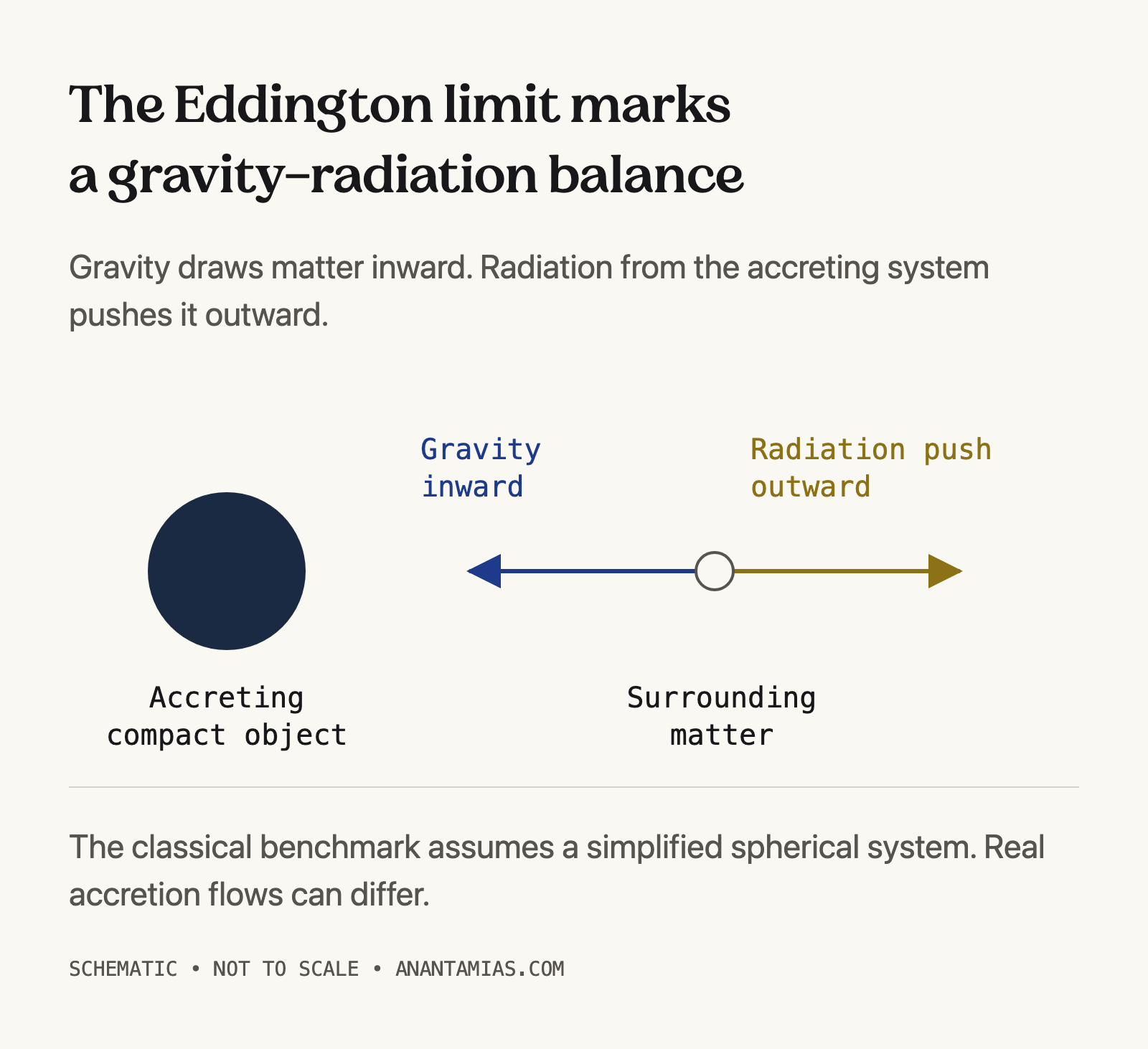
The classical benchmark compares gravity drawing matter inward with radiation exerting an outward push; interpreting an extreme source requires examining that balance.

  • Gravity attracts surrounding matter towards the compact object. Radiation produced by the hot inflow can push matter outward, creating competing effects within the same system rather than two unrelated sources of energy.
  • The Eddington limit expresses a simplified balance between these effects. It is a benchmark for interpreting an accreting source, rather than a direct measurement of the source’s mass obtained from its brightness alone.
  • A source appearing unusually luminous raises questions about the accretion model used to interpret it. The observation calls for testing the model and its assumptions; it does not establish that gravity has ceased operating.
  • Extreme accretion can involve powerful gas outflows and changing conditions around the central object. Researchers use observations to investigate those processes instead of assuming that every bright system contains the same kind of compact object.
  • The useful comparison is between a classical benchmark and an observed system. A model provides an expectation; the measured spectrum and its evolution determine whether that expectation adequately describes this particular accretion environment.
Classical Eddington balance with gravity pulling surrounding matter toward a compact object and radiation pushing outward
Schematic of the classical gravity–radiation balance; arrows show opposing effects, not measured forces or the observed geometry of ULX-8.

What the ULX-8 Study Establishes

The reported result favours a physical interpretation, while leaving room for better measurements and closer tests of the accretion model.

  • Long-term monitoring showed substantial brightness changes alongside continuing ultraluminous behaviour. This combination matters because a changing signal does not necessarily mean that the source repeatedly entered entirely different accretion states during the observed period.
  • The reported spectral evolution supports changing accretion conditions. PIB presents a stellar-mass black hole as the most likely explanation, which should be described as an inference supported by observations rather than a directly measured identity.
  • PIB uses both above-limit and near-limit descriptions in its account. The defensible takeaway is extreme accretion; the release does not justify a precise mass, a numerical excess, or an unconditional claim that a limit was violated.
  • This question differs from Centaurus X-3 accretion-stream inference: here, persistent luminosity and spectral evolution frame the explanation. Results from one compact system cannot automatically identify the central object in another system.
  • Proposed improvements in future observations remain prospective capabilities. As with satellite commissioning, the status of an instrument matters: expected performance should not be represented as evidence already obtained by an operational mission.

Way Forward

Test the Accretion Interpretation

  • Extend monitoring to distinguish sustained behaviour from short-lived changes.
  • Compare brightness and spectra across observations with their measurement limits stated.
  • Use improved observations to test the compact-object interpretation, retaining uncertainty where competing explanations remain.

Conclusion

  • ULX-8 connects an observable X-ray signal to an inferred compact engine through an accretion model. Its importance lies in testing how matter and radiation behave under extreme conditions, rather than simply labelling a source unusually bright.
  • For an answer, explain the gravity–radiation balance, describe the long-term evidence, and state the inference cautiously. Brightness, mass and accretion behaviour are related questions, but the reported observation does not make them interchangeable quantities.

UPSC Practice Questions

Prelims MCQ 1

With reference to ultraluminous X-ray sources, consider the following statements:

  1. They may be powered by neutron stars or black holes accreting matter.
  2. The Eddington limit concerns a classical balance between gravity and radiation.
  3. High X-ray brightness alone conclusively establishes that the source contains a supermassive black hole.

How many of the above statements are correct?

(a) Only one (b) Only two (c) All three (d) None

Answer: (b) Only two

Explanation:

Statements 1 and 2 are correct. Brightness alone does not uniquely establish the mass or nature of the compact object.

Prelims MCQ 2

Why are repeated measurements of an X-ray source’s spectrum useful?

(a) They automatically reveal the exact mass of any black hole. (b) They eliminate the need for physical models. (c) They help test how accretion conditions evolve over time. (d) They establish that radiation has no effect on infalling matter.

Answer: (c) They help test how accretion conditions evolve over time.

Explanation:

Spectral evolution supplies information about the changing accretion environment. Interpretation still requires physical models and recognition of measurement limits.

UPSC Mains Questions

  1. Explain the Eddington limit and discuss why an unusually luminous X-ray source requires careful interpretation.
  2. How does long-term astronomical monitoring help distinguish observation from inference? Illustrate with the reported ULX-8 study.

Source: PIB, Department of Science and Technology.

Frequently Asked Questions

What is ULX-8?

NGC 4490 ULX-8 is an exceptionally luminous X-ray source studied in the NGC 4490/4485 galaxy system. The reported observations favour a stellar-mass black hole undergoing extreme accretion.

What is the Eddington limit?

It is a classical luminosity benchmark based on the balance between gravity attracting matter and radiation pushing it outward. Researchers use it to interpret accreting objects and test the assumptions of their models.

Does high brightness prove a supermassive black hole exists?

No. The observed brightness must be interpreted alongside the spectrum, its changes and the accretion model. Different compact objects and accretion conditions can produce powerful X-ray emission.

What did long-term monitoring contribute?

It revealed substantial brightness changes while ULX-8 remained highly luminous. Spectral changes provided evidence about evolving accretion conditions, helping researchers assess the likely nature of the compact object.

Azini Rescue: Piracy and Maritime Response

Open article →Download PDF

Why in News?

On 3 November 2026, the Defence Ministry reported that the Indian Navy rescued all twenty crew members of the hijacked fishing vessel Azini off Somalia.

  • The operation lasted over forty-eight hours and ended without casualties or injuries, according to PIB.
  • Surveillance and intervention involved a mission-deployed warship, maritime reconnaissance aircraft and Marine Commandos.
  • Air Force support included a C-17 aircraft airdropping additional Marine Commandos for the operation.
  • A captured fishing vessel can threaten other shipping if pirates use it as a mobile base for further attacks.
  • Hostage rescue requires matching information, containment and intervention while protecting the crew aboard the same vessel.

UPSC Relevance

Prelims Relevance

  • Somalia and the western Indian Ocean
  • Mother-ship role in piracy
  • Maritime reconnaissance and persistent tracking
  • Naval intervention and Air Force transport support

Mains Relevance

GS Paper 3

  • Maritime security and protection of seafarers
  • Inter-service coordination in complex rescue operations

GS Paper 2

  • Cooperative security and stability of maritime trade routes

Essay

  • Security at sea connects the safety of individual workers with the continuity of international trade.

Background and Context

Why a Hijacked Fishing Vessel Threatens Other Shipping

The significance of Azini extends beyond one captured vessel because pirates could have used it to support attacks elsewhere in the surrounding waters.

  • Azini was reportedly hijacked off Somalia’s north-eastern coast in the preceding month. The release confirms its rescue but does not identify the crew’s nationality, the responding warship or the exact location of the final intervention.
  • A mother ship functions as a supporting platform from which further pirate attacks may be launched. In this case, PIB described that use as a possibility, rather than confirming attacks already launched from Azini.
  • The fishing vessel’s ordinary purpose does not determine its use after capture. Security assessment must consider who controls it and how it is moving, while recognising that its legitimate crew may remain trapped aboard.
  • Seafarer safety and protection of merchant shipping are linked objectives. Freeing the crew removes an immediate threat to people, while denying pirates a supporting vessel can reduce opportunities for additional attacks against commercial traffic.
  • The geographic reference is Somalia’s north-eastern coast. The report does not provide coordinates or specify the legal maritime zone; an answer should avoid assigning territorial waters or a particular jurisdiction to the operation without evidence.

Detection, Tracking and Intervention Have Different Jobs

A successful response requires more than finding a suspicious vessel: the force must maintain awareness of its movement and select a safe opportunity to intervene.

  • Maritime reconnaissance supported the deployed warship in locating Azini through persistent surveillance. Locating a vessel establishes where it is observed; continued tracking helps the response force follow its movements as the operational situation changes.
  • The warship and aircraft worked together to track the vessel. Their coordination connected information gathering with a platform able to intervene, illustrating why a surveillance observation alone does not complete a hostage-rescue mission at sea.
  • Non-kinetic measures were used to contain movement and prevent escape, according to PIB. The release does not specify those measures, so particular communications, manoeuvres or electronic techniques should not be presented as confirmed operational details.
  • Marine Commandos carried out the tactical intervention that secured the vessel and released the crew. The report establishes the outcome but supplies no basis for inventing weapons used, arrests made or a detailed sequence aboard.
  • Crew protection remained central to judging the result: all twenty were rescued without reported casualties or injuries. An effective operation combines control of the threat with protection of people exposed to it on the same vessel.

Inter-Service Coordination Must Be Judged by the Mission

The operation shows how distinct military capabilities can support a common rescue objective without making every participating platform responsible for the same task.

  • The Navy supplied the deployed maritime response and Marine Commandos, while the Air Force’s C-17 supported their augmentation through an airdrop. The capabilities were complementary, connecting transport support with intervention at the threatened vessel.
  • Coordination requires the participating elements to work from a sufficiently shared understanding of location, movement and mission needs. The published account supports that broad relationship, but does not disclose the operational communications or command arrangements used.
  • Exercises and operations offer different evidence: the BIMSTEC maritime exercise examined coordination through training, whereas Azini involved an actual hijacked vessel and crew rescue. Training participation alone cannot establish how a particular operation unfolded.
  • Regional cooperation remains relevant because maritime threats affect shipping across national boundaries. The wider regional security-cooperation agenda provides context, but should not be described as directing this Navy operation without an explicit official statement.
  • Operational reporting should distinguish confirmed outcomes from unanswered questions. Crew safety is confirmed here; the handling of suspects, evidentiary procedures and any subsequent prosecution are not described, so the rescue cannot establish those separate outcomes.

Way Forward

Protect Crews and Preserve Reliable Information

  • Maritime forces should sustain surveillance and information sharing that help distinguish a vessel’s legitimate crew from those controlling it unlawfully.
  • Response planning should integrate transport, tracking and intervention capabilities around the safety of hostages and nearby shipping.
  • Public communication should report verified outcomes while clearly identifying operational or legal details that remain undisclosed.

Conclusion

  • The Azini rescue demonstrates the connection between persistent surveillance, containment and coordinated intervention. A fishing vessel can become a wider security threat when pirates seek to use it as a supporting platform.
  • For security answers, evaluate both the immediate protection of seafarers and prevention of further attacks. Keep operational success separate from assumptions about jurisdiction, arrests or prosecution that the available evidence does not establish.

UPSC Practice Questions

Prelims MCQ 1

With reference to the reported Azini rescue, consider the following statements:

  1. A hijacked fishing vessel may be used as a mother ship for further pirate attacks.
  2. Locating a hijacked vessel by surveillance itself completes the rescue of its crew.
  3. An Air Force C-17 supported augmentation of Marine Commandos.

How many of the above statements are correct?

(a) Only one (b) Only two (c) All three (d) None

Answer: (b) Only two

Explanation:

Statements 1 and 3 are correct. Surveillance locates and tracks a vessel; securing it and rescuing the crew require further intervention.

Prelims MCQ 2

Which distinction best explains the relationship between surveillance and intervention in a maritime rescue?

(a) Surveillance establishes and updates situational information, while intervention acts on the threat. (b) Surveillance automatically establishes the nationality of every person aboard. (c) Intervention makes continued knowledge of vessel movement unnecessary. (d) Reconnaissance aircraft and transport aircraft necessarily perform identical functions.

Answer: (a) Surveillance establishes and updates situational information, while intervention acts on the threat.

Explanation:

The reported operation combined persistent surveillance and tracking with containment, commando augmentation and tactical intervention.

UPSC Mains Questions

  1. Explain how the possible use of a hijacked fishing vessel as a mother ship changes the maritime security threat.
  2. Discuss the contribution of surveillance and inter-service coordination to hostage rescue at sea, using the Azini operation as an example.

Source: PIB, Ministry of Defence.

Frequently Asked Questions

What did the Navy report about the Azini crew?

PIB reported that all twenty crew members were safely rescued after an operation lasting over forty-eight hours. No casualties or injuries were reported in the official account.

What is a mother ship in this context?

It is a supporting vessel that pirates may use as a base for further attacks against other shipping. The release described this as a possible use of the hijacked Azini.

How did the Air Force support the operation?

An Air Force C-17 aircraft airdropped additional Marine Commandos. This transport support complemented the Navy’s warship, reconnaissance and tactical intervention capabilities during the operation described by the Defence Ministry.

Does the release confirm arrests or prosecution?

No. It confirms that the vessel was secured and its crew rescued, but does not describe arrests, suspect custody or prosecution. Those outcomes should not be inferred from the successful rescue.

Somnath Temple: Heritage and the Debate over Food Restrictions

Open article →Download PDF

Why in News?

Recently, a Division Bench of the Gujarat High Court stayed a single judge’s ruling that had struck down restrictions on the preparation, storage and sale of non-vegetarian food near Somnath Temple. The restrictions cover a 500-metre radius and designated pilgrimage roads.

The order is an interim measure and does not constitute a final judicial determination on the constitutional validity of the notification.

UPSC Relevance: GS-1 History & Culture: Medieval India, Temple Architecture 

Prelims: Somnath Temple, Jyotirlingas, Chaulukya architecture

About Somnath Temple:

  • Location: Prabhas Patan, near Veraval, in Gir Somnath district, Gujarat, along the Arabian Sea coast.
  • Religious significance: Dedicated to Lord Shiva, it is traditionally regarded as the first among the twelve Jyotirlingas.
  • Sacred geography: Prabhas is associated with the Triveni Sangam of Hiran, Kapila and Saraswati (a local river). 
image

Historical Significance:

  • Medieval history: The temple was famously raided and despoiled by Mahmud of Ghazni in 1026 CE during the reign of the Chaulukya ruler Bhima I.
  • Colonial appropriation: In 1842, Governor-General Lord Ellenborough ordered gates from Mahmud’s tomb at Ghazni to be brought to India, claiming they belonged to Somnath. The claim proved unfounded: the gates were made of deodar rather than sandalwood and were deposited at Agra Fort. 
  • Post-independence reconstruction: Sardar Vallabhbhai Patel championed reconstruction after visiting the site in 1947.
  • Consecration: President Dr Rajendra Prasad performed the Pran-Pratishtha on 11 May 1951. Construction continued in subsequent stages. 

Architectural Features:

The present temple complex is built in the Chaulukya / Solanki tradition, a sub-school of Northern Indian Nagara architecture associated with Western India’s medieval Maru-Gurjara style. 

Structurally, it is designed in the majestic Kailas Mahameru Prasad form, representing a multi-storeyed, mountain-like celestial abode.

  • Shikhara: A monumental, elaborately carved main tower (Shikhara) rises directly above the primary sanctum, reaching a height of approximately 155 feet, topped with a massive Amalaka and a golden Kalasha.
  • Garbhagriha: The innermost, secure sanctum sanctorum houses the principal deity, the Jyotirlinga, arranged to receive natural light and accommodate essential ritual spaces.
  • Sabha Mandapa: A grand, pillared assembly hall designed with complex octagonal arrangements and multi-tiered ceilings to accommodate large congregations of devotees.
  • Nritya Mandapa: An interconnected, designated hall historically and structurally associated with sacred dance, ceremonial performances, and cultural functions.
  • Ornamentation: The structural surfaces feature dense, elaborate stone carvings depicting iconographic deities, musicians, celestial dancers (apsaras), and narrative friezes that embody the hereditary expertise of the Sompura temple-building tradition. 

The architectural layout and execution blueprints of the modern post-independence structure were meticulously prepared by the master traditional architect Prabhashankar Oghadbhai Sompura.

Arguments For and Against Restrictions: Constitutional Perspective

DimensionsArguments Supporting RestrictionsArguments Against Restrictions
Religious FreedomArticles 25-26: Protect religious practices and the autonomy of religious denominations to preserve the sanctity of religious institutions.Article 25: Freedom of conscience extends to all individuals; religious sentiments cannot automatically override the rights of others.
Food Choice & Personal AutonomyArticle 25: Respecting the religious beliefs and dietary sensitivities of pilgrims may be considered in regulating activities around sacred spaces.Article 21: Personal autonomy and privacy encompass individual food choices; the State should not impose dietary preferences on citizens.
Freedom of Trade & LivelihoodArticle 19(6): Permits reasonable restrictions on trade in the interest of the general public, including legitimate regulation of commercial activities around pilgrimage sites.Articles 19(1)(g) and 21: A blanket ban may infringe the occupational freedom and livelihood of meat vendors and associated workers.
Secularism & PluralismArticles 25-26: State accommodation of religious practices can be consistent with India’s model of secularism.Preamble and Articles 14, 15 and 25: State neutrality requires equal respect for diverse religious beliefs, dietary practices and individual freedoms.
Proportionality & ReasonablenessArticle 19(6): Reasonable restrictions can be imposed to balance individual freedoms with legitimate collective interests.Articles 14, 19 and 21: A blanket prohibition may fail the tests of necessity and proportionality if less restrictive alternatives are available.

Practice Prelims MCQ:

Q. Consider the following statements regarding the Somnath Temple:

1. The modern architectural plan of the Somnath Temple follows the Chaulukya or Solanki style and was prepared by Prabhashankar Sompura.

2. The Triveni Sangam at Prabhas Patan marks the confluence of the rivers Hiran, Kapila, and the inland-glacier-derived Vedic Saraswati.

Which of the statements given above is/are correct?

(a) 1 only

(b) 2 only

(c) Both 1 and 2

(d) Neither 1 nor 2 

Answer: (a)

UPSC PYQ 2022

Q. The Prime Minister recently inaugurated the new Circuit House near Somnath Temple, Veraval. Which of the following statements are correct regarding Somnath Temple?

1. Somnath Temple is one of the Jyotirlinga shrines.

2. A description of Somnath Temple was given by Al-Biruni.

3. Pran Pratishtha of Somnath Temple (installation of the present-day temple) was done by President S. Radhakrishnan.

Select the correct answer using the code given below:

(a) 1 and 2 only

(b) 2 and 3 only

(c) 1 and 3 only

(d) 1,2 and 3

Answer: (a)

Siang Upper Multipurpose Project

Open article →Download PDF

Why in News?

The proposed 11,200-MW Siang Upper Multipurpose Project (SUMP) in Arunachal Pradesh has faced sustained opposition from sections of the Adi community. 

Currently at the pre-feasibility survey stage, the project is being viewed as a strategic response to China’s proposed mega-dam on the Yarlung Tsangpo (Brahmaputra) in Tibet. 

UPSC Relevance: GS-3 Environment & Biodiversity: Conservation; Infrastructure 

Prelims: Siang Upper Multipurpose Project, Brahmaputra River 

Siang Upper Multipurpose Project (SUMP):

  • Location: Upper Siang district, Arunachal Pradesh, on the Siang River, which is known as the Yarlung Tsangpo in Tibet.
  • Proposed capacity: Approximately 11.2 GW, making it one of India’s major proposed hydropower projects.
  • Multipurpose objectives: Hydropower generation, flood moderation, water storage and strengthening India’s preparedness against possible upstream interventions by China.
  • Strategic significance: India views SUMP as a critical countermeasure to China’s 60 GW lower Yarlung Tsangpo project (Medog Hydropower Station) approved in 2024, serving as a strategic “water bomb” buffer and flood-moderation tool. The proposed reservoir is expected to provide India with greater operational flexibility in managing sudden changes in downstream river flows.
image 1

Brahmaputra River System: 

The Brahmaputra is a transboundary river system shared by China, India and Bangladesh.

Course of the River:

  • Origin: The Yarlung Tsangpo originates in the Tibetan Plateau, near the Angsi Glacier in the vicinity of Mount Kailash.
  • Tibet: It flows eastwards across southern Tibet before making a dramatic horseshoe-shaped bend around the Namcha Barwa massif.
  • India:
    • Arunachal Pradesh: It enters India as the Siang (also called Dihang).
    • Assam: The Siang joins the Dibang and Lohit rivers to form the Brahmaputra’s main channel.
  • Bangladesh: It enters Bangladesh as the Jamuna and eventually joins the Ganga-Padma system before draining into the Bay of Bengal.

Important tributaries and sub-basins in India:

  • Arunachal Pradesh: Subansiri, Kameng (Jia Bharali) and other Himalayan tributaries.
  • Assam: Manas, Dhansiri, Kopili, Sankosh and other tributaries.
  • Meghalaya: Umngot and Kynshi.
  • Sikkim and West Bengal: Teesta system, which joins the Brahmaputra-Jamuna system in Bangladesh.
image 2

Why is the Project facing Local Opposition?

  • Loss of Ancestral and Customary Land Rights: Land in Arunachal Pradesh is governed significantly by customary ownership and community-based arrangements. Adi community fears that reservoir construction and associated infrastructure could submerge ancestral settlements, agricultural land and community resources.
  • Displacement & Livelihood Loss: Submergence risks displacing riverbank communities, destroying agriculture, fishing, and forest-based livelihoods that cash compensation alone cannot replace.
  • Cultural & Spiritual Disruption: The Adi people revere the river as “Aane Siang” (Mother Siang); damming it causes deep cultural displacement beyond physical relocation.
  • Ecological & Seismic Vulnerability: Located in the tectonically active Eastern Himalayas, the dam raises fears of reservoir-induced seismicity, landslides, and Glacial Lake Outburst Floods (GLOFs).
  • Trust Deficit & Governance Gaps: Perceived coercive surveys, heavy security deployment, and a lack of transparency mirror past grievances from projects like the Subansiri Upper Hydroelectric Project.

The Siang project highlights the complex relationship between national security, infrastructure development, environmental sustainability and indigenous rights. 

India’s infrastructure development must therefore be founded on transparency, scientific assessment, meaningful community participation and respect for constitutional and statutory safeguards. 

Practice Prelims MCQ:

Q. With reference to the Brahmaputra river system, consider the following statements:

  1. The Yarlung Tsangpo enters India through Arunachal Pradesh, where it is known as the Siang.
  2. The Brahmaputra is formed in Assam by the confluence of the Siang, Dibang and Lohit rivers.
  3. The Teesta is a tributary of the Brahmaputra system and joins the river in India.
  4. India and China have a comprehensive bilateral treaty governing the equitable sharing of Brahmaputra waters.

Which of the statements given above are correct?

(a) 1 and 2 only

(b) 1, 2 and 3 only

(c) 2, 3 and 4 only

(d) 1, 2, 3 and 4

Answer: (a) 

Explanation: 

  • Statement 3: Incorrect. The Teesta joins the Brahmaputra (Jamuna) in Bangladesh, not India.
  • Statement 4: Incorrect. No comprehensive bilateral water-sharing treaty exists between India and China.

UPSC PYQ 2017:

Q. With reference to river Teesta, consider the following statements: 

  1. The source of river Teesta is the same as that of Brahmaputra but it flows through Sikkim.  
  2. River Rangeet originates in Sikkim and it is a tributary of river Teesta.  
  3. River Teesta flows into Bay of Bengal on the border of India and Bangladesh.  

Which of the statements given above is/are correct?

(a) 1 and 3 only  

(b) 2 only  

(c) 2 and 3 only  

(d) 1, 2 and 3  

Answer: (b)

SC permits Green Crackers for two days in Delhi-NCR

Open article →Download PDF

Why in News?

The Supreme Court has permitted the conditional use of certified green firecrackers in Delhi-NCR on November 7 and 8, 2026. The order provides a temporary relaxation, with the complete ban to resume from November 9. 

UPSC Relevance: GS-2 Polity and Governance: Judicial Intervention, Environmental Jurisprudence

Prelims: Green Crackers, Judicial Review, Fundamental Rights (Articles 19, 21, and 25), Gunpowder in Medieval India

What are Green Crackers?

Green crackers are low-emission firecrackers developed to reduce air and noise pollution during festivals.

  • Conceptualised and developed by the Council of Scientific and Industrial Research (CSIR), primarily led by the National Environmental Engineering Research Institute (NEERI).
  • Key Characteristics:
    • They do not contain banned toxic chemicals like Barium nitrate (which gives a green colour but is highly toxic), lithium, arsenic, lead, or mercury.
    • “Green” does not mean pollution-free: These crackers still generate particulate matter, noise and waste. 

Core Differences: Green vs. Traditional Crackers

ParametersTraditional CrackersGreen Crackers
Particulate Matter (PM)High emissions of PM2.5 and PM10.Reduced particulate emissions by 30% to 35%.
Sound LevelsOften exceed 120-160 decibels (dB).Capped at 110 to 125 dB (approx. 10% quieter).
Chemical AdditivesUse Barium Nitrate, Potassium Nitrate, Sulfur.Avoid Barium; use eco-friendly binders and dust suppressants.
Size & ComponentsStandard shell sizes; no water-vapour mechanism.Slightly smaller raw material composition; releases water vapour.
image 3

Key Directions of the Supreme Court:

  • Restricted timings: Bursting permitted only from 6-7 a.m. and 8-10 p.m. on both November 7 and 8.
  • No-cracker zones: A 300-metre exclusion radius around hospitals, nursing homes, health centres, old-age homes, educational institutions and notified silence zones.
  • Product prohibited: Barium-containing crackers, unauthorised conventional crackers, firecrackers joined in series (‘ladis’) and garlands. 
  • Traceability: Sealed boxes must carry product- and batch-specific QR codes, identifying the manufacturer, registration/licence and testing details.
  • Accountability: Manufacturers and traders must furnish monetary security, liable to forfeiture for violations. Sales are restricted to designated locations; online sales are prohibited.

Core Constitutional and Legal Dimensions:

1. Harmonising Article 21 and Article 25: The legal debate around firecrackers hinges on the intersection of the right to health and the right to practice religion:

  • Article 21 (Right to Life and Personal Liberty): The Supreme Court has repeatedly expanded Article 21 to include the right to a clean, healthy, and pollution-free environment (Subhash Kumar v. State of Bihar, 1991). The hazardous Particulate Matter (PM2.5 and PM10) from crackers directly threatens public health.
  • Article 25 (Freedom of Conscience and Free Profession, Practice, and Propagation of Religion): Freedom of religion is explicitly subject to public order, morality, and health. The court affirmed that religious sentiments cannot override the collective right to health under Article 21.

2. The Doctrine of Proportionality vs. Absolute Ban: The SC noted that it is not inclined toward a complete, absolute ban on firecrackers due to potential spiralling effects (economic distress to manufacturers, illegal black markets, and severe public backlash). Instead, the Court adheres to the doctrine of proportionality, seeking a middle path via:

  • Permitting only verified green firecrackers.
  • Restricting the hours of bursting.
  • Banning highly toxic chemical formulations (e.g., Barium-based salts).

3. Article 19(1)(g) Occupational Freedom: Manufacturers and traders possess a right to carry on business, subject to reasonable restrictions under Article 19(6). 

4. Environmental Responsibilities: 

  • Article 48A directs the State to protect the environment
  • Article 51A(g) makes environmental protection and compassion for living creatures a fundamental duty.

Historical Perspective: 

  • The Court stressed that ancient Hindu scriptures, including the Skandapurana and the Padmapurana, referred to the use of only lamps as a ritual during Deepavali.
  • With the introduction of gunpowder in India a few centuries ago, the celebration underwent a change. This led to the introduction of bursting firecrackers.
Gunpowder in Medieval India:

Chinese origin: Gunpowder originated in 9th-century China under the Tang dynasty, initially through alchemical experimentation.
Arrival in India: It probably reached India through Central Asian contacts during the late thirteenth-early fourteenth centuries; the precise route remains debated.
Early documented use: Gunpowder-based fireworks were used in Delhi during Firuz Shah Tughlaq’s reign (1351-1388).
Military expansion: Although fourteenth-century Deccan claims remain contested, firearms were used in Gujarat, Malwa and the Deccan by the later fifteenth century.
Babur’s contribution: At the First Battle of Panipat (1526), Babur effectively combined field artillery, matchlockmen, Ottoman-style cart defences and cavalry manoeuvres. His significance lies in tactical application, rather than the first introduction of gunpowder.

Institutional and Enforcement Gaps:

  • Absence of Ground-Level Verification: There is currently no robust, real-time mechanism for field officers to distinguish between spurious, toxic crackers and legitimate green crackers at retail points.
  • Executive Hesitation: Enforcement agencies often show reluctance to book criminal cases against ordinary citizens driven by seasonal and celebratory enthusiasm.
  • Supply-Driven Violations: Seasonal traders exploit high demand to push unauthorised, highly polluting products into markets to maximise short-term profits.

Way Forward:

  • Data-Driven Accountability: As directed by the SC, the state governments and the Commission for Air Quality Management (CAQM) must maintain transparent, quantifiable enforcement data on seizures and retail checks.
  • Empowering Statutory Bodies: The Central Pollution Control Board (CPCB) and State Pollution Control Boards (SPCBs) must rapidly deploy portable chemical testing kits to field personnel to identify unauthorised barium compounds.
  • Standardised Green Certification: Streamline the CSIR-NEERI certification mechanism for green crackers, embedding secure, tamper-proof QR codes on packaging to prevent counterfeit sales.
  • Staggered Public Management: Implement state-regulated community firecracker zones and strict time-window adherence to minimise peak PM concentration spikes.
  • Mass Awareness Campaigns: Utilise public icons, sportspersons, and digital influencers to shift the cultural perception of Deepawali back to its traditional roots as a “festival of lights”.

Protecting the right to breathe cannot rely solely on judicial mandates or police crackdowns. It demands statutory transparency, technological verification, and an internal behavioural shift within society to balance cultural expressions with the constitutional right to health.

UPSC PYQ 2015:

Q. Consider the following:

The arrival of Babur into India led to the

1. Introduction of gunpowder in the subcontinent

2. Introduction of the arch and dome in the region’s architecture

3. Establishment of Timurid dynasty in the region

Select the correct answer using the code given below.

(a) 1 and 2 only

(b) 3 only

(c) 1 and 3 only

(d) 1, 2 and 3

Answer: (b) 

Practice Prelims MCQ:

Q. With reference to “Green Crackers” in India, consider the following statements:

  1. They are developed exclusively by the Indian Space Research Organisation (ISRO) to capture space-grade pyrotechnic compositions.
  2. They do not emit any particulate matter (PM2.5 or PM10) upon combustion, making them entirely pollution-free.
  3. The chemical formulations SWAS, STAR, and SAFAL completely exclude the use of highly hazardous barium nitrate.

How many of the statements given above are correct?

(a) Only one

(b) Only two

(c) All three

(d) None

Answer: (a) Only one (Statement 3 is the only correct statement).

Explanation:

  • Statement 1 is incorrect: Green crackers were conceptualised and developed by the Council of Scientific and Industrial Research – National Environmental Engineering Research Institute (CSIR-NEERI), not ISRO.
  • Statement 2 is incorrect: Green crackers are low-emission formulations, not entirely pollution-free. They reduce particulate matter (PM) and harmful gaseous emissions like sulphur dioxide (SO2) and nitrogen oxides (NOx) by roughly 30%, but they do not eliminate them.
  • Statement 3 is correct: A defining structural characteristic of CSIR-NEERI’s certified green crackers (SWAS, STAR, and SAFAL) is that they completely exclude barium nitrate, which is a primary toxic heavy metal oxidiser responsible for the bright green colour and severe particulate emissions in traditional fireworks.

How AI Training Models could compromise Privacy?

Open article →Download PDF

Why in News?

The increasing use of personal and publicly available data by technology companies to train Artificial Intelligence (AI) models has raised concerns over the protection of individual privacy.

India, being a major market for platforms such as Meta’s Facebook and Instagram, faces particular challenges regarding the collection, scraping and commercial use of users’ data. This has brought into focus the adequacy of the Digital Personal Data Protection (DPDP) Act, 2023 in addressing emerging privacy risks associated with AI.

UPSC Relevance: GS-2 Polity and Governance: Fundamental Rights, Accountability, Data Governance; GS-3 Science and Technology: Artificial Intelligence 

Mains: Artificial Intelligence and associated Risks 

Evolution of India’s Data Protection Framework

  • Constitutional Basis: The Supreme Court recognised the Right to Privacy as a Fundamental Right under Article 21 in K.S. Puttaswamy v. Union of India (2017).
  • Earlier Framework: The IT Act, 2000, and its 2011 Rules primarily regulated sensitive personal data, including financial, medical and biometric information. Other personal information, including names, addresses and online activities, received relatively limited protection.
  • Current Framework: The DPDP Act, 2023, and DPDP Rules, 2025, provide the principal framework for digital personal data protection. However, implementation is phased, with most substantive obligations becoming effective in May 2027.

How AI Training Models Threaten Privacy?

AI models are trained on massive datasets collected from websites, social media platforms, photographs, videos and other digital sources. This creates the following risks:

  • Data Memorisation: AI models can memorise personal information in training datasets and reproduce it through carefully designed prompts, potentially exposing confidential information.
  • Re-identification of Individuals: AI techniques can combine anonymised datasets with publicly available information to identify individuals and reconstruct their personal profiles.
  • Inference of Sensitive Attributes: Ordinary digital footprints, such as location tags, photographs and social media interactions, can reveal sensitive attributes, including health conditions, emotional states and political preferences.
  • Unauthorised Profiling: Personal information collected for one purpose may be reused for AI training and behavioural profiling without meaningful user awareness or consent.

Constitutional and Governance Implications:

DimensionImplications
Article 21: Right to PrivacyUnauthorised collection, profiling and exploitation of personal data can undermine informational privacy and individual autonomy.
Article 14: Right to EqualityAI-based profiling can reinforce existing social biases and lead to discriminatory decisions in employment, credit and public service delivery.
Article 19(1)(a): Right to Freedom of SpeechFear of surveillance and profiling may discourage individuals from expressing opinions or participating in public discourse.
Data SovereigntyLarge-scale extraction of Indian users’ data by global technology companies raises concerns regarding control over data and its economic value.
Accountability and TransparencyIndividuals may remain unaware of how their data is collected, processed, inferred and reused by AI systems.

Key Gaps in India’s Data Protection Framework:

  • Exclusion of Publicly Available Data: Section 3(c) of the DPDP Act excludes personal data made publicly available by individuals or by persons legally required to make it public. This creates a regulatory gap concerning publicly accessible social media content, photographs and other digital footprints used for AI training.
  • Absence of a Separate Sensitive Data Category: Unlike the IT Rules, 2011, the DPDP Act does not create a separate category of sensitive personal data requiring heightened protection. Consequently, inherently sensitive information, such as biometrics, passwords and health records, is not accorded a distinct statutory protection tier.
  • Lack of Specific Provisions for AI Training: The Act does not explicitly address the use of personal data for AI model training, fine-tuning or development. It also does not expressly provide individuals with a separate right to object to the use of their publicly available data for AI training.
  • Limitations of the Right to Erasure: Section 12 provides individuals with the right to seek erasure of personal data, subject to applicable legal requirements. However, its application to information already memorised by trained AI models and sensitive attributes inferred from personal data remains unclear.
  • Ambiguity in Research Exemptions: Section 17(2)(b) exempts processing necessary for research, archiving or statistical purposes, provided it is not used to make decisions specific to individuals and complies with prescribed standards under the DPDP Rules, 2025. However, uncertainty over how these conditions apply to commercial AI training could create scope for regulatory avoidance. 
  • Absence of a general Right to Object: Unlike the opt-out mechanism offered by Meta to certain users in the European Union for the use of their information in AI development, Indian users lack an equivalent general statutory right to object to such processing.

Way Forward:

  • Extend DPDP Safeguards: Explicitly clarify the applicability of data protection obligations to personal data used in AI training, fine-tuning and model development.
  • Introduce a Right to Object: Provide individuals with meaningful mechanisms to object to the use of their personal data, including publicly available information, for commercial AI training.
  • Strengthen Sensitive Data Protection: Introduce differentiated safeguards for high-risk information such as biometric identifiers, health records and authentication credentials.
  • Clarify Research Exemptions: Define the scope of research exemptions to prevent commercial AI development from automatically escaping data protection obligations.
  • Strengthen Erasure Mechanisms: Clarify how erasure rights apply to AI-generated inferences and develop technical solutions such as machine unlearning to remove the influence of personal data from trained models, where feasible.
  • Promote Privacy-by-Design: Encourage privacy-enhancing technologies such as differential privacy, federated learning and encryption, alongside independent audits and greater transparency in AI training datasets.

India must strike a balance between AI-led economic growth and the constitutional protection of individual privacy. Rather than restricting the use of personal data altogether, the focus should be on ensuring its lawful, transparent and accountable use.

Mains Practice Question:

Q. The growing use of personal data in training Artificial Intelligence models has exposed gaps in India’s data protection framework. Comment.

Sardar Vallabhbhai Patel

Open article →Download PDF

Why in News?

India observed Sardar Vallabhbhai Patel’s 151st birth anniversary on October 31, 2026, commemorated as Rashtriya Ekta Diwas (National Unity Day). The occasion highlights his contribution to the freedom struggle, integration of princely states and creation of a unified administrative framework.

UPSC Relevance: GS-1 History & Culture: Modern India; Personalities in News 

Prelims & Mains: Sardar Vallabhbhai Patel: Key Contributions 

About Sardar Vallabhbhai Patel:

  • Born: October 31, 1875, in Nadiad, Gujarat. Popularly known as the Iron Man of India.
  • Professional background: A barrister who returned from England in 1913 and subsequently joined the national movement under Gandhi’s influence.
  • Public offices: Independent India’s first Deputy Prime Minister and Home Minister; also responsible for the States portfolio.
  • Early administrative experience: President of the Ahmedabad Municipality (1924-1928), where he worked on civic administration and public services.
  • Recognition: Awarded the Bharat Ratna posthumously in 1991.
image 5

Contribution to the Freedom Struggle:

(i) Peasant Mobilisation:

  • Kheda Satyagraha (1918):
    • Issue: Colonial refusal to suspend land revenue despite severe crop failure (violating the Bombay Land Revenue Code).
    • Role: As Secretary of Gujarat Sabha, organised peasants to withhold taxes despite asset seizures. First major agrarian success; proved his capacity to enforce disciplined non-violence.
  • Borsad Satyagraha (1923-24):
    • Issue: Imposition of a punitive poll tax (haidya tax) to fund policing against local dacoity.
    • Role: Deployed a village-level intelligence network to evade property attachments (zapti). Forced total withdrawal of the levy within five months.
  • Bardoli Satyagraha (1928):
    • Issue: Arbitrary 22% hike in land revenue during economic distress.
    • Role: Established 13 Satyagraha camps (Chhavanis) and mobilised women leaders (e.g., Mithuben Petit). Forced the Broomfield-Maxwell Committee to cut the hike to 6.03%. Earned the title “Sardar” from the women of Bardoli.

(ii) National Movement & Institutional Leadership

  • Non-Cooperation Movement (1920-22): Led the Gujarat leg; raised ₹10 lakhs for the Tilak Swaraj Fund and established Gujarat Vidyapith to build national education infrastructure.
  • Nagpur Flag Satyagraha (1923): Coordinated a pan-India influx of volunteers to defy the colonial ban on nationalist flags, resolving the deadlock through strategic negotiation.
  • Civil Disobedience Movement (1930): Arrested preemptively at Rasam village five days before the Dandi March; his arrest catalysed widespread anti-tribute strikes across western India.
  • Karachi Congress Presidency (1931): Presided over the historic session that adopted the Resolution on Fundamental Rights and Economic Programme, framing independent India’s socio-economic blueprint.
  • Quit India Movement (1942): Delivered key mobilisation speeches at Gowalia Tank; imprisoned at Ahmednagar Fort until 1945 (his longest continuous incarceration).

Role in Post-Independence Nation-Building

(i) Integration of Princely States (1947-1950):

At Independence, British India consisted of directly administered provinces and over 560 princely states. The lapse of British paramountcy created the possibility of political fragmentation.

Patel’s contribution:

  • As the Minister of States, Patel worked closely with V.P. Menon, Secretary of the States Department, to secure the accession and integration of princely states into the Indian Union.
  • He employed a combination of diplomatic negotiations, assurances to rulers, Instruments of Accession and administrative measures.
  • He addressed difficult cases such as Junagadh and Hyderabad through distinct political and administrative approaches.

Significance:

  • Prevented political fragmentation and strengthened India’s territorial integrity.
  • Facilitated the emergence of a unified political and administrative structure.
  • Created the foundations for democratic consolidation and national development.
  • Demonstrated the importance of diplomacy, negotiation and administrative coordination in nation-building.

(ii) Strengthening India’s Administrative Framework

  • All India Services: Strongly advocated the continuation and restructuring of the colonial-era administrative services into independent India’s All India Services.
  • Constitutional safeguards: Supported constitutional protection for civil servants to ensure administrative independence, impartiality and continuity.
  • Steel Frame of India: Famously described the All India Services as essential to preserving the unity and stability of the Union.

His position contributed to the constitutional framework under Article 312, which provides for the creation of All India Services common to the Union and the States.

Contemporary Relevance of Patel’s Ideas: 

Patel’s contributions remain relevant to several contemporary governance and nation-building challenges.

  • Cooperative Federalism and National Integration: His integration of princely states highlights the importance of dialogue, accommodation and institutional coordination. His legacy is relevant to Centre-State relations, regional aspirations and the management of diversity in a federal democracy.
  • Civil Service Reforms and Administrative Neutrality: His emphasis on an impartial and professional bureaucracy remains relevant to civil service reforms. His vision can be linked to Mission Karmayogi and capacity-building initiatives for civil servants.
  • National Unity Amidst Social Diversity: India’s linguistic, religious, cultural and regional diversity requires a shared constitutional identity. His legacy underscores the importance of fraternity, communal harmony and constitutional patriotism.
  • Internal Security and Territorial Integrity: His role in consolidating the Union highlights the importance of effective border management, internal security and institutional coordination. His approach remains relevant in addressing separatism, insurgency and threats to national sovereignty.
  • Ethical and Decisive Leadership: His public life demonstrated the importance of organisational discipline, decisiveness, integrity and commitment to public service. His leadership during the peasant movements illustrates the importance of connecting governance with grassroots concerns.

Thus, Patel helped connect three foundations of modern India: popular mobilisation, territorial consolidation and institutional continuity. 

Prelims Practice MCQ:

Q. With reference to Sardar Vallabhbhai Patel, consider the following statements:

1. He presided over the Karachi Session of the Indian National Congress in 1931.

2. He chaired the Fundamental Rights Sub-Committee of the Constituent Assembly.

3. He advocated the retention of All India Services after Independence.

Which statements are correct?

(a) 1 and 2 only

(b) 1 and 3 only

(c) 2 and 3 only

(d) 1, 2 and 3  

Answer: (b). Statement 2 is incorrect: J.B. Kripalani chaired the Fundamental Rights Sub-Committee; Patel chaired the overarching Advisory Committee.

Mains Practice Question:

Q. “Sardar Patel’s contribution to nation-building extended beyond the territorial integration of princely states.” Discuss with reference to his constitutional and administrative contributions. 

An Energy Revolution in the Making

Open article →Download PDF

Why in News?

The Union Minister for New and Renewable Energy highlighted India’s rapidly expanding renewable energy ecosystem ahead of the Bharat Renewable Energy Summit & Expo 2026 (November 2-5).

The government has outlined an ambitious roadmap to achieve 500 GW of installed non-fossil fuel-based electricity capacity by 2030. The transition is increasingly moving beyond large solar parks towards decentralised energy production, involving households, farmers, MSMEs and local communities.

UPSC Relevance: GS-3 Economy/Environment: Renewable Energy, Energy Security, Infrastructure

Prelims: PM Surya Ghar: Muft Bijli Yojana, PM-KUSUM, National Solar Mission; India’s Renewable Energy Transition; ISA 

India’s Renewable Energy Transition: Key Achievements

  • Expansion of solar capacity: Installed solar capacity increased from 2.82 GW in 2014 to approximately 171 GW as of September 2026, representing an increase of over 6000%.
  • Achievement of climate commitments: India achieved 50% of its installed electricity capacity from non-fossil sources in 2025, more than five years ahead of its 2030 NDC target. 
  • Declining solar tariffs: Competitive bidding and technological improvements have significantly reduced solar tariffs. Rates have fallen from around ₹8/unit in 2014-15 to approximately ₹2.15/unit in some competitive auctions.
  • Expansion of rooftop solar: Under the PM Surya Ghar: Muft Bijli Yojana, more than 21 lakh households have reportedly received zero electricity bills out of approximately 65 lakh homes with rooftop solar installations.
  • Growth of the non-fossil energy ecosystem: As of September 2026, India’s total non-fossil installed capacity stood at approximately 308 GW, including renewable energy and nuclear power.

Key Government Initiatives driving the Transition

  • PM Surya Ghar: Muft Bijli Yojana: Aims to install rooftop solar systems in one crore households, with central financial assistance and support for residential consumers. Promotes decentralised electricity generation, reduces household electricity expenditure and encourages consumer participation in the energy transition.
  • PM-KUSUM (Pradhan Mantri Kisan Urja Suraksha evam Utthaan Mahabhiyan): Promotes solarisation of agricultural pumps, installation of decentralised solar power plants and feeder-level solarisation. Enables farmers to become Urjadatas (energy producers) alongside their traditional role as Annadatas (food producers).
  • Production Linked Incentive (PLI) Scheme for High-Efficiency Solar PV Modules: Encourages domestic manufacturing of high-efficiency solar modules and reduces import dependence. Supports the development of an integrated domestic solar manufacturing ecosystem.
  • National Green Hydrogen Mission (2023): Aims to develop India as a global hub for green hydrogen production, utilisation and export. Targets at least 5 million metric tonnes of green hydrogen production annually by 2030, alongside domestic electrolyser manufacturing.
  • Green Energy Corridor (GEC): Strengthens transmission infrastructure to evacuate renewable electricity from resource-rich regions to consumption centres. The approved Green Energy Corridor Phase III includes intra-state transmission infrastructure and 50 GWh of battery energy storage systems, with ₹50,000 crore earmarked for the storage component.

Next Phase of India’s Energy Revolution: Four Key Priorities

India’s next phase of energy transition requires moving from capacity addition towards an integrated, reliable and domestically resilient energy ecosystem.

(i) Mobilising Capital and Investment

  • India requires approximately $220 billion in investment between 2027 and 2030 to achieve its 500 GW non-fossil capacity target, covering renewable generation, manufacturing, green hydrogen, storage and transmission infrastructure.
  • The investment strategy must leverage domestic institutional investors, foreign direct investment (FDI), pension funds, sovereign wealth funds and green bonds.
  • Rooftop solar installations and solar-powered agricultural infrastructure need to become financially viable and bankable investment assets to attract long-term institutional capital.
  • Public-private partnerships (PPPs) and stable regulatory frameworks can reduce investment risks and improve project viability.

(ii) Strengthening Domestic Manufacturing

India needs to move beyond assembling solar modules towards developing an integrated manufacturing ecosystem covering solar cells, wafers and polysilicon.

  • PLI Scheme: Has supported the expansion of domestic solar module manufacturing capacity.
  • Manufacturing capacity: India’s cumulative solar module manufacturing capacity reached approximately 261.7 GW in June 2026, while cell manufacturing capacity stood at approximately 36.6 GW. However, capacity listed under the respective ALMM lists was lower, at around 225.5 GW for modules and 35.5 GW for cells.
  • Green hydrogen ecosystem: The National Green Hydrogen Mission is supporting indigenous electrolyser manufacturing and reducing dependence on imported technology.

(iii) Developing Energy Storage and Grid Infrastructure

The growing share of intermittent renewable energy sources makes energy storage and grid flexibility essential.

  • Battery Energy Storage Systems (BESS): India’s projected requirement by 2031-32 is approximately 236 GWh.
  • Pumped Storage Projects (PSPs): Can store surplus electricity by pumping water to elevated reservoirs and generating electricity during periods of peak demand.
  • Green Energy Corridor: Strengthening transmission infrastructure will facilitate the evacuation of renewable electricity from generation centres.
  • Smart Grids: Digitalisation, artificial intelligence (AI), advanced forecasting and smart meters can improve demand management, grid balancing and renewable energy integration.

(iv) Creating Green Jobs and Building Human Capital

  • Decentralised employment: Rooftop solar requires local technicians for surveying, installation, grid connection, maintenance and servicing, creating employment opportunities beyond major urban centres.
  • Employment potential: A 2026 CEEW-NRDC study estimates that achieving India’s 500 GW non-fossil capacity target and National Green Hydrogen Mission objectives could generate over 44 lakh full-time-equivalent (FTE) jobs by 2030. Rooftop solar could account for around 43% of these jobs.
  • Skill development: Training in solar installation, battery management, power electronics, grid operations and green hydrogen technologies is essential.

Role of India in Global Renewable Energy Cooperation;

  • International Solar Alliance (ISA): Launched jointly by India and France at COP21 in Paris in 2015. Seeks to promote solar energy deployment, mobilise finance, facilitate technology transfer and build institutional capacity, particularly among solar-rich developing countries. Its initiatives include the Africa Solar Facility, capacity-building programmes and centres of excellence.
  • G20 Presidency (2023): India’s G20 Presidency facilitated the African Union’s permanent membership in the G20. The New Delhi Leaders’ Declaration supported efforts to triple global renewable energy capacity by 2030, strengthening international cooperation on energy transition.
  • BRICS Cooperation (2026): The September 2026 New Delhi Declaration welcomed the development of a BRICS Solar Photovoltaic Cooperation Roadmap. It also welcomed guiding principles on smart grids and energy storage, opening avenues for technology cooperation, financing and capacity-building among BRICS members.

These initiatives reinforce India’s ambition to emerge as a leader in affordable, inclusive and sustainable energy solutions for developing countries.

Challenges in India’s Renewable Energy Transition:

  • Intermittency and Grid Stability: Solar and wind generation depend on weather conditions, creating challenges in matching electricity supply with demand. Insufficient storage and transmission capacity can lead to renewable energy curtailment.
  • Import Dependence and Supply-Chain Vulnerabilities: India continues to depend on imports for critical components, including solar cells, wafers, polysilicon and battery-related minerals. Concentrated global supply chains create strategic vulnerabilities.
  • Financial Constraints: High upfront capital costs, land acquisition difficulties, DISCOM financial stress and delayed payments can affect project viability and discourage private investment.
  • Land and Environmental Concerns: Large renewable energy parks can create land-use conflicts, affect local livelihoods and threaten fragile ecosystems. Transmission infrastructure may also fragment habitats.
  • Uneven Geographical Distribution: Renewable energy potential is concentrated in certain States, while demand centres are often located elsewhere. This necessitates stronger inter-state transmission infrastructure and Centre–State coordination.
  • Recycling and Waste Management: Increasing deployment of solar panels and batteries will generate substantial end-of-life waste. Inadequate recycling infrastructure can create environmental and resource-recovery challenges.

Way Forward:

  • Adopt an integrated energy planning approach: Synchronise renewable capacity addition with storage, transmission, distribution and demand-side management.
  • Deepen domestic value chains: Promote R&D, technology transfer and manufacturing of solar cells, wafers, batteries, electrolyser components and critical minerals.
  • Mobilise innovative finance: Expand green bonds, blended finance, infrastructure investment trusts (InvITs) and viability-gap funding to attract long-term private capital.
  • Strengthen DISCOMs: Improve financial viability, payment discipline, tariff rationalisation and distribution infrastructure to ensure reliable renewable energy procurement.
  • Promote decentralised renewable energy: Expand rooftop solar, solar pumps, microgrids and community-based energy systems, particularly in rural and remote areas.
  • Establish a circular economy framework: Strengthen solar panel and battery recycling, extended producer responsibility and recovery of critical minerals.
  • Deepen international cooperation: Leverage ISA, BRICS, G20 and multilateral development banks to mobilise affordable finance and transfer clean-energy technologies to the Global South.

The energy transition must move beyond merely adding renewable capacity towards building a reliable, affordable, decentralised and domestically resilient energy ecosystem. This will be central to achieving Viksit Bharat 2047 while ensuring that India’s development pathway remains sustainable and inclusive. 

Mains Practice Question:

Q. Discuss the role of decentralised renewable energy initiatives such as PM Surya Ghar and PM-KUSUM in strengthening India’s energy security and promoting inclusive development.

Govt. can intervene in airfares in ‘extraordinary situations’

Open article →Download PDF

Why in news?

New rules under the Bharatiya Vayuyan Adhiniyam, 2024 allow the Centre to direct airlines on fares during extraordinary situations. The move follows a PIL by social activist S. Laxminarayan seeking binding norms against arbitrary pricing and ancillary charges during festivals, holidays and emergencies.

UPSC Relevance 

Prelims: Bharatiya Vayuyan Adhiniyam 2024, aviation regulators (DGCA, BCAS, AAIB, AAI, AERA), UDAN, ICAO and international aviation conventions, freedoms of the air.

Mains GS2: Statutory and regulatory bodies; government policies and interventions; consumer protection.

New Rules, Bharatiya Vayuyan Adhiniyam 2024

  • Written directions: The Union government can issue written directions to airlines on airfares in the public interest during “extraordinary situations”. The term is not defined in the rules.
  • Tariff filing: Airlines must submit their tariffs to the DGCA in the form, manner and at intervals specified.
  • Tariff display: Fares must be published on airline websites or other DGCA-specified digital platforms.
  • Fare breakup: Booking sites and tickets must show the total amount payable with base fare, taxes, fees, cancellation charges and refund conditions.
  • No fare caps: The government continues to treat airfares as market-driven. Earlier requirements under Air Transport Circular 2 of 2010 have now been built into the rules.

Past government interventions in airfares

OccasionNature of intervention
COVID-19 pandemic (2020)Lower and upper fare bands fixed by duration of flight; removed in August 2022
IndiGo operational crisis (December 2025)Fare bands imposed after nearly 5,000 flights were cancelled
Kumbh Mela, Pahalgam attack, Kerala floodsInformal advisories asking airlines to show restraint

Bharatiya Vayuyan Adhiniyam, 2024

  • Replaced: The Aircraft Act, 1934, which had been amended 21 times.
  • Scope: Regulates design, manufacture, maintenance, possession, use, operation, sale, export and import of aircraft.
  • Three statutory authorities under the Ministry of Civil Aviation:
    • DGCA – safety oversight and regulation.
    • BCAS (Bureau of Civil Aviation Security) – aviation security.
    • AAIB (Aircraft Accidents Investigation Bureau) – investigation of accidents and serious incidents.
  • Centre’s powers: Can issue directions to these bodies, make rules on licensing, aerodromes and safety, and issue emergency orders in the interest of public safety.
  • Radio telephone operator certificate: Its issue has been shifted from the Department of Telecommunications to the DGCA.
  • Appeals: Against penalties, first appeal lies to an officer senior to the adjudicating officer; second appeal to the Central government.
  • Penalties: Imprisonment up to 2 years and/or fine up to ₹1 crore for offences like carrying prohibited goods or building structures that endanger flights near aerodromes.
  • Criticism: It retains most features of the 1934 Act; regulators remain under government control and lack functional autonomy, unlike ICAO’s suggestion of independent oversight.

Who Regulates What in Indian Civil Aviation

BodyLegal basisRole
Ministry of Civil AviationExecutivePolicy for the sector; Entry 29 of the Union List covers airways, aircraft, air navigation and aerodromes
DGCABharatiya Vayuyan Adhiniyam, 2024 (earlier attached office)Safety regulation, licensing of pilots and aircraft, airworthiness, monitoring of tariffs
BCASSet up in 1987 after the Kanishka bombing (1985); made statutory in 2020Security standards at airports and for airlines
AAIBSet up in 2012; statutory status in 2020Independent investigation of aircraft accidents
Airports Authority of India (AAI)AAI Act, 1994Builds and manages airports; provides air navigation services
AERAAERA Act, 2008Fixes tariffs for aeronautical services (landing, parking, user fees) at major airports; does NOT fix airline fares
Competition Commission of IndiaCompetition Act, 2002Acts against cartelisation and abuse of dominance, including by airlines

Airfares: Regulation vs Market

  • Deregulation: The Air Corporations Act, 1953 had nationalised air transport (Indian Airlines and Air India). Its repeal in 1994 ended the state monopoly and opened the sector to private airlines. Since then fares are market-determined.
  • Dynamic pricing: Airlines use ‘fare buckets’; prices rise as seats fill up. Fares change with demand, seat occupancy, fuel (ATF) cost, aircraft capacity and season.
  • Arguments for no caps: Caps reduce competition, hurt airline finances and may cut services on low-demand routes. India’s airlines operate on thin margins and several have failed (Kingfisher, Jet Airways, Go First).
  • Arguments for intervention: Market concentration (IndiGo holds over 60% of the domestic market), price gouging during emergencies, hidden ancillary charges, and limited options on some routes.
  • Middle path: Transparency, monitoring, emergency powers and competition law, rather than permanent price control. The new rules follow this approach.

Practice MCQ

Q1. With reference to the Bharatiya Vayuyan Adhiniyam, 2024, consider the following statements:

1. It replaced the Aircraft Act, 1934.

2. It provides for the DGCA, BCAS and AAIB as authorities under the Central government.

3. It empowers the Airports Economic Regulatory Authority to fix maximum airfares on all domestic routes.

How many of the above statements are correct?

(a) Only one     (b) Only two     (c) All three     (d) None

Answer: (b)

Explanation: Statement 3 is incorrect. AERA, set up under the AERA Act, 2008, fixes charges for aeronautical services at major airports, not airline ticket prices. Airfares remain market-driven.

Q2. Consider the following statements:

Statement-I: Airfares charged by airlines in India are not directly regulated by the government.

Statement-II: The tariff-setting role of AERA is limited to aeronautical charges at major airports.

Which one of the following is correct in respect of the above statements?

(a) Both Statement-I and Statement-II are correct and Statement-II explains Statement-I

(b) Both Statement-I and Statement-II are correct but Statement-II does not explain Statement-I

(c) Statement-I is correct but Statement-II is incorrect

(d) Statement-I is incorrect but Statement-II is correct

Answer: (b)

Explanation: Both are correct, but fares are unregulated because the sector was deregulated after the repeal of the Air Corporations Act in 1994, not because of AERA’s limited role.

Mains Practice Question

Q. Should airfares in India be left entirely to market forces? Examine in the light of the recent rules under the Bharatiya Vayuyan Adhiniyam, 2024. (10 Marks, 150 words)

Govt. plans foreigners’ registration offices in all State capitals by 2027

Open article →Download PDF

Why in news?

MHA plans Foreigners Regional Registration Offices in all State capitals by 2027; FRRO count has risen to 20.

UPSC Relevance

Prelims – FRRO, Bureau of Immigration, Immigration and Foreigners Act 2025, laws repealed, e-FRRO, Protected and Restricted Area Permits, Inner Line Permit, OCI, rights of foreigners under the Constitution.

Mains – GS2: Government policies and interventions. 

GS3: Internal security, border management, security challenges from illegal migration.

What is an FRRO?

  • Meaning – Foreigners Regional Registration Office – the primary agency for registration, visa extension, visa conversion, exit permits and stay-related services for foreigners in India.
  • Parent body – Works under the Bureau of Immigration (BoI), Ministry of Home Affairs. The BoI was set up in 1971 and also manages immigration at airports, seaports and land check posts.
  • District level – Where there is no FRRO, the Superintendent of Police of the district works as the Foreigners Registration Officer (FRO).
  • Who must register – Generally, foreigners coming on long-term visas (more than 180 days), such as student, employment, research and medical visas, must register within 14 days of arrival. Some categories are exempt.
  • e-FRRO – An online, faceless system where most services can be availed without visiting the office. The certificate is sent by e-mail.

New FRROs 

  • Target – An FRRO in every State capital by 2027, on the direction of the Union Home Minister.
  • Total now – 20 FRROs: Ahmedabad, Amravati, Amritsar, Aizawl, Agartala, Bengaluru, Bhubaneswar, Calicut, Chennai, Cochin, Chandigarh, Delhi, Guwahati, Hyderabad, Kolkata, Kohima, Kozhikode, Lucknow, Mumbai and Thiruvananthapuram.
  • States still without one – Bihar, Goa, Himachal Pradesh, Jharkhand, Madhya Pradesh, Uttarakhand, Arunachal Pradesh, Manipur and Meghalaya.
  • Reason – More foreigners are coming for tourism, medical treatment and education. Local offices make visa extension, conversion and compliance easier, and improve Centre-State coordination.

Immigration and Foreigners Act, 2025

  • Timeline – Passed by Parliament in April 2025; came into force on September 1, 2025, along with the Immigration and Foreigners Rules and Order, 2025.
  • Aim – One law for the entry, stay, movement and exit of foreigners, replacing old and overlapping colonial-era laws.

Four laws repealed

LawWhat it dealt with
Passport (Entry into India) Act, 1920Need for passports for entry into India
Registration of Foreigners Act, 1939Registration of foreigners
Foreigners Act, 1946Powers of the Centre over entry, stay and exit of foreigners
Immigration (Carriers’ Liability) Act, 2000Liability of airlines and ships carrying passengers without valid documents

Key provisions

  • Bureau of Immigration – Gets statutory backing under the Act.
  • Denial of entry – An immigration officer can refuse entry to a foreigner on grounds of national security, sovereignty and integrity, relations with a foreign country or public health. The decision of the officer is final.
  • Mandatory reporting – Hotels, universities and educational institutions, hospitals and nursing homes must report information about foreigners staying or admitted with them.
  • Carriers’ duty – Airlines and ships must share passenger and crew information in advance and must not carry passengers without valid documents.
  • Burden of proof – Lies on the person to prove that he or she is not a foreigner. This principle continues from the Foreigners Act, 1946.
  • Control over places – The Centre can control places frequented by foreigners and can restrict the movement of foreigners.
  • Foreigners Tribunals – Continue to decide whether a person is a foreigner, mainly in Assam.

Penalties

OffencePunishment
Entering India without a valid passport or visaUp to 5 years imprisonment and/or fine up to ₹5 lakh
Using forged passport or visa2 to 7 years imprisonment and fine of ₹1 lakh to ₹10 lakh
Overstay or violating visa conditionsUp to 3 years imprisonment and/or fine up to ₹3 lakh
Carrier bringing a passenger without valid documentsFine up to ₹5 lakh; the carrier can be detained
  • Concerns raised – Wide powers to immigration officers with no appeal against their decisions, reporting duties on institutions, and the burden of proof on the individual.

Significance of the expansion

  • Ease of access – Foreigners in States like Mizoram or Andhra Pradesh no longer need to deal with offices in Kolkata or Hyderabad.
  • Tourism, health and education – Supports schemes like ‘Heal in India’ and ‘Study in India’.
  • Security – Better tracking of overstay, illegal migration and visa misuse, especially in border States of the Northeast.
  • Federal coordination – Closer working between the Centre and State police in enforcing the 2025 Act.

Practice MCQ

Q1. Which of the following laws were repealed by the Immigration and Foreigners Act, 2025?

1. Passport (Entry into India) Act, 1920

2. Registration of Foreigners Act, 1939

3. Citizenship Act, 1955

4. Immigration (Carriers’ Liability) Act, 2000

Select the correct answer using the code given below:

(a) 1, 2 and 3 only

(b) 1, 2 and 4 only

(c) 2, 3 and 4 only

(d) 1, 3 and 4 only

Answer: (b)

Explanation: The Act repealed four laws – the three listed above and the Foreigners Act, 1946. The Citizenship Act, 1955 continues and deals with acquiring and losing Indian citizenship.

Q2. Consider the following statements:

1. The Inner Line Permit is issued to Indian citizens under the Bengal Eastern Frontier Regulation, 1873.

2. The Protected Area Permit regime was reimposed in Manipur, Mizoram and Nagaland in 2024.

3. A foreigner lawfully staying in India can claim the right to reside and settle in any part of India under Article 19(1)(e).

How many of the above statements are correct?

(a) Only one

(b) Only two

(c) All three

(d) None

Answer: (b)

Explanation: Statement 3 is incorrect. Article 19 is available only to citizens. In Louis De Raedt (1991), the Supreme Court held that foreigners have no right to reside and settle in India.

Mains Practice Question

Q. Discuss the key provisions of the Immigration and Foreigners Act, 2025. How far does it balance national security with the need to make India an attractive destination for tourism, education and medical care? (10 marks, 150 words)

T.N. can lead in expenditure reform

Open article →Download PDF

Why in news?

Tamil Nadu’s June 2026 White Paper shows a rigid budget – a large share goes to salaries, pensions and interest, and little is left for investment. Tamil Nadu’s new committee on welfare and public spending is to measure spending properly, find out what each rupee achieves and cut leakage, duplication and low-value spending.

The issue is not only about one State. Most States face a mix of limited tax powers, rising committed spending and poor-quality data on what they actually spend.

UPSC Relevance

Prelims – Articles 202, 246A, 270, 275, 276, 280, 282, 293; Finance Commission; FRBM limits; committed expenditure; NITI Aayog Fiscal Health Index.

Mains 

GS2: Issues and challenges pertaining to the federal structure, devolution of powers and finances

GS3: Government budgeting, mobilisation of resources, fiscal policy.

Fiscal powers of States under the Constitution

  • Basis – Part XII (Articles 264-293) and the Seventh Schedule divide taxing powers between the Union and the States.
  • Own taxes (State List) – Land revenue, agricultural income tax, taxes on land and buildings, stamp duty (rates), excise on alcohol for human consumption, tax on consumption and sale of electricity, motor vehicle tax and tolls.
  • Professions tax – Article 276 allows States to levy it, subject to a cap of ₹2,500 per person per year.
  • After GST (101st Amendment, 2016) – Article 246A gave both Parliament and States power to levy GST. Most State taxes on goods and services were merged into GST. Sales tax is now limited to petroleum crude, petrol, diesel, natural gas, ATF and alcohol for human consumption.
  • Budget – Article 202 requires each State to present an Annual Financial Statement. No tax can be levied or spent without the authority of law and the legislature.
  • Borrowing – Article 293 lets States borrow only within India. If a State owes money to the Centre, it needs the Centre’s consent for fresh borrowing – which gives the Centre a strong lever.

How States receive money from the Centre

ChannelKey points
Tax devolution (Article 270)Share of the divisible pool of central taxes, as recommended by the Finance Commission. The 15th FC fixed it at 41% for 2021-26. Cesses and surcharges are outside the divisible pool.
Statutory grants (Article 275)Grants-in-aid on FC recommendation, e.g. revenue deficit grants, grants for local bodies and disaster management.
Discretionary grants (Article 282)Grants for any public purpose, used for Centrally Sponsored Schemes.
Loans and special assistancee.g. Special Assistance to States for Capital Investment (SASCI) – 50-year interest-free loans for capital projects since 2020-21.
  • Finance Commission (Article 280) – Set up every five years to recommend how central taxes are shared. The 16th FC, chaired by Arvind Panagariya, covers the period 2026-31.
  • State Finance Commissions (Articles 243-I and 243Y) – Recommend sharing of State revenue with panchayats and municipalities.

Measuring fiscal health of States

  • Fiscal deficit – Total borrowing need of a State. FRBM Acts of States generally cap it at 3% of GSDP. The 15th FC allowed an extra 0.5% for States carrying out power sector reforms.
  • Revenue deficit – Revenue spending more than revenue receipts. It means borrowing to pay for day-to-day spending rather than for assets.
  • Debt-GSDP ratio – The FRBM Review Committee (N.K. Singh, 2017) suggested a combined general government debt of 60% of GDP – 40% for the Centre and 20% for States. Most States are well above 20%.
  • Committed expenditure – Salaries, pensions and interest payments. These cannot be cut easily, so a high share leaves little room for new spending.
  • Quality of spending – Measured by the share of capital expenditure and spending on health and education.
  • NITI Aayog Fiscal Health Index (2025) – Ranked 18 major States on quality of expenditure, revenue mobilisation, fiscal prudence, debt index and debt sustainability. Odisha topped the list, while Punjab, Andhra Pradesh, West Bengal, Kerala and Haryana were at the bottom.

Challenges to fiscal health of States

  • Vertical fiscal imbalance – States carry about 60% of general government spending but raise a much smaller share of revenue, so they depend on the Centre.
  • Shrinking tax autonomy after GST – States gave up most indirect taxes. GST compensation ended in June 2022, and GST rate decisions need consensus in the GST Council.
  • Cesses and surcharges – Their share in the Centre’s gross tax revenue has risen, and they are not shared with States, so the actual share of States is lower than the 41% on paper.
  • Borrowing controls – Since 2022-23, the Centre counts off-budget borrowing by State PSUs within States’ borrowing limits. States like Kerala have challenged this in the Supreme Court.
  • Rising committed spending – Pay commission revisions, pensions and interest eat up revenue. Some States have returned to the Old Pension Scheme, which adds long-term burden.
  • Populist schemes – Free power, cash transfers and loan waivers without clear funding. The RBI has repeatedly warned about such spending.
  • Power discoms – Losses and unpaid subsidies keep coming back to State budgets despite schemes like UDAY (2015) and RDSS (2021).
  • Low capital spending – Capex is usually the first to be cut when money is short, which hurts long-term growth.
  • Data and transparency gaps – Off-budget borrowings, guarantees and hidden subsidies are not fully reported.

Committee recommendations

Committee / BodyKey recommendations
Rajamannar Committee (Tamil Nadu, 1969)Greater fiscal autonomy for States; a permanent Finance Commission.
Sarkaria Commission (1988)States should get a share of corporation tax; consultation with States before levying surcharges.
12th Finance Commission (2004)All States to pass FRBM laws; debt relief linked to fiscal discipline.
Punchhi Commission (2010)Review of cesses and surcharges; Centrally Sponsored Schemes to be limited in number.
C. Rangarajan Committee on Public Expenditure (2011)End the Plan and Non-Plan division of spending and move to revenue and capital classification – done from 2017-18.
FRBM Review Committee – N.K. Singh (2017)Debt anchor of 60% of GDP (20% for States); an independent Fiscal Council.
15th Finance Commission (2020)Gradual path back to 3% fiscal deficit; extra borrowing for power reforms; full reporting of off-budget borrowings.

Way forward

  • Common accounting standards – Reconcile State accounts with GFSM 2014 and move towards accrual accounting, as suggested by the CAG’s Government Accounting Standards Advisory Board.
  • Full fiscal picture – Publish all subsidies, guarantees, off-budget borrowings and the full public salary bill in one statement.
  • Outcome-based spending – Assess each major scheme for beneficiaries, unit cost, leakage, duplication and outcomes. Expand what works and redesign or close what does not.
  • Protect capital spending – Fix a minimum share of budget for capital spending on roads, water, schools and hospitals.
  • Own revenue – Improve property tax, stamp duty, mining and excise collection, and use technology to cut evasion.
  • Fair federal transfers – Bring cesses and surcharges within limits or into the divisible pool, and give States a stronger voice in GST decisions.
  • Independent fiscal councils – State-level bodies to check budget numbers and report publicly.
  • Power sector discipline – Make power subsidies explicit and pay them on time to discoms.

States deliver most public services that people use every day – schools, hospitals, police and roads. Their fiscal health is therefore the health of Indian federalism itself. If Tamil Nadu succeeds in measuring spending honestly and linking it to outcomes, it can offer a model that other States can follow.

Practice MCQ

Q1. With reference to the fiscal powers of States in India, consider the following statements:

1. A State can borrow from outside India with the approval of the Reserve Bank of India.

2. A State that owes money to the Union Government needs the Union’s consent to raise a fresh loan.

3. Cesses and surcharges levied by the Union are not part of the divisible pool of taxes.

4. The Constitution caps the professions tax that a State can levy on a person in a year.

How many of the above statements are correct?

(a) Only one

(b) Only two

(c) Only three

(d) All four

Answer: (c)

Explanation: Statement 1 is incorrect. Under Article 293, States can borrow only within the territory of India. The cap on professions tax is ₹2,500 under Article 276.

Q2. Consider the following statements:

Statement-I: The capital expenditure shown in a State’s budget may overstate the actual creation of physical assets.

Statement-II: Capital expenditure in budgets includes loans, equity infusions and repayment of debt, which do not create non-financial assets.

Which one of the following is correct in respect of the above statements?

(a) Both Statement-I and Statement-II are correct and Statement-II explains Statement-I

(b) Both Statement-I and Statement-II are correct but Statement-II does not explain Statement-I

(c) Statement-I is correct but Statement-II is incorrect

(d) Statement-I is incorrect but Statement-II is correct

Answer: (a)

Explanation: Because budget capex includes financial transactions like loans and debt repayment, it can look larger than the actual investment in roads, schools or hospitals. This is why standards like the IMF’s GFSM 2014 separate the two.

Mains Practice Question

“Indian States face a paradox of rising responsibilities and shrinking fiscal autonomy.” Examine the factors affecting the fiscal health of States and suggest measures to improve the quality and transparency of their public expenditure. (15 marks, 250 words)

What is the role of Legislative Councils?

Open article →Download PDF

Why in news?

Elections to 28 Legislative Council seats in UP, Bihar, Maharashtra and Karnataka renewed debate on the councils’ relevance.

UPSC Relevance

Prelims – Articles 168 to 173, 182, 197 and 198; composition, election and powers of Legislative Councils; States with councils

Mains GS2 – Indian Constitution, historical underpinnings and evolution; Structure, functioning and conduct of business of State Legislatures. 

What is a Legislative Council?

The Legislative Council (Vidhan Parishad) is the upper house of a State legislature. A State with two houses is called bicameral; the other house is the Legislative Assembly (Vidhan Sabha). Councils are optional – the Constitution allows each State to decide whether it wants one.

Today, six States have councils – Andhra Pradesh, Bihar, Karnataka, Maharashtra, Telangana and Uttar Pradesh (Article 168). Jammu and Kashmir also had one until it was abolished under the J&K Reorganisation Act, 2019.

Trick to remember : MAKTUB

Historical Background 

  • Government of India Act, 1935 – Introduced bicameralism in six provinces – Madras, Bombay, Bengal, United Provinces, Bihar and Assam.
  • Elitist character – Voting rights were limited to a small, wealthy or educated group. Councils could not be dissolved, members served nine years, and one-third retired every three years.
  • Equal powers – These councils had powers equal to the Assemblies on bills. Deadlocks were resolved by the Governor through a joint sitting.
  • Constituent Assembly debates – Supporters saw councils as a check on hasty laws by elected Assemblies. Critics called them a burden on the exchequer and a way to bring back defeated politicians. The compromise was to make them optional and to let Parliament decide by ordinary law.

Constitutional Provisions

Creation and Abolition – Article 169

  • The State Assembly passes a resolution by a special majority – a majority of its total membership and at least two-thirds of members present and voting.
  • Parliament then passes a law by simple majority.
  • Such a law is not considered an amendment of the Constitution under Article 368, even though it changes the First and Fourth Schedules.
  • Parliament is not bound to act on the State’s resolution. Proposals from Rajasthan, Assam and Odisha have remained pending for years.

Composition and Election – Article 171

CategoryShare of Members
Elected by local bodies (municipalities, district boards etc.)One-third
Elected by MLAs from among persons who are not MLAsOne-third
Elected by graduates of at least three years’ standingOne-twelfth
Elected by teachers (secondary school and above) with at least three years’ experienceOne-twelfth
Nominated by the Governor (literature, science, art, cooperative movement, social service)One-sixth

Elections are held through proportional representation by the single transferable vote. Thus about five-sixths of the members are indirectly elected and one-sixth nominated. Parliament can change this composition by law.

Powers – A Weak Second Chamber

  • Ordinary bills (Art 197) – The council can only delay a bill passed by the Assembly – up to three months the first time and one month the second time, so a maximum of four months. After that, the Assembly’s version is final.
  • No joint sitting – Unlike Parliament (Article 108), there is no joint sitting to break a deadlock. The Assembly always has the last word.
  • Bills originating in the council – If the Assembly rejects such a bill, it simply ends there.
  • Money Bills (Art 198) – Can only be introduced in the Assembly. The council must return it within 14 days, with or without recommendations, which the Assembly may ignore.
  • Executive control – The Council of Ministers is responsible only to the Assembly. The council can ask questions and discuss, but cannot remove the government.
  • Elections – MLCs do not vote in the election of the President or of Rajya Sabha members.
  • Ministers from the council – Ministers, including the Chief Minister, can be members of the council. Uddhav Thackeray, Yogi Adityanath and Nitish Kumar have been CMs as MLCs.

Legislative Council vs Rajya Sabha

BasisLegislative CouncilRajya Sabha
ExistenceOptional, only in six StatesMandatory at the Union level
Ordinary billsCan delay up to four monthsEqual power; deadlock settled by joint sitting
Money Bills14 days, recommendations only14 days, recommendations only
AbolitionBy ordinary law of ParliamentCannot be abolished without amending the Constitution
Special powersNoneArt 249 and Art 312 powers
Federal roleRepresents local bodies, graduates, teachersRepresents States

Is it needed ?

Arguments in FavourArguments Against
Acts as a revising house and checks hasty lawsHas no real power – can only delay, not stop, a bill
Brings in experts, teachers and intellectuals through nomination and special constituenciesNominations often go to party loyalists rather than experts
Gives space to people who may not win direct electionsBecomes a backdoor for defeated leaders
Represents local bodies, adding a grassroots voiceCostly burden on State finances
Lessens the workload of the Assembly through debateGraduate and teacher seats are outdated given wider literacy today

Issues – Politics over Principle

  • Creation and abolition driven by politics – Councils have come and gone with changes in government, not after careful study.
    • Tamil Nadu – Abolished in 1986 under M.G. Ramachandran; Assembly voted for revival in 2010 under M. Karunanidhi; the Jayalalithaa government passed a resolution against it in 2011.
    • Andhra Pradesh – Abolished in 1985 under N.T. Rama Rao, revived in 2007. In 2020, the Assembly again voted to abolish it, but withdrew the resolution in 2021.
    • West Bengal and Punjab abolished their councils in 1969 and 1970. West Bengal passed a resolution to revive it in 2021.
  • Mixed record on revision – Ruling parties often lack a majority in the council, so it may be used to block or delay bills for political reasons (as seen in Andhra Pradesh over the three-capitals bills).
  • No national policy – Whether a State gets a council depends on Assembly resolutions and Parliament’s will, with no clear criteria.

Second ARC Recommendation (2007)

The Second Administrative Reforms Commission, in its report on Local Governance, suggested that Parliament create a council in all States as a “Council of Local Governments”.

  • All members to be elected only by local body representatives.
  • Separate graduate and teacher constituencies are no longer needed, given higher literacy levels.
  • This would give panchayats and municipalities a direct voice in State law-making and strengthen the 73rd and 74th Amendments.

Way Forward

  • Clear criteria – A national policy on which States need a council, based on size, population and administrative need, instead of political convenience.
  • Implement the 2nd ARC’s idea – Turn councils into chambers of local governments, giving real meaning to decentralisation.
  • Merit-based nominations – Ensure Governor’s nominees truly come from the listed fields.
  • Stronger committee role – Use council committees for detailed scrutiny of bills and budgets.
  • Otherwise abolish – If councils cannot play a useful role, keeping them only as an ornament adds cost without value.

Practice MCQ 

Q1. With reference to the Legislative Council of a State in India, consider the following statements:

1. A law passed by Parliament to create a Legislative Council is treated as an amendment of the Constitution under Article 368.

2. One-sixth of the members of the council are nominated by the Governor.

3. Members of the Legislative Council take part in the election of the President of India.

4. The council can delay an ordinary bill passed by the Legislative Assembly for a maximum period of four months.

How many of the above statements are correct?

(a) Only one

(b) Only two

(c) Only three

(d) All four

Answer: (b)

Explanation: Statement 1 is incorrect – Article 169 says such a law is not an amendment under Article 368. Statement 3 is incorrect – only elected members of State Assemblies are part of the electoral college for the President. Statements 2 and 4 are correct.

Q2. Consider the following statements:

Statement-I: There is no provision for a joint sitting to resolve a deadlock between the Legislative Assembly and the Legislative Council over an ordinary bill.

Statement-II: The Constitution gives the Legislative Assembly the final say on ordinary bills, and the council can only delay them.

Which one of the following is correct in respect of the above statements?

(a) Both Statement-I and Statement-II are correct and Statement-II explains Statement-I

(b) Both Statement-I and Statement-II are correct, but Statement-II does not explain Statement-I

(c) Statement-I is correct, but Statement-II is incorrect

(d) Statement-I is incorrect, but Statement-II is correct

Answer: (a)

Explanation: Since the Assembly’s version prevails after the council’s limited delay (Article 197), a joint sitting is not needed. In Parliament, both houses have equal power on ordinary bills, which is why Article 108 provides for a joint sitting.

Mains Practice Question 

“Legislative Councils were meant to be revising chambers, but their creation and abolition have largely been driven by political considerations.” Critically examine the relevance of Legislative Councils in India and evaluate the Second ARC’s proposal to reform them. (15 marks, 250 words)