
Every time a war breaks out, a sanction is announced or a central bank quietly adds another shipment of gold, the same question floats back into the headlines: is the dollar finally losing its grip? The phrase that gets attached to the moment is de-dollarisation — the slow, deliberate effort by many countries to reduce their dependence on the US dollar for trade, reserves and finance. It has become one of the most over-promised and under-explained ideas in the news, predicted breathlessly by some and dismissed entirely by others. The truth sits awkwardly in between, and that is exactly why it makes such a good UPSC topic.
Because the dollar’s dominance is real and the discomfort with it is also real, and both can be true at once. Roughly nine-tenths of the world’s currency trades still pass through the dollar, most oil is still priced in it, and a country sanctioned out of the dollar system can find its economy choking within days. So nations from Beijing to Brasília have started looking for ways to settle some trade in their own money, hold a little less of their savings in dollars, and build payment rails that Washington cannot switch off. India is part of this story too, but on its own careful terms — pushing the rupee outward without ever calling itself anti-dollar. For an aspirant, de-dollarisation sits right where GS3 economics meets GS2 international relations, and it rewards anyone who can separate the slogan from the slow reality.
What the Dollar’s Dominance Actually Looks Like
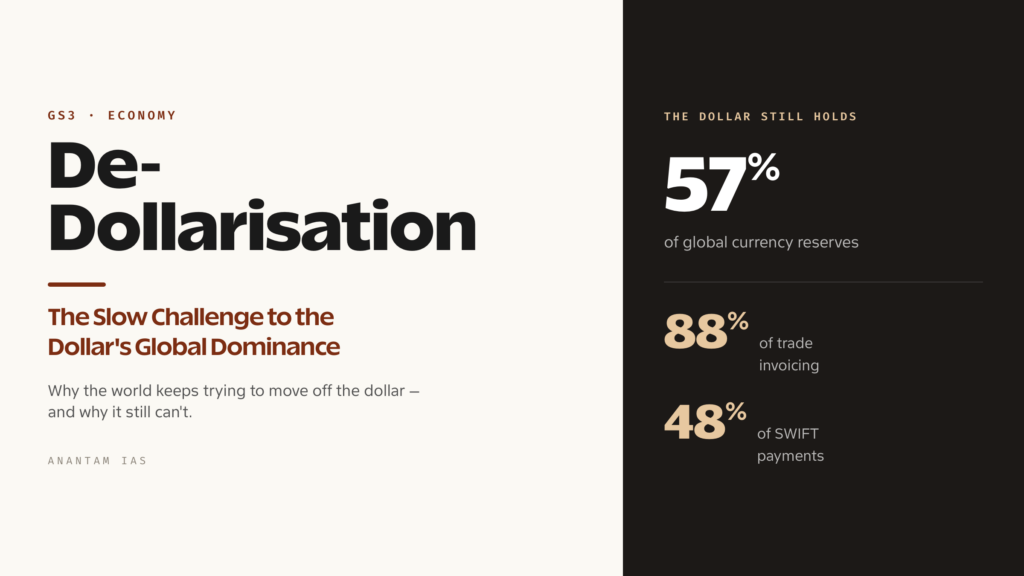
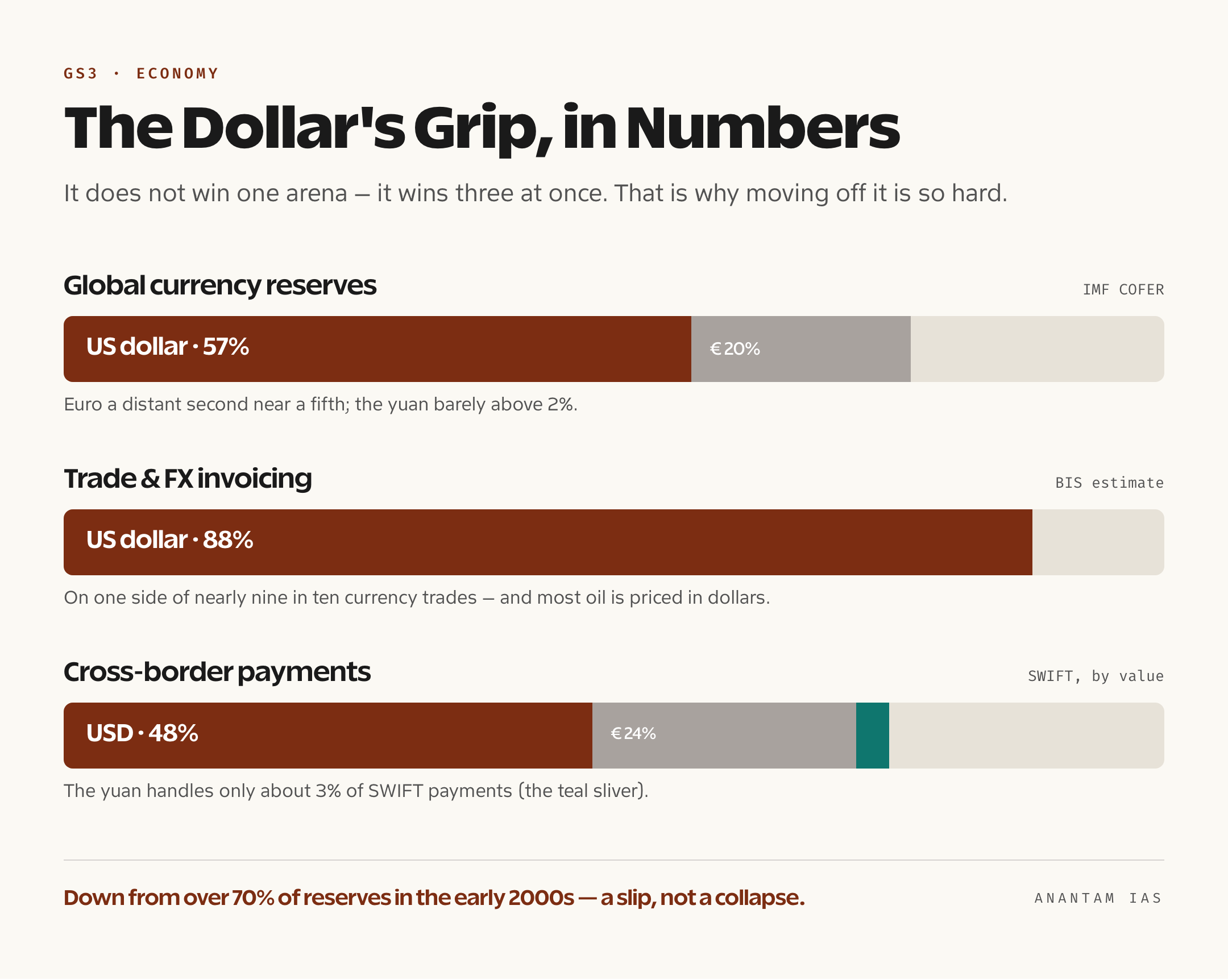
Start with how deep the dominance runs, because the scale is the whole reason de-dollarisation is so hard. The dollar is dominant in four separate arenas at once, and an answer that names all four reads far stronger than one that just says “the dollar is strong.” First, reserves: the US dollar still makes up around 57 per cent of the world’s allocated foreign exchange reserves, according to the IMF’s quarterly COFER data, with the euro a distant second near a fifth and the Chinese yuan barely above 2 per cent. That share has slipped from over 70 per cent in the early 2000s, but the slide has been gentle, not a collapse.
Second, trade invoicing: the dollar is used to price and bill the great majority of world trade — by Bank for International Settlements estimates close to 88 per cent of foreign-exchange transactions have the dollar on one side, and most commodities, oil above all, are quoted in dollars. This is the famous “petrodollar” arrangement, the long-standing habit of selling crude for dollars, which forces every oil importer to hold dollars whether it likes the United States or not. Third, payments: on the SWIFT messaging network that moves cross-border money, the dollar handles close to half of all payments by value, the euro roughly a quarter, and the yuan only around 3 per cent. Fourth, finance: the world borrows, lends and saves in dollars, because US Treasury bonds are the single deepest, most liquid and most trusted market on earth.
Pull those four threads together and you get what a French finance minister once called the dollar’s “exorbitant privilege.” Because the world wants dollars, the United States can borrow more cheaply than anyone else, run large deficits without immediate punishment, and — crucially — wield the dollar as a weapon. A country cut off from dollar clearing and from SWIFT can be locked out of global trade almost overnight. That power, more than economics, is what has turned a slow grumble about dollar dependence into a deliberate search for alternatives.
Why Countries Want Out — and What They Are Actually Doing
The trigger that changed everything is easy to date. When Russia invaded Ukraine in 2022, the West froze hundreds of billions of dollars of Russian central-bank reserves held abroad — overnight, money Moscow believed it owned became money it could not touch. Every reserve-managing government watched and drew the same blunt lesson: savings parked inside someone else’s currency and someone else’s banking system can be switched off in a crisis. The “weaponisation” of the dollar, as critics call it, did more to fuel de-dollarisation in three years than decades of speeches had managed. Add a steady worry about US deficits and debt eroding the dollar’s value over time, and the case for diversifying — for not keeping all your eggs in one nation’s basket — writes itself.
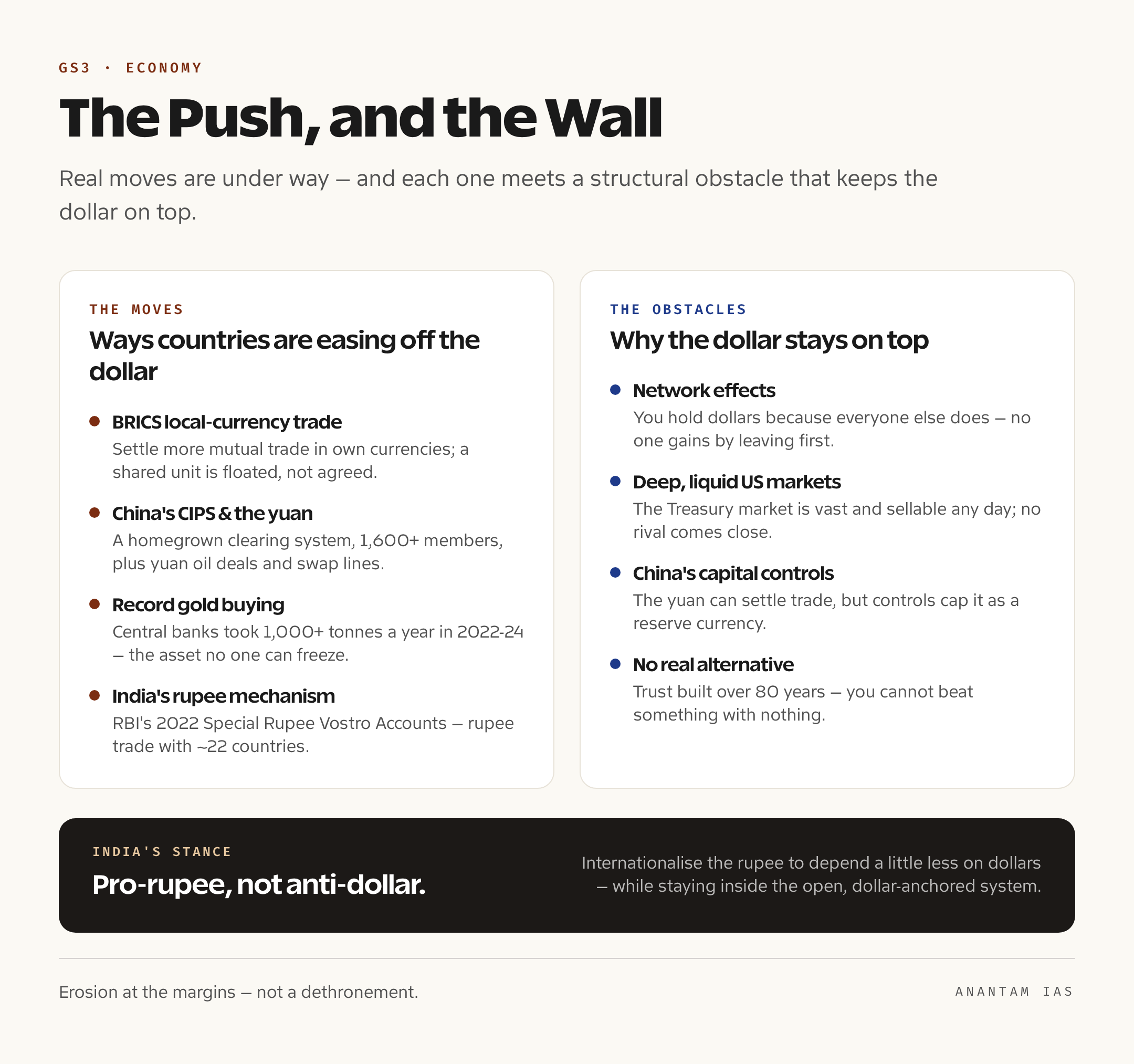
So what are countries actually doing about it? Four moves stand out. The first is BRICS local-currency trade: members of the expanded BRICS group have pushed to settle more of their mutual trade in their own currencies and have floated, in various forms, a shared settlement system or even a common unit — though, as we will see, the bloc is far from agreed on it. The second is China’s quiet build-out of its own plumbing: it runs CIPS, the Cross-Border Interbank Payment System, as a homegrown alternative to dollar clearing — by 2025 it had grown to over 1,600 participating institutions — and it keeps nudging the yuan into oil deals and swap lines to internationalise it. The third is gold: central banks have been buying bullion at a pace not seen in half a century, topping 1,000 tonnes a year in 2022, 2023 and 2024 and still adding about 863 tonnes in 2025, far above the roughly 470-tonne average of the previous decade. Gold is the one reserve asset that is nobody’s debt and nobody’s to freeze. The fourth is bilateral local-currency settlement — pairs of countries simply agreeing to invoice and pay each other in their own money, bypassing the dollar middleman entirely.
Why Full De-Dollarisation Is So Hard
For all the momentum, it is worth being honest about how far this can go, because the obstacles are structural, not cosmetic. The biggest is the network effect — the same reason everyone uses the same messaging app. You hold dollars because your trading partners hold dollars, your suppliers price in dollars, and your loans are written in dollars; no single country gains by leaving first, because a currency only works if others accept it. Money is a coordination game, and the dollar has already won the coordination. Switching costs are enormous, and the first mover bears them alone.
Behind that sits the depth of US markets. The Treasury-bond market is vast, liquid and open: a central bank can park a trillion dollars there and sell it tomorrow without moving the price much. No rival comes close. The euro lacks a single pan-European safe asset of comparable size, and — this is the decisive point — China’s yuan cannot replace the dollar while Beijing keeps strict capital controls. A true reserve currency must let foreigners move money in and out freely, which means giving up control over your exchange rate and your financial system. China is unwilling to do that, so the yuan can rise as a trade-settlement currency but is structurally capped as a reserve currency. There is also the simple matter of trust — built over eighty years of rule of law, independent courts and an independent central bank — which no rival can manufacture quickly. The deepest obstacle of all is the absence of an alternative: you cannot beat something with nothing, and right now there is no single currency ready to carry the load. That is why de-dollarisation is real at the margins — more trade in local currencies, more gold, less dollar exposure — but a wholesale toppling of the dollar is not on any near horizon.
India’s Rupee Strategy: Pro-Rupee, Not Anti-Dollar
India’s place in all this is distinctive, and getting the framing right is what separates a sharp answer from a clumsy one. India is not leading a crusade against the dollar. Its External Affairs Minister has said plainly that India is not for de-dollarisation; it is for the internationalisation of the rupee — a small but vital distinction. The goal is to make the rupee more usable in cross-border trade so India depends a little less on dollars it must earn through exports, not to dethrone the dollar or join any anti-Western currency bloc. India’s instinct is to de-risk by diversifying — more trade partners, more payment options — rather than to pick a fight.
The flagship instrument is the rupee-trade mechanism the RBI set up in July 2022, built around Special Rupee Vostro Accounts, or SRVAs. The plumbing is simpler than the name suggests: a partner country’s bank opens a rupee account with an Indian bank, an Indian importer pays in rupees into that account, and an Indian exporter is later paid out of the same pool — so the trade is settled entirely in rupees, with no dollar in the middle. The mechanism was aimed squarely at trade with countries facing currency shortages or sanctions, Russia and Iran among them. By early 2025 it had spread to roughly 150 such accounts opened by well over a hundred correspondent banks across some thirty nations, covering rupee-trade arrangements with around twenty-two countries. India has also signed local-currency settlement pacts directly — most notably the rupee-dirham arrangement with the UAE in 2023, under which Indian Oil Corporation paid for a crude shipment from Abu Dhabi’s ADNOC in rupees, a first.
But India’s experience also shows exactly why this is hard, which is the honest half of the answer. The rupee-ruble episode is the cautionary tale: because India buys far more from Russia (discounted oil) than it sells back, Russia ended up sitting on a mountain of rupees — a surplus running into tens of billions of dollars that it could not easily spend, since rupees are not yet freely usable elsewhere. Talks to settle oil trade in rupees stalled on precisely this point. The rupee-dirham channel hit a milder version of the same trade-imbalance problem. The lesson is that local-currency trade works smoothly only when flows are roughly balanced or the currency is freely convertible — and the rupee is not yet fully convertible on the capital account. So India keeps adding gold to its reserves, keeps widening the SRVA network, and keeps pushing the rupee outward, all while staying firmly inside the open, dollar-anchored system. It is hedging, not exiting.
For Your Mains Answer
This is a high-value topic that straddles two papers. It belongs to GS Paper 3 under the Indian economy, mobilisation of resources, the external sector and the balance of payments; and it touches GS Paper 2 international relations, through India’s groupings (BRICS), bilateral ties and the geopolitics of the global financial order. It is also a strong Essay theme on economic sovereignty and a multipolar world. The skill examiners reward is balance: show that the dollar’s dominance is real, that the de-dollarisation push is real, and that the gap between the two is where the marks live.
How to Build the Answer
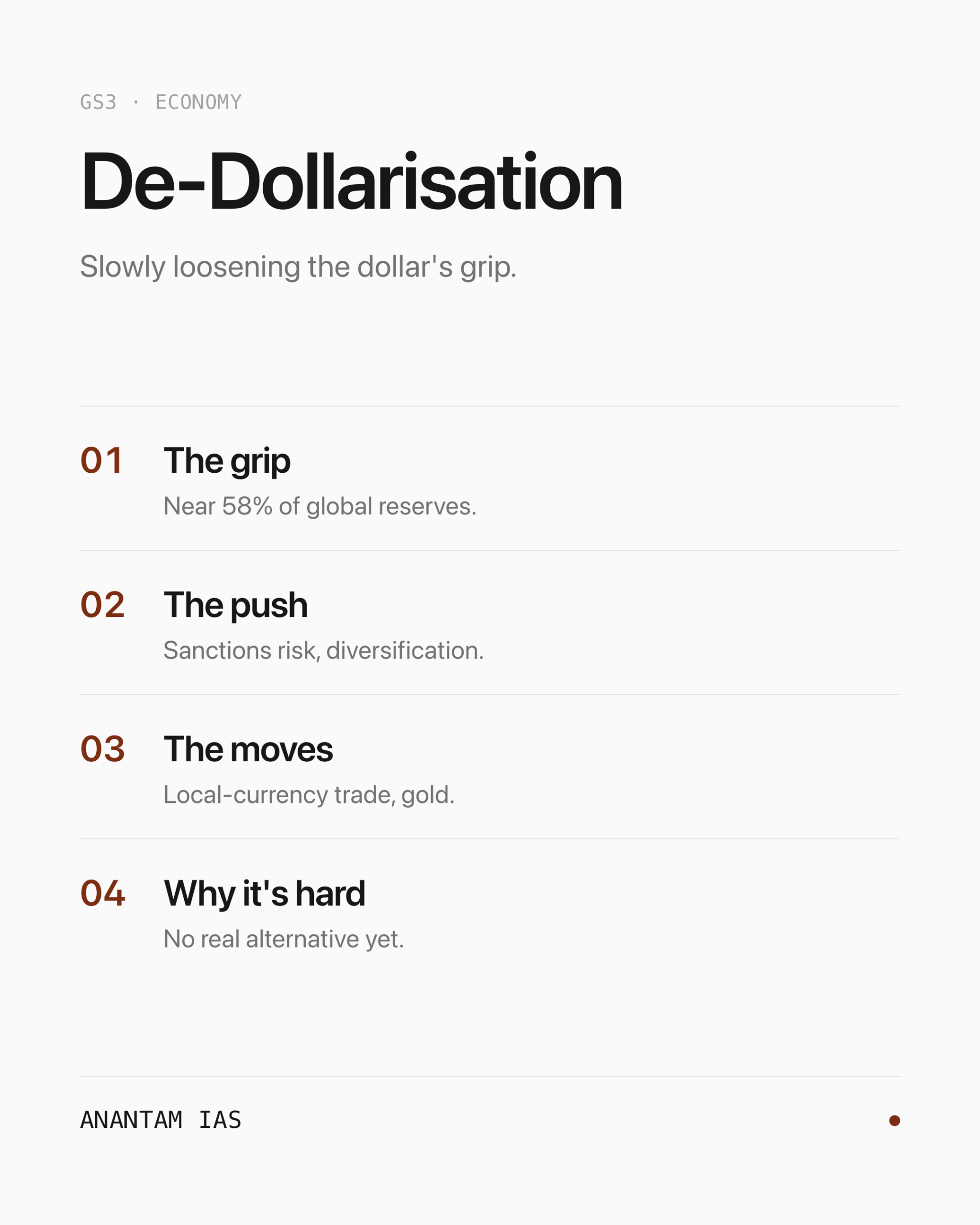
Move in a clean chain. Define de-dollarisation, then establish the dollar’s four-arena dominance (reserves, trade invoicing, payments, finance) and the “exorbitant privilege” it confers. Next, give the trigger (the 2022 freezing of Russian reserves) and the motives (sanctions risk, weaponisation, diversification). Then list the moves (BRICS local-currency trade, CIPS and yuan internationalisation, central-bank gold buying, bilateral settlement) and immediately set against them the obstacles (network effects, deep US markets, China’s capital controls, trust, no alternative). Finish with India’s specific, cautious strategy and a balanced verdict. That arc — define, dominate, motivate, move, obstruct, locate India, judge — fits almost any version of the question.
Common Mistakes to Avoid
Don’t announce the imminent death of the dollar — the data flatly contradicts it; frame the trend as gradual diversification at the margins. Don’t conflate the yuan as a trade currency with the yuan as a reserve currency; capital controls keep the second capped. Don’t paint India as anti-dollar or as backing a BRICS common currency — it has publicly resisted both. And don’t forget the obstacles: an answer that only lists the de-dollarisation moves, without the network effects and the missing alternative, reads as one-sided.
A Compact Answer Spine
De-dollarisation = reducing dependence on the USD in trade, reserves and finance → dollar still dominates: ~57% of reserves, ~88% of trade invoicing, ~48% of SWIFT payments, deepest bond market → “exorbitant privilege” + sanctions weapon → trigger: 2022 freeze of Russia’s reserves → moves: BRICS local-currency trade, China’s CIPS + yuan, record central-bank gold buying (>1,000 t/yr in 2022-24), bilateral settlement → obstacles: network effects, deep liquid US markets, China’s capital controls, trust, no alternative → India: “pro-rupee, not anti-dollar” — SRVA rupee-trade mechanism (2022, ~22 countries), rupee-dirham with UAE, rupee surplus problem with Russia → verdict: erosion at the margins, not dethronement.
Diagram or Flowchart Idea
Draw a simple two-column “push versus pull” diagram: on the left, the de-dollarisation moves (BRICS trade, CIPS/yuan, gold, bilateral settlement); on the right, the anchors that hold the dollar in place (network effects, deep markets, convertibility, trust). An arrow caught between them, barely tilting, captures the whole verdict — pressure exists, but the dollar holds.
A Balanced-Conclusion Line
A line that lands the marks: “De-dollarisation is best read not as the fall of the dollar but as the slow building of exits beside it — and India’s role is telling, pushing the rupee outward to gain room to manoeuvre, while staying firmly within the open, dollar-anchored system it has no interest in dismantling.”
How to Use Data Without Cramming
You need four anchors, not a table: ~57 per cent (dollar’s share of reserves), ~88 per cent (trade invoicing), the July 2022 RBI rupee-trade mechanism with around 22 countries, and central banks buying over 1,000 tonnes of gold a year in 2022-24. Attribute them plainly — “by the IMF’s COFER data,” “as the RBI’s 2022 framework set out” — rather than scattering numbers loose.
Frequently Asked Questions
What does de-dollarisation mean?
De-dollarisation is the gradual effort by countries to reduce their dependence on the US dollar across trade, reserves and finance — invoicing more trade in other currencies, holding fewer dollars in reserve, and building payment systems outside dollar clearing. It is a slow diversification away from the dollar, not a sudden replacement of it. The dollar still dominates, holding around 57 per cent of global reserves and about 88 per cent of trade invoicing.
Why do countries want to move away from the dollar?
Mainly because of risk. After Western nations froze Russia’s overseas reserves in 2022, governments saw that savings held in dollars and routed through the US-led financial system can be sanctioned or frozen in a crisis. That “weaponisation” of the dollar, plus worries about large US deficits eroding the currency’s value, has pushed many countries to diversify — to hold more gold, settle some trade in local currencies, and reduce their exposure to a single nation’s monetary policy.
Will the dollar lose its status soon?
No, not soon. The dollar is held in place by powerful network effects, the unmatched depth of US Treasury markets, decades of trust, and — decisively — the absence of any ready alternative. The euro lacks a single large safe asset and China’s yuan is capped by Beijing’s capital controls. So de-dollarisation is real at the margins, with more local-currency trade and more gold, but a wholesale toppling of the dollar is not on any near horizon.
What is India doing about de-dollarisation?
India describes its stance as pro-rupee, not anti-dollar. Rather than attacking the dollar, it is trying to internationalise the rupee so it depends a little less on dollars. The main tool is the RBI’s July 2022 rupee-trade mechanism using Special Rupee Vostro Accounts, which lets partner countries settle trade in rupees; by early 2025 this covered around twenty-two countries. India has also signed local-currency deals such as the rupee-dirham arrangement with the UAE, while keeping its reserves diversified with gold.
Practice Questions
Prelims MCQs
- The term “de-dollarisation” refers to which of the following?
(a) The United States reducing the supply of dollars to control inflation
(b) The gradual effort by countries to reduce dependence on the US dollar in trade, reserves and finance
(c) A country adopting the US dollar as its legal tender
(d) The IMF replacing the dollar with Special Drawing Rights
Answer: (b) De-dollarisation is the deliberate, gradual reduction of reliance on the dollar across trade, reserves and finance; option
(c) describes the opposite, dollarisation. - With reference to the US dollar’s role in the global economy, consider its share of allocated foreign exchange reserves. As per recent IMF data, this share is closest to:
(a) 25 per cent
(b) 40 per cent
(c) 57 per cent
(d) 75 per cent
Answer: (c) The dollar’s share of allocated reserves is around 57 per cent, down from over 70 per cent in the early 2000s but still dominant. - The Special Rupee Vostro Account (SRVA) mechanism, introduced in 2022, is associated with which of the following?
(a) Settlement of international trade in Indian rupees
(b) Domestic storage of the RBI’s gold
(c) A new SWIFT-like messaging system built by India
(d) The IMF’s allocation of Special Drawing Rights to India
Answer: (a) SRVAs let a partner country’s bank hold rupee accounts with Indian banks so that bilateral trade can be invoiced and settled in rupees. - CIPS, sometimes discussed in the context of de-dollarisation, is best described as:
(a) China’s cross-border interbank payment system, an alternative to dollar clearing
(b) A common currency proposed by the BRICS group
(c) The IMF’s reserve-tracking database
(d) A central-bank gold-storage facility
Answer: (a) CIPS is China’s Cross-Border Interbank Payment System, a homegrown alternative to dollar-based clearing, though most of its traffic still relies on SWIFT messaging. - Why is a wholesale replacement of the US dollar considered difficult in the near term?
(a) Because no other economy produces enough physical currency
(b) Because of network effects, the depth of US markets, China’s capital controls and the lack of an alternative
(c) Because international law requires reserves to be held in dollars
(d) Because gold cannot be used as a reserve asset
Answer: (b) Network effects, unmatched US market depth, the yuan’s cap from China’s capital controls, trust and the absence of a ready alternative all keep the dollar dominant.
Mains Practice Questions
- Examine what is meant by de-dollarisation. Why has the push to reduce dependence on the US dollar gained momentum in recent years? (15 marks, 250 words)
- The US dollar enjoys an “exorbitant privilege.” Discuss the sources of the dollar’s dominance and the structural obstacles that make full de-dollarisation difficult. (15 marks, 250 words)
- “India’s stance is pro-rupee, not anti-dollar.” Critically analyse India’s strategy of rupee internationalisation, including the Special Rupee Vostro Account mechanism and its limitations. (15 marks, 250 words)
- Distinguish between a currency’s use in trade settlement and its use as a reserve currency, with reference to the Chinese yuan. Why does this distinction matter for the de-dollarisation debate? (10 marks, 150 words)
- Record central-bank gold buying is often cited as evidence of de-dollarisation. Evaluate how far gold accumulation, local-currency trade and alternative payment systems are reshaping the global monetary order. (15 marks, 250 words)
Tell Google you want more of this.
Add Anantam IAS as a preferred sourceOne tap, and this site shows up more often in your own Top Stories, AI Overviews and AI Mode. Remove it any time.