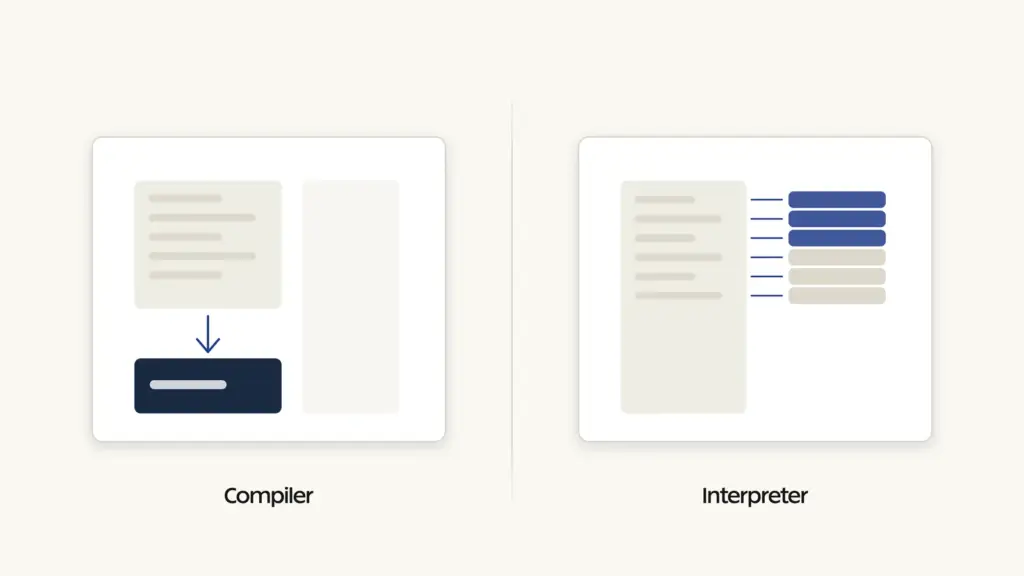
The difference between a compiler and an interpreter is when translation happens. A compiler reads your entire source program, checks it, converts it into machine code, and hands you a finished executable file — translation happens once, before the program ever runs. An interpreter takes the same source code and translates it statement by statement while the program is running, executing each piece as it goes.
Both solve the same underlying problem. A processor understands only its own binary instruction set; humans write in languages like C, Python, and Java. Something has to bridge that gap. The two approaches bridge it at different moments, and almost every practical difference — speed, error messages, memory use, portability — follows from that single choice of timing.
What a compiler does
A compiler is a translation program. You feed it source code; it produces an object file, which a linker turns into an executable containing machine instructions for one specific processor architecture and operating system. Run it, and the processor executes it directly. The compiler is not present at that point — its work finished before you started.
Translation is not a single pass. A compiler works through recognisable stages: lexical analysis breaks the text into tokens; syntax analysis builds a parse tree; semantic analysis checks that types and declarations make sense; an intermediate representation is generated; an optimiser rewrites it to be faster or smaller; and the code generator emits machine instructions.
The optimisation stage is why compiled code is fast. Because the compiler sees the whole program at once, it can unroll loops, eliminate dead code, keep frequently used values in registers, reorder instructions to suit the processor’s pipeline, and inline small functions. None of this is available to a translator that only ever sees one line at a time. The GNU Compiler Collection documents dozens of such optimisation passes.
The costs are equally clear. Compilation takes time, and you pay it on every change. The output is tied to one platform, so a binary built for Windows on an x86 processor will not run on an ARM-based phone. And the compiler must be satisfied that the whole program is correct before it produces anything at all.
What an interpreter does
An interpreter reads source code and executes it directly, without producing a standalone executable. It processes one statement, carries out its effect, moves to the next, and repeats. The interpreter itself must stay in memory the entire time the program runs.
That changes the working experience completely. You can run a half-finished program and it will execute correctly until it reaches the broken part. You can type a line into an interactive prompt and see the result immediately. You can change one line and re-run without waiting for a rebuild. This is why interpreted languages dominate scripting, data analysis, teaching, and rapid prototyping.
The cost is speed at run time. Every time a loop executes its body, the interpreter does the translation work again — a loop running a million times pays that cost a million times, where a compiler paid it once. Interpreted code commonly runs several times slower than equivalent compiled code, and the gap widens on computation-heavy work. That is why numerical libraries in interpreted languages are themselves usually written in C and merely called from the interpreter.
Compiler vs interpreter: comparison table
| Basis | Compiler | Interpreter |
|---|---|---|
| When translation happens | Once, before execution begins | Continuously, during execution |
| Unit of translation | The entire program | One statement or line at a time |
| Output produced | An object file or standalone executable | No permanent output; results are produced directly |
| Execution speed | Faster — machine code runs directly on the processor | Slower — translation overhead is paid repeatedly |
| Time to first run | Slower; you wait for the full build | Faster; execution starts immediately |
| Error reporting | Reports all detected errors together after scanning the program | Stops at the first error encountered during execution |
| Debugging | Harder; errors refer to compiled code and the whole program must rebuild | Easier; errors surface at the exact line, with the program state available |
| Memory during execution | Interpreter not needed in memory; object code occupies space | Interpreter must remain resident throughout execution |
| Optimisation scope | Whole-program optimisation is possible | Limited; little context is available at any moment |
| Portability of the artefact | Executable is tied to one processor architecture and operating system | Source runs anywhere an interpreter for the language exists |
| Source code distribution | Users receive a binary; source can be withheld | Users generally need the source code to run the program |
| Typical languages | C, C++, Rust, Go, Fortran | Python, Ruby, PHP, shell scripts, classic JavaScript |
| Suits | Operating systems, games, scientific computing, embedded firmware | Scripting, automation, data analysis, teaching, prototyping |
Error handling: the difference you notice first
A compiler will not produce an executable while errors remain, and it reports as many as it can in one pass. Compile a C program with five syntax errors and you typically get five messages, all before anything runs. The discipline is front-loaded: fix everything, then run.
An interpreter finds errors only when execution reaches them. A Python script with a spelling mistake on line 200 will run the first 199 lines, do whatever they do — including writing files or sending data — and then stop. Errors after that point are never reported, because execution never got there.
The consequence goes beyond convenience. Compiled languages catch a whole category of mistakes — type mismatches, undefined variables, wrong argument counts — before the program touches real data. Interpreted languages catch the same mistakes only when that code path executes, which may be in production, months later. Optional type annotations and static analysis tools now reintroduce compile-time-style checking without changing how these languages run.
C and Python: the same task, two models
Write a program in C and the sequence is: source file, compiler, object file, linker, executable. Run the executable and the processor executes your instructions directly. Ship it and the user needs only the binary. Change one line and you rebuild before you can test.
Write the same program in Python and the sequence is: source file, `python program.py`, output. Behind the scenes CPython compiles the source into an intermediate form called bytecode, caches it in a `.pyc` file, and executes that bytecode on its virtual machine — the process set out in Python’s own execution model documentation. Change a line and re-run instantly. Ship it and the user needs Python installed.
That detail about CPython is where the textbook distinction starts to leak. Python is called an interpreted language, and yet there is a compilation step inside it. It simply targets a virtual machine instead of a physical processor.
The middle ground: bytecode and just-in-time compilation
Most widely used languages today are neither purely compiled nor purely interpreted.
Java made the hybrid famous. The `javac` compiler translates source into bytecode — instructions for an abstract processor defined by the Java Virtual Machine specification. Bytecode is platform-independent, so the same `.class` file runs on Windows, Linux, or Android. At run time the JVM executes that bytecode, and its just-in-time compiler watches which methods run most often and compiles those hot paths into native machine code on the fly. You get portability from the bytecode and, for the code that matters, close to compiled speed.
Modern JavaScript engines go further. Google’s V8 starts by interpreting bytecode for fast start-up, profiles the running code, and hands the frequently executed parts to an optimising compiler that produces native machine code. If the assumptions behind an optimisation turn out to be wrong, the engine discards the optimised version and falls back to the interpreter.
Ahead-of-time compilation completes the picture from the other direction: Android compiles application bytecode into native code at install time, trading start-up delay for predictable performance.
So “compiled” and “interpreted” describe implementations, not languages. There are C interpreters and Python compilers. What a language is usually implemented as tells you about its typical use, not about a property of the language itself.
Where raw execution speed is the whole point, compilation still wins decisively. Scientific workloads on machines built under the National Supercomputing Mission are compiled with aggressive optimisation for the exact processor they run on, and code targeting a graphics processing unit is compiled into kernels specific to that hardware — as with the workloads on India’s AIRAWAT AI supercomputer, where a few per cent of translation overhead would cost real hours of compute.
Common confusions
“Python is slow because it is interpreted.” Partly. Interpretation overhead is real, and so are dynamic typing and the cost of object allocation. Programs that spend most of their time inside compiled numerical libraries can be nearly as fast as C, because the interpreter is only orchestrating.
“Java is a compiled language.” Java is compiled to bytecode, not machine code, and then needs a virtual machine to run. Calling it simply compiled or simply interpreted misses what is interesting about it.
“An assembler is a compiler.” An assembler translates assembly language into machine code, but the mapping is essentially one instruction to one instruction. A compiler translates a high-level language, restructures it, and optimises it.
“Compiled programs have no errors because the compiler checks them.” A compiler catches syntax and type errors. It cannot catch logical errors — a program that compiles cleanly and calculates the wrong answer is both possible and the most common kind of bug.
“The interpreter converts source code to machine code line by line.” A common textbook phrasing, and slightly misleading. Most modern interpreters translate source into an internal bytecode first and execute that. What is true is that execution and translation are interleaved rather than separated.
Frequently Asked Questions
Which is faster, a compiler or an interpreter?
A compiled program executes faster, because translation and optimisation are done once beforehand. An interpreter starts running sooner, because it does not wait for a full build. Which matters depends on whether you are optimising for run time or for the edit-and-test cycle.
Can the same language be both compiled and interpreted?
Yes. This is a property of the implementation, not the language. C has interpreters, Python has compilers, and Java uses both models in the same run.
What is bytecode?
An intermediate set of instructions for a virtual machine rather than a physical processor. It is more compact and faster to execute than raw source, and unlike machine code it runs anywhere the virtual machine exists. Java bytecode and Python’s `.pyc` files are both examples.
What is just-in-time compilation?
Compiling parts of a program into native machine code while the program is running, chosen on the basis of which parts execute most often. It combines an interpreter’s fast start-up with a compiler’s fast steady-state execution, at the cost of a more complex runtime and higher memory use.
Why do compiled programs need to be rebuilt for different operating systems?
Because machine code is specific to a processor’s instruction set, and an executable also depends on the operating system’s file format and system call conventions. Change either and the binary no longer runs, though the source code may be unchanged.
Does an interpreter use less memory than a compiler?
The translation process itself typically uses less, because no object code is built and stored. But the interpreter must stay resident in memory for as long as the program runs, so total memory use during execution is often higher.
Practice Questions
1. The principal difference between a compiler and an interpreter is:
a) A compiler works only with high-level languages while an interpreter works only with assembly
b) A compiler translates the entire program before execution while an interpreter translates during execution
c) A compiler produces no output file while an interpreter always produces one
d) A compiler executes the program while an interpreter only checks it
Answer: b) A compiler translates the entire program before execution while an interpreter translates during execution
2. Which stage of compilation is responsible for breaking source code into tokens?
a) Semantic analysis
b) Code generation
c) Lexical analysis
d) Linking
Answer: c) Lexical analysis
3. In the Java execution model, the output of the `javac` compiler is:
a) Machine code specific to the host processor
b) Platform-independent bytecode for the Java Virtual Machine
c) An assembly language listing
d) An optimised intermediate representation discarded after compilation
Answer: b) Platform-independent bytecode for the Java Virtual Machine
4. Just-in-time compilation is best described as:
a) Compiling a program immediately after it is written
b) Compiling frequently executed portions of a program into native code while it runs
c) Interpreting a program without any translation step
d) Translating machine code back into source code
Answer: b) Compiling frequently executed portions of a program into native code while it runs
5. Which of the following is an advantage of interpretation over compilation?
a) Faster execution of computation-heavy loops
b) Whole-program optimisation across function boundaries
c) Errors are reported at the exact line during execution, aiding debugging
d) The source code need not be distributed to users
Answer: c) Errors are reported at the exact line during execution, aiding debugging
- Distinguish between a compiler and an interpreter, and explain how the timing of translation accounts for their differences in speed, error reporting, and portability.
- “Compiled and interpreted describe implementations, not languages.” Examine this statement with reference to Java, Python, and JavaScript.
- Discuss the stages of compilation and explain why whole-program visibility allows optimisations that an interpreter cannot perform.
- Just-in-time compilation attempts to combine the advantages of both models. Analyse how it works and what it costs.
- Evaluate the trade-off between development speed and execution speed in the choice of programming language for scientific and high-performance computing applications.
Tell Google you want more of this.
Add Anantam IAS as a preferred sourceOne tap, and this site shows up more often in your own Top Stories, AI Overviews and AI Mode. Remove it any time.