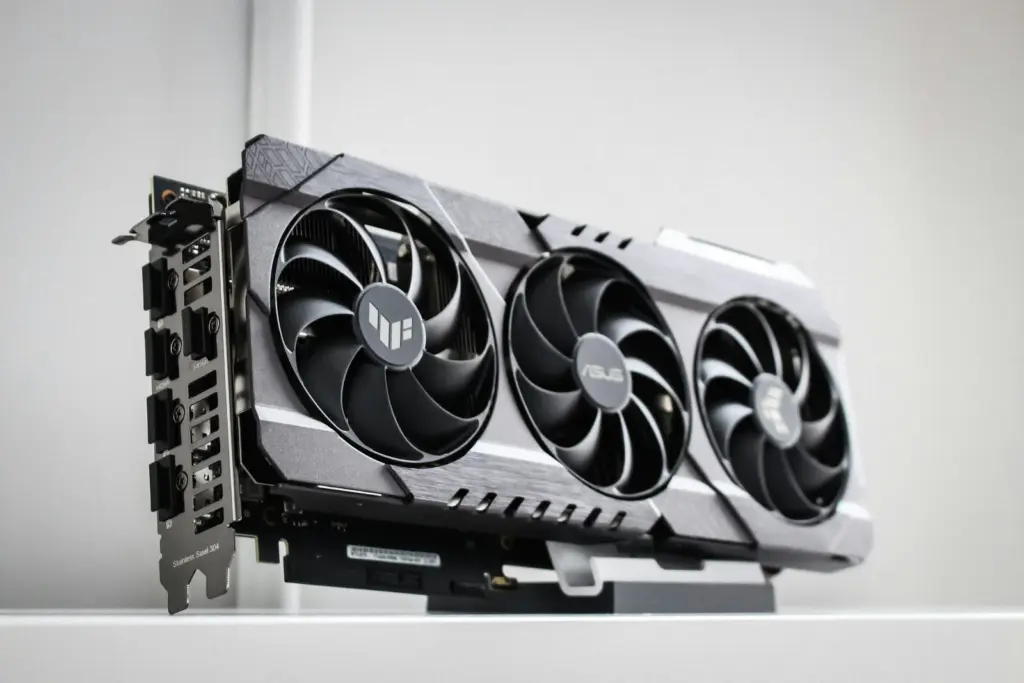
You keep seeing the letters GPU in three very different places, and nobody stops to tell you they are the same thing. It is in the spec sheet of a gaming laptop. It is in the headline that says a company spent billions on Nvidia chips to train a chatbot. And it is in the government press note announcing that India has put tens of thousands of these units online for its AI mission. Here is the plain answer that ties all three together. GPU stands for Graphics Processing Unit, a specialised processor originally built to draw images on a screen, which turned out to be the single most important piece of hardware behind the modern artificial-intelligence boom.
That last sentence carries the whole surprise of the topic. A chip designed to render the explosions in a video game is now the chip that trains the models writing your emails, and understanding why a graphics part became the engine of AI is the real lesson here. Get that, and a cluster of the science-and-technology syllabus, from supercomputing to India’s chip strategy, suddenly connects.
What is a GPU, in one clean sentence?
A GPU is a processor that performs many simple calculations at the same time, which is exactly what you need to fill a screen with millions of pixels, and, it turns out, exactly what you need to train a neural network. That single idea, doing thousands of things at once instead of one thing very fast, is the whole secret, so hold on to it.
Think of the two ways to solve a problem. You can hand it to one brilliant expert who works through it step by step, quickly and cleverly. Or you can hand small identical pieces of it to a thousand ordinary workers who all work in parallel. For a complicated, branching task, the lone expert wins. For a task that breaks into thousands of identical small sums, the crowd wins, and it is not close. A GPU is that crowd. The expert is the CPU, and the difference between them is the first thing to fix.
GPU versus CPU: the difference that explains everything
The CPU, or Central Processing Unit, is the general-purpose brain of a computer, built to handle any kind of instruction one after another, very fast, with a handful of powerful cores. The GPU is a specialist, built with thousands of much simpler cores that run the same operation across huge batches of data at once. CPUs are optimised for low latency, finishing a single task quickly. GPUs are optimised for high throughput, finishing an enormous pile of similar tasks together.
Here is a worked example that makes it concrete. Suppose you have to add two lists of a million numbers each, pair by pair. A CPU with, say, eight strong cores marches through them a few at a time, and it is fast at each addition, but it is still working through a queue. A GPU with several thousand simple cores hands one addition to each core and does thousands simultaneously. Neither chip is smarter. They are shaped for different jobs. The CPU is a Formula 1 car, unbeatable for one driver getting somewhere fast. The GPU is a fleet of buses, unbeatable for moving a stadium crowd.
| Feature | CPU (Central Processing Unit) | GPU (Graphics Processing Unit) |
|---|---|---|
| Core count | A few powerful cores (often 4 to 64) | Thousands of simpler cores |
| Optimised for | Low latency, one task done fast | High throughput, many tasks in parallel |
| Best at | Sequential logic, branching decisions, running the operating system | Repetitive maths on large data, done all at once |
| Analogy | One expert working step by step | A thousand workers doing identical small jobs together |
| Typical role | The general brain of every device | Graphics, AI training, scientific simulation |
The mental model that never fails you is this: the CPU decides what to do, and when there is a mountain of identical arithmetic to grind through, it hands that mountain to the GPU. Modern computing is the two of them working as a pair, and the label for using the GPU to do general heavy maths, not just graphics, has a name worth knowing: GPGPU, general-purpose computing on graphics processing units.
From pixels to intelligence: why a graphics chip trains AI
The reason a graphics chip became an AI chip is that both jobs are secretly the same kind of maths. To draw a 3D scene, a GPU multiplies and adds huge grids of numbers, called matrices, that describe where every point sits and how light falls on it. That is matrix multiplication, done millions of times per frame. When engineers looked at what it takes to train a neural network, the core of modern AI, they found the same operation staring back: layer after layer of matrix multiplications, each one a vast pile of multiply-and-add sums that are all independent of each other.
An independent, repetitive, parallel workload is precisely what a GPU eats for breakfast. Training a large model means adjusting billions of internal numbers, called parameters, again and again over mountains of data, and every pass is that same matrix arithmetic. On a CPU it would take a lifetime. On thousands of GPU cores running in parallel it takes days or weeks. This is why the AI revolution did not arrive the moment the algorithms were invented. The key ideas behind deep learning are decades old. What arrived recently was hardware cheap and parallel enough to run them at scale, and that hardware was the GPU. The story of artificial intelligence in India and everywhere else is, underneath, a story about compute finally catching up with theory.
One company, Nvidia, saw this early and built both the chips and the software layer, called CUDA, that let researchers program GPUs for AI without thinking about graphics at all. That head start is why a single firm ended up at the centre of the entire AI hardware economy, and why access to its chips became a matter of national strategy rather than a shopping decision.
Where GPUs actually get used
Graphics is still the founding job, and the one the name comes from. Every smooth game, every rendered film frame, every video-editing timeline that scrubs without stuttering leans on a GPU turning geometry and lighting into pixels many times a second. That is the visible, everyday face of the technology.
The bigger world is the invisible one. AI training and inference is now the headline use: the models behind chat assistants, image generators, translation, and recommendation systems are all trained on large banks of GPUs and then run on them to answer you. Scientific supercomputing is another: weather and climate models, drug-molecule simulations, fluid dynamics, and astrophysics all rest on the same parallel arithmetic, which is why India’s National Supercomputing Mission and its PARAM machines increasingly pack GPU accelerators alongside conventional processors. GPUs also drive cryptocurrency mining, where the profit comes from grinding the same hash calculation billions of times, and they sit inside the perception systems of self-driving cars, medical-imaging scanners, and defence sensors.
The thread running through every one of these is identical. Wherever a problem breaks into a huge number of similar calculations that can be done at the same time, the GPU is the tool. That single test, is this workload massively parallel, tells you instantly whether a GPU belongs in the picture.
Why GPUs became a national-strategy question
For most of computing history, no one thought of a processor as a strategic asset. That changed with AI, because whoever controls the compute controls the pace at which a country can build its own models, and the most capable AI GPUs are made by a handful of firms using the most advanced chip-manufacturing in the world. The chips are scarce, expensive, and export-controlled, which turns a piece of hardware into a question of national capability. A startup in Bengaluru cannot train a serious model if it cannot rent the GPUs to do it, and if those GPUs sit only in foreign data centres, the country is renting its own future.
This is exactly the gap India set out to close with the IndiaAI Mission, approved by the Union Cabinet on 7 March 2024 with an outlay of 10,371.92 crore rupees. The mission is built on seven pillars, and the very first is IndiaAI Compute Capacity, whose whole purpose is to put a large, shared pool of GPUs within reach of Indian startups, researchers, and students at a subsidised price, through a public-private partnership rather than a single giant government data centre.
The original target read modestly on paper, an AI computing facility of 10,000 or more GPUs. What actually happened outran it. Through the government’s AI compute portal, more than 38,000 GPUs have now been onboarded, with over 34,000 of those supplied by a set of empanelled private providers such as Yotta, E2E Networks, NxtGen, and Jio Platforms. These are offered to Indian users at one of the lowest subsidised rates anywhere, well under a dollar per GPU-hour, so that a small team can afford the compute that would otherwise cost a fortune on the open market. That is the concrete meaning of the mission: not a slogan about AI, but tens of thousands of specific chips made rentable to people who could never buy them.
The hidden cost: power, heat, and memory
There is a catch that the headline GPU counts never mention, and it is the reason “just buy more chips” is not a full strategy. A modern AI GPU is a furnace. A single high-end unit can draw hundreds of watts, and a cluster of thousands of them, packed into a data centre and run around the clock, consumes electricity on the scale of a small town and throws off enough heat to need serious cooling. Compute is not free-floating in the cloud. It is a physical building full of hot silicon that has to be fed power and kept cold, which is why the AI boom has quietly become an energy story. The question of whether India’s power system can keep up with the explosion in data centres is not a side issue for the AI mission, it is a binding constraint on it, and states have started competing to attract these facilities with dedicated policies such as the Gujarat data-centre framework.
The other hidden bottleneck is memory. Training a large model does not just need cores, it needs to hold enormous amounts of data close to those cores at very high speed, which is the job of a specialised chip called High Bandwidth Memory (HBM) stacked alongside the GPU. HBM is made by only a few firms in the world, and it has often been the real scarce ingredient, more so than the GPU logic itself. So when you read that a country or a company is “short of GPUs,” the shortage is frequently a shortage of the memory and the power and the cooling that surround them. The chip is only the visible tip of a much larger physical system, and that is worth remembering before treating a GPU number as the whole picture.
The chip behind the GPU: where India is still catching up
There is a catch worth stating plainly, because it is where the honest analysis lives. Onboarding 38,000 GPUs is a demand-side win. It gives Indian innovators access to compute. It does not mean India makes those GPUs. Almost every high-end AI GPU running in the country is designed by a foreign firm and fabricated in a foreign foundry, chiefly in Taiwan and South Korea, on manufacturing processes India does not yet possess. Renting the crowd of workers is not the same as being able to build them.
That is why the GPU story only makes sense sitting next to the semiconductor mission and the wider Make in India push. A GPU is, physically, a very advanced semiconductor, and the ability to design and eventually fabricate such chips at home is the deeper capability the country is chasing. India has begun that climb with chip-assembly and packaging plants and a first generation of fabrication units, but the leading-edge nodes that produce top AI accelerators remain years away. So the correct way to hold this topic is as two linked layers: access to compute, which the IndiaAI Mission is delivering now, and manufacture of the chips, which the semiconductor mission is trying to build for the long run. An answer that names both, and does not confuse one for the other, is the answer that scores.
It also connects outward to the rest of India’s deep-tech effort. The same national ambition that funds GPUs funds the National Quantum Mission, because quantum computing is the possible next paradigm beyond today’s silicon, and the same digital backbone that the Digital India programme built is what makes a shared national compute grid usable at all. GPUs are one node in that web, not an island.
How to study GPUs for the exam
Do not memorise GPU as a hardware fact. Learn it as a chain of cause and effect, because that is what turns a one-line definition into a full answer.
Start with the core distinction and say it in one breath: a CPU is a few powerful cores built for sequential tasks and low latency, a GPU is thousands of simple cores built for parallel tasks and high throughput. If you can produce that sentence cleanly, you have answered the most common form of the question.
Then attach the AI link, because that is where the marks are. The reason GPUs power AI is that training a neural network is mostly matrix multiplication, a massively parallel, repetitive workload, which is the exact shape of problem a GPU is built for. Add the punchline that the algorithms are old and it was cheap parallel hardware that unlocked them, and you sound like you understand the technology rather than the acronym.
Next, plug in the India story with its two figures. The IndiaAI Mission, approved in March 2024 with a 10,371.92 crore rupee outlay, has onboarded more than 38,000 GPUs for a shared compute facility, against an original target of 10,000. Keep the honest caveat attached: this is access to compute, not domestic manufacture of the chips, which is the separate job of the semiconductor mission. Numbers move, so learn them as orders of magnitude and directions, not as brittle exact digits.
Finally, connect upward to the theme. Whenever a GPU appears in the news, the underlying story is one of three things: the AI race, the compute bottleneck, or the chip-supply-chain question that ties into semiconductors and 5G and telecom infrastructure. Answer the theme, and the hardware detail slots in as evidence. That is the whole method with technology topics: know the mechanism well enough to explain it simply, then know where it plugs into policy.
Frequently Asked Questions
What is the full form of GPU?
GPU stands for Graphics Processing Unit. It is a specialised processor originally designed to render images and video, now widely used to train and run artificial-intelligence models because of its ability to perform many calculations in parallel.
What is the difference between a CPU and a GPU?
A CPU (Central Processing Unit) has a few powerful cores built for sequential tasks and quick single-task performance. A GPU has thousands of simpler cores built to do many similar calculations at the same time. The CPU runs the general logic of a computer, and it hands large, repetitive maths workloads to the GPU.
Why are GPUs used for artificial intelligence?
Training a neural network relies mostly on matrix multiplication, a huge number of independent multiply-and-add operations. This is a massively parallel workload, which is exactly what a GPU is built to handle, so GPUs train AI models far faster and cheaper than CPUs can.
Is a GPU only used for gaming?
No. Gaming and graphics are the original use, but GPUs are now central to AI training and inference, scientific supercomputing, weather and climate modelling, cryptocurrency mining, and the perception systems in self-driving cars and medical imaging.
How many GPUs has the IndiaAI Mission deployed?
Through the government’s AI compute portal, more than 38,000 GPUs have been onboarded for a common compute facility, with over 34,000 supplied by empanelled private providers. They are offered to Indian startups and academia at a heavily subsidised rate.
What is the IndiaAI Mission and when was it approved?
The IndiaAI Mission is a national programme approved by the Union Cabinet on 7 March 2024 with an outlay of 10,371.92 crore rupees. It has seven pillars, the first of which, IndiaAI Compute Capacity, builds the shared GPU infrastructure for the country.
Does India manufacture its own GPUs?
Largely no. The high-end AI GPUs used in India are designed by foreign firms and fabricated abroad. India’s semiconductor mission is working to build domestic chip design, assembly, and fabrication, but leading-edge manufacture of top AI chips is still some years away.
What is GPGPU?
GPGPU stands for general-purpose computing on graphics processing units. It means using a GPU for heavy general-purpose maths, such as AI and scientific simulation, rather than only for rendering graphics. Software layers like Nvidia’s CUDA made this possible.
Practice Questions
1. GPU, in the context of computing, stands for:
a) General Processing Unit
b) Graphics Processing Unit
c) Graphical Power Unit
d) Grid Processing Unit
Answer: b) GPU stands for Graphics Processing Unit, a processor built for highly parallel calculations.
2. Which of the following best explains why GPUs are preferred over CPUs for training AI models?
a) GPUs have higher clock speeds than any CPU
b) GPUs can perform many parallel calculations, matching the matrix maths of neural networks
c) GPUs consume no electricity
d) GPUs replace the need for any CPU in a computer
Answer: b) Neural-network training is massively parallel matrix multiplication, which suits the GPU’s thousands of cores.
3. Consider the following statements about the IndiaAI Mission. Which is/are correct?
- It was approved by the Union Cabinet in March 2024.
- Its first pillar is IndiaAI Compute Capacity.
- It aims to build shared GPU infrastructure through a public-private partnership.
a) 1 and 2 only
b) 2 and 3 only
c) 1 and 3 only
d) 1, 2 and 3
Answer: d) All three statements about the mission are correct.
4. With reference to CPUs and GPUs, which statement is correct?
a) A CPU has thousands of simple cores and a GPU has a few powerful ones
b) A GPU is optimised for low latency and a CPU for high throughput
c) A CPU is optimised for sequential tasks and a GPU for parallel tasks
d) GPUs cannot be used for anything other than graphics
Answer: c) The CPU handles sequential, branching logic, while the GPU handles parallel, repetitive workloads.
5. The onboarding of more than 38,000 GPUs under the IndiaAI Mission primarily addresses which challenge?
a) Domestic fabrication of advanced semiconductor chips
b) Access to affordable AI compute for Indian startups and researchers
c) Export of GPUs to other countries
d) Reducing electricity consumption in data centres
Answer: b) The compute pillar tackles access to compute, not the separate challenge of manufacturing the chips.
Mains-style questions
- Explain how the architectural difference between a CPU and a GPU makes the GPU the preferred hardware for training artificial-intelligence models. Illustrate with the nature of neural-network computation.
- “Access to compute is now a question of national capability.” Discuss the rationale behind the IndiaAI Mission’s compute pillar and its significance for India’s AI ecosystem.
- Distinguish between the demand-side goal of the IndiaAI Mission and the supply-side goal of India’s semiconductor mission. Why must the two be pursued together?
- Examine the strategic risks of depending on imported GPUs for a country building its own artificial-intelligence capabilities, and evaluate India’s response.
- Trace the evolution of the GPU from a graphics-rendering component to a general-purpose engine of scientific computing and AI. What does this shift reveal about the relationship between hardware and algorithmic progress?
The trick with GPUs is to resist treating the acronym as the destination. The full form, Graphics Processing Unit, is the least interesting thing about it. What matters is the shape of the machine, thousands of hands doing the same small sum at once, and the fact that this shape happens to be the shape of intelligence as we currently build it. Learn the mechanism and the India numbers together, keep the honest line between renting compute and making chips, and you will not just answer the definition question. You will be able to explain, in a sentence a non-technical examiner can follow, why a piece of gaming hardware became something a government spends thousands of crores to secure.
Tell Google you want more of this.
Add Anantam IAS as a preferred sourceOne tap, and this site shows up more often in your own Top Stories, AI Overviews and AI Mode. Remove it any time.