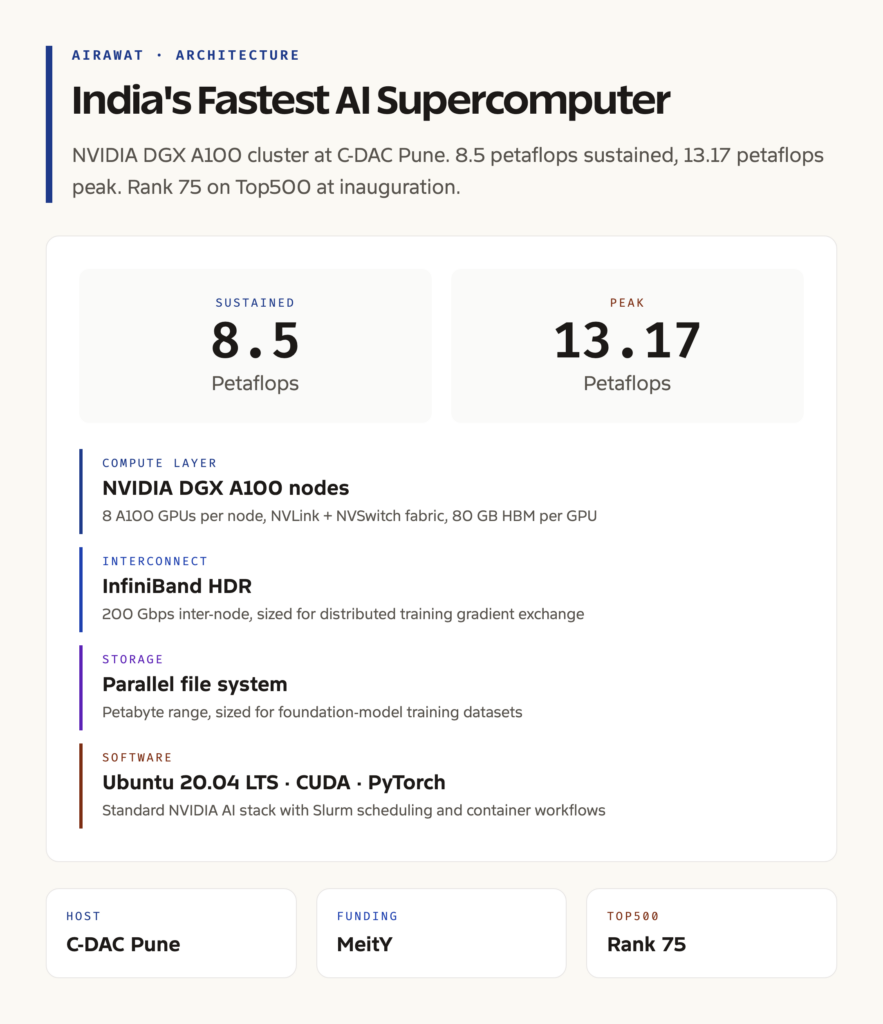
AIRAWAT is the fastest AI supercomputer in India and one of the most strategically important pieces of public-sector compute infrastructure the country has ever built. The system is hosted at the Centre for Development of Advanced Computing in Pune, runs on NVIDIA DGX A100 architecture, achieves a sustained 8.5 petaflops with a peak of 13.17 petaflops, and entered the Top500 global supercomputing list at the 75th rank when it was inaugurated. In an era when access to large-scale AI compute is becoming a determinant of national technology power, AIRAWAT marks the moment India crossed from being a software services consumer of foreign compute to operating sovereign AI infrastructure on its own soil.
This guide unpacks AIRAWAT for UPSC GS-III aspirants. It walks through what an AI supercomputer actually is, how AIRAWAT differs from a conventional supercomputer, the system architecture and specifications, where it sits in the IndiaAI Mission compute layer, how it compares with other Indian supercomputers, the global Top500 context, and the strategic stakes of sovereign AI compute.
What an AI Supercomputer Is
A general-purpose supercomputer is an array of CPUs and high-speed interconnects optimised for double-precision floating-point arithmetic, the kind of math that dominates climate modelling, computational chemistry, and physics simulations. An AI supercomputer is different. It is dominated by GPUs, graphics processing units that excel at the matrix multiplications and tensor operations that underpin neural network training and inference. The math is mostly mixed-precision rather than double-precision, which lets the hardware run far more operations per second on the same silicon. The interconnect is tuned for the all-to-all gradient exchange patterns of distributed deep learning. The storage is sized for the petabyte-scale training datasets that frontier models require.
The distinction matters because AI workloads are exploding while traditional HPC workloads are growing slowly. Every government in the world that takes AI seriously is investing in dedicated AI compute platforms separate from the older HPC fleet. AIRAWAT is India’s first major entry in that category.
The AIRAWAT System
AIRAWAT stands for AI Research, Analytics and KnoWledge Assimilation Technology. It is hosted at C-DAC Pune, the central agency for high-performance computing in India under the Ministry of Electronics and Information Technology. The system was developed under the National Programme on AI, with funding flowing through MeitY and operations under C-DAC.
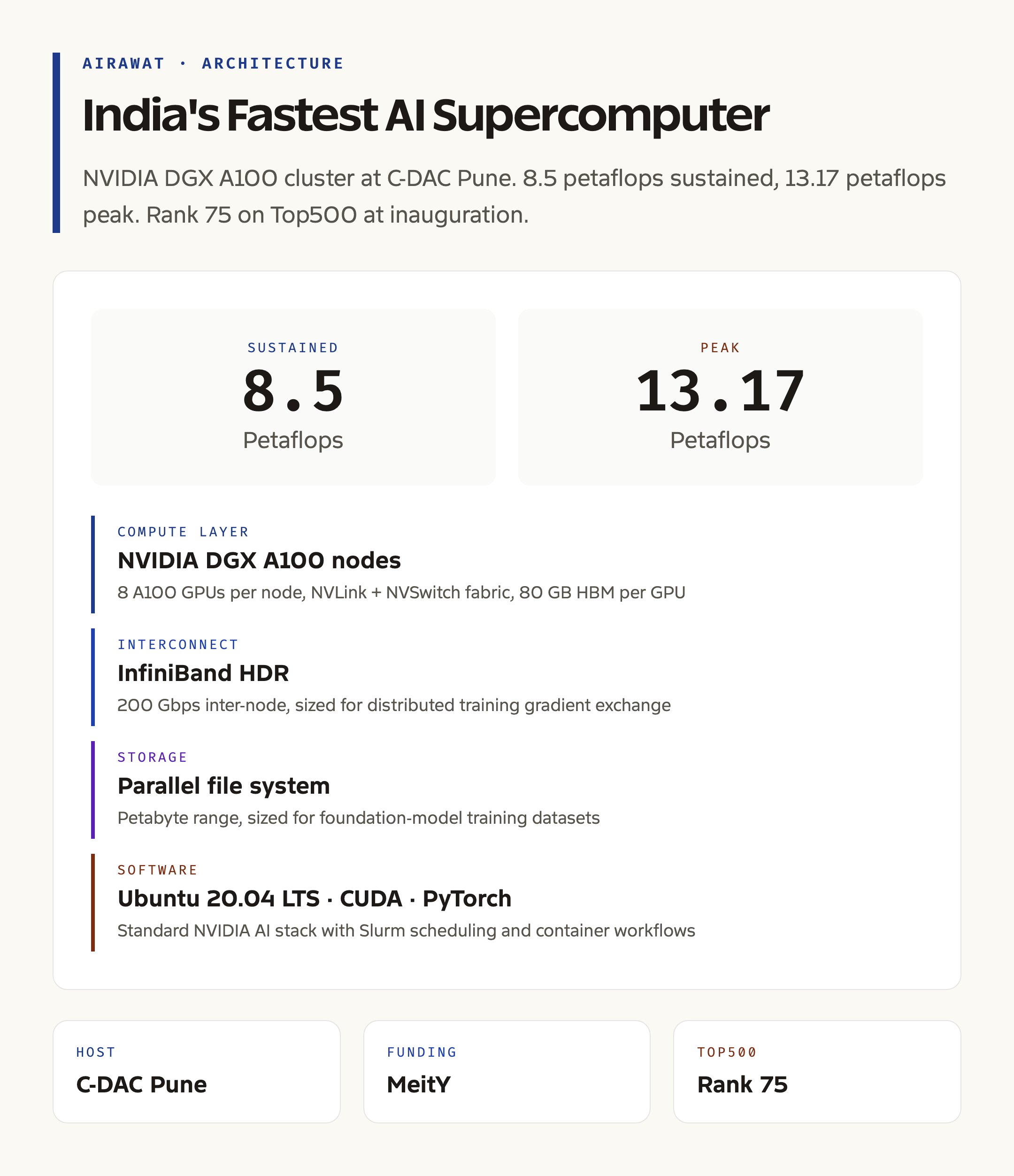
The hardware is built on NVIDIA DGX A100 nodes. Each DGX A100 contains eight A100 GPUs with 40 or 80 gigabytes of high-bandwidth memory per GPU, connected through NVLink and NVSwitch fabrics for fast on-node communication. AIRAWAT scales this to a multi-rack cluster with InfiniBand HDR networking between nodes, parallel file system storage in the petabyte range, and a Tier-4 data centre power and cooling envelope. The operating system is Ubuntu 20.04 LTS, with the standard NVIDIA AI software stack including CUDA, cuDNN, TensorRT, and the major deep learning frameworks pre-loaded for users.
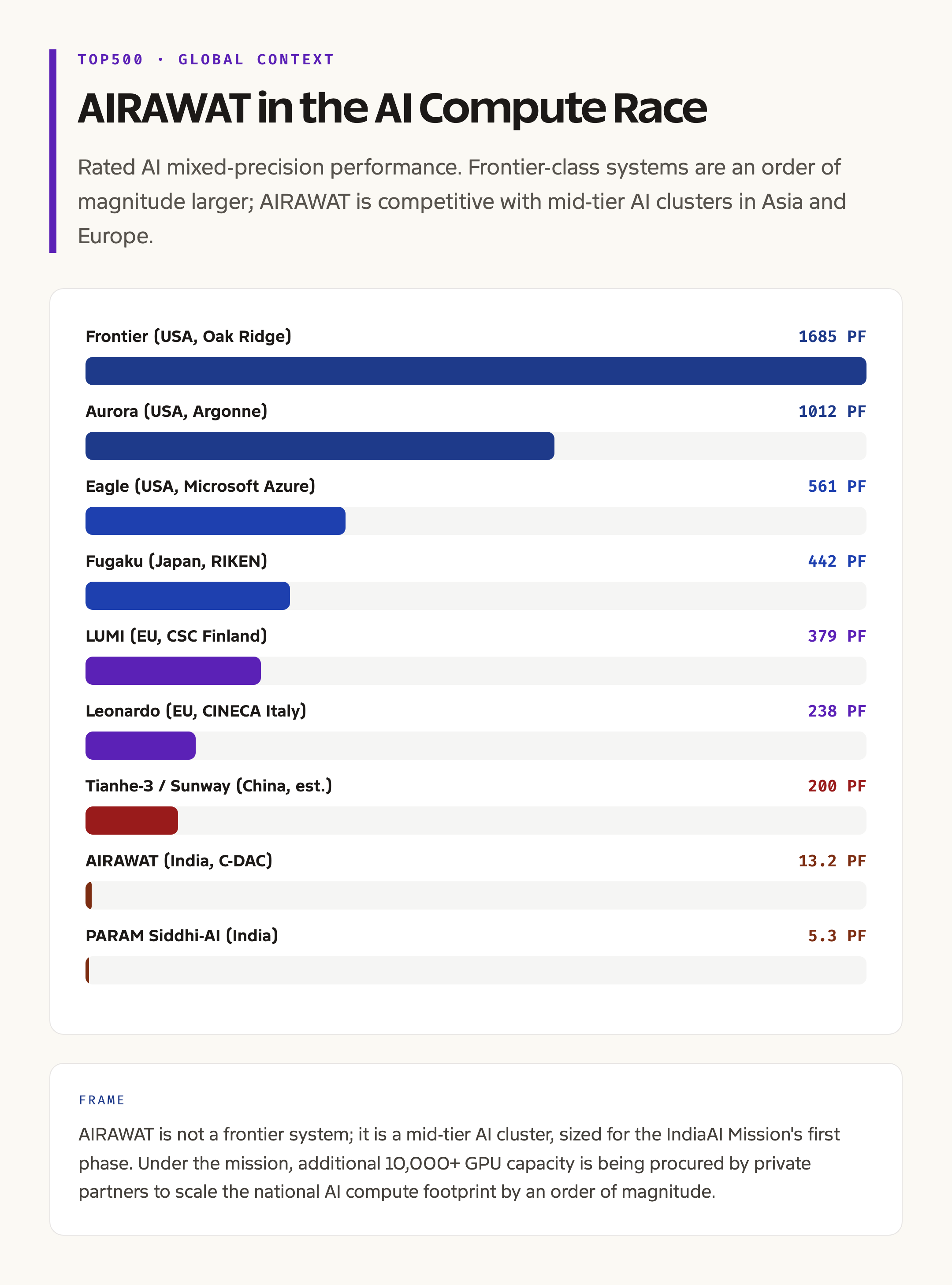
The headline numbers are 8.5 petaflops sustained and 13.17 petaflops peak, rated for AI mixed-precision workloads. At its inauguration AIRAWAT entered the Top500 global supercomputing list at rank 75. Top500 rankings shift quickly as new systems come online elsewhere, but the broader point is that India now operates a system that is competitive with mid-tier AI clusters in the United States, Europe, and Asia.
Why AIRAWAT Was Built
Until AIRAWAT came online, Indian AI researchers, startups, and government agencies that needed large-scale GPU compute had two options. They rented capacity from the global cloud hyperscalers, which is expensive at scale and routes sovereign data through foreign jurisdictions. Or they used smaller in-house clusters that were sufficient for academic research but not for training frontier-scale models. Neither option supported the ambitions of the IndiaAI Mission to build domestic foundation models, sector-specific large language models, and AI-enabled public services.
AIRAWAT addresses three needs at once. It provides large-scale training compute for Indian model builders. It hosts foundation model training and inference for the public-sector AI initiatives. And it supports the AI Bhashini language translation programme, the Bhashini speech corpus work, and the various AI applications under digital India. For the wider context of these applications, see the article on artificial intelligence in India and the IndiaAI Mission overview when published.
Position in the IndiaAI Mission
The IndiaAI Mission, approved by the Union Cabinet in 2024 with an outlay of Rs 10,372 crore over five years, has compute as one of its six pillars. The compute pillar sets the goal of building a national AI compute infrastructure of more than 10,000 GPUs through a public-private partnership model. AIRAWAT is the existing public-sector anchor that the new compute will scale around.
Under the IndiaAI Mission, additional GPU clusters will be procured by selected private partners, deployed in tier-1 cities, and made available to Indian researchers, startups, and government agencies through a subsidised compute marketplace. AIRAWAT continues to operate as the C-DAC-hosted public anchor, with the new clusters extending capacity by an order of magnitude. The combined AIRAWAT plus IndiaAI Mission compute footprint is intended to put India in the same league as the European AI compute initiatives and well above the GPU base of any other emerging economy.
The Indian Supercomputer Family
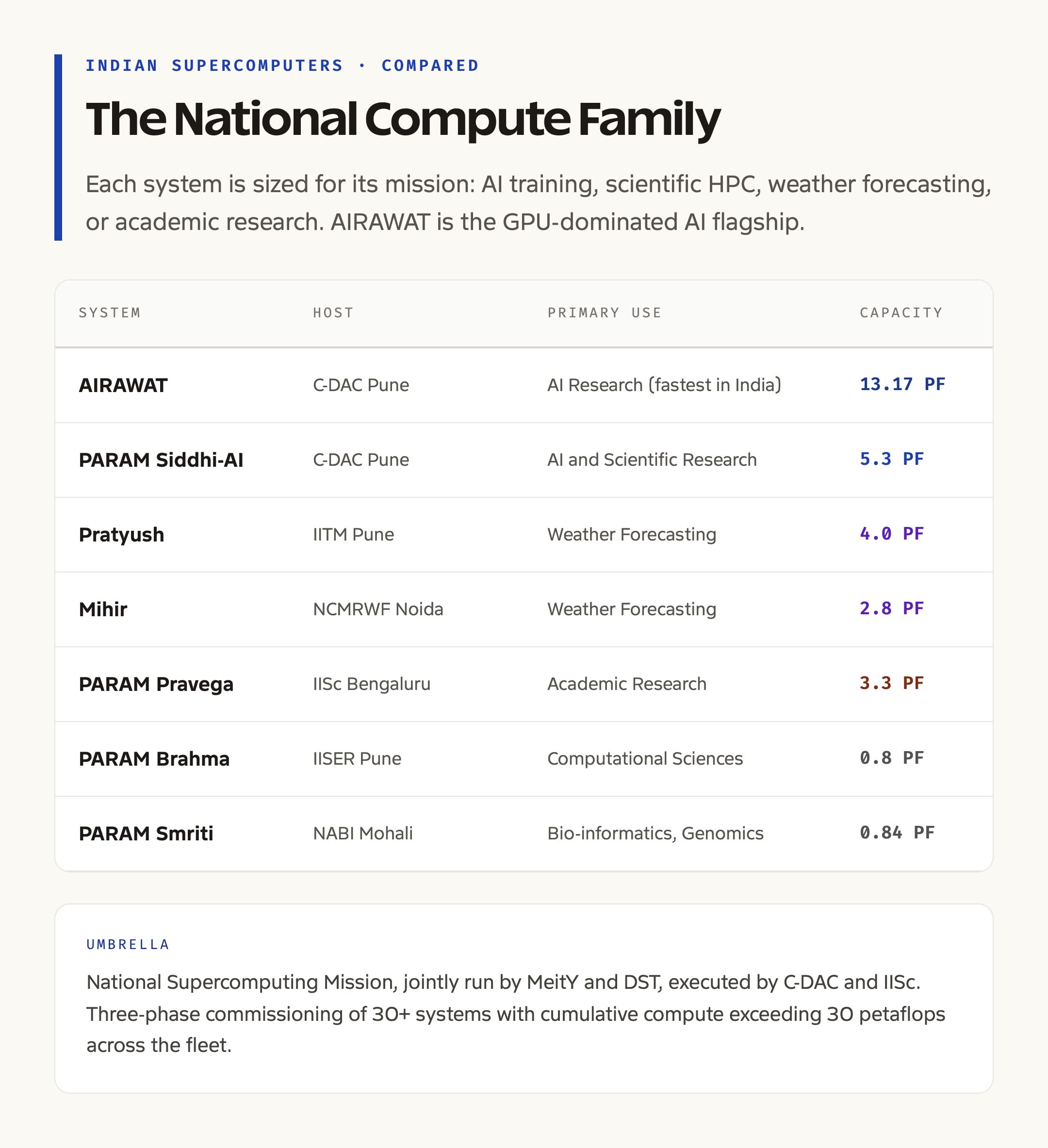
AIRAWAT is the fastest AI supercomputer in India, but it is part of a broader family of national supercomputers that serve different missions. PARAM Siddhi-AI, also at C-DAC Pune, is a smaller AI and scientific research system. Pratyush, hosted at the Indian Institute of Tropical Meteorology in Pune, and Mihir, hosted at the National Centre for Medium Range Weather Forecasting in Noida, are the meteorological supercomputers that power Indian weather forecasting. PARAM Pravega, at the Indian Institute of Science Bengaluru, is the academic research workhorse.
Each of these systems is sized for its mission. Pratyush and Mihir are CPU-heavy systems optimised for the regular grid simulations of atmospheric science. PARAM Pravega is a balanced HPC system for academic chemistry, physics, and engineering codes. PARAM Siddhi-AI is a smaller mixed CPU-GPU system for AI plus traditional HPC. AIRAWAT is the GPU-dominated AI flagship.
The National Supercomputing Mission, jointly run by MeitY and the Department of Science and Technology with execution by C-DAC and the Indian Institute of Science, is the umbrella programme that finances and operates the broader fleet. The mission has commissioned over 30 systems across academic and research institutions in three phases, with cumulative compute exceeding 30 petaflops across all systems.
Technical Anatomy of an A100 Cluster
For aspirants who want the technical detail, an A100-based AI cluster like AIRAWAT works at three layers. At the chip level, each A100 GPU has 6,912 CUDA cores plus 432 third-generation tensor cores, with a peak FP16 throughput of around 312 teraflops on a single chip. The 80-gigabyte memory variant has memory bandwidth of about two terabytes per second. At the node level, eight A100s share an NVSwitch fabric that gives any GPU full bandwidth access to any other GPU on the same node. At the cluster level, InfiniBand HDR fabric at 200 gigabits per second connects nodes for the inter-node gradient exchange that distributed training requires.
The software side is dominated by the NVIDIA AI stack. CUDA is the base GPU programming model. cuDNN provides optimised primitives for deep learning. TensorRT handles inference optimisation. The major deep learning frameworks, PyTorch, TensorFlow, JAX, and the distributed training libraries DeepSpeed, Megatron-LM, and Horovod, run on top. Containerised workflows through Docker and Singularity, with job scheduling by Slurm or Kubernetes, complete the user-facing interface.
This stack is what users actually touch. A researcher at an Indian university submits a Slurm job, the scheduler allocates the requested GPUs, the user code runs in a container with the right framework versions, and the trained model artefacts are written to the parallel file system. The same workflow runs on every major AI supercomputer in the world, which is why AIRAWAT is interoperable with the global AI research ecosystem.
Strategic Stakes of Sovereign AI Compute
The strategic case for sovereign AI compute rests on three pillars. The first is data sovereignty. Frontier AI models train on training data that often contains sensitive information. Indian healthcare, language, agricultural, and government datasets are among the most valuable in the world for building AI tailored to Indian conditions, and they cannot be exported under data localisation policy. A domestic compute platform lets that data train domestic models without crossing borders.
The second is supply security. Access to GPU capacity at the global hyperscalers has been gated by export controls, allocation politics, and price spikes during AI booms. A country that depends entirely on imported compute is vulnerable to a future where that compute is denied. AIRAWAT and the IndiaAI Mission compute layer reduce that vulnerability.
The third is industrial policy. Building, operating, and maintaining a large GPU cluster requires an ecosystem of system integrators, networking specialists, data centre engineers, and software teams. That ecosystem is the seed of an Indian AI hardware industry. The IndiaAI Mission has explicit objectives to develop domestic AI chips, AI accelerators, and AI infrastructure software, and AIRAWAT is the public-sector anchor that justifies that investment.
For the broader policy frame, the article on cyber security covers the data sovereignty dimensions, and the Indian Space Policy 2023 and the National Quantum Mission cover other deep-technology missions that share the sovereign-compute logic.
Limitations and Open Questions
AIRAWAT is significant, but it is not the end of the story. The system is fast on the Top500 list, but rankings shift quickly. The frontier of AI compute is now defined by clusters with tens of thousands of GPUs, not single-rack systems with hundreds. India’s IndiaAI Mission ambition of 10,000 GPUs is the right target, but execution is in the early stages. Private hyperscalers and Chinese state-backed AI labs are scaling far faster.
The second limitation is talent. Compute without skilled users is wasted capacity. Indian universities, public-sector laboratories, and startups need a much larger cadre of AI researchers and engineers trained to use systems at this scale. The IndiaAI Mission has fellowship programmes and centres-of-excellence funding for this, but the pipeline takes years to mature.
The third is the ongoing operating cost. AI supercomputers are power-hungry. AIRAWAT and its successors will consume significant electricity over their decade of operation, and the financing model that covers that operating cost has to be sustainable across budget cycles.
Frequently Asked Questions
What is AIRAWAT?
AIRAWAT is India’s fastest AI supercomputer, hosted at C-DAC Pune. The acronym stands for AI Research, Analytics and KnoWledge Assimilation Technology. It is a NVIDIA DGX A100-based cluster with 8.5 petaflops sustained and 13.17 petaflops peak performance.
Where is AIRAWAT located?
AIRAWAT is installed at the Centre for Development of Advanced Computing, C-DAC, in Pune. It operates under the Ministry of Electronics and Information Technology, MeitY.
What is the global rank of AIRAWAT?
At its inauguration, AIRAWAT entered the Top500 global supercomputing list at rank 75. Top500 rankings shift as new systems come online elsewhere, so the current rank changes from list to list.
How does AIRAWAT differ from PARAM Siddhi-AI or Pratyush?
AIRAWAT is GPU-dominated and sized for AI training. PARAM Siddhi-AI is a smaller mixed CPU-GPU system for AI plus traditional HPC. Pratyush at IITM Pune and Mihir at NCMRWF Noida are CPU-heavy weather forecasting systems. PARAM Pravega at IISc Bengaluru is an academic HPC system.
What is the IndiaAI Mission and how does AIRAWAT fit?
The IndiaAI Mission is a Rs 10,372 crore programme approved in 2024 to build national AI capability. Its compute pillar targets over 10,000 GPUs through public-private partnership. AIRAWAT is the public-sector anchor that the new IndiaAI compute scales around.
What is the architecture of AIRAWAT?
AIRAWAT uses NVIDIA DGX A100 nodes, each with eight A100 GPUs connected by NVLink and NVSwitch. Nodes are connected by InfiniBand HDR networking. Storage is a parallel file system in the petabyte range. The operating system is Ubuntu 20.04 LTS with the standard NVIDIA AI software stack.
Why is sovereign AI compute strategically important?
Sovereign AI compute matters for data sovereignty, supply security, and industrial policy. Indian datasets cannot always be exported, so domestic models need domestic compute. Foreign GPU access is gated by export controls and allocation politics. And operating a national AI compute layer seeds the broader AI hardware and software ecosystem.
Tell Google you want more of this.
Add Anantam IAS as a preferred sourceOne tap, and this site shows up more often in your own Top Stories, AI Overviews and AI Mode. Remove it any time.