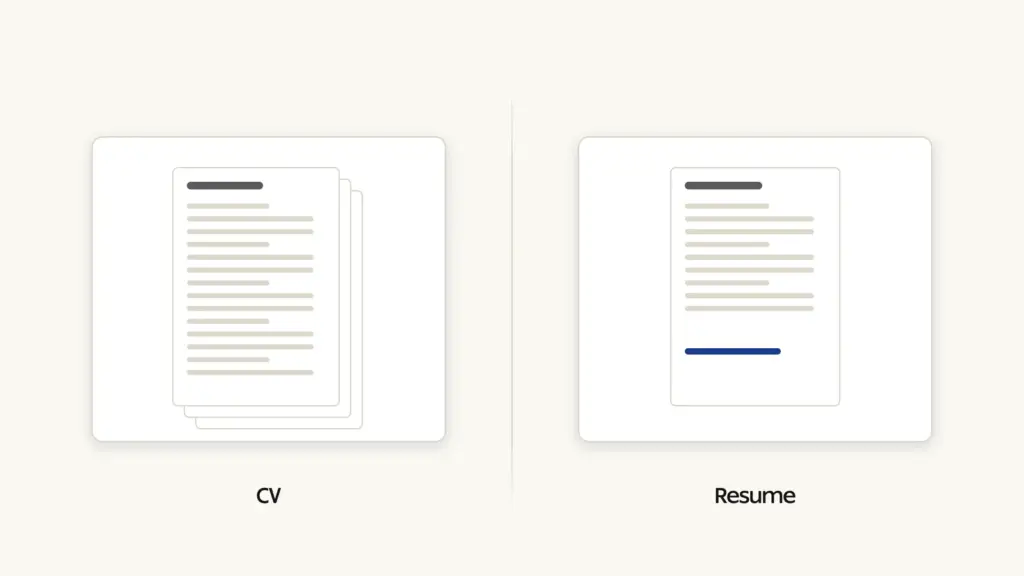
The difference between a CV and a resume is length, purpose, and how much of your life the document is expected to contain. A curriculum vitae is a complete, chronological record of your academic and professional life — publications, degrees, teaching, grants, conferences — and it grows for as long as your career does. A resume is a short, edited pitch, usually one or two pages, tailored to a single job and deliberately leaving things out.
There is one large complication: which word a country uses for which document. In the United States the two are genuinely different documents. In the United Kingdom, most of Europe, and India, “CV” is the everyday word for what an American would call a resume. Knowing which convention applies to the employer you are writing to matters more than knowing the textbook definition.
Where the two documents came from
*Curriculum vitae* is Latin for “course of life”, and the document does what the name says. It began in universities, where a scholar’s standing rested on a full, verifiable record: every degree, every paper, every course taught, every grant won. Nothing is summarised away, because a hiring committee in academia is assessing the whole body of work. An established professor’s CV can run to twenty pages or more, and that is not a flaw.
The resume — from the French *résumé*, “summary” — emerged from commercial hiring, where a manager has a stack of applications and a few minutes each. The document exists to answer one question quickly: can this person do this particular job? Everything that does not serve that answer gets cut. Two candidates with identical careers should produce different resumes for different roles, because a resume is an argument, not an archive.
That difference in purpose explains almost every other difference between them.
CV vs resume: comparison table
| Basis | Curriculum Vitae (CV) | Resume |
|---|---|---|
| Core purpose | Complete record of academic and professional life | Targeted summary arguing your fit for one specific role |
| Length | No fixed limit; two to twenty-plus pages depending on career stage | One page for early career, two pages for experienced professionals |
| Tailoring | Largely static; the same document goes to most applications | Rewritten or reordered for each application |
| Content included | Education, publications, research, conferences, grants, teaching, awards, memberships, references | Selected work experience, key skills, relevant education, measurable results |
| Ordering | Strictly chronological within each section, education usually first | Chronological, functional, or hybrid — whichever presents the strongest case |
| Level of detail | Exhaustive; every item listed in full citation form | Selective; only what supports the application |
| Typical users | Academics, researchers, doctors, scientists, applicants for fellowships and grants | Applicants in industry, business, technology, media, and most private-sector roles |
| How it changes over time | Only grows; entries are added, rarely removed | Constantly pruned; older or irrelevant items are dropped |
| Personal details | May include nationality, languages, professional affiliations | Contact details only; personal data is usually omitted |
| References | Often listed in full with names and affiliations | Usually omitted or noted as available on request |
| Standard term in the US and Canada | Academic document only | The default job application document |
| Standard term in the UK, Europe, India, and much of Asia | The default job application document, one to two pages | Term used interchangeably, often for the same short document |
What goes into a CV
A full academic CV is organised by category, and each category is complete. A typical order:
- Personal and contact details, with current institutional affiliation.
- Education, from most recent, including thesis titles and supervisors.
- Academic appointments and positions held, with dates.
- Publications, split into peer-reviewed articles, books, chapters, and reports, in full citation form.
- Conference presentations and invited talks.
- Grants and funding received, with agencies and amounts where appropriate.
- Teaching experience and supervision of research students.
- Professional service: editorial roles, peer review, committee work.
- Awards, fellowships, and memberships.
- References, named in full.
Nothing here is trimmed for brevity. A search committee expects to verify claims, and a gap in the record raises questions a well-written summary sentence cannot answer. The convention is to keep adding to a single master document across a career.
What goes into a resume
A resume is built backwards from the job advertisement. The standard structure:
- Name and contact details, plus one professional link if relevant.
- A short professional summary — two or three lines stating who you are and what you do. Skip the aspirational language; state the substance.
- Work experience, most recent first, with each role described in terms of what you achieved rather than what you were assigned. “Reduced monthly close from twelve days to five” says more than “responsible for month-end closing”.
- Skills, kept concrete and verifiable.
- Education, brief — degree, institution, year. It moves above experience only if you are a fresher.
- Anything else only if it earns its space: certifications, publications relevant to the role, languages.
Two rules do most of the work. First, quantify wherever honest numbers exist. Second, cut anything that does not help this application. A two-page resume that is all relevant beats a four-page one that is comprehensive.
Most large employers now screen applications through applicant tracking software before a person reads them, so a clean single-column layout with standard section headings survives better than a designed multi-column template. Save as PDF unless the posting asks for something else.
Regional conventions, and why the terms blur
United States and Canada. The two documents are genuinely distinct. Send a resume for any industry job. A CV is expected only for academic, research, scientific, and some medical positions, and for grant and fellowship applications. Sending a ten-page CV to a corporate recruiter in New York reads as a misunderstanding of the process.
United Kingdom, Ireland, and much of Europe. “CV” is the standard word for the job application document, and it is short — typically two pages. What an American calls a resume, a Briton calls a CV. Employers in the European Union may also accept or request the Europass CV, a standardised template designed to make qualifications comparable across member states.
Australia and New Zealand. Both terms are used, often interchangeably, for a document that tends to run slightly longer than the American resume — three to four pages is not unusual.
India. This is where the terms blur most. Most job postings say “send your CV” and mean a one to two page document that an American would call a resume. Many candidates use both words for the same file. Practically, the safest approach is to write a tight two-page targeted document and label it whatever the posting asks for. Only if you are applying to a university, a research institute, or a fellowship should you produce a full academic CV.
India also has a third term. Bio-data — short for biographical data — is an older format that leads with personal details: date of birth, father’s name, marital status, religion, sometimes height and complexion. It survives in some government paperwork and in matrimonial contexts. It is not a hiring document for the modern private sector, and that category of personal information is now regarded as unnecessary at best in a job application. Standardised biographical forms persist in public employment channels — both the government’s National Career Service portal and state employment exchange registration under schemes such as the berojgari bhatta programme collect structured profile data rather than a free-form document.
Common confusions
“A CV is just a longer resume.” The difference is editorial stance, not word count. A CV includes everything because completeness is the point. A resume excludes most things because selection is the point. Padding a resume to eight pages does not make it a CV.
“I should send my CV because it shows more.” In industry hiring, showing more usually costs you. A recruiter reading forty applications rewards the document that answers their question fastest, not the most thorough one.
“CV and resume mean the same thing everywhere.” They do not, and the mistake runs in both directions. An Indian applicant sending a two-page “CV” to a US corporate role is fine in substance but should relabel it. A US applicant sending a resume to a UK employer who asked for a CV is also fine — the employer means the same document.
“Bio-data, CV, and resume are three names for one thing.” Bio-data is a genuinely different format with a different emphasis, belonging to a different era of hiring. Confusing document types is the same category error that arises with professional designations, as with the difference between a lawyer and an advocate.
“One good resume will do for every application.” The strongest habit in job applications is reordering and rewording the top third of the document for each role. It takes fifteen minutes and it is the part most people skip.
Frequently Asked Questions
Should I send a CV or a resume for a job in India?
Send a targeted one to two page document. Label it “CV” if the posting says CV, which most Indian postings do. Only academic, research, and fellowship applications need a full multi-page academic CV.
How long should a resume be?
One page if you have under five years of experience. Two pages is acceptable and often expected beyond that. Beyond two pages you are almost certainly including material that is not helping.
Can a CV be one page?
An academic CV rarely can, because it is meant to be complete. But in the British and Indian sense of the word — where “CV” means the standard job document — a one-page CV is perfectly normal for a fresher.
Do I need to include a photograph?
In the US, UK, Canada, Ireland, and Australia, no — and it can actively work against you, because employers avoid anything that invites bias claims. In parts of continental Europe and Asia it is more common. Follow the local norm and the employer’s instructions.
Should I put my date of birth, marital status, and father’s name?
Not on a modern job application unless a specific form demands it. These fields belong to the older bio-data format. Omitting them costs nothing and keeps the document focused.
What file format should I use?
PDF, unless the application portal specifically asks for a Word file. PDF preserves layout across devices. Name the file clearly — your name and the role — rather than “resume_final_v3”.
Is a cover letter still necessary?
When one is invited, yes, and it should not repeat the resume. Its job is to explain the connection between your record and this particular role, which a bulleted document cannot do.
Practice Questions
1. The Latin phrase *curriculum vitae* translates most closely to:
a) Summary of work
b) Course of life
c) Record of service
d) Statement of purpose
Answer: b) Course of life
2. Which of the following is most characteristic of a resume as distinct from a CV?
a) It lists every publication in full citation form
b) It is expected to grow longer throughout a career
c) It is edited and reordered for each specific application
d) It always begins with the education section
Answer: c) It is edited and reordered for each specific application
3. In the United States, a curriculum vitae is normally expected for:
a) All private-sector job applications
b) Academic, research, and fellowship applications
c) Entry-level roles only
d) Applications made through recruitment agencies
Answer: b) Academic, research, and fellowship applications
4. The Europass format is best described as:
a) A résumé template used by United States federal agencies
b) A standardised CV template designed to make qualifications comparable across European Union countries
c) An applicant tracking system used by multinational employers
d) A verification service for academic degrees
Answer: b) A standardised CV template designed to make qualifications comparable across European Union countries
5. Bio-data differs from a modern resume mainly because it:
a) Is written in reverse chronological order
b) Emphasises measurable achievements over responsibilities
c) Leads with personal details such as date of birth and marital status
d) Is restricted to a single page by convention
Answer: c) Leads with personal details such as date of birth and marital status
- A document that includes everything and a document that leaves most things out can both be honest. Examine what “completeness” means in professional communication, and when leaving material out becomes misrepresentation.
- Reflect on why the same word — CV — means different documents in different countries. What does this tell you about how professional conventions travel, and fail to travel, across borders?
- Employers increasingly screen applications through automated systems before any human reads them. Discuss what this changes about how a job application document should be written, and what is lost in the process.
- The bio-data format asks for date of birth, marital status, and family details; the modern resume omits them. Analyse this shift in terms of what employers are considered entitled to know about a candidate.
- “A resume is an argument, not an archive.” Assess this claim, and consider what obligations it places on the writer.
Tell Google you want more of this.
Add Anantam IAS as a preferred sourceOne tap, and this site shows up more often in your own Top Stories, AI Overviews and AI Mode. Remove it any time.