Santiniketan is a campus town in Birbhum district of West Bengal, about 160 km by road from Kolkata, where Debendranath Tagore set up a meditation ashram in 1863 and his son Rabindranath opened a small open-air school in 1901. That school grew into Visva-Bharati, the university Rabindranath founded in 1921. In September 2023 UNESCO added Santiniketan to the World Heritage List, not for a single monument but for a way of teaching and living that its buildings and festivals still carry.
Most readers walk in with one line: Tagore founded Santiniketan in 1901. That folds three events into one. The father made the ashram and the son made the school, which became a university 20 years later. And Santiniketan isn’t an ASI monument like Sanchi. It’s a working university campus, shielded by an Act of Parliament of 1951. Keep those dates and that legal fact apart, and the rest falls into place.
What Santiniketan is and where it stands
Santiniketan means ‘abode of peace’, and it began as the name of a single house. Visva-Bharati’s own account says Debendranath built a house called Santiniketan in the early 1860s, and the name later spread to the whole area. The old ashram sits within the town of Bolpur, on laterite soil between the Ajay river to the south and the Kopai to the north. Because the UNESCO property lies inside the Visva-Bharati campus, its houses and studios are still in daily use.
| Fact | Detail |
|---|---|
| Location | Bolpur, Birbhum district, West Bengal; about 160 km by road from Kolkata |
| Ashram | Set up in 1863 by Debendranath Tagore at Bhubandanga, which he renamed Santiniketan |
| School | Brahmacharyashrama, opened by Rabindranath Tagore on 22 December 1901; called Patha Bhavana from 1925 |
| University | Visva-Bharati, founded by Rabindranath Tagore in 1921 |
| Legal status | Central university and institution of national importance under the Visva-Bharati Act, 1951, in force from 14 May 1951 |
| UNESCO inscription | 17 September 2023, at the extended 45th session of the World Heritage Committee in Riyadh |
| UNESCO criteria | (iv) and (vi) |
| Protected area | 36 ha property with a 537.73 ha buffer zone |
| Motto | Yatra visvam bhavatyekanidam, ‘where the world makes its home in a single nest’ |
Who built Santiniketan, and in what order
Two generations of one family built Santiniketan in four steps, and the order explains the place better than any single date. Debendranath gave it the ground and the prayer. Rabindranath built a school on that ground and grew it into a university.
Debendranath’s ashram, 1863
Debendranath Tagore, a leader of the Brahmo Samaj and Rabindranath’s father, took over a stretch of bare land called Bhubandanga in 1863 and renamed it Santiniketan. There he set up an ashram, a retreat for prayer and meditation. The sources differ on the terms: Visva-Bharati’s history says he bought the land, while Britannica says he leased it. Britannica also records his meditation spot under a pair of chhatim trees (Alstonia scholaris, the blackboard tree), still called Chhatimtala.
In 1888 he dedicated the land and buildings to a Brahmavidyalaya (a school of spiritual learning) and a library. The trust deed of that year also provided for a fair, which became the Poush Mela, formally started in 1892 and still held each December. In 1891 he added a glass-walled prayer hall for non-denominational worship, in keeping with the Brahmo belief in a formless God.
Rabindranath’s school, 1901
On 22 December 1901 Rabindranath Tagore opened the Brahmacharyashrama, a residential school with no more than five pupils on its roll. Visva-Bharati’s history calls it partly a fulfillment of his father’s wishes and a conscious rejection of the school system the British had brought to India. It followed the gurukul idea, the ‘house of the teacher’ where pupils and teacher share one life, and held its classes in the open. From 1925 it was known as Patha Bhavana, the name it still carries.
Visva-Bharati and Sriniketan, 1919 to 1922
The school grew outward in a few crowded years. Kala Bhavana, the art school, dates from 1919; Britannica adds that Sangit Bhavana, for music and dance, began inside it and became separate in 1933. In 1921 Tagore founded Visva-Bharati, which he described as India ‘where she has her wealth of mind which is for all’. Its stated mission is to bring the cultures of the East closer together and to make Santiniketan a meeting ground for East and West.
About 3 km away, at the village of Surul, the Institute of Rural Reconstruction was inaugurated on 6 February 1922 with Leonard Elmhirst as its first director, and the campus took the name Sriniketan. Its aim was to help villagers solve their own problems instead of handing them solutions from outside.
After Tagore: the museum and the 1951 Act
Rabindra Bhavana, the institute of Tagore studies, was founded in July 1942, a year after the poet’s death. The Visva-Bharati Act, 1951 came into force on 14 May 1951, and its Section 2 declares Visva-Bharati an institution of national importance and constitutes it as a university. Under the Act the President of India is the Paridarsaka (Visitor) and the Governor of West Bengal is the Pradhana (Rector).
The Acharya (Chancellor) hides a small trap. The Act doesn’t name the Prime Minister; it has the Visitor appoint the Acharya from a panel that the Karma-Samiti (Executive Council) recommends. In practice the Prime Minister holds the office.
What Tagore’s school tried to do differently
Tagore’s school was an answer to rote learning, and its method comes down to a handful of habits that were unusual in 1901 and sound ordinary now. Visva-Bharati’s summary of his ideas says as much: principles later common in educational theory were practiced here with fewer than half a dozen pupils. The habits, as the university records them:
- Open-air classes under trees, so that a child’s first lesson is a sense of oneness with nature.
- The mother tongue as the medium, because a child learns most naturally in the language of home.
- The arts inside the curriculum, with music and drama treated as learning rather than extras.
- Learning through activity and craft instead of memorized text.
- One shared life for teachers and students, in the manner of the gurukul.
- Seasonal festivals such as Vriksharopana, the tree-planting ceremony Tagore introduced in 1928.
The target was specific. According to the art historian Anshuman Dasgupta, Tagore wrote his allegory the ‘Parrot’s Tale’ in reaction to a new Calcutta University syllabus of 1916. The site was part of the argument too. In his essay ‘My School’, Tagore said he chose a spot far from town life, ‘where the sky is unobstructed to the verge of the horizon’, so that the mind could have its freedom.
How far did this travel beyond one small campus? Visva-Bharati’s own account admits that most contemporaries took the 1901 experiment for a poet’s whim. It also claims a descendant: Gandhi, it says, drew the first teachers for his basic schools from Santiniketan. The two men still disagreed on a great deal, which is why the note on Tagore’s philosophy is worth reading beside this one. Today the mother-tongue teaching and arts-integrated, experiential learning in NEP 2020 cover much of the ground Tagore marked out.
Visva-Bharati carried the idea to a world scale. Its motto, an ancient Sanskrit verse Tagore chose, is Yatra visvam bhavatyekanidam, ‘where the world makes its home in a single nest’. In 1940, a year before he died, Tagore handed Gandhi a letter calling Visva-Bharati ‘a vessel which is carrying the cargo of my life’s best treasure’.
Santiniketan’s buildings, in the order a visitor meets them
UNESCO names three areas as the prime sites of the property, and walking them in order takes you through Santiniketan’s history:
- the Ashram, Debendranath’s original ground;
- Uttarayan, the cluster of houses Tagore built for himself;
- Kala Bhavana, the art school whose teachers and students decorated the campus.
What joins them is experiment. UNESCO’s list of materials runs from mud and coal tar to cast iron and reinforced concrete, and most houses built after 1919 were designed by the artist Surendranath Kar to Tagore’s ideas. UNESCO calls the result a pan-Asian modernity, drawing on Indian traditions and on forms from Japan to Bali.
The Ashram: Chhatimtala and the glass prayer hall
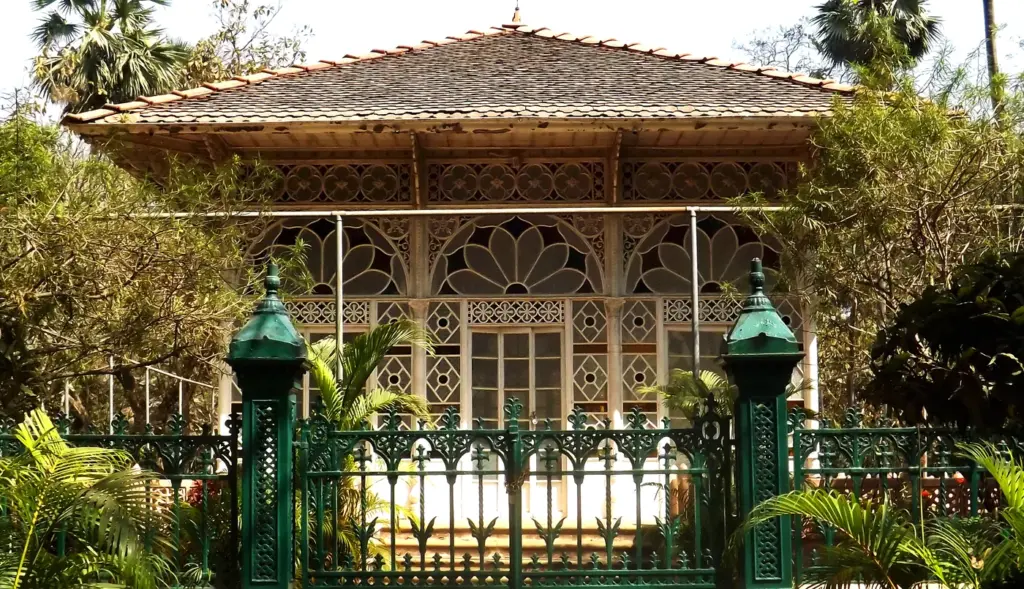
The walk starts where Santiniketan started, at Chhatimtala. Close by is Santiniketan Griha, the house that gave the area its name and the first building on the site. The building to look for is the Upasana Griha of 1891, Debendranath’s prayer hall, with a prefabricated metal frame made in Calcutta and colored glass from Belgium; that’s why it’s also called the Kanch Ghar, the glass house. Around these buildings, Patha Bhavana’s pupils still take lessons in the open.
UNESCO protects the festivals too. The seasonal celebrations Tagore began, among them Basanta Utsav in spring and Barsha Mangal for the rains, use traditional forms such as alpana (painted floor designs) and Vedic chants. Visva-Bharati calls the result ‘intrinsically Indian yet totally secular’.
Uttarayan: five houses for one poet
The second stop, Uttarayan, holds the houses Tagore lived in, now maintained by Rabindra Bhavana. Britannica counts seven houses he built at Santiniketan; five stand here, and each one tries something different:
- Udayan, the largest, grew between 1921 and 1938 into a many-leveled house designed by his son Rathindranath.
- Konark, named for the Sun Temple in Odisha, sets openings at different heights on one wall to bring the outside in.
- Shyamali (1935), a low mud house meant as a cheap prototype for village homes, where Gandhi stayed during his visit.
- Punascha (1936), meaning ‘postscript’, also kept close to the ground.
- Udichi (1938), the last, raised up a flight of stairs.
Read together, the houses show Tagore treating his own home the way he treated his school, as a place to try things out.
Kala Bhavana: murals, mud and a sculpture in the open
The third stop is the art school, where Santiniketan’s walls become canvases. Kalo Bari, the Black House, was built between 1934 and 1936 as a hostel for Kala Bhavana students: a mud building with a coal-tar finish, its reliefs borrowing motifs that range from Bharhut to Assyria. Many were made by students from South and Southeast Asia, who signed them in their own scripts.
Outside stands Santhal Family (1938) by Ramkinkar Baij, a family of Santhal peasants cast in cement and laterite mortar. The gallery DAG calls it arguably India’s first modernist public sculpture. Inside Hindi Bhavana, Benode Behari Mukherjee’s mural of the medieval saint-poets (1946-1947) runs about 80 feet across three walls, and the National Gallery of Modern Art calls it arguably the most ambitious mural of modern India.
How Santiniketan shaped the Bengal School and Indian modern art
Santiniketan gave the Bengal School a school in the literal sense. The movement grew around Abanindranath Tagore in Calcutta, and his pupil Nandalal Bose carried its search for an ‘Indian style’, drawn from sources such as the Ajanta murals, to Kala Bhavana. UNESCO’s criterion (vi) rests on this link, naming Tagore and his associates as pioneers of the Bengal School and of early Indian modernism.
UNESCO also sets Santiniketan’s growth against the backdrop of the Partition of Bengal in 1905, and calls the campus the crucible of an artistic and intellectual renaissance in the early 20th century.
Nandalal ran Kala Bhavana as principal from 1922 to 1951. The West Bengal tourism department’s profile of him lists what came out of those years:
- he decorated the manuscript of the Constitution of India;
- he designed the emblems of the Bharat Ratna and the Padma Shri at Jawaharlal Nehru’s request;
- his 1930 portrait of Gandhi, made after the protest against the salt tax, became an image of the non-violent movement;
- in 1976 the ASI named him among nine artists whose work, though not antique, was to be treated as art treasure.
The next generation took that freedom further. Ramkinkar Baij joined Kala Bhavana as a student in 1925 and later taught sculpture beside Nandalal and Benode Behari. DAG describes him as the first artist in Santiniketan to use oil paint and make distinctly modern and abstract work.
So Santiniketan’s art isn’t one style. It began with the Bengal School’s search for an Indian idiom and produced modernists who went their own way; the note on Indian painting schools places both halves.
Santiniketan today: UNESCO status and protection
Santiniketan has been a UNESCO World Heritage Site since 17 September 2023, when the World Heritage Committee inscribed it at its extended 45th session in Riyadh, Saudi Arabia. It had been on India’s Tentative List since 2010, and India filed the nomination dossier in January 2021. It became India’s 41st World Heritage property; the Hoysala temples of Karnataka followed on 18 September as the 42nd. The full record sits on UNESCO’s page for the property.
What the two criteria mean in plain words
Each of the two criteria recognizes a different thing:
- Criterion (iv) is for an outstanding building ensemble or landscape that illustrates a significant stage in human history. UNESCO reads Santiniketan as an experimental settlement and a ‘total work of art’ (the German term Gesamtkunstwerk), where learning and art were meant to be part of daily life.
- Criterion (vi) is for a direct link with ideas or with artistic and literary works of outstanding universal significance. Here the link is Tagore and the Bengal School pioneers; UNESCO adds that the place left its mark on leaders of the freedom movement, naming Gandhi and Nehru among them.
The pairing isn’t an accident. UNESCO’s rules say criterion (vi) should preferably be used with another criterion, so the ideas alone wouldn’t have carried the listing without the buildings that hold them.
Protected by a university Act, not by the ASI
This is the fact most readers get wrong. The property and its buffer zone lie inside the Visva-Bharati campus, and UNESCO records that their legal protection comes from the Visva-Bharati Act, 1951, with no other heritage designation at the national or state level. So UNESCO asked India to strengthen the legal framework, and its management terms read:
- no new development is to be approved inside the property boundary;
- the Visva-Bharati Heritage Committee oversees every conservation project and should put its heritage impact assessments in writing;
- a campus masterplan is being prepared to fit a working university to its heritage duties;
- national and state heritage agencies, the ASI among them, are to be engaged through the management system.
UNESCO also named the risks:
- building pressure on a buffer zone that is narrow in several places;
- new roads and growing visitor numbers;
- decay of physical materials, and a decline in the traditional skills needed to repair them.
The collections have been hit before. In March 2004 thieves took Tagore’s Nobel medal and about 50 other items from the university’s museum, and the state government handed the case to the CBI.
The 2023 plaque episode and after
The inscription brought one public dispute. Days after 17 September 2023, three white-stone plaques marking the honor went up on the campus. They named Prime Minister Narendra Modi as Acharya and Vice-Chancellor Bidyut Chakrabarty but not Tagore, and the omission drew protests. Chakrabarty’s term ended on 8 November 2023. On 16 November 2023 the Union Education Ministry asked the university to replace the plaques with text naming Tagore, and new plaques went up on 7 December 2023.
In March 2025 the Ministry of Education appointed Probir Kumar Ghosh as vice-chancellor, the first regular head after nearly 15 months of officiating ones. That matters for the heritage file too, since UNESCO relies on the university’s own Heritage Committee to run conservation. India’s list has kept growing, with Sarnath inscribed as the 45th property at the 48th session in Busan; the full list of UNESCO sites in India shows where Santiniketan fits.
How to study Santiniketan for exams
Santiniketan sits where several parts of the syllabus meet. In Prelims it belongs to art and culture and to the UNESCO list. In GS Paper I it belongs to modern Indian culture, with the Bengal School and the reform movements behind it. Its educational idea also feeds GS Paper II questions on education and essays on learning.
Mains tests the educational idea through comparison. Mains 2023 GS Paper I asked: “What was the difference between Mahatma Gandhi and Rabindranath Tagore in their approach towards education and nationalism?” Santiniketan is the evidence for half of that answer. On the Prelims side, art and culture accounts for 94 of the 1,403 questions in the Prelims question bank from 2013 to 2026.
The revision facts to fix first:
- 1863: Debendranath Tagore’s ashram at Bhubandanga, renamed Santiniketan.
- 22 December 1901: the Brahmacharyashrama opens with five pupils; it’s Patha Bhavana from 1925.
- 1919: Kala Bhavana begins; Nandalal Bose is its principal from 1922 to 1951.
- 1921 and 1922: Visva-Bharati is founded; Sriniketan’s institute opens on 6 February 1922.
- 14 May 1951: the Visva-Bharati Act makes it a central university and an institution of national importance.
- 17 September 2023: UNESCO inscription at the 45th session in Riyadh, under criteria (iv) and (vi), as India’s 41st property.
- Motto: Yatra visvam bhavatyekanidam.
The confusions that cost marks, and how to keep them apart:
- Santiniketan and Sriniketan. Santiniketan is the ashram and university ground; Sriniketan, about 3 km away, is the rural reconstruction campus of 1922.
- Visva-Bharati and Rabindra Bharati University. The first is Tagore’s own foundation at Santiniketan; the second is a separate university in Kolkata.
- Kala Bhavana and Kalo Bari. The first is the art institute; the second is one mud and coal-tar building within it.
- Founding and status. Debendranath founded the ashram and Rabindranath the school and the university; the 1951 Act changed only the university’s legal status.
- ASI and university protection. Santiniketan is protected under the Visva-Bharati Act, not as an ASI monument.
Compare it with its UNESCO siblings; criterion (vi) keeps traveling with a second criterion:
| Property | Inscribed | Session | Criteria |
|---|---|---|---|
| Santiniketan | 17 September 2023 | 45th, Riyadh | (iv), (vi) |
| Sacred Ensembles of the Hoysalas | 18 September 2023 | 45th, Riyadh | (i), (ii), (iv) |
| Maratha Military Landscapes of India | 11 July 2025 | 47th, Paris | (iv), (vi) |
| Ancient Buddhist Site of Sarnath | 2026 | 48th, Busan | (iii), (vi) |
Santiniketan rewards the aspirant who studies it as an idea with an address. Learn the founding dates and the protection question for Prelims, then carry the educational argument into Mains, where this one campus can anchor answers on education as well as on heritage.
Frequently Asked Questions
Who founded Santiniketan?
Debendranath Tagore, the Brahmo reformer and father of Rabindranath Tagore, founded Santiniketan as a meditation ashram in 1863 at Bhubandanga in Birbhum district. Rabindranath later opened his school there in 1901 and founded Visva-Bharati in 1921, which is why the place is so closely tied to his name.
When did Santiniketan become a UNESCO World Heritage Site?
Santiniketan was inscribed on 17 September 2023 at the extended 45th session of the World Heritage Committee in Riyadh, Saudi Arabia. It became India’s 41st World Heritage property under criteria (iv) and (vi). The Hoysala temples of Karnataka were inscribed the next day.
What is the difference between Santiniketan and Visva-Bharati?
Santiniketan is the place, the ashram town near Bolpur that Debendranath Tagore set up in 1863. Visva-Bharati is the university Rabindranath Tagore founded there in 1921, which became a central university under the Visva-Bharati Act, 1951. The UNESCO property lies inside the Visva-Bharati campus.
Why is Santiniketan famous?
Santiniketan is famous as the home of Rabindranath Tagore’s experiment in education, with open-air classes and a university meant to bring East and West together. It is also where Kala Bhavana artists such as Nandalal Bose and Ramkinkar Baij helped shape Indian modern art. Its Poush Mela and Basanta Utsav draw visitors every year.
Is Santiniketan protected by the ASI?
No. UNESCO records that Santiniketan’s legal protection comes from the Visva-Bharati Act, 1951, and that it has no other national or state heritage designation. Conservation is overseen by the Visva-Bharati Heritage Committee, with the ASI engaged as a specialist agency.
What was special about Tagore’s school at Santiniketan?
Tagore’s school opened on 22 December 1901 with five pupils and rejected rote learning in favor of outdoor classes under trees and a shared life between teachers and students. It taught in the mother tongue and treated music and painting as part of the curriculum. The school still runs today as Patha Bhavana.
Who was the first director of Sriniketan?
Leonard Elmhirst was the first director of the Institute of Rural Reconstruction, inaugurated at Surul on 6 February 1922. The campus came to be called Sriniketan, and its aim was to help villagers solve their own problems. It lies about 3 km from Santiniketan.
What is the motto of Visva-Bharati?
The motto is ‘Yatra visvam bhavatyekanidam’, an ancient Sanskrit verse that the university translates as ‘where the world makes its home in a single nest’. Tagore chose it to express his idea of a university where the cultures of the world would meet.
Practice Questions
Prelims
1. Consider the following statements about Santiniketan: 1. It was inscribed on the World Heritage List at the 45th session of the World Heritage Committee held in Riyadh. 2. It was inscribed under criteria (iv) and (vi). 3. It is a centrally protected monument of the Archaeological Survey of India. Which of the statements given above is/are correct?
- (a) 1 and 2 only
- (b) 2 and 3 only
- (c) 1 and 3 only
- (d) 1, 2 and 3
Answer: (a) UNESCO records that its legal protection comes from the Visva-Bharati Act, 1951, not from an ASI listing.
2. Consider the following statements: 1. Debendranath Tagore set up an ashram at Santiniketan in 1863. 2. Rabindranath Tagore’s school at Santiniketan opened in 1901 and was later renamed Patha Bhavana. 3. Visva-Bharati was declared a central university by an Act of Parliament in 1921. Which of the statements given above is/are correct?
- (a) 1 only
- (b) 1 and 2 only
- (c) 2 and 3 only
- (d) 1, 2 and 3
Answer: (b) Visva-Bharati was founded in 1921, but the Act that made it a central university came in 1951.
3. Who was the first director of the Institute of Rural Reconstruction set up by Rabindranath Tagore at Sriniketan in 1922?
- (a) C. F. Andrews
- (b) Leonard Elmhirst
- (c) E. B. Havell
- (d) Surendranath Kar
Answer: (b) Visva-Bharati records that the institute was inaugurated on 6 February 1922 with Leonard Elmhirst as its first director.
4. Consider the following pairs: 1. Santhal Family : Ramkinkar Baij 2. Life of Medieval Saints mural at Hindi Bhavana : Benode Behari Mukherjee 3. Kalo Bari : glass-walled prayer hall built by Debendranath Tagore. Which of the pairs given above is/are correctly matched?
- (a) 1 only
- (b) 1 and 2 only
- (c) 2 and 3 only
- (d) 1, 2 and 3
Answer: (b) Kalo Bari is a mud and coal-tar hostel of Kala Bhavana; the glass prayer hall is the Upasana Griha of 1891.
5. Under the Visva-Bharati Act, 1951, who is the Paridarsaka (Visitor) of the university?
- (a) The Prime Minister of India
- (b) The President of India
- (c) The Governor of West Bengal
- (d) The Union Minister of Education
Answer: (b) The President is the Paridarsaka and the Governor of West Bengal the Pradhana, while the Prime Minister serves as Acharya.
Mains
- Safeguarding the Indian art heritage is the need of the moment. Discuss. (10 marks, 150 words) Previous year: Mains 2018, GS Paper I.
- UNESCO inscribed Santiniketan under criteria (iv) and (vi). Explain what each criterion recognizes at Santiniketan and why the two were needed together. (10 marks, 150 words)
- Tagore’s school at Santiniketan was a conscious rejection of colonial schooling. Examine its principles and assess how far they anticipate the approach of the National Education Policy, 2020. (15 marks, 250 words)
- Discuss the contribution of Kala Bhavana at Santiniketan to the growth of modern Indian art, with reference to Nandalal Bose and Ramkinkar Baij. (15 marks, 250 words)
- A heritage site that is also a working university faces conservation problems that a monument does not. Discuss with reference to Santiniketan. (15 marks, 250 words)
Tell Google you want more of this.
Add Anantam IAS as a preferred sourceOne tap, and this site shows up more often in your own Top Stories, AI Overviews and AI Mode. Remove it any time.