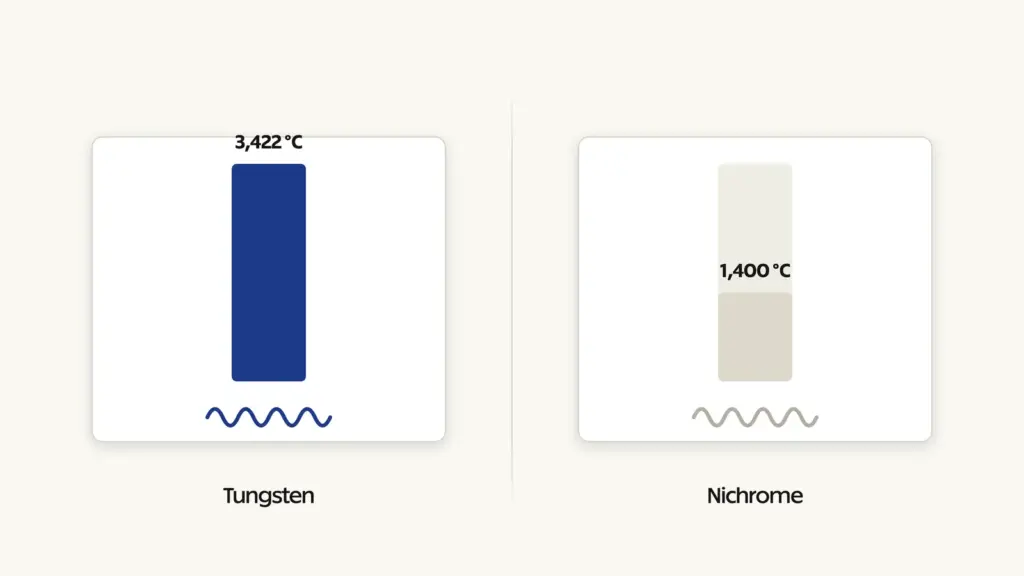
The difference between tungsten and nichrome starts with what they are: tungsten is a pure metallic element, nichrome is a man-made alloy of nickel and chromium. Tungsten has the highest melting point of any metal (3422 °C) but a low electrical resistivity and it burns in air. Nichrome melts around 1400 °C but has roughly eighteen times tungsten’s resistivity and forms a protective oxide skin that lets it glow red-hot in open air for years. That is why tungsten goes inside a sealed bulb as a filament and nichrome goes into your toaster, iron and immersion heater.
What each material is
Tungsten is element 74, symbol W, also called wolfram. It is a hard, dense, greyish-white transition metal found mainly in the ores wolframite and scheelite. In pure form it is brittle and hard to work, but doped tungsten can be drawn into wire as thin as a human hair, which is exactly what a lamp filament needs.
Nichrome is not an element and has no fixed formula. The commonest grade, Nichrome 80/20, is about 80% nickel and 20% chromium; other grades add iron, typically around 60% nickel, 15% chromium and 25% iron. It was developed at the start of the twentieth century specifically to solve a problem no pure metal solved well: a wire that gets hot, stays hot, and does not corrode away while doing it.
Both conduct electricity and both get hot when current passes through them, following the same joule heating relation H = I²Rt. Everything else about how they are used follows from a handful of physical properties.
Tungsten vs nichrome: the full comparison
| Property | Tungsten | Nichrome |
|---|---|---|
| Nature of substance | Pure element (W, atomic number 74) | Alloy of nickel and chromium (often with iron) |
| Typical composition | ~100% tungsten (with trace dopants) | ~80% Ni, 20% Cr (Nichrome 80/20) |
| Melting point | About 3422 °C — the highest of all metals | About 1400 °C |
| Electrical resistivity at room temperature | About 5.6 × 10⁻⁸ Ω m | About 100 × 10⁻⁸ Ω m (1.0 × 10⁻⁶ Ω m) |
| Temperature coefficient of resistivity | About 0.0045 per °C — resistance rises sharply when hot | About 0.0004 per °C — resistance almost unchanged when hot |
| Density | About 19,300 kg/m³ (19.3 g/cm³) | About 8,400 kg/m³ (8.4 g/cm³) |
| Behaviour in air when hot | Oxidises rapidly; must be sealed in vacuum or inert gas | Forms an adherent chromium oxide (Cr₂O₃) layer that protects the metal |
| Usual working temperature | Around 2500 °C in a lamp filament | Up to roughly 1150–1200 °C in air |
| Mechanical character | Hard and brittle; difficult and costly to form | Ductile and springy; easily drawn and coiled |
| Cost | High | Comparatively low |
| Principal use | Incandescent lamp filaments, X-ray targets, welding electrodes, cutting tools | Heating elements in toasters, irons, geysers, hair dryers, furnaces, resistors |
| Why it suits that use | Only metal that stays solid at incandescent temperature | High, stable resistance plus oxidation resistance in open air |
Why tungsten makes a good filament
A filament lamp works by getting a wire so hot that it radiates visible light. Below about 2000 °C most of the radiation is infrared and the lamp glows a dull red; the higher the temperature, the whiter and more efficient the light. So the filament material has to survive temperatures that would vaporise almost anything else.
Tungsten’s melting point of 3422 °C is what makes this possible. Running at around 2500 °C, a tungsten filament is comfortably below its melting point — and no other metal even reaches that range. Tungsten also has a very low vapour pressure, so it evaporates slowly rather than boiling away in a few minutes.
But tungsten has an ordinary metal’s resistivity, only about 5.6 × 10⁻⁸ Ω m. To get enough resistance to dissipate power, the filament must be very long and very thin. Manufacturers solve this by winding it into a coil, and then winding that coil into a second coil — the “coiled coil” you can see if you look closely at an old bulb. A filament that would be half a metre long straight fits into a couple of centimetres.
The catch is oxygen. Hot tungsten reacts readily with air to form tungsten oxide, and a glowing filament exposed to air fails almost instantly. This is why bulbs are evacuated or filled with an inert gas such as argon with a little nitrogen — the gas fill also slows evaporation of the filament. Tungsten’s high temperature coefficient of resistivity, about 0.0045 per °C, has a visible consequence too: a cold filament has far lower resistance than a hot one, so the inrush current at switch-on is several times the running current. That is why filament bulbs almost always fail at the moment you turn them on.
Why nichrome makes a good heating element
A heating element has the opposite job. It must produce heat, not light, sit in open air, and last for years of switching on and off.
High resistivity. At about 100 × 10⁻⁸ Ω m, nichrome’s resistivity is roughly eighteen times tungsten’s. A short, reasonably thick nichrome wire gives the resistance a 1000-watt appliance needs. Made of copper, the same element would have to be absurdly long and thin.
Oxidation resistance. This is nichrome’s real trick. When it is first heated in air, the chromium in the alloy oxidises to form a thin, dense, tightly adhering layer of chromium oxide on the surface. That layer is stable and blocks oxygen from reaching the metal underneath, so the wire stops corroding instead of corroding away. It is the same passivation principle that makes stainless steel stainless.
A high enough melting point. Nichrome melts around 1400 °C and is normally worked up to about 1150–1200 °C in air — far above the 300–800 °C at which household appliances operate, so there is a comfortable margin.
A very low temperature coefficient. At about 0.0004 per °C, nichrome’s resistance barely changes between cold and glowing. That means a nearly constant current draw and steady heat output — valuable in a toaster, essential in a laboratory furnace or a precision resistor.
It can be made and shaped cheaply. Nichrome is ductile, springy and easy to draw into wire and wind into the flat spirals and coils you see inside appliances. Tungsten, brittle and expensive, resists every one of those operations.
Common confusions
“Tungsten has higher resistance than nichrome.” It does not. Nichrome’s resistivity is about eighteen times tungsten’s. What confuses people is that a bulb filament has high *resistance* — but that comes from its extreme length and hair-thin cross-section, not from a high resistivity. Resistance is R = ρL/A; geometry does the work, not the material.
“Why not make the bulb filament from nichrome?” It would melt. Nichrome fails around 1400 °C, while a filament needs to sit at roughly 2500 °C to radiate white light. Below that it would glow a feeble red and waste almost all its energy as heat.
“Why not make the toaster element from tungsten?” It would burn out. A tungsten element exposed to open air oxidises rapidly and disintegrates. It is also brittle, expensive, and its resistivity is too low to give useful resistance in a short wire.
“Oxidation only matters for iron.” It matters for every metal that gets hot in air, and the two materials here sit at opposite ends of it — tungsten is destroyed by oxidation, nichrome is protected by it. The general mechanisms of metal attack and protection are set out in this note on corrosion causes and prevention.
“Nichrome is a metal.” Nichrome is an alloy — a solid mixture of metals, not an element. This matters conceptually: alloying is precisely how its high resistivity and low temperature coefficient are engineered. Adding chromium to nickel disturbs the regular lattice, scatters conduction electrons more strongly, and pushes resistivity up.
“The connecting wires and the element are the same thing.” In an electric iron or a bulb, the leads are made of a low-resistivity metal such as copper, deliberately chosen so almost no heat is produced in them. Nearly all the resistance, and therefore nearly all the heat, is concentrated in the element or the filament.
Similar material-property reasoning appears in other physical comparisons, such as the difference between mass and weight, where a single confusion between an intrinsic property and a situational quantity causes most of the errors.
Frequently Asked Questions
Is nichrome an element or an alloy?
Nichrome is an alloy, most commonly about 80% nickel and 20% chromium, sometimes with iron added. Tungsten, by contrast, is a chemical element with the symbol W and atomic number 74.
Which has the higher melting point, tungsten or nichrome?
Tungsten, by a wide margin. Tungsten melts at about 3422 °C — the highest melting point of any metal — while nichrome melts at about 1400 °C.
Which has higher resistivity?
Nichrome. Its resistivity is about 100 × 10⁻⁸ Ω m against tungsten’s 5.6 × 10⁻⁸ Ω m, roughly an eighteen-fold difference. The high resistivity is exactly why nichrome is chosen for heating elements.
Why must a tungsten filament be enclosed in vacuum or inert gas?
Because hot tungsten oxidises rapidly in air and would burn out within moments. The inert filling also reduces evaporation of tungsten atoms from the filament, extending the lamp’s life.
Why does nichrome not burn away in open air?
Its chromium content forms a thin, dense, adherent layer of chromium oxide on the surface when first heated. That layer seals the metal beneath from oxygen, so the wire survives repeated heating in air.
Why do filament bulbs usually blow at switch-on?
Tungsten has a large temperature coefficient of resistivity, so a cold filament has much lower resistance than a hot one. At the instant of switching on, the current surge is several times the normal running current, and a filament already thinned by evaporation gives way then.
Can nichrome be used to make wires for a rheostat?
Yes, and it commonly is. Its high resistivity gives a useful resistance in a short length, and its very low temperature coefficient keeps that resistance nearly constant as the wire warms up — both desirable in resistance boxes, rheostats and standard resistors.
Practice Questions
1. Which of the following is the principal reason tungsten is used as the filament of an incandescent lamp?
a) It has the highest electrical resistivity among metals
b) It has the highest melting point among metals
c) It has the lowest density among metals
d) It has a negative temperature coefficient of resistance
Answer: b) It has the highest melting point among metals
2. Nichrome is best described as:
a) A pure metallic element
b) An alloy chiefly of nickel and chromium
c) An alloy of copper and zinc
d) A non-metallic conductor
Answer: b) An alloy chiefly of nickel and chromium
3. Nichrome is preferred for heating elements over copper mainly because nichrome has:
a) Lower resistivity and lower melting point
b) Higher resistivity and greater resistance to oxidation at high temperature
c) Higher density and better thermal conductivity
d) A larger temperature coefficient of resistance
Answer: b) Higher resistivity and greater resistance to oxidation at high temperature
4. The resistance of a tungsten filament at the instant of switching on is much lower than its resistance in steady operation. This is because tungsten has:
a) A large positive temperature coefficient of resistivity
b) A negative temperature coefficient of resistivity
c) A resistivity independent of temperature
d) Superconducting behaviour at room temperature
Answer: a) A large positive temperature coefficient of resistivity
5. The protective layer that prevents a nichrome heating element from corroding away in air is composed mainly of:
a) Nickel oxide
b) Iron oxide
c) Chromium oxide
d) Tungsten oxide
Answer: c) Chromium oxide
Mains-style questions
- Compare tungsten and nichrome with reference to resistivity, melting point and oxidation behaviour, and explain how each property determines the material’s principal application.
- “Resistance and resistivity are not the same thing.” Explain this statement using the example of a lamp filament, which is made of a low-resistivity metal yet has a high resistance.
- Explain why the temperature coefficient of resistivity is a critical selection criterion for materials used in standard resistors and heating elements, using nichrome as an example.
- Describe the role of alloying in modifying the electrical properties of metals, taking the nickel-chromium system as your case.
- An incandescent lamp converts only a small fraction of its input energy into visible light. Explain the physical reasons for this, and discuss why raising the filament’s operating temperature improves efficiency but shortens lamp life.
Tell Google you want more of this.
Add Anantam IAS as a preferred sourceOne tap, and this site shows up more often in your own Top Stories, AI Overviews and AI Mode. Remove it any time.