
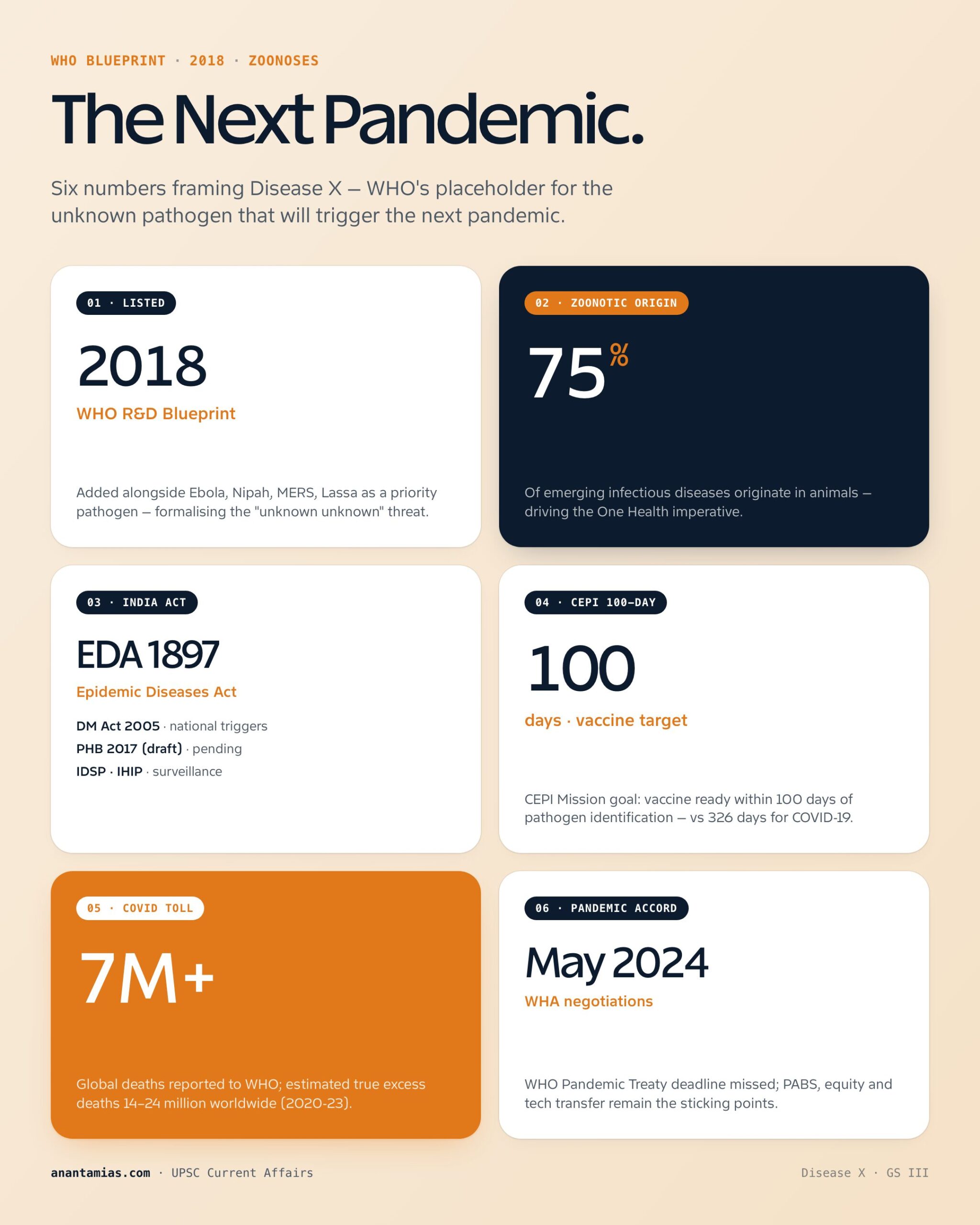
Disease X is not the name of a particular pathogen. It is a placeholder that the World Health Organization (WHO) added to its priority pathogen list in 2018 to represent the next unknown disease — a yet-to-emerge infection capable of causing a pandemic. Within 18 months of that listing, SARS-CoV-2 arrived: the original Disease X, in real time. COVID-19 killed an estimated 7-20 million people, cost the world over USD 14 trillion in lost output, and laid bare the fragility of every health system.
The next Disease X is not a question of if but of when. Around 70-80% of emerging and re-emerging infectious diseases are of zoonotic origin — they jump from animals to humans. As humans push deeper into wildlife habitats, livestock densities rise, and the climate destabilises, the rate of spillover events is accelerating.
For UPSC, Disease X sits squarely under GS III — Science & Technology, Disaster Management and Internal Security, with strong overflow into GS II — Health, Governance and International Relations.
What is Disease X — the underlying science
Three concepts frame the science of pandemic threats:
- Zoonosis — an infection that jumps from animals (wild or domesticated) to humans. SARS, MERS, Ebola, Marburg, Lassa, Nipah, Zika, COVID-19, mpox and avian influenza are all zoonotic.
- Spillover — the moment a pathogen first crosses the species barrier into humans. Most spillovers fizzle out; a few, with the right mutations, ignite epidemics.
- Pandemic potential — capacity for sustained human-to-human transmission, often via respiratory or droplet routes, against a population with little or no immunity.
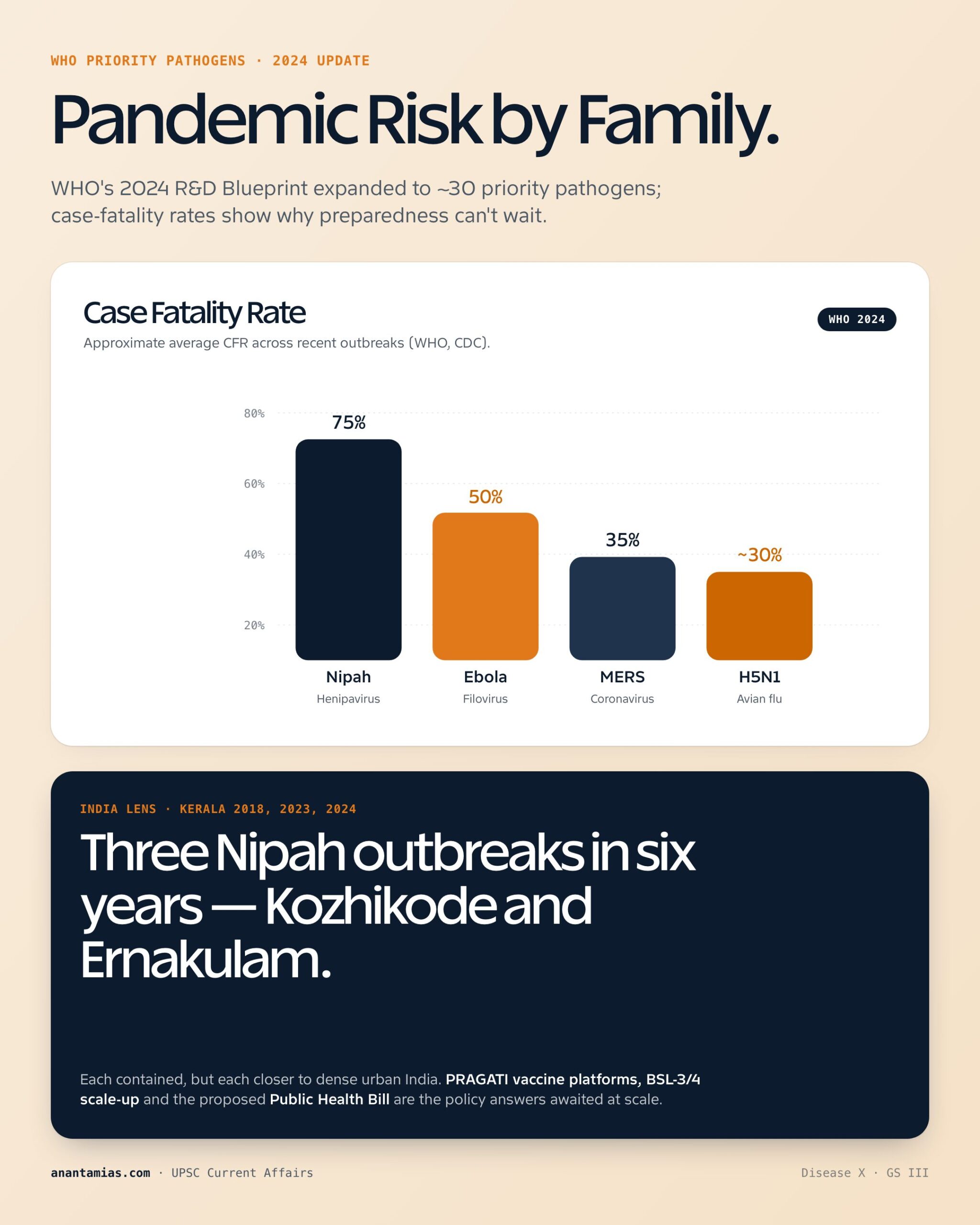
The WHO's R&D Blueprint lists pathogens of pandemic concern that need urgent research. The 2024 update reaffirmed:
| Pathogen | Disease |
|---|---|
| SARS-CoV-2 / SARS coronavirus | COVID-19, SARS |
| MERS-CoV | Middle East Respiratory Syndrome |
| Ebola virus, Marburg virus | Viral haemorrhagic fevers |
| Lassa virus | Lassa fever |
| Nipah, Hendra (henipaviruses) | Encephalitis |
| Crimean-Congo haemorrhagic fever virus | CCHF |
| Rift Valley fever virus | RVF |
| Zika virus | Zika |
| Mpox virus | Mpox |
| Disease X | Unknown future pathogen |
In 2024, WHO expanded the list to include influenza A viruses with pandemic potential, dengue, mpox clade Ib, and a broader family-level approach (e.g., the entire Coronaviridae family, Filoviridae, Paramyxoviridae) rather than just specific pathogens.
Why Disease X risk is rising
Several drivers are stacking up:
- Land-use change — deforestation, agricultural expansion and urbanisation push humans into wildlife reservoirs.
- High-density livestock — pigs and poultry act as "mixing vessels" where avian, swine and human flu strains can recombine.
- Wildlife trade and wet markets — bring exotic species into close human contact.
- Climate change — shifting habitats of mosquitoes, ticks, bats; thawing permafrost may release ancient pathogens.
- Antimicrobial resistance (AMR) — turning treatable infections into killers; AMR is a "silent pandemic" projected to cause 10 million deaths a year by 2050 if unchecked.
- Global travel — turns localised outbreaks into international emergencies in days.
- Lab biosafety — debate over gain-of-function research and accidental release.
How outbreaks become pandemics
A typical pandemic timeline has four phases:
- Spillover — an animal-to-human jump in a forest, farm or market.
- Local outbreak — small clusters; misdiagnosed initially.
- Epidemic — sustained transmission in a region; healthcare system stress.
- Pandemic — global spread, declared a Public Health Emergency of International Concern (PHEIC) by WHO under the International Health Regulations (IHR), 2005.
Recent PHEICs include H1N1 (2009), Ebola West Africa (2014), Zika (2016), Ebola DRC (2019), COVID-19 (2020), mpox (2022 and 2024), and polio (since 2014).
Pandemic preparedness — global architecture
| Initiative | Body | Role |
|---|---|---|
| R&D Blueprint | WHO | Priority pathogen list; speeds vaccine, diagnostic, therapeutic R&D |
| CEPI 100 Days Mission | CEPI + G7/G20 | Develop a vaccine within 100 days of a new threat being identified |
| Pandemic Treaty / Pandemic Accord | WHO members | Negotiated 2024-25; aims at equitable access to medical countermeasures |
| Pandemic Fund | World Bank-FIF | Financial intermediary fund operationalised 2022 |
| GISRS / FluNet / GISAID | WHO | Global influenza surveillance |
| PIP Framework | WHO | Sharing of influenza viruses and benefits |
| One Health Joint Plan of Action (2022-26) | WHO, FAO, UNEP, WOAH | Integrated human-animal-environment health |
| Scientific Advisory Group for the Origins of Novel Pathogens (SAGO) | WHO | Investigates novel pathogen origins |
| mRNA Technology Transfer Hub, South Africa | WHO | Builds vaccine capacity in LMICs |
The Pandemic Treaty negotiations, although delayed past their 2024 deadline, reached agreement on a draft in 2025 covering pathogen access and benefit sharing (PABS), surveillance, technology transfer, financing and One Health.
India's pandemic preparedness
Statutory and policy framework
| Instrument | Year | Detail |
|---|---|---|
| Epidemic Diseases Act | 1897 | Colonial-era; powers to states for outbreak control |
| National Disaster Management Act | 2005 | Was invoked for COVID-19 lockdowns |
| Public Health (Prevention, Control and Management of Epidemics, Bio-terrorism and Disasters) Bill | Draft | Replaces 1897 Act; pending |
| National Health Mission | 2013 | Strengthens primary care infrastructure |
| National One Health Mission | 2023 | ICMR, ICAR, MoHFW, DBT, MoEFCC integration |
| National Action Plan on Antimicrobial Resistance (NAP-AMR) | 2017 (update 2025) | One Health AMR control |
Key institutions
- Indian Council of Medical Research (ICMR) — apex biomedical research; ran COVID-19 testing and surveillance.
- National Centre for Disease Control (NCDC) — outbreak detection.
- Integrated Disease Surveillance Programme (IDSP) — district-level outbreak tracking.
- Indian Veterinary Research Institute (IVRI) — animal-disease surveillance.
- National Institute of Virology (NIV), Pune — BSL-4 facility.
- DBT-Translational Health Science and Technology Institute (THSTI) and National Institute of Immunology (NII) — vaccine R&D.
- Centre for One Health, Nagpur (under ICMR) — One Health hub.
Vaccine power
India is the world's largest vaccine producer by volume. During COVID-19, India developed:
- Covaxin (Bharat Biotech) — inactivated whole-virion.
- Covishield (Serum Institute) — adenoviral-vector, licensed from Oxford-AstraZeneca.
- Corbevax (Biological E) — protein subunit.
- ZyCoV-D (Zydus) — first DNA vaccine in the world.
- iNCOVACC (Bharat Biotech) — first intranasal COVID-19 vaccine.
- GEMCOVAC-19 (Gennova) — India's first mRNA vaccine.
The Mission COVID Suraksha under DBT-BIRAC accelerated this pipeline.
Steps to reduce Disease X risk
- One Health surveillance — joint human-animal-environment monitoring.
- Global biosurveillance — wastewater monitoring, genomic sequencing networks.
- Universal Health Coverage — strong primary care detects outbreaks early.
- Vaccine platforms — mRNA, viral-vector, protein-subunit kept ready for rapid retooling.
- Diagnostic innovation — point-of-care multiplex tests for entire pathogen families.
- R&D pipeline — anti-virals against priority families (e.g., broadly neutralising antibodies).
- Equitable access — pandemic treaty's PABS system to share pathogens and benefits.
- Wildlife protection — reduce deforestation and unregulated wildlife trade.
- AMR control — rational antibiotic use in humans, animals and agriculture.
- Risk communication — counter misinformation; build public trust.
Recent developments (2024-26)
- Pandemic Accord — WHO members agreed in 2025 on a draft Pandemic Agreement covering surveillance, PABS, technology transfer, financing and One Health.
- WHO updated priority pathogens list (2024) — now includes mpox clade Ib, expanded family-level focus (Coronaviridae, Filoviridae, Paramyxoviridae) and influenza A H5N1.
- H5N1 avian influenza in dairy cattle — surprised regulators in the US in 2024-25; first dairy-cow-to-human transmission documented.
- Mpox PHEIC declared again in August 2024 by WHO (clade Ib in Africa).
- India's National One Health Mission rolled out at state level from 2024.
- NAP-AMR 2.0 (2025) — second-generation Antimicrobial Resistance plan with sharper One Health metrics.
- CEPI 100 Days Mission — DCGI partnered with CEPI in 2024 to advance India's vaccine response capacity.
- Genome India and Pathogen Genome Surveillance Programme — wastewater + clinical genomics.
- WHO mRNA Hub — Bharat Biotech's mRNA programme operational; tech transfer arrangements emerging.
- Pandemic Fund — disbursed first round of grants in 2023; India eligible for capacity-building grants.
- Nipah outbreak in Kerala (2023, 2024) — contained quickly through state-level One Health response.
Challenges
| Challenge | Detail |
|---|---|
| Surveillance gaps | Animal health, veterinary diagnostics, wildlife epidemiology under-resourced |
| Health workforce | Shortage of epidemiologists, clinical microbiologists, infectious-disease specialists |
| Hospital capacity | ICU, oxygen, ventilator capacity remains uneven across states |
| Regulatory speed | Approval timelines for vaccines, diagnostics need codification |
| Equity | Vaccine nationalism repeated risk; LMICs need own production capacity |
| AMR | India's AMR burden among the highest in the world |
| Misinformation | Erodes public trust; complicates response |
| Climate-driven shifts | Vector-borne disease range expansion; need adaptive surveillance |
Way forward
- Modernise the Epidemic Diseases Act 1897 with a comprehensive Public Health Act.
- Operationalise One Health at district level with named focal officers across human, animal and environment ministries.
- Build BSL-3 / BSL-4 capacity beyond NIV Pune; regional centres.
- Strengthen wastewater surveillance as routine national infrastructure.
- Stockpile and platform readiness — mRNA, viral-vector, protein-subunit pipelines maintained between pandemics.
- Public health cadre — dedicated cadre across central and state services.
- AMR action — full roll-out of NAP-AMR 2.0; antibiotic stewardship in animal husbandry.
- Climate-health integration in National Action Plan on Climate Change.
- Vaccine equity champion — India's diplomacy to shape Pandemic Treaty in favour of Global South.
- Citizen-led surveillance — apps, community health workers, digital reporting.
Mains hook
"Disease X is not a hypothesis but an inevitability." In light of this, examine India's preparedness for the next pandemic with reference to One Health, vaccine platforms and the WHO Pandemic Treaty. (GS III, 250 words, 15 marks)
Prelims pointers
- Disease X — placeholder term coined by WHO in 2018 for an unknown future pandemic pathogen.
- WHO R&D Blueprint — priority pathogen list (updated 2024).
- PHEIC — Public Health Emergency of International Concern; declared under IHR (2005).
- 70-80% of emerging infectious diseases are zoonotic.
- One Health — integrated approach across human, animal, environmental health.
- CEPI 100 Days Mission — vaccine within 100 days of identification.
- Pandemic Fund — World Bank-hosted financial intermediary fund (operational 2022).
- WHO Pandemic Accord — agreement reached 2025 (drafting and adoption phases).
- India's COVID-19 vaccines — Covaxin, Covishield, Corbevax, ZyCoV-D (DNA), iNCOVACC (intranasal), GEMCOVAC-19 (mRNA).
- Mission COVID Suraksha — under DBT-BIRAC.
- National One Health Mission (2023) — ICMR, ICAR, MoHFW, DBT, MoEFCC.
- Mpox PHEIC — declared August 2024 (clade Ib).
- NAP-AMR — National Action Plan on Antimicrobial Resistance (2017; revised 2025).
For UPSC, Disease X is the lens through which to assess every aspect of India's health, science and disaster-management state. The aspirant who treats pandemic preparedness as a systems challenge — biological, institutional, financial and diplomatic — will write the answer that scores.
Tell Google you want more of this.
Add Anantam IAS as a preferred sourceOne tap, and this site shows up more often in your own Top Stories, AI Overviews and AI Mode. Remove it any time.





