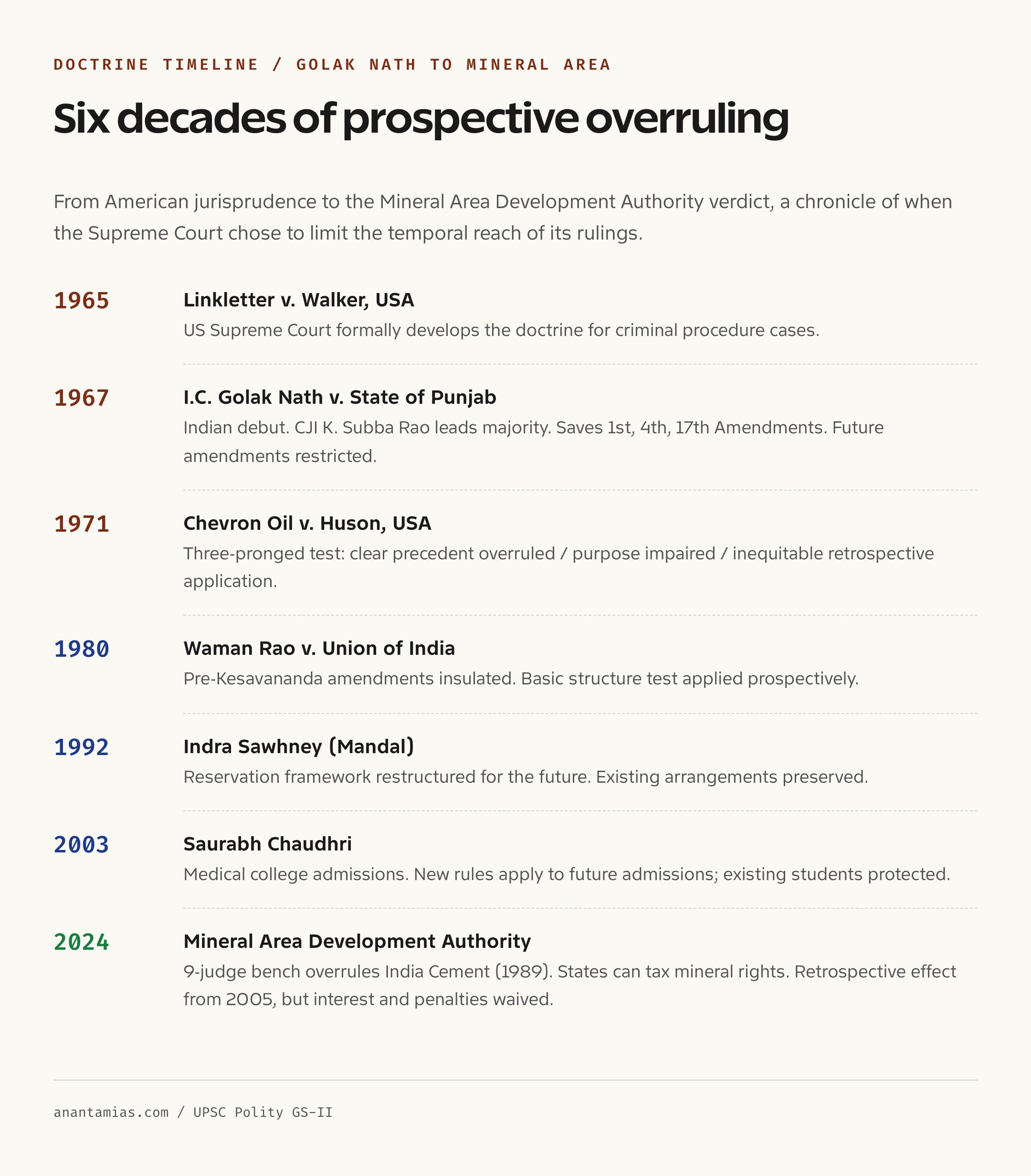
A judicial decision, by its classical Anglo-Indian conception, is declaratory rather than constitutive. The court does not make new law; it discovers and declares what the law has always been. From this conception flows the default rule that a judgment is retrospective: if the Supreme Court today says a particular statute is unconstitutional, the statute is treated as if it had been unconstitutional from the day it was enacted. This is logical, neat, and disastrous in practice.
The disaster lies in the consequences. A tax law in operation for thirty years, suddenly declared unconstitutional, would in pure logic require refund of every rupee collected under it. A land allocation system that allotted lakhs of plots over forty years, suddenly invalidated, would unsettle title in lakhs of homes. A criminal procedure followed in tens of thousands of trials, ruled unconstitutional today, would in theory require every conviction under it to be reopened. No legal system can survive the literal application of pure retrospective overruling for major constitutional decisions. The doctrine of prospective overruling is the safety valve that the Supreme Court of India has built to manage this problem.
This guide walks through the origins of the doctrine in American jurisprudence, its Indian debut in I.C. Golak Nath v. State of Punjab, the constitutional anchor in Article 142 of the Indian Constitution, the major applications of the doctrine over six decades, and the recent Mineral Area Development Authority verdict of 2024 that reopened the debate over how the doctrine should be applied to tax and revenue matters.
Quick Facts on the Doctrine of Prospective Overruling
The doctrine of prospective overruling is a judicial tool that declares a law or legal principle invalid but limits the operation of the ruling to future cases. The doctrine originated in American jurisprudence, where it was developed by the United States Supreme Court in the mid-twentieth century. It made its Indian debut in I.C. Golak Nath v. State of Punjab, 1967, where Chief Justice K. Subba Rao led a majority of the bench in invoking it. The constitutional anchor in India is Article 142, which gives the Supreme Court the power to pass any decree or order necessary for “complete justice” in any cause or matter pending before it. Only the Supreme Court of India can invoke the doctrine; High Courts do not have the equivalent power. The doctrine is discretionary, not automatic, and the Court applies it only when retrospective application would cause serious administrative or financial chaos. Recent applications include the Mineral Area Development Authority v. Steel Authority of India case, decided by a nine-judge bench in 2024.
What Prospective Overruling Is
In ordinary judicial language, “overruling” means setting aside a previous legal precedent or invalidating a statute on constitutional grounds. The classical default of overruling is retrospective; the law as restated by the court is treated as having always been the law, and past transactions, judgments and actions taken under the old, now-invalid, rule are exposed to challenge. Prospective overruling departs from this default. The Court still declares the old rule invalid, but holds that the new rule will apply only to causes of action that arise on or after a specified date. Past transactions and judgments are insulated from the new rule.
The Court can deploy three variations of the doctrine. Pure prospective overruling applies the new rule only to events occurring after the date of the judgment, and even the parties to the case are governed by the old rule. Selective prospective overruling applies the new rule to the parties before the court and to all future cases, but not to other parties whose claims arose before the judgment. The Indian model has typically followed selective prospective overruling, although the Court has discretion to fashion the appropriate variant for each case.
Background and Historical Context
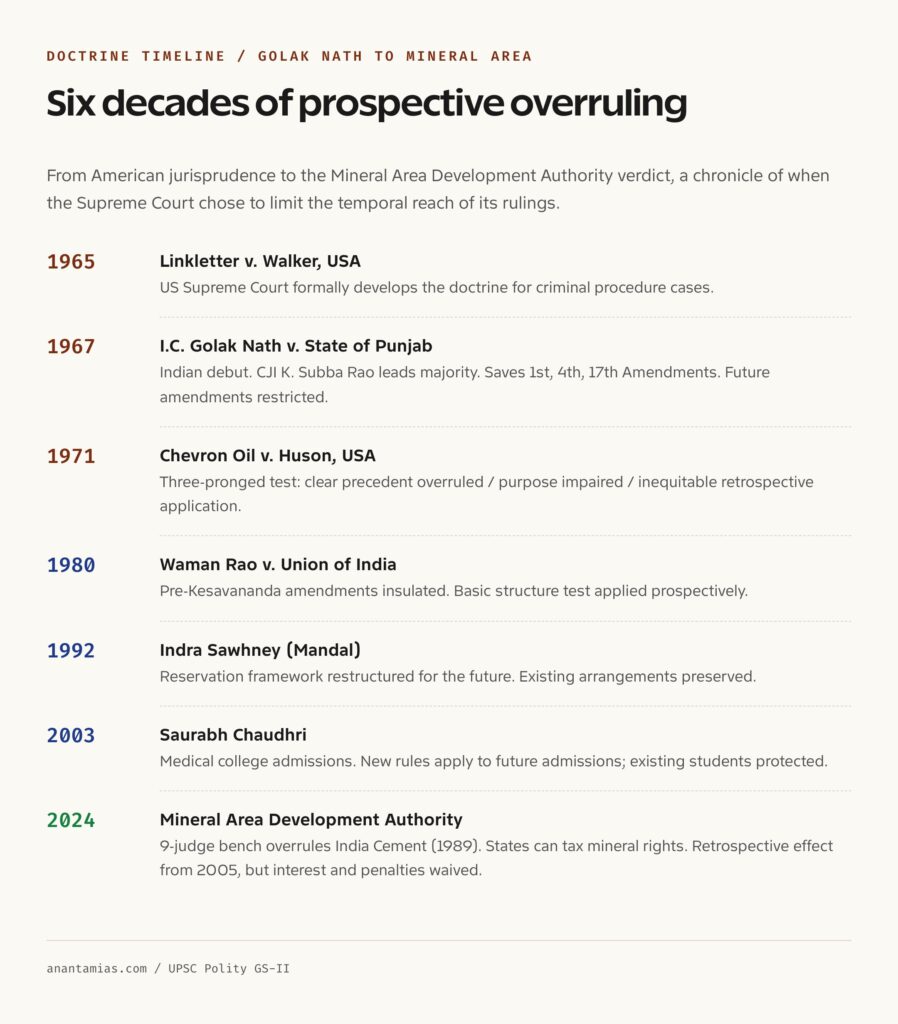
The doctrine traces its modern intellectual lineage to American jurisprudence in the early twentieth century. Justice Benjamin Cardozo, while still on the New York Court of Appeals, defended the idea that a court should be allowed to make a fresh constitutional ruling without unsettling the reliance interests built up under the old rule. The United States Supreme Court formally adopted the doctrine in a series of mid-twentieth-century cases, culminating in the three-pronged Chevron Oil v. Huson framework of 1971, which set out the conditions under which a new rule could be applied prospectively only.
In India, the doctrine arrived on 27 February 1967 with the Supreme Court’s eleven-judge bench decision in I.C. Golak Nath v. State of Punjab. The Court was dealing with a constitutional question of explosive consequence: whether Parliament had the power to amend the Fundamental Rights chapter of the Constitution. A majority of six judges led by Chief Justice K. Subba Rao held that Parliament did not have the power to amend the Fundamental Rights, overruling earlier Supreme Court decisions, including the 1951 Shankari Prasad case and the 1965 Sajjan Singh case, that had upheld such amendments. For a fuller doctrinal context, see our basic structure doctrine explainer and the 42nd Amendment of the Indian Constitution.
The practical problem with the Golak Nath majority view was severe. If Parliament could not amend Fundamental Rights, then several constitutional amendments already passed under the older view, including the First Amendment of 1951 and the Seventeenth Amendment of 1964, which dealt with land reform, would be retrospectively invalid. Every land redistribution effected under those amendments would be exposed to legal challenge; agricultural settlements built up over decades would be unsettled. To prevent that chaos, the majority drew on the American doctrine and held that the new rule, that Parliament cannot amend Fundamental Rights, would apply only prospectively. The First, Fourth and Seventeenth Amendments were therefore allowed to stand, even though under the new constitutional logic they were now considered ultra vires. The doctrine has been part of Indian constitutional law ever since.
Why the Doctrine Is Used
The doctrine exists for a single, practical reason: to prevent the administrative, financial, and social chaos that would follow from applying a fresh constitutional ruling retrospectively. Three categories of cases attract it most often. Tax cases form the first category; if a tax statute is struck down retrospectively, the Government may have to refund decades of collections, with crippling fiscal consequences. Land reform and land allocation cases form the second category; if a land statute is invalidated retrospectively, lakhs of allotments and settlements are exposed. Service and criminal procedure cases form the third category; if a procedural rule used in tens of thousands of past adjudications is held unconstitutional, reopening every past case is administratively unimplementable.
The doctrinal innovation, in each of these categories, is to use Article 142 of the Constitution as the anchor. Article 142 empowers the Supreme Court to pass any decree or order necessary for “complete justice” in any cause or matter pending before it. The Court has read Article 142 broadly enough to include the power to mould the temporal scope of its judgments. The Court is not legislating, technically; it is exercising its complete-justice power to balance the rights of present and future litigants against the reliance interests of those who acted under the old rule.
Major Applications of the Doctrine in Indian Jurisprudence
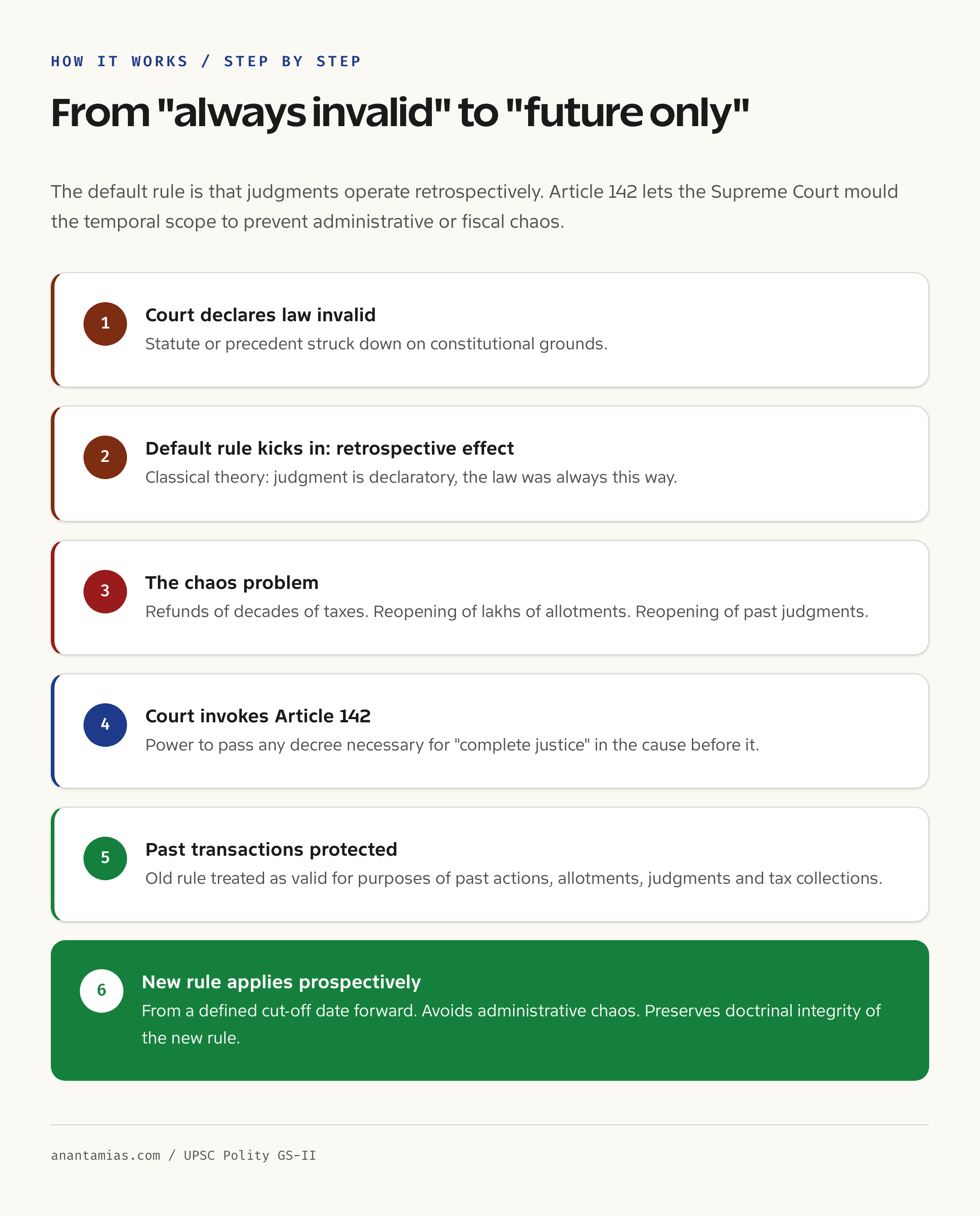
After Golak Nath, the doctrine has been applied in a series of important cases. The Waman Rao case in 1980, on the validity of constitutional amendments passed before the Kesavananda Bharati judgment of 1973, used a prospective approach to insulate pre-Kesavananda amendments from basic structure challenge while applying the basic structure test prospectively. The Indra Sawhney judgment of 1992 on reservations in public employment applied prospective overruling to certain aspects of its ruling, allowing existing reservation arrangements to continue while restructuring the framework for the future.
The Saurabh Chaudhri case of 2003 on medical college admissions used the doctrine to protect students who had already been admitted under the old rules while applying the new rules to future admissions. The Madras Bar Association cases on the constitutionality of various tribunals have repeatedly used a prospective approach to allow existing tribunals to continue functioning while their structural defects are remedied through legislative or executive action.
The doctrine is therefore not a one-off device. It is a regular tool in the Supreme Court’s decisional arsenal, used whenever the Court concludes that the social cost of full retrospective application would be disproportionate to the legal benefit.
Detailed Analysis: The Mineral Area Development Authority Verdict, 2024
The Mineral Area Development Authority v. Steel Authority of India case, decided by a nine-judge bench of the Supreme Court in July 2024, is the most consequential recent application of the doctrine. The case dealt with the question of whether states have the power to levy taxes on mineral rights, in addition to the royalty already paid under the Mines and Minerals (Development and Regulation) Act, 1957. A 1989 seven-judge bench in India Cement Ltd. v. State of Tamil Nadu had held that states could not impose such taxes; “royalty is a tax,” and the field was occupied by the central regulator.
The 2024 nine-judge bench overruled India Cement and held that royalty is not a tax, and states retain the constitutional power to levy taxes on mineral rights and on lands containing minerals. This was a major shift in fiscal federalism, with revenue implications running into tens of thousands of crores of rupees for mineral-rich states such as Jharkhand, Odisha, Chhattisgarh and Andhra Pradesh.
The retrospective application question then arose in a follow-up hearing. State governments, naturally, wanted to recover taxes from 1989 onwards, going back thirty-five years. Mining companies argued for prospective overruling, that they should pay only from the date of the judgment. The Court took a middle path. It permitted retrospective application of the new rule from 1 April 2005, allowing states to recover taxes from that date forward. But it waived the interest and penalties for the period from 2005 to the date of the judgment, recognising that the companies had acted on the basis of the existing 1989 ruling. The decision is a textbook illustration of how the doctrine can be calibrated, applied partially or fully, with different financial heads (principal, interest, penalty) treated differently to balance equities.
Why It Matters: The Doctrine and Judicial Statesmanship
The doctrine matters for three reasons. First, it allows the Court to do justice between present and past litigants without sacrificing the integrity of the new rule. The new rule is still a rule; it just operates within a calibrated temporal envelope. Second, it preserves administrative and financial stability in a country where governmental action operates at scale, with millions of contracts, allotments and tax assessments depending on the existing legal framework. Third, it reflects a form of judicial statesmanship that recognises courts as institutions with practical responsibilities, not just rule-pronouncing oracles.
The doctrine is also a natural sister of the basic structure doctrine. Both are instruments through which the Supreme Court has shaped the practical operation of the constitutional system in ways the bare text of the Constitution does not anticipate. Both are products of judicial creativity within a federal democratic framework. For the wider judicial activism context and the judicial reforms in India framework, the existing primers are useful companions.
Comparative Models: US, UK, and India
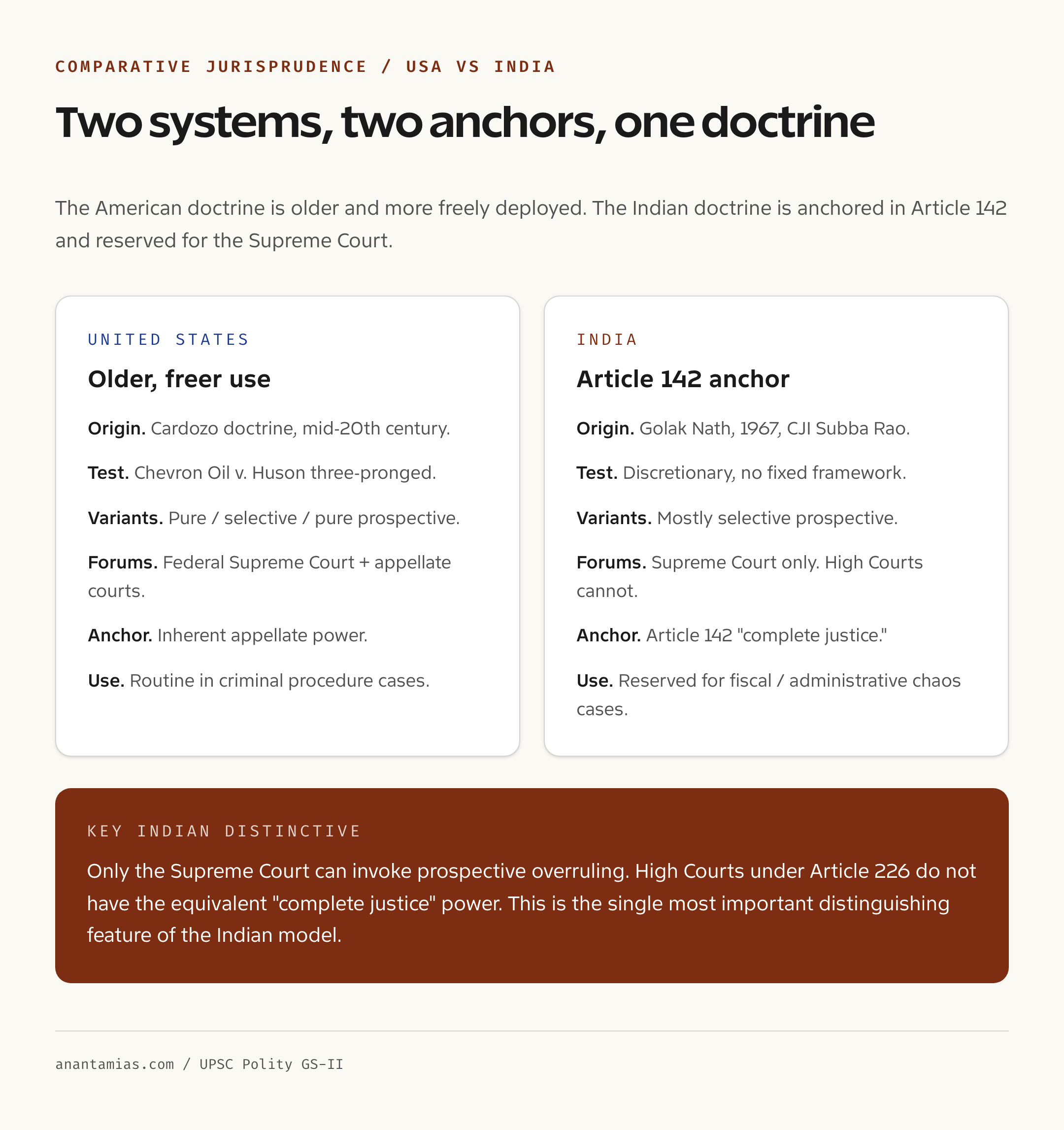
In the United States, the doctrine is a settled part of judicial practice, developed through cases such as Linkletter v. Walker, Stovall v. Denno, and Chevron Oil v. Huson. The Chevron Oil framework asks three questions: whether the new rule overrules a clear past precedent, whether retrospective application would impair its purpose, and whether retrospective application would produce substantial inequitable results. If all three are answered in favour of prospectivity, the new rule applies only to future cases.
In the United Kingdom, the doctrine has been more cautiously received. The classical Anglo-Indian view, that a judicial decision is declaratory, has been more strongly held in English jurisprudence. The House of Lords (now Supreme Court) in In re Spectrum Plus Ltd accepted in principle that prospective overruling could be available in exceptional cases, but the doctrine has rarely been deployed in practice.
In India, the doctrine is more frequently applied than in the United Kingdom but more cautiously than in the United States. Two distinguishing features mark the Indian model. First, only the Supreme Court can invoke the doctrine; High Courts do not have the equivalent Article 142 power. Second, the doctrine is treated as a discretionary tool to be deployed in cases of administrative or fiscal chaos, rather than as a routine option in every overruling.
Challenges and Concerns
The doctrine raises three doctrinal concerns. The first is the legitimacy concern. By choosing the temporal scope of its judgment, the Court exercises a power that resembles legislative drafting. Critics have argued that this blurs the line between adjudication and legislation in a way that ought to make courts uncomfortable. The second is the inequality concern. Prospective overruling creates differential treatment between similarly situated litigants based on the timing of their cause of action; the parties before the court may benefit from the new rule, while others whose causes arose just months earlier are stuck with the old rule. The third is the predictability concern. The discretion to invoke or not invoke the doctrine creates uncertainty about whether a fresh ruling will affect past transactions, complicating planning by governments, businesses and individuals.
The standard response to these concerns is that the doctrine is reserved for cases of substantial administrative or fiscal disruption, that judicial statesmanship in such cases is preferable to legal chaos, and that the predictability cost is offset by the legitimacy cost of unsettling decades of governmental action. The Mineral Area Development Authority case shows how these tensions are managed: by calibrating the temporal scope and by treating different financial heads differently to balance equities.
Prelims Pointers
The doctrine of prospective overruling originated in American jurisprudence. Its Indian debut was in I.C. Golak Nath v. State of Punjab, 1967, not in Kesavananda Bharati or Minerva Mills. Chief Justice K. Subba Rao led the majority that invoked the doctrine. The constitutional anchor is Article 142, the Supreme Court’s “complete justice” power. The doctrine validates past actions taken under the now-invalid law and applies the new rule only to future cases; this is the opposite of pure retrospective overruling. Only the Supreme Court of India can invoke the doctrine; High Courts cannot. Recent applications include the Mineral Area Development Authority v. Steel Authority of India nine-judge bench decision of 2024.
Mains Practice Questions
- “The doctrine of prospective overruling is a tool of judicial statesmanship, not a doctrine of strict legalism.” Critically examine in the context of I.C. Golak Nath, 1967 and the Mineral Area Development Authority verdict, 2024. (15 marks, 250 words)
- Discuss the constitutional anchor of the doctrine of prospective overruling under Article 142 of the Indian Constitution. Why is the doctrine confined to the Supreme Court of India? (10 marks, 150 words)
- “Prospective overruling sits in tension with the classical declaratory theory of judicial decisions.” Examine. (10 marks, 150 words)
Way Forward
The doctrine is well-settled in Indian jurisprudence, and the question is not whether it should be retained but how it should be calibrated. Three doctrinal refinements would strengthen the framework. First, a clearer set of guideposts on when prospective overruling is appropriate, similar to the Chevron Oil three-pronged test in American jurisprudence, would reduce predictability concerns. Second, an explicit framework for partial prospective application, where different elements of a judgment apply with different temporal scopes, would build on the Mineral Area Development Authority approach and help in fiscal and tax cases. Third, a clearer treatment of reliance interests, with the Court articulating how it weighs the reliance built up under the old rule against the rights of present litigants, would strengthen the doctrinal foundation. None of these requires legislative amendment; all of them sit within the Court’s constitutional architecture under Article 142.
Frequently Asked Questions
What is the doctrine of prospective overruling?
It is a judicial tool by which a court declares a law or legal principle invalid but mandates that the ruling will apply only to future cases. Past transactions, judgments and actions taken under the old, now-invalid, rule are insulated from challenge. The doctrine is the opposite of pure retrospective overruling, which would treat the new rule as having always been the law.
When was the doctrine first applied in India?
The doctrine was first applied in India in I.C. Golak Nath v. State of Punjab, decided on 27 February 1967 by an eleven-judge bench of the Supreme Court. Chief Justice K. Subba Rao led the majority that invoked the doctrine to insulate the First, Fourth and Seventeenth Amendments from invalidation under the new rule that Parliament could not amend Fundamental Rights.
What is the constitutional anchor for the doctrine?
The constitutional anchor is Article 142 of the Indian Constitution, which empowers the Supreme Court to pass any decree or order necessary for u0022complete justiceu0022 in any cause or matter pending before it. The Court has read Article 142 broadly enough to include the power to mould the temporal scope of its judgments and apply new rules only prospectively where retrospective application would cause administrative or fiscal chaos.
Can High Courts invoke the doctrine of prospective overruling?
No. Only the Supreme Court of India can invoke the doctrine. High Courts do not have the equivalent Article 142 power; their orders are made under Article 226, which does not contain the u0022complete justiceu0022 formulation. This is one of the distinguishing features of the Indian model of prospective overruling, in contrast to the American model where appellate courts at multiple levels can invoke the doctrine.
Does prospective overruling invalidate past actions?
No. Prospective overruling validates past actions taken under the old, now-invalid, law and invalidates only future actions. The doctrine is specifically designed to prevent administrative and financial chaos that would follow from invalidating decades of governmental action. The Mineral Area Development Authority case in 2024 showed how the Court can calibrate the doctrine, with retrospective application from a defined cut-off date but waiver of interest and penalties for the past period.
What is the Mineral Area Development Authority case 2024?
The Mineral Area Development Authority v. Steel Authority of India case, decided by a nine-judge bench in July 2024, held that states have the constitutional power to levy taxes on mineral rights, overruling the 1989 India Cement decision. In a follow-up hearing, the Court permitted retrospective application of the new rule from 1 April 2005 but waived the interest and penalties for the period from 2005 to the date of the judgment, balancing the doctrine’s application across financial heads.
How is the Indian model different from the American model?
The American model, developed through cases such as Chevron Oil v. Huson, sets out a three-pronged test for prospective application and is available to multiple levels of appellate courts. The Indian model is anchored in Article 142, is confined to the Supreme Court, and is treated as a discretionary tool reserved for cases of substantial administrative or fiscal disruption rather than a routine option in every overruling.
Is prospective overruling the same as basic structure doctrine?
No. The two are distinct, although both are products of judicial creativity within the Indian constitutional system. The basic structure doctrine, articulated in Kesavananda Bharati, 1973, limits the constituent power of Parliament to amend the Constitution. Prospective overruling, articulated in Golak Nath, 1967, regulates the temporal scope of judicial decisions. The two doctrines often interact in constitutional cases but operate on different legal questions.
Why was prospective overruling used in Golak Nath?
The Golak Nath majority held that Parliament could not amend the Fundamental Rights, overruling earlier decisions to the contrary. Pure retrospective application of this new rule would have invalidated several constitutional amendments already passed, including the First Amendment of 1951 and the Seventeenth Amendment of 1964, which dealt with land reform. To prevent the resulting chaos in agricultural settlements built up over decades, the Court applied the new rule prospectively, allowing the earlier amendments to stand while limiting future amendments.
Tell Google you want more of this.
Add Anantam IAS as a preferred sourceOne tap, and this site shows up more often in your own Top Stories, AI Overviews and AI Mode. Remove it any time.