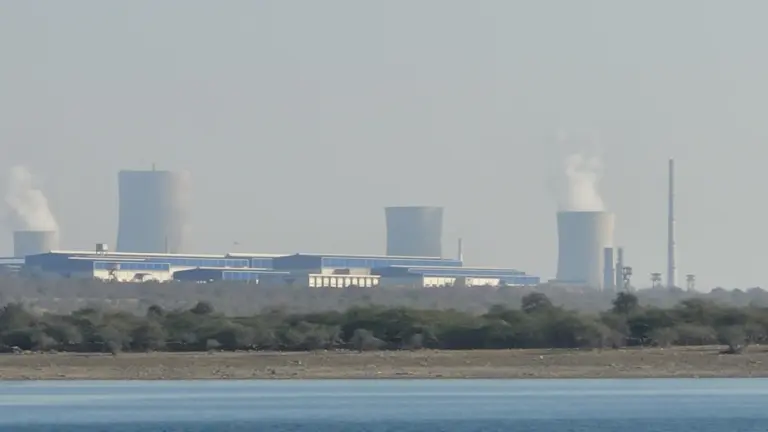
India currently operates 24 nuclear reactors across seven sites, producing roughly 8,180 MW — still only about 2-3 percent of total electricity generation. The government has pledged 500 GW of non-fossil capacity by 2030 and net-zero by 2070, for which nuclear power is a strategic lever. For UPSC GS Paper III, nuclear energy sits at the crossroads of science, economy, environment and national security.
Why Nuclear Power Matters
- Low-carbon baseload — complements intermittent solar and wind.
- Energy security — reduces dependence on imported coal and gas.
- Strategic capability — civil programme feeds expertise into the defence nuclear ecosystem.
- Industrial multiplier — supports advanced manufacturing in steel, control systems and precision engineering.
Mechanism: The Science Behind Nuclear Power
A nuclear reactor releases energy through controlled fission of heavy nuclei such as uranium-235 or plutonium-239. Neutrons split nuclei, releasing heat, more neutrons and fission products. Coolants (heavy water, light water, liquid sodium) transfer heat to produce steam that drives turbines. India's workhorse is the Pressurised Heavy Water Reactor (PHWR) using natural uranium with heavy water as moderator and coolant, culminating in the indigenous 700 MWe PHWR now operating at Kakrapar (Gujarat) and Rawatbhata (Rajasthan).
India's Three-Stage Nuclear Programme
Architected by Homi Bhabha in the 1950s:
- Stage 1 — PHWRs using natural uranium; produces plutonium as by-product.
- Stage 2 — Fast Breeder Reactors (FBRs) using plutonium-uranium fuel; breed fissile uranium-233 from thorium.
- Stage 3 — Thorium-based reactors (Advanced Heavy Water Reactor, AHWR) leveraging India's vast thorium reserves.
The Prototype Fast Breeder Reactor (PFBR) at Kalpakkam achieved core loading in March 2024 — a landmark moment for Stage 2.
Factors Influencing Nuclear Power Growth
Land Requirements
- Large exclusion zones (1.5 km radius as per AERB norms) mean each plant requires several square kilometres.
- Land acquisition, rehabilitation and public resistance (Kudankulam, Jaitapur) slow projects.
Fuel Requirements
- India has low uranium reserves but the world's largest thorium deposits (Kerala, Tamil Nadu and Odisha sands).
- India operates a closed fuel cycle to reprocess spent fuel, extract uranium and plutonium, and maximise resource utilisation.
- Three reprocessing plants operate at Trombay, Tarapur and Kalpakkam under BARC, using PUREX technology.
- Spent fuel is treated as a resource, not waste.
Manufacturing Needs
- India has built indigenous capacity for reactor pressure vessels, steam generators and core components via L&T, BHEL, Walchandnagar and Godrej.
- Scaling cost and capability remains a priority, particularly for Stage 2 and SMRs.
Manpower
- DAE projections from 2006 indicated the need for about 700 scientists and engineers annually in R&D units, and 650 engineers annually in public sector and industry units, to replace retirees and support expansion.
- The sector faces a shortfall of nuclear scientists and engineers, compounded by talent migration abroad.
Issues Constraining Growth
Availability of Fuel
India does not have large natural uranium reserves and must import — from Kazakhstan, Uzbekistan, France, Canada and Russia. Geopolitical shocks can disrupt fuel planning.
Limited Contribution to Energy Mix
Nuclear accounts for only about 2-3 percent of installed capacity and generation, despite five decades of operation.
High Cost
Nuclear power tariffs typically exceed Rs 4-7 per unit, significantly higher than solar (Rs 2-3 per unit after the renewables revolution).
Nuclear Waste
- Fission produces long-lived radioactive waste — some isotopes persist for hundreds of thousands of years.
- Safe long-term storage remains an unsolved global problem; India's reprocessing model reduces, but does not eliminate, the challenge.
Nuclear Accidents
- Fukushima (2011) and Chernobyl (1986) demonstrate the catastrophic downside of safety failure.
- Extensive land exclusion around Chernobyl (over 650,000 acres) continues decades later.
Government Monopoly
- All commercial reactors are operated by the Nuclear Power Corporation of India Limited (NPCIL); private sector entry has been restricted by the Atomic Energy Act 1962.
Nuclear Liability
- The Civil Liability for Nuclear Damage Act, 2010 places primary compensation on the operator but allows recourse against the supplier if equipment is defective.
- This supplier-recourse clause deters foreign vendors (Westinghouse, GE, Areva), delaying projects such as the French EPRs at Jaitapur, Maharashtra.
Regulatory Environment
- India's regulator, the Atomic Energy Regulatory Board (AERB), is not statutorily independent — a key reform proposed under the Nuclear Safety Regulatory Authority Bill that remains pending.
India's Position Globally
India is one of only nine countries with both a civil and weapons nuclear programme. It has a unique waiver from the Nuclear Suppliers Group (2008) that allows civil nuclear trade despite not signing the NPT. The Indian programme is known for indigenous PHWRs, advanced thorium research, and FBR demonstration.
Way Forward
- Fleet-mode indigenous 700 MWe PHWRs — 10 sanctioned units are in various stages of construction.
- Small Modular Reactors (SMRs) co-located with retiring thermal plants can add modular capacity at lower cost.
- Accelerate Stage 2 and Stage 3 development to unlock thorium's potential.
- Amend the Atomic Energy Act 1962 to permit phased induction of NTPC and private sector in reactor ownership and operation.
- Government retains control over fuel management and security, with private participation in construction and operations.
- Improve public perception through transparent environmental and health data.
Ethical and Policy Concerns
- Inter-generational equity — radioactive waste affects future generations.
- Displacement and livelihoods around reactor sites.
- Accident risk and informed consent of surrounding populations.
- Proliferation risk and the civil-military nuclear interface.
- Transparency of safety data, so often absent globally.
Latest Developments (2024-26)
- Union Budget 2024-25 announced a Nuclear Energy Mission for SMRs and Bharat Small Reactors (BSR) with a Rs 20,000 crore outlay, targeting deployment by 2033.
- Amendments to the Atomic Energy Act 1962 and Civil Liability for Nuclear Damage Act 2010 were proposed in Budget 2025, to enable private sector participation and address supplier liability concerns.
- AI Action Summit, Paris (2025) — India highlighted AI-driven reactor monitoring and safety analytics.
- India Semiconductor Mission — supplies radiation-hardened chips for reactor control systems.
- Chandrayaan-4 and Gaganyaan progress indirectly strengthens the strategic high-technology ecosystem that supports nuclear innovation.
- National Quantum Mission enables post-quantum cryptography for reactor control networks.
- DPDP Act governs worker and community data handled by NPCIL operations.
- PFBR core loading at Kalpakkam achieved in March 2024.
- Kudankulam Units 3, 4, 5 and 6 construction progressing with Russian collaboration.
- Jaitapur EPR discussions revived in 2024-25 under modified liability framework.
UPSC Relevance
For Prelims, remember AERB, NPCIL, three-stage nuclear programme, Civil Liability for Nuclear Damage Act 2010, PFBR at Kalpakkam, and the Bharat Small Reactors plan. For GS III Mains, nuclear power touches energy security, climate policy, industrial policy and regulatory governance. Ethics papers can address waste legacy and informed consent. The 2025 Budget reforms position nuclear as a growth lever — keep track of the bill proposing amendments to the Atomic Energy Act and Civil Liability for Nuclear Damage Act.
Tell Google you want more of this.
Add Anantam IAS as a preferred sourceOne tap, and this site shows up more often in your own Top Stories, AI Overviews and AI Mode. Remove it any time.