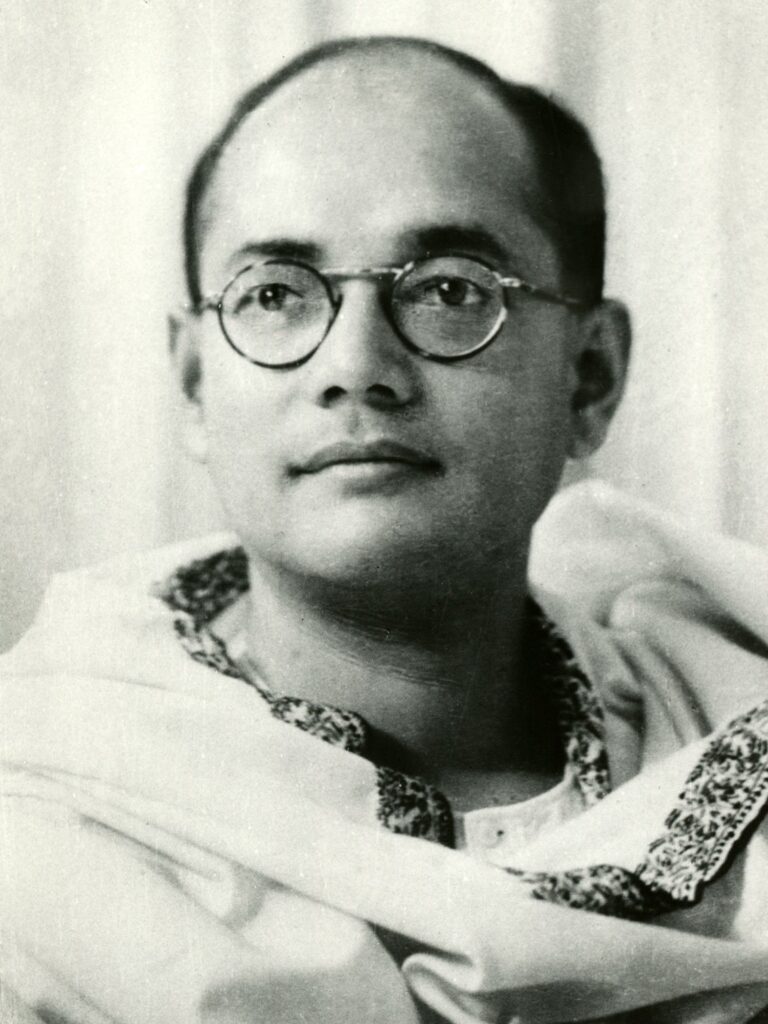
The Forward Bloc 1939 was Subhas Chandra Bose‘s attempt to consolidate the left within the Indian National Congress into a single disciplined caucus capable of pushing the freedom movement toward a more militant anti-colonial line. Founded on 3 May 1939 in Makur (Kolkata) after Bose’s resignation from the Congress presidency over the Pant resolution at the Tripuri session, the Forward Bloc 1939 was both a personal vehicle for Bose and a serious ideological experiment in revolutionary mass politics. Its first year was its most consequential. By 1942 it was banned by the British and its leadership in jail or in flight — but the Forward Bloc 1939 had already changed the rhetorical centre of gravity of Indian nationalism.
This article traces the run-up at Haripura and Tripuri, the Pant resolution, Bose’s resignation, the formation of the bloc, its ideological platform, its failures with Gandhi and the Communist Party, and its WWII strategy that culminated in Bose’s escape to Berlin and the formation of the Azad Hind Fauj.
Background: Haripura and Tripuri
Haripura 1938
In February 1938 the Congress met at Haripura in Gujarat under Subhas Chandra Bose’s presidency. The atmosphere was triumphant. Bose used his presidential address to call for a National Planning Committee under Jawaharlal Nehru, to outline a programme of industrialisation, and to indicate that the Congress should now move from constitutional opposition to outright mass struggle for purna swaraj.
Tripuri 1939 and the Pant Resolution
At Tripuri in February–March 1939, Bose stood for a second term — and won. He defeated Pattabhi Sitaramayya, the candidate endorsed by Gandhi, by 1580 to 1377 votes. Gandhi’s famous reaction — “the defeat is more mine than his” — signalled a crisis.
The Congress old guard refused to work under Bose. The Pant Resolution, moved by Govind Ballabh Pant at Tripuri, expressed full confidence in Gandhi, required the Working Committee to be appointed in accordance with Gandhi’s wishes, and effectively reduced Bose to a figurehead. After weeks of failed negotiations, Bose resigned the Congress presidency on 29 April 1939.
Formation: 3 May 1939
On 3 May 1939 — four days after his resignation — Bose announced the Forward Bloc 1939 at a public meeting in Makur, Kolkata. The party was originally conceived as a bloc within the Congress: not a breakaway, but a disciplined left caucus that would push Congress policy from within. The first All India Conference of the Forward Bloc was held in Bombay in June 1940, by which time the bloc had begun functioning more like an autonomous party.
Membership
Founding members and early leadership included:
- Subhas Chandra Bose (founding president)
- Sardul Singh Caveeshar (vice-president)
- Lal Shankarlal, Senapati Bapat, H. V. Kamath, R. S. Ruikar, Sheel Bhadra Yajee, S. S. Batliwala.
- The bloc had its strongest mass base in Bengal, but built footholds in Punjab, Maharashtra, the United Provinces and Andhra.
Ideology of the Forward Bloc
The Forward Bloc 1939 ideology can be summarised under five heads:
1. Left Consolidation
Bose’s stated aim was to bring together the scattered left within Congress — Congress Socialists, the Communist Party of India, the Kisan Sabha movement, the Royists — into a unified anti-imperialist front. He believed that the left’s diffuseness made it ineffective.
2. Complete Independence (Purna Swaraj)
The bloc rejected any compromise short of complete independence. Dominion status, federation under the 1935 Act, or any cooperation with the war effort were all ruled out.
3. Socialism and Planning
Influenced by the Soviet model and by Nehru’s National Planning Committee, the Forward Bloc 1939 advocated state-led industrialisation, land reform, nationalisation of key industries and a planned economy.
4. Mass Struggle
The bloc rejected the gradualist constitutional path. It called for a militant, non-negotiable mass struggle — the “national war” against British rule, to be intensified the moment imperial Britain became militarily engaged elsewhere.
5. Anti-Imperialist Foreign Policy
Solidarity with anti-colonial movements globally — Ireland, Vietnam, China, the Arab nationalists — and openness to seeking aid from any power, including the Axis, against Britain. This last principle would prove the most controversial.
Failures: Why the Bloc Could Not Unite the Left
The Forward Bloc 1939 never delivered the unity it promised. Three failures stand out.
1. Gandhi’s Non-Confidence
Mahatma Gandhi treated the bloc as personal indiscipline. He refused to accept the bloc as a legitimate intra-Congress formation, and the AICC under his influence passed a resolution in August 1939 disqualifying Bose from holding any elected office in Congress for three years on the charge of indiscipline. This expulsion-in-substance crippled the bloc’s strategy of operating within Congress.
2. Communist Non-Support
The Communist Party of India initially expressed sympathy. But after the Soviet entry into the war on the Allied side (June 1941), the CPI declared the war a “people’s war” and supported the British war effort. The bloc’s anti-British posture became, from the CPI’s perspective, objectively pro-Axis. The Communists therefore broke with the bloc.
3. The MN Roy and JP Position
M. N. Roy and his Radical Democratic Party also broke with Bose, taking a strongly anti-fascist line and supporting the war. Jayaprakash Narayan and the Congress Socialist Party, while sympathetic to Bose’s left agenda, preferred Congress unity over a separate bloc and refused to merge their organisation into Bose’s. The hoped-for “united left front” therefore never materialised.
The result: by 1940, the Forward Bloc 1939 stood largely alone — a Bose-led organisation rather than a left federation.
WWII Strategy
The Second World War was the bloc’s strategic moment. Bose’s reasoning was straightforward: Britain’s distress is India’s opportunity. He called for an immediate mass uprising while Britain was militarily preoccupied. In Calcutta, the bloc organised an “anti-compromise” campaign and the famous removal of the Holwell Monument (commemorating the alleged Black Hole of Calcutta) in July 1940.
Arrest and Escape
Bose was arrested under the Defence of India Rules in July 1940. He undertook a hunger strike and was released to house arrest. In January 1941, he escaped from Calcutta in disguise — first to Peshawar, then through Afghanistan to the Soviet Union, and ultimately to Berlin. From Europe he eventually reached Southeast Asia and took command of the Indian National Army (Azad Hind Fauj).
The Bloc Without Bose
After Bose’s escape, leadership passed to figures like R. S. Ruikar, Lal Shankarlal and Sheel Bhadra Yajee. The bloc participated actively in the Quit India Movement of August 1942 and was banned by the colonial government in 1942 under the Defence of India Rules. Most senior leaders were jailed for the duration of the war.
The Holwell Monument Campaign
One of the most striking episodes of the Forward Bloc 1939 mass mobilisation was its 1940 campaign against the Holwell Monument in Kolkata — the colonial obelisk that commemorated the alleged Black Hole of Calcutta. Bose argued that the monument was both historically dubious (the Black Hole figures were inflated by Holwell’s own self-serving narrative) and politically humiliating. The bloc launched a satyagraha with the explicit threat of removing the monument. The colonial government, anxious to avoid a provocation that could ignite Bengal, quietly relocated the obelisk to St John’s Church cemetery. The campaign was a propaganda victory: an outright concession by the British, secured by direct action without Gandhi’s blessing.
A Theoretical Note: Left Consolidation vs Congress Unity
The structural argument inside Indian nationalism in the 1939–42 period was whether the priority should be left consolidation (Bose’s view) or Congress unity (Gandhi’s and Nehru’s view). Both sides could marshal serious arguments. Left consolidation promised ideological clarity and a sharper anti-imperialist edge. Congress unity promised a broader mass base, retention of the Gandhian charkha constituency, and a single coordinated national leadership. The verdict of history is mixed: the Congress went on to win freedom, but it did so over an ideologically diluted programme that contributed to the long-running structural inequalities of post-1947 India — exactly the inequalities the Forward Bloc 1939 programme had targeted.
Why It Matters for UPSC
The Forward Bloc 1939 topic sits in GS-I Modern History, with regular prelims and mains touches:
- The Tripuri crisis, the Pant resolution and Bose’s resignation are perennial questions.
- The bloc’s ideology is a classic case of left consolidation politics within Indian nationalism.
- Its failures illustrate the structural difficulty of forming a united Indian left.
- Its WWII strategy is the prelude to the INA and the larger Bose phenomenon.
Afterlife
The Forward Bloc 1939 survived partition and is today a recognised political party with pockets of presence in West Bengal. Its symbol is the leaping tiger. It has never recovered the influence of its founding moment, but its 1939 platform — left unity, complete independence, militant mass struggle and a planned economy — entered Indian political vocabulary permanently.
The Bloc’s Wider Lesson
The Indian left of the 1930s and 1940s was rich in talent and poor in organisation. The Forward Bloc 1939 was an attempt to fix the second problem. It failed in its own time because Gandhi withheld legitimacy, the Communists were tied to Soviet foreign policy, and the Congress Socialists preferred a wider tent. But it correctly identified the problem — left fragmentation — and proposed the right structural answer. Most subsequent Indian leftist projects, from the United Front in Bengal to contemporary anti-NDA coalitions, have replayed the same dilemma.
Frequently Asked Questions
When was the Forward Bloc founded?
The All-India Forward Bloc was founded by Subhas Chandra Bose on 3 May 1939 at Makur, Kolkata, four days after his resignation from the Congress presidency.
Why did Bose resign from the Congress presidency?
The Pant Resolution at the Tripuri session (March 1939) required him to constitute his Working Committee per Gandhi’s wishes, effectively making him a figurehead. After failed negotiations he resigned on 29 April 1939.
Who were the early leaders of the bloc?
Bose was founding president, Sardul Singh Caveeshar vice-president. Other early leaders included Lal Shankarlal, Senapati Bapat, H. V. Kamath, R. S. Ruikar, Sheel Bhadra Yajee and S. S. Batliwala.
What was the bloc’s ideology?
Left consolidation, complete independence (purna swaraj), socialism with state-led planning, militant mass struggle and an anti-imperialist foreign policy open to all sources of support against Britain.
Why did the Communists break with the Forward Bloc?
After the Soviet entry into the Second World War (June 1941), the CPI declared the war a u0022people’s waru0022 and supported the British war effort. The bloc’s anti-British line therefore conflicted with Soviet policy.
Did MN Roy and JP join the Forward Bloc?
No. MN Roy’s Radical Democratic Party took a strongly anti-fascist pro-war line. Jayaprakash Narayan and the Congress Socialists preferred Congress unity over a separate bloc and declined to merge.
When was the Forward Bloc banned?
The bloc was banned by the colonial government in 1942 under the Defence of India Rules following its active participation in the Quit India Movement.
Does the Forward Bloc still exist?
Yes. The All-India Forward Bloc survives as a recognised political party with limited pockets of presence in West Bengal. Its symbol is the leaping tiger.
Tell Google you want more of this.
Add Anantam IAS as a preferred sourceOne tap, and this site shows up more often in your own Top Stories, AI Overviews and AI Mode. Remove it any time.