India has changed the name of its foreign policy doctrine three times and its underlying logic almost not at all. From non-alignment to strategic autonomy to multi-alignment, the constant is a refusal to accept alliance obligations that constrain independent decision-making. Understanding the foundations of India’s foreign policy means seeing that continuity underneath the vocabulary.
Foreign policy is the set of principles, objectives and strategies through which a country manages its relations with other states and international institutions to safeguard its national interests. India’s is currently being reshaped by US-China rivalry, the Russia-Ukraine war, West Asian instability, Indo-Pacific competition, supply-chain disruption, climate negotiations, technological rivalry and its own ambition to become a leading global power.
Six Phases
Idealism and non-alignment, 1947 to 1962. Anti-colonialism, peace, disarmament, Afro-Asian solidarity and opposition to racial discrimination. Nehru’s non-alignment allowed India to stay outside both blocs while preserving decision-making independence, later institutionalised through the Non-Aligned Movement. Panchsheel, the Five Principles of Peaceful Coexistence, followed in 1954, alongside support for decolonisation.
The 1962 India-China War ended this phase by exposing what idealism without military preparedness costs.
Realist turn and security consolidation, 1962 to 1971. Defence preparedness, border management and strategic partnerships. The 1965 and 1971 wars with Pakistan and deepening China-Pakistan cooperation reinforced the shift. The 1971 Treaty of Peace, Friendship and Cooperation with the Soviet Union let India counter the US-China-Pakistan alignment during the Bangladesh Liberation War while formally retaining non-alignment, which tells you non-alignment was always a strategy rather than a creed.
Regional primacy and strategic autonomy, 1971 to 1991. After Bangladesh’s creation, India was the dominant South Asian power. Pokhran-I in 1974 demonstrated technological sovereignty. India continued to support decolonisation, anti-apartheid movements and Palestinian rights, and pressed for a more equitable global economic order. Limited economic capacity and dependence on Soviet defence supplies capped its global influence.
Post-Cold War pragmatism, 1991 to 2008. The Soviet collapse and India’s economic reforms made trade, investment, technology and energy security central to diplomacy. The Look East Policy launched, ties with the United States improved, ASEAN engagement expanded, relations with Israel were normalised, and Gulf partnerships strengthened, while Russia ties continued. The 1998 nuclear tests brought sanctions; the India-US Civil Nuclear Agreement of 2008 brought integration into the global nuclear order.
Economic diplomacy and global integration, 2008 onwards. India’s total exports of goods and services were estimated at about USD 820.93 billion in FY 2024-25. Economic diplomacy now covers free trade agreements, supply-chain resilience, semiconductor partnerships, critical minerals, digital public infrastructure, start-up collaboration, energy security and development finance.
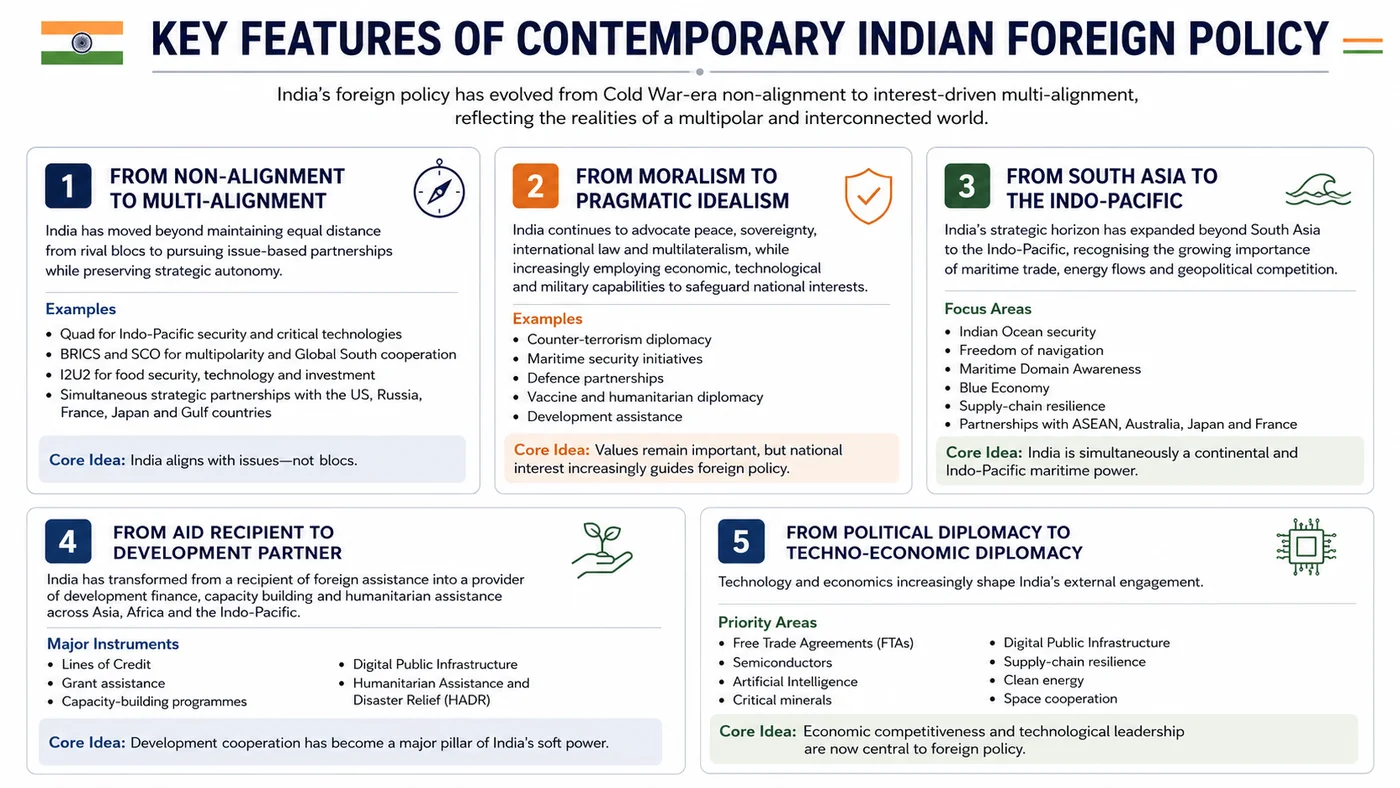
Issue-based multi-alignment, present. Partnering with different countries on different issues while avoiding dependence on any single bloc.
- Quad with the United States, Japan and Australia for a free and open Indo-Pacific
- BRICS and SCO with Russia and China for Eurasian and Global South engagement
- I2U2 with Israel, the UAE and the United States for technology, food and investment
- India-France partnership in the Indian Ocean
- India-Russia for defence and energy
- India-US for technology, defence, diaspora and the Indo-Pacific
The one-line version: idealism, then realism, then regional leadership, then economic pragmatism, then economic diplomacy, then multi-alignment.
The Determinants
Geography is the most permanent. Himalayan borders shape relations with China and Nepal. The western frontier drives Pakistan and Afghanistan policy. The Indian Ocean links India to West Asia, Africa and Southeast Asia. A long coastline and extensive land borders force India to be both a continental and a maritime power, which is expensive and unavoidable.
History and civilisational links supply soft power: Buddhist connections with Sri Lanka, Myanmar, Thailand, Japan, Vietnam and Mongolia, and shared cultural heritage across South and Southeast Asia.
Economic capability determines how much of any ambition is affordable, which is why the 1991 reforms mattered more to foreign policy than any doctrine.
Domestic politics, military capacity, the structure of the international system, energy needs and the diaspora complete the set.
The Honest Assessment
Multi-alignment is often described as India having it both ways. That understates the difficulty and overstates the freedom.
The advantages are real: leverage in every direction, no single dependency, and the ability to extract benefits from rivals simultaneously. The costs are also real. Partners discount commitments from a state that will not commit. Sitting in both the Quad and the SCO means neither treats India as a full member of its inner logic. And multi-alignment requires diplomatic bandwidth and consistent capability that a middle-income state has to ration.
The deeper point is that multi-alignment is not a doctrine India chose in the abstract. It is what strategic autonomy looks like when a country is large enough to be courted and not yet strong enough to lead.
The Way Forward
- Build capability faster than commitments, since autonomy without capacity is merely refusal.
- Deepen the Indian Ocean position, where India’s geography gives it advantages no partner can substitute.
- Convert economic diplomacy into supply-chain security rather than headline trade targets.
- Keep issue-based groupings issue-based, resisting pressure to convert them into alliances.
- Invest in diplomatic bandwidth, which is the binding constraint on a multi-aligned strategy.
Frequently Asked Questions
What is foreign policy?
The principles, objectives and strategies through which a country manages its relations with other states and international institutions in order to safeguard its national interests. It is shaped by geography, history, capability and the structure of the international system, not by preference alone.
What were the phases of India’s foreign policy?
Six. Idealism and non-alignment from 1947 to 1962; the realist turn and security consolidation from 1962 to 1971; regional primacy and strategic autonomy from 1971 to 1991; post-Cold War pragmatism from 1991 to 2008; economic diplomacy and global integration from 2008; and the present phase of issue-based multi-alignment.
What was Panchsheel?
The Five Principles of Peaceful Coexistence, promoted in 1954: mutual respect for territorial integrity and sovereignty, mutual non-aggression, non-interference in internal affairs, equality and mutual benefit, and peaceful coexistence. It was the normative core of early Indian diplomacy.
How did the 1962 war change Indian foreign policy?
It exposed the limits of idealism without military preparedness. India shifted towards a security-centric posture, strengthening defence, border management and strategic partnerships. The 1965 and 1971 wars with Pakistan, alongside growing China-Pakistan cooperation, reinforced that shift.
What was the significance of the 1971 Treaty with the Soviet Union?
The Treaty of Peace, Friendship and Cooperation helped India counter the emerging United States-China-Pakistan alignment during the Bangladesh Liberation War, while India formally retained its non-aligned position. It showed that non-alignment was a strategy rather than a doctrine of isolation.
What is strategic autonomy?
The capacity to take independent decisions on national interest without being constrained by alliance obligations. It is the continuous thread running from non-alignment through to multi-alignment, and it explains why India joins issue-based groupings rather than formal alliances.
What is issue-based multi-alignment?
Partnering with different countries on different issues while avoiding dependence on any single bloc. India works with the United States, Japan and Australia through the Quad on the Indo-Pacific, with Russia and China through BRICS and the SCO on Eurasian and Global South questions, with Israel, the UAE and the United States through I2U2 on technology and food, with France in the Indian Ocean, and with Russia on defence and energy.
What are the main determinants of India’s foreign policy?
Geography, which is the most permanent; history and civilisational links; economic capability; domestic politics; military capacity; the structure of the international system; energy and resource needs; and the diaspora. Geography sets the constraints, capability sets the options.
Practice Questions
Prelims MCQs
- Panchsheel, the Five Principles of Peaceful Coexistence, was promoted in
(a) 1947
(b) 1950
(c) 1954
(d) 1961
Answer: (c) Panchsheel was articulated in 1954 and became a normative anchor of early Indian diplomacy. - The Treaty of Peace, Friendship and Cooperation with the Soviet Union was signed in
(a) 1962
(b) 1965
(c) 1971
(d) 1974
Answer: (c) The 1971 treaty helped India counter the US-China-Pakistan alignment during the Bangladesh Liberation War. - The Look East Policy was launched in which phase of India's foreign policy?
(a) Idealism and non-alignment
(b) Realist turn
(c) Post-Cold War pragmatism
(d) Multi-alignment
Answer: (c) Look East was a product of the post-1991 pragmatic phase, alongside improved ties with the US and normalisation with Israel. - India's total exports of goods and services in FY 2024-25 were estimated at approximately
(a) USD 420 billion
(b) USD 620 billion
(c) USD 820 billion
(d) USD 1,020 billion
Answer: (c) Estimated at about USD 820.93 billion, which is why economic diplomacy is now central to foreign policy. - I2U2 is a grouping of
(a) India, Iran, UAE, USA
(b) India, Israel, UAE, USA
(c) India, Indonesia, UK, USA
(d) India, Israel, Uzbekistan, UAE
Answer: (b) I2U2 covers technology, food security, clean energy, water, transport and investment.
Mains Questions
- India's foreign policy has evolved from non-alignment to multi-alignment while retaining strategic autonomy. Examine the continuity beneath the change. (250 words)
- The 1962 war marked the end of idealism in Indian foreign policy. Critically evaluate. (250 words)
- Geography is the most permanent determinant of India's foreign policy. Discuss with examples. (150 words)
- Assess the role of economic diplomacy in contemporary Indian foreign policy. (250 words)
- Issue-based multi-alignment carries risks as well as advantages. Discuss. (150 words)
Tell Google you want more of this.
Add Anantam IAS as a preferred sourceOne tap, and this site shows up more often in your own Top Stories, AI Overviews and AI Mode. Remove it any time.