The Non-Aligned Movement (NAM) is a grouping of states that chose not to formally align with either the United States-led Western bloc or the Soviet-led Eastern bloc during the Cold War. Founded at the 1961 Belgrade Conference, NAM today has 120 member states, making it the largest grouping of countries outside the United Nations. India was a founding member and, alongside Egypt, Yugoslavia, Indonesia and Ghana, one of the intellectual architects of the movement.
For UPSC, NAM is a core topic in International Relations (GS2), India’s post-independence foreign policy, and the politics of the Global South.
Cold War Context
After the Second World War (1945), the world split into two antagonistic blocs.
| Bloc | Leader | Alliance | Ideology |
|---|---|---|---|
| Western bloc | USA | NATO (1949) | Liberal democracy, capitalism |
| Eastern bloc | USSR | Warsaw Pact (1955) | Communism, planned economy |
Newly independent countries in Asia and Africa faced pressure to pick a side. Many — led by India — argued for a third path: independent foreign policy, peaceful coexistence and no military alliances.
Origins of NAM
1. Panchsheel Agreement (1954)
On 29 April 1954, India and China signed the Panchsheel (Five Principles of Peaceful Coexistence). These became the ethical backbone of NAM.
| # | Principle |
|---|---|
| 1 | Mutual respect for territorial integrity and sovereignty |
| 2 | Mutual non-aggression |
| 3 | Mutual non-interference in internal affairs |
| 4 | Equality and mutual benefit |
| 5 | Peaceful co-existence |
2. Bandung Conference (1955)
The Afro-Asian Conference was held in Bandung, Indonesia (18–24 April 1955), with 29 newly independent countries participating.
| Aspect | Detail |
|---|---|
| Host | President Sukarno of Indonesia |
| Key Participants | India (Nehru), China (Zhou Enlai), Egypt (Nasser), Ghana (Nkrumah), Indonesia (Sukarno) |
| Outcome | Bandung Declaration with 10 principles, expanding Panchsheel |
The Bandung Conference is considered the ideological precursor of NAM.
3. Brioni Meeting (1956)
On 19 July 1956, three leaders met at Brioni Island, Yugoslavia and formalised the idea of non-alignment:
- Jawaharlal Nehru (India)
- Josip Broz Tito (Yugoslavia)
- Gamal Abdel Nasser (Egypt)
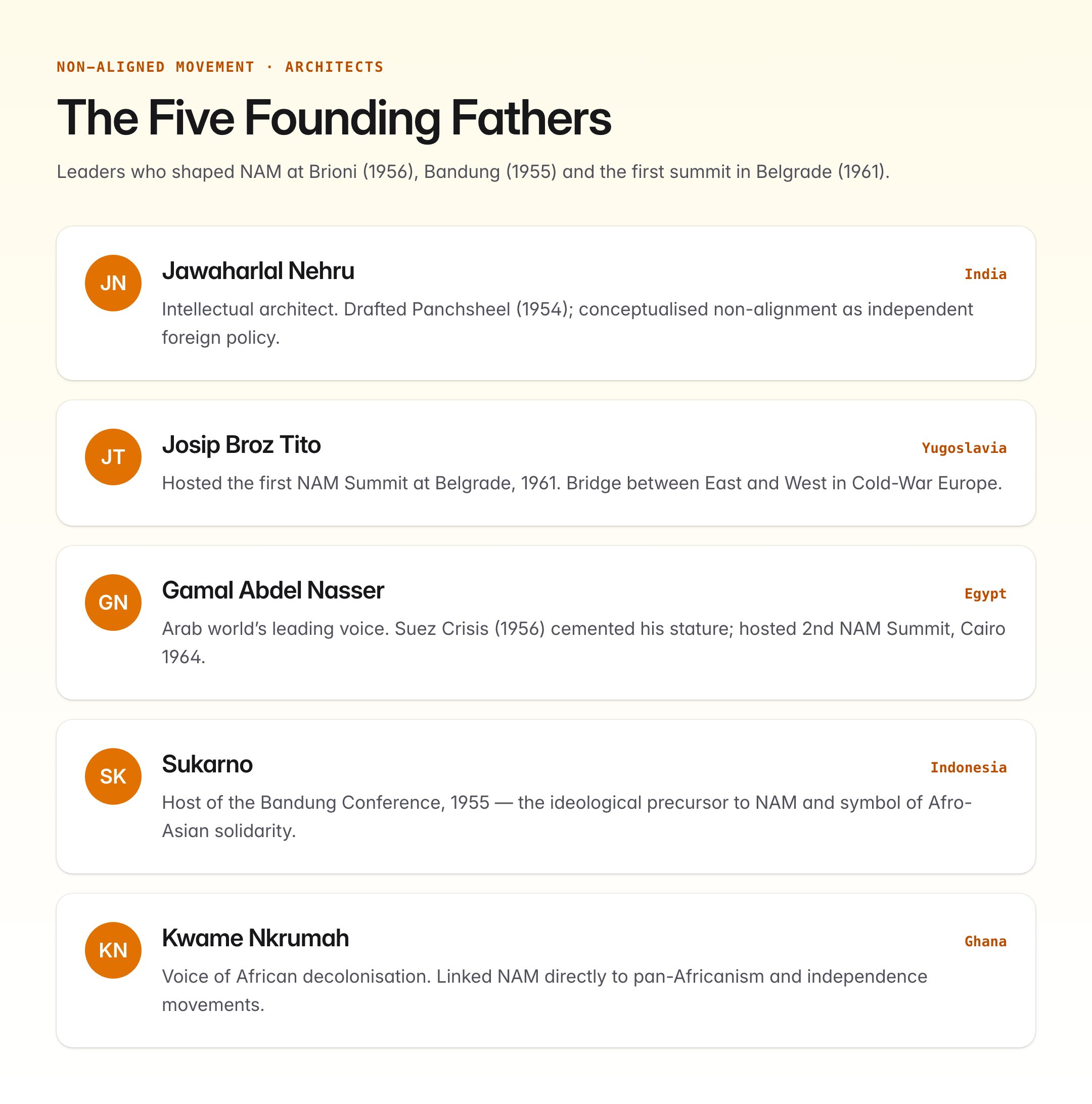
The Five Founding Fathers
| Leader | Country | Role |
|---|---|---|
| Jawaharlal Nehru | India | Intellectual architect, concept of non-alignment |
| Josip Broz Tito | Yugoslavia | Host of first summit; bridge between East and West |
| Gamal Abdel Nasser | Egypt | Arab world's leading voice; Suez Crisis 1956 |
| Sukarno | Indonesia | Bandung host; Asian-African solidarity |
| Kwame Nkrumah | Ghana | Voice of African decolonisation |
First NAM Summit — Belgrade 1961
The first summit was held in Belgrade, Yugoslavia (1–6 September 1961).
| Aspect | Detail |
|---|---|
| Members | 25 countries + 3 observers |
| Chairperson | Marshal Tito |
| Key Theme | Decolonisation, disarmament, peaceful coexistence |
| Outcome | Founding Declaration; NAM formally established |
Core Principles of NAM
Adopted at Cairo in 1961, the original criteria for NAM membership were:
| # | Criterion |
|---|---|
| 1 | Pursue an independent foreign policy based on peaceful coexistence and non-alignment |
| 2 | Support national liberation movements consistently |
| 3 | Should not be a member of a multilateral military alliance linked to great-power conflicts |
| 4 | If member of a bilateral military agreement, it must not be in the context of Cold War conflict |
| 5 | If hosting a foreign military base, it must not be in the context of great-power conflict |
Objectives of NAM
- Oppose colonialism, neo-colonialism, imperialism and racism
- Promote peaceful coexistence and non-interference
- Work for disarmament and nuclear non-proliferation
- Advocate a New International Economic Order (NIEO)
- Strengthen the United Nations and multilateralism
- Support national sovereignty and equality of states
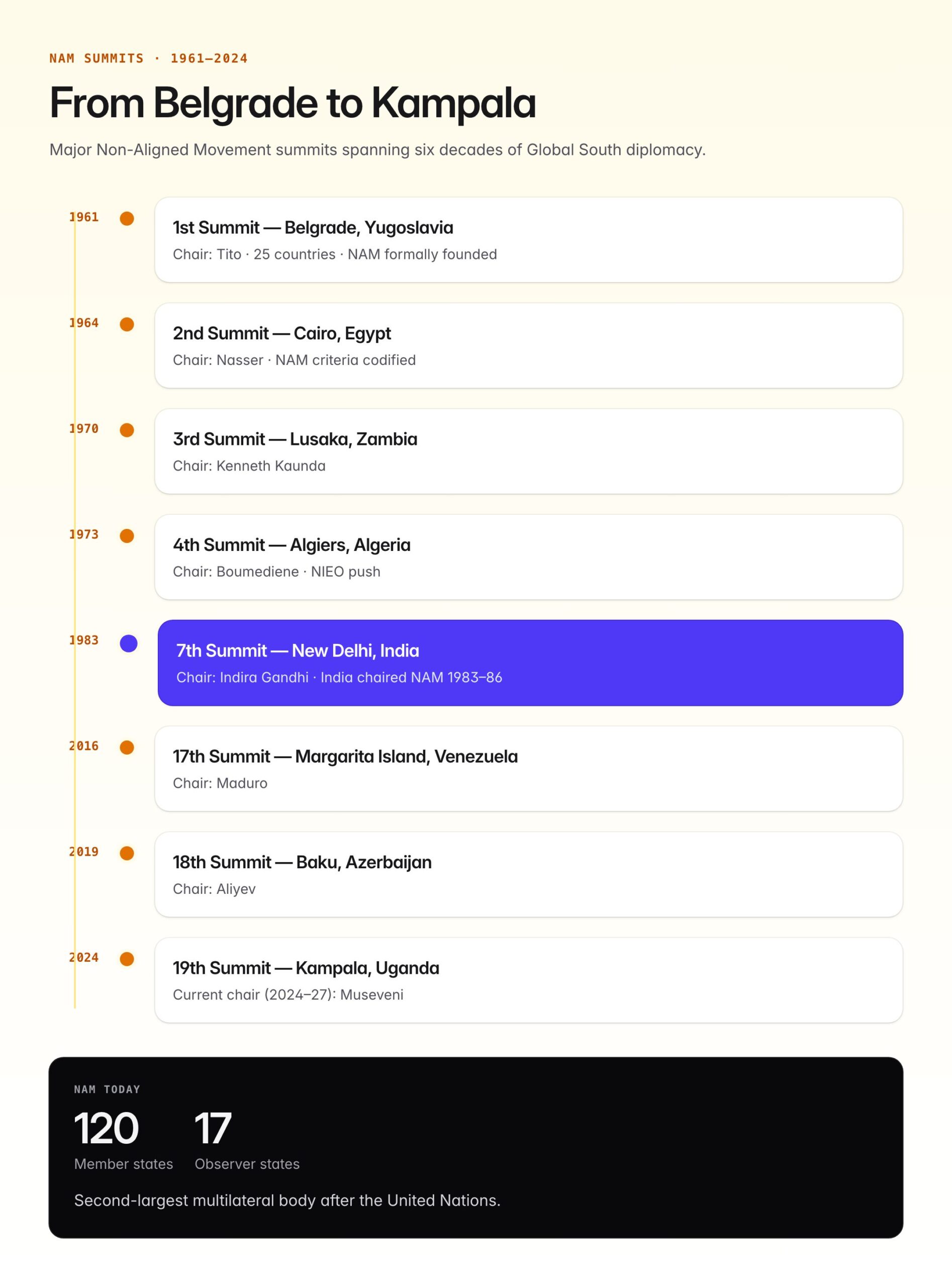
Major NAM Summits
| # | Year | Host | Host Country | Presiding Leader |
|---|---|---|---|---|
| 1 | 1961 | Belgrade | Yugoslavia | Tito |
| 2 | 1964 | Cairo | Egypt | Nasser |
| 3 | 1970 | Lusaka | Zambia | Kenneth Kaunda |
| 4 | 1973 | Algiers | Algeria | Houari Boumediene |
| 5 | 1976 | Colombo | Sri Lanka | Sirimavo Bandaranaike |
| 6 | 1979 | Havana | Cuba | Fidel Castro |
| 7 | 1983 | New Delhi | India | Indira Gandhi |
| 17 | 2016 | Margarita Island | Venezuela | Maduro |
| 18 | 2019 | Baku | Azerbaijan | Aliyev |
| 19 | 2024 | Kampala | Uganda | Museveni |
India's Role in NAM
India has been the intellectual and moral anchor of the movement from day one.
| Era | Contribution |
|---|---|
| Nehru era (1947–64) | Conceptualised non-alignment; drafted Panchsheel; hosted 1983 summit later |
| Indira Gandhi era | Hosted 7th NAM Summit in New Delhi (1983); India chaired NAM 1983–86 |
| Post-Cold War | Continued participation; reframed NAM for development, climate, reform of UN |
| 21st century | India advocates NAM revitalisation; PM Modi addressed 2020 Online Summit and 2024 Kampala Summit (via External Affairs Minister) |
Indira Gandhi at the 7th Summit, New Delhi (1983)
India chaired NAM from 1983 to 1986. Indira Gandhi's opening speech emphasised:
- Nuclear disarmament
- New International Economic Order
- Peaceful settlement of regional conflicts
- Apartheid in South Africa
NAM After the Cold War
The fall of the USSR in 1991 raised questions about NAM's continued relevance.
| Debate | Argument |
|---|---|
| For continued relevance | Global South still faces unequal trade, climate injustice, Western dominance |
| Against relevance | Original bipolar context is gone; major members (India, China) pursue strategic autonomy through new groupings (BRICS, G20, SCO) |
NAM has shifted focus to:
- Climate change and sustainable development
- UN Security Council reform
- Fair global trade
- Terrorism and transnational crime
- Pandemics and global health equity
NAM Today: Key Facts
| Aspect | Detail |
|---|---|
| Member States | 120 countries |
| Observer states | 17 |
| Headquarters | No permanent HQ; current chair's capital serves as centre |
| Current Chair (2024–27) | Uganda (19th Summit, Kampala, January 2024) |
| Largest grouping | Second-largest multilateral body after the UN |
NAM vs Other Groupings
| Grouping | Core Focus | India's Role |
|---|---|---|
| NAM | Political-strategic autonomy, Global South solidarity | Founding member |
| G77 | Economic cooperation of developing nations | Founding member (1964) |
| BRICS | Emerging economies | Founding member (2009) |
| SCO | Eurasian security | Full member (2017) |
| QUAD | Indo-Pacific security | Member (2017 revival) |
Relevance of NAM Today
- Continues to be a moral voice of the Global South on climate justice, vaccine equity, debt crises
- Reflects India's doctrine of strategic autonomy
- Platform to push UN Security Council reform
- Framework to address food, fuel and fertiliser crises exposed by recent conflicts
- Provides space for South-South cooperation
Criticisms of NAM
- Lacks institutional decision-making mechanisms
- Diverse membership makes consensus difficult
- Some members hold conflicting positions (e.g., India vs Pakistan)
- Viewed as less relevant in a multipolar, post-Cold War world
- Has struggled to move from rhetoric to concrete outcomes
UPSC Relevance
GS2 (IR): India's foreign policy, groupings of which India is part, Global South diplomacy.
Key Prelims facts:
- NAM founded at Belgrade Summit, 1961
- Five founding fathers: Nehru, Tito, Nasser, Sukarno, Nkrumah
- Bandung Conference (1955) in Indonesia preceded NAM
- Panchsheel (1954) between India and China was an ideological foundation
- Brioni meeting (1956) between Nehru, Tito and Nasser shaped NAM
- India hosted the 7th NAM Summit (1983) in New Delhi under Indira Gandhi
- NAM has 120 member states today — second-largest after UN
- 19th NAM Summit: Kampala, Uganda (2024); Uganda is current chair
- NAM criteria codified in Cairo (1961)
- India's position: strategic autonomy, reform of UN, climate justice
Tell Google you want more of this.
Add Anantam IAS as a preferred sourceOne tap, and this site shows up more often in your own Top Stories, AI Overviews and AI Mode. Remove it any time.