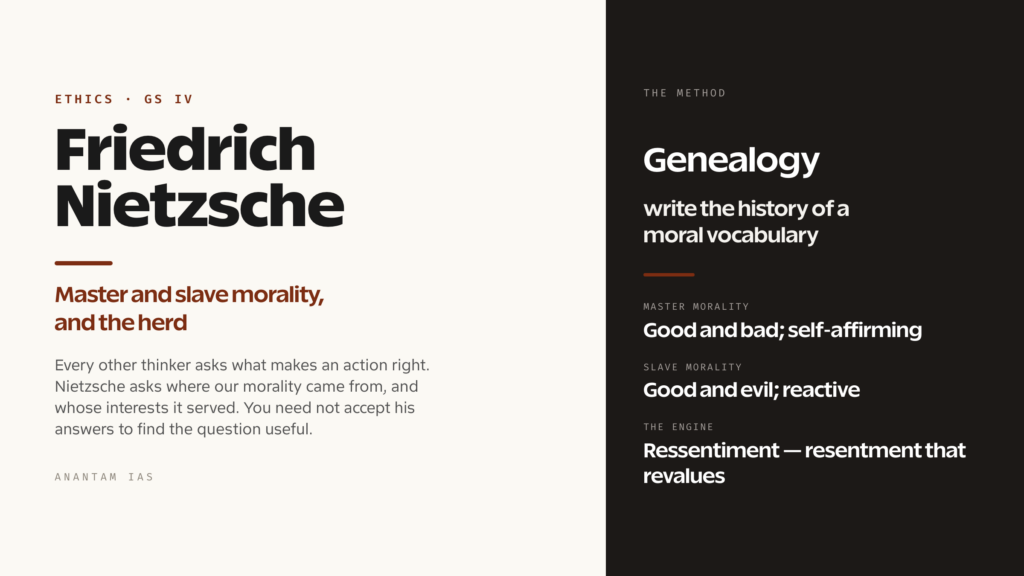
Every other thinker in this part of the syllabus asks a version of the same question: what makes an action right? Kant looks for a rule any rational being could will. Bentham counts consequences. Aristotle asks what a person of good character would do. Each assumes morality is the sort of thing that can be justified, and sets out to justify it.
Nietzsche asks something else entirely. Not is this morality correct, but where did it come from, and whose interests did it serve? He treats moral systems as historical products with a genealogy, and suspects that what a society calls good often reflects the needs of those who found it useful to call it that. You do not have to accept his conclusions to find the question permanently useful — and for a paper about the values of public servants, a thinker who asks whose interests a set of values quietly protects is worth taking seriously.
The Genealogical Method
Nietzsche’s approach in On the Genealogy of Morals is to write the history of a moral vocabulary. His claim is that our current sense of good and evil is not self-evident or eternal but the residue of a long contest, and that examining its origins tells us something its defenders would rather not face.
The method has an obvious logical hazard, and critics name it immediately: showing that a belief has a disreputable origin does not show it is false. That is the genetic fallacy. A doctrine of human equality would not be refuted by discovering it was first advanced by people who stood to gain from it.
Nietzsche’s better defence is that he is not primarily arguing about truth. He is arguing about value — whether a given morality is good for the people who hold it, whether it makes them stronger or weaker, more or less capable of achievement. On that question, origins are relevant evidence.
Master Morality and Slave Morality
The distinction is his most cited and most misunderstood contribution.
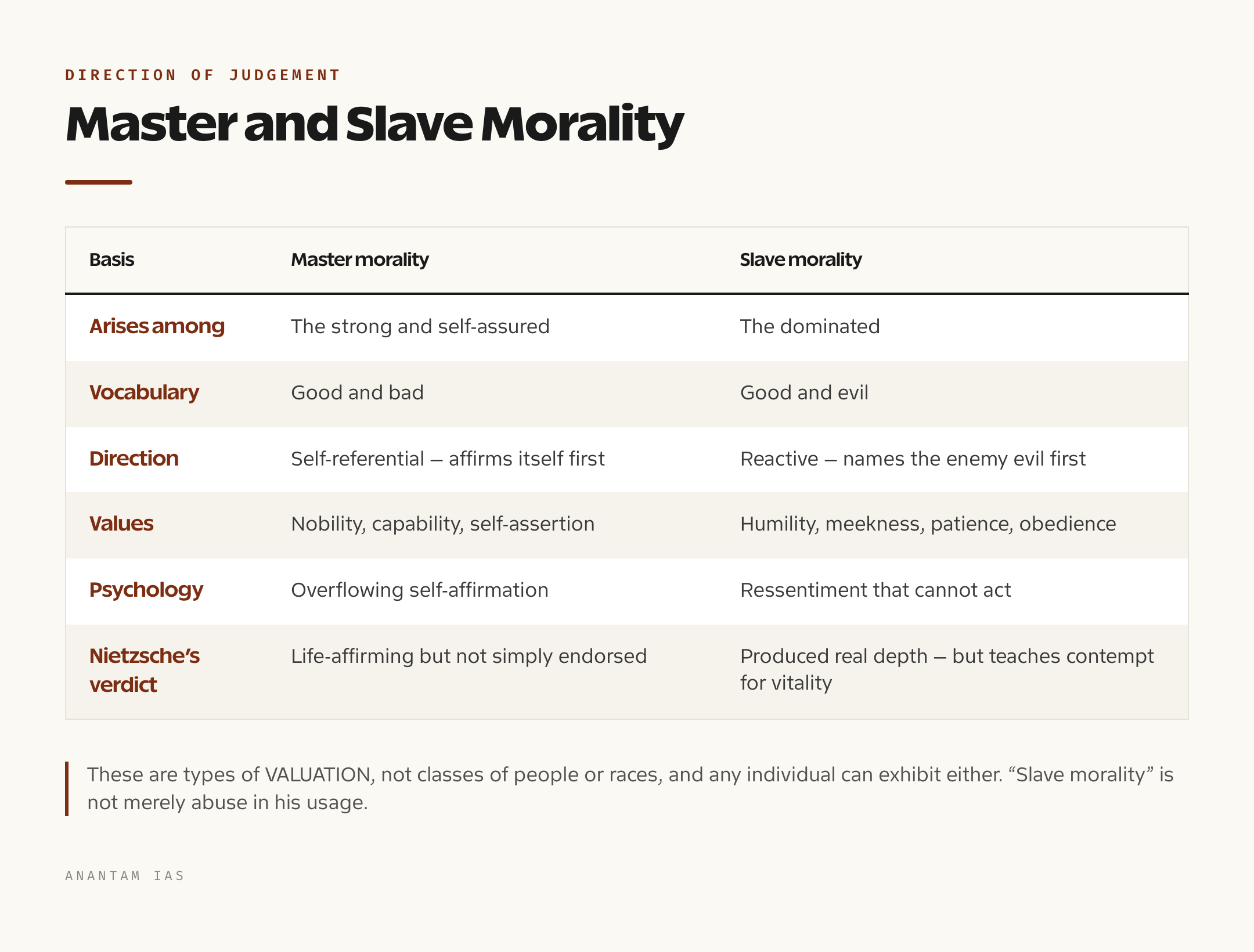
Master morality arises among the strong and self-assured. It is a morality of good and bad, where good means noble, capable, powerful, life-affirming, and bad simply means what is contemptible or weak. Crucially, it is self-referential: the noble type looks at itself, calls what it finds good, and only then notices what is unlike it. Its judgement flows outward from a positive self-affirmation.
Slave morality arises among the dominated. It is a morality of good and evil, and it is reactive: it begins by identifying the powerful as evil, and derives its own goodness from the negation of them. Humility, meekness, patience, obedience and self-denial become virtues; pride, strength and self-assertion become sins. The valuation runs inward from a prior judgement about the enemy.
The psychological engine of this reversal is ressentiment — a durable, festering resentment of the strong that cannot express itself in action and so expresses itself in revaluation instead. Unable to defeat the powerful, the weak redefine power as wickedness and their own condition as virtue. Nietzsche called this the slave revolt in morals, and he regarded it as the most consequential event in the history of values.
Two things must be said plainly. Nietzsche is describing types of valuation, not classes of people or races, and any individual can exhibit either. And “slave morality” is not simply a term of abuse in his usage: he thought it produced real depth, subtlety and interiority. His objection is that it became the only permitted morality, and that it teaches contempt for vitality.
Will to Power, and What It Is Not
The will to power is Nietzsche’s proposed basic drive: not the desire to dominate others but a more general striving to grow, to overcome resistance, to extend one’s capacities. Read this way, an artist perfecting a form and a scholar mastering a discipline express it as fully as any conqueror; self-overcoming is its highest expression.
Nietzsche contrasts it with the will to survive and with the pursuit of comfort. His charge against utilitarianism is exactly here: an ethics organised around maximising pleasure and minimising pain treats the avoidance of suffering as the point of life, when suffering is a condition of every serious achievement. He is scathing about what he sees as an ethics fit for shopkeepers.
The Übermensch — overman — is the figure who creates values rather than inheriting them, having recognised that no external authority underwrites them. This is what “God is dead” announces: not atheism as a doctrinal claim, but the collapse of the metaphysical guarantee that Western morality assumed. Nietzsche treats that collapse as a crisis, not a liberation, and feared nihilism as the likely consequence — the conclusion that since nothing is guaranteed, nothing matters. His transvaluation of values is the attempted answer: consciously creating values that affirm life rather than deny it.
Two associated ideas are worth knowing. Amor fati — love of fate — is the disposition of affirming one’s life including its suffering. Eternal recurrence poses it as a test: if you had to live this same life again endlessly, could you welcome it?
The Nazi Association Is a Distortion
This has to be addressed directly, because it is the first thing many readers have heard.
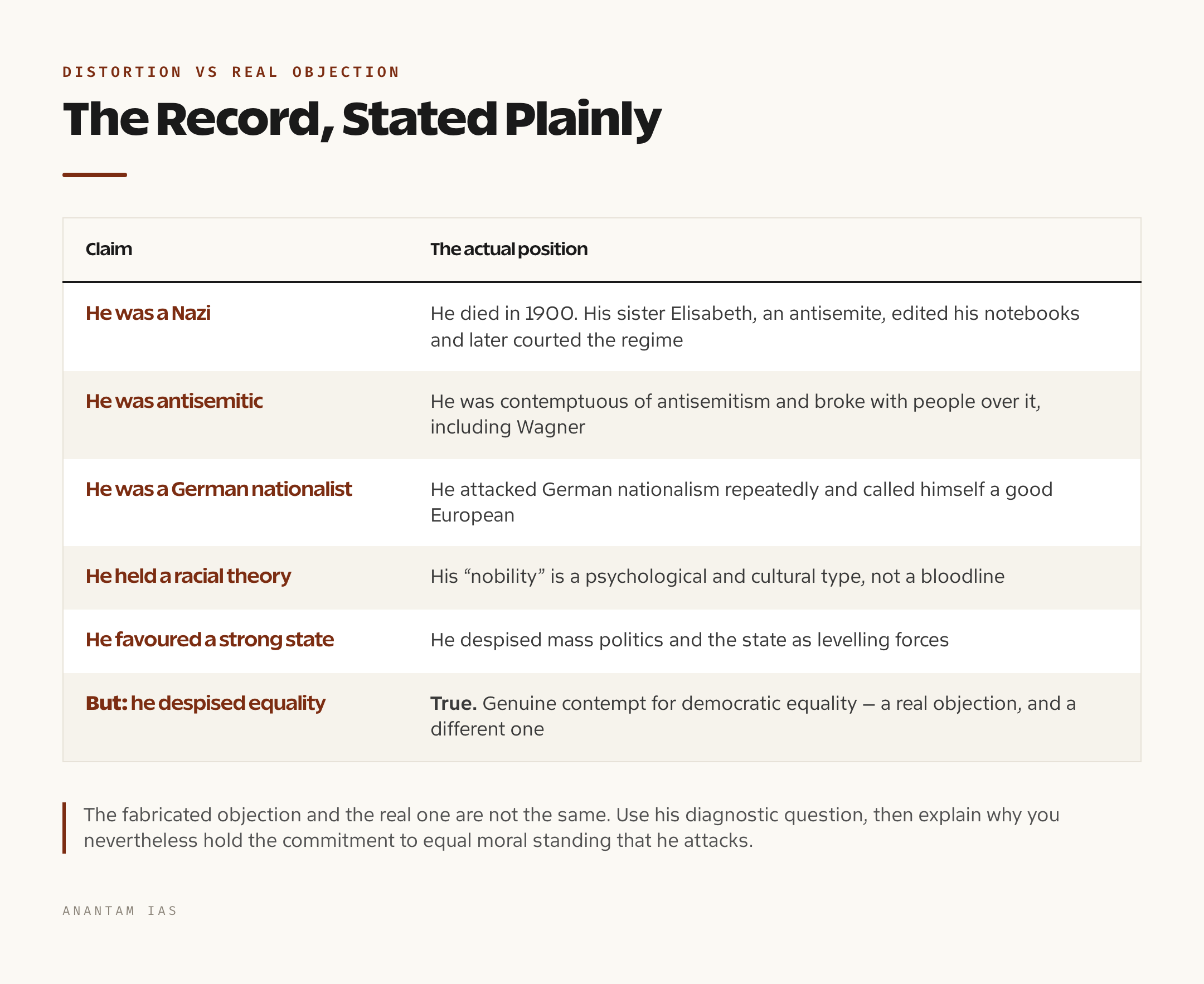
Nietzsche died in 1900. His sister Elisabeth Förster-Nietzsche, an antisemite and German nationalist, took control of his unpublished notebooks after his collapse and assembled selections into The Will to Power, editing and arranging material to suit her own politics. She later cultivated the Nazi regime, which found the vocabulary of strength and the Übermensch convenient.
Nietzsche’s own texts run the other way on the specific points. He was contemptuous of antisemitism and broke with people over it, including his publisher and, notably, Wagner. He attacked German nationalism repeatedly and described himself as a good European. He had no theory of racial hierarchy; his “nobility” is a psychological and cultural type, not a bloodline. And he despised mass politics and the state as levelling forces — the least promising foundation imaginable for a totalitarian movement.
None of that makes him comfortable. His contempt for democratic equality is genuine, his remarks on women are indefensible, and an ethics of value-creating individuals gives weak protection to the weak. Those are real objections, and they are different objections from the fabricated one.
Using Nietzsche Honestly
He is not a source of policy prescriptions. His value in this paper is diagnostic, and there are four defensible uses.
Interrogating inherited values. Nietzsche’s question — whose interests does this value protect, and who taught us to hold it? — is a legitimate tool for examining any moral consensus, including administrative ones. Where “propriety”, “discipline” or “decorum” are invoked to suppress dissent, the genealogical question is the right one.
Diagnosing ressentiment in public life. Politics driven by grievance against a resented group, where the aim is the humiliation of the other rather than any positive good, is exactly Nietzsche’s mechanism. This is analytically useful and does not require endorsing his prescriptions.
Guarding against herd conformity. His critique of the herd converges with Arendt on thoughtlessness and with Kohlberg’s conventional stage — the person whose conscience is calibrated to what everyone around them is doing. Moral courage requires the capacity to hold a position the group rejects, which is the same insight from the other side; see Hannah Arendt on thoughtlessness.
As the strongest objection to the rest of the syllabus. An answer that can state the Nietzschean challenge to Kant, Bentham and Mill — that they universalise one historically specific morality and mistake it for reason itself — demonstrates real command. See the utilitarians.
Where he must be resisted is on the value of equal moral standing. A constitutional order rests on the premise that persons are entitled to equal concern regardless of capacity or achievement, and Nietzsche gives no support for it. The right move in an answer is to use his diagnostic question and then explain why one nevertheless holds the commitment he attacks.
FAQ
What is the difference between master and slave morality? Master morality is self-affirming and judges in terms of good and bad, calling noble what it finds in itself. Slave morality is reactive and judges in terms of good and evil, first identifying the powerful as evil and deriving its own virtues from negating them.
What is ressentiment? A lasting resentment of the strong that cannot express itself in action and so expresses itself by revaluing: redefining power as wickedness and one’s own powerlessness as virtue.
Is the will to power about dominating others? No. It is a general drive to grow, overcome resistance and extend one’s capacities. Nietzsche treats self-overcoming as its highest form, so an artist or scholar can express it as fully as a conqueror.
What does “God is dead” mean? Not a doctrinal claim about atheism but the collapse of the metaphysical guarantee that European morality had assumed. Nietzsche saw it as a crisis likely to produce nihilism, not as a liberation.
Was Nietzsche a Nazi or an antisemite? No. He died in 1900; his sister Elisabeth edited his notebooks and later courted the Nazi regime. Nietzsche himself attacked antisemitism, German nationalism and mass politics, and had no racial theory. His real objectionable positions — contempt for equality, remarks on women — are different from that fabrication.
Can Nietzsche be used in a GS IV answer? Yes, diagnostically: to interrogate whose interests a value protects, to name grievance-driven politics, and to state the strongest objection to Kantian and utilitarian universalism. He is not a source of policy prescriptions and gives no support for equal moral standing.
Practice Questions
Prelims MCQs
- In Nietzsche’s account, slave morality is characterised as: (a) self-affirming and outward-flowing (b) reactive, beginning by identifying the powerful as evil (c) indifferent to power (d) derived from divine command — Answer: (b) Its valuation begins with a judgement about the enemy.
- “Ressentiment” in Nietzsche refers to: (a) rational disagreement (b) resentment that cannot act and so revalues instead (c) nostalgia for aristocracy (d) sympathy for the weak — Answer: (b) It is the psychological engine of the slave revolt in morals.
- The “will to power” is best understood as: (a) the desire to rule others (b) a striving to grow and overcome resistance, including self-overcoming (c) the instinct for self-preservation (d) the pursuit of pleasure — Answer: (b) Nietzsche explicitly contrasts it with mere survival and comfort.
- The Will to Power as a published book was: (a) completed by Nietzsche in 1888 (b) assembled from his notebooks by his sister after his collapse (c) written jointly with Wagner (d) a collection of his letters — Answer: (b) Elisabeth Förster-Nietzsche edited and arranged the material.
- Nietzsche’s principal objection to utilitarianism was that it: (a) miscalculates consequences (b) treats avoidance of suffering as life’s point, when suffering conditions achievement (c) ignores individual rights (d) relies on divine sanction — Answer: (b) This is the root of his contempt for what he saw as an ethics of comfort.
Mains Practice Questions
- “Nietzsche asks not whether a morality is true but whose interests it serves.” Examine the genealogical method and the genetic-fallacy objection to it. (15 marks, 250 words)
- Distinguish master morality from slave morality. Is Nietzsche’s account a description of psychological types or a defence of hierarchy? (15 marks, 250 words)
- Nietzsche’s critique of herd morality converges with Arendt on thoughtlessness. Discuss what both imply for moral courage in a bureaucracy. (15 marks, 250 words)
- “The Nazi appropriation of Nietzsche was a distortion, but his contempt for equality was genuine.” Discuss how a public servant should read a thinker on these terms. (10 marks, 150 words)
- Explain the transvaluation of values as Nietzsche’s response to the threat of nihilism. (10 marks, 150 words)
Tell Google you want more of this.
Add Anantam IAS as a preferred sourceOne tap, and this site shows up more often in your own Top Stories, AI Overviews and AI Mode. Remove it any time.