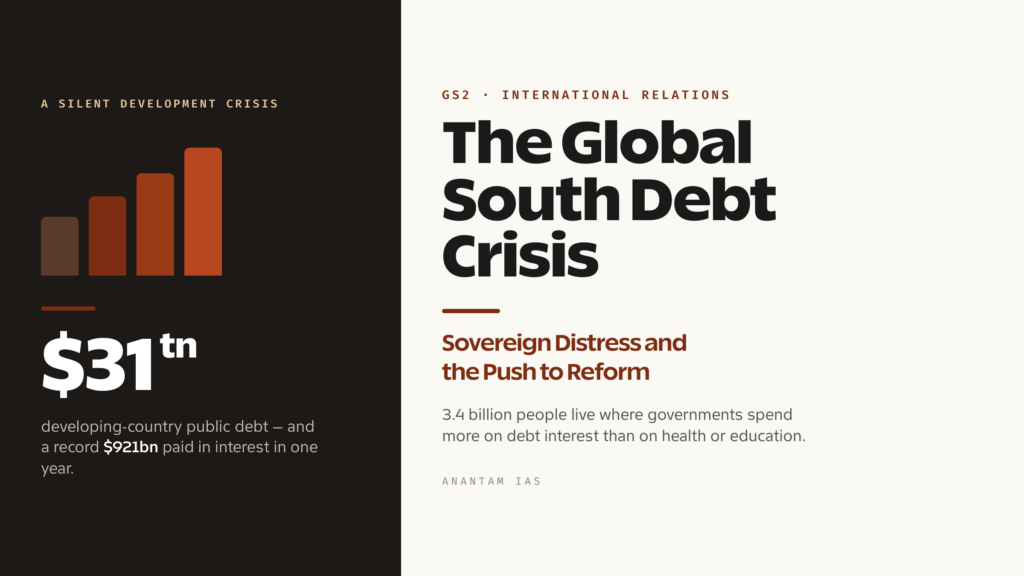
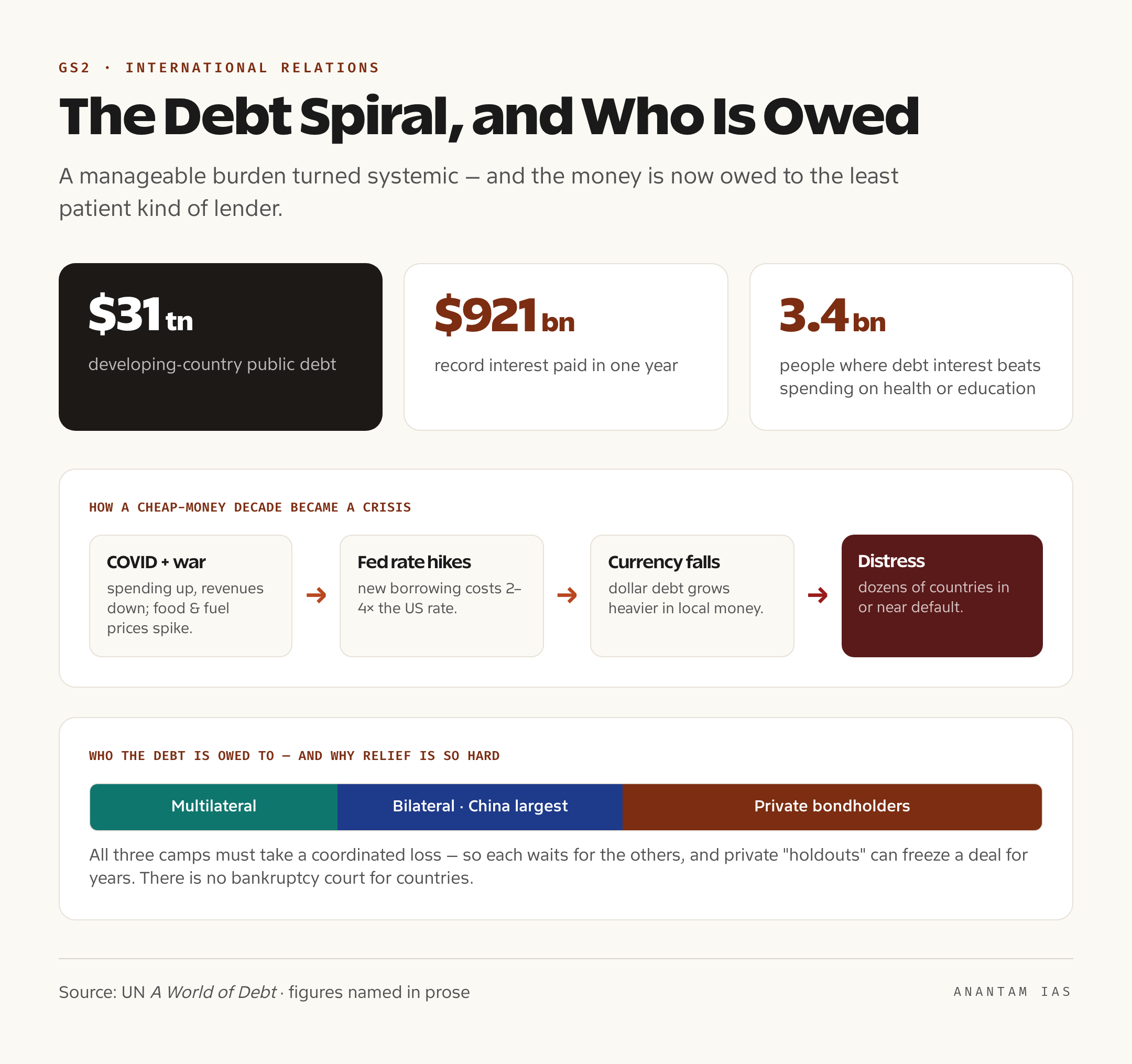
In June 2025, the United Nations put a single number on a problem that had been building for years. Developing countries now owe around $31 trillion in public debt, and in one year alone they paid a record $921 billion just in interest on it. Strip away the abstraction and the figure lands hard: roughly 3.4 billion people — more than two in five humans alive — live in a country that spends more on servicing its debt than on either health or education. The UN calls it a “silent” or “development” crisis, because no single bank collapses and no single currency crashes on a given morning. The damage shows up slowly, in clinics that don’t get built and teachers who don’t get paid, while the money flows out to creditors abroad.
This is the Global South debt crisis, and it sits at the heart of GS Paper 2’s international-relations syllabus — the workings of global institutions, the gap between the developed and developing worlds, and India’s claim to speak for the latter. For an aspirant it ties together a dozen threads that usually get studied in isolation: the IMF and World Bank, the G20, China’s rise as a creditor, climate finance, and the slow drift toward a more multipolar economy. And it matters for India directly. India’s own external debt is comfortably sustainable, which is exactly why it can afford to champion the cause of countries whose debt is not — positioning itself, again and again, as the voice of the Global South.
How the Debt Mountain Was Built
Start with how a manageable burden turned into a crisis, because the chain of causes is examinable in itself. For most of the 2010s, developing countries borrowed cheaply. Global interest rates were near zero, money was hunting for yield, and bond markets were happy to lend to emerging economies that promised a better return than rich-world debt. Governments took the offer, financing roads, power and social spending. So far, so ordinary. The trouble was the kind of debt they were taking on — and what would happen when conditions turned.
Then came a stacked sequence of shocks. The COVID-19 pandemic forced governments everywhere to spend heavily on health and relief while their revenues collapsed, pushing borrowing sharply up. Before balance sheets could recover, the war in Ukraine sent food and fuel prices spiking, which hit import-dependent poorer countries hardest. And to fight the resulting inflation, the US Federal Reserve and other rich-world central banks raised interest rates at the fastest pace in decades. For a developing country, that final move was brutal in two ways at once. New borrowing suddenly cost far more. And as investors chased higher US returns, capital fled emerging markets, so their currencies fell against the dollar. A weaker local currency makes dollar-denominated debt mechanically more expensive to repay — you need more rupees, or kwacha, or rupiah to buy each dollar you owe. As UNCTAD’s annual A World of Debt report has stressed, developing countries since 2020 have been borrowing at rates two to four times higher than the United States, a penalty that has little to do with their actual policies and much to do with how the system is wired.
The deeper structural shift, though, is in who the lending came from. A generation ago, a poor country’s debt was mostly owed to other governments and to multilateral lenders like the World Bank, on long, cheap, patient terms. Now a far larger share is owed to private bondholders on Wall Street and in London, and to a new set of bilateral lenders led by China. Private debt is costlier and far harder to restructure, because the creditors are scattered, anonymous and legally entitled to demand full repayment. This is the trap. The same countries that most need breathing room are locked into the most unforgiving kind of debt, and the architecture built to help them — designed for an older, simpler world of government-to-government loans — no longer fits the problem it faces.
Who Is Owed, and Why It Is So Hard to Fix
Now the creditors, because you cannot understand why restructuring fails without knowing who has to agree to it. A modern sovereign-debt pile has three rough camps, each pulling in a different direction. The first is the multilaterals — the IMF and World Bank — who lend on concessional terms and by convention are repaid first, treated as “preferred creditors” so that the global safety net stays solvent. The second is bilateral creditors, governments lending to other governments. Once this meant the rich democracies of the Paris Club; today the single largest bilateral lender to the developing world is China, which built up enormous claims through Belt and Road infrastructure lending and which is not a Paris Club member. The third is private creditors — the bondholders and commercial banks who now hold the biggest share and the priciest terms.
The reason a default is so hard to resolve is that all three camps must take a coordinated loss for a restructuring to work, and each has an incentive to wait for the others to move first. If China grants relief but private bondholders refuse, China is effectively subsidising Wall Street. If bondholders accept a “haircut” — a cut in what they’re owed — but suspect official creditors aren’t sharing the pain equally, they hold out. This is the “holdout” problem, and it can freeze a country in limbo for years while its economy bleeds. You can read this dynamic in a deeper analysis of how global institutions and South-South cooperation are reshaping the developing world’s bargaining power, but the core point is simple: there is no bankruptcy court for countries. A company that can’t pay goes through an orderly legal process; a country that can’t pay must instead herd a fractious crowd of creditors toward a voluntary deal, with no judge to bind the holdouts.
The Broken Architecture: The Common Framework and Its Limits
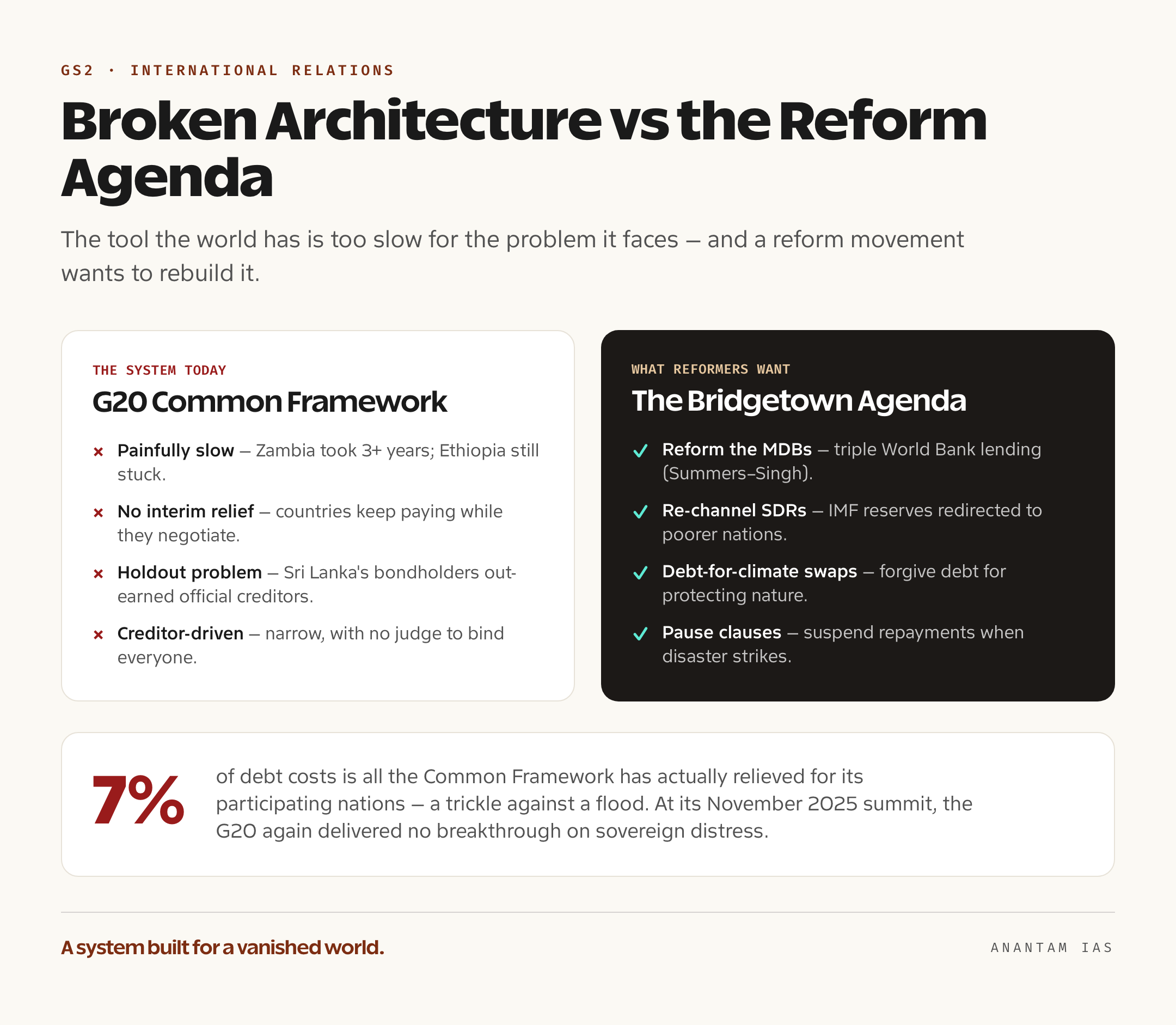
So what does the world actually have to manage all this? The main tool is the G20 Common Framework for Debt Treatments, launched in late 2020 to bring China and other new creditors to the same table as the traditional Paris Club. On paper it was the right idea: a single process where all official bilateral creditors negotiate together so the burden is shared. In practice, it has been painfully slow, and its record is the strongest evidence that the system is broken.
Look at the cases. Zambia became the first African country to default in the pandemic era, requesting Common Framework treatment in early 2021 — and it took until 2024, more than three years, to finalise a deal with its bilateral creditors, with private-creditor negotiations dragging on separately. Chad reached an agreement that delivered almost no actual debt reduction. Ghana, which defaulted in 2022, secured a deal but only after long delays. Ethiopia has been stuck in the process for years. By one advocacy group’s count, the Framework relieved only about 7 per cent of the debt costs for its participating nations — a trickle against a flood. There is no debt-service suspension while talks drag on, so countries keep paying even as they negotiate relief, and the uncertainty itself scares off the investment they need to recover. At its November 2025 summit, the G20 again failed to deliver any breakthrough on sovereign distress, leaving the Framework widely judged too slow, too narrow and too creditor-friendly.
Sri Lanka is the case that made all of this visible to the wider world. In April 2022 it became the first Asia-Pacific country in decades to default, running out of dollars to import fuel, food and medicine; the resulting hardship toppled the government as protesters stormed the presidential residence. Sri Lanka wasn’t even inside the Common Framework — as a middle-income country it negotiated separately — but its restructuring exposed every fault line. It owed China, its largest single bilateral lender, billions; it owed India a smaller but strategically charged sum; and it owed private bondholders the most of all. When deals finally came in 2024, bondholders extracted terms widely seen as more generous to themselves than what governments accepted, with debt-justice campaigners calculating that private creditors would be repaid substantially more than China. The lesson examiners love: in the current system, the actors who lent least patiently often walk away best, while the citizens of the defaulting country pay in austerity.
The Reform Agenda: Bridgetown, the MDBs and Debt Swaps
Against this broken machinery sits a growing reform movement, and naming its parts is what turns a good answer into a strong one. The most prominent banner is the Bridgetown Initiative, launched by Barbados Prime Minister Mia Mottley, which argues that the entire post-war financial architecture — built at Bretton Woods in 1944 for a world of rich-country creditors — is unfit for an age of climate shocks and developing-country distress. The IMF and World Bank explainer behind the International Monetary Fund’s mandate shows why this matters: those institutions still hold the keys, and Bridgetown wants the locks changed.
The reform agenda has a few concrete planks worth memorising. First, reform of the multilateral development banks — the World Bank and its regional cousins — so they lend far more, and more cheaply, to development and climate. India put real weight behind this during its G20 presidency, commissioning an Independent Expert Group co-chaired by economist Lawrence Summers and India’s N.K. Singh, whose report The Triple Agenda called for MDBs to roughly triple their lending and act as “the tip of the spear” against poverty and climate risk. Second, the re-channelling of Special Drawing Rights — the IMF’s reserve asset — from rich countries, which received the lion’s share of a 2021 allocation they don’t need, toward the poorer countries that do. Third, new instruments such as debt-for-climate and debt-for-nature swaps, where a slice of a country’s debt is forgiven in exchange for protecting a rainforest or coral reef, turning a debt burden into climate action. And running through all of it, calls for “pause clauses” that automatically suspend repayments when a hurricane or pandemic hits, so a disaster doesn’t instantly become a default.
None of this is settled, and that honesty belongs in your answer. Creditor governments worry about who pays for generosity; China resists rules it had no hand in writing; private bondholders guard their legal rights fiercely. The push to reduce reliance on the dollar-centred system — the slow drift toward de-dollarisation and a more multipolar financial order — feeds the same debate, because a system anchored in one currency and one set of rules is exactly what reformers say leaves the Global South exposed. The reform agenda is best described not as a finished plan but as a direction of travel, with India among the louder voices pushing the convoy forward.
India’s Stake: Voice of the Global South
Why does India invest so much diplomatic energy here when its own house is in order? Begin with that order, because it is the foundation of India’s credibility. India’s external debt is large in absolute terms but modest relative to the economy — an external-debt-to-GDP ratio in the high teens, well over ninety per cent of it comfortably covered by foreign-exchange reserves, with the short-term, panicky portion kept small. For a fuller treatment of how the country manages this, the explainer on India’s debt-to-GDP ratio lays out the fiscal picture. The short version: India is not a debtor in distress, and that is precisely what lets it speak for those who are without sounding self-interested.
So India has chosen the role of bridge and advocate. During its 2023 G20 presidency it made debt a headline issue, co-chairing with the IMF and World Bank the new Global Sovereign Debt Roundtable, a forum bringing together old creditors, new creditors like China, private lenders and borrowing nations to unstick the restructuring process. It convened two Voice of the Global South Summits, gathering more than a hundred developing countries to channel their grievances into the G20, and pushed the African Union’s admission as a permanent G20 member — a structural win for the bloc most crushed by debt. India also lent its weight to the MDB-reform drive through the Summers-Singh expert group. The consistent thread is that India presents itself as a developing country that has succeeded, and so as a trustworthy interpreter of the Global South’s demands to the rich world’s clubs.
But India’s position is a balancing act, and the best answers acknowledge the tension. India is itself an emerging creditor — it lends to neighbours like Sri Lanka and across Africa — so it has skin in both games. It must press for debtor-friendly reform while protecting its own modest claims, and it must criticise the system without alienating the Western powers and institutions it works within. It also competes with China for influence across the same indebted states, offering an alternative to Belt and Road lending. The crisis, then, is for India not only a moral cause but a strategic opening: by championing reform, it builds the diplomatic capital of a leader of the Global South, even as it guards its own interests as a rising power inside the very system it wants to change.
For Your Mains Answer
This is a high-value topic for GS Paper 2, which covers important international institutions, their structure and mandate, and the effect of policies and politics of developed and developing countries on India’s interests. It speaks directly to questions on the IMF and World Bank, the G20, North-South relations, and India’s role as a voice of the Global South. It also feeds GS Paper 3 on the external sector and Essay themes of global inequality and economic justice. The skill examiners reward is structural: define the crisis with one or two hard numbers, then move cleanly from scale to drivers to the broken architecture to reform to India’s stake.
How to Build the Answer
Open with the human scale, not the jargon — the $31 trillion pile and the 3.4 billion people whose governments spend more on interest than on health or education. Then walk the chain: how the debt was built (cheap-money decade, then COVID, war, rate hikes and currency falls), who is owed (multilaterals, China, private bondholders) and why that mix makes restructuring fail, what tools exist (the G20 Common Framework) and why they’re too slow (Zambia, Ghana, Sri Lanka), what reform looks like (Bridgetown, MDB reform, SDR re-channelling, debt swaps), and where India fits (sustainable at home, advocate abroad). Close with a judgement on whether the system can be fixed. That arc — scale, cause, creditors, tools, reform, India — answers almost any framing of the question.
Common Mistakes to Avoid
Don’t treat this as a single country’s bankruptcy; it is a systemic, structural crisis spanning dozens of nations. Don’t blame the debtors alone — the rate-hike cycle and the lending structure are causes they didn’t choose. Don’t ignore China; leaving out the largest bilateral creditor guts the analysis. Don’t confuse the IMF (a lender of last resort and crisis manager) with the World Bank (a development lender). And don’t present reform as accomplished — the G20 has repeatedly failed to deliver, and saying so shows command of the present, not just the textbook.
A Compact Answer Spine
Developing-country debt ≈ $31 tn, record interest ≈ $921 bn, 3.4 bn people in countries spending more on debt than health or education → built by a cheap-money decade then COVID + Ukraine war + Fed rate hikes + currency depreciation → creditor mix shifted to private bondholders and China (largest bilateral lender), making restructuring fail via holdouts → G20 Common Framework too slow (Zambia 3+ years, Chad minimal relief, Sri Lanka default 2022) → reform: Bridgetown Initiative, MDB reform (Summers-Singh “Triple Agenda”), SDR re-channelling, debt-for-climate swaps, pause clauses → India: sustainable external debt, voice of the Global South, G20 presidency, Global Sovereign Debt Roundtable, AU into G20.
Diagram or Flowchart Idea
Sketch a simple cause-and-effect chain across the page: Cheap-money decade → COVID + war + rate hikes → currency falls + costly private/Chinese debt → distress → slow, creditor-driven restructuring → reform calls. Beside it, a small three-segment bar showing the creditor mix (multilateral · bilateral incl. China · private). The visual carries the whole story and takes thirty seconds to draw.
A Balanced-Conclusion Line
A line that lands the marks: “The Global South debt crisis is less a failure of borrowers than of an outdated financial architecture built for a vanished world — and India, secure in its own finances, has staked its claim to lead the developing world by pushing that architecture, patiently, toward reform.”
How to Use Data Without Cramming
You need only four anchors, not a dossier: $31 trillion (developing-country debt), $921 billion (record annual interest), 3.4 billion people (living where debt beats health or education spending), and 7 per cent (the meagre relief the Common Framework delivered). Attribute them plainly — “as the UN’s A World of Debt report showed” — and let one or two cases (Zambia, Sri Lanka) do the rest.
Frequently Asked Questions
What is the Global South debt crisis in simple terms?
It is the wave of sovereign-debt distress spreading across developing countries, where governments owe so much and pay so much interest that they cannot fund basic services. Developing countries now hold around $31 trillion in public debt and paid a record $921 billion in interest in a single year, and roughly 3.4 billion people live in countries that spend more on debt interest than on health or education. The UN calls it a “silent” development crisis because the harm shows up slowly, in unbuilt clinics and unpaid teachers, rather than in a sudden crash.
Why is it so hard for these countries to get debt relief?
Because there is no bankruptcy court for nations, and the creditors are split into camps — the IMF and World Bank, bilateral lenders led by China, and private bondholders — who must all agree to share the loss. Each waits for the others to move first, and private “holdout” creditors can block a deal for years. The G20 Common Framework was meant to coordinate this but has proved painfully slow: Zambia took more than three years to restructure, and the Framework has delivered only a fraction of the relief needed.
What is the Bridgetown Initiative?
It is a reform agenda launched by Barbados Prime Minister Mia Mottley, arguing that the post-war financial system built at Bretton Woods is unfit for an age of climate shocks and developing-country distress. It calls for the multilateral development banks to lend far more and cheaply, for the IMF’s Special Drawing Rights to be re-channelled to poorer countries, for debt-for-climate swaps, and for “pause clauses” that suspend repayments when disaster strikes.
What is India’s role in the crisis?
India’s own external debt is sustainable — modest relative to GDP and well covered by reserves — which lets it champion reform credibly as a voice of the Global South. During its 2023 G20 presidency it made debt a priority, co-chairing the Global Sovereign Debt Roundtable with the IMF and World Bank, convening Voice of the Global South Summits, backing MDB reform through the Summers-Singh expert group, and securing the African Union’s permanent seat at the G20.
Practice Questions
Prelims MCQs
- The G20 Common Framework for Debt Treatments was launched primarily to achieve which of the following?
(a) Replace the IMF as the global lender of last resort
(b) Bring China and other new bilateral creditors to the same table as the Paris Club for coordinated debt restructuring
(c) Provide grants instead of loans to all low-income countries
(d) Set a uniform global interest rate for sovereign borrowing
Answer: (b) The Common Framework, launched in 2020, was designed to coordinate official bilateral creditors — including non-Paris Club lenders like China — in restructuring the debt of distressed low-income countries. - With reference to the components of a developing country’s sovereign debt, which is today the single largest bilateral creditor to the developing world?
(a) The United States
(b) The Paris Club as a bloc
(c) China
(d) The World Bank
Answer: (c) China became the largest bilateral creditor through its Belt and Road infrastructure lending, and it is not a member of the Paris Club. - The Bridgetown Initiative is associated with which of the following?
(a) Reform of the international financial architecture, led by Barbados
(b) A regional free-trade agreement in the Caribbean
(c) A military alliance of small island states
(d) A new reserve currency to replace the dollar
Answer: (a) Launched by Barbados PM Mia Mottley, the Bridgetown Initiative seeks to reform the IMF, World Bank and the broader financial system to better serve climate-vulnerable and debt-distressed nations. - “Special Drawing Rights (SDRs),” which feature in debt-reform proposals, are best described as:
(a) Loans given by the World Bank to middle-income countries
(b) The IMF’s international reserve asset, allocated to members by quota
(c) Bonds issued by developing-country governments
(d) A credit rating used by private lenders
Answer: (b) SDRs are the IMF’s reserve asset; reformers want the large share allotted to rich countries re-channelled to poorer ones that need it more. - Which country’s 2022 sovereign default, marked by fuel shortages and mass protests, became the most visible Asian example of the wider debt crisis?
(a) Pakistan
(b) Sri Lanka
(c) Bangladesh
(d) Nepal
Answer: (b) Sri Lanka defaulted in April 2022 after running out of dollars to fund essential imports, and its drawn-out restructuring exposed the holdout problem between China and private bondholders.
Mains Practice Questions
- The Global South debt crisis is often described as a “silent” development crisis rather than a financial one. Examine the scale and drivers of developing-country debt distress and explain why this framing is apt. (15 marks, 250 words)
- “There is no bankruptcy court for countries.” In light of this, analyse why the restructuring of sovereign debt has become so difficult, with reference to the changing mix of creditors. (15 marks, 250 words)
- Critically evaluate the G20 Common Framework for Debt Treatments. Why has it been judged too slow and creditor-friendly, and what reforms have been proposed to fix it? (15 marks, 250 words)
- Discuss the Bridgetown Initiative and the agenda for reforming the multilateral development banks. To what extent do these proposals address the structural roots of the Global South debt crisis? (10 marks, 150 words)
- India positions itself as the voice of the Global South while remaining an emerging creditor and a power within the existing financial system. Evaluate India’s role and the tensions in its stance on the developing-world debt crisis. (15 marks, 250 words)
Tell Google you want more of this.
Add Anantam IAS as a preferred sourceOne tap, and this site shows up more often in your own Top Stories, AI Overviews and AI Mode. Remove it any time.