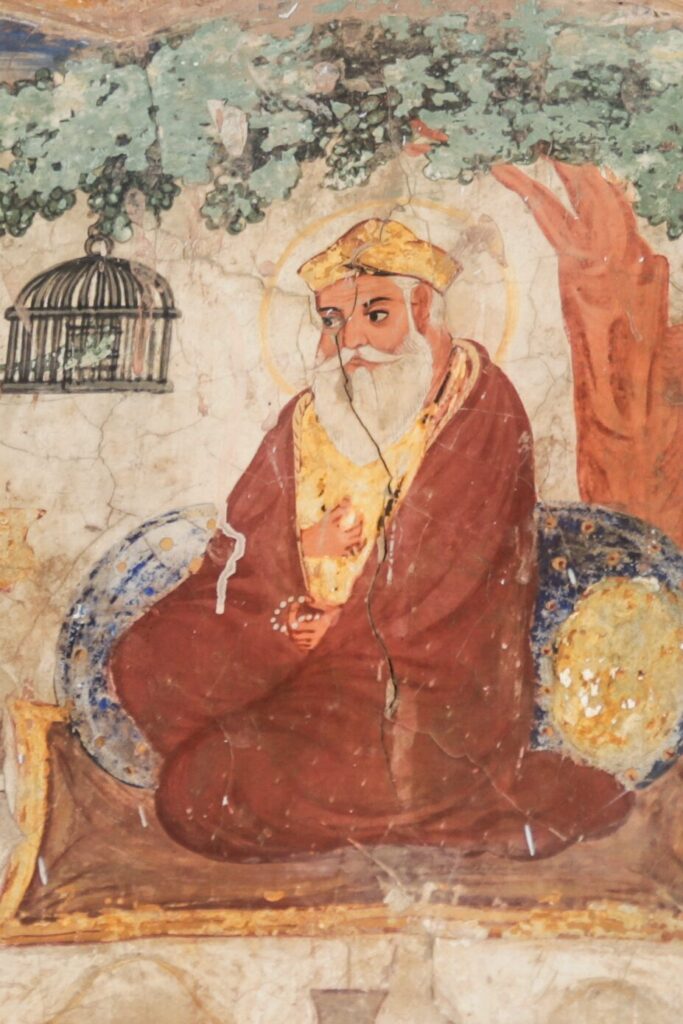
Guru Nanak Dev Ji was born on 15 April 1469 at Talwandi, a small town in the Punjab forty miles west of Lahore, today called Nankana Sahib in Pakistan. He died on 22 September 1539 at Kartarpur on the Ravi, having spent the last fifteen years of his life as a householder farmer, leading a congregation, running a free kitchen, and composing the hymns that would become the opening section of the Sikh scripture. Between Talwandi and Kartarpur he undertook four long journeys — the Udasis — that took him from Assam to Mecca and from Sri Lanka to Tibet. The religion he founded would, two centuries later, become the fifth-largest tradition in the world.
The teachings of Guru Nanak Dev Ji can be stated in three sentences. There is one formless god, Ik Onkar. The path to that god is the householder life of honest work, remembrance of the divine name, and sharing with others. Caste, ritual, image worship, pilgrimage, mortification, and brahmin priesthood are all irrelevant to salvation.
This article reads Guru Nanak Dev Ji with a UPSC History and Art-and-Culture lens. It traces his early life at Talwandi, the founding moment at Sultanpur, the four Udasi journeys, the three pillars, the institution of langar, the relationship to the Bhakti movement and the Sufi movement, and the succession of nine Gurus that followed him.
Early Life at Talwandi
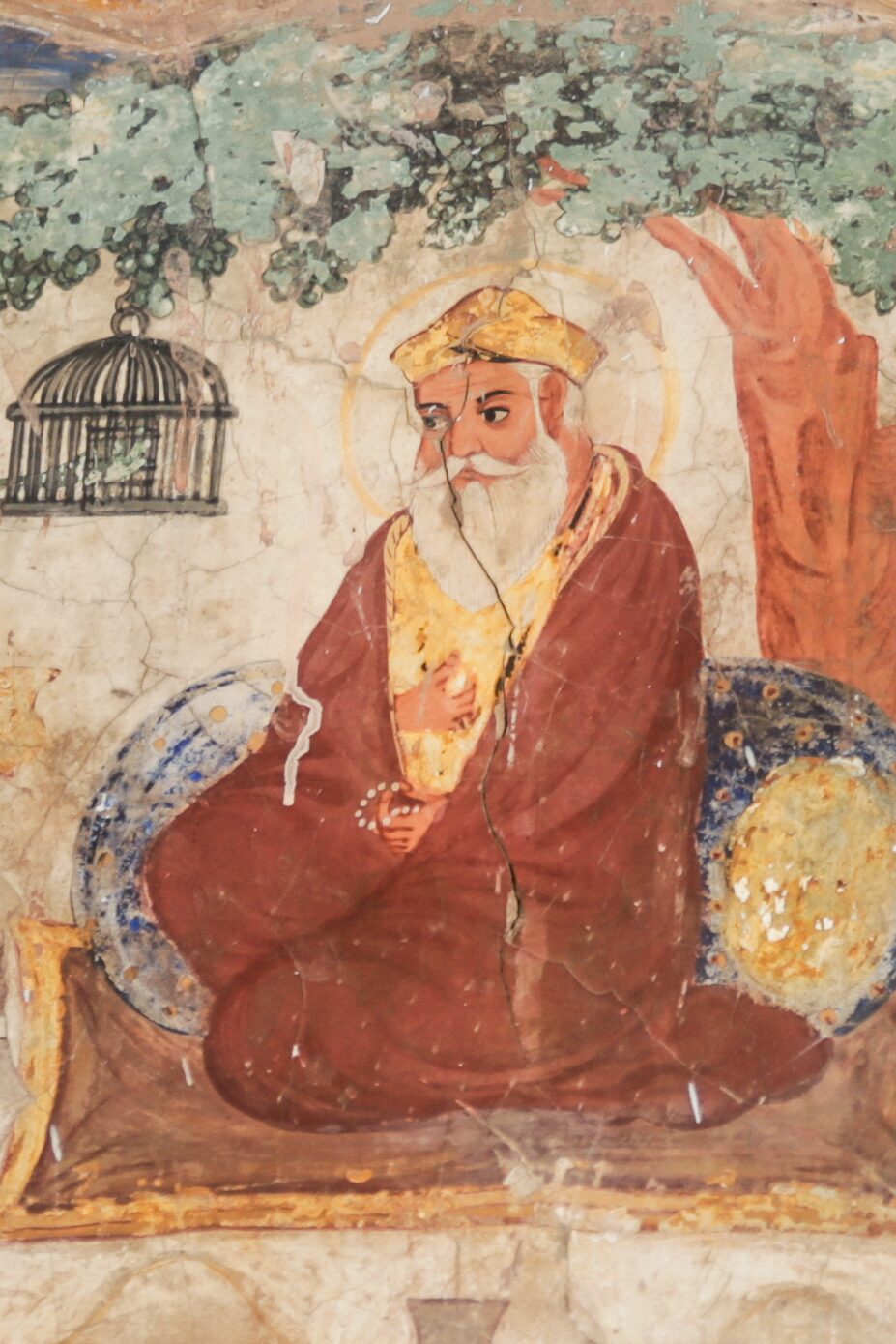
Guru Nanak Dev Ji was born to Mehta Kalu, a Khatri patwari (village accountant) in the employ of the local Muslim landlord Rai Bular Bhatti, and to Mata Tripta. His sister Bibi Nanaki, five years older, recognised his spiritual depth before anyone else and remained his closest early devotee. The hagiographic literature — the janamsakhis composed in the sixteenth and seventeenth centuries — records a series of childhood incidents that mark him as exceptional. The cobra shading his sleeping head. The refusal of the sacred thread at age nine on the grounds that god is not a string. The trading capital lent by his father, spent instead on feeding wandering sadhus — the sacha sauda or “true bargain” episode.
Married at sixteen to Mata Sulakhni and father to two sons, Sri Chand and Lakhmi Das, Guru Nanak Dev Ji moved to Sultanpur Lodhi around 1485 to take up a post as storekeeper for Daulat Khan Lodhi, the local governor under the Lodi sultanate. He worked the office with absolute integrity, gave away surplus to the poor, and spent his nights in the company of his Muslim companion Bhai Mardana, the rebab player who would accompany him on every later journey.
The Founding Moment at Sultanpur
The decisive event in the life of Guru Nanak Dev Ji took place at Sultanpur around 1499. He walked into the Vein river to bathe at dawn and did not emerge for three days. When he reappeared, he uttered his first public statement of doctrine: “Na koi Hindu, na koi Musalman” — there is neither Hindu nor Muslim. Pressed to explain, he composed the Mool Mantar, the foundational creed of Sikhism, beginning with the formula Ik Onkar Satnam Karta Purakh — One Reality, Truth by Name, Creator-Being.
This is the founding moment of Sikhism as a distinct tradition. Guru Nanak Dev Ji resigned his post, gave away his belongings, donned a peculiar mixed dress of Hindu and Muslim attire, and set out with Bhai Mardana on what would become a quarter-century of travel.
The Four Udasis
The Udasis are the four great missionary journeys of Guru Nanak Dev Ji, undertaken roughly between 1500 and 1524.
First Udasi (1500–1506)
Guru Nanak Dev Ji travelled east across the Indo-Gangetic plain. He visited Hardwar (where he is recorded as having mocked the priests offering water to ancestors in the rising sun by pouring water westward toward his own fields in Punjab), Banaras (where he held discourse with Brahmin pandits), Gaya, Patna, Dhaka, Assam (where he met the Tantric practitioners), and Puri (where he composed the Aarti).
Second Udasi (1506–1513)
Guru Nanak Dev Ji travelled south through the Deccan to Sri Lanka. He met the king Shivnabh, established a sangat at Batticaloa, and returned via the Konkan coast. The southern Udasi is the least well-documented but is the basis for the small Sikh communities along the south Indian coast.
Third Udasi (1514–1518)
Guru Nanak Dev Ji travelled north into Kashmir, Ladakh, and Tibet. He is recorded as meeting Hindu and Buddhist ascetics in the Himalayan reaches. The famous dialogue with the Siddhas — preserved as the Siddh Gosht in the Adi Granth — where Guru Nanak Dev Ji defends the householder life against the renunciate path, belongs to this period.
Fourth Udasi (1519–1524)
Guru Nanak Dev Ji travelled west to Mecca, Medina, and Baghdad. The hagiographic tradition records the Mecca episode in which he is found sleeping with his feet pointing toward the Kaaba and replies to the offended qazi that he should turn his feet in whatever direction god is not. He visited Multan, where he met the Sufi pirs and is said to have placed a jasmine flower atop a vessel of milk to indicate that the city’s spiritual capacity, though full, could accommodate one more saint.
By 1524 Guru Nanak Dev Ji had returned to Punjab. He founded the town of Kartarpur on the right bank of the Ravi and spent the last fifteen years of his life there, farming, leading the daily congregation, running the langar, and composing hymns.
The Three Pillars
Guru Nanak Dev Ji distilled his ethics into three householder principles. They remain the operative core of Sikh ethical life.
Naam Japo — Meditate on the divine name. Sikh practice centres on the constant remembrance of god through repetition of the Name. This is not silent withdrawal but an ongoing awareness of the divine in all activity.
Kirat Karo — Earn an honest living. Guru Nanak Dev Ji rejected the renunciate path and insisted that the householder life of productive labour is the proper field of spiritual practice. He himself farmed at Kartarpur to model this.
Vand Chakko — Share with others. A portion of what one earns must be given to those in need. This principle institutionalised itself as daswandh — the tenth — and as the langar, the free community kitchen open to all.
These three pillars distinguish Sikhism from both Hindu sannyasa traditions and from Sufi khanqah-based dependence on patronage. Guru Nanak Dev Ji built a religion of working people, by working people, for working people.
Theological Core: Ik Onkar
The Mool Mantar opens with Ik Onkar — One Reality. This is uncompromising monotheism: god is one, formless, eternal, self-created, beyond fear and enmity, beyond birth and death, knowable only through the grace of the satguru.
Guru Nanak Dev Ji rejected:
- Image worship and idolatry of every kind
- Pilgrimage as a means to salvation
- Caste hierarchy and the brahmanical monopoly on the sacred
- Sati, female infanticide, and the seclusion of women
- The authority of the Vedas or any other text as final
- The renunciate path and external asceticism
- Empty ritual whether Hindu or Muslim
This places Guru Nanak Dev Ji squarely within the Nirguna Bhakti current — his theology has structural similarities to Kabir and to the broader Sant tradition — but with the institutional innovation of building a self-replicating community: the Sangat (congregation), the Pangat (eating together regardless of caste), the Langar (free kitchen), and the Granth (scripture).
Langar: The Sacred Kitchen
The institution of langar at Kartarpur was Guru Nanak Dev Ji’s most concrete attack on caste. Everyone — Brahmin and Shudra, Hindu and Muslim, rich and poor, man and woman — sat in the same row (pangat) and ate the same food prepared by everyone together. This single act of commensality dissolved caste pollution in practice. The langar would later be expanded by Guru Amar Das, who required even the Mughal emperor Akbar to sit and eat in the pangat before being granted an audience.
To this day every Gurdwara worldwide runs a free langar open to all. The Golden Temple at Amritsar feeds roughly one lakh meals daily. The principle was set by Guru Nanak Dev Ji at Kartarpur.
The Succession: Bhai Lehna Becomes Guru Angad
Guru Nanak Dev Ji had two sons. He did not appoint either as his successor. Sri Chand, the elder, was an ascetic — he founded the Udasi order — which violated the householder principle. Lakhmi Das was attached to worldly business.
Guru Nanak Dev Ji instead chose Bhai Lehna, a disciple of perfect obedience, and renamed him Angad — “of my own limb.” This act of choosing a worthy disciple over a biological son set the pattern for the succession of the Sikh Gurus. Authority passed through spiritual fitness, not blood. The ten Gurus over two and a half centuries — from Guru Nanak Dev Ji (1469–1539) through Guru Gobind Singh (1666–1708) — built a community, a theology, a scripture, an army, and finally, in 1708, transferred the Guruship to the Adi Granth itself.
The Ten Gurus
For UPSC orientation, the ten Sikh Gurus are:
- Guru Nanak Dev Ji (1469–1539) — founder.
- Guru Angad Dev Ji (1504–1552) — standardised Gurmukhi script.
- Guru Amar Das Ji (1479–1574) — institutionalised langar; abolished sati and purdah within the community.
- Guru Ram Das Ji (1534–1581) — founded Amritsar.
- Guru Arjan Dev Ji (1563–1606) — compiled the Adi Granth; built Harmandir Sahib; martyred under Jahangir.
- Guru Hargobind Ji (1595–1644) — introduced Miri-Piri, the dual swords of temporal and spiritual authority.
- Guru Har Rai Ji (1630–1661).
- Guru Har Krishan Ji (1656–1664) — child guru.
- Guru Tegh Bahadur Ji (1621–1675) — martyred under Aurangzeb at Delhi for defending the religious freedom of Kashmiri Pandits.
- Guru Gobind Singh Ji (1666–1708) — founded the Khalsa in 1699; declared the Adi Granth as Guru Granth Sahib in 1708.
The Adi Granth: Scriptural Beginning
Guru Nanak Dev Ji composed roughly 974 hymns during his lifetime. These were preserved by his successors and finally compiled by Guru Arjan Dev Ji in 1604 as the Adi Granth, installed at the newly built Harmandir Sahib in Amritsar. The Adi Granth contains the compositions of the first five Gurus, of the ninth Guru (added later), and of fifteen bhagats from outside the Sikh fold — including Kabir, Ravidas, Namdev, Sheikh Farid, Jaidev, and others. This deliberate inclusion of Hindu and Muslim devotional poetry across caste makes the Guru Granth Sahib the only major world scripture to be authored by multiple religious traditions side by side. Guru Gobind Singh added the compositions of Guru Tegh Bahadur and in 1708 declared the completed text as the perpetual eleventh Guru.
Relationship to Bhakti, Sufi, and Mughal India
Guru Nanak Dev Ji lived through the foundational decades of Mughal India. He witnessed Babur’s invasions of Punjab in 1521 and composed the Babarvani — three hymns recording the horror of the sacking of Saidpur. He was a contemporary of the late Bhakti movement saints — Kabir, who died around 1518, and Meerabai, born around 1498. He drew on Sant vocabulary, on Sufi metaphors of the inner heart and the divine beloved, on the Bhakti insistence on vernacular devotion. But he built something none of them built — a self-sustaining religious institution with its own scripture, its own ritual, its own succession, and its own social form.
Legacy
Guru Nanak Dev Ji’s Gurpurab — the celebration of his birth anniversary on Kartik Purnima — is the principal Sikh festival worldwide. Nankana Sahib, Sultanpur Lodhi, and Kartarpur Sahib form the three core pilgrimage sites of his life. The Kartarpur Corridor opened in 2019 allows Indian pilgrims visa-free access to the gurdwara at the site where he spent his final years.
For UPSC purposes Guru Nanak Dev Ji belongs to Medieval History, Art and Culture, and Indian Society — the founder of one of the world’s major religions, a reformer who challenged caste and ritual, and a figure whose teachings on equal worship and shared meals continue to shape Indian public life.
Frequently Asked Questions
When was Guru Nanak Dev Ji born?
Guru Nanak Dev Ji was born on 15 April 1469 at Talwandi (now Nankana Sahib, Pakistan), in the Punjab forty miles west of Lahore. His birth anniversary is celebrated on Kartik Purnima as Guru Nanak Gurpurab, the principal festival of Sikhism worldwide.
What are the three pillars of Sikhism taught by Guru Nanak?
Guru Nanak Dev Ji taught three householder principles: Naam Japo (remember the divine name), Kirat Karo (earn an honest living through productive labour), and Vand Chakko (share what you have with others). These three pillars remain the operative ethical core of Sikh life.
What are the four Udasis of Guru Nanak Dev Ji?
The Udasis are the four great journeys of Guru Nanak Dev Ji between 1500 and 1524. The first took him east to Bengal and Assam. The second took him south to Sri Lanka. The third took him north to Kashmir and Tibet. The fourth took him west to Mecca, Medina, and Baghdad.
What is Ik Onkar?
Ik Onkar is the opening phrase of the Mool Mantar — u0022One Reality.u0022 It expresses the uncompromising monotheism at the centre of Guru Nanak Dev Ji’s teaching: god is one, formless, eternal, self-created, beyond birth and death, and accessible to anyone regardless of caste, gender, or creed.
Why did Guru Nanak Dev Ji choose Bhai Lehna over his sons?
Guru Nanak Dev Ji’s elder son Sri Chand became an ascetic, violating the householder principle, and his younger son Lakhmi Das was attached to worldly business. Guru Nanak instead chose his disciple Bhai Lehna, renaming him Angad, on the principle that spiritual authority must pass through spiritual fitness rather than blood.
What is the langar and why is it important?
The langar is the free community kitchen instituted by Guru Nanak Dev Ji at Kartarpur. Everyone, regardless of caste, religion, gender, or class, sits in the same row (pangat) and eats the same meal prepared together. This commensality dissolved caste pollution in practice and remains the most visible Sikh institution — every Gurdwara worldwide runs a langar open to all.
How is Guru Nanak Dev Ji related to the Bhakti movement?
Guru Nanak Dev Ji drew on the Nirguna stream of the Bhakti movement, sharing its rejection of caste, idolatry, and ritualism. His theology has clear affinities with Kabir and the Sant tradition. But unlike most Bhakti saints, Guru Nanak Dev Ji built a self-replicating institution — the Sangat, Pangat, Langar, and Granth — that became Sikhism.
Who were the ten Sikh Gurus?
The ten Sikh Gurus in order are Guru Nanak Dev Ji, Guru Angad, Guru Amar Das, Guru Ram Das, Guru Arjan Dev, Guru Hargobind, Guru Har Rai, Guru Har Krishan, Guru Tegh Bahadur, and Guru Gobind Singh. In 1708 Guru Gobind Singh transferred the Guruship to the Adi Granth, henceforth Guru Granth Sahib, the eleventh and perpetual Guru.
Tell Google you want more of this.
Add Anantam IAS as a preferred sourceOne tap, and this site shows up more often in your own Top Stories, AI Overviews and AI Mode. Remove it any time.