Transport burns a large share of India’s imported crude, and it is the sector where emissions, air quality and the current-account deficit meet on the same road. Green mobility in India is the policy response, and the useful way to understand it is not as one transition but as seven parallel ones, each solving a different problem for a different vehicle class.
Treating it as a single race between petrol and batteries is the most common analytical mistake. A city scooter, an intercity bus and a Delhi-to-Chennai truck do not have the same answer.
What Green Mobility Is Trying to Achieve
Six objectives run in parallel, and they do not always point the same way.
- Energy security: cut crude oil imports and the exposure that comes with them
- Climate action: lower greenhouse gas emissions in line with India’s nationally determined contributions and the 2070 net-zero target
- Clean air: reduce PM2.5, oxides of nitrogen and oxides of sulphur in cities
- Farmer welfare: create demand for agricultural produce and residue through biofuels
- Industrial growth: build domestic industries in batteries, electric vehicles and hydrogen
- Circular economy: waste-to-fuel, bio-CNG and battery recycling
The tension is visible immediately. Ethanol serves farmer welfare and energy security, but can work against water security. Batteries serve clean air, but import their mineral supply chain. Policy has to hold all six at once.
The Seven Pillars
Electric mobility. The flagship. PM E-DRIVE for demand incentives, production-linked incentives for advanced chemistry cell batteries and for the auto sector, a battery-swapping policy, and the National Mission on Transformative Mobility and Battery Storage.
Ethanol blending. Blending ethanol into petrol, now well past the early single-digit targets and moving through E20.
Other biofuels. Biodiesel and advanced fuels from non-edible feedstock.
CNG and PNG. Compressed and piped natural gas, largely for urban fleets.
Bio-CNG or compressed biogas. Delivered through SATAT, GOBARdhan, the Waste-to-Wealth Mission and Swachh Bharat.
LNG for heavy transport. The pragmatic bridge fuel for long-haul trucking.
Green hydrogen. The National Green Hydrogen Mission, targeting about 5 million metric tonnes a year by 2030 with roughly 125 GW of associated renewable capacity.
Matching Fuel to Use Case
This is the part worth memorising, because it is what a good answer turns on.
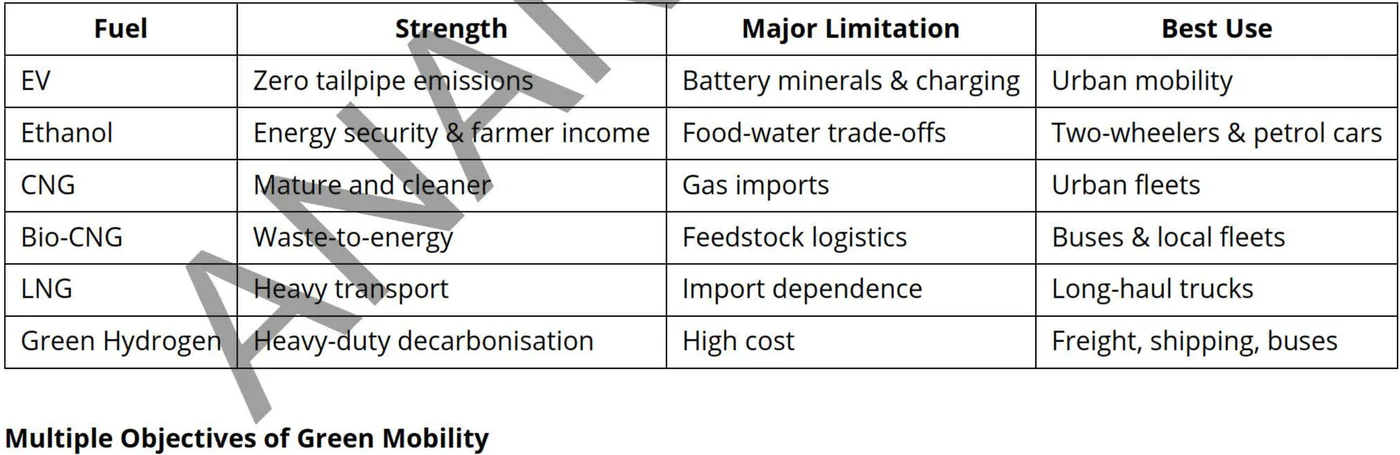
- Electric battery: limited by mineral supply and charging infrastructure. Best for urban mobility, above all two and three wheelers.
- Ethanol: limited by food and water trade-offs. Best for two wheelers and the existing petrol car fleet.
- CNG: limited by gas imports. Best for urban fleets.
- Bio-CNG: limited by feedstock logistics. Best for buses and local fleets.
- LNG: limited by import dependence. Best for long-haul trucks.
- Green hydrogen: limited by cost. Best for freight, shipping and buses.
Notice that every option has an import or a resource constraint. None of them is a free transition.
Where Electric Mobility Actually Stands
India is among the fastest-growing electric vehicle markets in the world, and the policy focus is squarely on two wheelers, three wheelers, buses and trucks rather than on private cars. That focus is correct: those segments have the highest utilisation, the shortest payback and the greatest air-quality benefit per rupee of subsidy.
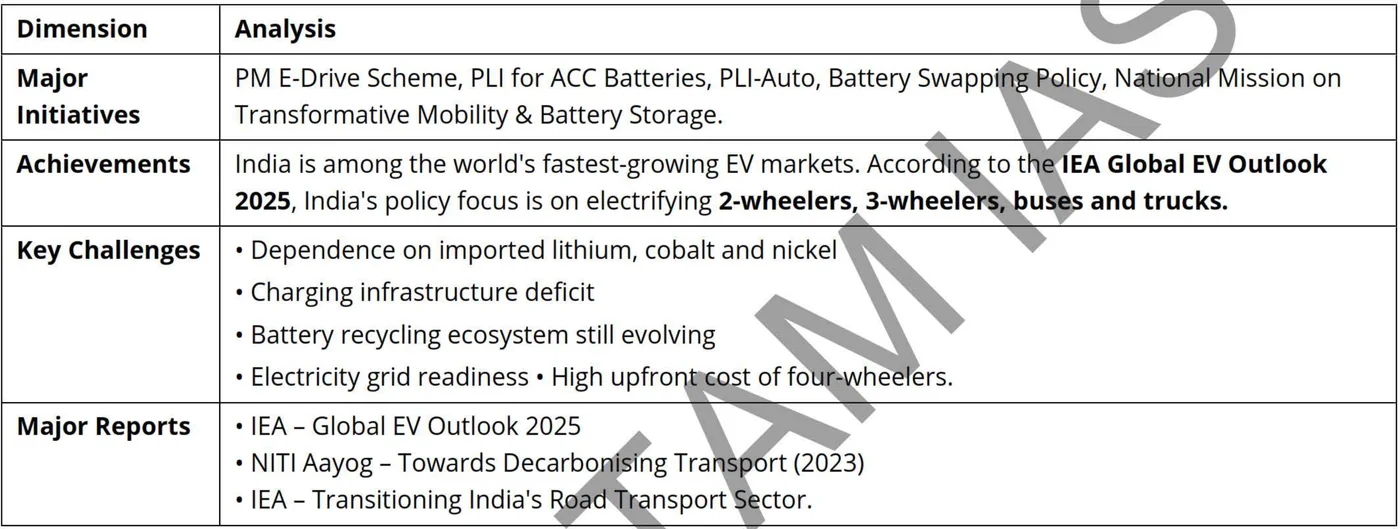
The constraints are consistent and well documented.
- Dependence on imported lithium, cobalt and nickel
- A charging infrastructure deficit outside major corridors
- A battery recycling ecosystem that is still forming
- Grid readiness that varies sharply between states
- High upfront cost relative to the equivalent petrol vehicle
The first and the last are being addressed by industrial policy. The second is the one that decides adoption, and it is a state and municipal problem as much as a central one.
Green Hydrogen: Right Answer, Wrong Timeline for Most Uses
Hydrogen earns its place where batteries physically cannot go: heavy trucks, buses, railways, shipping and long-distance freight. Its advantages are real, higher energy density than batteries and faster refuelling.
The obstacles are equally real: high production cost, expensive electrolysers, almost no refuelling infrastructure, difficult storage and transport, and safety regulation still being written. Treating hydrogen as a near-term substitute for the car fleet is a category error. Treating it as the decarbonisation route for freight and shipping is sound.
Compressed Biogas: The Underrated Pillar
Bio-CNG deserves more attention than it gets, because it solves three problems with one plant. Feedstock is agricultural residue, cattle dung, municipal solid waste, sewage sludge and food waste. The output displaces imported fuel, the process reduces methane emissions from decaying waste, and the collection system gives farmers a market for residue that would otherwise be burned.
Its problems are logistical rather than technical: aggregating feedstock, collection economics, plant viability, marketing infrastructure and the absence of long-term purchase agreements.
The Ethanol Trade-Off, Stated Honestly
Ethanol blending is the most advanced pillar and the most contested.
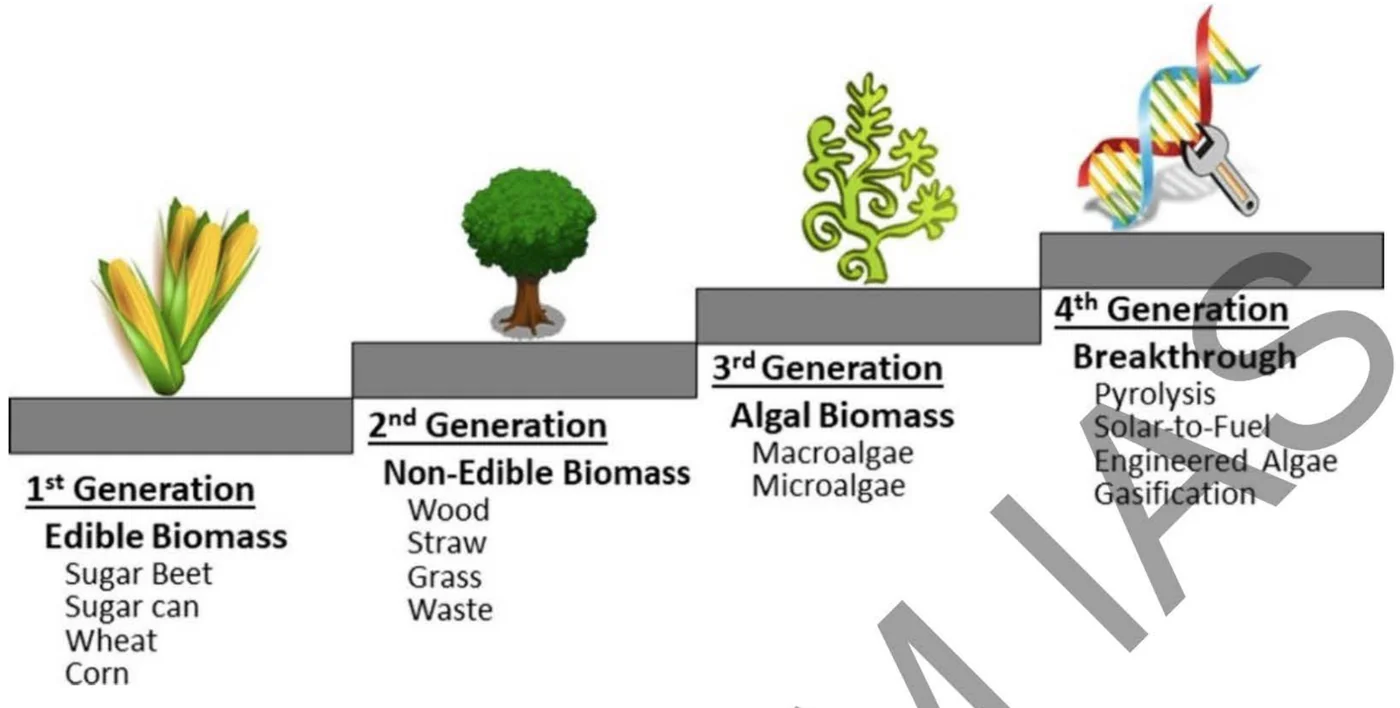
- Food versus fuel: first-generation ethanol from edible biomass can affect food security, food inflation and public distribution availability. Restrictions have at times been placed on diverting rice from Food Corporation of India stocks precisely for this reason.
- Water: heavy reliance on sugarcane pushes groundwater extraction and monoculture in already stressed basins.
- Cost: second-generation ethanol from straw and grass avoids the food trade-off but remains expensive.
- Compatibility: older vehicles are not fully suited to E20.
The direction of travel has to be feedstock diversification, from edible biomass towards agricultural residue and eventually algal biomass. Staying on sugarcane converts an energy policy into a groundwater policy, and not in a good way.
The Way Forward
- Fix charging density and grid readiness before adding further purchase subsidies.
- Shift ethanol feedstock decisively towards second-generation residue.
- Treat hydrogen as a freight and shipping programme, not a car programme.
- Give compressed biogas plants long-term offtake agreements, which is what they lack.
- Prioritise bus fleet electrification, where each rupee removes the most emissions and the most local pollution.
Green mobility works when each fuel is put where its physics and its economics fit. It fails when one technology is asked to carry the whole transition.
Frequently Asked Questions
What is green mobility?
Green mobility is the shift of transport away from imported fossil fuels towards electricity, biofuels, gaseous fuels and hydrogen, together with a shift from private vehicles to electrified public transport. It is pursued for four reasons at once: energy security, climate targets, urban air quality and farm incomes.
What are the main pillars of green mobility in India?
Seven: electric mobility, ethanol blending, other biofuels, CNG and PNG, bio-CNG or compressed biogas, LNG for heavy transport, green hydrogen, and the electrification of public transport.
Which fuel suits which segment?
Batteries suit urban mobility, especially two and three wheelers. Ethanol suits two wheelers and existing petrol cars. CNG suits urban fleets, bio-CNG suits buses and local fleets, LNG suits long-haul trucking, and green hydrogen suits freight, shipping and buses where batteries are too heavy.
What is the PM E-DRIVE scheme?
It is the successor demand-incentive scheme for electric vehicles, focused on electric two wheelers, three wheelers, buses, trucks and charging infrastructure. It works alongside the production-linked incentive schemes for advanced chemistry cell batteries and for the auto sector.
What is the target of the National Green Hydrogen Mission?
Launched in 2023, it targets about 5 million metric tonnes of annual green hydrogen production by 2030, with roughly 125 GW of associated renewable capacity, and expects large investment and job creation alongside avoided carbon dioxide emissions.
What is SATAT?
Sustainable Alternative Towards Affordable Transportation is the scheme that promotes compressed biogas from agricultural residues, cattle dung, municipal solid waste, sewage sludge and food waste. It attacks stubble burning, waste management and fuel imports through the same plant.
What is the food versus fuel debate in ethanol blending?
First-generation ethanol uses edible biomass such as sugarcane, corn and grain. Diverting these to fuel can affect food security, food inflation and public distribution availability, which is why restrictions have been placed at times on diverting rice from Food Corporation of India stocks. Sugarcane dependence also raises groundwater and monoculture concerns.
Why is charging infrastructure the binding constraint for EVs in India?
Vehicle cost is falling and models are multiplying, but range confidence depends on predictable charging. India’s charger density remains thin outside major corridors and cities, grid readiness varies by state, and apartment parking rarely supports home charging. Until that is fixed, adoption stays concentrated in short-range urban segments.
Practice Questions
Prelims MCQs
- Which fuel is considered best suited for long-haul heavy trucking in India's green mobility framework?
(a) Battery electric
(b) Ethanol
(c) LNG
(d) Piped natural gas
Answer: (c) LNG is identified for long-haul trucks, where battery weight and charging time are limiting; its main constraint is import dependence. - Consider the following about the National Green Hydrogen Mission. 1. It was launched in 2023. 2. It targets 5 MMT annual green hydrogen production by 2030. 3. It is aimed mainly at passenger cars. Which are correct?
(a) 1 and 2 only
(b) 2 and 3 only
(c) 1 and 3 only
(d) 1, 2 and 3
Answer: (a) Green hydrogen is aimed at hard-to-abate segments such as trucks, buses, rail and shipping, not passenger cars, so statement 3 is wrong. - SATAT is associated with which of the following?
(a) Solar rooftop installation
(b) Compressed biogas production
(c) Electric bus procurement
(d) Ethanol import substitution
Answer: (b) SATAT promotes compressed biogas from agricultural residue, cattle dung, municipal waste and sewage sludge. - Second-generation ethanol differs from first-generation ethanol chiefly because it uses
(a) Sugarcane and corn
(b) Agricultural residue and non-edible biomass
(c) Algal biomass
(d) Imported molasses
Answer: (b) Second-generation ethanol uses straw, grass and other lignocellulosic residue, avoiding the food versus fuel trade-off but at higher production cost. - Which of the following is not among the stated objectives of green mobility?
(a) Reducing crude oil imports
(b) Reducing PM2.5 and NOx emissions
(c) Creating new markets for agricultural produce
(d) Increasing per capita private car ownership
Answer: (d) Green mobility explicitly favours electrified public transport over rising private vehicle ownership.
Mains Questions
- Green mobility is not a single technology but a portfolio. Examine how India should allocate electricity, biofuels and hydrogen across transport segments, and justify your allocation. (250 words)
- The ethanol blending programme delivers energy security at a possible cost to food and water security. Critically examine. (250 words)
- Charging infrastructure, not vehicle cost, is now the binding constraint on electric mobility in India. Discuss. (150 words)
- Compressed biogas simultaneously addresses waste management, farm income and fuel imports. Evaluate its scalability in India. (150 words)
- Assess the case for prioritising public transport electrification over private electric vehicle subsidies. (250 words)
Tell Google you want more of this.
Add Anantam IAS as a preferred sourceOne tap, and this site shows up more often in your own Top Stories, AI Overviews and AI Mode. Remove it any time.