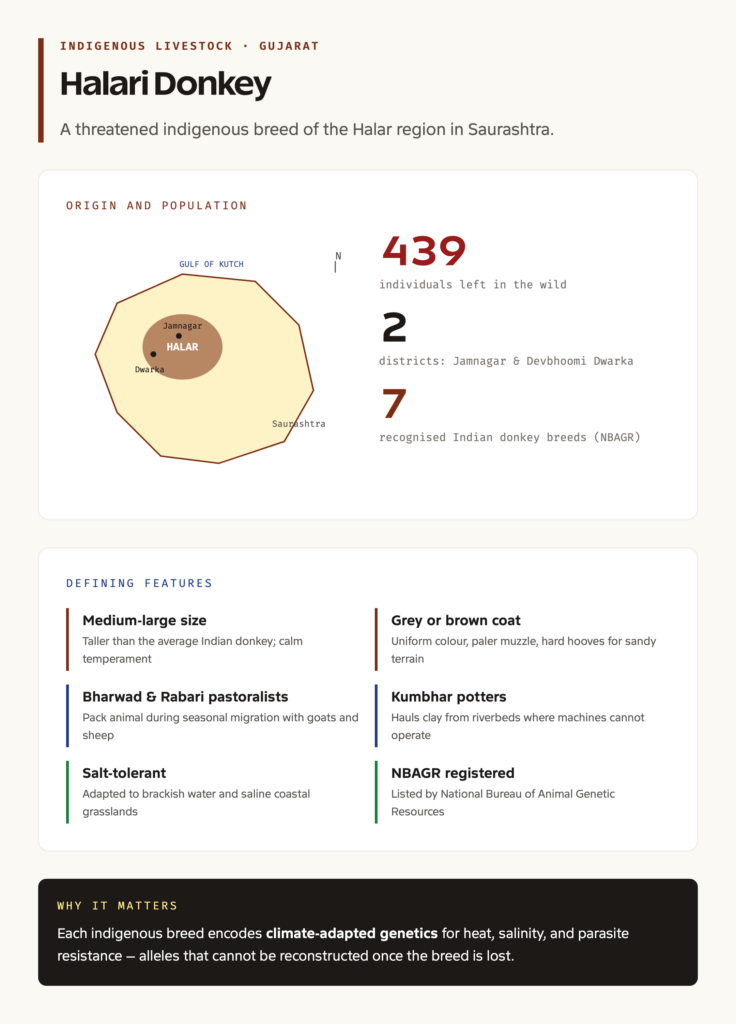
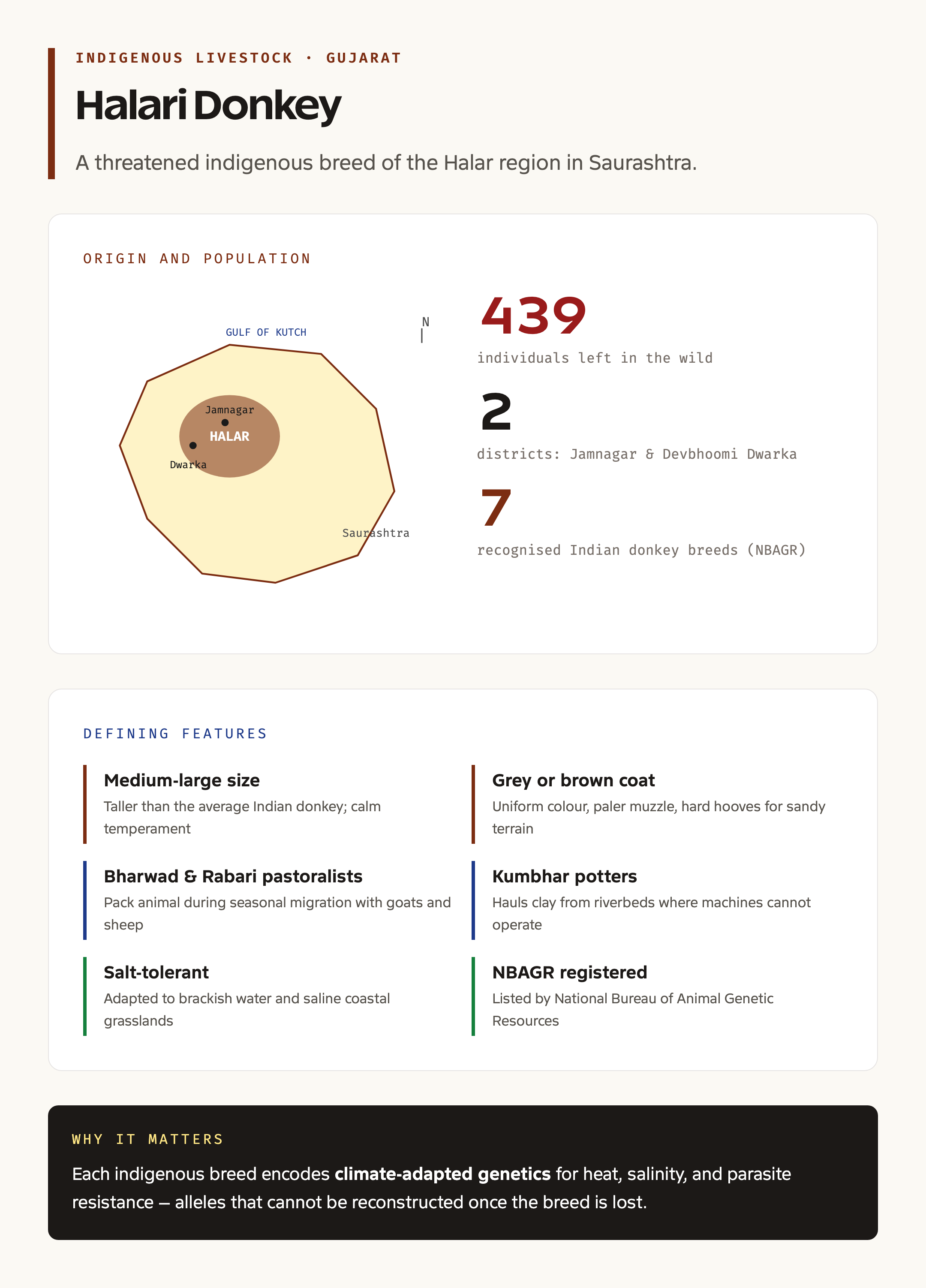
In the dry, salty terrain of Saurashtra, where the wind off the Gulf of Kutch scrapes a fine crust of salt onto the grasslands, a tall grey donkey carries pots of milk, bundles of wool, and clay through villages that no truck can easily reach. This is the Halari donkey, one of India’s seven recognised donkey breeds and one of its most endangered domestic animals. The latest livestock census places its population at just 439 individuals, almost entirely concentrated in two districts of Gujarat, Jamnagar and Devbhoomi Dwarka.
The breed takes its name from the Halar region, an old Kathiawar geographic block named for the Hala mountains and the people who settled around them. For centuries the Halari has been the working partner of the Bharwad and Rabari pastoralists during their long seasonal migrations, and of the Kumbhar potters who depend on it to haul clay from riverbeds to kilns. Yet it has never been industrially bred, never officially protected as a flagship species, and never marketed beyond its own villages. The result is a slow-motion extinction: a breed that survived 800 years of monsoons is now being squeezed out in a single generation.
For UPSC, the Halari is a small but high-yield topic. It cuts across animal genetic resources, agro-pastoralism, the National Bureau of Animal Genetic Resources framework, and the broader question of what counts as biodiversity worth saving. This guide expands every dimension of the breed and its policy context.
Quick Facts
- Common name: Halari donkey
- Origin region: Halar (Saurashtra, Gujarat), now Jamnagar and Devbhoomi Dwarka districts
- Status: Threatened breed, registered under National Bureau of Animal Genetic Resources
- Population: 439 individuals (latest available data)
- Build: Medium-sized, taller than the average Indian donkey
- Coat colour: Grey or brown
- Primary keepers: Bharwad and Rabari pastoral communities; Kumbhar potter community
- Working role: Pack animal during migration; clay transport for pottery
- Habitat: Semi-arid Saurashtra grasslands and saline coastal flats
- Recognition: One of seven Indian donkey breeds registered with NBAGR
- Conservation lead: Sahjeevan, an NGO based in Bhuj, with state animal husbandry support
- Geographical Indication candidate: Discussions ongoing for breed and product tagging
What Is the Halari Donkey
The Halari donkey is a registered indigenous breed of Equus asinus native to the Halar region of Gujarat. It is genetically and morphologically distinct from the more common non-descript donkeys you see across northern India. Halari individuals stand taller at the withers, carry a longer back, and tend to display a uniform grey or brown coat free from the dark dorsal stripes seen on some hill donkeys. The breed has been shaped by centuries of natural selection in a landscape that swings between scorching summer dryness and short, intense monsoon flooding, plus the human selection pressure exerted by pastoralists who needed an animal that could haul thirty to forty kilograms across forty kilometres a day on minimal feed.
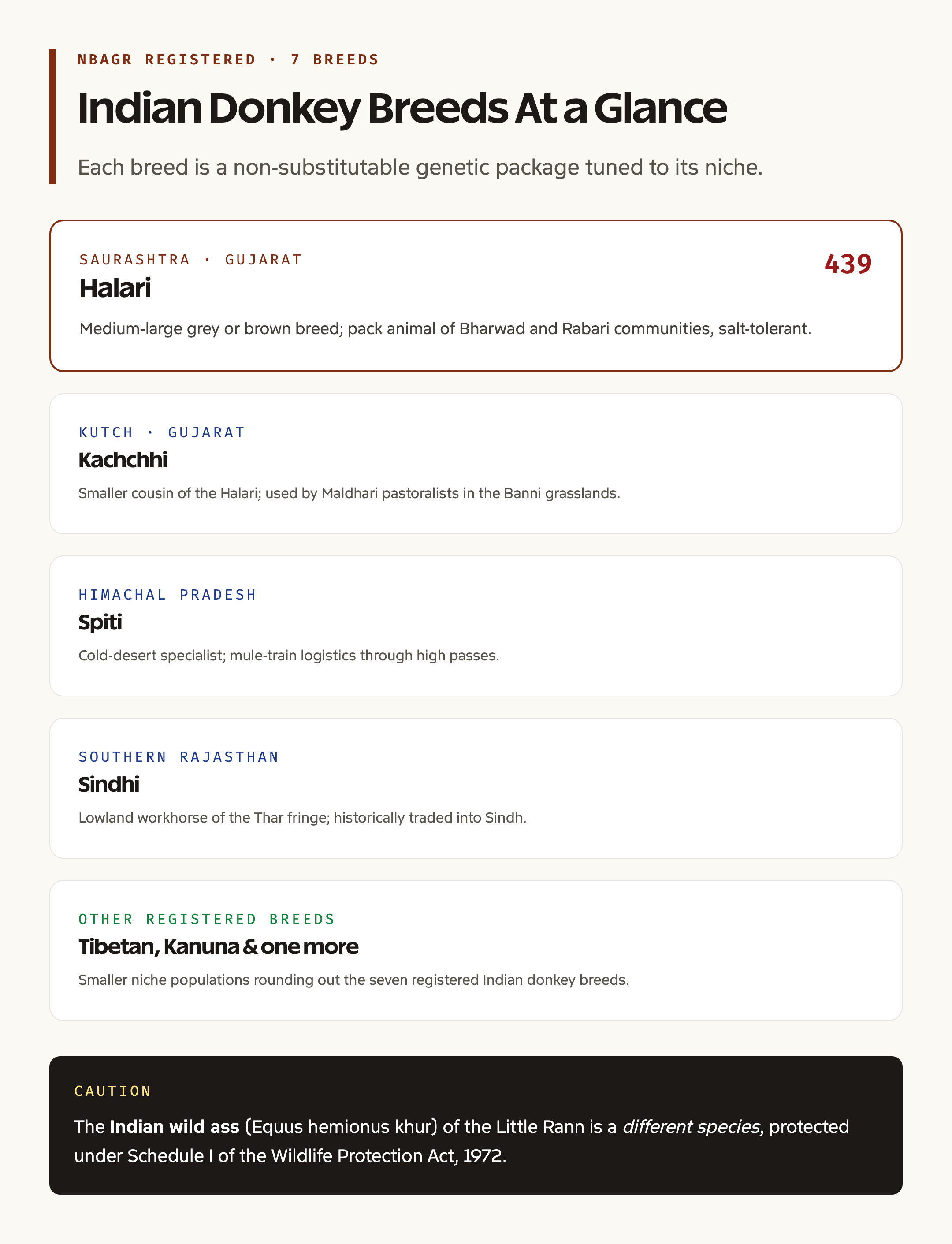
The breed is officially recognised by the National Bureau of Animal Genetic Resources (NBAGR) at Karnal, the body responsible for cataloguing and conserving India’s farm animal genetic diversity. Halari is listed alongside breeds like Spiti from the cold deserts, Kachchhi from neighbouring Kutch, Sindhi from the western frontier, and a handful of others including Tibetan and Kanuna. Each breed represents a unique adaptive package, and the Halari’s package is engineered for the salty, hot, low-fodder Saurashtra environment.
In daily life the Halari does what no jeep, scooter, or camel can do efficiently. Pastoralists use it to carry tents, water vessels, food, and bedding while moving sheep and goat flocks across long distances during the dry months. Potters use it to ferry wet clay from natural deposits to the workshop, where machine transport is impossible because the loose pathways collapse under tyres. The animal is also valued for its milk in some communities, with reports suggesting medicinal properties, though commercial donkey-milk industries here remain underdeveloped compared with examples in Greece or Italy.
Background and Historical Context
Saurashtra has hosted pastoral livestock economies for over a thousand years. Bharwad and Rabari communities, both traditionally Hindu pastoralists, trace their movement patterns back to medieval centuries when they migrated south and west from Sindh and Marwar in waves driven by drought and political upheaval. Their livelihoods rest on three legs: sheep and goat for wool and meat, cattle for milk, and the donkey as the load-bearing engine that ties the system together. Without the donkey, the entire migration cycle collapses because no other animal can be muscled, fed, and watered as cheaply during the long dry walks from Saurashtra into central Gujarat and back.
The Halari donkey emerged out of this very specific work pattern. Its size, gait, and tolerance for saline water made it the only economically feasible draft animal for the coastal-saline belt around the Gulf of Kutch. Old British district gazetteers from the late nineteenth century describe the breed indirectly under the catch-all label of Kathiawari donkeys, but the formal scientific recognition of Halari as a separate breed came only in the post-independence period as part of the larger NBAGR cataloguing project, which has continued through the twenty-first century.
Two parallel forces have started cutting into the population. First, mechanisation: tractors, motorbikes, and small trucks have replaced donkey trains for many short-haul tasks, especially around bigger villages. Second, agricultural intensification: shrinking common grazing lands, expansion of cropland, and saltpan industries have pushed pastoralists into faster, shorter migrations or out of pastoralism altogether. The result is a population that has fallen from informal estimates of several thousand a generation ago to the 439 individuals counted in the most recent census exercise.
Key Features and Physical Characteristics
The Halari is medium-sized when compared to global donkey breeds but tall by Indian standards. Adults typically stand around 108 to 115 centimetres at the withers, with stallions slightly larger. The coat is uniformly grey, ranging from a light silvery shade to a dusky brown, and the muzzle is often paler than the body. Limbs are clean and strong, with hard hooves adapted to walking on rocky and sandy ground without iron shoes.
Behaviourally the breed is calm and tractable. Bharwad herders report that Halaris will stand quietly while being loaded, will follow voice commands without needing a halter once trained, and will refuse to drink visibly contaminated water, which is an unusual trait in equids. Females typically deliver one foal every two years; the foal is independent within a few months and starts light load-carrying at around eighteen months. Lifespan in working conditions ranges between eighteen and twenty-five years, though access to veterinary care strongly affects this.
For comparison, the Halari fits within the broader Indian network of seven recognised donkey breeds and connects directly with the question bank around animal-based pastoralism that overlaps with topics like the Banni grasslands, biodiversity in India, and the Wildlife Protection Act, 1972 framework that protects wild equids such as the Indian wild ass.
Why the Halari Donkey Matters
A first reaction to news of a breed with 439 individuals is to wonder why a donkey deserves national attention when so many flagship wild species are also struggling. The answer lies in the genetic, ecological, and cultural value packed into indigenous livestock breeds.
Genetically, indigenous breeds carry alleles tuned to local stresses such as heat, salinity, parasite load, and low feed quality. Once a breed is lost, those alleles cannot be reconstructed. The Halari’s salt-tolerance and water-economy traits, for example, may matter enormously for future climate scenarios where saline intrusion expands inland from the coast.
Ecologically, the Halari is part of a working landscape. Pastoralists move livestock through grasslands that would otherwise be encroached for cropping or industrial use. Their grazing maintains grass diversity, prevents shrub takeover, and recycles nutrients across the landscape. Remove the Halari and the human migration becomes economically unviable, which removes the rotational grazing that maintains the grassland mosaic.
Culturally, the breed is tied to caste-based work practices, festival cycles, and the very identity of communities like the Bharwad and Rabari. Conservation here is not separable from livelihood support, just like in many tribal and pastoralist contexts under the Forest Rights Act, FRA 2006 framework.
Detailed Analysis: Threats Facing the Breed
Several stress factors combine to drive the population downwards.
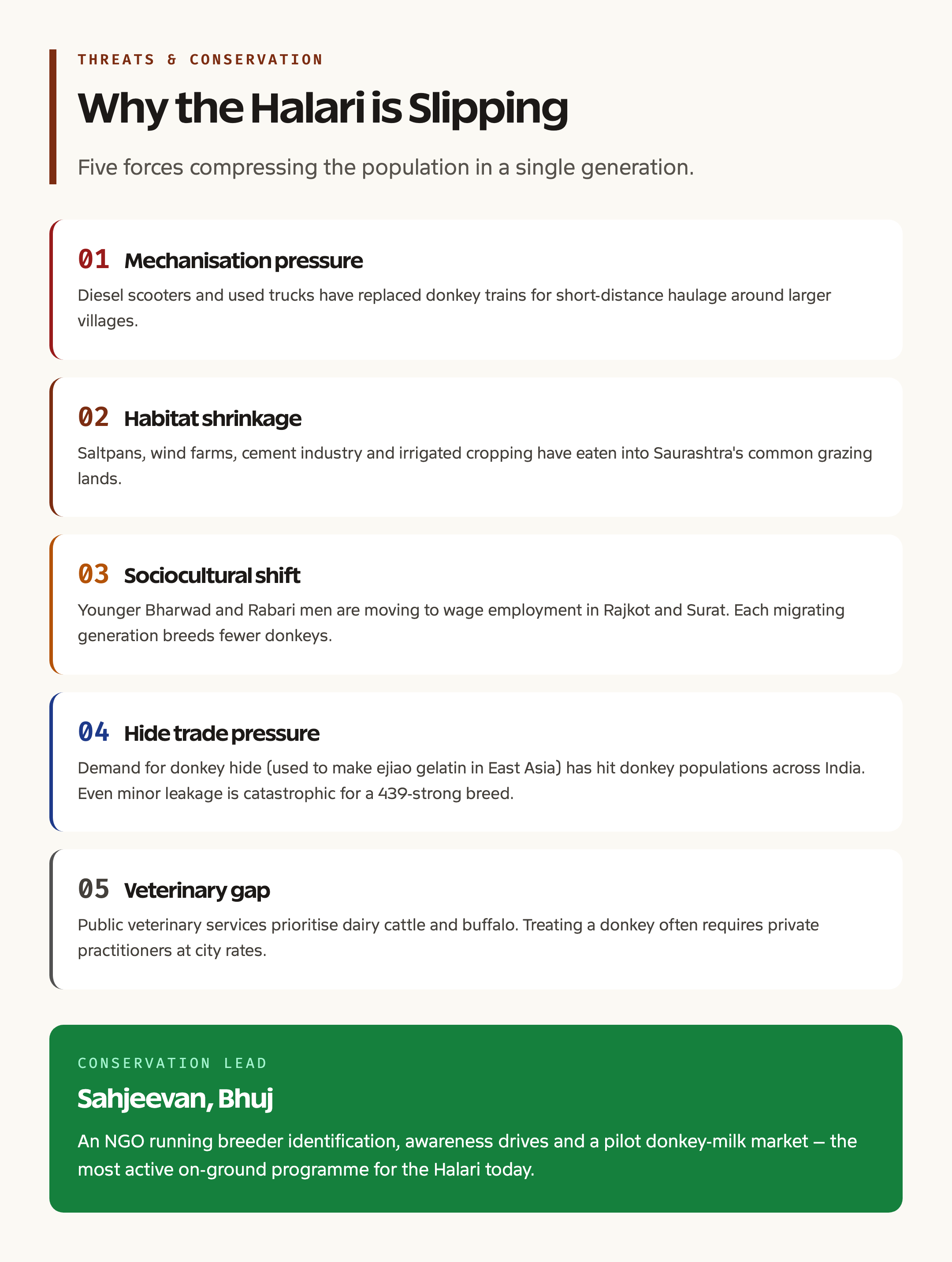
Mechanisation pressure is the single largest factor. Cheap diesel scooters and used trucks now perform much of the short-distance haulage Halaris used to perform. The economics flip quickly: a donkey costs about twelve thousand rupees to acquire and roughly nine thousand rupees a year to feed and care for, while a second-hand motorbike, once owned, costs less per kilometre even after fuel.
Habitat shrinkage matters next. Saurashtra has seen rapid expansion of saltpans, wind farms, cement industry, and irrigated cropping. The common grazing lands, often classified as gauchar or wasteland, have shrunk to a fraction of their twentieth-century extent, leaving fewer routes and feed for migrating donkeys.
Sociocultural shifts also play a role. Younger Bharwad and Rabari men are entering wage employment in cities such as Rajkot and Surat, and the rate of full-time pastoralism is dropping with each generation. A donkey that no one is migrating with becomes redundant and is sold or simply not bred again.
Slaughter and trade for skin is an emerging threat across India for donkeys generally, driven by demand for ejiao, a Chinese gelatin product made from boiled donkey hide. While Gujarat has not seen the worst of it compared with some northern states, even small-scale extraction from a population of 439 is catastrophic.
Animal welfare issues round out the picture. Cruelty in informal pack work, untreated injuries, and lack of organised veterinary outreach all contribute to slow attrition.
Comparative Snapshot: Halari vs Other Indian Donkey Breeds
A clean comparison helps. Among the seven NBAGR-registered breeds, Spiti is the cold-desert specialist of Himachal Pradesh, used in mule-train logistics; Kachchhi is the close cousin of the Halari from neighbouring Kutch, smaller and used by Maldhari pastoralists; Sindhi is the lowland workhorse of southern Rajasthan and parts of Sindh historically; and Halari occupies the salty, semi-arid Saurashtra niche.
Halari stands out for height, milk-yield potential, and the social anchor of its keeper communities. Kachchhi is sometimes confused with Halari because of geographical proximity, but morphometric studies separate them on body length, head profile, and coat shade. Each breed represents a non-substitutable genetic resource, similar to how each protected area in our list of national parks of India protects a non-substitutable ecological niche.
Challenges to Conservation
On paper the Halari is registered, monitored, and acknowledged. In practice the conservation effort runs into hard constraints.
Funding is scattered. There is no flagship scheme dedicated to indigenous donkey breeds the way Project Tiger covers the tiger or RKVY covers cattle and buffalo. Sahjeevan, an NGO based in Bhuj, runs a Halari donkey conservation programme that includes breeder identification, awareness drives, and a small market-creation effort around donkey milk, but its budget cannot compensate for the absent federal scheme.
Demand-side support is weak. Cattle and buffalo benefit from massive milk-procurement infrastructure through Amul-style cooperatives. Donkey milk has no comparable network. Without organised offtake of milk or other products, the economic case for keeping a Halari shrinks each year.
Veterinary outreach is thin. Public veterinary services are tuned to dairy cattle and buffalo, not to working equids. Pastoralists report that getting a donkey treated for a colic episode often requires private practitioners at city rates, an expense that pushes families toward giving up the animal.
Trade-related risks need monitoring. India banned donkey hide exports more than once after demand spiked in East Asia, but enforcement at small slaughter clusters remains uneven, and even minor leakage can damage micro-populations.
Prelims Pointers
- Halari donkey is a registered indigenous breed of Gujarat
- It originates from the Halar region, covering Jamnagar and Devbhoomi Dwarka districts
- The breed is medium-sized with a grey or brown coat
- Population stands at 439 individuals as per the latest available census
- Used as a pack animal by Bharwad and Rabari pastoralists during seasonal migration
- Used by the Kumbhar community for transporting clay in pottery work
- Listed by the National Bureau of Animal Genetic Resources at Karnal
- Belongs to the species Equus asinus (domesticated donkey)
- One of seven recognised Indian donkey breeds
- Sahjeevan, a Bhuj-based NGO, leads on-the-ground conservation
- Habitat overlaps with Banni grasslands and the Saurashtra coastal belt
- The Indian wild ass (Equus hemionus khur) is a separate species, found in Little Rann of Kutch
Mains Practice Questions
- Indigenous livestock breeds carry irreplaceable genetic resources but face market-driven extinction. Critically examine using the case of the Halari donkey of Gujarat. (250 words)
- Pastoral communities act as ecological stewards of common grasslands. How does the loss of the Halari donkey threaten the Bharwad-Rabari migratory livelihood and the Saurashtra grassland mosaic? (250 words)
- Discuss the institutional gaps in India’s animal genetic resources conservation framework, with reference to NBAGR-registered minor breeds such as the Halari donkey. Suggest reforms. (150 words)
Way Forward
A few steps would meaningfully change the trajectory.
A dedicated central scheme for threatened indigenous donkey breeds, modelled on the protocol used for tiger reserves in India but tuned for working livestock, would create funding certainty.
A milk-procurement and value-addition pilot, similar to the Amul cooperative model, could convert one Halari mare into a small-business asset rather than a depreciating burden. Donkey milk is finding niche markets in cosmetics and infant nutrition globally, and a state-supported branding effort could open price premiums.
Veterinary outreach must be retooled. Mobile veterinary units that follow pastoralist migration routes during the dry months would directly cut attrition.
A Geographical Indication tag for Halari-derived products and integration with the eco-tourism circuits in the Gulf of Kutch would lift the cultural visibility of both the breed and its keepers, similar to how community-led conservation has worked around biosphere reserves in India.
Strict enforcement against hide trade, with random monitoring at known slaughter clusters, should continue.
Above all, conservation has to be coupled with livelihood. The Halari survives only if the Bharwad and Rabari families that breed it can earn a living from the surrounding pastoral system. Treat the breed as a stand-alone wildlife asset and it disappears. Treat it as the keystone of a working landscape and it has a real future.
Frequently Asked Questions
What is the Halari donkey known for?
The Halari is an indigenous Indian donkey breed native to the Halar region of Gujarat. It is known for its medium-large size, grey or brown coat, calm temperament, and its central role in the migration cycles of Bharwad and Rabari pastoralists, plus the working life of Kumbhar potter families.
How many Halari donkeys are left in India?
The latest available census places the population at 439 individuals, concentrated almost entirely in Jamnagar and Devbhoomi Dwarka districts of Gujarat. This makes it one of the most threatened registered livestock breeds in the country.
Where does the Halari donkey live?
Its core range is the semi-arid grassland and saline coastal belt of the Halar region in Saurashtra, Gujarat. The breed thrives in the dry-monsoon climate with low fodder quality and tolerates the saline water common to the Gulf of Kutch coast.
What communities keep the Halari donkey?
The Bharwad and Rabari pastoralists use it as a pack animal during seasonal migration with sheep and goat flocks. The Kumbhar potter community uses it to transport clay from riverbeds to workshops, a job no mechanical alternative does economically.
Is the Halari donkey a wild or domestic species?
It is fully domestic, belonging to Equus asinus. The Indian wild ass, Equus hemionus khur, found in the Little Rann of Kutch, is a different species and protected under Schedule I of the Wildlife Protection Act, 1972.
Why is the Halari donkey threatened?
Mechanisation has replaced donkeys for short-distance haulage, common grazing land has shrunk under industrial and agricultural pressure, younger pastoralists are leaving the trade, and trade in donkey hide for ejiao has put pressure on populations across India.
Who is leading conservation efforts for the breed?
Sahjeevan, an NGO based in Bhuj, runs the most active on-ground programme. The National Bureau of Animal Genetic Resources at Karnal handles formal registration and monitoring. The Gujarat Animal Husbandry Department supports veterinary outreach in pockets.
Is donkey milk from the Halari sold commercially?
Sales remain informal and small-scale. Some pilot efforts position Halari milk in cosmetics and niche nutrition markets, but no organised cooperative procurement structure exists, which limits demand-side support for keepers.
How does the Halari relate to other Indian donkey breeds?
It is one of seven NBAGR-registered breeds, alongside Spiti, Kachchhi, Sindhi, and others. Each breed occupies a distinct ecological niche and represents a unique genetic package. Halari is the Saurashtra-adapted member of this set.
Is there a UPSC angle to the Halari donkey?
Yes. It connects animal genetic resources, indigenous breeds, pastoralism, the NBAGR framework, biodiversity conservation, and the broader livelihood-conservation linkage. It pairs well with topics like Banni grasslands, the Indian wild ass, and the Wildlife Protection Act.
Tell Google you want more of this.
Add Anantam IAS as a preferred sourceOne tap, and this site shows up more often in your own Top Stories, AI Overviews and AI Mode. Remove it any time.