India's health story since 1947 is one of both remarkable progress and persistent gaps. Life expectancy has risen from 32 years in 1947 to 70.8 years in 2022. Infant mortality has fallen from over 140 per 1,000 live births to 28 (SRS 2020). Smallpox was eradicated; polio followed in 2014. Yet India still hosts the world's largest absolute burden of tuberculosis, anaemia and undernutrition, and spends less than 2% of GDP on public health — well below the National Health Policy 2017 target of 2.5%.
This evergreen guide surveys India's health status, maps the policy architecture and discusses contemporary reforms.
Key Health Indicators
Mortality
- Life expectancy at birth (2022): 70.8 years (UN World Population Prospects).
- Infant Mortality Rate (IMR): 28 per 1,000 live births (SRS 2020).
- Under-5 Mortality Rate: 32 per 1,000 live births (SRS 2020).
- Maternal Mortality Ratio (MMR): 97 per 1,00,000 live births (SRS 2018-20).
- Neonatal Mortality Rate: 20 per 1,000 (SRS 2020).
- Crude Birth Rate: 19.5; Crude Death Rate: 6.0.
Fertility
- Total Fertility Rate (TFR): 2.0 (NFHS-5, 2019-21) — below replacement.
- State variation — Bihar 3.0, Kerala 1.8.
Nutrition
- Stunting (NFHS-5): 35.5% — down from 38.4% in NFHS-4.
- Wasting: 19.3%.
- Underweight: 32.1%.
- Anaemia in women 15-49: 57% (up from 53% in NFHS-4 — a regression).
- Anaemia in children 6-59 months: 67.1%.
Morbidity
- Tuberculosis incidence: 237 per 1,00,000 (WHO 2023) — India accounts for 27% of global cases.
- HIV prevalence: 0.21% among adults.
- Non-communicable diseases (NCDs): 61% of deaths (ICMR, NCD Risk Factor Collaboration).
- Mental health: 14% of Indians aged 18+ have a mental health condition (NMHS 2015-16).
Immunisation
- Full immunisation coverage: 76.4% (NFHS-5), up from 62% (NFHS-4).
Public Health Expenditure
- Public health spending: 2.1% of GDP (2024 Economic Survey).
- NHP 2017 target: 2.5% by 2025.
- Out-of-pocket expenditure (OOPE): declined from 64% in 2013-14 to ~40% by 2022, but remains high.
- Catastrophic health expenditure continues to push millions into poverty annually.
Constitutional and Legal Framework
- Article 21 — right to health has been read into the right to life by the Supreme Court (e.g., Paschim Banga Khet Mazdoor Samity 1996).
- Article 39(e), (f), 42, 47 — DPSPs on nutrition, standard of living, public health.
- Seventh Schedule — health is primarily a State List subject (Entry 6); certain aspects like disease control cross into Concurrent List (Entry 29).
Policy Architecture
National Health Policy 2017
- Target of 2.5% of GDP on public health.
- Assurance-based approach.
- Preventive and promotive care priority.
- Support for private sector through strategic purchasing.
- Target IMR of 28, U5MR of 23 by 2025.
Flagship Programmes
Ayushman Bharat (2018) — two pillars:
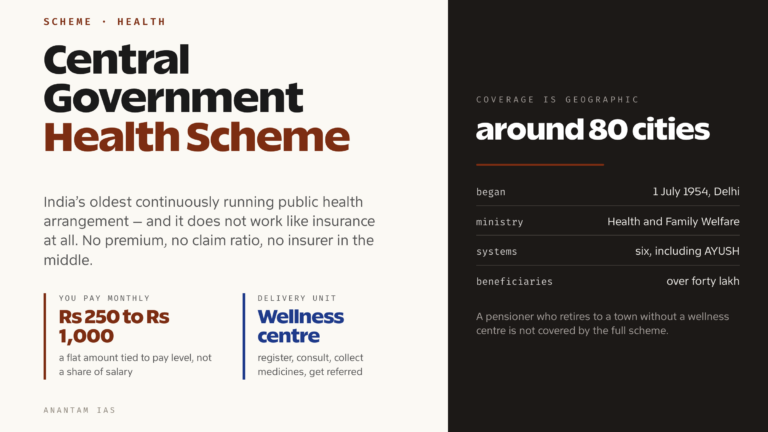
- Health and Wellness Centres (HWCs) — 1.6 lakh+ by 2024; primary care, NCD screening, mental health.
- Pradhan Mantri Jan Arogya Yojana (PM-JAY) — Rs 5 lakh hospitalisation cover for 12+ crore families.
National Health Mission (NHM) — umbrella for rural and urban health missions.
Mission Indradhanush — immunisation scale-up.
LaQshya — labour room quality.
Janani Suraksha Yojana / Janani Shishu Suraksha Karyakram — maternal care.
Nikshay Poshan Yojana — nutrition support for TB patients.
Pradhan Mantri Surakshit Matritva Abhiyan — free antenatal care.
PM Ayushman Bharat Health Infrastructure Mission (PM-ABHIM) — Rs 64,180 crore for health infrastructure.
Ayushman Bharat Digital Mission (ABDM) — unique health ID, digital registries, interoperable EHR.
Ayushman Vay Vandana (2024) — senior citizens.
National Disease Control Programmes
- Revised National Tuberculosis Control Programme (RNTCP) / National TB Elimination Programme (NTEP) — target elimination by 2025.
- National AIDS Control Programme.
- National Vector Borne Disease Control Programme.
- National Mental Health Programme.
- National Programme for Control of Blindness.
Persistent Challenges
Double Burden of Disease
- Communicable diseases still account for 28% of deaths.
- Non-communicable diseases account for 61% — diabetes, hypertension, cardiovascular, cancer, respiratory.
- Injuries account for 11%.
Rural-Urban Divide
- Doctor-population ratio: 1 per 834 (national), but rural areas have much lower availability.
- Health infrastructure concentrated in cities.
- Sub-centres, PHCs, CHCs often understaffed.
Public Sector Capacity
- Human resources for health: shortages of specialists, nurses, ANMs.
- Medical education — MBBS seats expanded to 1 lakh+ but quality concerns remain.
OOPE and Financial Protection
- Despite PMJAY, OOPE is still ~40%.
- Out-patient care is largely out-of-pocket.
- Health insurance penetration is low.
Pandemic Preparedness
- COVID-19 revealed gaps — oxygen infrastructure, ICU beds, surveillance, manufacturing.
- National Centre for Disease Control (NCDC) strengthening ongoing.
Mental Health
- Treatment gap of 70-85%.
- Inadequate human resources for mental health.
- Tele-MANAS (2022) expanding access.
Air and Environmental Health
- Air pollution causes about 16 lakh premature deaths annually (State of Global Air 2024).
- Indoor air pollution from biomass fuels reduced by PMUY but still significant.
Latest Developments (2024-26)
Ayushman Vay Vandana. Launched 2024 — free hospitalisation for senior citizens regardless of income.
PMJAY Expansion. Operational benefit limit per family may be expanded; centrally coordinated enrolment drives underway.
NMC Reforms. National Medical Commission is rolling out new medical education regulations through 2024-26.
Digital Health. Ayushman Bharat Digital Mission (ABDM) — 70+ crore ABHA numbers created by late 2024.
Tele-MANAS. National tele-mental health service launched 2022; operational across 34 states and UTs by 2024.
U-WIN. Universal immunisation digital platform rolled out nationally in 2024.
Maternal Mortality. India's MMR target of reducing MMR to under 70 by 2030 (SDG 3.1) on track.
Caste Census 2025. Union Cabinet approved caste enumeration in the next national census (April 2025); health indicators will be disaggregated.
MPI 2024. Global Multidimensional Poverty Index 2024 confirmed 415 million Indians exited multidimensional poverty between 2005-06 and 2019-21; health indicators drove a significant share.
Women's Reservation Act. The Nari Shakti Vandan Adhiniyam 2023 — post-delimitation implementation; women's political representation will shape reproductive and maternal health priorities.
Global Gender Gap Index 2024. India ranked 129/146; health parity remained relatively strong but declining reflecting weakness in sex ratio at birth.
Policy Recommendations
- Increase public health spending to 2.5% of GDP.
- Universal Health Coverage through PMJAY extension + HWCs.
- Human resources strategy — medical colleges, nursing, ASHA strengthening.
- NCD focus — primary prevention through HWCs.
- Mental health — parity with physical health in funding and access.
- Digital health — interoperable, privacy-protected.
- Climate and environmental health — integrating air, water, heat into health policy.
UPSC Relevance
GS Paper I — Indian Society
- Population; issues relating to poverty and hunger.
GS Paper II — Governance, Social Justice
- Issues relating to development and management of social sectors — health, education, human resources.
- Welfare schemes for vulnerable sections.
Possible mains questions
- "India's health status reflects remarkable progress and persistent gaps. Examine." (250 words)
- "Ayushman Bharat has transformed Indian public health financing. Critically assess." (150 words)
- "The double burden of disease requires a reconfigured public health architecture. Discuss." (150 words)
Prelims pointers. NHP 2017; Ayushman Bharat (2018); PM-JAY; HWCs; PM-ABHIM (2021, Rs 64,180 crore); ABDM; ABHA; Ayushman Vay Vandana (2024); NFHS-5 (2019-21); SRS 2020 IMR 28, MMR 97; TFR 2.0; NTEP elimination target 2025; Tele-MANAS (2022).
Essay themes. "Health for all"; "A nation's wellbeing"; "From illness to wellness".
India's next decade in health will be shaped not by one flagship scheme but by a maturing health system that combines coverage with quality and resilience.
Tell Google you want more of this.
Add Anantam IAS as a preferred sourceOne tap, and this site shows up more often in your own Top Stories, AI Overviews and AI Mode. Remove it any time.