Horticulture Plus is the policy term for the highest-value sub-segments within Indian horticulture — floriculture, spices, cashew, cocoa, mushrooms, aromatic plants, saffron, vanilla, ginseng-like medicinal crops, and exotic vegetables. While horticulture as a whole already contributes about 33% of India's agriculture GVA from just 18% of cropped area, the Plus category delivers the steepest income gains per acre and the largest export multipliers — which is why both the Mission for Integrated Development of Horticulture (MIDH) and the Agriculture Export Policy 2018 treat these crops as priority growth engines for doubling farmers' income.
For UPSC, Horticulture Plus is a frequent GS-III topic, intersecting with agricultural diversification, food processing, agri-export competitiveness, climate-smart agriculture, and rural livelihoods. Prelims has tested India's rank in spices (largest producer/consumer/exporter), saffron-growing states, and MIDH components. Mains has asked about the role of horticulture in agricultural transformation and why India underperforms in floriculture exports.
What Counts as Horticulture Plus?
Conventional horticulture covers fruits, vegetables, plantation crops (coconut, areca, cashew), spices, flowers, mushrooms, honey, and medicinal/aromatic plants. The "Plus" subset is high-value, often export-oriented, and capable of generating Rs 2-10 lakh per hectare in net realisation — multiples of staple cereal income.
Core Horticulture Plus Crops
- Floriculture: cut flowers (roses, gerbera, carnation, orchid, anthurium), loose flowers (marigold, jasmine, chrysanthemum), and decorative greens.
- Spices: cardamom (small and large), pepper, turmeric, ginger, chilli, fenugreek, fennel, coriander, cumin, vanilla.
- Plantation crops: cashew, cocoa, coffee, tea, areca, oil palm.
- Mushrooms: button, oyster, milky, paddy-straw, shiitake.
- Medicinal and aromatic plants (MAP): ashwagandha, lemongrass, tulsi, palmarosa, sandalwood, mentha.
- Saffron: Kashmir, Ramban valley.
- Exotic crops: avocado, kiwi, dragon fruit (kamalam), strawberry, blueberry, asparagus, broccoli.
Background: India's Horticulture Story
Production Snapshot
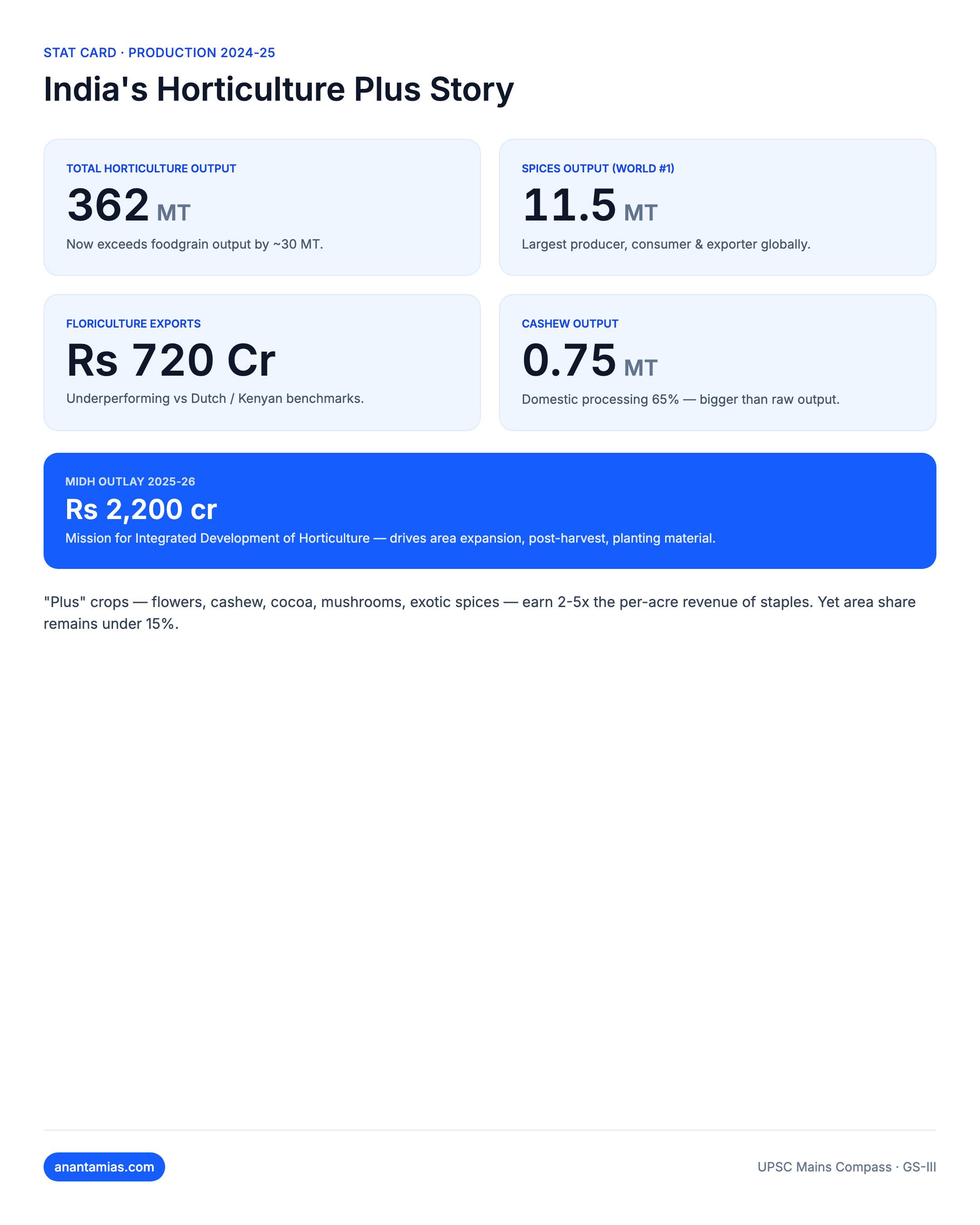
India produced ~352 million tonnes of horticulture in 2024-25 — surpassing food-grain output. Total horticulture area: ~28 million hectares. India is the second-largest producer of fruits and vegetables globally after China, and the largest producer, consumer and exporter of spices.
| Segment | Indian Status (2024-25) | Key Producing States |
|---|---|---|
| Spices | World's largest producer/exporter | Kerala, Karnataka, AP, Gujarat, MP, Rajasthan |
| Cashew | 2nd-largest producer; 3rd-largest exporter | Maharashtra, Goa, Karnataka, Kerala, AP, TN, Odisha |
| Cocoa | 60% imports; growing domestic plantation | TN, AP, Kerala, Karnataka |
| Floriculture | Large area, low yield, marginal global share | Karnataka, Tamil Nadu, West Bengal, Maharashtra |
| Saffron | Premium niche; Kashmir GI | Jammu & Kashmir |
| Mushrooms | Rapid 20% YoY growth | Punjab, Haryana, Maharashtra, UP, Uttarakhand |
| Coconut | Largest area in world; 2nd in production | Kerala, TN, Karnataka, AP |
Why "Plus" Crops Matter
- Higher returns: Saffron earns Rs 2-3 lakh per kg; vanilla Rs 30,000-50,000 per kg; small cardamom Rs 2,500/kg.
- Export earnings: Spices alone exported worth USD 4.46 billion in 2023-24; APEDA data show floriculture exports growing.
- Employment intensity: Cashew supports 1.5 million workers; spices ~5 million; floriculture ~200,000 jobs.
- Climate resilience: Most are perennial or short-cycle, climate-adaptive, and drought-tolerant compared to paddy/wheat.
- Diversification away from MSP-dependent crops: Reduces water and subsidy pressure.
Components/Sub-Segments of Horticulture Plus
Floriculture: Underperforming Giant
India has the world's largest area under floriculture but a negligible global export share (less than 1%), dwarfed by Netherlands, Colombia, Ecuador, Kenya.
Key issues:
- Yield per hectare is 30-50% of global benchmarks.
- Cold-chain and rapid-shipment infrastructure missing for cut flowers.
- Mostly grown for the domestic loose-flower market (temple, weddings).
- Lack of protected cultivation (greenhouses, polyhouses) outside Karnataka and Maharashtra.
Push: MIDH subsidies (50% for protected cultivation), APEDA-led export promotion, Bengaluru International Flower Auction Centre.
Spices: World Leader, Margin Pressure
India produces ~75 spices out of 109 listed by the International Standards Organization (ISO). Black pepper, cardamom, turmeric, ginger, chilli, fenugreek, fennel, coriander, cumin dominate.
Recent push:
- Spices Board's Sustainable Spices Programme.
- GI tagging for Malabar pepper, Alleppey green cardamom, Coorg green cardamom, Erode turmeric.
- Saffron Mission under National Mission on Saffron — Kashmir saffron got GI in 2020.
Cashew and Cocoa: Underexplored Plantations
- Cashew: Maharashtra, Goa, Karnataka, Kerala dominate. India imports raw cashew nuts (~Rs 5,000 crore/year) for processing and re-export. Yield gap with Vietnam is wide.
- Cocoa: India imports ~60% of cocoa demand. Tamil Nadu, AP, Kerala, Karnataka are emerging plantation states. Cadbury (Mondelez) and Amul have backward-integration programmes.
Mushrooms and Aromatics
- Mushroom: India produces ~150,000 tonnes/year; demand growing 20% annually. Aroma Mission of CSIR has popularised lavender, lemongrass cultivation in J&K.
Benefits of Horticulture Plus for India
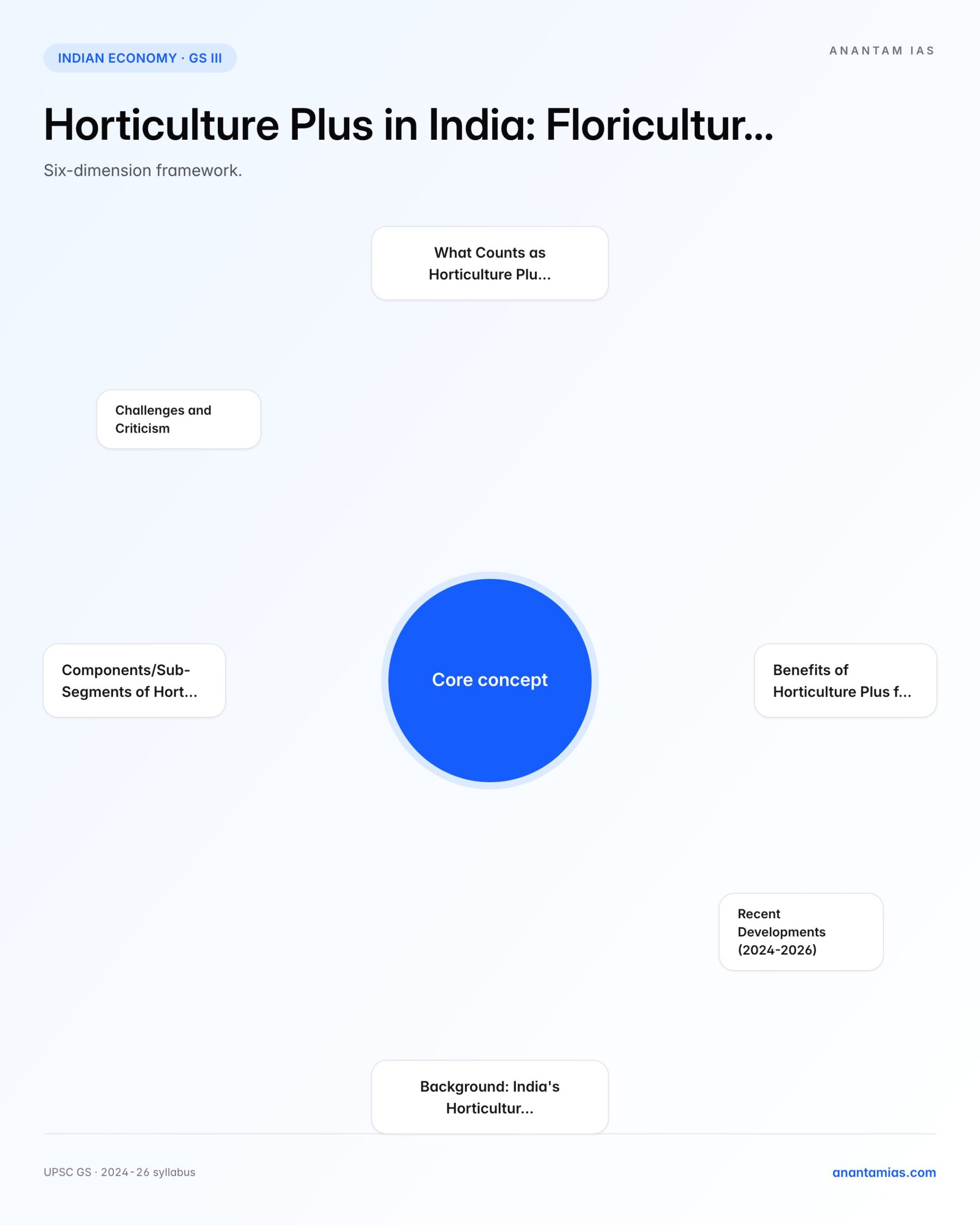
- Higher net farm income — average net income per ha is 2-10x higher than cereals.
- Export earnings — spices, floriculture, plantation crops collectively bring in over USD 7 billion annually.
- Employment generation — labour-intensive crops absorb rural workers, especially women.
- Resource efficiency — many Plus crops use 30-50% less water than rice/sugarcane.
- Nutrition security — fruits, vegetables, mushrooms address India's micronutrient gap.
- Climate-smart — perennial trees (cashew, cocoa, coconut) sequester carbon.
- Aligned with FPO mission — high-value horticulture is the natural product line for the 10,000 FPOs target.
- Tribal and remote-area development — cashew, cocoa, MAP crops grow on hilly, forest-fringe land.
Challenges and Criticism
- Post-harvest losses — 25-40% of horticulture produce is lost; cold-chain infrastructure inadequate.
- Yield gaps vs global benchmarks — Indian floriculture yields are 30-50% of Netherlands; cashew yields are 30% of Vietnam.
- Fragmented marketing — APMC restrictions, lack of e-NAM coverage for perishables, limited contract farming.
- Quality and pesticide compliance — EU rejects of Indian chillies, basmati rice, grapes due to pesticide residues; need for Good Agricultural Practices (GAP) certification.
- Inadequate processing — only 10-12% of horticulture produce is processed (versus 30-40% in developing peers).
- Climate volatility — saffron, cardamom yields hit by erratic rainfall; cashew flowering disrupted by unseasonal showers.
- Policy bias — MSP and procurement focus on rice and wheat; horticulture gets relatively smaller share of public investment.
- Skill gap — protected cultivation, post-harvest management, packaging — requires extension which is weak.
Recent Developments (2024-2026)
- Budget 2025-26: MIDH outlay of Rs 2,400 crore; cluster development programme expanded.
- Cluster Development Programme (CDP) under NHB — 55 horticulture clusters identified for end-to-end value-chain development.
- PM Cluster Development Programme: focused on banana (Anantapur), apple (Shopian), mango (Lucknow), grapes (Nashik).
- PM-KISAN AgriStack integration: digitised plot-level crop data for horticulture advisories.
- Operation Greens expanded beyond TOP (Tomato, Onion, Potato) to 22 crops including banana, mango, papaya.
- Saffron Park in Pampore, Kashmir, modernised with quality testing and packaging.
- Aroma Mission Phase II scaled up in J&K, Himachal, Uttarakhand, North East.
- Coconut Development Board rolled out neera (palm sap) certification.
- Spices export crossed USD 4.46 billion in 2023-24 — highest ever.
- Sikkim: India's first fully organic state drives premium spices export.
- Drone spraying approved for horticulture pesticide application under Namo Drone Didi.
Reforms and Way Forward
- Boost protected cultivation — polyhouses, shade nets — through MIDH 75% subsidy in hill and tribal areas.
- Expand cold-chain infrastructure — pack-houses, ripening chambers, reefer trucks under Pradhan Mantri Kisan Sampada Yojana.
- Strengthen Spices Board, Coffee Board, Tea Board, Coconut Development Board.
- GI tagging for niche crops — Coorg coffee, Naga king chilli, Alphonso mango, Nagpur orange.
- Integrate horticulture with FPOs — value addition, branding, e-commerce.
- GAP certification at scale — for export market access (INDIA-GAP, GLOBAL-G.A.P.).
- Targeted MSP/Market Intervention Scheme (MIS) for perishables when prices crash.
- Policy support for plantation crops — replanting subsidy for old cashew/coconut groves.
- Promote agri-startups — agritech for cold chain, traceability, drone spraying.
- Climate-resilient varieties — ICAR-IIHR releases for saffron, cardamom, mango.
- Skill development — short courses for protected cultivation, mushroom growing, beekeeping at KVKs.
Government Schemes and Budget Allocations (2025-26)
- Mission for Integrated Development of Horticulture (MIDH): Rs 2,400 crore.
- Operation Greens: Rs 500 crore (price stabilisation for 22 horticulture crops).
- PM Kisan Sampada Yojana (PMKSY): cold-chain, food processing infrastructure.
- Cluster Development Programme: 55 horticulture clusters.
- PM Formalisation of Micro Food Processing Enterprises (PMFME): One District One Product approach.
- Spices Board, Tea Board, Coffee Board, Coconut Development Board: commodity-specific budgets.
- APEDA: agri-export promotion with focus on horticulture.
- NHB (National Horticulture Board): subsidy for hi-tech horticulture, cold storage.
- Aroma Mission (CSIR): lavender, lemongrass cultivation in hill states.
Mains Answer Hook
A high-scoring GS-III answer should: (a) frame Horticulture Plus as the engine for doubling farmers' income because of high net realisation per hectare; (b) cite production data — 352 million tonnes, world leadership in spices, USD 4.46 billion spice exports; (c) flag systemic gaps — yield benchmark gaps in floriculture and cashew, 25-40% post-harvest losses, low processing share; (d) connect MIDH-Operation Greens-FPO-PMKSY policy stack; (e) end with the agri-export competitiveness angle.
Useful one-liner: "Horticulture Plus is where Indian agriculture trades scale for sophistication — and where the next billion dollars of agri-export will originate."
Prelims Pointers
- Horticulture share of agri-GVA: ~33% from 18% of cropped area.
- Total horticulture output 2024-25: ~352 million tonnes.
- India's spices rank: largest producer, consumer, exporter (~USD 4.46 billion exports).
- Saffron: GI tag awarded 2020 for Kashmir saffron.
- MIDH: Mission for Integrated Development of Horticulture — Rs 2,400 crore (2025-26).
- Operation Greens: covers 22 perishable horticulture crops.
- Cocoa imports: ~60% of demand (TN, AP, Kerala lead domestic plantation).
- Cashew employment: 1.5 million; states — Maharashtra, Goa, Karnataka, Kerala, AP, TN, Odisha.
- Aroma Mission: implemented by CSIR.
- Sikkim: India's first fully organic state.
FAQ on Horticulture Plus
What does Horticulture Plus include?
High-value crops within horticulture — floriculture, spices, cashew, cocoa, saffron, mushrooms, aromatic plants, vanilla, exotic fruits.
Why is India’s floriculture export weak despite the largest area?
Low yield per hectare, lack of cold-chain, weak protected cultivation, and small global market share.
Which body promotes spice exports?
Spices Board of India under the Ministry of Commerce, with APEDA support for export logistics.
Where is saffron grown in India?
Kashmir Valley (Pampore, Pulwama), Kishtwar, Doda — covered under National Saffron Mission.
What is MIDH?
Mission for Integrated Development of Horticulture — umbrella scheme covering NHM, HMNEH, NHB, CDB, CIH; Rs 2,400 crore in Budget 2025-26.
How does Horticulture Plus help double farmers’ income?
Net realisation per hectare for cardamom, vanilla, saffron, banana, mango is 2-10x that of paddy/wheat; MIDH-Operation Greens-FPO ecosystem accelerates the shift.
Horticulture Plus is the part of Indian agriculture where productivity, exports, and rural income converge. For UPSC, anchor your prep in MIDH-Operation Greens-Cluster Development, the 352 mn-tonne output, the USD 4.46 bn spice export, and the floriculture yield gap. Layer in the policy ecosystem and the export angle for a Mains-grade answer.
Tell Google you want more of this.
Add Anantam IAS as a preferred sourceOne tap, and this site shows up more often in your own Top Stories, AI Overviews and AI Mode. Remove it any time.