Newspaper note-making is where more aspirant hours disappear than anywhere else in the preparation, and where the return per hour is lowest.
The pattern is familiar. Two hours with the paper. Careful notes on eight or nine articles. A growing file. And by month six, a file so large that revising it is itself a project, containing a great deal about events that turned out to matter to nobody.
The problem is not reading speed and it is not the newspaper you chose. It is that daily note-making forces you to judge significance on the day, which is the one day you cannot possibly judge it.
Read Daily, Note Weekly
This is the single change that fixes most newspaper workflows.
On the day, you cannot tell whether a story is a passing development or the start of something. A committee is constituted; will it report? A bill is introduced; will it pass? A minister makes a statement; is it policy? Note it on Tuesday and you have committed effort before the information exists to justify it.
Wait a week and the answer is usually obvious. Most stories die. A handful develop. The ones that develop can be noted once, whole, in a fraction of the time seven daily fragments would have taken — and without the fragments needing to be reconciled later.
So: read daily, mark, and note once a week. Marking takes seconds. The weekly session takes thirty to forty-five minutes and produces something you will actually reopen.
What Is Actually Worth Noting
Four buckets. Everything else is reading, not noting.
1. Institutions, mechanisms and instruments. A new regulator, an amended act, a scheme’s design, a treaty’s provisions, a court’s reasoning. These have long half-lives and they are what the examiner asks about. Our Prelims PYQ analysis shows conventions, institutions and instruments recurring year after year; individual events almost never do.
2. Data with a source. A ratio, a rank, a share, a growth figure — with the report it came from. Three or four good figures per week is plenty. These are what lift a Mains answer out of the generic, as the Mains PYQ analysis shows for GS-3 in particular.
3. Arguments you did not already hold. The editorial’s actual reasoning, not its conclusion. If a piece changes how you would answer a question, that reasoning is worth two lines. If it merely confirms what you thought, it is not.
4. Static material the news happened to surface. A story about a tiger reserve is a prompt to check where it is and what its status is. The story is disposable; the geography is not.
What to Skip Without Guilt
- Party politics, cabinet reshuffles, election arithmetic
- Crime, accidents, individual court cases without a doctrinal point
- Sport, other than a genuinely new institutional development
- Personality profiles and obituaries, unless the person is themselves syllabus material
- Bilateral visits, unless an agreement was actually signed
- Anything you cannot connect to a syllabus clause in under ten seconds
That last test is the useful one. If you cannot name the clause, the article is general awareness and belongs in your reading, not your notes.
The Format That Survives Revision
One entry per theme, not per article, and each entry short enough to read in twenty seconds:
- What it is — one line, plain
- Why it exists — the problem it addresses
- The one number — with its source
- The tension — the strongest argument against, in a clause
- Syllabus hook — the paper and clause it serves
That last field is what makes the file usable. Six months on you will not search by date; you will search by “GS-2 governance” or “GS-3 agriculture”. A file organised by theme with syllabus hooks is revisable. A file organised by date is an archive.
Keep it typed. Current affairs is the clearest case against handwriting — the volume is high, the material gets amended as stories develop, and you need to search it. See Handwritten Notes for UPSC for where handwriting does earn its cost.
A Realistic Weekly Rhythm
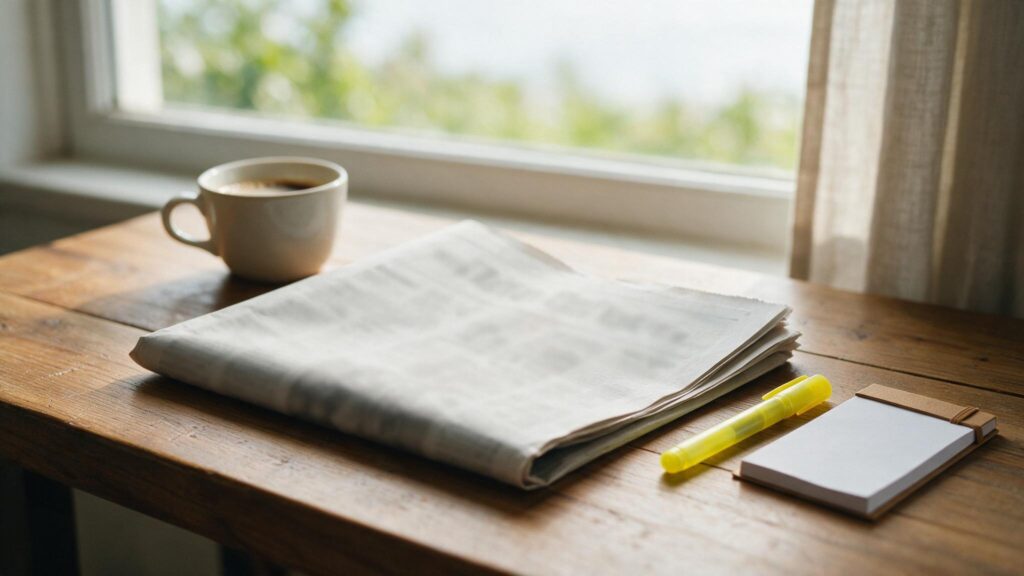
Daily, 30-40 minutes: read the paper. Mark what falls in the four buckets. Do not write notes. Marking is a highlight or a one-word margin tag, nothing more.
Weekly, 30-45 minutes: revisit the week’s marks. Most will have died — drop them without ceremony. Note the survivors as themes, not as articles. Merge anything that developed across several days into one entry.
Monthly, 20 minutes: reread the month’s entries. Delete what has gone nowhere. A current-affairs file should shrink as often as it grows.
That is under five hours a month, against the fifteen or twenty a daily-notes habit consumes, and it produces a smaller file with a higher hit rate.
Which Paper, and How Much of It
One paper, read properly, beats two skimmed. The Hindu and the Indian Express both work; the choice matters far less than the consistency. Add PIB for the primary text of schemes and reports — it is where the detail the examiner uses actually lives.
Do not add a monthly compilation to a daily habit and a weekly note. Pick one primary source and one backstop. Our current affairs strategy covers the sourcing question in more depth, and how to read The Hindu covers the reading itself.
Frequently Asked Questions
How much time should newspaper reading take for UPSC? Thirty to forty-five minutes daily once you are practised, plus a thirty-to-forty-five-minute weekly note-making session. Two hours a day on the paper is a sign of noting while reading rather than after.
Should I make newspaper notes daily or weekly? Weekly. On the day a story breaks you cannot tell whether it will matter; a week later you usually can. Weekly noting also lets you merge a developing story into one entry instead of seven fragments.
Should newspaper notes be handwritten or typed? Typed. Current affairs has high volume, gets amended as stories develop, and needs to be searchable — the three conditions under which handwriting performs worst.
How do I know if a news item is UPSC-relevant? Try to name the syllabus clause it serves in under ten seconds. If you cannot, it is general awareness rather than notes material. Institutions, mechanisms, sourced data and genuine arguments are the four things worth keeping.
Is one newspaper enough for UPSC? Yes, if read consistently and paired with PIB for the primary text of schemes and reports. A second paper adds far less than the same time spent revising what you already noted.
Do I still need a monthly current affairs magazine? Only as a backstop to check for gaps, not as a parallel source. Running a daily habit, a weekly note and a monthly compilation means reading the same material three times and revising none of it.
Tell Google you want more of this.
Add Anantam IAS as a preferred sourceOne tap, and this site shows up more often in your own Top Stories, AI Overviews and AI Mode. Remove it any time.