How to Read The Hindu for UPSC: Strategy, Notes & Time Management
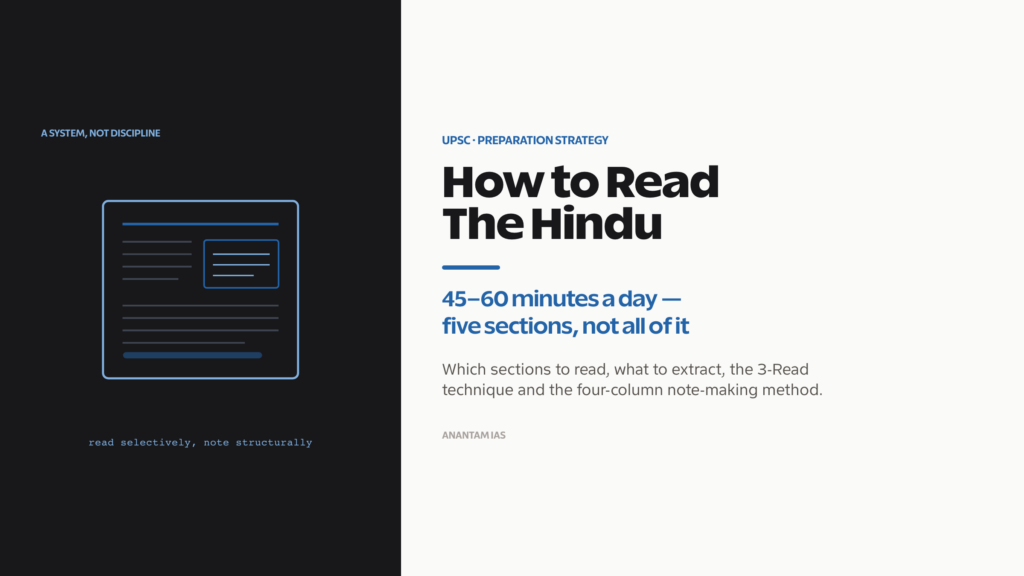
Read The Hindu for UPSC by spending 45–60 minutes daily, focusing on Editorial, Op-Ed, National, International, and Economy sections — and skipping everything else. The biggest mistake aspirants make isn’t reading The Hindu; it’s reading all of it. Indiscriminate reading wastes 90 minutes and gives you 20 minutes worth of useful material.
The Hindu is the single most cited newspaper in UPSC CSE mains answer evaluation. Its editorial positions on governance, policy, and international relations directly shape the quality of answers in GS2, GS3, and Essay. But the newspaper has around 24–28 pages daily. You need a system, not discipline.
Why The Hindu for UPSC? The Case is Simple
The Hindu’s editorial desk understands constitutional democracy, international relations, and governance with a depth that other newspapers rarely match. Its Op-Ed contributors — economists, retired bureaucrats, Supreme Court advocates, former diplomats — write the kind of nuanced, multi-perspective analysis that UPSC expects in mains answers.
Three things set The Hindu apart:
First, its language. UPSC mains demands formal, precise English. Reading 60 minutes of The Hindu daily improves sentence construction, vocabulary in context, and argument structure — skills that directly improve your answer quality.
Second, its institutional coverage. The Hindu covers Supreme Court judgements, CAG reports, parliamentary debates, and constitutional commissions with more detail than any competitor. GS2 (Polity, Governance, International Relations) draws heavily from exactly these sources.
Third, its economic analysis. The Hindu’s Economy page and Business Line connections give better coverage of RBI policy, fiscal policy, and macroeconomics than most newspapers.
The competition — Indian Express, Times of India, Mint — each has strengths. But for UPSC mains specifically, The Hindu remains the default recommendation of the coaching establishment and toppers alike.
Best Books for UPSC Prelims and Mains
Which Sections to Read: The Non-Negotiables
The Hindu has many sections. UPSC aspirants need exactly four to five of them.
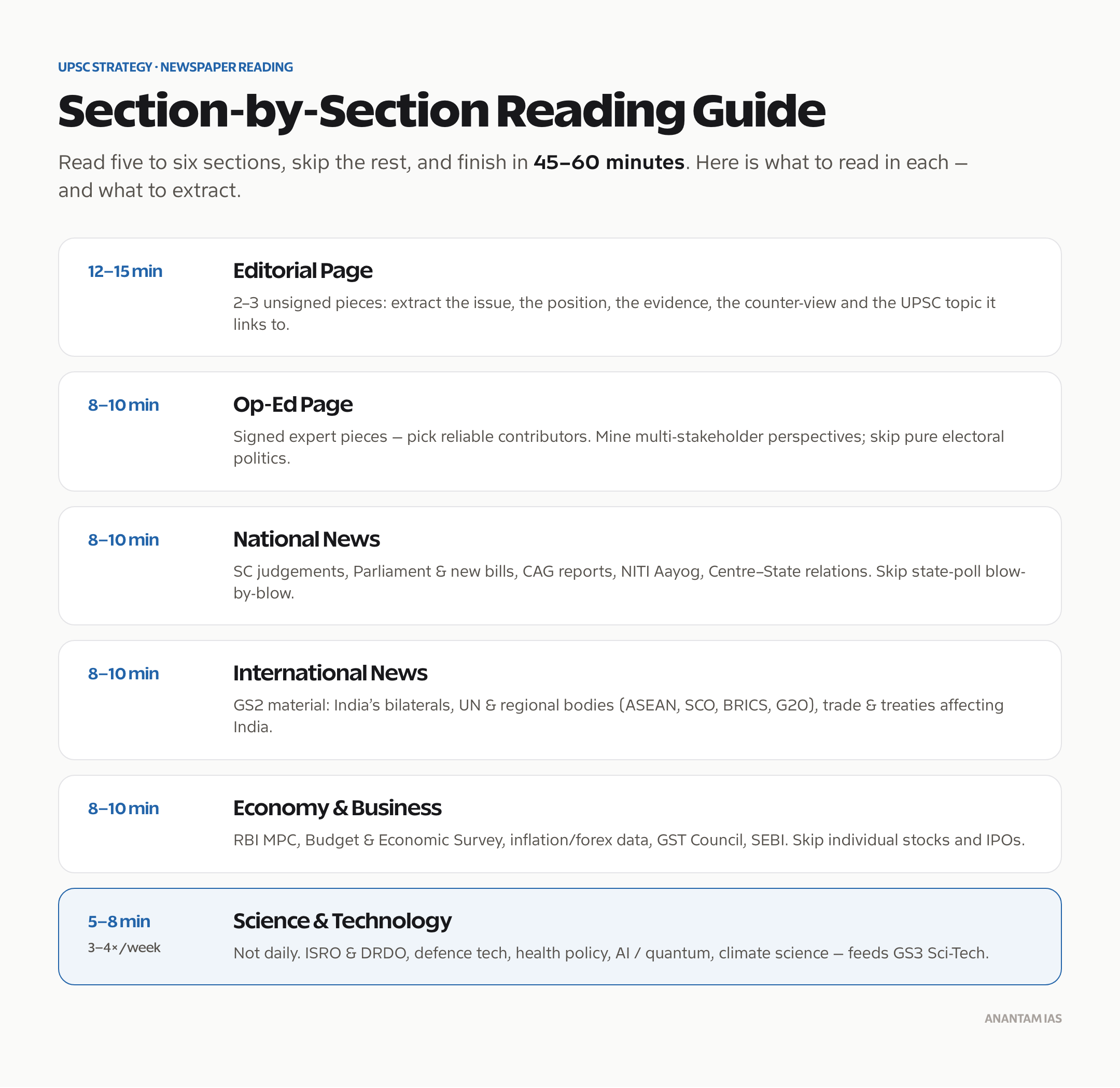
Section 1: The Editorial Page
Time required: 10–15 minutes
The Editorial page (usually Page 8 or 9 in print) has 2–3 editorials daily. These are written by The Hindu’s editorial board — unsigned pieces representing the newspaper’s institutional position.
What makes them essential: every editorial takes a clear stance on a current issue and backs it with specific facts, historical context, and constitutional/legal reasoning. This is exactly how you’re expected to write in UPSC mains.
How to read: Don’t just read — actively extract the argument structure.
- What is the issue being discussed?
- What is the editorial’s position?
- What evidence does it cite?
- What is the alternative view (if mentioned)?
- Which UPSC topic does this connect to?
Example: An editorial on the Supreme Court’s ruling on PMLA (Prevention of Money Laundering Act) connects to GS2 (Judiciary, Fundamental Rights), GS3 (Security, Money Laundering), and Ethics (Rule of Law).
Section 2: Op-Ed Page (Opposite Editorial)
Time required: 10–12 minutes
The Op-Ed page carries 2–3 signed articles by external contributors. Quality varies by author. Learn to identify the reliable contributors quickly.
High-priority Op-Ed contributors: Retired IAS officers (on governance, federalism), economists (N.R. Narayana Murthy, Jean Drèze on welfare), Supreme Court advocates (on constitutional law), retired diplomats (on international relations), scientists and technologists (on Science and Technology policy).
Skip: Purely political opinion pieces with no substantive analysis. If an Op-Ed is entirely about electoral politics, party positions, or media commentary with no governance content — skip it.
Note-making from Op-Ed: The Op-Ed page is where you pick up nuanced multi-stakeholder perspectives. A well-written Op-Ed on climate finance from a development economist gives you material for GS3, GS2 (International Organisations), and Essay in one read.
Section 3: National News
Time required: 8–10 minutes
The National pages cover Parliament, Supreme Court, policy announcements, and governance news.
Must-read items:
- Supreme Court judgements — especially constitutional benches, PIL outcomes, and landmark rulings
- Parliament debates and new legislation — especially bills introduced, passed, or referred to standing committees
- CAG (Comptroller and Auditor General) reports tabled in Parliament
- NITI Aayog, Planning Commission-era retrospectives, and government scheme evaluations
- Centre-State relations issues — especially governance disputes, fiscal transfers, disaster relief
Skip within National:
- State elections blow-by-blow coverage
- Individual politician statements and party-political news
- Sports, entertainment, and regional crime coverage on inside pages
Section 4: International News
Time required: 8–10 minutes
International news is GS2 (International Relations) material. Read selectively.
Must-read:
- India’s bilateral relations with key partners — China, USA, Russia, Pakistan, Bangladesh, Sri Lanka, UAE, EU
- UN General Assembly, Security Council, and specialised agency decisions
- Regional organisations — ASEAN, SAARC, SCO, BRICS, G20 — when India is involved
- Major geopolitical developments affecting India’s neighbourhood
- International trade, sanctions, and treaty developments relevant to India
Skip:
- Internal politics of most countries unless it has direct India-relevance
- Natural disaster coverage with no policy relevance
- Celebrity, culture, and entertainment news from abroad
Practical filter: Ask yourself — could this appear in a UPSC Prelims question or GS2 Mains question? If yes, read and note. If no, skip.
Section 5: Economy and Business
Time required: 8–10 minutes
The economy section (and the standalone Business Line supplement on certain days) covers fiscal policy, monetary policy, trade, agriculture economics, and corporate news.
Must-read:
- RBI Monetary Policy Committee (MPC) decisions and statements
- Union Budget coverage, Interim Budget, and Economic Survey data
- Inflation figures (CPI, WPI), trade deficit, forex reserves, FDI/FII flows
- Agricultural policy — MSP, procurement, food inflation
- GST Council decisions
- SEBI regulations and major securities law developments
Skip:
- Individual company earnings, stock price movements
- IPO news
- Real estate market commentary
UPSC Prelims Current Affairs: Monthly Compilation Strategy
Section 6: Science and Technology Page
Time required: 5–8 minutes, not daily — 3–4 times a week
The Science page covers ISRO missions, DRDO developments, health research, space policy, and emerging technologies. GS3 has a dedicated Science and Technology section in UPSC mains.
Must-read:
- ISRO launches and mission outcomes
- Defence technology developments (hypersonic missiles, drones, aircraft programmes)
- Health policy — disease outbreaks, vaccination drives, new drug approvals
- AI, blockchain, quantum computing policy developments
- Climate science — IPCC reports, carbon market developments
The Science page doesn’t run daily in The Hindu print edition. When it does, spend 5–8 focused minutes on it.
What to Skip Completely
Knowing what to skip saves you 20–30 minutes daily. Don’t feel guilty about this.
Skip entirely:
- Sports section (unless UPSC writes a question about governance of sports — rare)
- Entertainment and lifestyle pages
- Matrimonial, classifieds, weather reports
- Regional inserts (Tamil Nadu, Andhra, etc.) unless you’re writing a state-specific exam
- Photo spreads and feature stories without policy relevance
- Stock market tables
- Cinema and cultural criticism (unless you’re writing Essay and need an example)
The rule: If you can’t map it to a GS1, GS2, GS3, GS4, or Essay topic within 5 seconds — don’t read it.
Time Allocation: 45–60 Minutes Daily
Here’s the realistic schedule:
| Section | Time |
|---|---|
| Editorial (2–3 pieces) | 12–15 minutes |
| Op-Ed (1–2 selected pieces) | 8–10 minutes |
| National News (scan + read key items) | 8–10 minutes |
| International News (scan + read key items) | 8–10 minutes |
| Economy (scan + read key items) | 8–10 minutes |
| Science page (when present) | 5–8 minutes |
| Total | 49–63 minutes |
This is a hard cap. Don’t let newspaper reading expand to 90 minutes or 2 hours. When it does, you’re reading things that don’t matter for UPSC, and you’re sacrificing static syllabus preparation time.
Best time to read: Morning, before your study session begins. But don’t delay studying because the newspaper is taking too long. Newspaper reading is a daily input — not the centrepiece of preparation.
The 3-Read Technique
Don’t read every article three times — that’s inefficient. Use this sequence:
- Headline scan (2 minutes total for a section): Go through all headlines in the section. Mark 2–3 items worth reading.
- First paragraph + last paragraph (30 seconds per article): Journalists put the key information in these two places. This tells you if the full article is worth reading.
- Full read (only for marked articles): Read completely and take notes only for these.
This technique cuts reading time without missing material. Most news articles have 80% filler and 20% UPSC-relevant content.
Note-Making Method: What Works
Reading without notes is reading for entertainment. Notes make it studying.
The Four-Column Method
Keep a daily notes file (physical or digital). For each significant news item, write:
| What Happened | Key Facts/Data | Syllabus Link | Opinion/Analysis |
|---|---|---|---|
| Supreme Court upholds 10% EWS quota | Upheld by 3:2 majority, Justice Lalit dissented, overrules no precedent per majority | GS2: Reservation policy, Judiciary, Constitutional Amendment | Debate: Does reservation address structural disadvantage or privilege? |
| RBI raises repo rate to 6.75% | 4th hike in cycle, MPC vote was 5:1, CPI inflation at 6.2% | GS3: Monetary Policy, RBI, Inflation | Tension: Rate hike tightens growth, but inflation control priority |
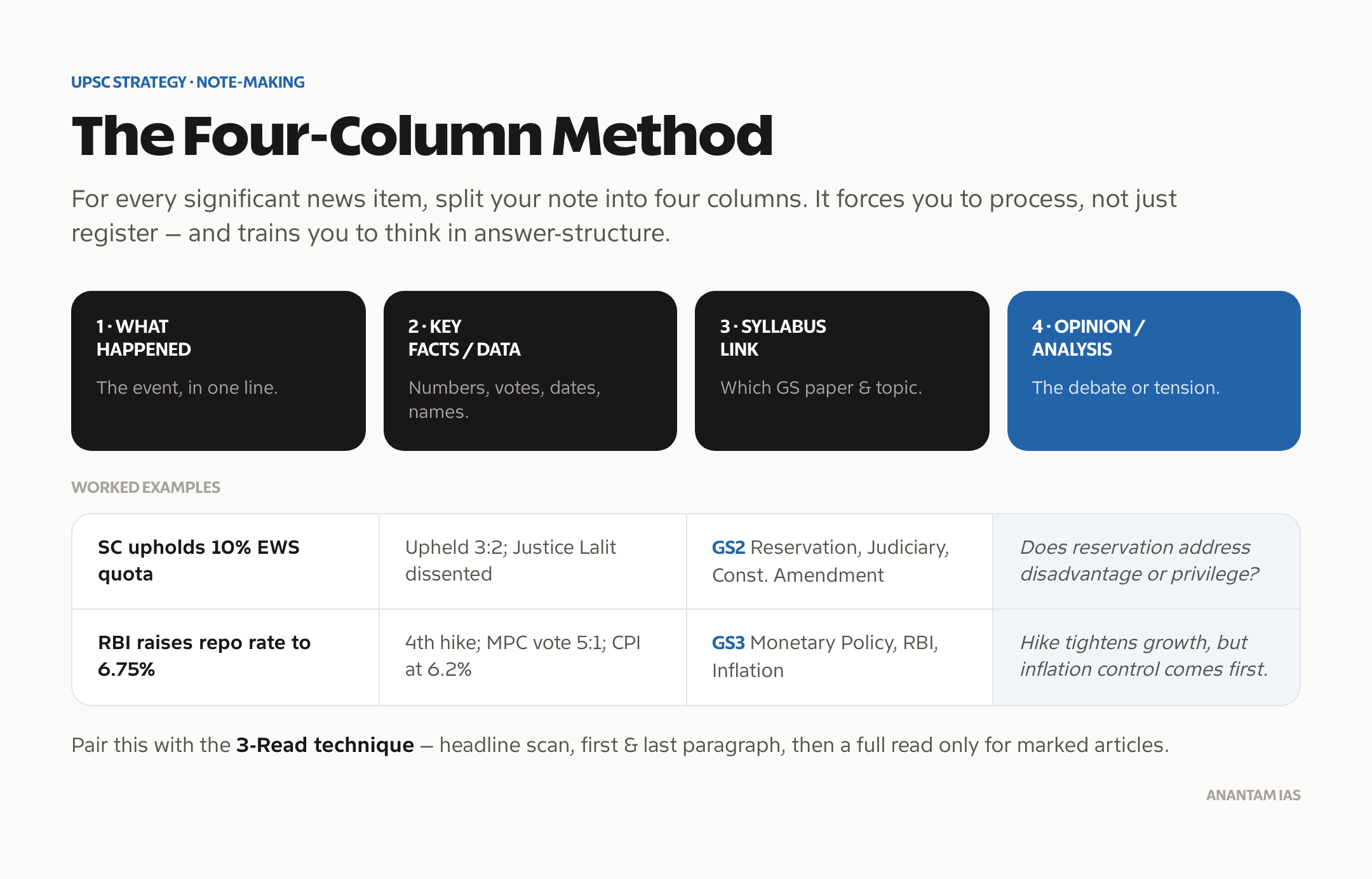
This method does three things:
- Forces you to process what you read (not just register it)
- Creates a revision-ready summary for later
- Trains you to think in answer-structure format
Digital vs Physical Notes
Digital (Google Docs, Notion, OneNote): Searchable, shareable, accessible on any device. Easier to update and reorganise. Preferred if you’re comfortable typing and have a consistent device.
Physical (spiral notebook, one per month): Better for memory encoding according to most cognitive science research. Easier to annotate and connect with pen/pencil. Better for drawing flowcharts and concept maps.
Recommendation: Digital for news notes (easy to search later), physical for static topic summaries.
Monthly Compilation
Don’t let daily notes pile up unreviewed. At the end of each month:
- Go through the month’s notes
- Identify recurring themes (e.g., “federalism disputes,” “cryptocurrency regulation”)
- Merge related items into topic-based notes
- Flag items with Prelims-specific data (dates, numbers, institutional names)
This monthly review session takes 2–3 hours but is one of the highest-ROI activities in UPSC preparation.
Linking News to UPSC Syllabus
Disconnected current affairs is useless. Every news item you note must link to a syllabus topic.
GS Paper-Wise Mapping
GS1 — History, Geography, Society:
- Heritage site news → Art and Culture
- Climate/monsoon → Physical Geography
- Social indicators (NFHS data, gender gaps) → Indian Society
- Natural disasters → Geography
GS2 — Polity, Governance, International Relations:
- Constitutional amendments, SC judgements → Polity
- Parliamentary legislation → Parliament/Governance
- State-Centre disputes → Federalism
- Bilateral agreements, summits → International Relations
- UN/multilateral institutions → International Organisations
GS3 — Economy, Environment, Security:
- RBI/SEBI/IRDA decisions → Economy
- Budget/fiscal data → Public Finance
- Forest rights, biodiversity conventions → Environment
- Defence acquisitions, border incidents → Security
- Agri policy, MSP → Agriculture
GS4 — Ethics, Integrity, Aptitude:
- Corruption cases, whistleblower news → Ethics
- Governance failures → Case studies for ethics
- Judicial accountability → Ethics in governance
Essay:
- Any major editorial theme can become an Essay prompt
Practice: The “So What?” Test
After noting any news item, ask: “So what does this mean for UPSC?” This prevents you from noting irrelevant facts.
A court judgement ruling on river water disputes isn’t just a news item — it’s GS2 (Centre-State Relations, Inter-State Disputes), GS1 (Geography — river systems), and GS3 (Water Resources Management). One item, three papers.
The Hindu Online vs Print: Which is Better for UPSC?
| Parameter | Online (thehindu.com) | |
|---|---|---|
| Reading experience | Better for sustained focus | Distracting (links, ads, notifications) |
| Searchability | Poor | Excellent |
| Cost | ₹600–800/month | ₹150–400/month (digital subscription) |
| Access | Home delivery only | Any device, any location |
| Archive access | Only current issue | Full archive back to 1878 |
| Annotations | Physical highlighting | Digital highlights, saving |
Recommendation: Digital subscription is more practical for most aspirants. If concentration is an issue with digital reading, use a PDF reader app that blocks social features rather than the live website.
Avoid reading The Hindu through free aggregators (news apps, Telegram channels with copy-paste content). The editorial context, layout, and full articles matter. Summaries from coaching institutes replace your own thinking — don’t outsource the reading itself.
Common Mistakes Aspirants Make
Reading everything: Already covered. Indiscriminate reading is the most common mistake. Selectivity is a skill.
Reading without notes: Passive reading. You’ll remember 15% of what you read without notes, 60% with structured note-taking.
Skipping editorial for news: Editorials are more valuable than most hard news for UPSC mains. Never skip editorials for news coverage of the same event.
Starting newspaper reading too early: In the first 6 months of UPSC preparation, static syllabus (NCERT, standard books) should dominate. Newspaper reading becomes high-value only when you have enough static knowledge to contextualise what you read. A news item about the Scheduled Tribes and Other Traditional Forest Dwellers (Recognition of Forest Rights) Act means nothing if you don’t know what the Forest Rights Act says.
Changing newspapers frequently: Pick one primary newspaper and stick with it for a year. Consistency builds pattern recognition. Switching newspapers breaks continuity of theme tracking.
UPSC Mains Answer Writing: Structure and Practice Method
Frequently Asked Questions
Is The Hindu sufficient for UPSC current affairs or do I need other sources?
The Hindu covers 70–75% of UPSC current affairs needs. Supplement it with monthly government publications (Economic Survey, PIB summaries, India Year Book), and Yojana/Kurukshetra magazines for in-depth policy analysis. You don’t need multiple newspapers daily — depth from one source beats superficial coverage from five.
How long should I spend reading The Hindu for UPSC daily?
45–60 minutes maximum. Reading beyond 60 minutes usually means you’re reading low-priority sections. If you consistently need more than 60 minutes, you haven’t yet mastered the selective reading approach — not the content.
Should I read The Hindu editorial every day without exception?
Yes, the editorial page is the highest-priority UPSC content in the newspaper. Missing editorials regularly means missing the analytical quality that elevates mains answers. If time is short on any day, read the editorial first and skip everything else.
Which is better for UPSC — The Hindu or Indian Express?
Both are widely used. The Hindu is stronger on governance, judiciary, and international relations depth. Indian Express is stronger on investigative stories and political analysis. Most successful aspirants read one consistently rather than both partially. If forced to choose one: The Hindu for UPSC mains depth.
How should I make notes from The Hindu for Prelims?
For Prelims, focus on static-anchor facts from current affairs: specific dates, institutional names, constitutional provisions invoked, data points (percentages, ranks, indices), and first-time occurrences. Keep a separate Prelims current affairs notebook with bullet-point facts, not long notes. Revise this list monthly.
Tell Google you want more of this.
Add Anantam IAS as a preferred sourceOne tap, and this site shows up more often in your own Top Stories, AI Overviews and AI Mode. Remove it any time.