Disclosure: this guide contains Amazon affiliate links. As an Amazon Associate, Anantam IAS earns from qualifying purchases — at no extra cost to you.
HAS is the Himachal Pradesh Administrative Service — the state’s premier civil service, the HP equivalent of the IAS — recruited by the Himachal Pradesh Public Service Commission (HPPSC) through the three-stage HAS Combined Competitive Examination (often written HPAS).
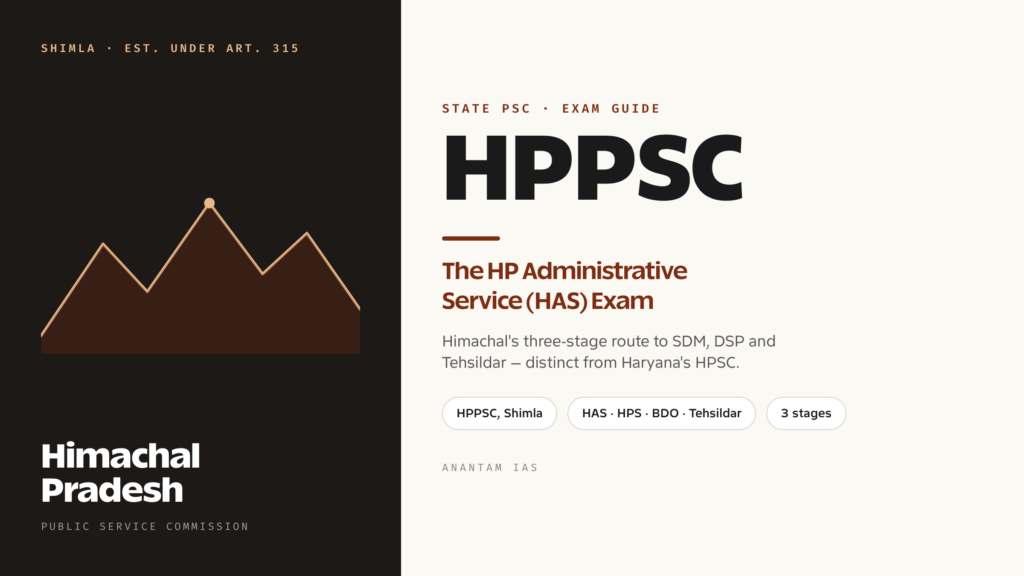
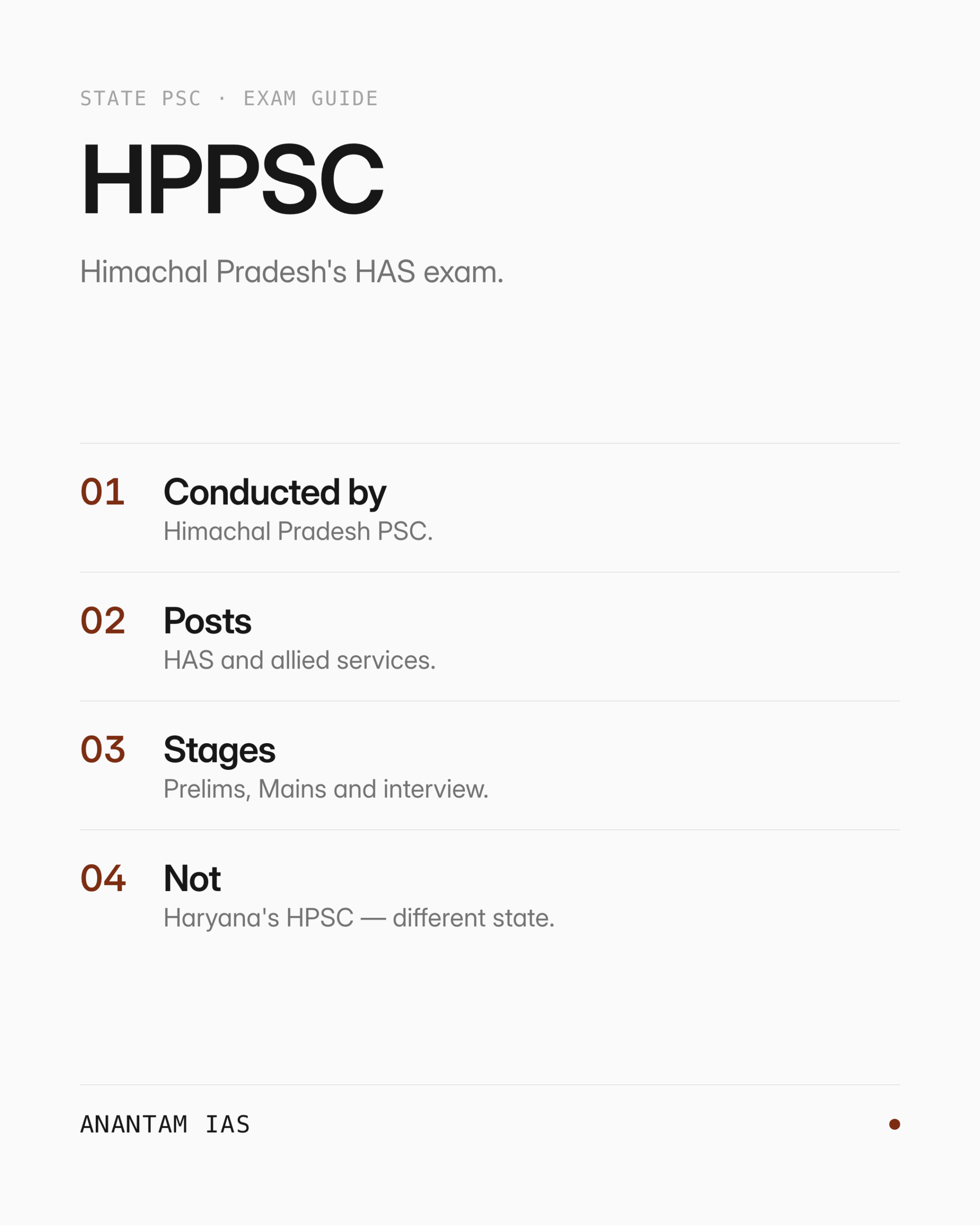
The Himachal Pradesh Public Service Commission, almost always shortened to HPPSC, is the constitutional body that recruits officers for the Himachal Pradesh state civil services. Set up under Article 315 of the Constitution and headquartered in Shimla, it runs the exam that puts an aspirant into the field as a Sub-Divisional Magistrate, a Deputy Superintendent of Police, or a Tehsildar across the hill state.
Its flagship exam is the HP Administrative Service (HAS) Combined Competitive Examination — often written as HPAS. It selects officers for the cadre that runs Himachal’s districts, sub-divisions, and revenue administration, the state-level equivalent of the IAS and IPS. One point of confusion worth clearing up at the start: HPPSC is Himachal Pradesh, and it is a completely separate commission from HPSC, the Haryana Public Service Commission. Same-looking acronym, different state, different exam.
What Is HPPSC?
HPPSC conducts the HAS Combined Competitive Examination to fill Class I and Class II gazetted posts in the Himachal Pradesh government. A single notification and a single three-stage exam feed several services at once, which is why it carries the word “Combined” in its name. Clear the exam and the post you get depends on your final rank and the vacancies declared that cycle.
The services recruited through the HAS exam include the HP Administrative Service itself — where officers serve as Sub-Divisional Magistrate (SDM) and Assistant Commissioner — alongside the HP Police Service (HPS), whose entry post is Deputy Superintendent of Police (DSP). The same exam recruits the allied and revenue services too: Block Development Officer, Tehsildar, Naib Tehsildar, and Assistant Commissioner (State Taxes and Excise). HPPSC separately conducts a Subordinate Allied Services exam, but the HAS exam is the one that leads the administrative cadre.
Key Facts
- Conducting authority: Himachal Pradesh Public Service Commission, Shimla — a constitutional body under Article 315.
- Flagship exam: HP Administrative Service (HAS) Combined Competitive Examination, often called HPAS.
- Services covered: HAS (SDM, Assistant Commissioner), HPS (DSP), BDO, Tehsildar, Naib Tehsildar, Assistant Commissioner (State Taxes and Excise).
- Stages: Three — Prelims, Mains, and Personality Test.
- Frequency: Typically once a year, subject to vacancies; recent cycles have notified roughly 30-plus posts.
- Scale: Tens of thousands apply against a few dozen vacancies, so the real competition is at Prelims and Mains.
If you’re still getting your bearings on what “PCS” means and how state services sit below the central UPSC structure, our PCS full form guide lays out the basics before you dive into HPPSC specifics.
HPPSC Exam Pattern
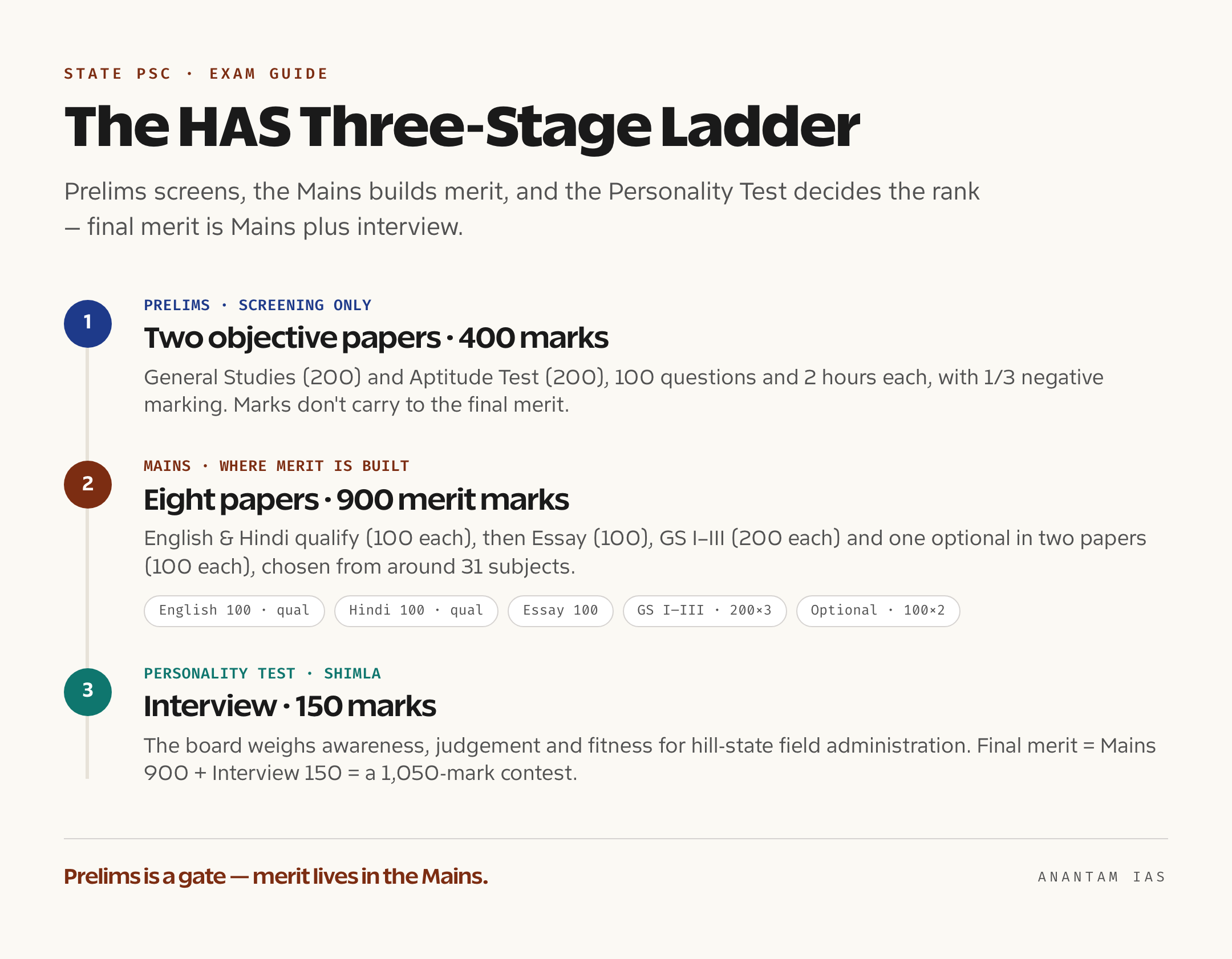
The HAS exam runs across three stages: an objective Preliminary test, a descriptive Mains, and a Personality Test. The structure rhymes with UPSC but isn’t identical — most differences sit in the Mains paper count and marking weight.
Prelims
The Preliminary Examination has two objective papers, each carrying 200 marks for a combined 400 marks.
| Feature | Details |
|---|---|
| Papers | 2 (General Studies, Aptitude Test) |
| Marks per paper | 200 |
| Questions per paper | 100 |
| Duration | 2 hours per paper |
| Type | Objective (MCQ) |
| Negative marking | 1/3 mark per wrong answer |
| Purpose | Screening only |
The Prelims is a screening test. Your Prelims score gets you into the Mains but does not carry into the final merit list — that mirrors UPSC, and it differs from a state like Madhya Pradesh, where the Prelims aptitude paper counts. So treat Himachal’s Prelims as a gate to clear cleanly, not a place to bank marks.
Mains
The Mains Examination has eight papers and is where merit is actually built. Two language papers are qualifying; the rest count.
| Paper | Subject | Marks | Nature |
|---|---|---|---|
| I | English | 100 | Qualifying |
| II | Hindi | 100 | Qualifying |
| III | Essay | 100 | Merit |
| IV | General Studies I | 200 | Merit |
| V | General Studies II | 200 | Merit |
| VI | General Studies III | 200 | Merit |
| VII | Optional Subject — Paper I | 100 | Merit |
| VIII | Optional Subject — Paper II | 100 | Merit |
The merit-counting papers total 900 marks. Candidates pick one optional subject from a list of around 31, and unlike UPSC’s two 250-mark optional papers, Himachal keeps each optional paper at 100 marks — so the optional weighs less here than at the centre. The English and Hindi papers only need a pass; clear them and the marks are set aside.
Interview / Personality Test
The final stage is a Personality Test worth 150 marks, conducted by the Commission at Shimla. The board weighs awareness, judgement, and suitability for field administration in a hill state — questions on Himachal’s geography, governance, and current affairs come up often. The final merit list is built from the Mains (900) plus the Personality Test (150), a 1,050-mark contest.
HPPSC Eligibility
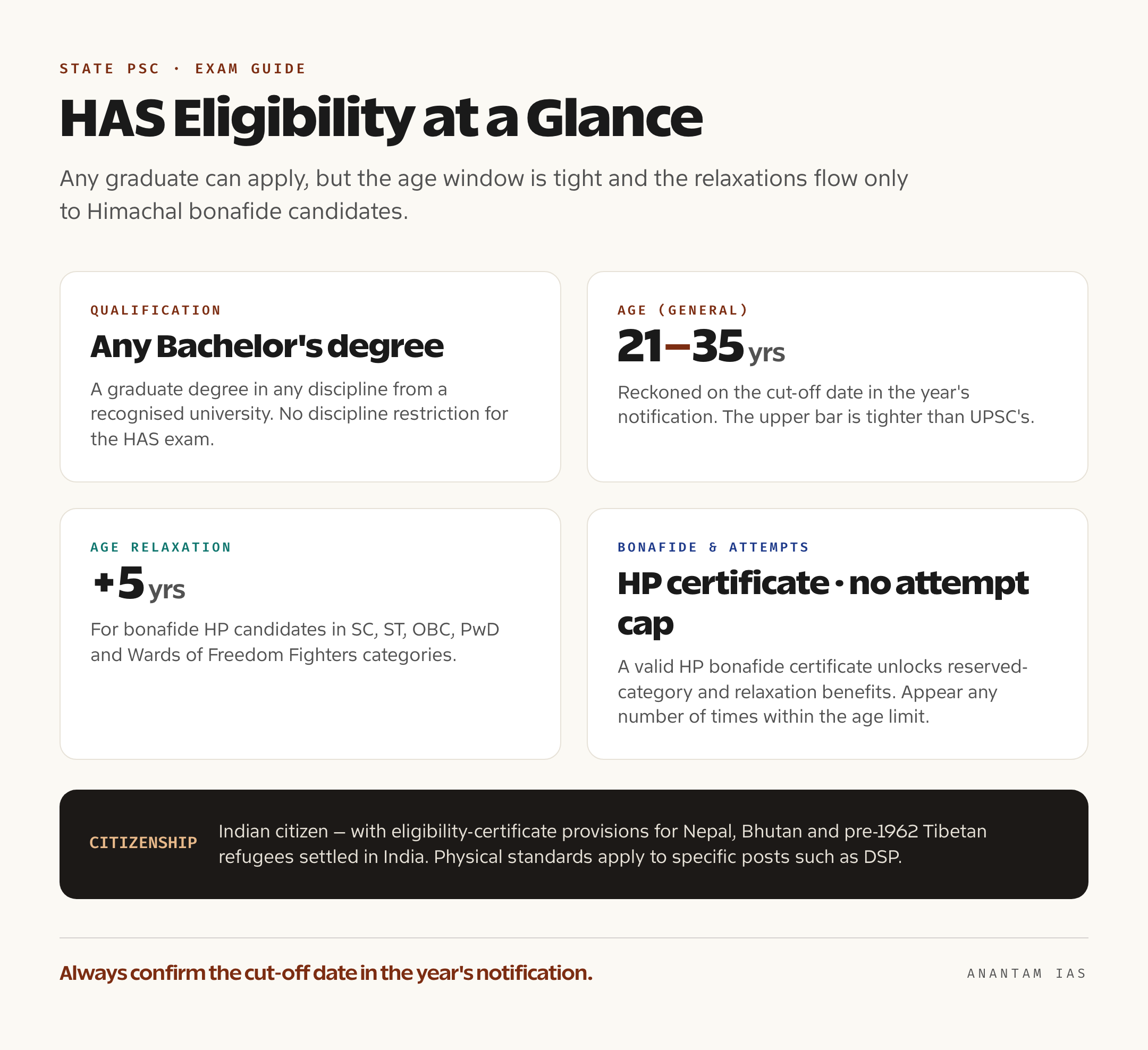
Eligibility for the HAS exam turns on nationality, age, qualification, and — the part that matters most for a state PCS — Himachal bonafide status.
| Criterion | Details |
|---|---|
| Nationality | Indian citizen (with eligibility certificate provisions for Nepal, Bhutan, and pre-1962 Tibetan refugees) |
| Age (General) | 21 to 35 years, reckoned on the cut-off date in the notification |
| Age relaxation | 5 years for bonafide HP candidates in SC/ST/OBC, PwD, and Wards of Freedom Fighters categories |
| Attempts | No fixed cap — you can appear as long as you’re within the age limit |
| Education | Bachelor’s degree in any discipline from a recognised university |
| HP bonafide / domicile | Required to claim reserved-category and age-relaxation benefits |
Two things trip up first-timers. The upper age limit of 35 is tighter than UPSC’s, so the runway is shorter. And the five-year relaxation flows only to bonafide residents of Himachal — a candidate from outside the state can sit the General-category exam, but reserved-category and relaxation benefits need a valid HP bonafide certificate. Physical standards apply for posts such as DSP. Always read the year’s notification, since the age cut-off date and exact relaxations are set fresh each cycle.
HPPSC Syllabus
The HAS syllabus reads like UPSC’s General Studies with a thick Himachal layer woven through every paper. That state-specific content is the real differentiator — and where most outside-state aspirants lose ground.
Prelims Syllabus
Paper I — General Studies (200 marks): current events of national and international importance; history of India and the Indian national movement; Indian and world geography, with Himachal’s physical, social, and economic geography; Indian polity and governance; economic and social development; environment, ecology, biodiversity, and climate change; and general science. Layered on top is a heavy dose of Himachal Pradesh — its history, geography, polity, economy, art, and culture.
Paper II — Aptitude Test (200 marks): comprehension; interpersonal and communication skills; logical reasoning and analytical ability; decision-making and problem-solving; general mental ability; basic numeracy and data interpretation at roughly Class X level. Both papers are objective, both carry negative marking, and both serve only to screen for the Mains.
Mains Syllabus
The three merit-counting GS papers each blend a national theme with its Himachal counterpart:
- General Studies I — history and culture of India and of Himachal Pradesh; Indian heritage; physical and human geography of India and HP; disaster management; Indian society, and Himachal’s tribes, family systems, and social structure.
- General Studies II — the Constitution, Parliament and state legislatures, the executive and judiciary, governance and public service delivery, local administration, India’s international relations, and Himachal’s political structure and governance.
- General Studies III — the Indian and Himachal economy; agriculture and horticulture; energy, including the state’s hydropower sector; science and technology; environment and sustainability; and Himachal’s tourism policy.
Then comes the Essay paper (100 marks), where a balanced view on a social, economic, or state-relevant theme is rewarded, plus the English and Hindi qualifying papers testing comprehension, précis, and grammar.
Optional Subjects
Candidates choose one optional subject — two papers of 100 marks each — from a list of around 31 options spanning the humanities, sciences, commerce, and several engineering and applied subjects. Because each optional paper is only 100 marks, the choice carries less weight than UPSC’s optional; most aspirants pick a subject they already studied or one with strong overlap with the GS papers.
State-Specific Focus
This is the section that decides ranks. The Himachal layer you must master includes:
- History: the medieval hill states such as Kangra, Kullu, Chamba, and Bushahr; the Gorkha invasion; British paramountcy; and the Praja Mandal movements of 1848-1948 that fed into the Suket Satyagraha and the state’s formation, with full statehood arriving in 1971.
- Geography: the western Himalayan relief and climate zones; the five rivers that drain the state — Sutlej, Beas, Ravi, Chenab, and Yamuna; and a hydropower potential of roughly 18,540 MW, about an eighth of India’s assessed total, which makes power a defining economic and political theme.
- Polity and economy: the state’s administrative structure, panchayati raj, horticulture (apple and stone fruit), tourism, and the welfare and development schemes that recur in current affairs.
If you want to see where HPPSC sits among India’s many recruitment routes, our overview of government exams in India maps the landscape from UPSC down to the state services.
HPPSC Preparation Strategy
A focused aspirant can crack the HAS exam in a year of honest work. The plan splits into a national foundation and a Himachal layer.
Build the National Foundation
Most of the GS content overlaps with UPSC, so the standard NCERTs from class 6 to 12 and the established standard books for polity, geography, economy, history, and environment do the heavy lifting. If you’ve already touched UPSC preparation, you’re a long way in. Our UPSC syllabus 2026 guide is a useful checklist for the GS spine that HPPSC shares.
Add the Himachal Layer
This is the part you can’t borrow from a national course. Build dedicated notes on HP history, geography, polity, economy, art, and culture from a good Himachal General Knowledge book plus the state government’s official portals and economic survey. Track the hill-states history, the river-and-hydropower geography, and the welfare schemes — these recur year after year in both Prelims and Mains.
Stay Current — With a State Tilt
Read a national daily for the all-India current affairs, then add Himachal-specific developments: state budget highlights, new schemes, district-level news, and big infrastructure or hydropower projects. A monthly compilation that separates national from state affairs keeps this manageable.
Mine the Previous Year Papers
Pull HPPSC’s past Prelims and Mains papers and read the pattern: which Himachal topics repeat, how the aptitude paper is weighted, what the essay themes look like. PYQ analysis is the fastest way to see where the Commission actually puts its marks, and it tells you how deep to go on each topic.
Practise Answer Writing and Mocks
The Mains is descriptive, so the GS score depends on structured, time-bound writing as much as on knowledge. Write full-length answers, get them reviewed, and sit at least a few full mock tests for both Prelims and Mains. Finish with a tight revision cycle in the last month — short notes, formulae for the aptitude paper, and a rapid pass over your Himachal notes.
Posts, Salary and Career
Clearing the HAS exam lands you in a Class I or Class II gazetted post, with the exact service decided by rank and vacancies. The HP Administrative Service is the senior cadre — you start as a Sub-Divisional Magistrate or Assistant Commissioner and run a sub-division before moving up to district administration and, over a career, to senior secretariat roles. The HP Police Service entry post is DSP, and the revenue and allied stream covers Tehsildar, Naib Tehsildar, Block Development Officer, and Assistant Commissioner (State Taxes and Excise).
Pay follows the Himachal Pradesh structure for gazetted officers, with grade pay, dearness allowance, and house rent allowance on top of basic, plus the field authority that comes with a magisterial or police post. Recent cycles have notified roughly 30-plus combined vacancies, so the contest is sharp — but for a candidate set on serving in Himachal, the HAS route is the most direct path into the state’s leadership cadre. Cut-offs swing with vacancy count and difficulty each year, so treat any single year’s figure as a guide, not a guarantee.
Books for HPPSC HAS
Most of what you read for UPSC transfers to HPPSC HAS: polity, economy, modern history and the NCERT base. What does not transfer is the Himachal Pradesh section, and that is where the selection is decided. One state book, read three times, beats five read once.

Know Your State: Himachal Pradesh 2026-27 — Arihant
- 264 pages, Arihant, revised 2026-27 edition
- Himachal history, geography, economy, polity and culture
- For HPPSC, HPSSC and the allied state exams

Lucent's General Knowledge 2026 — English (15th revised edition)
- 460 pages, Lucent Publications
- Static GK in the compressed, list-heavy format state PSC prelims reward
- Overrated for UPSC, right for this exam
- Indian Polity, M. Laxmikanth (Amazon.in). The polity questions are the same exam everywhere.
- Lucent’s General Knowledge (Amazon.in). Overrated for UPSC, right for the static questions here.
- Indian Economy, Ramesh Singh (Amazon.in). Read the concept chapters; the state budget goes on top.
- A Brief History of Modern India, Spectrum (Amazon.in). The freedom-struggle questions come straight from here.
- Know Your State: Himachal Pradesh 2026-27 — Arihant (Amazon.in): the Himachal-specific section for HAS.
- NCERTs, Classes 6 to 12, for history, geography and science. Free from NCERT; nothing to buy.
Skip the coaching compilations until you have finished these. They summarise books you have not read yet.
Frequently Asked Questions
Is HPPSC the same as HPSC?
No — they only look alike. HPPSC is the Himachal Pradesh Public Service Commission, which conducts the HAS exam for Himachal. HPSC is the Haryana Public Service Commission, a separate body for Haryana’s civil services. The states, the syllabi, and the bonafide requirements are all different, so make sure you’re studying the right one.
How many stages does the HPPSC HAS exam have?
Three. An objective Preliminary test (two papers of 200 marks each, screening only), a descriptive Mains (eight papers, with the merit-counting papers totalling 900 marks), and a 150-mark Personality Test. The final merit list is built from the Mains plus the Personality Test, a 1,050-mark contest.
What is the age limit for the HPPSC HAS exam?
The general age range is 21 to 35 years on the notification’s cut-off date. Bonafide Himachal candidates in the SC, ST, OBC, PwD, and Wards of Freedom Fighters categories get a five-year upper-age relaxation. There’s no cap on the number of attempts — you can appear as long as you stay within the age limit.
Do I need to be a Himachal resident to apply?
You can sit the General-category exam without HP bonafide status, but the reserved-category benefits and the age relaxation flow only to bonafide residents of Himachal Pradesh with a valid certificate. The state-specific syllabus also rewards local knowledge heavily, so outside-state candidates need to put real time into the Himachal layer.
Tell Google you want more of this.
Add Anantam IAS as a preferred sourceOne tap, and this site shows up more often in your own Top Stories, AI Overviews and AI Mode. Remove it any time.