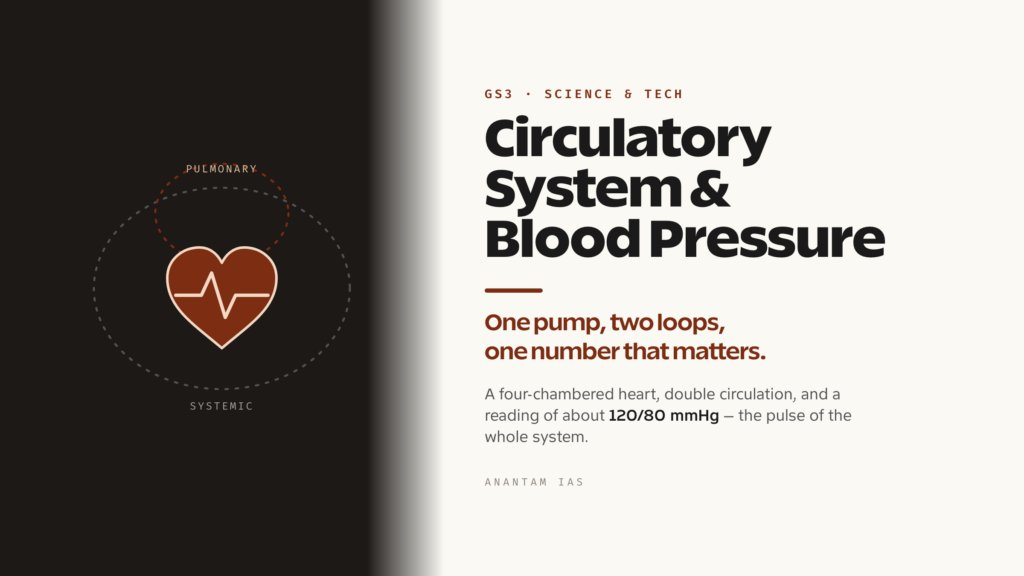
Your heart is the hardest-working muscle you own. It beats around 100,000 times a day, never taking a holiday, pushing roughly five litres of blood through a closed network of vessels long enough to wrap around the Earth more than twice. Every cell in the body — from the ones in your fingertips to the ones in your brain — depends on this circuit arriving on time with oxygen and food and leaving with the waste. When a doctor wraps a cuff around your arm and reads out two numbers like “120 over 80”, they are taking the pulse of that whole system in a single, painless measurement.
And that is exactly why the circulatory system and blood pressure show up so often in general-science questions. They tie together a clean piece of anatomy (a four-chambered pump), a neat bit of physics (pressure in a closed pipe), and a public-health story that touches almost every Indian family — high blood pressure, or hypertension, is now one of the country’s biggest silent killers. Get the basic plumbing right and the rest follows: what the heart does, why human blood runs in two loops instead of one, what the two blood-pressure numbers actually mean, and how the blood itself is built. This explainer walks through all of it in the order an examiner expects.
The Heart and Double Circulation
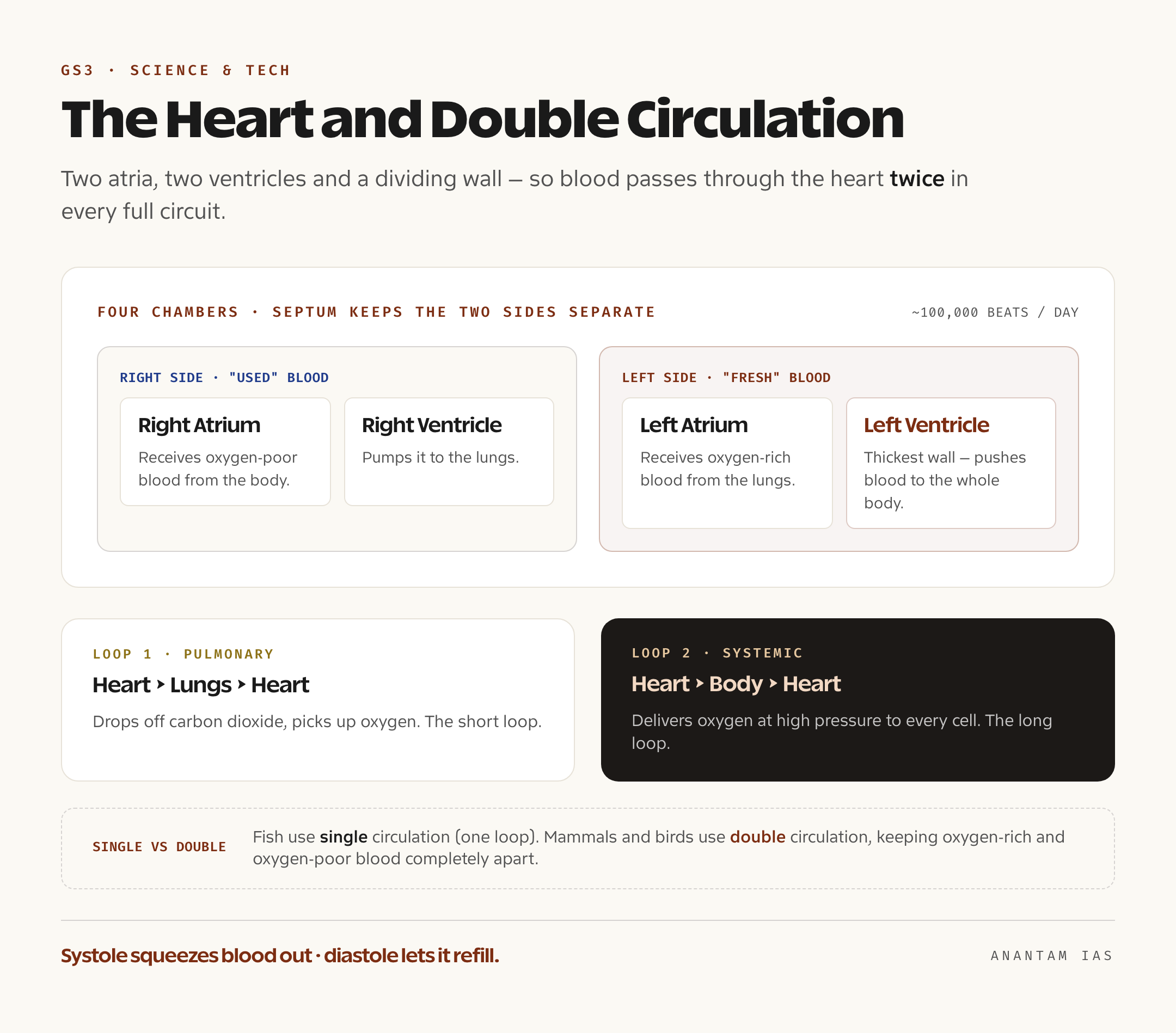
Start with the pump. The human heart is a fist-sized muscular organ sitting slightly left of centre in the chest, and it has four chambers — two on top called atria and two below called ventricles. The right side handles “used” blood that has given up its oxygen to the body; the left side handles “fresh” oxygen-rich blood on its way out. A thick muscular wall, the septum, keeps the two sides from mixing, which matters enormously, because it means oxygen-poor and oxygen-rich blood never blend. Valves between the chambers — and at the exits — act as one-way doors, snapping shut to stop blood flowing backwards. The familiar “lub-dub” of a heartbeat is simply the sound of these valves closing.
Now trace the journey, because this is where humans differ from a fish. Blood low in oxygen returns from the body into the right atrium, drops into the right ventricle, and is pumped to the lungs, where it dumps carbon dioxide and picks up fresh oxygen. That oxygen-rich blood comes back to the left atrium, drops into the left ventricle, and is pumped out with real force to the entire body. So the blood passes through the heart twice in one full circuit — once on the way to the lungs and once on the way to the body. This is called double circulation, and it splits neatly into two loops: the pulmonary circulation between heart and lungs, and the systemic circulation between heart and the rest of the body. Fish have single circulation, where blood goes heart → gills → body → heart in one loop; the double system lets mammals and birds keep oxygen-rich and oxygen-poor blood completely separate and deliver oxygen at high pressure, which is what powers a warm, active body.
The pumping itself runs on a two-beat rhythm you should be able to name. When the heart muscle contracts and squeezes blood out, that phase is called systole. When it relaxes and the chambers refill, that phase is called diastole. The left ventricle, which has to push blood all the way to your toes and back, has the thickest, most powerful wall of all four chambers — and the pressure it generates during systole is, quite literally, the upper number a doctor reads off your arm. Hold on to that link between the heartbeat and the reading; it is the bridge to everything in the next section.
What Blood Pressure Really Means
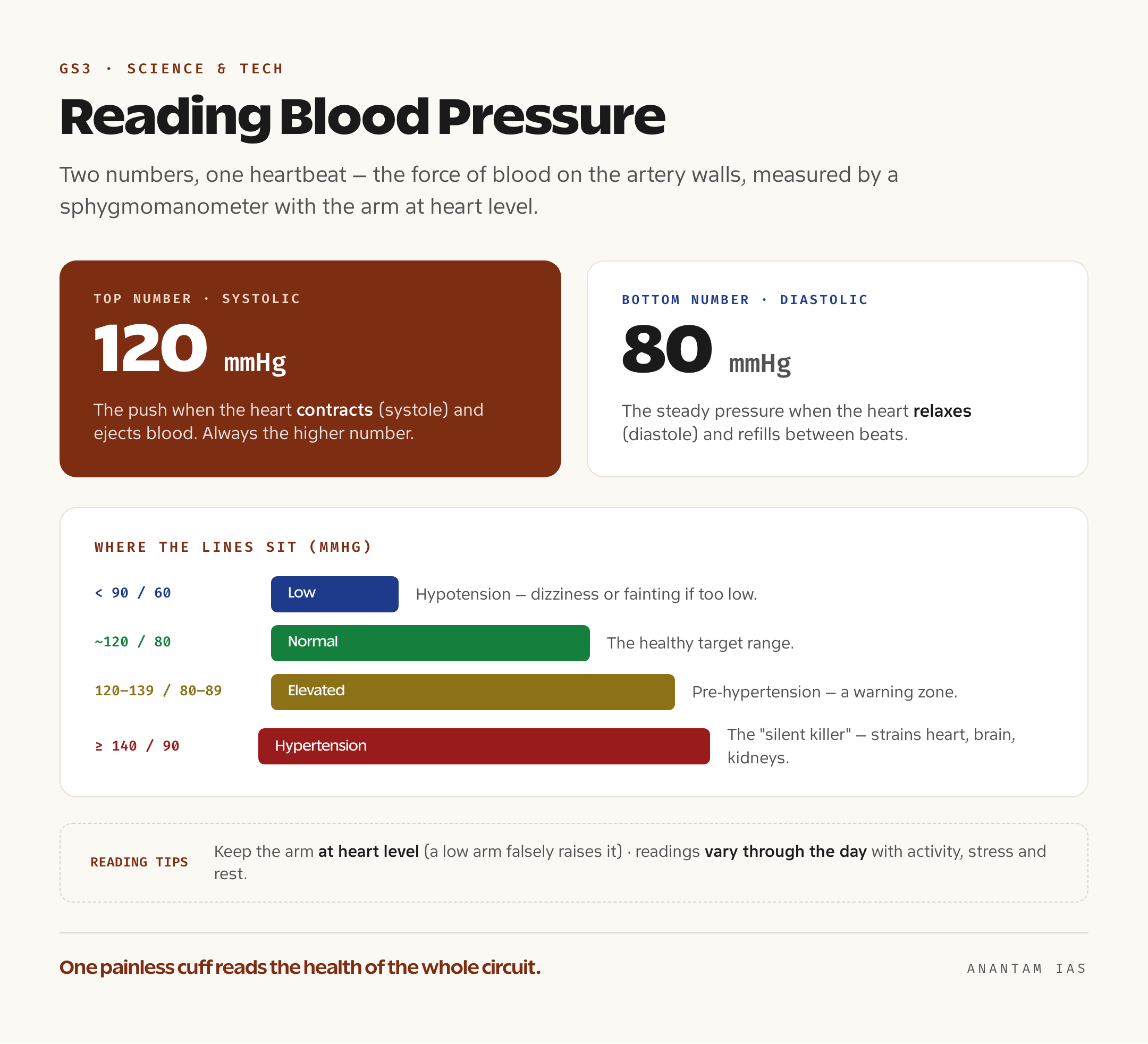
Blood pressure is just the force that flowing blood pushes against the inner walls of your arteries — the same way water presses on the inside of a hose. It is written as two numbers, and each one captures a different moment of the heartbeat. The top, higher number is the systolic pressure: the push against the artery walls when the heart contracts and ejects blood. The bottom, lower number is the diastolic pressure: the gentler, steady pressure that remains when the heart relaxes between beats and refills. So a “normal” reading of about 120/80 means 120 millimetres of mercury during the squeeze and 80 during the rest. Because the heart pushes harder than it relaxes, the systolic number is always higher than the diastolic — that ordering is fixed by the physiology and is worth remembering as a one-line fact.
The unit is the odd-looking “mmHg”, millimetres of mercury, and it comes from the old instrument that measured it. Blood pressure is read with a sphygmomanometer — a cuff that inflates around the upper arm, squeezing the artery shut, then slowly releases while a stethoscope (or, in modern digital machines, a sensor) listens for the blood to start and stop flowing. How you sit changes the reading, which is the kind of practical detail that trips people up. The arm should rest at the level of the heart, not dangling below it; an arm held low sits below heart level and the column of blood adds its own weight, falsely raising the number. And one reading is never the whole truth, because blood pressure naturally rises and falls through the day — higher when you are active, stressed, or have just climbed stairs, lower when you are calm or asleep. That daily variation is normal and expected, which is why doctors look at repeated, rested readings rather than a single snapshot.
What makes the two numbers powerful is that they read out the health of the whole circuit at once. A high systolic number can mean stiff or narrowed arteries forcing the heart to push harder; a high diastolic number suggests the vessels never fully relax. Pulse pressure — the gap between the two — and the steadiness of the readings tell a clinician how elastic the arteries are and how hard the heart is working. None of this needs a single drop of blood drawn; it is all inferred from how the cuff feels the pulse. That is why blood pressure, despite being so simple to take, is treated as one of the four classic “vital signs” alongside pulse, temperature and breathing rate.
Hypertension and Hypotension
When blood pressure stays too high over time, the condition is called hypertension, and it is one of the most common and most dangerous chronic conditions in the world. Most health bodies, including the World Health Organization, treat a reading at or above 140/90 mmHg, taken on more than one occasion, as hypertension; the band just below — roughly 120-139 over 80-89 — is often flagged as “elevated” or “pre-hypertension”, a warning zone. The danger is that high blood pressure usually causes no symptoms at all, which is why it is nicknamed the “silent killer”. Left unchecked, the relentless extra force damages arteries and overworks the heart, and over years it becomes a leading cause of heart attacks, strokes, kidney failure and heart enlargement. The WHO estimates well over a billion adults worldwide live with hypertension, and a large share don’t even know it — India alone counts hypertension among its biggest public-health burdens, which is why “know your numbers” has become a national health message.
Hypertension comes in two broad types, and the distinction is examinable. The far more common kind, primary or essential hypertension, has no single identifiable cause; it builds up gradually from a mix of genetics, age, excess salt, obesity, physical inactivity, stress, smoking and alcohol. The rarer kind, secondary hypertension, is driven by an identifiable underlying problem — kidney disease, hormonal disorders, or certain medicines — and often eases when that root cause is treated. The reassuring part is how much of the common kind is preventable: cutting salt, losing excess weight, exercising, eating more fruit and vegetables, and limiting alcohol and tobacco can lower readings substantially, with medication added when lifestyle alone isn’t enough.
The opposite problem, low blood pressure, is called hypotension, generally a reading below about 90/60 mmHg. It is far less talked about but matters because, when pressure drops too low, organs — especially the brain — may not get enough blood, causing dizziness, fainting, blurred vision or fatigue. It can follow dehydration, sudden blood loss, certain medicines, or simply standing up too fast (the head-rush called orthostatic hypotension). For most healthy people a naturally low reading is harmless and can even signal good fitness; it only becomes a concern when it produces symptoms or follows a sudden drop. The takeaway is that blood pressure has a healthy window, not a single ideal point — too high strains the system silently, too low starves it of supply.
Arteries, Veins and Capillaries
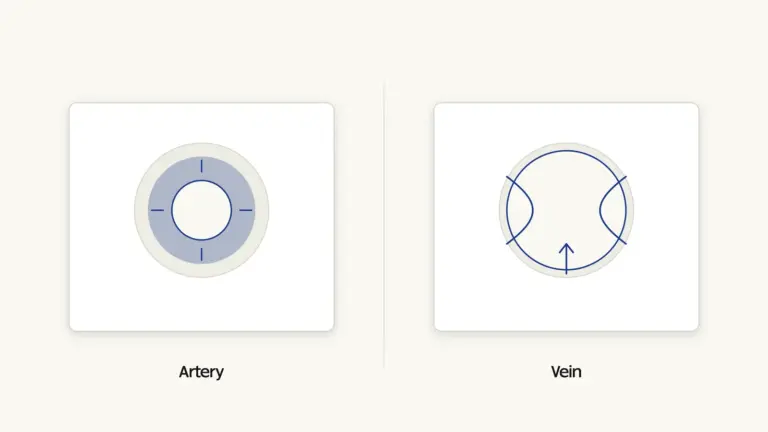
The heart is only the pump; the vessels are the pipes, and they come in three kinds with three different jobs. Arteries carry blood away from the heart. Because they receive blood under the full force of each systolic beat, they have thick, muscular, elastic walls that can stretch with the surge and recoil between beats, smoothing the flow — which is also why you can feel a pulse in an artery near the surface, such as at the wrist. Almost all arteries carry oxygen-rich blood, with one famous exception: the pulmonary artery, which carries oxygen-poor blood from the heart to the lungs. Remembering that the definition of an artery is “away from the heart”, not “oxygen-rich”, saves you from a classic trap.
Veins do the reverse — they carry blood back toward the heart. By the time blood reaches them, most of the pressure from the heartbeat is spent, so veins have thinner, less muscular walls and a wider bore. To stop blood pooling under gravity, especially in the legs, many veins contain one-way valves that keep it moving upward, helped along by the squeeze of surrounding muscles when you walk. Most veins carry oxygen-poor blood back to be re-oxygenated, with the matching exception of the pulmonary vein, which carries oxygen-rich blood from the lungs back to the heart. Notice the neat symmetry: the two “exception” vessels are both part of the pulmonary loop.
Between the smallest arteries and the smallest veins lies the real workplace of the whole system: the capillaries. These are microscopic vessels, often just one cell thick, woven through every tissue, and it is across their paper-thin walls that the actual exchange happens — oxygen and nutrients seep out to the cells, while carbon dioxide and waste seep in. No cell in the body sits far from a capillary. So the grand architecture is simple to recite: heart pushes blood into arteries → arteries branch into ever-finer vessels → capillaries deliver and collect at the cellular level → veins gather the spent blood and return it to the heart. It is a closed loop, meaning the blood always stays inside vessels and never spills freely into body cavities, which is part of what makes the human system so efficient.
Blood Itself: Components and Groups
Finally, look at what is actually flowing through all those pipes, because blood is not a simple red liquid but a tissue with several distinct parts. A little over half of it, by volume, is plasma — a pale-yellow fluid that is mostly water but carries dissolved proteins, glucose, hormones, salts and the waste products on their way to be removed. Floating in that plasma are three kinds of cells, each with a clear job. Red blood cells, or RBCs (erythrocytes), are by far the most numerous and carry oxygen using the iron-rich pigment haemoglobin, which is what makes blood red. White blood cells, or WBCs (leukocytes), are the body’s defence force, hunting and destroying germs as part of the immune system. And platelets (thrombocytes) are tiny cell fragments that rush to a wound and clump together to start a clot, stopping bleeding. A useful shorthand: plasma is the river, RBCs carry the cargo, WBCs are the soldiers, and platelets are the repair crew.
Blood also comes in types, and the system that matters most is the ABO blood group, discovered by Karl Landsteiner. It sorts blood into four groups — A, B, AB and O — based on which marker molecules, called antigens, sit on the surface of the red cells: group A has the A antigen, group B has the B antigen, AB has both, and O has neither. This matters for transfusions, because the plasma carries antibodies against whatever antigen the body lacks, and giving the wrong group can make the recipient’s blood clump dangerously. Because group O has no A or B antigens to trigger a reaction, it is often called the universal donor for red cells, while AB, having no antibodies against A or B, is called the universal recipient. Knowing your group can be life-saving in an emergency.
Layered on top of ABO is the Rh factor, another antigen named after the rhesus monkey in which it was first found. People who have it are “Rh-positive” and those who lack it are “Rh-negative”, which is the plus or minus you see after a blood group, as in “B positive” or “O negative”. The Rh factor carries a special significance in pregnancy: if an Rh-negative mother carries an Rh-positive baby, her immune system can react against the baby’s blood, a condition that today is routinely prevented with a simple injection. Put the two systems together — ABO plus Rh — and you get the eight common blood types that hospitals match before any transfusion. It is a fitting place to end, because it shows how the same circulatory system that keeps one body alive also connects us to one another, one donated unit of blood at a time.
For Your Mains Answer
This topic sits in the General Science portion of the syllabus and supports answers in GS Paper 3 wherever science, technology and their everyday applications appear, as well as health-policy questions that touch the rising burden of non-communicable diseases. Hypertension as a public-health challenge also links to GS Paper 2 governance and health themes. The examiner’s reward here is the same skill the article uses: explain a body system with correct terms and a few precise numbers, then connect the biology to a real-world consequence — in this case, India’s silent epidemic of high blood pressure.
How to Build the Answer
Move from structure to function to significance. Begin with the four-chambered heart and double circulation (the anatomy), explain systole/diastole and how that produces the 120/80 reading (the function), then pivot to hypertension as a preventable public-health threat (the significance). If the question is purely scientific, end on blood vessels or blood groups; if it leans towards health policy, end on prevention and screening. That arc — pump, pressure, problem, prevention — fits almost any question on this theme.
Common Mistakes to Avoid
Don’t say arteries always carry oxygen-rich blood — the pulmonary artery is the exception, and the definition is “away from the heart”. Don’t reverse systolic and diastolic; systolic (the contraction number) is always the higher one. Don’t confuse single and double circulation — fish have one loop, humans have two. And don’t describe group O as a universal recipient; O is the universal donor of red cells, AB the universal recipient.
A Compact Answer Spine
Four-chambered heart (2 atria + 2 ventricles, septum prevents mixing) → double circulation = pulmonary loop (heart-lungs) + systemic loop (heart-body), blood crosses the heart twice → systole (contract) and diastole (relax) → blood pressure ≈ 120/80 mmHg, systolic > diastolic, measured by sphygmomanometer with the arm at heart level → hypertension (≥140/90, “silent killer”, primary vs secondary, largely preventable) vs hypotension (<90/60) → vessels: arteries (away, thick, pulse), veins (toward, valves), capillaries (one-cell exchange) → blood = plasma + RBC + WBC + platelets → groups: ABO + Rh, O universal donor, AB universal recipient.
Diagram or Flowchart Idea
Sketch the heart as four boxes with arrows showing the two loops — right side to the lungs, left side to the body — and label systole and diastole on the pumping side. Beside it, draw a simple cuff-and-gauge with “120 systolic / 80 diastolic” and a small colour band from normal to hypertension. The two-panel visual — how blood moves and how its pressure is read — captures the whole topic at a glance and is fast to draw under time pressure.
A Balanced-Conclusion Line
A line that lands the marks: “The circulatory system is a marvel of simple engineering — one muscular pump, a closed loop of pipes and a self-renewing fluid — yet its single most-measured signal, blood pressure, has become a national health priority, reminding us that the line between physiology and public policy is thinner than an artery wall.”
How to Use Data Without Cramming
You need only a handful of anchors: a four-chambered heart beating around 100,000 times a day, a normal reading of roughly 120/80 mmHg, a hypertension threshold near 140/90, low pressure below about 90/60, and four ABO groups crossed with the Rh factor to give eight types. Drop those into the right sentences and the answer reads as authoritative without becoming a list of figures.
FAQ
What is double circulation and why do humans have it? Double circulation means blood passes through the heart twice in one complete circuit — once on the pulmonary loop between the heart and lungs to pick up oxygen, and once on the systemic loop between the heart and the rest of the body to deliver it. Humans, like all mammals and birds, have it because a four-chambered heart keeps oxygen-rich and oxygen-poor blood completely separate, letting the body receive oxygen at high pressure. Fish, by contrast, have single circulation, with blood passing through the heart only once per circuit.
What do the two blood-pressure numbers mean and what is normal? The top number is systolic pressure — the force in the arteries when the heart contracts and pushes blood out. The bottom number is diastolic pressure — the lower force when the heart relaxes and refills between beats. A normal reading is about 120/80 mmHg, and the systolic number is always higher than the diastolic. It is measured with a sphygmomanometer cuff, with the arm kept at heart level, and it naturally varies through the day with activity, stress and rest.
What is hypertension and why is it called the “silent killer”? Hypertension is persistently high blood pressure, usually a reading at or above 140/90 mmHg on more than one occasion. It is called the silent killer because it typically causes no symptoms while quietly damaging the arteries, heart, brain and kidneys over years, raising the risk of heart attacks, strokes and kidney failure. Most cases are “primary” with no single cause and are largely preventable through less salt, weight control, exercise and avoiding tobacco and excess alcohol.
What are blood groups and who is the universal donor? Blood groups classify blood by the antigens on red cells. The main ABO system gives four groups — A, B, AB and O — and the Rh factor adds a positive or negative, producing eight common types in all. Group O has no A or B antigens, so its red cells can usually be given to anyone, making it the universal donor; group AB has no anti-A or anti-B antibodies, making it the universal recipient. Matching groups before a transfusion prevents the blood from clumping dangerously.
Practice Questions
Prelims MCQs
- With reference to the human heart, which statement is correct?
(a) It has two chambers, both called ventricles
(b) It has four chambers — two atria and two ventricles — with a septum preventing mixing
(c) The atria are below the ventricles
(d) Oxygen-rich and oxygen-poor blood mix freely in the left ventricle
Answer: (b) The heart has two upper atria and two lower ventricles, and the septum keeps oxygen-rich and oxygen-poor blood separate. - In a blood-pressure reading of 120/80 mmHg, the figures 120 and 80 respectively represent:
(a) Diastolic and systolic pressure
(b) Systolic and diastolic pressure
(c) Pulse rate and breathing rate
(d) Pressure in veins and capillaries
Answer: (b) The higher number (120) is systolic pressure during heart contraction; the lower number (80) is diastolic pressure during relaxation, and systolic is always higher. - Consider the following statements about measuring blood pressure:
1. The arm should be kept below the level of the heart while measuring.
2. Systolic pressure is always higher than diastolic.
3. Blood pressure can change at different times of the day. Which are correct?
(a) Only 1 and 2
(b) Only 1 and 3
(c) Only 2 and 3
(d) 1, 2 and 3
Answer: (c) The arm should rest at heart level, not below it (a low arm falsely raises the reading), so statement 1 is wrong; statements 2 and 3 are correct. - Which of the following vessels carries oxygen-poor (deoxygenated) blood?
(a) Aorta
(b) Pulmonary vein
(c) Pulmonary artery
(d) Carotid artery
Answer: (c) The pulmonary artery is the exception that carries oxygen-poor blood from the heart to the lungs; arteries are defined by carrying blood away from the heart, not by oxygen content. - In the ABO blood group system, which group is generally called the “universal donor” of red cells?
(a) Group A
(b) Group AB
(c) Group B
(d) Group O
Answer: (d) Group O red cells carry neither the A nor the B antigen, so they can usually be given to recipients of any ABO group, while AB is the universal recipient.
Mains Practice Questions
- Describe the structure of the human heart and explain how double circulation differs from single circulation. Why is double circulation advantageous for mammals and birds? (15 marks, 250 words)
- Explain what blood pressure is, how it is measured, and what the systolic and diastolic readings indicate about cardiovascular health. (10 marks, 150 words)
- Hypertension has been called India’s “silent epidemic”. Discuss its causes, consequences and the public-health measures needed to control it. (15 marks, 250 words)
- Distinguish between arteries, veins and capillaries in terms of structure and function, and explain the role of capillaries in the exchange of materials. (10 marks, 150 words)
- Describe the components of human blood and the basis of the ABO and Rh blood group systems. Why is correct matching essential before a blood transfusion? (15 marks, 250 words)
Tell Google you want more of this.
Add Anantam IAS as a preferred sourceOne tap, and this site shows up more often in your own Top Stories, AI Overviews and AI Mode. Remove it any time.