IAS Coaching: Online vs Offline — What’s Better?
Neither online nor offline coaching is universally superior — the better option depends on the candidate’s circumstances, learning style, financial capacity, and self-discipline level. Online coaching offers flexibility and lower cost; offline coaching provides structure, peer interaction, and accountability. Both have produced UPSC toppers. The real question isn’t which is better, but which suits the individual candidate.
The coaching industry for UPSC preparation has expanded dramatically since the pandemic. What was once a Delhi-centric offline ecosystem now includes hundreds of online platforms, YouTube channels, and hybrid models. This makes the choice more complex — and more important.
Head-to-Head Comparison
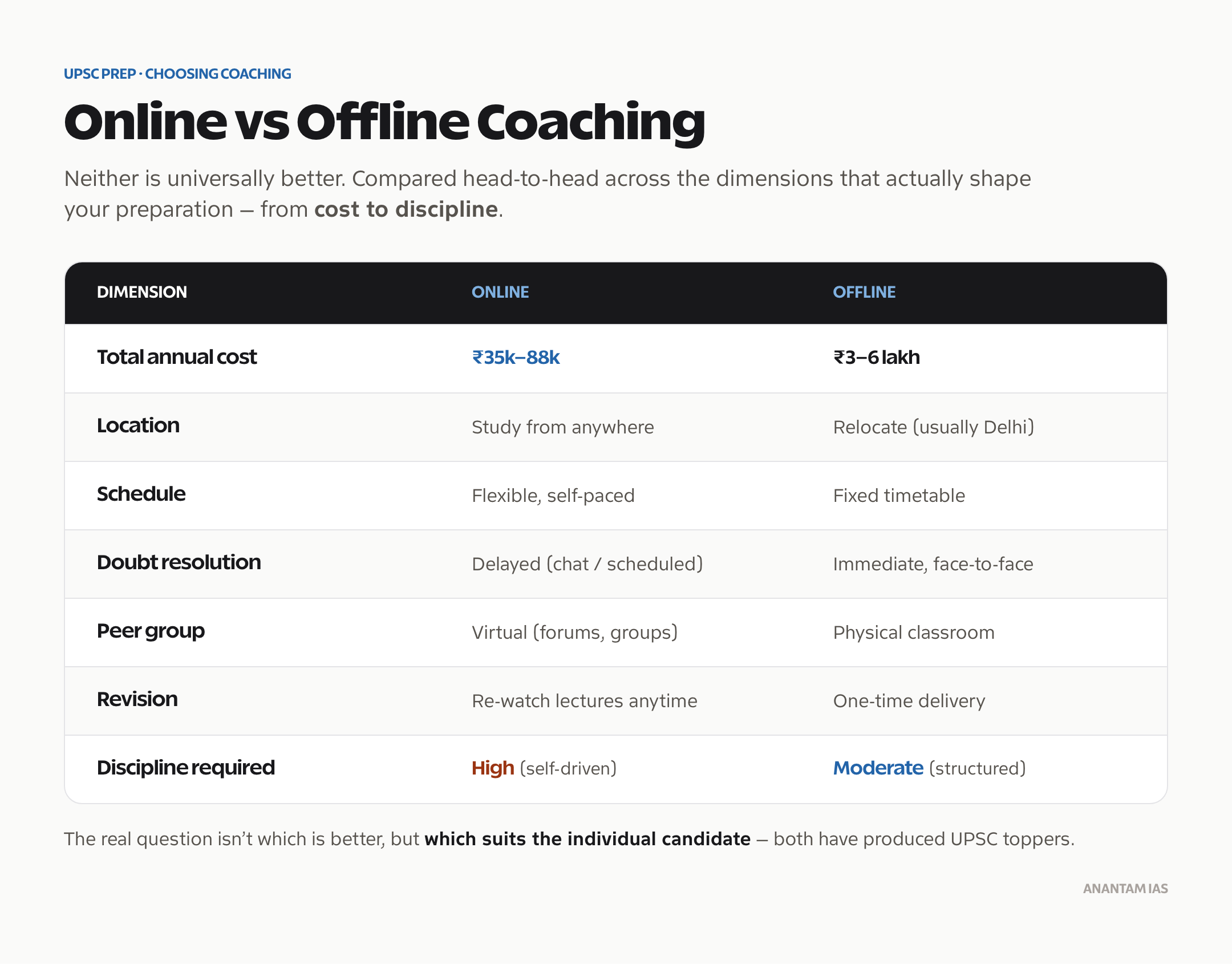
Online vs Offline IAS Coaching: Key Differences
| Parameter | Online Coaching | Offline Coaching |
|---|---|---|
| Cost | ₹20,000–80,000/year | ₹1,00,000–3,00,000/year |
| Location | Study from anywhere | Must relocate (usually Delhi) |
| Living Expenses | None (at home) | ₹15,000–25,000/month |
| Total Annual Cost | ₹20,000–80,000 | ₹3,00,000–6,00,000 |
| Schedule | Flexible, self-paced | Fixed timetable |
| Faculty Access | Limited (recorded + live sessions) | Direct, daily interaction |
| Peer Group | Virtual (Telegram, forums) | Physical classroom |
| Doubt Resolution | Delayed (chat/email/scheduled calls) | Immediate (face-to-face) |
| Test Series | Included (online evaluation) | Included (often manual evaluation) |
| Answer Evaluation | Digital, sometimes delayed | In-person, detailed feedback |
| Study Material | Digital (PDF/video) | Physical (printed notes + classroom notes) |
| Revision Flexibility | Re-watch lectures anytime | One-time classroom delivery |
| Discipline Required | High (self-motivated) | Moderate (externally structured) |
Cost Breakdown: The Real Numbers
| Expense Item | Online (Annual) | Offline Delhi (Annual) |
|---|---|---|
| Course Fee | ₹30,000–80,000 | ₹1,00,000–2,50,000 |
| Test Series | Often included | Often included |
| Books | ₹5,000–8,000 | ₹5,000–8,000 |
| Accommodation | ₹0 | ₹1,20,000–2,40,000 |
| Food | At home | ₹60,000–1,00,000 |
| Transport | ₹0 | ₹12,000–24,000 |
| Total | ₹35,000–88,000 | ₹3,00,000–6,00,000 |
The financial gap is significant. For candidates from economically weaker backgrounds, online coaching removes a major barrier to quality preparation.
UPSC Preparation at Home: Self-Study Strategy
Advantages of Online Coaching
Flexibility and Convenience
Online coaching allows candidates to study at their own pace. A working professional can attend lectures at night; a candidate in a small town doesn’t need to relocate. Recorded lectures can be paused, rewound, and re-watched — something impossible in a classroom.
Access to Top Faculty
Geography is no longer a barrier to accessing quality teaching. Top faculty from Delhi-based institutes now teach online, reaching candidates across India. A student in Manipur or Chhattisgarh gets the same lecture as someone sitting in Old Rajinder Nagar.
Revision Advantage
Recorded lectures create an automatic revision library. Candidates can revisit complex topics (monetary policy, constitutional provisions, geography concepts) multiple times without waiting for a revision class schedule.
Technology-Enhanced Learning
Online platforms offer features unavailable in classrooms:
- Searchable lecture databases
- Interactive quizzes after each lecture
- Progress tracking dashboards
- AI-based performance analysis
- Spaced repetition reminders
Lower Opportunity Cost
Candidates don’t need to quit jobs, leave families, or relocate to Delhi. For working professionals, this is often the deciding factor.
Advantages of Offline Coaching
Structured Environment
The biggest advantage of offline coaching is externally imposed discipline. A fixed timetable, mandatory attendance, and regular tests create accountability that many candidates struggle to self-generate.
Peer Learning and Motivation
Sitting alongside 200 aspirants who share the same goal creates a powerful motivational ecosystem. Peer discussions, study groups, and informal knowledge sharing happen naturally in physical settings. The competitive energy of a classroom is hard to replicate online.
Direct Faculty Interaction
Raising a hand and asking a question in real-time, staying after class for doubt sessions, and building a mentorship relationship with faculty — these experiences are qualitatively different from typing questions in a chat box.
Answer Evaluation Quality
While online platforms are improving, many experienced evaluators still provide richer feedback on physical answer sheets. The nuances of handwriting feedback, paragraph structure, and presentation are easier to convey in person.
Exam Simulation
Offline test series conducted in exam-like conditions (hall, timing, invigilators) prepare candidates for the actual exam day experience. The psychological preparation of writing for 3 hours in a room full of test-takers has value.
Who Should Choose Online Coaching?
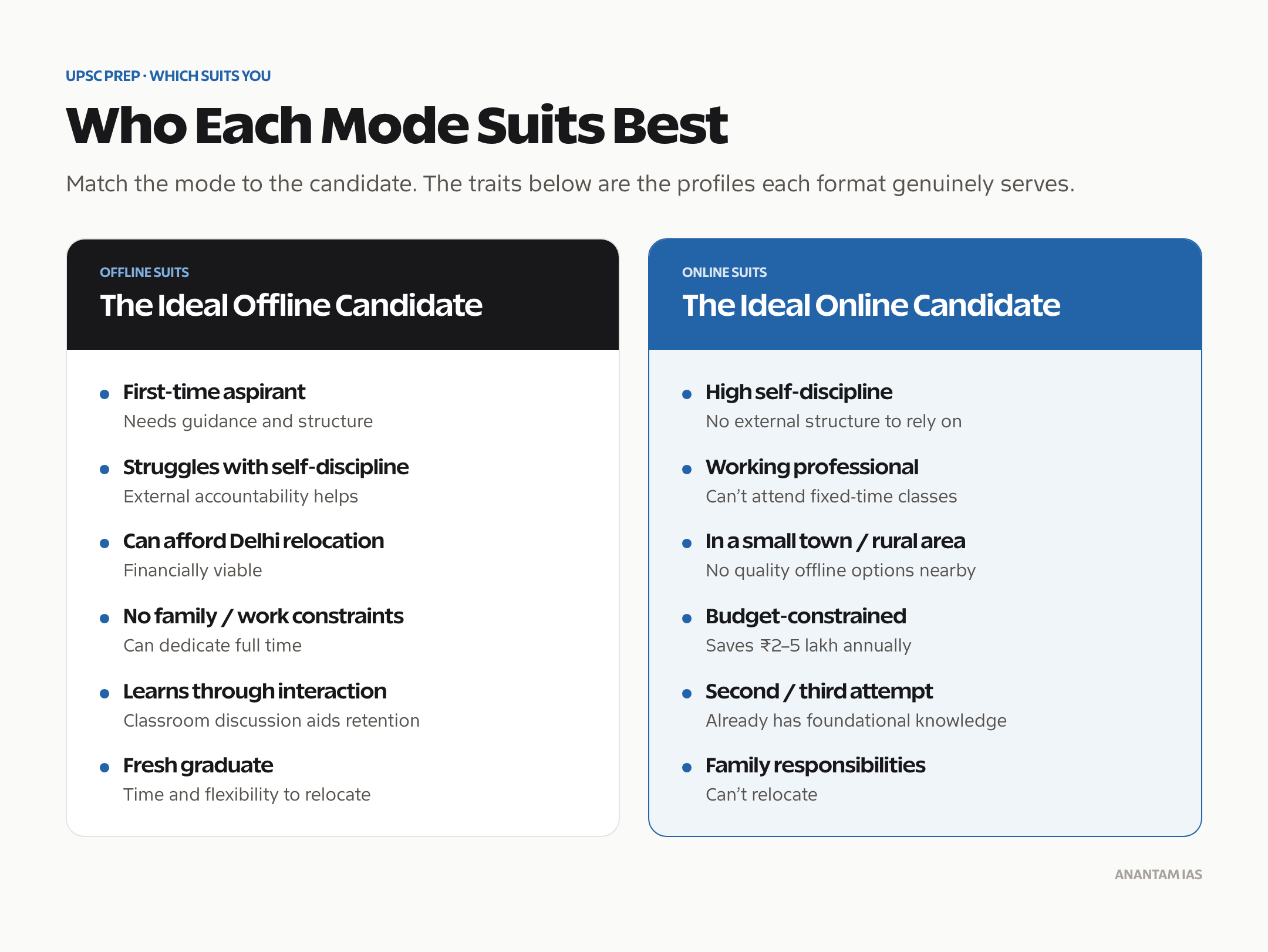
The Ideal Online Coaching Candidate
| Characteristic | Why It Matters |
|---|---|
| High self-discipline | No external structure to rely on |
| Working professional | Can’t attend fixed-time classes |
| Located in small town/rural area | No quality offline options nearby |
| Budget-constrained | Saves ₹2–5 lakh annually |
| Second/third attempt | Already has foundational knowledge |
| Comfortable with technology | Digital note-making, online tests |
| Family responsibilities | Can’t relocate |
Making Online Coaching Work
- Create a fixed schedule — Treat online lectures like classroom sessions
- Join a study group — Find 3–4 serious aspirants for weekly discussions
- Take the test series seriously — Set exam conditions at home
- Use the discussion forums — Post doubts, engage with peers
- Set weekly targets — Track progress against a study plan
Who Should Choose Offline Coaching?
The Ideal Offline Coaching Candidate
| Characteristic | Why It Matters |
|---|---|
| First-time aspirant | Needs guidance and structure |
| Struggles with self-discipline | External accountability helps |
| Can afford Delhi relocation | Financially viable |
| No family/work constraints | Can dedicate full time |
| Learns better through interaction | Classroom discussions aid retention |
| Fresh graduate | Time and flexibility to relocate |
Maximizing Offline Coaching
- Don’t be a passive listener — Ask questions, participate in discussions
- Form a study group — 3–4 members with complementary strengths
- Use coaching as a supplement — Self-study remains the backbone
- Don’t blindly follow one institute — Supplement with other sources
- Attend all tests — Test series is the most valuable coaching component
The Hybrid Model
Many candidates now use a hybrid approach — arguably the best of both worlds.
How the Hybrid Model Works
| Component | Source |
|---|---|
| Foundation lectures | Online (watch at own pace) |
| Test series | Offline (exam simulation) |
| Answer evaluation | Offline or one-on-one online sessions |
| Current affairs | Online (daily news analysis videos) |
| Peer discussion | Offline study groups |
| Revision | Online (re-watch weak topics) |
This model gives flexibility in learning while maintaining the accountability and testing rigor of offline preparation.
UPSC Study Plan: 12-Month Preparation Strategy
Evaluating Coaching Quality: Red Flags and Green Flags
Green Flags (Good Coaching)
- Experienced faculty with UPSC teaching track record
- Strong test series with personalized feedback
- Focus on answer writing from early stages
- Updated content aligned with UPSC trends
- Transparent results data (not inflated claims)
- Reasonable batch sizes
Red Flags (Avoid)
- Guaranteed rank promises
- Exaggerated topper claims (misattributing success)
- No answer evaluation component
- Faculty without subject expertise
- Extremely large batches (300+ in a class)
- Aggressive sales tactics
Questions to Ask Before Joining
- What’s the faculty-to-student ratio?
- How many answer sheets are personally evaluated per student?
- What’s the refund policy?
- Can existing students provide reviews?
- Is the content updated for the current year?
- Are mock interviews included for Mains qualifiers?
The Self-Study Alternative
A third option often overlooked: no coaching at all. Many toppers have cleared UPSC through pure self-study with just a test series subscription.
| Resource | Cost |
|---|---|
| Standard books | ₹5,000–8,000 |
| Test series (online) | ₹3,000–5,000 |
| Newspaper subscription | ₹2,000–3,000 |
| Total | ₹10,000–16,000 |
Self-study works best for candidates with strong academic backgrounds, high self-discipline, and access to quality books and internet resources.
Best Books for UPSC Prelims 2026: Subject-wise List
Frequently Asked Questions
Can online coaching produce UPSC toppers?
Multiple recent UPSC toppers have credited online coaching as their primary preparation mode. The content quality from top online platforms matches or exceeds most offline institutes. Success depends more on the candidate’s effort, consistency, and answer writing practice than the delivery mode of instruction.
Is Delhi necessary for UPSC preparation?
Delhi is no longer necessary. While it offers the densest coaching ecosystem, the same resources are now accessible online. The u0022Delhi advantageu0022 historically came from peer groups and library culture — both now replicable through online communities and digital resources. Relocating makes sense only if coaching quality in the local area is genuinely poor.
How to verify coaching institute claims about toppers?
Cross-reference topper lists with UPSC’s official results. Ask institutes for specific roll numbers. Many toppers join multiple test series and institutes, leading all of them to claim credit. The most reliable indicator is the test series quality and answer evaluation feedback, not topper claims.
Is it worth switching from online to offline mid-preparation?
Switching mid-preparation is disruptive. The first 2–3 months in any new system go toward adjustment rather than learning. If the current mode is working (consistent study, improving test scores), don’t switch. Consider switching only if there’s a clear, specific problem that the other mode solves.
What’s the minimum coaching needed for UPSC?
At minimum, a good test series (for Prelims and Mains) is essential. Everything else — lectures, notes, mentorship — can be supplemented through books, free YouTube lectures, and self-study. If budget allows one coaching investment, make it a quality test series with answer evaluation.
Tell Google you want more of this.
Add Anantam IAS as a preferred sourceOne tap, and this site shows up more often in your own Top Stories, AI Overviews and AI Mode. Remove it any time.