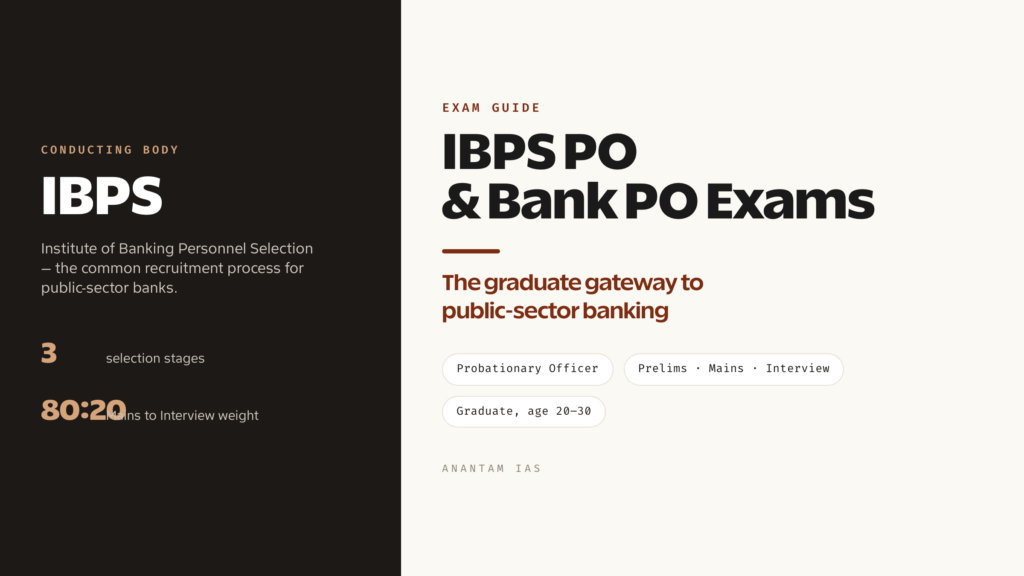
For lakhs of graduates who want a stable, well-paid career without the years-long grind of the civil services, the bank Probationary Officer exam is the most direct route into a government job. The IBPS PO exam is the gateway to officer posts across most of India’s public-sector banks, and a strong score can put you behind an officer’s desk within a year of graduating.
IBPS stands for the Institute of Banking Personnel Selection, an autonomous body that runs a common recruitment process for participating banks. This guide walks through what the exam is, how the three stages work, who can apply, what the syllabus actually covers, and how to prepare so that speed and accuracy carry you through.
What Is the IBPS PO Exam?
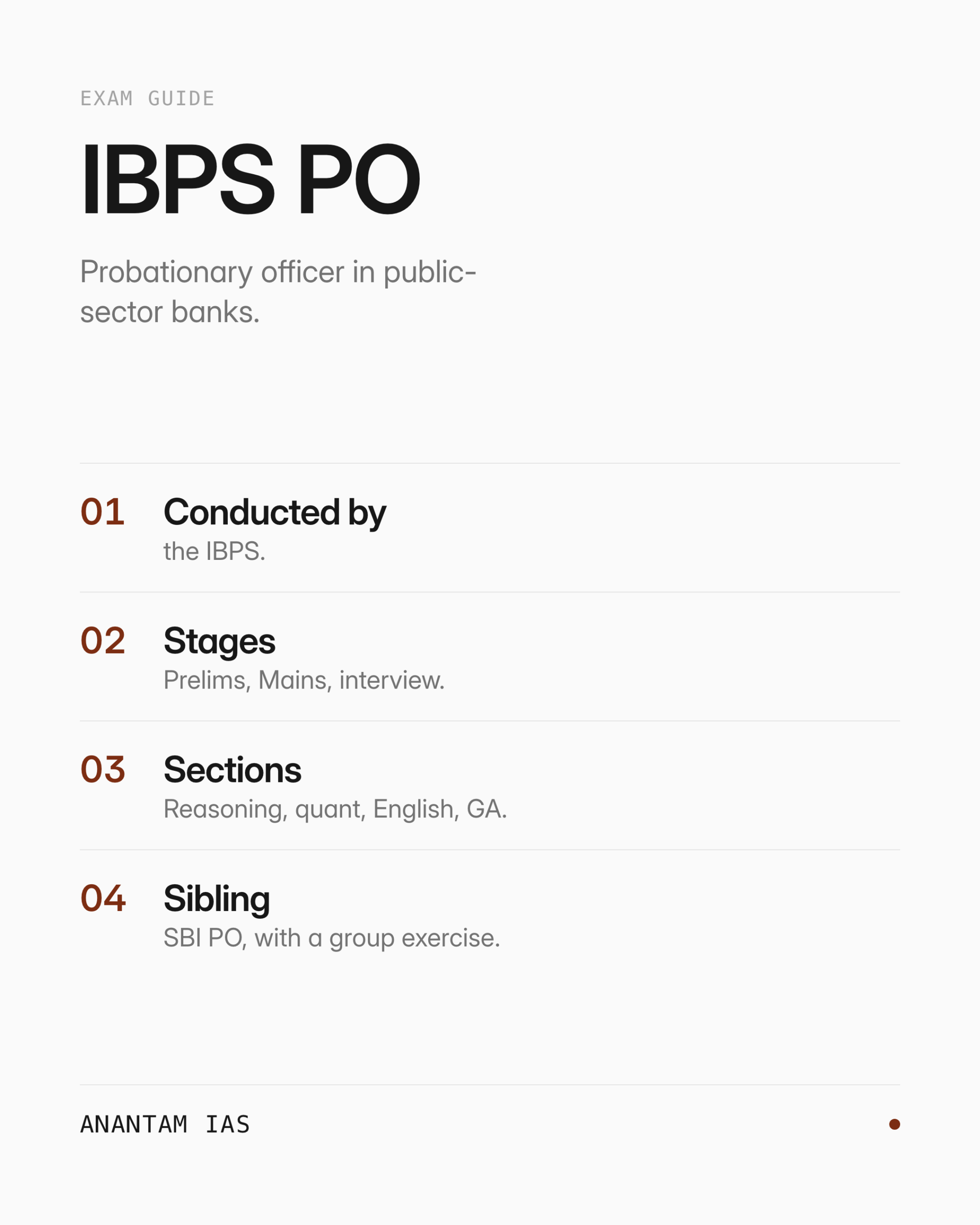
The IBPS PO exam is a national-level recruitment test that selects Probationary Officers — entry-level scale-I bank officers — for public-sector banks across India. IBPS conducts it through a Common Recruitment Process, so a single exam feeds candidates into many participating banks rather than each bank holding its own test. After clearing the exam and a provisional allotment, a successful candidate joins a bank as a trainee officer, usually with a two-year probation.
The exam matters because of its scale and stability. A typical cycle draws several lakh applicants for a few thousand vacancies, and the resulting job comes with a structured pay scale, pension-style benefits, and a clear promotion ladder. The State Bank of India runs its own parallel exam — the SBI PO — which recruits for SBI alone and follows a very similar pattern, so aspirants usually prepare for both together. Think of IBPS PO as the multi-bank gateway and SBI PO as its tougher sibling.
Key Facts
- Conducting authority: Institute of Banking Personnel Selection (IBPS), an autonomous body set up to handle recruitment for member banks.
- Posts recruited: Probationary Officer / Management Trainee (Junior Management Grade Scale-I) across participating public-sector banks.
- Frequency: Once a year, with the notification usually out in the second half of the calendar year.
- Scale of competition: Several lakh registrations against a few thousand vacancies in most cycles, so the effective ratio is steep.
IBPS PO Exam Pattern
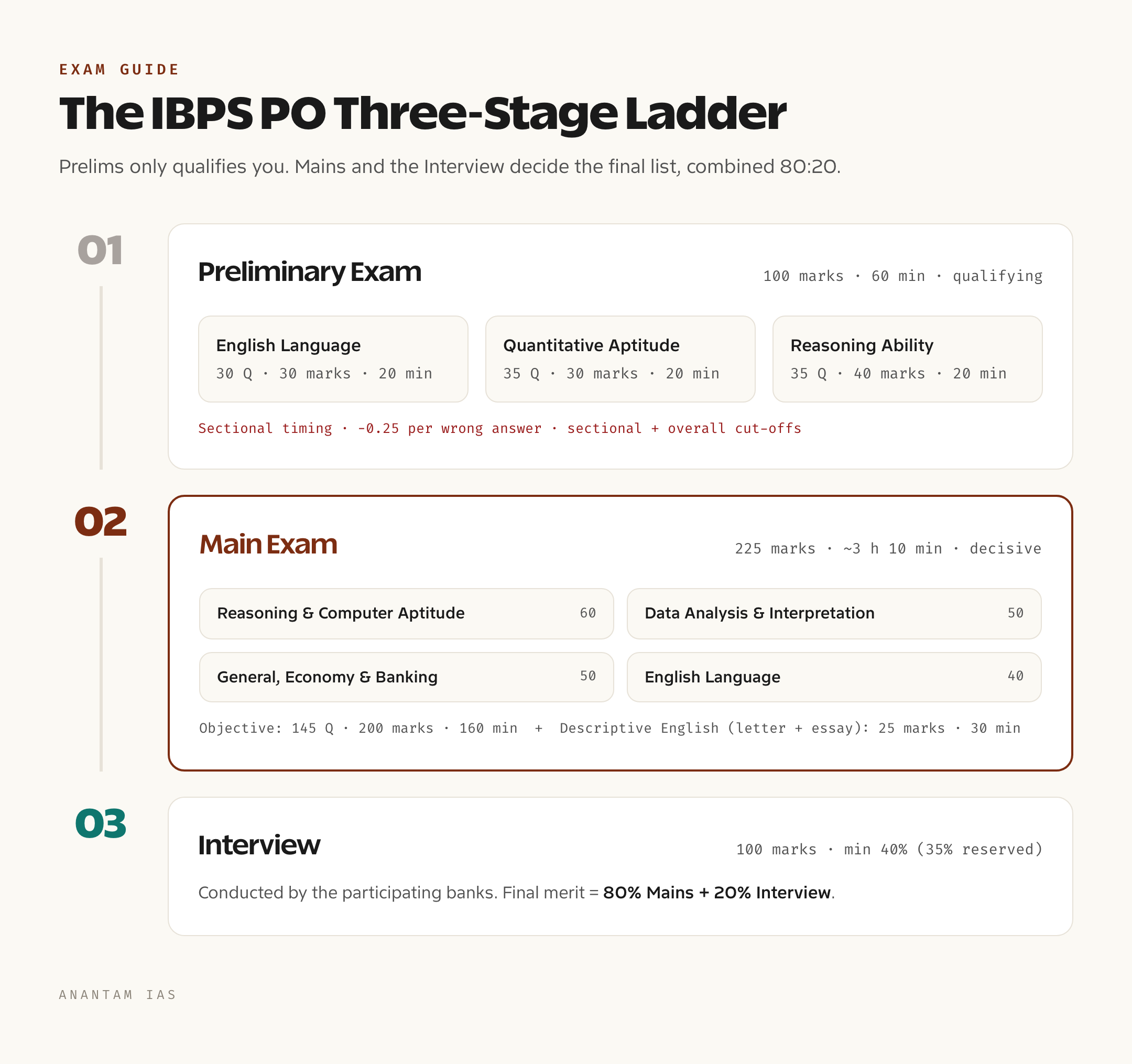
The IBPS PO selection runs in three stages — a Preliminary exam, a Main exam, and an Interview. Prelims is a qualifying screen; only your Mains and Interview scores count toward the final merit list, in an 80:20 weightage.
Prelims
The Preliminary exam is an online objective test of 100 questions for 100 marks, completed in 60 minutes. It has three sections, and IBPS enforces sectional timing — you get a fixed 20-minute window for each section and cannot move freely between them.
- English Language — 30 questions, 30 marks, 20 minutes.
- Quantitative Aptitude — 35 questions, 30 marks, 20 minutes.
- Reasoning Ability — 35 questions, 40 marks, 20 minutes.
There’s a negative marking of 0.25 marks for every wrong answer, and you must clear both the sectional cut-offs and the overall cut-off to move on. Prelims marks don’t carry forward; the stage only decides who qualifies for Mains.
Mains
The Main exam is the decisive objective stage, plus a short descriptive English paper. The objective portion has 145 questions for 200 marks across four sections, each separately timed, for a total of 160 minutes.
- Reasoning & Computer Aptitude — 40 questions, 60 marks, 50 minutes.
- English Language — 35 questions, 40 marks, 40 minutes.
- Data Analysis & Interpretation — 35 questions, 50 marks, 45 minutes.
- General, Economy & Banking Awareness — 35 questions, 50 marks, 25 minutes.
A 0.25-mark penalty applies to wrong objective answers. Immediately after the objective test, candidates sit a Descriptive English paper — a letter and an essay — worth 25 marks in 30 minutes, designed to check written communication. So Mains totals 225 marks across roughly three hours and ten minutes.
Interview
Candidates who clear the Mains cut-off are called for an Interview worth 100 marks, conducted by the participating banks. You need at least 40% (35% for reserved categories) to qualify. The final merit list combines Mains and Interview in an 80:20 ratio, which is why a strong Mains score does most of the heavy lifting. Compared with the UPSC Civil Services route, the whole IBPS PO cycle is far shorter — months rather than the better part of a year.
IBPS PO Eligibility
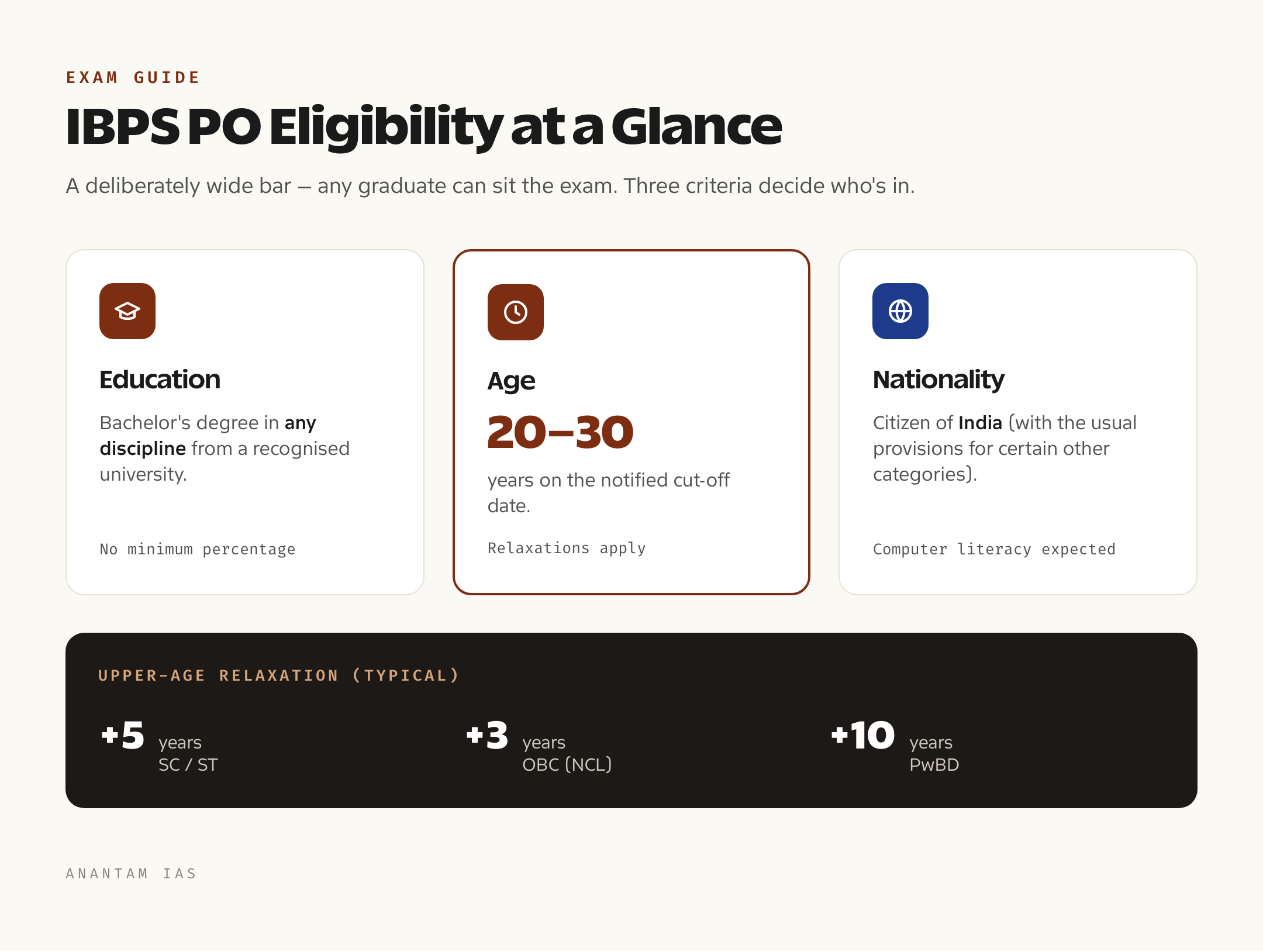
The eligibility bar for IBPS PO is deliberately wide, which is part of why it draws such large applicant pools. The core requirements are nationality, age, and a graduation degree.
- Nationality: A candidate must be a citizen of India (with the usual provisions for certain other categories such as subjects of Nepal or Bhutan, subject to an eligibility certificate where required).
- Age limit: Between 20 and 30 years as on the cut-off date specified in the notification. Upper-age relaxations follow government norms — typically 5 years for SC/ST, 3 years for OBC (non-creamy layer), and 10 years for persons with benchmark disabilities, with further relaxation for ST candidates with disability.
- Educational qualification: A Bachelor’s degree in any discipline from a recognised university, or an equivalent qualification recognised by the central government. There’s no minimum-percentage bar at the eligibility stage, but the degree must be completed by the cut-off date in the notification.
- Computer literacy: Operating and working knowledge of computers is expected, since the job and the exam itself are fully digital.
Because the degree can be in any stream, engineers, commerce graduates, arts graduates and science graduates all compete on the same footing — the exam, not your background, decides the outcome.
IBPS PO Syllabus
The IBPS PO syllabus is built around four competencies — English, quantitative ability, reasoning, and awareness — that recur across both stages, with the difficulty and the addition of banking-specific content rising in Mains.
Prelims Syllabus
- English Language: Reading comprehension, cloze tests, para jumbles, error spotting, sentence improvement, fillers and vocabulary.
- Quantitative Aptitude: Simplification and approximation, number series, quadratic equations, data interpretation (tables, bar/line/pie), and arithmetic word problems — percentages, ratio, profit and loss, time-speed-distance, time and work, simple and compound interest.
- Reasoning Ability: Puzzles and seating arrangements, syllogisms, inequalities, blood relations, direction sense, coding-decoding, order and ranking, and input-output.
Mains Syllabus
Mains carries the Prelims topics forward at a harder level and layers on banking-specific content.
- Reasoning & Computer Aptitude: Advanced puzzles and arrangements, data sufficiency, logical reasoning, plus computer fundamentals — hardware, software, networking, MS Office, the internet, and basic security.
- Data Analysis & Interpretation: Complex and caselet DI, data sufficiency, and quantitative problem-solving applied to data sets.
- English Language: Higher-level comprehension, vocabulary in context, and grammar, alongside the Descriptive paper’s letter and essay.
- General, Economy & Banking Awareness: Banking and financial awareness, key Reserve Bank of India and government policies and circulars, the structure of the Indian economy, important schemes, national and international current affairs (with a banking-and-economy slant), static general knowledge, and abbreviations.
Banking & Financial Awareness Focus
This is the section that separates serious bank-exam aspirants from generalists. It rewards consistent reading of banking developments — RBI policy decisions, types of banks and accounts, payment systems, financial-inclusion schemes, money-market basics, and the headline economic data of the day. A daily current-affairs habit aimed specifically at banking and the economy, rather than broad civil-services-style coverage, is what moves the needle here.
IBPS PO Preparation Strategy
Bank PO exams reward speed, accuracy, and disciplined revision more than encyclopedic depth. The exam is a race against the clock under sectional timing, so your strategy has to be built around the stopwatch, not just the syllabus.
Master Speed and Accuracy
With sectional timing, you can’t borrow minutes from an easy section to rescue a hard one. Practise each section against its own clock until you can identify and skip time-traps quickly. The skill being tested is selection — choosing which questions to attempt — as much as raw problem-solving.
Build Sectional Accuracy
Because negative marking docks 0.25 for every wrong answer, blind guessing erodes your score. Aim for a high strike rate within whatever you attempt, and let your accuracy, not your attempt count, climb first. Cut-offs are decided section by section, so a weak area can sink you even with a strong overall total — shore up your weakest section deliberately.
Make Banking Awareness a Daily Habit
The General, Economy & Banking Awareness section is the most coachable and the most score-defining at Mains. Read a banking-current-affairs digest every day, keep monthly compilations, and revise RBI and government policy moves before the exam. This is also where you’ll find overlap with broader awareness if you ever sit for other government exams.
Drill Mock Tests Relentlessly
Full-length mocks under exam conditions are non-negotiable for bank PO preparation. They train your time allocation, expose weak sections, and build the stamina to stay sharp through the longer Mains. Review every mock to convert mistakes into patterns you’ll recognise next time.
Practise the Descriptive Paper
Don’t ignore the 25-mark letter-and-essay paper. Write a few timed letters and essays each week, keep them tight and well-structured, and you’ll bank easy marks that many candidates leave on the table.
Posts, Salary & Career
A successful candidate joins as a Probationary Officer in Junior Management Grade Scale-I, the first rung of the bank-officer hierarchy. The pay is governed by the industry-wide bank pay scales settled between banks and employee unions, and the in-hand package is bolstered by the dearness allowance, house-rent allowance, and other perks, which lifts total compensation well above the basic figure. Most banks also offer a special allowance for the PO grade.
The real attraction is the career ladder. From Scale-I, officers move up to Scale-II, Scale-III and beyond — toward Chief Manager, Assistant General Manager and senior management roles — through a mix of seniority and internal promotion exams. Postings span branch banking, credit, treasury, rural and digital banking, giving officers broad exposure. For graduates weighing a banking career against an administrative one, it’s worth comparing routes the way our UPSC vs SSC guide does — and bank PO sits as a faster-entry, well-compensated alternative to both.
Frequently Asked Questions
Is IBPS PO tougher than SBI PO?
The two follow a very similar three-stage pattern, but SBI PO is generally considered tougher — its questions run a notch harder, its General Awareness section is heavier, and it adds a Group Exercise (group discussion) and, in recent cycles, a psychometric test before the interview, where IBPS PO goes straight to a 100-mark interview. Most aspirants prepare for both since the syllabus overlaps almost entirely.
What is the minimum qualification for the IBPS PO exam?
You need a Bachelor’s degree in any discipline from a recognised university, completed by the cut-off date in the notification. There’s no minimum-percentage requirement at the eligibility stage, and any graduate — arts, science, commerce or engineering — can apply.
How many stages does the IBPS PO exam have?
Three: a qualifying Prelims (100 marks), a decisive Mains (225 marks including a 25-mark descriptive English paper), and an Interview (100 marks). Only the Mains and Interview count toward the final merit list, combined in an 80:20 ratio.
Does IBPS PO have negative marking?
Yes. Both Prelims and the objective part of Mains deduct 0.25 marks for each wrong answer, while unanswered questions carry no penalty. The descriptive paper is not negatively marked. Because of this, accuracy matters more than the sheer number of questions you attempt.
Tell Google you want more of this.
Add Anantam IAS as a preferred sourceOne tap, and this site shows up more often in your own Top Stories, AI Overviews and AI Mode. Remove it any time.