An IFS (Indian Foreign Service) officer starts at a basic pay of ₹56,100 per month — 7th CPC Pay Level 10, identical to an IAS officer at entry — for an in-hand of roughly ₹1.1 lakh at a domestic posting in Delhi. On a foreign posting, a tax-free Foreign Allowance lifts effective compensation 3–5 times, which is why IFS is regarded as the best-paying UPSC service in real terms.
| IFS salary snapshot | Detail |
|---|---|
| Full form | Indian Foreign Service |
| Entry pay level | Level 10 (7th CPC) |
| Basic pay (entry) | ₹56,100/month |
| Dearness Allowance | 60% of basic (w.e.f. January 2026) |
| In-hand (Delhi, entry) | ~₹1,10,000/month |
| Abroad (with Foreign Allowance) | ₹2.5–8 lakh+/month (FA is tax-free) |
| Recruitment | UPSC Civil Services Examination |
| Entry post | Third Secretary |
| Apex post | Foreign Secretary (Pay Level 17) |
IFS Salary: Indian Foreign Service Pay, Allowances & Career Path
An IFS (Indian Foreign Service) officer earns a basic pay starting at ₹56,100 per month (Pay Level 10) — identical to IAS at entry level. But the IFS salary story changes completely when you’re posted abroad. Foreign Allowance can multiply your effective compensation 3–5 times, making IFS one of the highest-paying central government services in real terms.
IFS is one of the three All India Services under UPSC CSE. You don’t apply separately for IFS — your preference in UPSC rank and service choice determines your allocation. Typically, IFS goes to ranks in the 30–150 range, though this varies each year.
IFS Basic Pay Under 7th Pay Commission
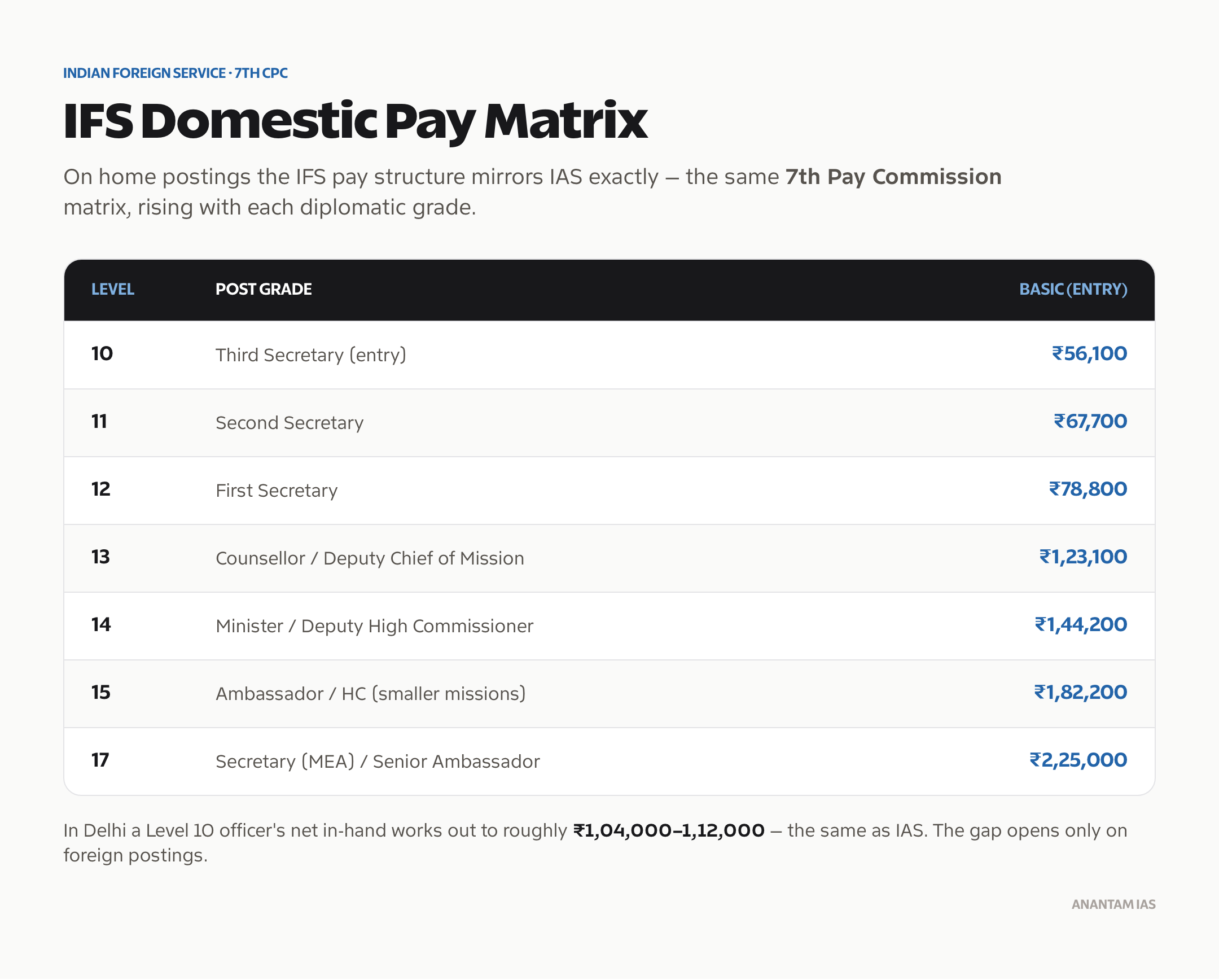
The domestic pay structure for IFS mirrors IAS exactly. Both services follow the same 7th CPC pay matrix.
IFS Pay Matrix: Domestic Posting
| Pay Level | Post Grade | Basic Pay (Entry) | Basic Pay (Maximum) | Typical Service Years |
|---|---|---|---|---|
| Level 10 | Third Secretary (entry) | ₹56,100 | ₹1,77,500 | 0–4 years |
| Level 11 | Second Secretary | ₹67,700 | ₹2,08,700 | 4–9 years |
| Level 12 | First Secretary | ₹78,800 | ₹2,09,200 | 9–14 years |
| Level 13 | Counsellor / Deputy Chief of Mission | ₹1,23,100 | ₹2,15,900 | 14–20 years |
| Level 14 | Minister / Deputy High Commissioner | ₹1,44,200 | ₹2,18,200 | 20–26 years |
| Level 15 | Ambassador / High Commissioner (smaller missions) | ₹1,82,200 | ₹2,24,100 | 26–30 years |
| Level 16 | Ambassador / High Commissioner (major missions) | ₹2,05,400 | ₹2,24,400 | 30–34 years |
| Level 17 | Secretary (MEA) / Senior Ambassador | ₹2,25,000 | Fixed | 34–37 years |
When posted in India — at MEA (Ministry of External Affairs) headquarters in New Delhi, or at the Consulates — IFS officers draw the standard 7th CPC pay plus allowances.
Domestic In-Hand Salary (Delhi, Level 10)
| Component | Amount (₹/month) |
|---|---|
| Basic Pay | 56,100 |
| DA @ 60% | 33,660 |
| HRA @ 30% (Delhi) | 16,830 |
| Transport Allowance | 7,200 + DA |
| Gross | ~1,12,000–1,20,000 |
| NPS Deduction | 5,610 |
| Other deductions | ~1,500 |
| Net In-Hand (Delhi) | ~₹1,04,000–1,12,000 |
At this stage — domestic posting with no foreign allowance — IFS and IAS pay are essentially the same. The differentiation begins the moment you fly out.
Foreign Allowance: Where IFS Salary Becomes Extraordinary
Foreign Allowance (FA) is paid to IFS officers during foreign postings. It’s calculated in US Dollars and paid in local currency. It’s designed to cover the cost of living in foreign countries while maintaining a standard befitting India’s diplomatic representation.
How Foreign Allowance Works
The Ministry of External Affairs fixes Foreign Allowance rates based on:
- Country classification: Countries are grouped into different grades based on cost of living, hardship level, and strategic importance
- Post grade: Your rank (Third Secretary, Second Secretary, etc.) determines the base rate
- Dependent allowance: Additional amounts for spouse and children
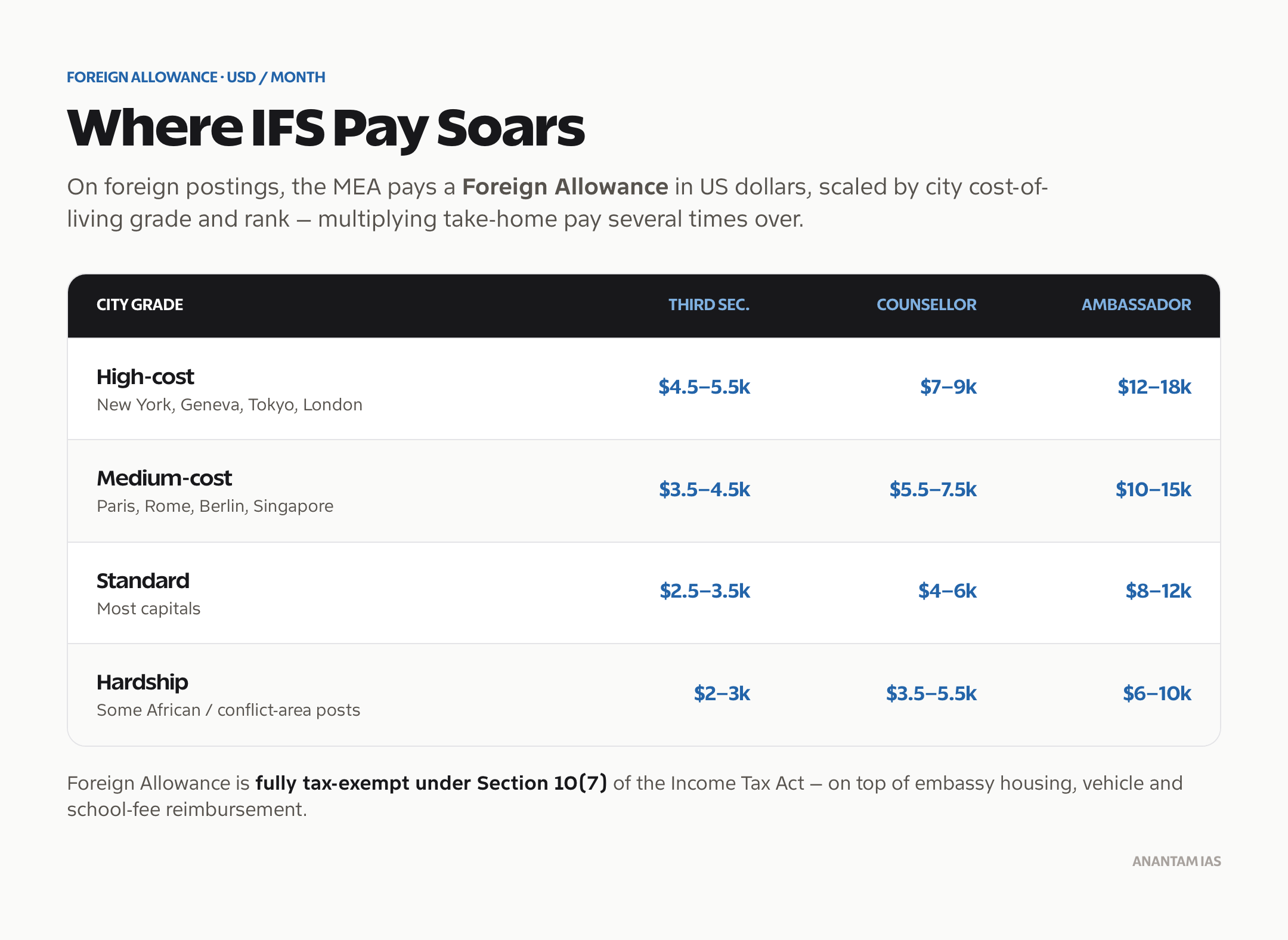
Indicative Foreign Allowance rates (USD/month, approximate):
| Country/City Grade | Entry Level (Third Sec.) | Mid-Career (Counsellor) | Senior (Ambassador) |
|---|---|---|---|
| High-cost (New York, Geneva, Tokyo, London) | $4,500–5,500 | $7,000–9,000 | $12,000–18,000 |
| Medium-cost (Paris, Rome, Berlin, Singapore) | $3,500–4,500 | $5,500–7,500 | $10,000–15,000 |
| Standard (Most capitals) | $2,500–3,500 | $4,000–6,000 | $8,000–12,000 |
| Hardship (some African, conflict-area posts) | $2,000–3,000 + hardship add | $3,500–5,500 | $6,000–10,000 |
Total effective income abroad: A Third Secretary in New York or Geneva might receive their Indian basic pay (₹56,100) plus $4,500–5,500 in Foreign Allowance. At current USD rates, that Foreign Allowance alone is ₹3,75,000–₹4,60,000 per month. Combined effective compensation: ₹4,30,000–₹5,20,000 per month.
This is why IFS is widely considered the best-paying UPSC service in terms of actual take-home compensation during foreign postings.
Tax Treatment of Foreign Allowance
Foreign Allowance paid to IFS officers is fully exempt from Indian income tax under Section 10(7) of the Income Tax Act, 1961. This is a significant benefit. An IAS officer earning the same basic pay in India pays income tax. An IFS officer drawing Foreign Allowance abroad pays no tax on that component.
IAS Officer Salary and Career Progression
Non-Monetary Perks of IFS: Embassy Life
Foreign Allowance is the headline number, but embassy life comes with substantial in-kind perquisites.
Official Residence Abroad
Most IFS officers posted abroad get official residential accommodation — paid for by the Indian government, not deducted from salary. The standard of accommodation scales with rank:
- Entry level (Third/Second Secretary): Comfortable apartment in a decent neighbourhood of the city, usually 2–3 BHK
- Senior level (Counsellor/DCM): Larger apartment or house, often in premium areas
- Head of Mission (Ambassador/HC): The Indian Embassy or High Commission residence — often a prestigious property in the best diplomatic area of the city. Some Embassy residences (Washington DC, London, Paris) are heritage properties worth tens of millions of dollars
The Ambassador’s Residence is not just a home — it’s a diplomatic asset used for state dinners, official functions, and representing India. The government maintains it fully, including staff (cooks, butlers, security).
Official Vehicle Abroad
Embassy vehicles are provided to all posted IFS officers. Ambassadors and High Commissioners get the flagship vehicle — typically a BMW 7 Series, Mercedes S-Class, or equivalent, with diplomatic number plates.
Domestic Help
Many postings provide or subsidise domestic staff — cook, driver, household help. The Indian government budgets for this as part of the diplomatic representation expense.
School Fees
Children of IFS officers posted abroad are entitled to school fee reimbursement. International schools in cities like London, Washington, Geneva, or Tokyo cost $20,000–$40,000 per year per child. The government reimburses these fees — an enormous benefit for officers with school-age children.
This single benefit can be worth ₹30,00,000–₹70,00,000 per year for an officer with two children in a high-cost city. It’s rarely talked about when comparing IFS to other services, but it’s material.
Diplomatic Privileges
IFS officers posted abroad enjoy diplomatic immunity under the Vienna Convention on Diplomatic Relations (1961). This includes:
- Exemption from host country jurisdiction in civil and criminal matters (for most senior officers)
- Exemption from customs duties on personal effects
- Diplomatic passport and special travel facilities
- Access to diplomatic channels for various services
IFS Career Progression: Third Secretary to Ambassador
The career ladder in IFS is defined and predictable — but competitive at the top.
Career Timeline
| Stage | Title | Typical Service Years | Key Activities |
|---|---|---|---|
| Entry | Third Secretary | 0–3 years | First foreign posting, learning diplomatic tradecraft |
| Junior | Second Secretary | 3–8 years | Bilateral affairs, visa section, press/cultural work |
| Mid-career | First Secretary | 8–14 years | Economic/political reporting, section head at Embassy |
| Senior | Counsellor | 14–18 years | Deputy to DCM, head of major sections |
| Senior management | DCM / Deputy HC | 18–24 years | Second-in-command at a mid-size mission |
| Heads of Mission | Ambassador / HC (smaller mission) | 24–30 years | Full head of mission, presenting credentials |
| Senior Ambassador | Ambassador (major mission) | 30+ years | Major capitals — Washington, Beijing, Moscow, London |
| Apex | Foreign Secretary / Secretary MEA | 34–37 years | Top of IFS hierarchy |
Foreign Secretary is the highest position in IFS — the administrative head of the Ministry of External Affairs and principal diplomatic adviser to the government. India has had notable Foreign Secretaries including S. Jaishankar (later External Affairs Minister), Vijay Gokhale, T.S. Tirumurti, and others who shaped key diplomatic outcomes.
Posting Allocation
MEA decides postings based on:
- Service requirements and language skills
- Officer’s area expertise (regional specialists: South Asia, East Asia, Europe, Americas)
- Availability of posts and service requirements
- Personal preferences (considered but not determinative)
Language training is a key differentiator. IFS officers learn a foreign language as part of their training — Chinese, Japanese, French, German, Arabic, Russian, Spanish, Portuguese among others. Officers proficient in rare languages (Chinese, Japanese, Arabic) often get premium postings and are in higher demand.
How to Crack UPSC CSE in First Attempt
IFS vs IAS: Which Service to Choose?
This is the question most UPSC aspirants ask when they’re in the rank range where both are accessible.
Detailed Comparison
| Parameter | IFS | IAS |
|---|---|---|
| Pay Level (Entry) | Level 10 | Level 10 |
| Domestic Pay | Same as IAS | Standard 7th CPC |
| Foreign Posting Pay | ₹3,50,000–₹8,00,000+/month (total) | Not applicable |
| Perquisites (Foreign) | Embassy housing, vehicle, school fees, diplomatic privileges | Not applicable |
| Perquisites (India) | Moderate — MEA headquarters is a ministry post | Bungalow, vehicle, security as Collector/DM |
| Career nature | International focus, city-based | District-based, grassroots |
| Field power | Limited (MEA is policy, not field execution) | Extensive (Collector has direct executive power) |
| Career ceiling | Foreign Secretary (Level 17) | Cabinet Secretary (Level 18) |
| Family life | Frequent international transfers every 2–3 years | Transfers within state, more predictable |
| Language requirement | Learn a foreign language | Regional languages preferred |
| Posting predictability | MEA decides — less predictable | State cadre — more predictable geography |
Choosing IFS: If you want international exposure, diplomatic work, and the lifestyle of embassy postings across the world — IFS is exceptional. The compensation abroad is genuinely outstanding.
Choosing IAS: If you want direct administrative power, prefer India-based work, want to drive district-level change, and prefer more predictable postings within your home state cadre — IAS offers that.
Neither is universally “better.” They’re different services for different people.
IFS Exam: Same as UPSC CSE
You don’t write a separate exam for IFS. It’s the same UPSC CSE (Civil Services Examination) that selects IAS, IPS, IRS, and over 20 other central services.
What Differentiates IFS Selection Within UPSC
After the final merit list is published, candidates fill a preference form for services. IFS selection works as follows:
- Top ranks (approximately 1–150): Can secure IFS if they mark it as preference
- Service allocation: Follows the preference + merit order logic
- IFS Training: Selected IFS officers do a Foundational Training at LBSNAA (common with all Civil Services) followed by specialised IFS training at the Foreign Service Institute (FSI) in New Delhi
- Foreign language training: At FSI, officers are assigned a language. They then go for language training to the country where that language is spoken
The IFS Foundation Course at FSI covers diplomacy, international law, protocol, international economics, and foreign policy. It’s intensive and prestigious.
IFS Salary Summary: The Real Picture
At this point, you have all the numbers. Let’s consolidate:
| Scenario | Effective Monthly Compensation |
|---|---|
| IFS officer in Delhi (domestic posting) | ₹1,04,000–1,12,000 (same as IAS) |
| IFS Third Secretary, standard capital abroad | ₹2,50,000–3,50,000 (FA + basic) |
| IFS Counsellor, high-cost city (NYC/London) | ₹6,00,000–8,00,000 (FA + basic) |
| IFS Ambassador, major mission (Washington/Beijing) | ₹12,00,000–18,00,000 (FA + pay) |
| Non-monetary perks (school fees, housing, vehicle) | Add ₹2,00,000–8,00,000/month equivalent |
These are estimated ranges, not official published figures. MEA doesn’t publicly disclose FA rates — they’re revised periodically based on UN cost-of-living indices and bilateral considerations.
Frequently Asked Questions
What is the starting salary of an IFS officer?
An IFS officer starts at Pay Level 10 with a basic pay of ₹56,100 per month — identical to IAS. During domestic postings, in-hand salary is approximately ₹1,04,000–₹1,12,000 in Delhi. During foreign postings, Foreign Allowance adds $2,500–$5,500 per month depending on country, making the total compensation 3–5 times higher.
Is IFS salary higher than IAS salary?
Domestically, IFS and IAS pay are identical. IFS significantly outpays IAS in real terms when the officer is posted abroad, due to Foreign Allowance (tax-free), official housing abroad, school fee reimbursement, and other embassy perquisites. An IFS Counsellor in London or Washington earns more total compensation than an IAS Secretary in a state government.
How long before an IFS officer becomes an Ambassador?
Most IFS officers become Heads of Mission (Ambassador or High Commissioner) between 24–30 years of service. Smaller missions get officers earlier in this range; major missions like Washington, Beijing, London, or Moscow require more seniority. The Foreign Secretary is the apex, typically reached after 34–37 years.
Do IFS officers pay income tax on Foreign Allowance?
No. Foreign Allowance paid to IFS officers is exempt from Indian income tax under Section 10(7) of the Income Tax Act, 1961. This makes the net take-home from Foreign Allowance 100% of the stated amount, which significantly increases the real value compared to equivalent taxable income.
Can an IFS officer resign and work in the private sector?
Yes, with certain restrictions. IFS officers must obtain government permission before joining private sector roles after resignation, particularly in roles related to foreign affairs, defence, or sensitive sectors. The cooling-off period and restrictions are governed by IFS conduct rules and the relevant All India Services (Conduct) Rules.
Tell Google you want more of this.
Add Anantam IAS as a preferred sourceOne tap, and this site shows up more often in your own Top Stories, AI Overviews and AI Mode. Remove it any time.