Important Acts & Laws for UPSC: Complete List
Legislation forms the backbone of governance in India. UPSC tests knowledge of important acts and laws across Prelims (factual questions about provisions) and Mains (analytical questions about implementation, impact, and judicial interpretation). This comprehensive reference covers all major acts that every UPSC aspirant must know — organized by subject area with key provisions, year of enactment, and exam relevance.
Constitutional and Governance Laws
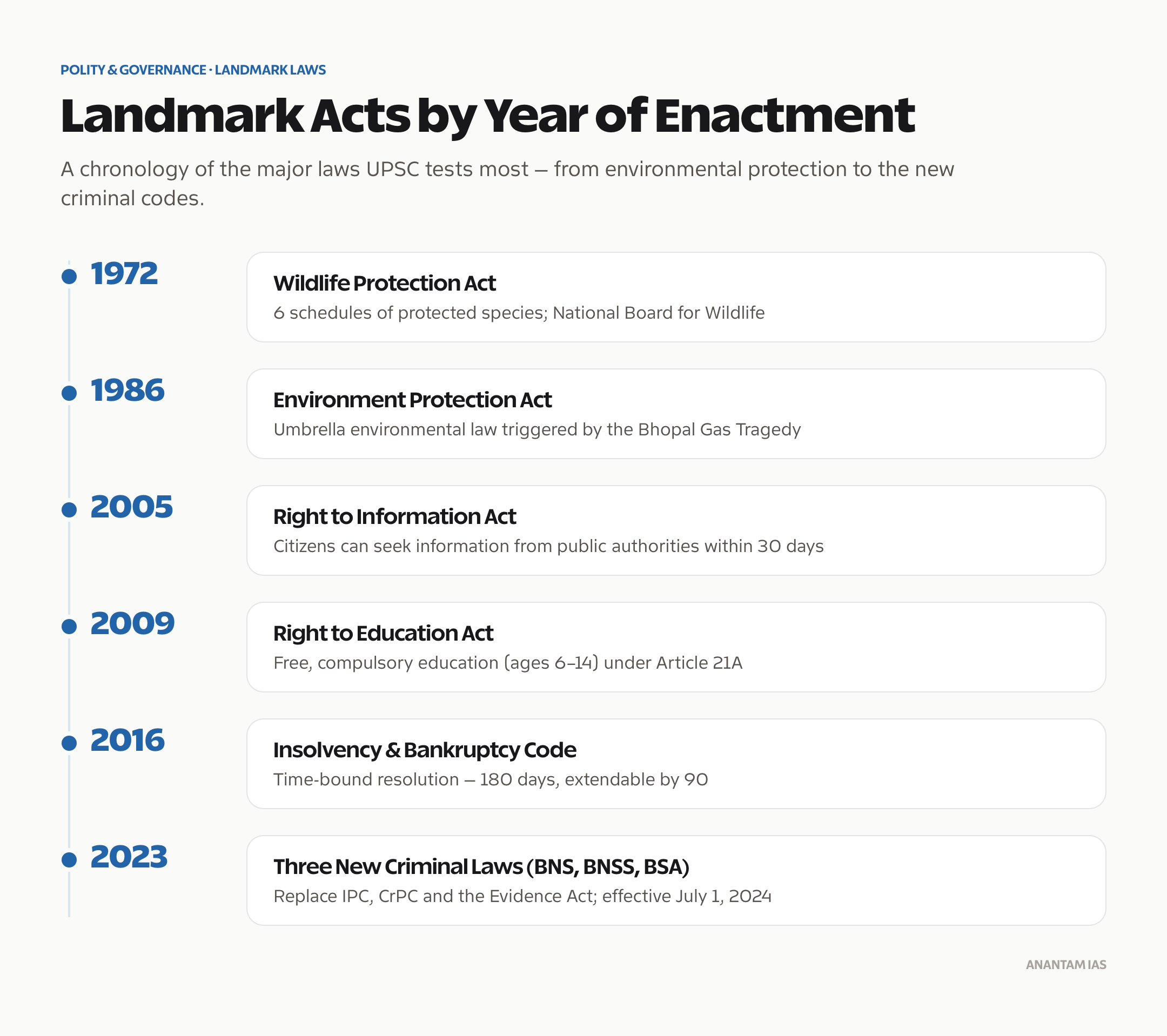
Right to Information Act, 2005
| Feature | Detail |
|---|---|
| Year | 2005 |
| Objective | Transparency and accountability in governance |
| Key Provision | Every citizen can seek information from public authorities |
| Response Time | 30 days (48 hours in life/liberty matters) |
| Appellate Authority | First appeal to departmental officer, then Information Commission |
| Exemptions | Section 8 lists exemptions (national security, cabinet papers, etc.) |
| Significance | Strengthened democratic accountability |
The RTI Act is arguably India’s most transformative governance law. It shifted the information asymmetry between government and citizens, enabling accountability at every level.
Lokpal and Lokayuktas Act, 2013
| Feature | Detail |
|---|---|
| Year | 2013 |
| Objective | Anti-corruption ombudsman at Centre and states |
| Jurisdiction | PM (with exceptions), ministers, MPs, Group A–D officers |
| Composition | Chairperson + 8 members (50% judicial) |
| Key Power | Preliminary inquiry, investigation, prosecution recommendation |
Lokpal and Lokayukta: Complete Guide
Representation of the People Act, 1950 & 1951
| Act | Focus |
|---|---|
| RPA 1950 | Delimitation, electoral rolls, allocation of seats |
| RPA 1951 | Conduct of elections, corrupt practices, election petitions, disqualification |
Key provisions include disqualification for convicted persons (Section 8), election expenses limit, and grounds for declaring elections void.
Social Justice and Rights
Protection of Children from Sexual Offences Act (POCSO), 2012
| Feature | Detail |
|---|---|
| Year | 2012 |
| Objective | Protection of children from sexual abuse |
| Key Provisions | Defines sexual assault, harassment against children under 18 |
| Special Courts | Mandatory special courts for speedy trial |
| Burden of Proof | Reversed — accused must prove innocence |
| Amendment | 2019 — death penalty for aggravated penetrative sexual assault |
Sexual Harassment of Women at Workplace (POSH) Act, 2013
| Feature | Detail |
|---|---|
| Year | 2013 |
| Based On | Vishaka Guidelines (Supreme Court, 1997) |
| Applicability | All workplaces — organized and unorganized sector |
| Key Mechanism | Internal Complaints Committee (ICC) mandatory |
| Covers | Physical contact, demand for sexual favours, sexually coloured remarks |
| Complaint Timeline | Within 3 months of incident |
Scheduled Castes and Scheduled Tribes (Prevention of Atrocities) Act, 1989
| Feature | Detail |
|---|---|
| Year | 1989 (Amended 2015, 2018) |
| Objective | Prevent atrocities and discrimination against SC/ST |
| Key Provisions | Special courts, victim compensation, non-bailable offences |
| 2018 Amendment | Restored original provisions after SC diluted in Subhash Kashinath Mahajan case |
Right to Education Act, 2009
| Feature | Detail |
|---|---|
| Constitutional Basis | Article 21A (86th Amendment, 2002) |
| Age Group | 6–14 years |
| Key Provision | Free and compulsory education as fundamental right |
| Private Schools | 25% reservation for economically weaker sections |
| Pupil-Teacher Ratio | 30:1 for primary, 35:1 for upper primary |
Right to Education: Complete Guide
Domestic Violence Act, 2005
Also called the Protection of Women from Domestic Violence Act, it provides civil remedies to women facing physical, sexual, verbal, emotional, or economic abuse within domestic relationships.
Economic and Financial Laws
Insolvency and Bankruptcy Code (IBC), 2016
| Feature | Detail |
|---|---|
| Year | 2016 |
| Objective | Time-bound resolution of insolvency |
| Timeline | 180 days (extendable by 90 days) for corporate insolvency |
| Key Bodies | NCLT (adjudicating), IBBI (regulating), IPs (managing) |
| Significance | Replaced multiple overlapping laws, improved ease of doing business |
The IBC consolidated and replaced the SICA, Recovery of Debts Act, and other fragmented insolvency laws into a single, time-bound framework.
Goods and Services Tax Acts, 2017
| Act | Scope |
|---|---|
| CGST Act | Central GST on intra-state supplies |
| SGST Act | State GST on intra-state supplies |
| IGST Act | Integrated GST on inter-state supplies |
| UTGST Act | UT GST for union territories |
RERA (Real Estate Regulation and Development Act), 2016
| Feature | Detail |
|---|---|
| Objective | Regulate real estate sector, protect homebuyers |
| Key Provision | Mandatory registration of real estate projects |
| Escrow Account | 70% of project funds in separate account |
| Penalty | Up to 3 years imprisonment for developers |
| Regulator | State-level Real Estate Regulatory Authorities |
Benami Transactions (Prohibition) Amendment Act, 2016
Strengthened the original 1988 law by defining benami transactions, establishing adjudicating authorities, and providing for confiscation of benami properties.
Environmental Laws
Environment Protection Act, 1986
| Feature | Detail |
|---|---|
| Year | 1986 |
| Objective | Umbrella legislation for environmental protection |
| Authority | Central Government (Ministry of Environment) |
| Powers | Set standards, regulate industry, restrict areas |
| Triggered By | Bhopal Gas Tragedy (1984) |
Forest Conservation Act, 1980
Restricts the use of forest land for non-forest purposes without Central Government approval. Any diversion of forest land requires compensatory afforestation.
Forest Conservation: UPSC Notes
Wildlife Protection Act, 1972
| Feature | Detail |
|---|---|
| Schedules | 6 schedules listing protected species |
| Schedule I | Highest protection (tiger, elephant, rhinoceros) |
| NBWL | National Board for Wildlife — advisory body |
| Amendment 2022 | Incorporated CITES provisions, rationalized schedules |
Environmental Impact Assessment (EIA) Notification
EIA is mandatory for certain categories of projects before environmental clearance. The EIA notification under the EPA 1986 requires projects to undergo public hearing and environmental appraisal.
Criminal Laws
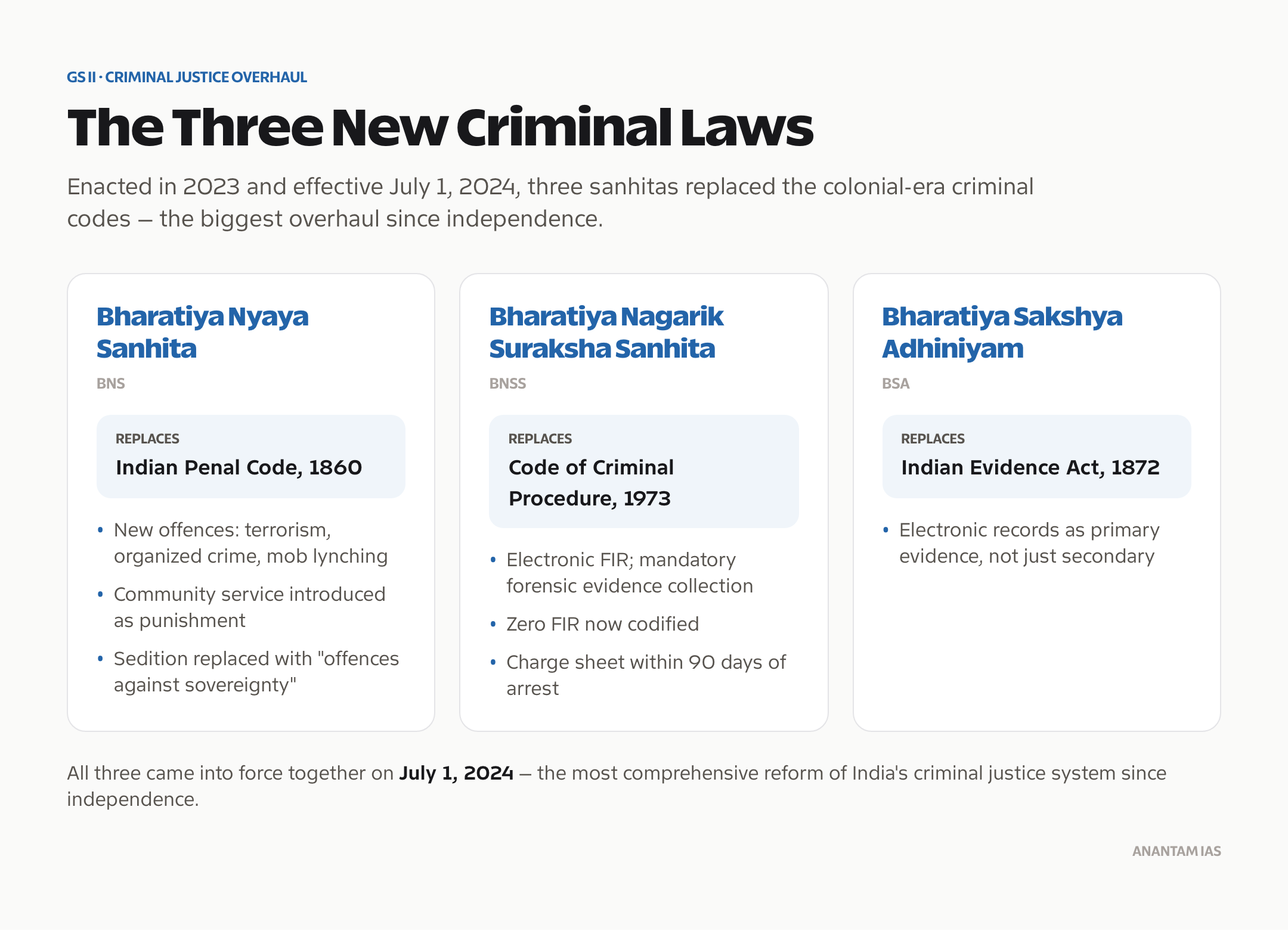
Bharatiya Nyaya Sanhita (BNS), 2023
| Feature | Detail |
|---|---|
| Replaces | Indian Penal Code, 1860 |
| Effective | July 1, 2024 |
| Key Changes | New offences (terrorism, organized crime, mob lynching) |
| Community Service | Introduced as a form of punishment |
| Sedition | Replaced with “offences against sovereignty” |
Bharatiya Nagarik Suraksha Sanhita (BNSS), 2023
| Feature | Detail |
|---|---|
| Replaces | Code of Criminal Procedure, 1973 |
| Key Changes | Electronic FIR, mandatory forensic evidence collection |
| Zero FIR | Now codified |
| Timeline | Charge sheet within 90 days of arrest |
Bharatiya Sakshya Adhiniyam (BSA), 2023
| Feature | Detail |
|---|---|
| Replaces | Indian Evidence Act, 1872 |
| Key Changes | Electronic records as primary evidence, not just secondary |
These three new criminal laws represent the most comprehensive overhaul of India’s criminal justice system since independence.
Important Acts: Quick Reference Table
| Act | Year | Subject | Key UPSC Topic |
|---|---|---|---|
| RTI Act | 2005 | Governance transparency | GS II — Governance |
| POSH Act | 2013 | Workplace sexual harassment | GS II — Social Justice |
| POCSO Act | 2012 | Child protection | GS II — Social Justice |
| RTE Act | 2009 | Education as fundamental right | GS II — Education |
| IBC | 2016 | Insolvency resolution | GS III — Economy |
| GST Acts | 2017 | Unified taxation | GS III — Economy |
| RERA | 2016 | Real estate regulation | GS III — Economy |
| EPA | 1986 | Environmental protection | GS III — Environment |
| FCA | 1980 | Forest conservation | GS III — Environment |
| Wildlife Protection Act | 1972 | Wildlife conservation | GS III — Environment |
| SC/ST Atrocities Act | 1989 | Caste-based discrimination | GS II — Social Justice |
| Lokpal Act | 2013 | Anti-corruption | GS II — Governance |
| MGNREGA | 2005 | Rural employment guarantee | GS II/III — Social Justice/Economy |
| Food Security Act | 2013 | Right to food | GS II — Social Justice |
| BNS | 2023 | Criminal law | GS II — Governance |
| BNSS | 2023 | Criminal procedure | GS II — Governance |
| Anti-Defection Law | 1985 | Political defection | GS II — Polity |
| CAA | 2019 | Citizenship | GS II — Polity |
| UAPA | 1967 | Unlawful activities prevention | GS III — Security |
| AFSPA | 1958 | Armed forces special powers | GS III — Security |
Labour Laws: The Four Labour Codes
The government consolidated 29 labour laws into 4 codes:
| Code | Replaces | Key Focus |
|---|---|---|
| Code on Wages, 2019 | Payment of Wages Act, Minimum Wages Act, etc. | Universal minimum wage, timely payment |
| Code on Social Security, 2020 | EPF Act, ESI Act, Maternity Benefit Act, etc. | Social security for organized and gig workers |
| Industrial Relations Code, 2020 | Industrial Disputes Act, Trade Unions Act | Strikes, lockouts, industrial disputes |
| Occupational Safety Code, 2020 | Factories Act, Mines Act | Working conditions, safety standards |
Frequently Asked Questions
Which acts are most important for UPSC Prelims?
RTI Act, POCSO Act, POSH Act, RTE Act, Forest Conservation Act, Wildlife Protection Act, Anti-Defection Law (10th Schedule), SC/ST Atrocities Act, and MGNREGA are the most frequently tested in Prelims. Focus on specific provisions, year of enactment, and constitutional basis rather than full legal text.
How to study acts and laws for UPSC?
Don’t read the bare acts. Instead, study key provisions, objectives, and judicial interpretations from standard polity and governance textbooks. Laxmikanth covers most constitutionally important laws. For specific acts, read 2–3 page summaries focusing on important sections, penalties, and implementation mechanisms. Connect each law to current affairs developments.
What are the three new criminal laws of 2023?
Bharatiya Nyaya Sanhita (BNS) replaced the IPC, Bharatiya Nagarik Suraksha Sanhita (BNSS) replaced the CrPC, and Bharatiya Sakshya Adhiniyam (BSA) replaced the Indian Evidence Act. All three came into effect on July 1, 2024. Key changes include new offences for organized crime and terrorism, electronic evidence recognition, and community service as punishment.
How are acts different from constitutional amendments?
Acts are laws passed by Parliament under its legislative powers (Articles 245–246). Constitutional amendments modify the Constitution itself (Article 368). Acts operate within the constitutional framework and can be struck down if they violate fundamental rights. Constitutional amendments change the framework itself, though the Supreme Court has ruled that basic structure can’t be amended.
What is the significance of the IBC for UPSC?
The Insolvency and Bankruptcy Code, 2016 is significant for GS III (Economy) questions on economic reform, ease of doing business, and banking sector health. It consolidated India’s fragmented insolvency regime into a time-bound process, directly impacting NPA resolution, credit culture, and India’s World Bank Ease of Doing Business ranking improvement.
Tell Google you want more of this.
Add Anantam IAS as a preferred sourceOne tap, and this site shows up more often in your own Top Stories, AI Overviews and AI Mode. Remove it any time.