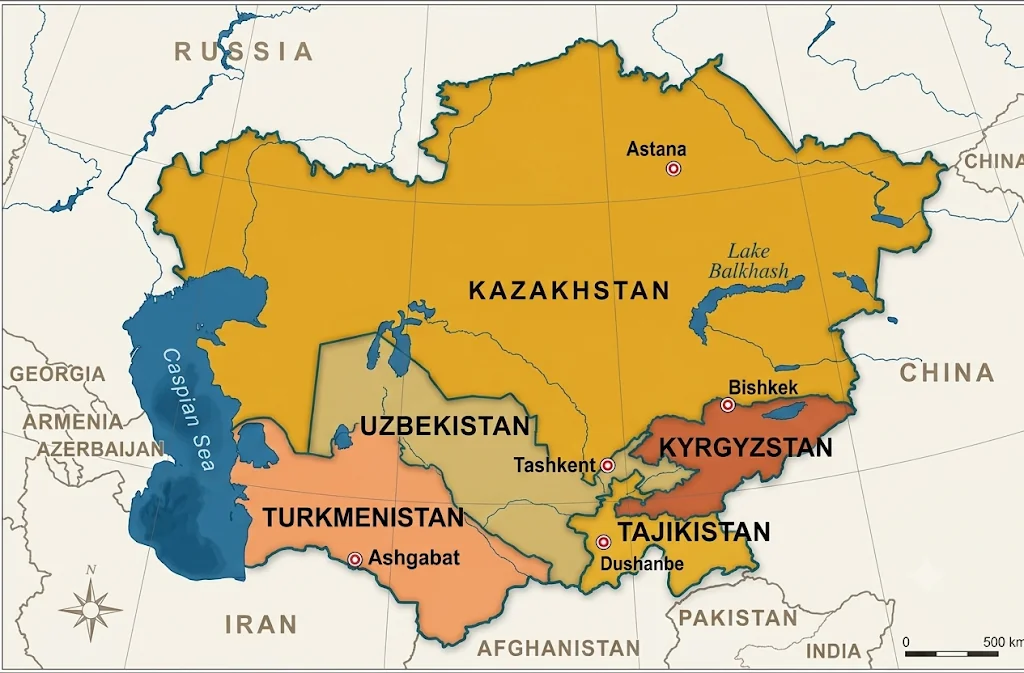
India’s relationship with Central Asia has a durable problem that no summit can fix: there is no road. Pakistan denies overland transit, Afghanistan is unstable, and every route India uses to reach five landlocked republics has to go the long way round by sea. India-Central Asia relations are, before anything else, a logistics problem with a strategic rationale attached.
The rationale is strong. Kazakhstan, the Kyrgyz Republic, Tajikistan, Turkmenistan and Uzbekistan hold uranium, natural gas, rare earths, copper and gold, and they sit exactly where India’s continental and security interests converge.
The Policy Framework
The Connect Central Asia Policy of 2012 organises engagement around the 4Cs: Commerce, Capacity enhancement, Connectivity and Contacts.
The institutional machinery is more developed than the trade numbers suggest: biennial India-Central Asia Summits with a dedicated Secretariat in New Delhi, Foreign Ministers’ Dialogues with the fourth held in 2025, National Security Adviser level meetings, and Joint Working Groups on Afghanistan and on Chabahar Port.
Why Central Asia Matters
- Energy and critical minerals. Kazakhstan is India’s largest supplier of nuclear fuel, and Uzbekistan also supplies uranium, which underwrites India’s nuclear expansion. Turkmenistan holds strategic gas reserves.
- Gateway to Eurasia. A continental bridge to Russia, Eastern Europe and Eurasian markets that bypasses South Asian bottlenecks.
- Security buffer. Monitoring cross-border terrorism, radicalisation and narcotics trafficking emanating from Taliban-ruled Afghanistan.
- Balancing China. Preventing an uncontested Chinese economic and infrastructure monopoly through the Belt and Road Initiative.
The Connectivity Answer, and Its Limits
Because there is no direct overland route, India relies on multimodal alternatives.
Chabahar Port. A ten-year contract for the Shahid Beheshti Terminal was signed in May 2024, giving India sea access to Iran with onward connection to Afghanistan and Central Asia, entirely bypassing Pakistan.
INSTC and the Ashgabat Agreement. Multimodal networks connecting the Indian Ocean to the Caspian Sea and Eurasia.
Both routes run through Iran. That is the vulnerability. US sanctions on Iran have repeatedly slowed investment, banking and insurance for Chabahar and INSTC, which means India’s Central Asia access is hostage to a third-country sanctions regime it does not control.
This is worth stating plainly, because Indian policy documents tend not to. India has built its Eurasian connectivity strategy on a single geography, and that geography is under sanction.
Energy, Defence and Digital
Civil nuclear. Kazakhstan and Uzbekistan supply uranium, an unglamorous but foundational element of the relationship.
Hydrocarbons. India remains formally committed to TAPI, the Turkmenistan-Afghanistan-Pakistan-India gas pipeline, which remains non-operational because of Afghan instability, security risk and financing constraints. It has been a decade of commitment without a pipeline.
Critical minerals. Emerging emphasis on joint exploration and technology partnerships for rare earth elements needed for the energy transition.
Defence. Joint exercises including Ex-KAZIND with Kazakhstan, counter-terror exchanges, and engagement through SCO-RATS against terrorism, separatism and extremism.
Digital and soft power. Deployment of UPI-like payment systems, e-governance platforms and telemedicine networks, alongside ITEC scholarships, educational exchange, and the durable pull of Buddhism, Sufi links and Indian popular culture.
Country by Country
- Kazakhstan: the principal partner, supplying uranium, oil and strategic minerals
- Uzbekistan: trade, manufacturing, pharmaceuticals, regional logistics and mineral partnerships, with bilateral trade reaching about USD 1.3 billion in 2025
- Turkmenistan: gas diplomacy through TAPI, and Caspian route access
- Tajikistan: counter-terrorism, defence intelligence and proximity to the Afghan border
- Kyrgyz Republic: higher education, particularly medical studies, health and ITEC capacity building
The Honest Constraints
- Geographic discontinuity. No land transit, because of Pakistan’s blockade and Afghan instability.
- Sanctions exposure. US measures on Iran directly slow Chabahar and INSTC.
- Asymmetric footprint. Chinese trade and BRI infrastructure funding vastly outpaces Indian investment, and the gap is widening rather than closing.
- Private sector hesitancy. High logistics costs, regulatory hurdles, absent direct banking channels and transit risk keep Indian firms away.
- Stalled energy projects. TAPI has been a decade of intent without delivery.
The Way Forward
- Commercialise the corridors. Standardise customs rules, offer freight incentives and link INSTC with the Ashgabat Agreement so the routes carry real cargo rather than pilot consignments.
- Secure minerals through joint ventures. Government-backed vehicles for acquiring, processing and off-taking rare earths and strategic metals from Kazakhstan and Uzbekistan.
- Export digital public infrastructure, which is the one area where India competes with China on capability rather than on capital.
- Solve banking before promoting trade. Without direct banking channels, private trade will not scale whatever the tariff position.
- Compete selectively. India cannot match BRI spending. It can match it on training, health, education and digital systems, where the return is political rather than commercial.
Central Asia is the clearest case in Indian foreign policy where ambition exceeds access. Until the corridors work commercially, the relationship stays institutional rather than economic.
Frequently Asked Questions
Which countries form Central Asia in India’s foreign policy?
Kazakhstan, the Kyrgyz Republic, Tajikistan, Turkmenistan and Uzbekistan. All five are landlocked and Uzbekistan is doubly landlocked, meaning every neighbour is also landlocked. They form a core pillar of India’s Extended Neighbourhood policy.
What is the Connect Central Asia Policy?
Announced in 2012, it is the framework guiding India’s engagement with the five republics. It is structured around the 4Cs: Commerce, Capacity enhancement, Connectivity and Contacts.
What is the institutional architecture of the relationship?
Biennial India-Central Asia Summits supported by a dedicated Secretariat in New Delhi, Foreign Ministers’ Dialogues with the fourth held in 2025, National Security Adviser level meetings, and Joint Working Groups on Afghanistan and on Chabahar Port.
Why is Chabahar port central to this relationship?
Because Pakistan denies India overland transit. Chabahar in Iran gives India sea access that bypasses Pakistan, connecting onward to Afghanistan and Central Asia. India signed a ten-year contract for the Shahid Beheshti Terminal in May 2024.
What is the INSTC?
The International North-South Transport Corridor, a multimodal network connecting the Indian Ocean to the Caspian Sea and onward into Eurasia. With the Ashgabat Agreement, it is the main alternative to overland routes blocked by Pakistan.
Why does Central Asia matter for India’s energy security?
The republics hold major reserves of uranium, natural gas, rare earth elements, copper and gold. Kazakhstan is India’s largest supplier of nuclear fuel and Uzbekistan also supplies uranium, which directly supports India’s nuclear power expansion. Turkmenistan holds strategic gas reserves and is the source for the TAPI pipeline.
What is the status of the TAPI pipeline?
The Turkmenistan-Afghanistan-Pakistan-India gas pipeline remains non-operational. Afghan political instability, security risks along the route and financing constraints have kept it stalled despite continued Indian commitment in principle.
What are the main obstacles to deeper engagement?
Geographic discontinuity caused by Pakistan’s transit blockade and Afghan instability; US sanctions on Iran hampering Chabahar and INSTC investment; China’s Belt and Road footprint vastly outpacing Indian investment; and private sector hesitancy driven by logistics costs, regulatory hurdles, absent banking channels and transit risk.
Practice Questions
Prelims MCQs
- The 4Cs framework of India's Central Asia policy stands for
(a) Commerce, Capacity enhancement, Connectivity, Contacts
(b) Culture, Commerce, Cooperation, Connectivity
(c) Counter-terrorism, Commerce, Culture, Capacity
(d) Connectivity, Credit, Culture, Cooperation
Answer: (a) The Connect Central Asia Policy of 2012 is built on Commerce, Capacity enhancement, Connectivity and Contacts. - Which Central Asian republic is doubly landlocked?
(a) Kazakhstan
(b) Tajikistan
(c) Uzbekistan
(d) Turkmenistan
Answer: (c) Uzbekistan is one of only two doubly landlocked countries in the world, meaning all its neighbours are themselves landlocked. - India signed a ten-year contract for the Shahid Beheshti Terminal at Chabahar in
(a) May 2016
(b) May 2020
(c) May 2024
(d) May 2026
Answer: (c) The long-term operating contract was signed in May 2024. - Ex-KAZIND is a military exercise conducted with
(a) Kyrgyzstan
(b) Kazakhstan
(c) Tajikistan
(d) Uzbekistan
Answer: (b) Ex-KAZIND is the India-Kazakhstan joint military exercise. - SCO-RATS is designed to combat which of the following?
(a) Narcotics and money laundering only
(b) Terrorism, separatism and extremism
(c) Cyber crime and data theft
(d) Illegal migration
Answer: (b) The Regional Anti-Terrorist Structure targets the three evils of terrorism, separatism and extremism.
Mains Questions
- India's Central Asia policy is constrained less by intent than by geography. Examine the connectivity options available and their limits. (250 words)
- Evaluate Chabahar port and the INSTC as instruments of India's Eurasian strategy. (250 words)
- Central Asia is critical to India's nuclear and critical mineral supply chains. Discuss. (150 words)
- Compare India's and China's approaches to Central Asia and assess where India can realistically compete. (250 words)
- Discuss why private Indian investment in Central Asia remains limited and what would change it. (150 words)
Tell Google you want more of this.
Add Anantam IAS as a preferred sourceOne tap, and this site shows up more often in your own Top Stories, AI Overviews and AI Mode. Remove it any time.