
France was the first major Western power to establish a Strategic Partnership with India in 1998, just months after the Pokhran-II nuclear tests when most of the world was imposing sanctions. That decision defines the relationship: France has consistently stood by India when others wavered.
This is not just a diplomatic nicety. France is India’s second-largest defence supplier in recent years, a critical nuclear energy partner, a resident Indian Ocean power, and a co-founder of the International Solar Alliance. UPSC tests this relationship through defence deals, nuclear cooperation, and Indo-Pacific strategy questions.
Defence Cooperation: The Backbone
Rafale Fighter Jets
The Rafale deal is the most prominent India-France defence agreement. India procured 36 Rafale omnirole fighter aircraft from Dassault Aviation for approximately $8.7 billion. The jets became operational with the IAF at:
- Ambala Air Force Station (No. 17 Squadron "Golden Arrows") from 2020
- Hasimara Air Force Station (No. 101 Squadron "Falcons of Chamb") from 2022
The Rafale carries SCALP cruise missiles (range 300+ km), Meteor beyond-visual-range air-to-air missiles (range 150+ km), and HAMMER precision-guided munitions. These weapons give India a significant edge over Pakistan's F-16 fleet and match China's J-20 capabilities in certain parameters.
Scorpene Submarines (Project 75)
India contracted 6 Scorpene-class submarines (Kalvari-class) built at Mazagon Dock Shipbuilders Limited (MDL), Mumbai, under technology transfer from Naval Group (formerly DCNS). As of 2026, 5 submarines have been commissioned: INS Kalvari, Khanderi, Karanj, Vela, and Vagir. The 6th (Vagsheer) is in sea trials.
These are diesel-electric attack submarines with air-independent propulsion (AIP) capability being retrofitted. Each submarine carries Exocet SM39 anti-ship missiles and heavyweight torpedoes.
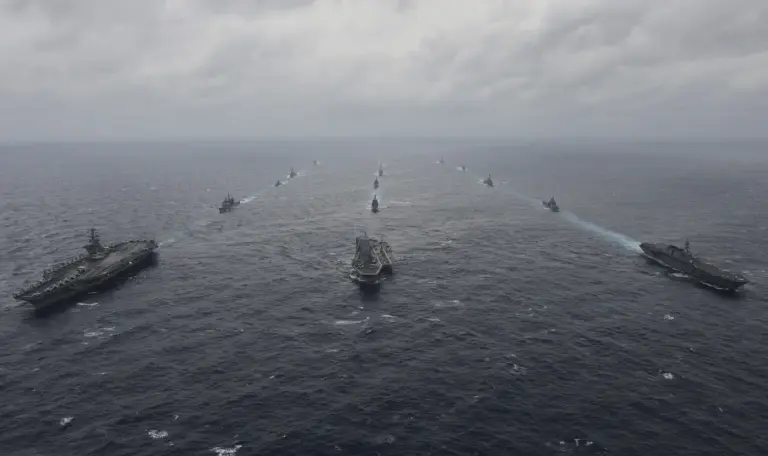
Joint Military Exercises
| Exercise | Service | Frequency | Significance |
|---|---|---|---|
| Varuna | Navy | Annual since 2001 | India's longest-running bilateral naval exercise |
| Garuda | Air Force | Biennial | Includes complex air combat scenarios |
| Shakti | Army | Biennial | Counter-terrorism and jungle warfare focus |
| Pegase | Air Force (French deployment to India) | Periodic | Long-range power projection demonstration |
Nuclear Cooperation
France's nuclear support for India has been uniquely consistent. While the US, Canada, and others cut nuclear ties after India's 1974 and 1998 tests, France maintained engagement.
Key milestones:
- 2008: India-France Civil Nuclear Cooperation Agreement signed (alongside the NSG waiver and Indo-US nuclear deal)
- Jaitapur Nuclear Power Plant: The flagship project. 6 European Pressurised Reactors (EPR) to be built by EDF (Electricite de France) in Maharashtra's Ratnagiri district
- Planned capacity: 9.6 GW, which would make it the world's largest nuclear power plant when complete
- Status: Environmental Impact Assessment clearance obtained, but construction has faced delays due to land acquisition issues, cost negotiations, and local opposition
Common student mistake: Confusing EPR technology with other reactor types. The EPR is a Generation III+ pressurized water reactor. Jaitapur would use EPR-1200 design, distinct from the Russian VVER reactors at Kudankulam or the Indian PHWR design.
France also supplies enriched uranium fuel for India's Tarapur reactors, continuing a supply relationship that the US abandoned after 1974.
Indo-Pacific: France as a Resident Power
France is not an outside player in the Indo-Pacific. It is a resident power with sovereign territories and military bases across the region:
- Reunion Island and Mayotte in the Indian Ocean (2+ million French citizens)
- New Caledonia and French Polynesia in the Pacific
- Military bases in Djibouti and Abu Dhabi
- France's Exclusive Economic Zone is the world's second largest (11.7 million sq km), mostly in the Indo-Pacific
In 2018, India and France issued a Joint Strategic Vision for the Indian Ocean Region, committing to:
- Freedom of navigation and overflight
- Rules-based maritime order under UNCLOS
- Mutual logistics support (Reciprocal Logistics Support Agreement)
- Maritime domain awareness sharing
French naval vessels regularly transit the Indian Ocean, and Varuna exercises increasingly include complex multi-domain scenarios in this region. France provides India a European partner in the Indo-Pacific, complementing the QUAD framework without the baggage of a formal alliance.
Counter-Terrorism Cooperation
France has been India's strongest European supporter on counter-terrorism issues:
- After the Pulwama attack (February 2019), France actively pushed for the listing of Masood Azhar as a global terrorist at the UN Security Council, using its veto leverage to pressure China to drop its objections
- France co-sponsored India's Comprehensive Convention on International Terrorism (CCIT) at the UN
- Bilateral intelligence sharing on terrorist networks, radicalization, and cyber threats
- Joint working group on counter-terrorism since 2001
Both countries have experienced devastating terrorist attacks (Paris 2015, Mumbai 2008) and share a practical, non-ideological approach to counter-terrorism that UPSC essays can reference.
Space Cooperation
ISRO-CNES (French space agency) collaboration spans decades:
- Megha-Tropiques satellite (2011): Joint Indo-French satellite studying tropical climate and water cycles
- TRISHNA (Thermal infraRed Imaging Satellite for High-resolution Natural resource Assessment): Joint earth observation mission for monitoring water stress, urban heat islands, and coastal ecosystems
- SARAL/Altika: Indo-French satellite for ocean surface study using altimetry
- Cooperation on Gaganyaan (human spaceflight) training: Indian astronauts trained at CNES facilities
Climate: International Solar Alliance
India and France co-founded the International Solar Alliance (ISA) at COP21 in Paris (November 2015). The ISA, headquartered in Gurugram, India, was the first international organization headquartered in India.
ISA now has 120+ member countries and focuses on mobilizing $1 trillion in solar investments by 2030. It targets countries between the Tropics of Cancer and Capricorn with high solar potential.
Major Defence Deals and Agreements
| Deal/Agreement | Year | Value/Details |
|---|---|---|
| Strategic Partnership | 1998 | First non-G7 country to get this status with India |
| Civil Nuclear Agreement | 2008 | Framework for Jaitapur EPR reactors |
| Rafale aircraft | 2016 (contract) | 36 jets, approximately $8.7 billion |
| Scorpene submarines (P-75) | 2005 (contract) | 6 submarines, approximately $3.75 billion, MDL Mumbai |
| Reciprocal Logistics Support | 2018 | Mutual access to military facilities |
| Joint Strategic Vision (Indo-Pacific) | 2018 | Maritime cooperation framework |
| ISA co-founding | 2015 | 120+ member solar alliance |
| Jaitapur Nuclear Plant | Ongoing | 6 EPR reactors, 9.6 GW planned capacity |
India-France relations should be studied alongside the broader Indo-Pacific strategy and India's approach to nuclear disarmament and non-proliferation. The Cold War context also explains why France, as a non-aligned NATO member with an independent foreign policy tradition (Gaullism), became a natural partner for India.
Tell Google you want more of this.
Add Anantam IAS as a preferred sourceOne tap, and this site shows up more often in your own Top Stories, AI Overviews and AI Mode. Remove it any time.