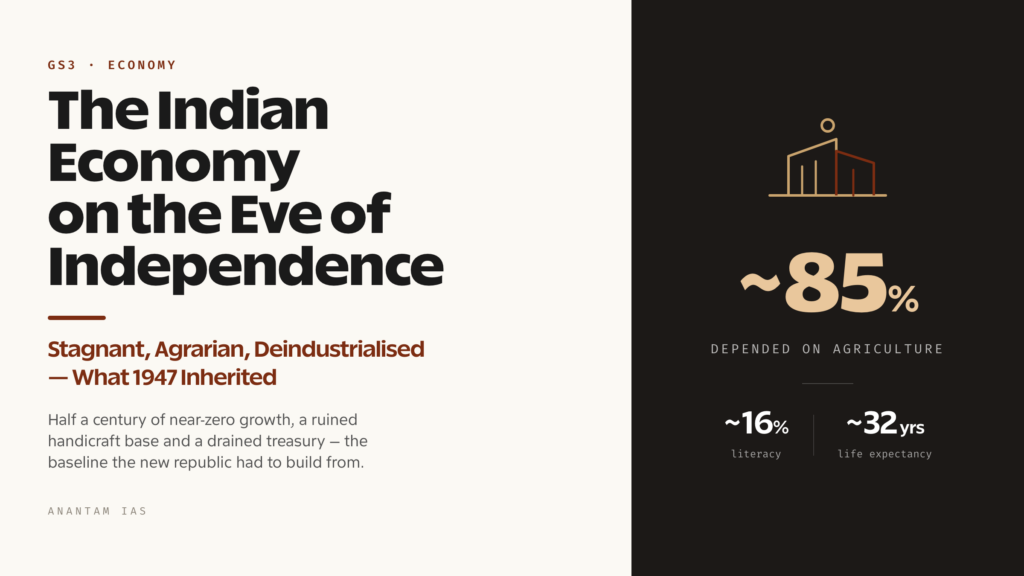
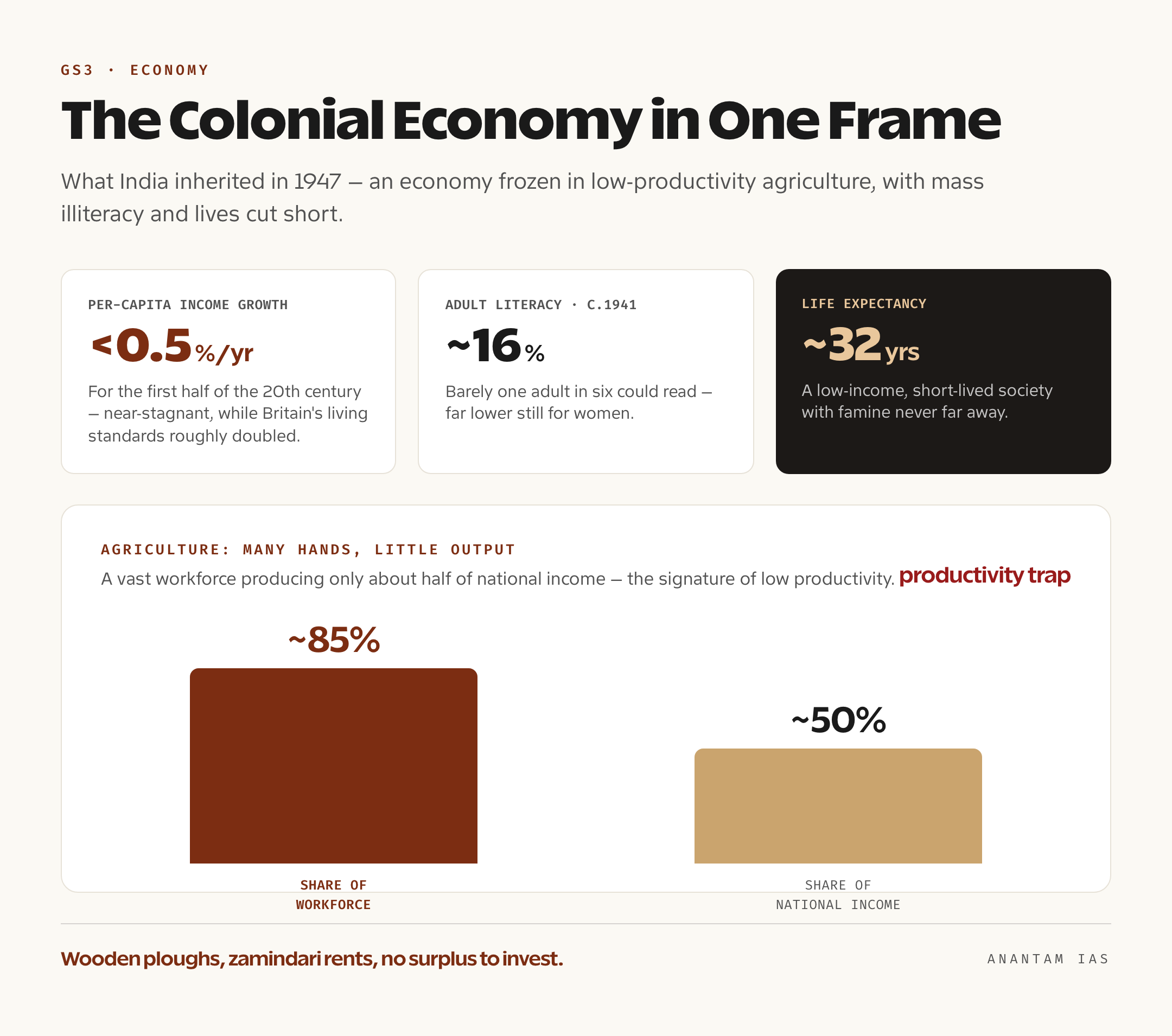
When India woke to freedom at midnight on 15 August 1947, it inherited far more than a divided map. It inherited an economy that had, by almost every honest measure, gone nowhere for fifty years. Per-capita income had crawled along at well under half a per cent a year for the first half of the twentieth century; by some careful estimates the average Indian was no richer in 1947 than at the turn of the century, while Britain’s living standards had roughly doubled in the same stretch. Around 85 out of every 100 Indians still lived off the land, the vast majority of them on the edge of subsistence. Life expectancy was about 32 years. Barely one adult in six could read. This was the starting line — not a poor country about to grow, but a stagnant, drained, semi-feudal economy that nearly two centuries of colonial rule had hollowed out from the inside.
Understanding that starting line is the whole point of the topic, because everything India did after 1947 — the Five-Year Plans, the public-sector push, the Green Revolution, even the 1991 reforms — was an answer to a problem the colonial economy had created. For a UPSC aspirant this isn’t dry history. It is the foundation chapter of Indian economic development, the thing that explains why the new republic chose planning over laissez-faire, why land reform mattered so much, and why self-reliance became almost a national religion. Get the colonial baseline right, with a few sharp figures and a clear chain of cause and effect, and half the economy syllabus suddenly makes sense.
A Stagnant, Agrarian Economy
Start with the size and shape of what India had. The colonial economy was overwhelmingly agrarian and almost completely stuck. National income over the first half of the twentieth century grew at a dismal rate — most estimates put aggregate growth around 0.4 to 1 per cent a year, and per-capita income growth at close to zero once you account for a slowly rising population. Real GDP per head actually fell in the 1906-1950 period on some series, even as Britain’s rose by nearly half and America’s more than doubled. Stagnation, not development, is the word examiners want here.
Agriculture was the heart of it, and the heart was weak. About 85 per cent of the population depended on farming, yet that enormous sector produced only around half of national income — a sign of how little each worker actually generated. Productivity was abysmal because the land was worked with the same wooden plough and the same monsoon gamble that had served for centuries, with almost no fertiliser, no improved seed, and irrigation that reached only a fraction of the cultivated area. Land was locked inside exploitative revenue systems the British had built — the Permanent Settlement of Bengal that created a class of rent-collecting zamindars, the ryotwari and mahalwari systems elsewhere — under which the actual tiller surrendered a punishing share of his crop to landlords and the state and had neither the surplus nor the security to invest. You can read the full story of that revenue experiment in our guide to the Permanent Settlement of 1793. The result was a countryside trapped in low-yield, low-investment subsistence — a poverty machine that ran on its own.
And it ran on a population that was both poor and unhealthy. With life expectancy near 32 years, literacy around 16 per cent, and famine never far away, the human base of the economy was as undeveloped as its farms and factories. The year 1921 is remembered as the “Year of the Great Divide” in India’s demographic history — before it, high birth rates were matched by equally savage death rates and population barely grew; after it, deaths began to fall while births stayed high, and population started its long climb. But on the eve of independence, India was still a low-income, low-literacy, short-lived society, which is exactly why human development would become central to planning later.
Deindustrialisation and the Drain of Wealth
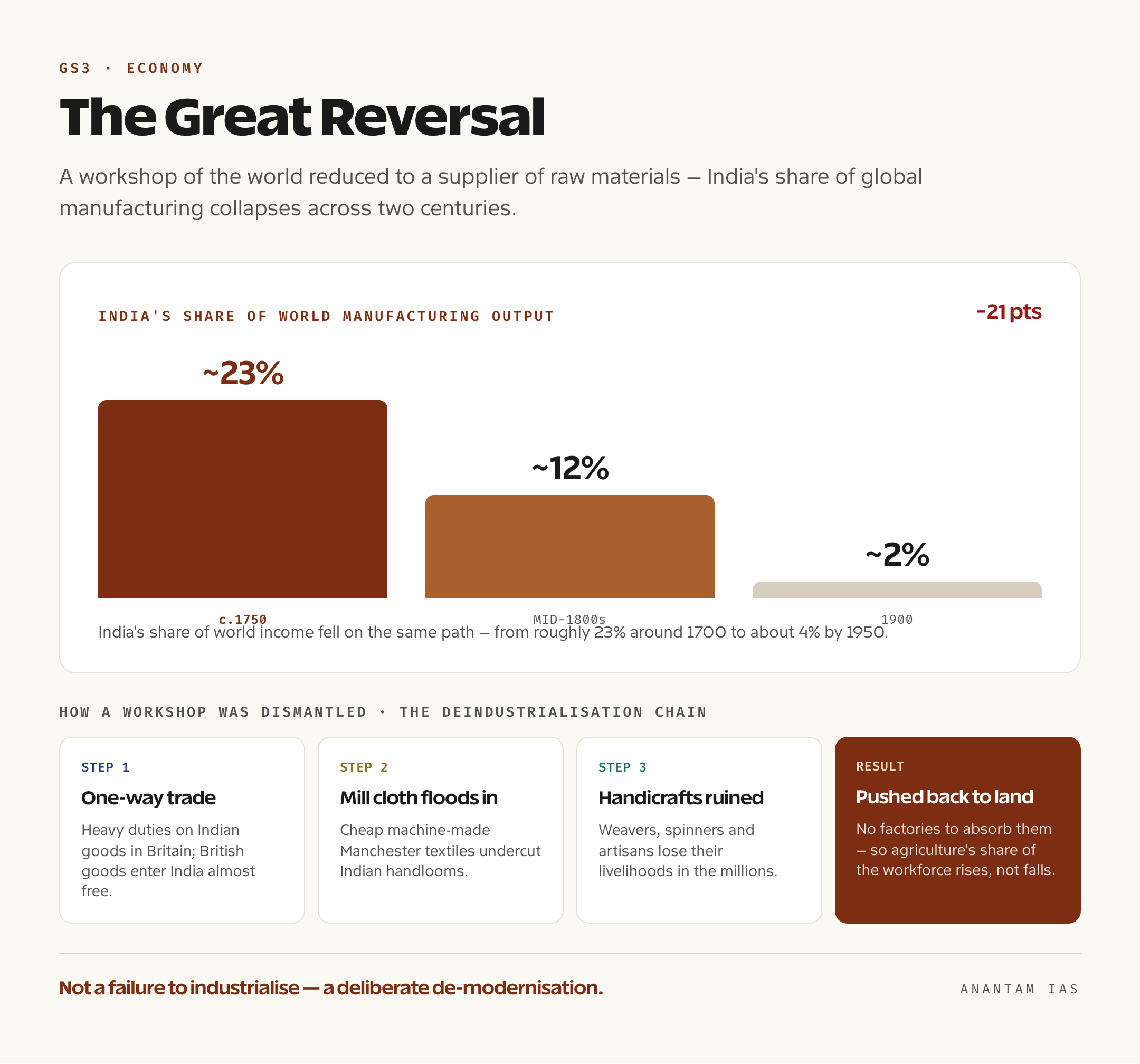
Here is where the colonial economy did its deepest damage, and where the story turns from neglect to active extraction. Around 1700, India was one of the workshops of the world — its handlooms, its fine cottons and muslins, its metalwork and shipbuilding made it a manufacturing powerhouse whose goods were prized across Europe and Asia. By some widely cited estimates India produced close to a quarter of world manufacturing output in 1750. By 1900 that share had collapsed to about 2 per cent. This is deindustrialisation — not a country that simply failed to industrialise, but one whose existing industry was deliberately dismantled.
The mechanism was brutally simple. After the Industrial Revolution mechanised British textile production — a story we trace in our piece on the Industrial Revolution in Britain — cheap, machine-made Manchester cloth flooded the Indian market under a one-way trade regime: Indian goods faced heavy duties entering Britain, while British goods entered India almost free. India was reduced to two roles, both serving the metropolis — a captive market for British finished goods and a supplier of cheap raw materials like cotton, jute and indigo. Indian weavers, spinners and artisans, undercut and unprotected, lost their livelihoods in their millions. And because there was nowhere else for them to go — no growing factories to absorb them — they fell back onto the already overcrowded land. This is the single most examinable consequence of the whole period: deindustrialisation did not move workers from farms to factories, it pushed them the other way, swelling the share of the workforce stuck in agriculture rather than shrinking it. The economy de-modernised.
Sitting underneath all this was the “drain of wealth” — the idea, sharpened by Dadabhai Naoroji in his 1901 work Poverty and Un-British Rule in India, that Britain was systematically siphoning India’s resources without return. The drain took concrete forms: the “Home Charges” India was forced to pay London for the privilege of being governed, the salaries and pensions of British officials, the interest on debt raised in Britain, and an export surplus India was never paid for in real terms — Indian goods left the country, but the proceeds financed British purchases rather than coming home as income. Naoroji estimated this bleed at roughly £30 million a year in the late nineteenth century, a colossal sum that, invested at home, might have built the industry and infrastructure India so badly lacked. You can read more about the man and his theory in our profile of Dadabhai Naoroji. The drain is the bridge between the two halves of this story: it explains both why India had no capital to industrialise and why Britain did.
Commercialisation of Agriculture and the Age of Famines
The colonial state did change Indian farming — just not for the farmer’s benefit. Through the nineteenth century it pushed the commercialisation of agriculture: a shift from growing food for the family and the village to growing cash crops for the market, and specifically for export to feed British and global industry. Cotton for Lancashire’s mills, jute for the world’s sacking and packaging, indigo for dye, tea, opium and oilseeds — these were grown increasingly on Indian soil to serve someone else’s factory. On paper, commercialisation sounds like progress, the kind of market integration economists usually applaud. In colonial India it was something darker.
Because the farmer rarely chose it freely. Cash demands — revenue payable in money rather than grain, and debts owed to moneylenders — forced peasants into cash crops whether the price was fair or not. The gains flowed to traders, exporters and British industry; the risks stayed with the cultivator, who was now exposed to volatile world prices he could not control. Worst of all, land that had grown food now grew fibre and dye, shrinking the cushion that had once protected villages in a bad monsoon. So when the rains failed, there was less grain in reserve and a transport-and-trade system geared to moving crops out of distressed regions rather than relief in.
The result was an age of famines almost without parallel. The nineteenth and early twentieth centuries saw a grim procession of them, culminating in the Bengal Famine of 1943, when an estimated three million people died — not from a total absence of food, but from a collapse in their ability to buy it amid wartime hoarding, inflation and administrative failure. Famine on this scale was not an act of nature alone; it was the visible failure of an economy organised for extraction rather than for the welfare of the people who lived in it. This is the human cost behind the statistics, and a Mains answer that names the Bengal Famine lands the point with force.
A Weak Industrial Base and Infrastructure Built for Extraction
India did have some modern industry by 1947 — it just wasn’t nearly enough, and it wasn’t built for India. A few sectors had taken root: a cotton textile industry centred on Bombay and Ahmedabad, owned substantially by Indian capital; a jute industry around Calcutta, owned mostly by the British; and, crucially, the Tata Iron and Steel Company, which opened its plant at Jamshedpur in 1907-08 and grew into one of the largest steel producers outside the Western world. These were real achievements, often won against official indifference. But the overall industrial structure was lopsided and shallow — concentrated in a handful of consumer-goods sectors, starved of a capital-goods base, and contributing only a small slice of national income. There was almost no machine-making, no heavy chemicals, no electrical or engineering industry worth the name. A country that cannot make the machines that make things cannot industrialise on its own, and that is precisely the gap India inherited.
The infrastructure tells the same story of investment that served the ruler, not the ruled. The British did build India a railway network — by the late nineteenth century one of the largest in the world, expanding from barely 1,350 km in 1860 to over 25,000 km by 1880. But look at what it was for. The lines ran from the interior to the ports, designed to carry raw materials out to Britain and finished British goods in, and to move troops to keep order. They were financed on a “guaranteed return” basis that loaded the risk onto Indian revenues and the profit onto British investors. The same logic shaped ports, telegraph and roads: useful arteries, yes, but laid out to drain a colony efficiently, not to knit together a national economy. The institution that ran much of this earlier extraction, before the Crown took over in 1858, was the East India Company, whose commercial monopoly first turned trade into tribute.
So the balance sheet India inherited in 1947 was stark. On the asset side: a railway, a few industrial nuclei, a small modern entrepreneurial class, an administrative and legal framework. On the liability side: near-zero growth, a ruined handicraft base, a semi-feudal agrarian structure, mass illiteracy and ill-health, recurrent famine, and a treasury bled by a century of drain. It is this inheritance — assets too thin to build on, liabilities too deep to ignore — that pushed independent India toward state-led planning, heavy-industry self-reliance and land reform. The colonial economy didn’t just leave India poor. It left India with a very specific kind of poverty that demanded a very specific kind of answer.
For Your Mains Answer
This is a foundational topic for GS Paper 1 (modern Indian history and the economic impact of colonialism) and GS Paper 3 (the Indian economy, its structure and the legacy that shaped post-independence planning). It also feeds the Essay paper on themes of colonialism, development and self-reliance. The skill examiners reward is the one this article uses throughout: don’t just describe colonial poverty, explain its mechanism — show how revenue systems, one-way trade and the drain connected to produce stagnation, and back each claim with a precise figure.
How to Build the Answer
Open with the verdict — India in 1947 inherited a stagnant, agrarian, deindustrialised economy — then prove it sector by sector. Move in a logical chain: the macro picture (near-zero per-capita growth), then agriculture (85 per cent of people, low productivity, exploitative revenue systems), then deindustrialisation and the drain (the share of world manufacturing collapsing from ~23 per cent to ~2 per cent, handicrafts ruined, workers pushed back onto land), then commercialisation and famine (the 1943 Bengal Famine), then weak industry and extractive infrastructure (TISCO; railways for ports, not people). Close by linking the inheritance to the choices of 1947 — planning, public sector, land reform. That arc — stagnation, agriculture, drain, famine, industry, legacy — fits almost any question on the colonial economy.
Common Mistakes to Avoid
The biggest trap is treating colonial India as merely “underdeveloped” when the sharper, mark-earning point is deindustrialised — India had industry and lost it. Don’t claim the railways were a gift; argue they were built for extraction and financed on Indian revenues. Don’t say the workforce moved from farms to factories — the opposite happened, as ruined artisans fell back onto agriculture, raising its share of the workforce. And don’t reduce famines to bad monsoons; tie them to commercialisation, falling food acreage and an administration geared to export, not relief.
A Compact Answer Spine
Per-capita income near-stagnant (<0.5%/yr) for half a century → ~85% on agriculture but only ~half of national income, low productivity under zamindari/ryotwari → deindustrialisation: India's share of world manufacturing collapses from ~23% (c.1750) to ~2% (1900), handicrafts ruined by one-way trade, artisans pushed back onto land → drain of wealth (Naoroji, ~£30 mn/yr; Home Charges) strips investible capital → commercialisation of agriculture + recurring famines, Bengal 1943 (~3 mn deaths) → weak, lopsided industry (cotton, jute, TISCO 1907) with no capital-goods base → railways built for extraction → inheritance forces state-led planning, self-reliance, land reform.
Diagram or Flowchart Idea
Draw a simple cause-and-effect chain: Colonial policy → (one-way trade + drain + extractive revenue) → deindustrialisation + agrarian stagnation → mass poverty, famine, low human development → the 1947 inheritance. Beside it, a small two-bar “great reversal” showing India’s share of world manufacturing falling from ~23% to ~2%. Two clean visuals like this communicate the whole argument at a glance.
A Balanced-Conclusion Line
A line that lands the marks: “The British did not simply find India poor — through deindustrialisation, the drain of wealth and an agriculture organised for extraction, colonial rule actively impoverished a country that had once been a workshop of the world, leaving independent India with the twin task of building industry from almost nothing and lifting an exhausted peasantry off the land.”
How to Use Data Without Cramming
You need only a handful of anchors, not a spreadsheet: per-capita growth under 0.5 per cent a year; about 85 per cent dependent on agriculture for roughly half of national income; India’s share of world manufacturing falling from around 23 per cent to about 2 per cent; literacy near 16 per cent and life expectancy around 32 years; TISCO 1907; the 1943 Bengal Famine. Drop those into the right sentences and the answer reads as authoritative — and attribute them plainly to “estimates of the colonial economy” rather than scattering numbers without a frame.
FAQ
Why is the Indian economy on the eve of independence called stagnant? Because it had barely grown for half a century. Per-capita income rose at well under 0.5 per cent a year through the first half of the twentieth century — on some estimates real income per head actually fell during 1906-1950 — while populations and living standards in Britain and the United States surged. India was not a poor country on the cusp of growth; it was an economy frozen in low-productivity agriculture, with a ruined industrial base and almost no capital to invest.
What is deindustrialisation, and why does it matter so much? Deindustrialisation is the deliberate decline of India’s existing industry under colonial rule. Around 1750 India produced close to a quarter of world manufacturing; by 1900 that had fallen to about 2 per cent, as cheap machine-made British cloth flooded an unprotected market and ruined Indian handicrafts. It matters because the displaced artisans had nowhere to go but back to farming, raising agriculture’s share of the workforce — the opposite of normal development, where industry pulls workers off the land.
What was the “drain of wealth”? It is the systematic transfer of India’s resources to Britain without an equivalent return, formulated by Dadabhai Naoroji in Poverty and Un-British Rule in India (1901). It worked through the “Home Charges” India paid London, the salaries and pensions of British officials, debt interest, and an unrequited export surplus. Naoroji estimated the bleed at roughly £30 million a year — capital that, kept at home, might have funded the industry and infrastructure India lacked.
Did the British railways and industry help India develop? Only partly, and not by design. The railways were among the world’s largest by 1900, but they were laid to carry raw materials to ports and British goods inland — and financed on guaranteed returns that loaded risk onto Indian revenues. A few industries like cotton textiles, jute and the Tata steel plant at Jamshedpur (1907) did take root, but the structure was shallow, with no capital-goods base. The net effect was infrastructure and industry built for extraction, not for a self-sustaining national economy.
Practice Questions
Prelims MCQs
- Which one of the following was not a feature of the Indian economy under British rule?
(a) Widespread acute poverty
(b) A weak industrial structure
(c) Farming carried on mainly with traditional methods
(d) A considerable fall in the share of the working population in agriculture
Answer: (d) Deindustrialisation pushed ruined artisans back onto the land, so agriculture’s share of the workforce rose or stayed high — it did not fall. The other three were all genuine features. - The term “drain of wealth” in the context of colonial India is most closely associated with which thinker?
(a) R.C. Dutt only
(b) Dadabhai Naoroji
(c) M.G. Ranade
(d) Gopal Krishna Gokhale
Answer: (b) Dadabhai Naoroji systematised the drain theory in Poverty and Un-British Rule in India (1901), estimating the annual drain at around £30 million. - The “commercialisation of agriculture” under British rule primarily meant:
(a) A rise in food-grain self-sufficiency in villages
(b) A shift from subsistence food crops to cash crops grown for the market and export
(c) The mechanisation of Indian farms
(d) State ownership of all agricultural land
Answer: (b) Farmers were pushed, often by cash revenue demands and debt, to grow cotton, jute and indigo for export rather than food for local consumption. - The year 1921 is significant in India’s demographic history because it is known as the:
(a) First census year
(b) Year of the Great Divide
(c) Year of the Bengal Famine
(d) Year of peak population growth
Answer: (b) 1921 marks the “Great Divide”: before it, high death rates checked population growth; after it, mortality fell while fertility stayed high, and population began rising. - The Tata Iron and Steel Company (TISCO), an early example of modern Indian industry, set up its plant at Jamshedpur in:
(a) 1875
(b) 1907
(c) 1925
(d) 1947
Answer: (b) TISCO established its Jamshedpur plant around 1907-08 and grew into one of the largest steel producers outside the Western world.
Mains Practice Questions
- “The Indian economy on the eve of independence was the product of nearly two centuries of colonial extraction.” Critically examine the structural features of this economy and their long-term consequences. (15 marks, 250 words)
- Explain the process of deindustrialisation of India under British rule. How did it shape the occupational structure of the workforce by 1947? (15 marks, 250 words)
- Discuss the “drain of wealth” theory and assess its role in keeping colonial India underdeveloped and capital-starved. (15 marks, 250 words)
- The commercialisation of agriculture under colonial rule is often linked to the recurrence of famines. Critically analyse this relationship. (10 marks, 150 words)
- “The infrastructure the British built in India was designed for extraction, not development.” Evaluate this statement with reference to railways, industry and trade policy on the eve of independence. (15 marks, 250 words)
Tell Google you want more of this.
Add Anantam IAS as a preferred sourceOne tap, and this site shows up more often in your own Top Stories, AI Overviews and AI Mode. Remove it any time.