Disclosure: this guide contains Amazon affiliate links. As an Amazon Associate, Anantam IAS earns from qualifying purchases — at no extra cost to you.
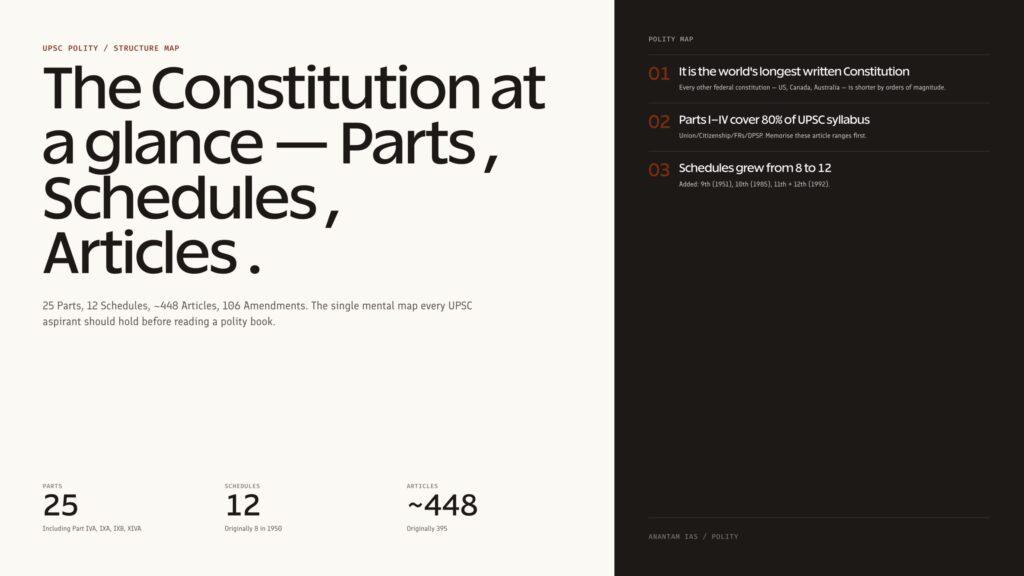
You can read 800 pages of Laxmikanth and still not see the shape of the Indian Constitution. That’s the failure mode I’ve watched in three consecutive Mains years — aspirants who know individual articles cold but can’t draw the structure on a blank sheet. A good indian polity map pdf fixes that. It compresses the Constitution into one diagrammable mental model: 25 Parts, 12 Schedules, 448 Articles, 106 Amendments. This piece gives you that map — visual, navigable, exam-aligned — and the four sub-maps you’ll need for Prelims.
What is the Indian Polity Map?
The Indian polity map is a structural diagram of the Indian Constitution showing all 25 Parts, 12 Schedules, ~448 Articles, and the major institutions they create. It is the single most useful revision artefact for UPSC Prelims polity — one A3 sheet that captures the entire architecture of Indian constitutional law as of 2026.
Why a polity map beats a chapter list
Look, Laxmikanth is great for depth. But depth doesn’t help you when the question asks “Which Part deals with Local Government?” and you’re trying to mentally reconstruct 92 chapters in 12 seconds. A map does. Once you see the Constitution as a building, you stop memorising rooms — you remember floors.
The mental model I use:
- Foundation = Preamble
- First floor = Citizenship and Territory (Parts I, II)
- Second floor = Rights and Duties (Parts III, IVA) + DPSP (Part IV)
- Third floor = Government (Parts V, VI)
- Fourth floor = Federal architecture (Parts XI, XII, XIII)
- Fifth floor = Local Government (Parts IX, IXA, IXB)
- Roof = Emergency, Amendment, Schedules (Parts XVIII, XX, plus 12 Schedules)
That’s the map. Everything else is detail.
The 25 Parts — what each one covers
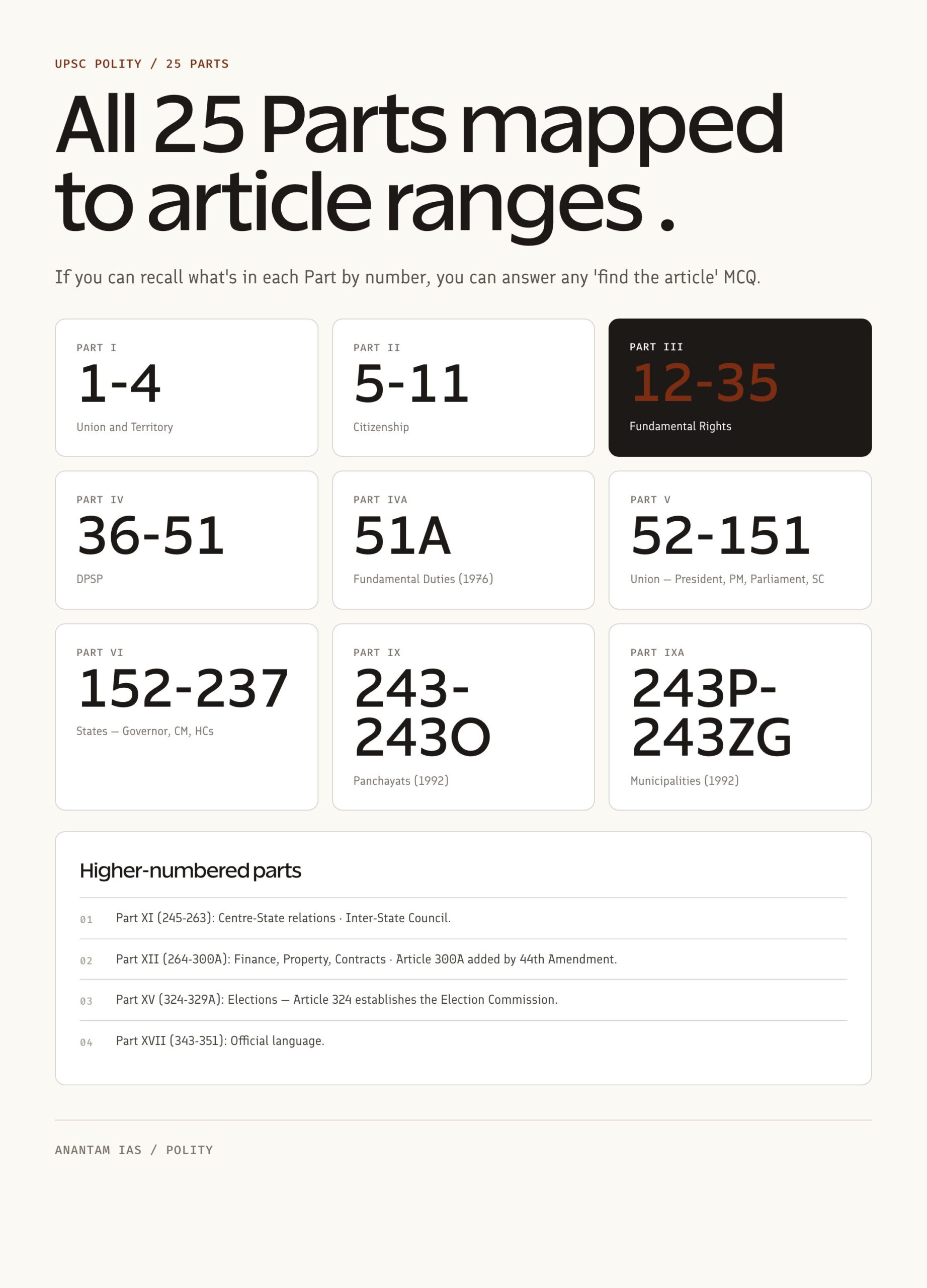
Memorise these by Part number. UPSC tests the mapping directly.
| Part | Subject | Articles |
|---|---|---|
| I | Union and Its Territory | 1–4 |
| II | Citizenship | 5–11 |
| III | Fundamental Rights | 12–35 |
| IV | Directive Principles of State Policy | 36–51 |
| IVA | Fundamental Duties (added by 42nd Am, 1976) | 51A |
| V | The Union (President, PM, Parliament, SC) | 52–151 |
| VI | The States (Governor, CM, State Legislature, HC) | 152–237 |
| VII | (Repealed by 7th Amendment, 1956) | — |
| VIII | Union Territories | 239–242 |
| IX | Panchayats (added by 73rd Am, 1992) | 243–243O |
| IXA | Municipalities (added by 74th Am, 1992) | 243P–243ZG |
| IXB | Co-operative Societies (added by 97th Am, 2011) | 243ZH–243ZT |
| X | Scheduled and Tribal Areas | 244–244A |
| XI | Centre-State Relations | 245–263 |
| XII | Finance, Property, Contracts, Suits | 264–300A |
| XIII | Trade and Commerce within India | 301–307 |
| XIV | Services under Union and States | 308–323 |
| XIVA | Tribunals (added by 42nd Am, 1976) | 323A–323B |
| XV | Elections | 324–329 |
| XVI | Special Provisions for SC, ST, OBC, Anglo-Indians | 330–342 |
| XVII | Official Language | 343–351 |
| XVIII | Emergency Provisions | 352–360 |
| XIX | Miscellaneous (President’s immunity, etc.) | 361–367 |
| XX | Amendment of the Constitution | 368 |
| XXI | Temporary, Transitional and Special Provisions | 369–392 |
| XXII | Short Title, Commencement, etc. | 393–395 |
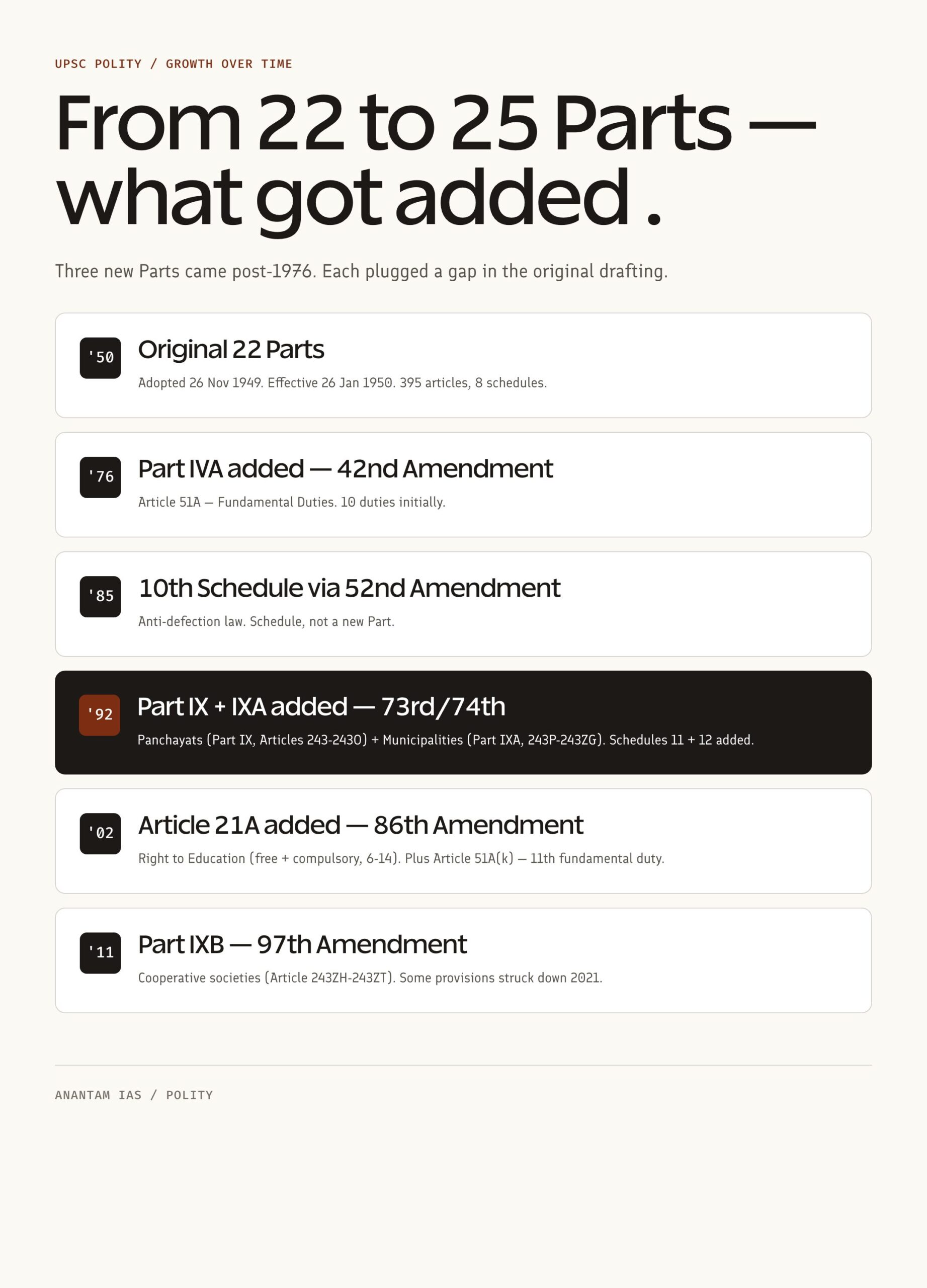
Three Parts were added (IVA, IXA, IXB, XIVA — count Part IXA and IXB and XIVA as additions). One Part was repealed (Part VII, by the 7th Amendment, 1956). That’s how you go from original 22 Parts to current 25.
Note: Some sources count differently (XIVA — Tribunals — was added by the 42nd Am along with IVA). The number that matters for Prelims is 25, the original was 22, and four sub-Parts were added.
The 12 Schedules — what each one lists
Schedules are the Constitution’s appendices. They list things — states, allowances, languages — that would clutter the main body. UPSC tests Schedule numbers directly almost every year.
- First Schedule — Names of States and Union Territories with their territories.
- Second Schedule — Salaries and emoluments of President, Vice-President, Governors, Speakers, Judges of SC and HC, CAG.
- Third Schedule — Forms of Oaths and Affirmations (President, Ministers, Judges, MPs, MLAs).
- Fourth Schedule — Allocation of seats in Rajya Sabha among States and UTs.
- Fifth Schedule — Administration of Scheduled Areas and Scheduled Tribes (excluding Sixth Schedule areas).
- Sixth Schedule — Administration of Tribal Areas in Assam, Meghalaya, Tripura, and Mizoram. See 6th Schedule.
- Seventh Schedule — Three Lists: Union List (97 items, now 100), State List (66 items, now 61), Concurrent List (47 items, now 52).
- Eighth Schedule — Languages recognised by the Constitution. Currently 22 languages.
- Ninth Schedule — Acts and Regulations beyond judicial review (originally). Added by 1st Amendment, 1951. I.R. Coelho (2007) brought post-1973 additions under basic structure review. See 9th Schedule.
- Tenth Schedule — Anti-Defection provisions. Added by 52nd Amendment, 1985.
- Eleventh Schedule — 29 subjects under Panchayats (Article 243G). Added by 73rd Amendment, 1992.
- Twelfth Schedule — 18 subjects under Municipalities (Article 243W). Added by 74th Amendment, 1992.
Original Constitution had 8 Schedules. Four added: 9th (1951), 10th (1985), 11th and 12th (both 1992).
Articles — the 1 to 395 range, plus all the appended ones
The Constitution numbers articles 1 to 395, but the actual count is around 448 because of insertions like 21A (Right to Education, 86th Amendment, 2002), 31A, 31B, 31C, 35A (now repealed, 2019), 41 (deleted), 51A, 244A, 300A, 323A, 323B.
The article numbers most aspirants need to lock down — these come up year after year:
- Article 1 — Name and territory of the Union (India, that is Bharat…).
- Article 14 — Equality before law.
- Article 17 — Abolition of untouchability.
- Article 19 — Six freedoms (originally seven; right to property removed by 44th Am, 1978).
- Article 21 — Right to life and personal liberty. Most-litigated article in Indian history.
- Article 21A — Right to Education (86th Am, 2002).
- Article 32 — Right to Constitutional Remedies. “Heart and soul” of the Constitution — Ambedkar.
- Article 44 — Uniform Civil Code (DPSP).
- Article 51A — 11 Fundamental Duties.
- Article 72 — President’s pardoning power.
- Article 110 — Money Bill definition.
- Article 123 — President’s Ordinance power.
- Article 226 — High Court writ jurisdiction.
- Article 280 — Finance Commission.
- Article 312 — All-India Services.
- Article 324 — Election Commission.
- Article 352, 356, 360 — Three emergencies.
- Article 368 — Amendment procedure.
For the full list, see Important Articles of the Indian Constitution.
Amendments — the timeline that explains the current Constitution
106 amendments through September 2023. Most are housekeeping. Around 15 are landmarks. Lock these:
- 1st Amendment, 1951 — Added 9th Schedule. Restricted free speech under Article 19.
- 7th Amendment, 1956 — Reorganised states on linguistic lines. Repealed Part VII.
- 24th Amendment, 1971 — Affirmed Parliament’s power to amend FRs (response to Golaknath).
- 42nd Amendment, 1976 — “Mini-Constitution.” Added “socialist, secular, integrity” to Preamble, introduced Fundamental Duties (Part IVA), Tribunals (Part XIVA), DPSP precedence over FRs (struck down in Minerva Mills).
- 44th Amendment, 1978 — Reversed many 42nd Am provisions. Removed Right to Property from FRs (now Article 300A). National Emergency requires written advice of Cabinet.
- 52nd Amendment, 1985 — Anti-Defection (10th Schedule).
- 61st Amendment, 1989 — Voting age 21 → 18.
- 73rd & 74th Amendments, 1992 — Panchayats and Municipalities. Parts IX & IXA, Schedules 11 & 12.
- 86th Amendment, 2002 — Right to Education (Article 21A). Modified Article 51A.
- 101st Amendment, 2016 — Goods and Services Tax (GST).
- 102nd Amendment, 2018 — Constitutional status to NCBC.
- 103rd Amendment, 2019 — 10% EWS reservation.
- 104th Amendment, 2020 — Extended SC/ST reservation in Lok Sabha and State Assemblies; abolished Anglo-Indian nominated seats.
- 105th Amendment, 2021 — Restored states’ power to identify SEBCs (response to Maratha judgment).
- 106th Amendment, 2023 — Nari Shakti Vandan Adhiniyam (Women’s Reservation Act). 33% seats for women in Lok Sabha and State Legislative Assemblies. Effective post-delimitation.
The three pillars — Legislature, Executive, Judiciary
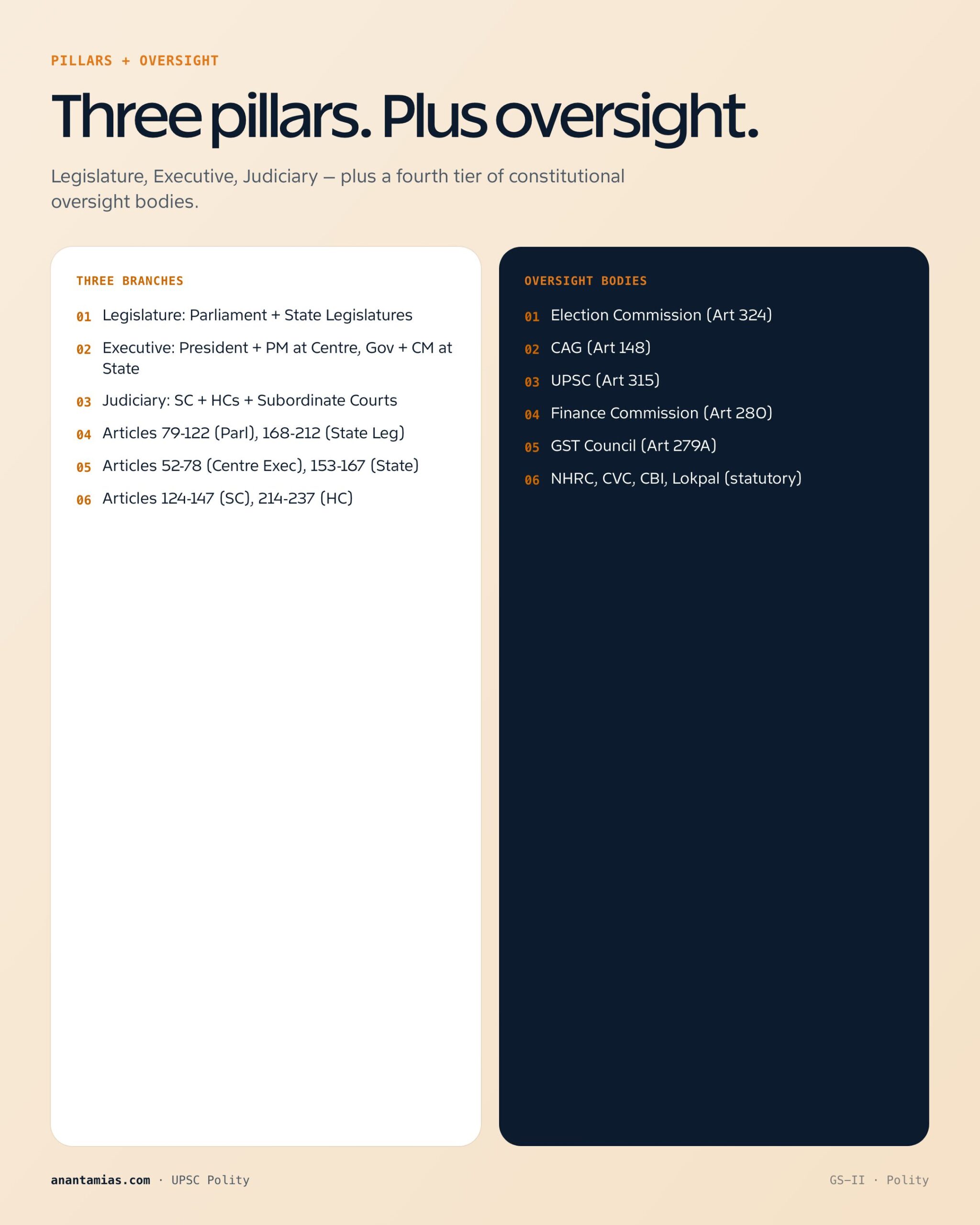
Every constitutional system rests on three. India’s setup:
| Pillar | At Centre | At State | Key Articles |
|---|---|---|---|
| Legislature | Parliament (Lok Sabha + Rajya Sabha + President) | State Legislature (Assembly + Council in some states) | 79–122 (Centre); 168–212 (State) |
| Executive | President + PM + Council of Ministers | Governor + CM + Council of Ministers | 52–78 (Centre); 153–167 (State) |
| Judiciary | Supreme Court | High Courts + Subordinate Courts | 124–147 (SC); 214–237 (HC) |
Plus the fourth pillar that doesn’t show up in NCERT but matters in 2026 — Constitutional and Statutory Bodies. Election Commission (Article 324), CAG (148), UPSC (315), Finance Commission (280), GST Council (279A), NHRC (statutory), CBI (DSPE Act), Lokpal (statutory). These bodies don’t fit neatly into Legislature/Executive/Judiciary — they’re independent oversight institutions.
Federal architecture — how Centre and States interact
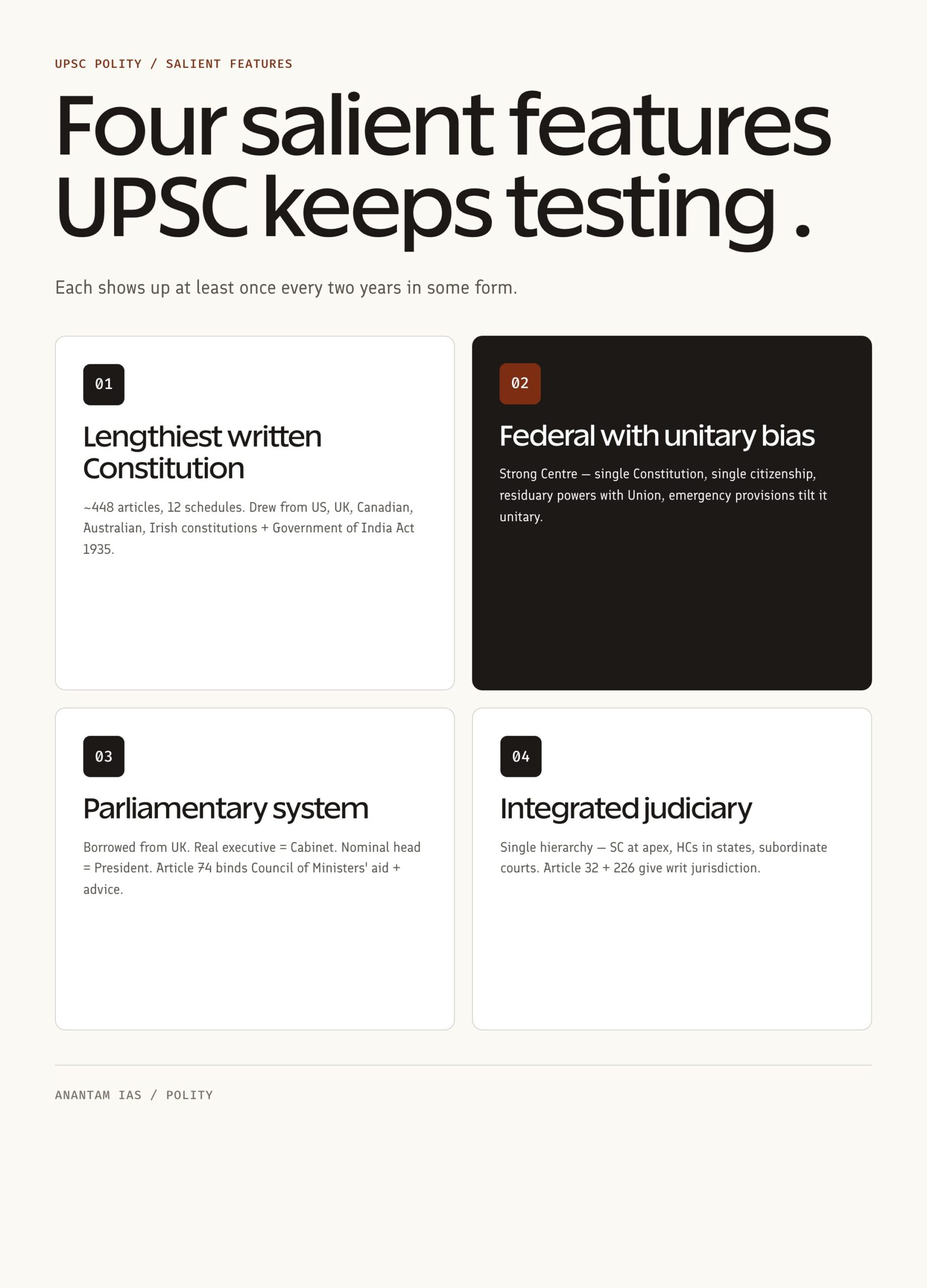
The Indian Constitution is federal with unitary bias. Three sets of relations:
- Legislative relations (Articles 245–255) — Seventh Schedule’s three Lists (Union, State, Concurrent). Parliament can legislate on State List under Article 249 (national interest), 250 (emergency), 252 (state consent), 253 (international treaty).
- Administrative relations (Articles 256–263) — Centre directs States; All-India Services; Inter-State Council under Article 263.
- Financial relations (Articles 264–293) — Tax distribution; Finance Commission (Article 280); GST Council (279A); Article 275 grants.
Read Federalism in India for the deeper treatment. The map view: Centre dominates because the Union List has 100 items, State List has 61, and most residuary powers vest with the Centre.
Common misconceptions about the polity map
Myth 1: “There are 22 Parts in the Constitution.” That was the original count. Current count is 25, after addition of Parts IVA, IXA, IXB, XIVA. Some sources still say 22 — they’re using the original numbering and missing the appended Parts.
Myth 2: “There are 395 Articles.” That’s the original numbering. Current effective count is around 448 because of inserted articles (21A, 31A–C, 51A, 244A, 300A, 323A, 323B) and additional sub-articles. The numbering still ends at 395, which confuses people.
Myth 3: “The Preamble is part of the Constitution and can be amended like any other Part.” The Preamble is part of the Constitution (Berubari Union, 1960, said it wasn’t; Kesavananda Bharati, 1973, said it is). It can be amended (42nd Am amended it) but its basic structure cannot be altered.
Myth 4: “Schedules are decorative — not really law.” Wrong. The 10th Schedule (anti-defection) decides who sits in Parliament. The 7th Schedule (Lists) decides who legislates on what. Schedules are operational law.
Why the polity map matters for UPSC
Three reasons:
One. Prelims-pattern recognition. UPSC frames questions like “Which Part of the Constitution deals with Panchayati Raj?” or “Which Schedule lists languages?” If you have the map, the answer takes 4 seconds. Without it, 40.
Two. Mains structure. Every GS-II answer needs constitutional anchoring. “As per Part XI, Articles 245–263…” beats “according to the Constitution…” every time.
Three. Interview clarity. The interview board often asks “Where does Article X fit in the Constitution?” — they want to see whether you understand structure, not just facts.
How to revise the polity map in 30 minutes
You can revise the entire structural map in 30 minutes. Here’s how:
- Minutes 1–10: Re-draw the 25 Parts table from memory. Check yours against the table above.
- Minutes 11–20: Re-draw the 12 Schedules. Note which were original and which were added.
- Minutes 21–25: Re-list the 15 landmark amendments with year and one-line effect.
- Minutes 26–30: Re-list the 18 key article numbers.
Done. That’s your structural foundation locked in for the next two weeks.
For the deeper article-wise treatment, work through Important Articles of the Indian Constitution, and for the philosophical foundation read the Indian Constitution overview.
Frequently Asked Questions
How many Parts are there in the Indian Constitution as of 2026?
25 Parts. Original was 22; added Parts IVA (Fundamental Duties), IXA (Municipalities), IXB (Co-operative Societies), XIVA (Tribunals). Part VII was repealed in 1956.
How many Schedules are there?
12 Schedules. Original was 8; added 9th (1951), 10th (1985), 11th (1992), 12th (1992).
How many Articles are there in the Indian Constitution?
The numbering ends at 395, but effective count is approximately 448 due to inserted articles like 21A, 31A–C, 51A, 244A, 300A, 323A, 323B.
How many amendments have been made?
106 amendments through 28 September 2023 (latest being the 106th — Women’s Reservation Act, Nari Shakti Vandan Adhiniyam).
What is the longest Part of the Constitution?
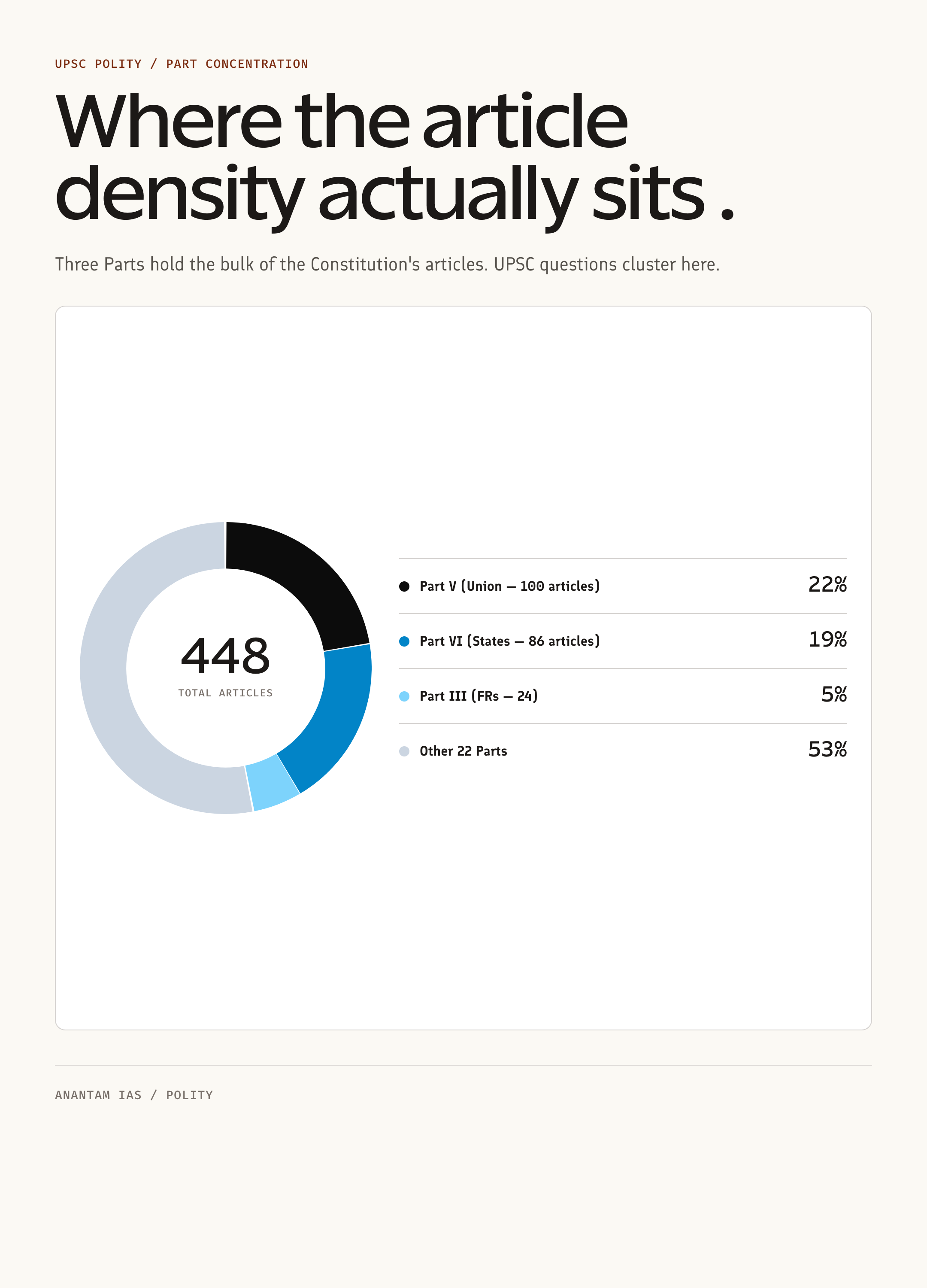
Part V (The Union) — Articles 52 to 151 — covers President, PM, Parliament, Supreme Court. ~100 articles.
Which Schedule contains the three Lists?
The Seventh Schedule. Union List (originally 97, now 100 items), State List (originally 66, now 61), Concurrent List (originally 47, now 52).
Where is the Indian polity map PDF available?
For free, see ncert.nic.in (Class XI textbook), constitutionofindia.net (full text), and indiacode.nic.in (bare act). For exam-ready visual maps, Vision IAS, Drishti IAS, and PW Only IAS publish polity wall charts.
Tell Google you want more of this.
Add Anantam IAS as a preferred sourceOne tap, and this site shows up more often in your own Top Stories, AI Overviews and AI Mode. Remove it any time.